Daily reading
Semidouble · June 2 · Sanctoral
June 2, 2023
From Dom Guéranger’s The Liturgical Year.
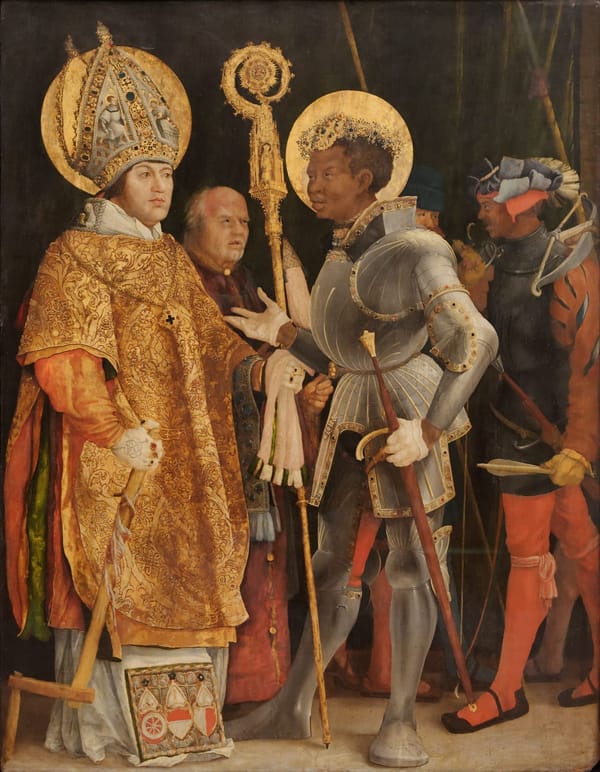
June 2: Sts. Marcellinus, Peter, and Erasmus, Martyrs
THE glory of martyrdom illumines this day with a profusion rarely met with in the cycle; and already we seem to descry the rosy dawn of that brightest day of this month, on which Peter and Paul will consummate in their blood their own splendid confession. Italy and Gaul, Rome and Lyons concur in forming a legion of heroes in the service of heaven. For to-day Lyons, the illustrious daughter of Rome, is keeping the special festival of a whole phalanx of warriors, headed by the veteran chief, St Pothinus, disciple of St Polycarp, who, in the second century, levied the brave recruits of his battalion on the banks of the Rhone.1 But to the mother Church are due the first honours. Let us, then, hail Marcellinus, together with the numerous progeny begotten by his fruitful priesthood, and rendered worthy by the Holy Ghost to share in his triumph. Let us hail, likewise, the exorcist, Peter, leading to the sacred font a long line of pagans whom he won over to Christ by proving to them the weakness of the demons.
When Christianity appeared on earth, Satan was visibly the prince of this world. To him was every altar reared; to his empire were all laws and customs subservient. From the depths of their famous temples, the demon chiefs directed the political affairs of the cities that came to consult their oracles; under divers names the lowest of the fallen angels found honour and influence at the domestic hearth; others had functions assigned to them, in forests, on mountains, at fountains, or on sea, occupying, in opposition to God, this world that had been created by him for his glory, but which Satan, through man’s connivance, had conquered. Four thousand years of abandonment on the part of heaven permitted the usurper to consolidate his conquest; and a strong defence had been planned in preparation for the day on which the lawful King should offer to re-enter on his rights.
The coming of the Word made Flesh was the signal for the assertion of the divine claim. The prince of this world, personally vanquished by the Son of God, understood well enough that he must needs return to the depths of hell. But the countless powers of darkness constituted by him would maintain the struggle through the length of ages, and dispute their position inch by inch. Driven from towns by the abjurations of holy Church and the triumph of martyrs, the infernal legions would fain marshal their ranks in the wilderness; there, under the leadership of an Anthony or a Pachomius, the soldiers of Christ must wage against them ceaseless and terrific battle. In the west, Benedict, the patriarch of monks, finds altars to the demons, and even demons themselves, on the heights of Cassino as late as the sixth century. Even in the seventh, they are found contending against St Gall for possession of the woods, lakes and rocks of what we now call Switzerland; and at last they are heard uttering mournful complaint, because, driven from the haunts of men, even such desolate spots as these are denied them. Verily, in the divine mind, the vocation of a monk to the desert has for itsend, not only flight from the world and its concerns, but likewise the pursuit of demons into their last entrenchments.
We have dwelt upon these considerations because their importance is extreme, and because this subject is now systematically ignored. True Christians firmly believe, now as formerly, in the spiritual combat which the soul has to sustain against hell, in the secrecy of conscience; but too many have no scruple in rejecting, as if belonging to the domain of the imagination, whatever is related of the public combats maintained by our fathers against the demons. The excuse for such Christians is, no doubt, the fact that they live in a land where this external war was ended centuries ago by the social victory of Christendom. But the Holy Ghost has declared that the old serpent, bound up for a thousand years, is at last to be again unchained for a while.2 If we be nearing this fatal epoch, it is high time to look about us; we shall be ill prepared for waging the old battles, if we persist in our ignorance, and in branding with the name of legend the best attested facts in the history of our ancestors. After all, what is history, since the revolt of Lucifer, but a picture of the war that is being waged between God and Satan? Now if Satan has, by divine permission, invaded the exterior world as well as that of souls, must not the struggle to cast him out3 be a hand to hand fight, an exterior and visible encounter?
‘The Word,’ says St Justin, ‘was made Flesh for two ends: to save believers, and to drive away demons.’4 So also, the expulsion of demons from the places they occupy in this material world, and specially in the noblest part thereof, the bodies of men, appears in the Gospel to have been one of the chief characteristics of our Saviour’s power. Again, when on quitting the earth he sent his apostles to continue his work amidst the nations, this is the very thing he singled out as a primary sign of the mission they were to fulfil.5 The world of that day made no mistake about it. Soon enough had the pagans to witness the cessation of the ancient oracles in every place;6 and the cause of a phenomenon of such import to the ancient religion was evident to all: the very demons themselves were not backward in ascribing to the Christians their enforced silence. As regards this power of Christianity against hell, the apologists of the second and third centuries appeal on the subject to public testimony, without fear of contradiction. ‘Before the eyes of everyone,’ says St Justin to the emperors, ‘ the Christians drive out demons in the name of Jesus Christ, not only in Rome, but in the whole universe.᾽7 The gods of Olympus beheld themselves shamefully unmasked, in the presence of their confused adorers, and Tertullian might well challenge the magistrates of the empire thus: ‘Let one of those men who declare themselves to be under the power of the gods, be brought before your tribunals: at the command of the first comer amongst us, the spirit whereby they are possessed will be constrained to confess what he is; if he avow not himself a demon and no god, fearing to lie to a Christian, at once shed the blood of this Christian blasphemer. But no; it is the terror they have of Christ that forces them to take flight at the mere touch or even the breath of one of his servants.᾽8
Baptism sufficed to give man such power as this; and this was the real meaning of our Lord’s promise, when speaking not only of the heads of the Church, but of all who would believe in him, he said: ‘In my name they shall cast out devils.᾽9 At an early date, however, the Church, organizing the holy war, constituted among her sons one special Order having for its direct mission the pursuit of Satan on every point of this visible world. The exorcists were, by this delegation, invested with a power that accelerates the downfall of the prince of this world; and to render this defeat more odious and humiliating the Church raised no higher than to the rank of inferior clergy an Order so terrible to hell. Lucifer had aimed at being equal to the Most High;10 hurled down from heaven, he flattered himself in his folly that he would be able to supplant God upon the earth: and lo! the charge of defeating him here is confided not to angels, his equals by nature, but to men, and even to the least of this credulous race which for long ages he had seen prostrate before him! Their hand of flesh constrains him, spirit though he be, to come off his throne; at their word he must needs cast away his vain adornments, he must unmask himself; the water they bless rekindles within him his eternal tortures; of the prince of this world and his pomps nought remains but mere Satan, the ugly-faced apostate, the condemned criminal wincing in the dust at the feet of the sons of men, or fleeing like a dry leaf before the breath of their mouth.
The archangel Michael recognizes, in these sons of Adam, the worthy allies of the faithful angels he led forward to victory. But amid those who continue the mighty battle begun on the heights of heaven,11 the exorcist Peter comes before us to-day radiant with matchless splendour. The triumph of martyrdom has been added to his victories won over Satan's cohorts. None better than he drove hell back; for, chasing the demons out of men’s bodies, he moreover made conquest of their souls. The priest Marcellinus, the companion of his victories and martyrdom, is likewise his associate in glory. The Church wishes that these two names, so formidable to the spirits of darkness, should shine in one same aureole here below as in heaven. Daily does she render them the most solemn homage in her power by naming them both, on the diptych of the holy Sacrifice, together with the apostles and her first sons. Such was the importance of the mission they fulfilled and the renown of their final combat, that their bodies, translated to the Via Latina, became the nucleus of an illustrious cemetery. In the age of peace, that came soon after their glorious confession, the Christians vied with one another in obtaining sepulture near these soldiers of Christ, whose protection they craved. Constantine the Great, the vanquisher of idolatry, deposited at their sacred feet the remains of his mother, St Helena, who had herself become a terror to the demons by her discovery of the true Cross. A celebrated inscription was composed in their honour by St Damasus, who in childhood had learned the details of their martyrdom from their executioner himself after his conversion; this inscription, near their tomb, completed the monuments of that catacomb wherein Christian art had multiplied its richest teachings.
To the memory of Saints Marcellinus and Peter is joined, in the liturgy of to-day, the name of a holy bishop and martyr, formerly well known to the faithful. If the acts of his life which have reached us are not free from all reproach from a critical point of view, the favours obtained by the intercession of St Erasmus or Elmo wafted his name over the whole of Christendom, as is attested by the numberless forms this name assumed in various countries of the west during the middle ages. He holds a place in the group of saints styled auxiliatores or helpers, whose cultus is widespread particularly in Germany and Italy. Mariners look upon him as their patron, because of a certain miraculous voyage related in his life; one of the tortures to which he was subjected during his martyrdom has caused him to be invoked for colic. Nor should we forget to mention here how great a veneration St Benedict, the patriarch of western monks, had for St Erasmus; when he quitted the Campagna for his solitude on the banks of the Anio, he marked his principal station between Subiaco and Monte Cassino, by building a church and monastery at Veroli under the invocation of this holy martyr; he dedicated another in Rome itself to St Erasmus.
Let us now read the few lines devoted by the Church to the memory of our three Saints.
Holy martyrs, you all confessed Jesus Christ, in the midst of the most terrific storm ever raised by the demon against the Church. Though all three in different grades of the hierarchy, you were alike guides of the Christian people, drawing them by thousands in your train, into the arena of martyrdom, and, by still more numerous conversions, filling up the void made in earth's chosen band by the departure of your victorious companions to heaven. Wherefore the Church this day joins her grateful homage here below, with the congratulation that rings through the Church triumphant. Be propitious, as of yore, in alleviating the ills that overwhelm mankind in this vale of tears. The excess of man's misery is that he seems to have forgotten how to call on such powerful protectors in his hour of need. Revive your memory, in our midst, by new benefits to our race.
As thou, O Erasmus, wast formerly protected by heaven, do thou now, in thy turn, succour those who are a prey to the tempest-tossed sea. In thy last hour of bitter anguish, thou didst suffer thine executioners to tear thy very bowels; lend a kindly aid to such as call upon thy name when racked by pains which bear some resemblance, though but faint, to what thou didst endure for Christ.
Peter and Marcellinus, linked one to another both in toil and in glory, cast gentle eyes upon us: one glance of yours would make all hell to tremble, and would drive far from us its cohorts. But how much is your aid needed in society at large, in the whole visible world! The foe you so mightily thrust backwards into the fiery pit is once more master. Alas! have we come to the time in which, again taking up war against the saints, it shall be granted him to overcome them?12 Scarce does he even hide himself nowadays. Societies which formerly worked in secret have now openly surrendered to him a thousand sources of evil; he may be seen trying to push his way into gatherings of all sorts, into the very bosom of homes, as a family guest, as a comrade in diversion or in business, with table-turning and all those processes for divination, such as Tertullian denounced in your early day.13 The expulsion of demons by Christianity had been so absolute that, up to more recent times, such fatal practices had fallen into utter oblivion amongst us. If at first, in Christian families, the warning voice of the pastors of God's Church has prevailed over the incitements of an unhealthy curiosity, a sect has since been formed, in which Satan is sole guide and oracle. The spiritists, as they are called, in concert with freemasonry, are preparing the way for the final invasion of the exterior world by infernal bands. Antichrist, with his usurped power and vain prestige, will be but the common product of political lodges and of this sect which proposes to bring back, under a new form, the ancient mysteries of paganism. Valiant soldiers of the Church, make us, we beseech you, worthy of our forefathers. If the Christian army must needs decrease in numbers, let its faith wax all the stronger; let its courage neither fail nor go astray; may its ranks be seen facing the foe, at that last hour in which the Lord Jesus will slay, with the breath of his mouth, the man of sin,14 and plunge once again and for ever the whole of Satan's crew down into the lowest depths of the bottomless pit.
- Note of the Translator. Ss. Pothinus, Blandina, and companions, martyrs of Lyons, are marked on this day in the Roman Martyrology, but as the feast is kept only in France, we have omitted in our translation the pages devoted to their memory in this place. ↩︎
- Apoc. xx 2, 3. ↩︎
- St John xii 31. ↩︎
- 2 Apol. vi. ↩︎
- St Mark xvi 17. ↩︎
- Plutarch, De oraculor. defectu. ↩︎
- 2 Apol. vi. ↩︎
- Apol. xxiii. ↩︎
- St Mark xvi 17. ↩︎
- Is. xiv 12-15. ↩︎
- Apoc. xii 7-9. ↩︎
- Apoc. xiii 7. ↩︎
- Apolog. xxiii. ↩︎
- 2 Thess. ii 8. ↩︎
Friday in Whitsun Week
|
So far, we have considered the action of the Holy Ghost in the Church; we must now study His workings in the soul of the Christian. Here, also, we shall find fresh motives for admiration and gratitude towards this divine Paraclete, who so graciously condescends to minister to us in all our necessities, and lead us to the glorious end for which we were created.
As the Holy Ghost, who was sent that He might abide with us for ever,1 exercises His power in upholding and guiding the Church, that thus she may be the faithful bride of Jesus; so, likewise, does He work in each one of us, that He may make us worthy members of our divine Head. This is His mission: to unite us so closely with Jesus, that we may be made one body with Him. His office is, to create us in the supernatural order, to give and maintain within us the life of grace, by applying to us the merits acquired for us by Jesus, our Mediator and our Saviour.
Let us begin by considering how sublime is this mission given by the Father and the Son to the Holy Ghost. In the Godhead, the Holy Ghost is produced, and does not produce. The Father begets the Son; the Father and the Son produce the Holy Ghost. This difference is founded on the divine Nature itself, which is not and cannot be but in three Persons. Hence, as the holy fathers teach, the Holy Ghost has received a fecundity outside, having none within, the Godhead. Thus, when the Humanity of the Son of God was to be produced in Mary’s womb, it was the Holy Ghost that achieved the mystery. Again, when the Christian is to be formed in the creature corrupted by original sin, it is the same holy Spirit who produces the new being. St. Augustine thus forcibly expresses himself: ‘The same grace that produced Christ when He first became Man, produces the Christian when He first becomes a believer; the same Spirit of whom Christ was conceived, is the principle of the new birth of the Christian.’2
We have dwelt at some length on the action of the Holy Ghost in the formation and government of the Church, because the chief work of this divine Spirit is to produce, here upon the earth, the bride of the Son of God, and because it is through her that all blessings come to us. She is the depository of a portion of the Paraclete’s graces, inasmuch as He is ever ready to serve her for our salvation and sanctification’s sake. It is for us, also, that He made her Catholic and visible to the world; and this, to the end that we might the more easily find her. It is for us that He maintains her in truth and holiness, that so we may drink our fill at these two sources of life-giving water. Coming now to consider what He does in the souls of men, the first marvel that demands our attention is His creative power. Is it not a veritable creation, when He raises a soul from the abyss of original sin, or from the still deeper fall of actual guilt, and instantly makes her an adopted child of God, and a member of the Son of God? The Father and the Son look with complacency upon this work of the Spirit, who is their own mutual love. They sent Him into the world that He might work, yea, work with sovereign authority; and wheresoever He reigns, there do They also reign.
This elect soul has been eternally present to the mind of the blessed Trinity. The time fixed by the divine decree having come, the Holy Ghost descends, and takes possession of this object of His love. Swifter than ever eagle to his prey, the Dove of infinite mercy flies to His destined habitation. If no hindrance be offered to His action by the creature’s free-will, there happens in her what St. Paul describes as happening in the Church herself: the things that were not become superior to the things that were,3 and where sin abounded, grace is made to dwell in rich superabundance.4
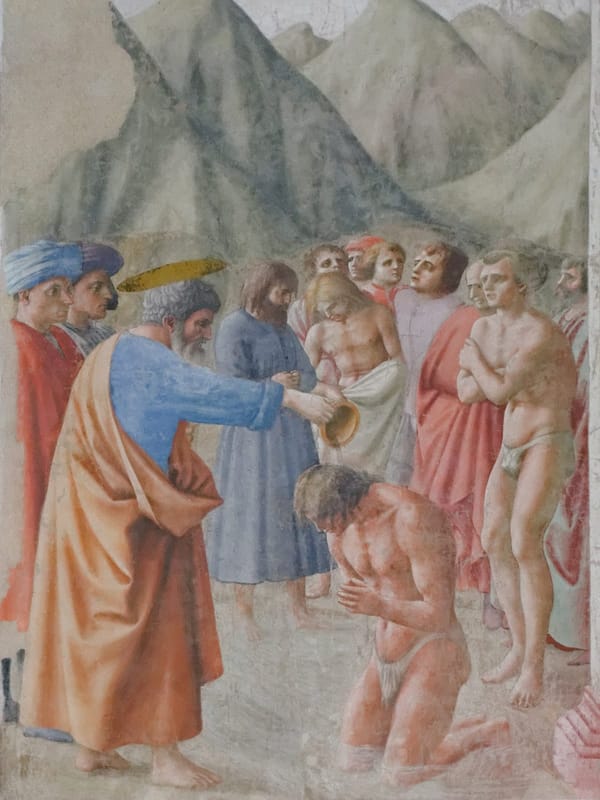
We have already seen how our Emmanuel gave to water the power of purifying the soul; but we also remember how, when He went down into the Jordan stream, the Dove rested upon Him; hereby showing that He, the Spirit of God, took possession of the element of regeneration. The font of Baptism is His domain.’The water of Baptism,’ says the great St. Leo,’is like the virginal womb (that conceived Jesus) it gives to man a spiritual regeneration; for the same holy Spirit that gave fecundity to the Virgin, gives fecundity to the font, to the end that sin, of which there could be no question in the sacred conception (of the Son of God in Mary’s womb), may be washed away by the mystic font.’5
What tongue could describe the fond delight wherewith the holy Spirit looks upon the new creature that rises from the font, or the impetuosity of love wherewith He comes into such a soul? He is’the Gift of the Most High,’ sent that He may dwell within us. He takes up His abode in the new-born soul, be it that of an infant but one day old, or that of an adult advanced in years. He is well-pleased with the dwelling He has, from all eternity, longed to possess; He fills it with His glowing and His light; and being, by nature, one with the other divine Persons, He brings thither with Him the presence of the Father and the Son, and all Three abide in that happy soul!6
But the Holy Ghost has here His own special action, His mission of sanctification: and in order that we may understand the full effect of His presence in the Christian, we must know that it is not confined to the soul. The body, too, is part of man, and had its share in the regeneration. The apostle tells us that the soul is the dwelling of the Holy Ghost;7 but he also assures us that our bodies are the temple of the same divine Spirit,8 who bids us make them serve justice unto sanctification.9 He graces them with a germ of immortality, which will rest upon them even in the tomb, and give them to rise again, at the last day, spiritualized,10 and bearing on them the seal of the divine Paraclete, who deigned to be their Guest during the term of their mortality.
After having thus made the Christian to be His dwelling-place, the Holy Ghost bestows upon him what may fit him for this high destiny. Think, for a moment, of the beauty of the theological virtues! Faith puts us into the certified and real possession of the divine truths which our mind cannot, in this present life, understand; hope gives us both the divine assistance we stand in need of, and the eternal happiness we look forward to; charity unites us to God by the strongest and sweetest of ties. Now it is to the indwelling of the Holy Ghost within him, that the Christian is indebted for these three virtues, these three means whereby regenerated man is made capable of attaining the end of his creation. The holy Spirit marked His first entrance into the soul by this triple gift, which surpasses all the creature’s merits, past, present, or future.
Over and above the three theological virtues, He bestows on the soul four other virtues, which are the hinges whereon the rest of the moral virtues turn, and hence their name of cardinal; they are, justice, fortitude, prudence, and temperance. Though, in themselves, natural qualities, the Holy Ghost transforms them by making them serve the supernatural end of the Christian. Finally, as a finish to the beauty of His abode, He infuses His seven gifts, which are to impart movement and life to the seven virtues.
But though the virtues and gifts relate to God, yet do they need that element, which is the essential means of union with Him: an element which is indispensable, for which nothing can serve as substitute, the soul of the soul, the life-giving principle, without which man can neither see nor possess God, viz. sanctifying grace. The Holy Ghost exultingly plants it in the soul; it becomes part of herself, and makes her an object of delight to the blessed Trinity. So close is the union between this grace and the presence of the holy Spirit, that when it is lost by mortal sin, He, that same instant, ceases to dwell in the soul.
He watches most carefully over His inheritance. He is ceaselessly working for the interests of His much-loved dwelling. The virtues He has infused into her are not to remain inert; they must elicit virtuous acts, and by the merits they thus produce, must increase, strengthen, and develop the fundamental element of sanctifying grace, which unites the Christian to his God. The Holy Ghost is, therefore, ever exciting the soul to action, either interior or exterior, by means of those divine influences, which theologians call actual graces. He thus enables the soul to raise herself higher and higher in virtue, add to her riches, strengthen her strength, and, in a word, become the instrument of glory to her Maker, who created her that she might serve Him, labour for Him, and yield Him fruit.
To this end, the Spirit, after giving Himself to her, and dwelling within her with devoted love, urges her to prayer, whereby she may procure every blessing: light, strength, and success in what she undertakes. But how are we to know what to pray for? The apostle solves the difficulty, by telling us the truth, of which he himself had such experience. He says: ‘The Spirit Himself asketh for us with unspeakable groanings’.11 Yes, the Holy Ghost makes our wants His own. God as He is, He unites His own speakings with the voice of our prayer, and, with His dove-like moaning, cries in our hearts to the Father.12 He thus, by His presence and His workings, makes us feel that we are children of God.13 Could there be intimacy greater than this? And who, after this, can be surprised at our Jesus’ saying that we have but to ask, and we shall receive?14 Is it not His own Spirit that asks within us?
So that He is the author of our prayer, when we pray: He is, also, the great co-operator with us in the good actions we do. So intimate is His union with the soul, that He leaves her no liberty of her own save what is necessary for her to have merit; but it is He that does the rest: that is, He inspires her, He supports her, He directs her. All she has to do, is to co-operate in what He does in and by her. It is by this mark, that is, by the united action of the Holy Ghost and the soul, that our heavenly Father knows who are His. Hence that saying of the apostle: Whosoever are led by the Spirit of God, they are the sons of God.15 O glorious union! which brings the Christian to life everlasting, and makes Jesus triumph in him, Jesus, whose likeness is imprinted by the Holy Ghost in the creature, that the creature may become worthy to be united with his divine Head!
Alas! this union may be severed, as long as we are on earth. Our free-will is not confirmed in good, until we reach heaven; and meanwhile, it may, and frequently does, lead to a rupture between the Spirit that sanctifies, and the creature that is sanctified. The unhappy love of independence, and the passions, which we cannot master, save when we are docile to the divine Spirit, excite the unguarded heart to the desire of what is unworthy of her. Satan is jealous of the reign of the Holy Ghost, and seeks to make us disloyal, by holding out to us the lying promise of happiness and good, other than those we can find in God. The world, too, which is a spirit of evil, sets itself up as a rival of the holy Spirit of God. Wily, audacious, and active, it excels in the art of seduction, and its victims are countless, although our Saviour has put us on our guard against it, by telling us that He excluded it from any share in His prayers;16 and the apostle tells us, that we have received, not the spirit of the world, but the Spirit that is of God.17
And yet, how many there are who bring about in themselves a cruel separation of their soul from the Holy Ghost! The separation is generally preceded by a certain coolness of the creature for his divine Benefactor. A want of respect, a slight disobedience, are the preliminaries of the rupture. This occasions in the holy Spirit a displeasure, which proves the tender love He bears to a faithful soul. The apostle describes the nature of this displeasure, where he says: ‘Grieve not the holy Spirit, who put His seal upon you on the day of your redemption.’18 There is a deep meaning in these few words, and, among other truths, they reveal to us the effects of venial sins: the Holy Ghost is grieved, He finds but little pleasure in that soul; there is danger of a separation; and though, as St. Augustine tells us, ‘He does not leave us, unless we leave Him,’ and though, consequently, such a soul still possesses sanctifying grace, yet actual grace becomes less frequent and less powerful.
But, when mortal sin—that act of the creature’s boldest malice and worst ingratitude—enters the soul, it breaks the sacred compact which closely united the Christian and the Holy Ghost. He, the Spirit of love, is driven from the dwelling He had chosen for Himself and had enriched with so many graces. A greater outrage cannot be offered to God by man; for, as the apostle so strongly expresses it, he hath trodden under foot the Son of God, and hath esteemed the Blood of the testament unclean, by which he was sanctified, and hath offered an affront to the Spirit of grace.19
And yet, this miserable state of the sinner may excite the compassion of the Holy Ghost, who has been sent that He might ever be our Guest. Could anything be imagined more sad, than the wretchedness of a Christian, who, by having cast out the divine Spirit, has lost the soul of his soul, forfeited the treasure of sanctifying grace, and robbed himself of all past merits? But—O mystery of mercy, worthy of eternal praise!—the Holy Ghost longs to return to the dwelling whence sin has driven Him. Yes, such is the fulness of the mission given by the Father and the Son to the Holy Ghost: He is love, and in His love He abandons not the poor ungrateful worm, but would restore him to his former dignity, and make him, once more, a partaker of the divine nature.20
This divine Spirit of love labours to regain possession of His dwelling. He begins by exciting within the soul a fear of divine justice; He makes her feel the shame and anguish of spiritual death. He thus detaches her from evil, by what the holy Council of Trent calls ‘impulses of the Holy Ghost, not indeed as yet dwelling within the soul, but moving her.’21 Dissatisfied and unhappy, the soul sighs after a reconciliation; she breaks the chains of her slavery; the sacrament of Penance then comes, bringing life-giving love, and her justification is completed. Who could describe the triumphant joy wherewith the divine Spirit re-enters His dear abode? The Father and the Son return to the dwelling that for days, or perhaps for years, had been defiled with sin. The soul is restored to life. Sanctifying grace returns to her, just as it was on the day of her Baptism. As we have already said, she had lost, by mortal sin, that fund of merit which had developed the power of grace; it is now restored to her fully and entirely, for the power of the holy Spirit is equal to the vehemence of His love.
This admirable raising from death to life is going on every day, yea every hour. It is part of the mission given to the Holy Ghost. He does the work He came for—the sanctification of man. The Son of God came down from heaven, and gave Himself to us. He found us slaves to satan; He ransomed us at the price of His Blood; gave us everything that could lead us to Himself and His heavenly Father; and, when He returned to heaven, there to prepare a place for us, He sent us His own Spirit to be our second Comforter, until He Himself should return to us. We have seen how strenuously this divine Helper undertakes His work. Let us fervently celebrate the love wherewith He treats us, and the wisdom and power wherewith He accomplishes His glorious mission. May He be blessed and glorified! May He be known throughout the whole world, for it is through Him that all blessings are imparted unto men! He is the soul of the Church; may she render Him the homage of her praise! And may He be tenderly loved by those countless millions of hearts, wherein He desires to dwell that He may give them eternal salvation and happiness.
This is the second of the three days’ fast prescribed for this week. To-morrow is the day for the ordination of the priests and other sacred ministers. It behoves us to redouble our efforts to obtain from God that the abundance of His grace may be in keeping with the sacred and ever-abiding character, which the divine Spirit is to imprint on these aspirants to Holy Orders.
At Rome, to-day’s Station is in the church of the twelve apostles, where repose the bodies of St. Philip and St. James the Less. This allusion to the favoured ones of the cenacle is most appropriate, for they were the first guests of the Holy Ghost.
The Armenian Church again lends us its beautiful hymn, in praise of the coming of the Paraclete.
Hymn (Canon sextæ diei)
implevisti apostolos; precibus horum miserere.
The following is taken from the Mozarabic missal. It is an address made to the faithful by the bishop, during the Mass of Whit Sunday. He exhorts them to receive with devotion the divine Spirit, who is about to visit them.
Missa
- St. John, xiv. 16. ↩︎
- De Prædestinatione Sanctorum, cap. xv. ↩︎
- 1 Cor. i. 28. ↩︎
- Rom. v. 20. ↩︎
- Serm. xxiv. In Nativitate Domini, iv. ↩︎
- St. John, xiv. 23. ↩︎
- Rom. viii. 11. ↩︎
- 1 Cor. vi. 19. ↩︎
- Rom. vi. 19. ↩︎
- 1 Cor. xv. 44. ↩︎
- Rom. viii. 26. ↩︎
- Gal. iv. 6. ↩︎
- Rom. viii. 16. ↩︎
- St. Luke, xi. 9. ↩︎
- Rom. viii. 14. ↩︎
- St. John, xvii. 9. ↩︎
- 1 Cor. ii. 12. ↩︎
- Eph. iv. 30. ↩︎
- Heb. x. 29. ↩︎
- 2 St. Peter, i. 4. ↩︎
- Sess. xiv. cap. iv. De Pœitentia. ↩︎
Friday in Whitsun Week: The Gift of Understanding
This sixth gift of the Holy Ghost raises the soul to a still higher state. The first five gifts all tend to action. The fear of God keeps man in his right place, for it humbles him; godliness opens his heart to holy affections; knowledge enables him to discern the path of salvation from that of perdition; fortitude arms him for the battle; counsel directs him in his thoughts and works:—thus gifted, he can act, and pursue his journey with the sure hope of coming at length to his heavenly home. But the Holy Ghost has other favours in store for him. He would give him a foretaste, here below, of the happiness that awaits him in the next life: it will give him confidence, it will encourage him, it will reward his efforts. Contemplation—this is the blissful region thrown open to him, and the Holy Ghost leads him thither by the gift of understanding.
There will be a feeling of surprise and hesitation arising in the minds of many at hearing this word, contemplation. They have been taught to look on contemplation as an element of the spiritual life which is rarely to be hoped for, and almost impossible for persons who are in the ordinary walks of life. We must begin, then, by telling them that such an idea is a great and dangerous error, and one that checks the progress of the soul. No: contemplation is a state to which, more or less, the soul of every Christian is called. It does not consist in those extraordinary effects which the Holy Ghost occasionally produces in some privileged souls, and by which He would convince the world of the reality of the supernatural life. It is simply a relation of close intimacy existing between God and a soul that is faithful to Him in action. For such a soul, unless she herself put an obstacle, God reserves two favours: the first is the gift of understanding, which consists in a supernatural light granted to the mind of man.
This light does not remove the sacred obscurity of faith: but it enlightens the eye of the soul, strengthens her perception, and widens her view of divine things. It dispels clouds, which were occasioned by the previous weakness and ignorance of the soul. The exquisite beauty of the mysteries is now revealed to her, and the truths which hitherto seemed unconnected, now delight her by the sweetness of their harmony, It is not the face-to-face vision which heaven gives, but it is something incomparably brighter than the feeble glimmer of former days, when all was mist and doubt. The eye of her spirit discovers analogies and reasons, which do something more than please—they bring conviction. The heart opens under the influence of these bright beams, for they feed faith, cherish hope, and give ardour to love. Everything seems new to her. Looking at the past, and comparing it with the present, she wonders within herself, how it is that truth, which is ever the same, has a charm and a power over her now which once it had not.
The reading or hearing of the Gospel produces an impression far deeper than formerly: she finds a relish in the words of Jesus, which, in times past, she never experienced. She can understand so much better the object of the institution of the Sacraments. The holy liturgy, with its magnificent ceremonies and sublime formulas, is to her an anticipation of heaven. She loves to read the lives of the saints; she can do so, and never feel a temptation to carp at their sentiments or conduct: she prefers their writings to all others, and she finds in these communications with the friends of God a special increase of her spiritual good. No matter what may be the duties of her station in life, she has, in this glorious gift, a light which guides her in each of them. The virtues required from her, however varied they may be, are so regulated, that one is never done to the detriment of another; she knows the harmony that exists between them all, and she never breaks it. She is as far from scrupulosity as from tepidity; and when she commits a fault, she loses no time in repairing it. Sometimes the Holy Ghost favours her with an interior speaking, which gives her additional light for some special emergency.
The world and its maxims are mere vanities in her estimation; and when necessity obliges her to con- form to what is not sinful in either, she does so without setting her heart upon it. Mere natural grandeur or beauty seems unworthy of notice to her whose eye has been opened, by the holy Spirit, to the divine and the eternal. To her, this outward world which the carnal-minded man loves to his own destruction, has but one fair side, viz: that the visible creation, with the impress of God’s beauty upon it, can be turned to its Maker’s glory. She gives Him thanks when she uses it; she elevates it to the supernatural order, by praising, as did the royal prophet, Him who shadowed the likeness of His own beauty on this world of created things, which men so often abuse to their perdition, but which were intended as so many steps to lead us to our God.
The gift of understanding teaches the Christian a just appreciation of the state of life in which God has placed Him. It shows him the wisdom and mercy of those designs of Providence which have, at times, disconcerted his own plans, and led him in a direction the very opposite to his wishes. He sees that had he been left to arrange things according to his own views, he would have gone astray; whereas now, God has put him in the right place, though the workings of His fatherly wisdom were, at first, hidden from him. Yes, he is so happy now! he enjoys such peace of soul! he knows not how sufficiently to thank his God for having brought him where he is, without consulting his poor fancies! If such a Christian as this be called upon to give counsel, if either duty or charity require him to guide others, he may safely be trusted; the gift of understanding teaches him to see the right thing for others as well as for himself. Not that he ever intrudes his counsel upon others, or makes himself adviser-general to all around him; but if his advice be asked, he gives it, and the advice is a reflex of the inward light that burns within him.
Such is the gift of understanding. It is the true life of the soul, and it is weaker or stronger according to the measure of her correspondence with the other gifts. Its safeguards are humility, restraint over the desires of the heart, and interior recollection. Dissipation of mind would dim its brightness, or even wholly put out the light. But where duty imposes occupations, not only busy and frequent, but even distracting, let the Christian discharge them with a pure intention, and his soul will not lose her recollection. Let him be single-hearted, let him be little in his own eyes, and that which God hides from the proud and reveals to the humble,1 will be manifested to him and abide with him.
It is evident from all this, that the gift of understanding is of immense importance to the salvation and sanctification of the soul. It behoves us, therefore, to beg it of the Holy Ghost with all the earnestness of supplication; for we must not forget that it is obtained rather by the longings of our love, than by any efforts of the intellect. True, it is the intellect that receives the light; but it is the heart, the will, inflamed with love, that wins the radiant gift. Hence that saying of Isaias: ‘Unless ye believe, ye shall not understand!’2 Let us, then, address ourselves to the holy Spirit in these words of the psalmist: ‘Open Thou our eyes, and we will consider the wondrous things of Thy law! Give us understanding and we shall live!’3 Let us beseech Him in these words of the apostle, wherein he is praying for his Ephesians: ‘Give us the Spirit of wisdom and revelation, whereby we may have the knowledge of our God! Enlighten the eyes of our heart, that we may know what is the hope of our calling, and what the riches of the glorious inheritance prepared for the saints!’4
| Previous Thursday in Whitsun Week: The Gift of Counsel | Next Friday in Whitsun Week |