Daily reading
Semidouble · June 3 · Sanctoral
June 3, 2023
From Dom Guéranger’s The Liturgical Year.
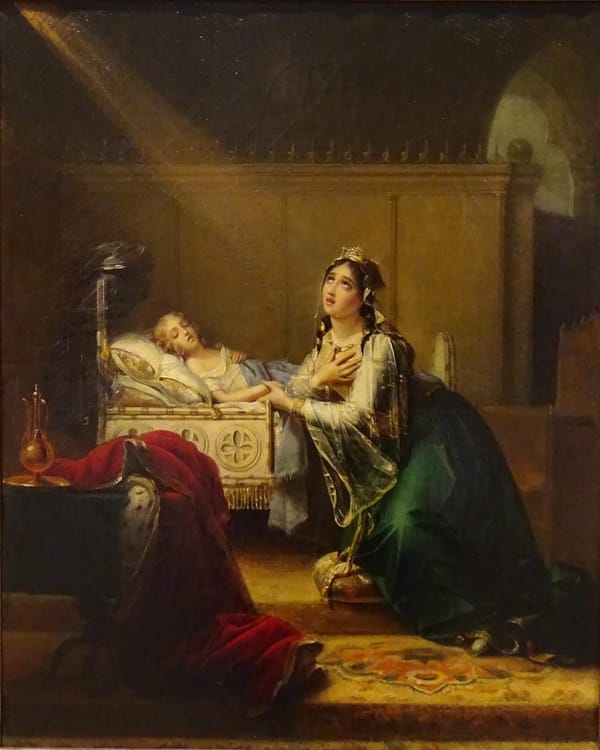
June 3: St. Clotilde, Queen of the Franks
At this season, in which the Office of the time is leading us to consider the early developments of holy Church, eternal Wisdom so arranges, now as ever, that the feasts of the saints should complete the teachings of the movable cycle. The Paraclete, who has but just come down upon us, is to fill the whole earth;1 the Man-God has sent Him expressly to win over the whole earth and to secure all time to His Church. Now, it is by subjecting kingdoms to the faith, that He is to form Christ’s empire;
it is by enabling the Church to assimilate all nations to herself, that He gives growth and continuance to the bride. See, therefore, how at this Season wherein He has but just taken possession of the world anew, His co-operators in this His work of conquest shine out on every side in the heavens of the holy liturgy. But the west above all concurs in forming the magnificent constellation that is mingling its radiant splendour with the fires of Pentecost. Indeed, what could better show the omnipotence of the Spirit of Christ, than the establishment of this Latin Christendom, in these distant lands of the west?
What star is this shining to-day in such silvery beauty on the land of the Franks? The city of Lyons, prepared by the blood of martyrs for this her second glory, sees this new light rise in her midst. Clotilde is a mother; and the cruel sufferings which wrung her heart while she was yet young matured her soul for the grand destinies reserved by God for the privileged children of sorrow. The violent death of her father Chilperic, dethroned by a fratricidal usurper; the sight of her brothers massacred, and of her mother drowned in the Rhone; her long captivity in the Arian court of the murderer who brought heresy with him to the throne of the Burgundians, developed in her the heroism that was to make this niece of Gondebaud become the mother of a whole nation to Christ.
God drew the visible universe out of nothingness, solely to manifest His goodness. In like manner, He has willed that man, coming from His hands without power as yet to recognize his Creator, should recognize, at least, a mother’s tender love, the first sensible ray, as it were, of infinite love. Irresistible is this ray, sublime in its gentleness, exquisite in its purity, giving to the mother a facility, belonging only to her, to complete in the soul of her child the reproduction of the divine ideal that is to be impressed upon him. Now this she does by education. To-day’s feast reveals how much more sublime, more potent, more extensive, is maternity in the order of grace than in that of nature. For when God, coming down amongst us, was pleased, to take Flesh of a daughter of Adam, maternity was raised in her to the extreme limit that separates the endowments of a simple creature from the divine attributes. Thus rising above the heavens, maternity at the same time embraced the world, bringing all mankind together into close union, without distinction of nation or family, in the one filiation of that Virgin-Mother. The new Adam, the perfect model of our race, and our first born,2 willed to have us for His brethren, in all fullness, brethren in Mary as in God.3 The Mother of God was then proclaimed Mother of men on Calvary; from the summit of the cross, the Man-God replaced upon the brow of Mary that diadem of Eve, broken beneath the fatal tree. Constituted sole Mother of the living by this noble investiture,4 our Lady once again participated in the privileges of the Father who is in heaven. Not only was she Mother by nature, as He is Father, of His Son; but, just as all paternity flows down from the eternal Father, and borrows thence supereminent dignity; so from that moment, all maternity was nought but an outflow of Mary’s in the truest sense; a delegation of her love, and a communication of her august privilege whereby she brings forth men unto God, whose sons they are to be.
Good reason, therefore, have Christian mothers to glory in their maternity, for in that does their greatness consist; through Mary, their dignity has increased to a degree that nature could never have dreamed of. But at the same time, under the aegis of Mary, not less real is the maternity of holy virgins, not only in God’s eyes, but often manifested to their own: the wife, too, prepared by a special call from God and by suffering, is sometimes, like Clotilde, endowed with a fecundity of a spiritual order, a thousand times more prolific than that of earth. Happy the fruits of this supernatural maternity, which under the favour of Mary is fraught with so much greatness! Happy the nations on whom the divine munificence has bestowed a mother!
History tells us how the founders of empires have ever had the terrible prerogative of impressing upon nations the distinctive character, disastrous or beneficial, which, through length of ages, continues to be theirs. How often does that want of counterpoise to the preponderance of power, make itself only too evident in the impetus given rather to destroy than to build up! And wherefore? Because ancient empires never had a mother; for this noble title cannot be applied to those heroines who have transmitted their names to posterity merely for having rivalled the ambition and pomp of conquerors. To Christian times it was reserved to behold introduced into a people’s life this element of maternity, more salutary, more efficacious in its humble gentleness, than that which springs from the talents or vices, from the power or genius, of their first princes.
Time was needed to subdue the savage instincts of the warriors of Clovis, and to fit his sword to the noble destiny that awaited it in the hand of a Charlemagne, or of a St. Louis. With good reason has it been said that the honour of this labour is due to the bishops and the monks. But to be more accurate and to prove a deeper insight into the ways of divine Providence, it would have been well, perhaps, to pass less lightly over woman’s part in the work of conversion and of education, which made the Frankish nation become the eldest son of the Church. Clotilde it was who led the Franks to the baptistery of Rheims, and presented to Remigius the proud Sicambrian, transformed far less by the exhortations of the holy bishop than by the force of prayer, the prayer of that strong woman elected by God to bear away this rich spoil from the camp of hell. What manly energy, what devotedness to God, are displayed in every measure taken by this noble daughter of the Burgundians’ dethroned king! Beneath the suspicious eye of the usurper, the murderer of her family, she awaits, in the silence of prayer and in the exercise of charity, heaven’s appointed hour. When at last the moment comes, taking counsel of none save the Holy Ghost and her own heart, how nobly does she dart forward to conquer unto Christ her betrothed, though yet a stranger to her, out-doing in valour, in this instance, all the warriors of her escort! Strength and beauty were indeed her covering,5 her adornment on her bridal day; and the heart of Clovis soon learnt that the conquests reserved to his bride far out-stripped in importance the booty he had hitherto seized by force of arms. Clotilde, on the other hand, found her work already prepared on the banks of the Seine. For fifty years, St. Genevieve had been busy defending Paris against the pagan hordes, and only awaiting the Baptism of the king of the Franks in order to open to him the city gates.
Still, when on that Christmas night Clotilde gave birth to the eldest son of holy Church in Mary’s name, the great work was far from being completed; this new-born people had yet, by the slow process of a laborious education to be fashioned into the most Christian nation. This chosen one of God and of our Lady does not fall short of the maternal task. But still what anguish of heart to be endured, what tears yet to be shed over these her sons, whose inborn violence seems simply indomitable, and the very exuberance of whose rich nature yields them up to the fury of passions, urging them blindly on to crimes the most atrocious! Her grand-children, inveigled from her side and caught in the perfidious trap laid for them by their faithless uncles, are massacred. Fratricidal wars carry devastation over the whole of that territory of ancient Gaul, purged by her from paganism and heresy. Finally another pang, but one of a more glorious kind, seems given as a compensation for the bitterness of intestine strife. Her cherished daughter, Clotilde the younger, dies, worn out by ill usage endured for her faith at the hand of her Arian husband. Surely all this must have shown clearly enough to the queen of the Franks, that if she was chosen by heaven to be their mother, she was to have all the pangs as well as the honour that title involves. Thus does Christ ever deal with His own, when they have earned His confidence. Clotilde well understood this: already a widow and deprived by death of the aid of Genevieve likewise, she had long ago retired to Tours, near to the sepulchre of the Thaumaturgus of the Gauls. There, in the secret of prayer and in the heroism of her childhood’s faith, did she continue, aided by St. Martin, the preparation of this new people for its mighty destinies.
An immense work was this, and one for which no single life-time could suffice! But though Clotilde was not to witness the desired transformation accomplished, her life was not to close until she had pressed to her heart, at Tours, her illustrious daughter-in-law, Radegonde; and having by this last embrace invested her with her own sublime maternity, she sends her to Poitiers, there to continue, at the tomb of St. Hilary, this great work of intercession. Then, when at length Radegonde herself, having ended her task of suffering and love, must likewise quit this earth, Bathilde will presently come forward to consummate the work, in that remarkable seventh century, when ‘the Frank, at last ready for his mission, is betrothed to holy Church, and dubbed a knight of God.’6
Clotilde, Radegonde, Bathilde, all three of them mothers of France, bear a striking resemblance to one another. All three are prepared, from the early dawn of life, to the devotedness their grand mission would require, by the like trials, captivity, slavery, and massacre or loss of their own relatives: all three bring to the throne nought but a dauntless love of Christ, the King, and a desire of seeing Him rule the people; all three set aside the queenly diadem as soon as may be, in order to be able, prostrate before God in retirement and penitence, to attain more surely the one object of their maternal and royal ambition. Heiresses of Abraham, in very deed, they found in his faith7 the fecundity which made them mothers of those countless multitudes, which the soil watered by their tears produced for heaven. Even in these weakened times of ours, there is still a goodly throng ever passing from the land of the Franks to their true home yonder, there to join the happy bands of the combatants of better days. At the sight of this ever increasing group of sons joyously pressing round their thrones, the hearts of Clotilde, Radegonde, and Bathilde, overflowing with love, give utterance in one united cry, to this word of the Prophet: ‘Who hath begotten these? I was barren and brought not forth, led away, and captive: and who hath brought up these? I was destitute and alone: and these where were they?’ Then the Lord answering, saith: ‘As I live, thou shalt be clothed with all these as with an ornament, and as a bride thou shalt put them about thee. For thy deserts, and thy desolate places, and the land of thy destruction shall now be too narrow by reason of the inhabitants. The children of thy barrenness shall still say in thine ear: the place is too strait for me, make me room to dwell in. And kings shall be thy nursing fathers, and queens thy nurses. And thou shalt know that I am the Lord, for they shall not be confounded that wait for Him.’8
But it is time to listen to the liturgical account of Saint Clotilde’s life.
Great is thy glory on earth and in heaven, O Clotilde, mother of nations! Not only hast thou given to holy Church that people of France, surnamed the most Christian; but our own England and Spain also claim their descent from thee (in the pedigree of faith) by Bertha and Ingonda, thy noble granddaughters. Ingonda, more fortunate than thy daughter Clotilde, succeeded, by the help of Saint Leander of Seville, in bringing back to the true faith her husband Hermenegilde, and even leading him to the crown of martyrdom. Bertha, queen of our own fair Kent, welcomed Augustine to our Saxon shores, and through her influence was our royal Ethelbert brought from the darkness of paganism even unto Baptism and the aureola of sanctity: realizing thus that word of the apostle, that the unbelieving husband is sanctified by the believing wife.9 Since those early days, in how many other parts of Europe, and on how many other more distant shores, have the sons of thine own nation, that nation of which thou wast mother, propagated that light of faith which they received of thee: whether brandishing the sword in defence of the Church’s right to teach freely and everywhere the word of truth; or whether, becoming themselves missioners and apostles, carrying that same truth to infidel nations, far beyond reach of any possible protection, and at the expense of their sweat and of their blood. Happy thou, to be the first in bringing forth unto Christ, the King, a nation pure from every stain of heresy and vowed to holy Church from the first moment of its new birth! Rightly indeed the church of Sainte-Marie at Rheims was the one selected on that Christmas day of the year 496, for this birth unto God of the Frankish nation; wherein our Lady, in a proportionate measure, gave thee to share her own motherhood of our race.
There especially lies our motive of confidence as we turn to thee, O Clotilde, in our intercessory prayer this day. Alas! how many of thy sons are far from being what they should be towards such a mother! But when our Lady gave thee a share in her own maternal rights, she necessarily communicated to thee also her own tender compassion for beguiled children deaf to their mother’s voice. Take pity on these unfortunate sons, led so very far astray by strange doctrines.10 The Christian monarchy founded by thee is no more. Thou didst build it upon the recognized rights of God in His Christ and in the Vicar of His Christ. Princes with shortsighted views of self-interest, traitors to the mission they had received to maintain thy work, imagined they were performing marvels, when they allowed maxims to be spread in thy France, proclaiming the independence of civil power in respect of that of holy Church; and now by a just retribution, society has proclaimed its independence of princes! But at the same time, the infatuated populace has really no other idea than that of being its own sovereign; and intoxicated by this false liberty which it dreams of having acquired, it goes so far as to contemn even the supreme dominion of the Creator Himself. The rights of man have usurped the rights of God, as the basis of social contract; a new-fangled Gospel, which France, with misguided proselytism, is fain to carry over the whole world in place of the true Gospel so loved of yore!
In that unhappy country poisoned by a lying philosophy, such is the excess of delirium, that many who deplore the apostasy of the mass of the population, and wish to remain themselves Christians, imagine they can do so whilst at the same time maintaining the destructive principle of liberalism, the very essence of revolution. Let Christ have heaven and souls, say they, but let man have earth, together with full right of governing it as he chooses, and of thinking as suits him best. While they fall on their adoring knees before the Divinity of our Lord Jesus Christ in the sanctuary of their own conscience, they search the Scriptures, and are too blind to see there expressed how the Man-God is and must be King of the whole earth. In learned theses they inform us that they have probed the very depths of history, and find therein nothing that can contradict their arguments. If indeed they must admit that the government of a Clovis, or a Charlemagne, or a St. Louis does not correspond in everything with their political axioms, we must, they say, make allowances for those primitive ages: a nation cannot be expected to come in a day to the perfect age attained at last by the law of progress! Alas! have pity, O dear mother of France, on the ravings of these poor sons of thine! Arouse once more, in that noble land, the faith of the Franks! Oh! may the God of Clotilde, the Lord of hosts, the King of nations, show Himself once more, leading on thy sons to victory, in the name that won for Clovis the field of Tolbiac: Jesus Christ!
Saturday in Whitsun Week
|
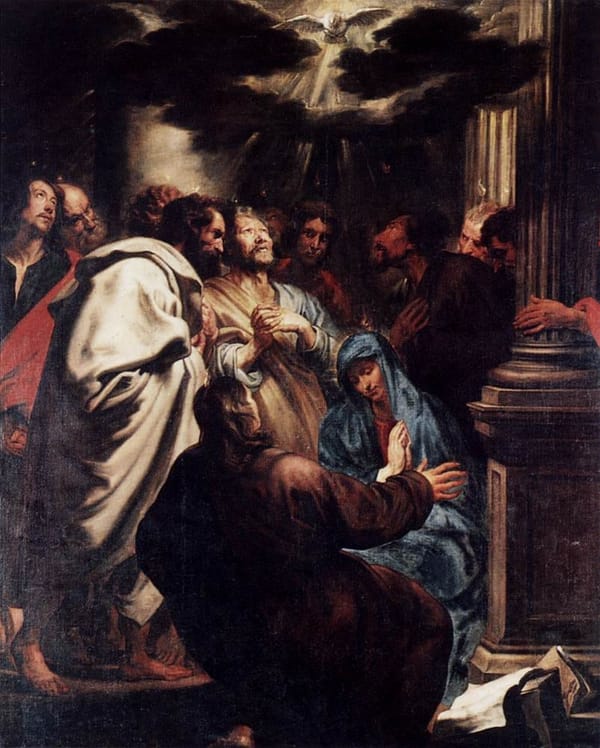
We have been contemplating, with grateful hearts, the inexpressible devotedness, the divine untiredness, wherewith the Holy Ghost fulfils His mission in the souls of men; we have something still to add to our considerations, in order to have anything like a true idea of the wonders wrought by the divine Guest when the heart raises no obstacles. And first of all we deem it necessary to say a word to those Christians, who, after hearing what we have said regarding the prodigies of power and love of the divine Spirit, and the sublime mystery of His presence among us, might be tempted to fear lest all this may, in some degree, tend to make us forget our dearest Jesus, who being in the form of God, and equal to God, emptied Himself, being made in the likeness of man, and in habit found as man.1
The superficial knowledge of their religion is the reason why so many Christians have very vague notions about the Holy Ghost and His special workings in the Church and the souls of men. You will find these same individuals well instructed upon the mysteries of the Incarnation and Redemption; you will find them really devout in honouring the Son of God; but, judging from their conduct, you would say that they have put off knowing and honouring the Holy Ghost until they get to heaven.
We would, therefore, tell them, that the mission of this divine Spirit, far from being likely to make us forget what we owe to our Saviour, is the grandest gift bestowed upon us by this our Redeemer. Who is it that produces and keeps up within us the loving and meritorious remembrance of our Jesus’ mysteries? It is the Holy Ghost, who dwells in our hearts for the sole purpose of forming Christ, the new Man, within us, to the end that we may be united with Him, for ever, as His members. Consequently, the love we bear to our Jesus is inseparable from that we bear to the Holy Ghost; and the love we have for this divine Spirit, closely unites us with the Son of God, from whom He (the Spirit) proceeds and is given to us. When we meditate on the sufferings of Jesus, we are excited to feelings of affectionate compassion, and it ought to be so; but how comes it that we never think of, or, if we think of, never grieve over, the resistances, the slights, the disloyalties, which the Holy Ghost is every day receiving from ourselves and others? It is, indeed, most true that we are children of our heavenly Father: but, why should we forget the immense debt we owe to the other two divine Persons, who have come down from heaven to serve us, and at the risk of receiving nought but ingratitude!
After this short, but almost necessary, digression, we will continue our reflections upon the workings of the Holy Ghost in the soul of man. As we were just saying, His aim is to form Christ within us by the imitation of this our Redeemer’s sentiments and actions. Who, better than this divine Spirit, knows Jesus, whose Humanity He formed in Mary’s womb? Jesus, in whom He dwelt so unreservedly? Whom He aided and directed in all things, with a fullness of grace becoming the dignity of the human Nature which was personally united with the Divinity? We repeat—His object is to reproduce, in our humble persons, a faithful copy of Jesus, as far as our fallen nature will permit so grand a work to be realized.
The holy Spirit produces the most noble results in this His work, which is one truly worthy of a God. We have already seen how He wins from sin and Satan the creatures purchased by Christ; now let us consider Him achieving His victories in what the apostle so magnificently calls the consummation of the saints.2 He takes them as He finds them, that is, fallen children of Adam; He first applies to them the ordinary means of sanctification, though He intends to carry them to extraordinary virtue. The courage wherewith He carries on His work is truly divine. He has to deal with nature, fallen indeed and tainted with a poison which is mortal, but a nature which retains some resemblance to its Creator; it is a ruin, but still it is an image. The Spirit, then, has to destroy what there is of corruption and defilement; at the same time, He has to purify and foster what has not been irremediably affected by the poison. The case requires an infinite care. He knows where and when to out or burn; and, what is very wonderful, He makes the invalid himself help Him to apply the saving remedies. Just as He does not save the sinner, without the sinner’s sharing in the work; so neither does He sanctify the saint, without the saint’s co-operation. But He inspirits and encourages him by countless touches of grace; so that, while corrupt nature keeps gradually losing ground in the soul, the healthy parts are being transformed into Christ, and finally the whole man is under the perfect mastery of grace.
The virtues are neither inactive nor half formed in such a Christian as this; and each day they grow more vigorous. The holy Spirit suffers none of them to lag behind, for He is unceasingly showing His disciple the great original whom he is to copy, namely Jesus, in whom are all the virtues in all perfection. There are times when He makes the soul feel her own weakness, in order that she may humble herself; He permits her to feel certain repugnances and temptations; but these are precisely the seasons wherein He evinces the most watchful solicitude. The soul must act, and she must suffer; the Holy Ghost loves her with extreme tenderness, and will never permit her to be tried above her strength. Oh! what a wonderful work is this, to enable a fallen creature to be a saint! Of course, there will be moments of discouragement, there may be defects now and then; but the work goes on in spite of all, for the divine Spirit keeps up within the soul an unchanging love, which is ever burning out the dross, whilst its own bright flame is every day gaining new intensity and beauty.
The human element at last disappears; it is Christ who lives in this new man, and this man lives in Christ.3 His life is one of prayer, for it is in prayer that he finds union with his Jesus; the more he prays, the closer is the bond. The Holy Ghost is continually opening out new charms of truth to him, in order to encourage him to seek his sovereign good in prayer. He has made it the mystic ladder; it rests on earth, but its summit reaches to high heaven. Who could tell the favours bestowed by God on a soul that has broken every tie of self-love and interest, in order that, with oneness of purpose and energy, she may see and enjoy her Lord, and lose herself eternally in His infinite beauty! The whole blessed Trinity is devoted to such a soul: the Father embraces her in His paternal affection, the Son has no reserves of His love towards her, the Holy Ghost is ever working within her, enlightening and consoling her.
The citizens of heaven, with their wonted interest in us, which makes them keep a feast of joy at the conversion of one poor sinner,4 are enraptured at the lovely sight of a saint; they yearn over him with an indescribable love; they sing a loud hymn of praise to the Holy Ghost who has produced such a masterpiece of perfection out of such materials as fallen nature yields. At times, the blessed Mother evinces her joy by appearing to this her new-born child; the angels show themselves to this brother upon whom they look as worthy to be throned among them; the saints treat him with an intimacy which tells him that they expect him to be soon their companion in the home of everlasting glory. Is it to be wondered at, that this dear child of the Holy Ghost should sometimes be allowed to stay the laws of nature, and work miracles in favour of his suffering or necessitous fellow mortals? Does he not love them with an affection which springs from the love which he has for God, and which is not shackled by the egotism of a heart divided between the world and its Creator?
Nor must we forget to speak of the grandest feature in the soul thus perfected by the Holy Ghost. Men of the world may scoff, and frivolous spirits may feel sceptical, at what we are going to say; it is not the less true, and, thank God, it is not so rare as some among us pretend. It evinces the power of the merits won for us by our Redeemer; it testifies the greatness of His love for mankind; it manifests the divine energy of the Holy Ghost in the souls that put no obstacles to His working within them. The soul, then, that we have been describing, is called to an espousal with Jesus, not only in heaven, but now and on this earth of exile. Jesus loves, as only a God can, the bride He has redeemed with His Blood; and this bride is not only the beloved Church; it is this soul of whom we are speaking, who was once mere nothingness, whose present existence is not known by the world, and yet whose beauty is such that her Creator deigns to say that He, the King, greatly desireth it.5 He, together with the Holy Ghost, has wrought this beauty within her; and He wishes her to be all His. Then is achieved by the holy Spirit, in favour of an individual soul, the same mystery that we have seen accomplished in the Church herself; He prepares her, He establishes her in unity, He fixes her in truth, He perfects her in sanctity. This done, the Spirit and the bride say: ‘Come’!6
It would take a volume to describe the workings of the Holy Ghost in the saints, and we are obliged to be satisfied with this hurried and imperfect sketch. The little we have said was a necessity, in order that we might give a general idea of the mission of the Holy Ghost upon earth, such as we are taught it is by the words of sacred Scripture, and by the principles of dogmatic and mystical theology. What we have said to-day will, moreover, assist our readers in their study and appreciation of the saints. In the course of the liturgical year, during which the names and actions of the saints have been so frequently proclaimed and celebrated by the Church herself, it was important to find an occasion for honouring the sanctifying Spirit: and surely, Pentecost was the most fitting season for doing so.
This is the last day of Paschal Time; it is the last of the Pentecost octave; we must not allow it to pass without offering to the Queen of saints the homage which is so justly her due, and without presenting our adoration and praise to the Holy Ghost for all the glorious things He has achieved in her. After the sacred Humanity of our Redeemer, which received from this holy Spirit every gift that could make it worthy, as far as a creature can be, of the divine Nature to which the Incarnation united it, Mary’s soul, and whole being, were adorned with grace above all other creatures together. It could not but be so, as must be evident to us if we reflect for a moment upon the meaning of a Mother of God. Mary, in her single self, forms a world apart in the order of grace; she alone was, for a short time, the Church of Jesus. The holy Spirit was at first sent for her alone, and He filled her with grace from the instant of her Immaculate Conception. That grace developed itself in her, by the continuous action of the Holy Ghost, until at length she became worthy, as far as a creature could be, of conceiving and giving birth to the very Son of God, who became thus the Son of Mary. During these days of Pentecost, we have seen the new gifts wherewith the divine Spirit prepared her for her new office. Is it possible for us her children to think of all these things, and not be ardent in our admiration of her? or not be overflowing with gratitude for the august Paraclete, who has deigned to show such munificence to this our own matchless Mother?
At the same time, we cannot help being overpowered with delight at the thought of the perfection, wherewith this favourite of the holy Spirit corresponded with the graces she received from Him. Not one was lost, not one was fruitless, as is sometimes the case with even the holiest souls. At her very commencement, she was as the rising morn;7 from that time, her sanctity gradually mounted to the midday of its perfection, and that midday was to have no setting. Even before the Archangel announced to her that she was to conceive the Son of God in her chaste womb, she had already conceived Him in her soul, as the holy fathers teach us. The eternal Word loved her as His bride, even before He conferred upon her the honour of being His Mother. If Jesus could say of a soul that had needed regeneration:’They that seek Me, will find Me in the heart of Gertrude,’ what must have been the harmony of soul existing between Him and His blessed Mother! how close must have been their union! Trials of the severest kind awaited her in this world; she bore them all with heroic fortitude; and when the hour came for her to unite her own sacrifice with that made by her Son, she was ready. After Jesus’ Ascension, the Holy Ghost descended upon her; He opened out to her a new career, which would require her being an exile, for many long years, from the heaven where her Son was reigning: —she did not hesitate to accept the bitter chalice thus offered to her; she proved herself to be indeed the handmaid of the Lord, desirous, above all other things, to do His will in every tittle.
So that the triumph of the Holy Ghost in Mary’s person was of the most perfect kind: how grand soever might be His gifts, she worthily corresponded with them all. The sublime office of Mother of God, to which she was called, entitled her to graces in keeping with such a dignity; she received them, and turned them to the richest account. In return for her fidelity, as also in consideration of her incomparable dignity, the Holy Ghost allotted to Mary the place she well merited in the great work He had come to do, namely, the consummation of the saints and the formation of the Church, the body of Christ.8 Her divine Son is the Head of the immense body of the faithful; He gives it unity; but she herself represents the neck, whereby life and motion are communicated from the head to the rest of the body. Jesus is the chief agent; but He acts upon each member through Mary. Her union with the Incarnate Word is immediate, on account of her being to Him what no other creature could be; but with regard to us, the graces and favours, the light and consolation, which we receive from our divine Head, come to us through Mary.
Hence the influence of this blessed Mother upon the Church in general, and upon each individual in particular. She unites us to her Son, and He unites us to the Divinity. The Father gave us His Son; the Son chose a Mother from among His creatures; and the Holy Ghost, by giving fruitfulness to this Virgin-Mother, perfected the union of creatures with their Creator. The end God proposed in creation, was to effect this union; and now that the Son is glorified, and the Holy Ghost has come, we understand the whole divine plan. More favoured than those who lived before the descent of the divine Spirit, we have, not only in promise, but in reality, a Brother who is crowned with the diadem of the divinity; a Paraclete who is to abide with us for ever, to enlighten our path and strengthen us; a mother, whose intercession is all-powerful; a Church, a second mother, by and from whom we receive all these blessings.
The Station at Rome is in St. Peter’s. It was in this noble basilica that the neophytes of Pentecost appeared in their white robes for the last time, and were presented to the Pontiff as the last lambs of the Pasch, which closes to-day.
This Saturday is now kept as the day for ordinations. The three days’ fasting and prayer prescribed by holy Church have rendered heaven propitious; we may confidently hope that the Holy Ghost, who is about to seal the new priests and sacred ministers with the sacramental character, will vouchsafe to act with all the plenitude of His goodness as well as with all the might of His power; for, upon this day, there is question not only of an immense privilege granted to those who are ordained, but likewise of the salvation of the flocks who are hereafter to be entrusted to their care.
We will praise the divine Spirit with these concluding stanzas of the hymn used by the Armenian liturgy during the feast of Pentecost.
Hymn (Canon septimæ diei.)
Sequence
Spes salutis, vitæ dator,
Adsit tua gratia!
Dulcis ardor, ros divine,
Bonitatis germine
Eadem substantia.
Et a neutro separatus,
Ad utrumque colligatus
Sempiterno foedere;
Ros et vapor utriusque,
Donet Pater Filiusque
Quod effluas ad nos usque
Largifluo munere.
Crede simul et odorem
Quo Deus discernitur.
Rorem istum quem emittit
Qui plus gustat, magis sitit,
Nec ardor reprimitur.
Per hunc unda consecratur,
Cui super ferebatur
In rerum exordium;
Fons, origo pietatis,
Fons emundans a peccatis,
Fons de fonte deitatis,
Fons sacrator fontium!
Munda sinus et fecunda,
Subministra gratiam;
Charitatis tactos igne,
Nosmet tibi fac benigne
Sanctitatis hostiam.
Vitiorum medicamen,
Fessis esto sublevamen,
Mœstis consolatio.
Æstus ardens, sed modestus,
Quos urit ardor incestus
Tua sanet unctio.
Vox subtilis, vox privata,
Vox beatis inspirata,
O vox dulcis,
O vox grata,
Sona nostris mentibus!
Lux inducens veritatem,
Vitam atque sanitatem
Et æternam claritatem
Nobis confer omnibus.
hope of our salvation, giver of life!
aid us with thy grace.
O sweet fire, O divine dew!
thou art, with Father and Son,
the germ of infinite goodness.
from neither ever separate,
but united to both
with an everlasting link.
O thou their dew and Spirit!
may the Father and Son
grant thee to flow in copious gift,
even unto us.
believe, too, that he is the fragrance
that tells thee he is God.
The more we drink of this heaven-sent dew,
the more we thirst to drink,
and pant the more to have.
he gives water its mystic power,
he that moved over the waters
when this world began.
He is the fount of holiness,
the fount that cleanses us from sin,
the fount that springs from the fountain Godhead,
the fount that consecrates the font.
cleanse and fructify our hearts,
and give them grace.
Inflame us with the fire of charity,
and then, in mercy,
make us a holy offering to thyself.
thou remedy of sin!
be to the wearied help,
and to the sorrowing consolation!
O burning, yet purest love!
may thine unction
heal the wound of seething lust.
Voice mysterious and still!
Voice whispered in the faithful ear!
O voice most sweet
and dear!
speak to our souls!
O truth-bearing light!
grant to each and all of us
thy servants life, and health,
and brightness everlasting.
Saturday in Whitsun Week: The Gift of Wisdom
The second favour destined by the Holy Ghost for the soul that is faithful to Him in action, is the gift of wisdom, which is superior to that of understanding. The two are, however, connected together, inasmuch as the object shown by the gift of understanding, is held and relished by the gift of wisdom. When the psalmist invites us to draw nigh to God, he bids us relish our sovereign good:’Taste’, says he,’and see that the Lord is sweet!’1 Holy Church prays for us, on the day of Pentecost, that we may relish what is right and just (recta sapere), because the union of the soul with God is rather an experience or tasting, than a sight, for such sight would be incompatible with our present state. The light given by the gift of understanding is not intuitive; it gladdens the soul, and gives her an instinctive tendency to the truth; but its own final perfection depends upon its union with wisdom, which is, as it were, its end.
Understanding, therefore, is light; wisdom is union. Now, union with the sovereign good is attained by the will, that is, by love, which is in the will. Thus, in the angelic hierarchy, the Cherubim, with their sublime intellect, are below the Seraphim, who are inflamed with love. It is quite true that the Cherubim have ardent love and the Seraphim profound intelligence; but they differ from each other by their predominating quality; and that choir is the higher of the two which approaches the nearer to the Divinity by its love and relish of the sovereign good.
The seventh gift is called by the beautiful name of wisdom, which is taken from its uniting the soul, by love, to the eternal Wisdom. This eternal Wisdom, who mercifully puts Himself within our reach even in this vale of tears, is the divine Word, whom the apostle calls the brightness of the Father’s glory, and the figure of His substance.2 It is He who sent us the Holy Ghost, that He might sanctify us and lead us to Himself; so that the sublimest of the workings of this holy Spirit is His procuring our union with Him, who, being God, became Flesh, and for our sake made Himself obedient unto death, even to the death of the cross.3 By the mysteries wrought in His Humanity, Jesus enabled us to enter within the veil of His Divinity; by faith, enlightened by supernatural understanding, we see the glory of the Only-Begotten of the Father;4 and just as He made Himself a partaker of our lowly human nature, so does He give Himself, the uncreated Wisdom, to be loved and relished by that created wisdom, the noblest of the gifts which the Holy Ghost forms within us.
Happy, then, they who possess this precious wisdom, which makes the soul relish God and the things that are of God!’The sensual man,’ says the apostle,’perceiveth not the things that are of the Spirit of God;’5 and in order that he may enjoy this gift, he must become spiritual, and docile to the teachings of the holy Spirit; and then there will happen to him, what has happened to thousands of others, namely, that after being a slave to a carnal life, he will recover his Christian freedom and dignity. The man who is less depraved than the former, but still imbued with the spirit of the world, is also incapable of receiving or even comprehending the gifts of understanding and wisdom. He is ever ridiculing those who, he cannot help knowing, possess these gifts; he never leaves them in peace, but is ever carping at their conduct, setting himself in opposition to them, and, at times, seeking to satiate his jealousy by bitter persecution. Jesus assures us that the world cannot receive the Spirit of truth, because it seeth Him not, nor knoweth Him.6 They, therefore, who would possess the supreme good, must first divorce themselves from the spirit of the world, which is the personal enemy of the Spirit of God. If they break asunder the chain that now fetters them, they may hope to be gifted with wisdom.
The special result of this gift is great vigour in the soul, and energy in all her powers. Her whole life is, so to speak, seasoned with it; the effect may be likened to that produced in the body by wholesome diet. There is no disagreement between such a soul and her God; and hence, her union with Him is almost inevitable. ‘Where the Spirit of the Lord is,’ Bays the apostle, ‘there is liberty.’7 Everything is easy to the soul that is under the influence of the Spirit of wisdom. Things that are hard to nature, are sweet to such a soul; and suffering does not appal her, as once it did. To say that God is near to her is saying too little: she is united with Him. And yet, she must keep herself in an attitude of profound humility, for pride may reach her even in that exalted state, and oh, how terrible would be her fall!
Let us with all the earnestness of our hearts, beseech the Holy Ghost to give us this wisdom, which will lead us to our Jesus, the infinite Wisdom. One who was wise under the old Law aspired to this gift, when he wrote these words, of which we Christians alone can appreciate the full meaning: ‘I wished and understanding was given to me; and I called upon God and the Spirit of wisdom came upon me.’8 So that we are to ask for this gift, and with great fervour. In the new Covenant, we have the apostle Saint James thus urging us to pray for it:’If any of you want wisdom, let him ask of God who giveth to all men abundantly, and upbraideth not; and it shall be given him; but let him ask in faith, nothing wavering.’9 O holy Spirit! we presume to follow this injunction of the apostle, and say to Thee: O Thou who proceedest from Power and Wisdom, give us wisdom! He that is Wisdom has sent Thee unto us, that Thou mayst unite us to Him. Take us from ourselves, and unite us to Him who united Himself to our weak nature. O sacred source of unity! be Thou the link uniting us for ever to Jesus; then will the Father adopt us as His heirs, and joint-heirs with Christ!10
The series of the mysteries is now completed, and the movable cycle of the liturgy has come to its close. We first passed, during Advent, the four weeks, which represented the four thousand years spent by mankind in entreating the eternal Father to send His Son. Our Emmanuel at length came down; we shared in the joys of His Birth, in the dolours of His Passion, in the glory of His Resurrection, in the triumph of His Ascension. Lastly, we have witnessed the descent of the Holy Ghost upon us, and we know that He is to abide with us to the last. Holy Church has assisted us throughout the whole of this sublime drama, which contains the work of our salvation. Her heavenly canticles, her magnificent ceremonies, have instructed us day by day, enabling us to follow and understand each feast and season. Blessed be this mother for the care wherewith she has placed all these great mysteries before us, thus giving us light and love! Blessed be the sacred liturgy, which has brought us so much consolation and encouragement! We have now to pass through the immovable portion of the cycle: we shall find sublime spiritual episodes, worthy of all our attention. Let us, then, prepare to resume our journey: let us take fresh courage in the thought that the Holy Ghost will direct our steps, and, by the sacred liturgy, of which He is the inspirer, will continue to throw open to us treasures of precept and example.
| Previous Friday in Whitsun Week: The Gift of Understanding | Next Saturday in Whitsun Week |