Daily reading
After Pentecost
Double · June 5 · Sanctoral
June 5, 2023
From Dom Guéranger’s The Liturgical Year.
A Double leads the weekday.Rubric
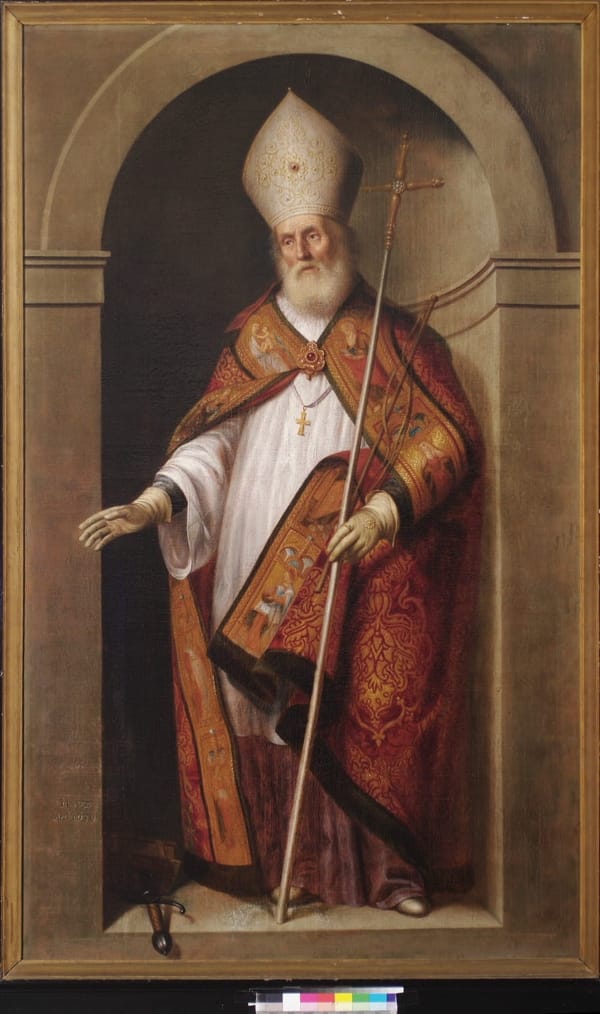 |
June 5: St. Boniface, Apostle of Germany, Bishop and Martyr
THE Son of Man, proclaimed King in the highest heavens on his triumphant Ascension day, leaves to his bride on earth the task of making his sovereign dominion recognized here below: this is her glory. Pentecost gives the signal for the Church's work of conquest; now does she awake, aroused by the breath of the Holy Ghost; replenished with this Spirit of love, she is all eagerness, as he is, to be possessed at once of the whole earth. We have already seen the Franks and the Anglo-Saxons pledging in her hands their oath of fealty to Christ, ‘to whom is given all power on earth and in heaven.’1 To-day we see how Winfrid realizes the fair name of Boniface, or well-doer, given him by Pope Gregory II. He presents himself before us, surrounded by the multitudes he has snatched at one blow from paganism and barbarism. Thanks to the Apostle of Germany, the hour is nigh when the Church may constitute in this world, apart from the spiritual dominion of souls, an empire more powerful than any that has ever been or is to be.
The eternal Father draws to his Son2 not men only but nations; these are his inheritance on earth no less than heaven is in eternity. The good pleasure that God takes in the Word made Flesh could never be content with merely seeing nations come, one here, another there, offering an isolated homage of recognition to Christ, as their Lord and Master. It was the whole world that was promised as his possession, without distinction of nations, without limits, save those of the earth itself:3 recognized or not, his power is universal. In the case of many, no doubt, the contempt or the ignorance of this regal claim of the Man-God is to last on throughout ages; for revolt, alas! is always possible to all. But it was the duty of the Church to exercise her influence over baptized nations, so as to gather them together in one public acknowledgement of the royalty of Christ, which is the source of every kingly power. At the Pontiff’s side there seemed to be a fitting place for a mailed chieftain of Christendom to be the lieutenant of Christ, who alone is Lord of lords and King of kings. Thus would be realized, in all its plenitude, the magnificent principality announced by the prophets for the Son of David.4
Such an institution was indeed worthy of the name it was to receive, that of the Holy Empire: in it we have the final result of our glorious Pentecost, the consummation of the testimony rendered by the Holy Ghost to Jesus, both as Pontiff and as King.5 In a few days, Leo III, the illustrious Pope called by the Holy Spirit to crown this his divine work, will proclaim, to the joy of the whole world, the establishment of this new empire beneath the sceptre-sway of the Man-God, in the person of Charlemagne, the representative of the King of kings. This marvellous work was not prepared all at once. Vast regions, destined to form the very nucleus of this future empire, for long centuries knew not so much as the very name of the Lord Jesus; or, at best, preserved but confused notions of truth, derived from some earlier evangelization that had been stifled in its birth by the turmoil of invasions—a mere mixture of Christian practices and idolatrous superstitions. At length we behold Boniface arise, endued with power from on high,6 the worthy precursor of St Leo III. Bom of those angelfaced Angles, by whom ancient Britain was transformed into the Island of Saints, he bums to carry into the heart of Germany, whence his ancestors had sprung, the light which first shone upon them in the land of their conquest.
Thirty years of monastic life, begun in childhood despite the tears and caresses of a tender father, had braced his soul. Prepared by this long period of retreat and silence, filled with divine science, and accompanied by the prayers of his cloistered brethren, he could now in all security set forth to follow the attraction of a divine call. But, first and foremost, Rome beholds him at the feet of the Sovereign Pontiff, submitting his plans and prospects to him who is the only source of all mission in the Church. Gregory II, in every way worthy of the great Popes that have borne that name, was at that time watching with apostolic vigilance over the Christian world, and preparing for the glorious sovereignty that awaited the Church in the coming eighth century. In the humble monk prostrate at his feet, the immortal Pontiff recognizes a powerful auxiliary sent to him by heaven; and so, armed with the apostolic benediction, Winfrid, now become Boniface, feels the powerful attraction of the Holy Spirit drawing him irresistibly to conquests of which ancient Rome had never dreamed.
Beyond the Rhine, farther than Roman legions ever penetrated, the Church now advances into this barbarous land, along pathways tracked for her by Boniface; overturning in her victorious march the last idols of the false gods, civilizing and sanctifying those savage hordes, the scourge of the old world. This Anglo-Saxon, a true son of St Benedict, gives to his work a stability that will defy the lapse of ages. Everywhere monasteries arise, taking root in the very soil, for God's sake; and, by force of example and beneficence, fixing around them its various nomad tribes. From the river banks, from the forest depths, instead of cries of war and of vengeance, is wafted the accent of prayer and of praise to the Most High. Sturm, the beloved disciple of St Boniface, presides over these peaceful colonies far superior to those of pagan Rome, planted though they were by her noblest veterans and manned by the best forces of her empire.
Here, too, where violence has hitherto reigned supreme, in these savage wilds, a novel kind of army is organized, formed of the gentle brides of Christ. The Spirit of Pentecost, like a mighty wind, has blown over the land of the Angles; and, even as in the cenacle holy women had a share in its influence, consecrated virgins, obedient to the heavenly impulse, have quitted the land of their birth, even the monastery that has sheltered them from childhood. Having for a while administered only at a distance to Winfrid's needs, and copied out for him the sacred books in letters of gold, they at length come to join the apostle. Fearlessly have they crossed the sea, and, guided by their divine Spouse, have come to share the labours undertaken for his glory. Lioba is at their head; she whose gentle majesty, whose heavenly aspect, uplifts the mind from earthly thoughts, and who by her knowledge of the scriptures, of the fathers, and of the sacred canons, is equal to any of the most celebrated doctors. But the Holy Ghost has still more richly gifted the soul of Lioba with humility and Christian heroism. Behold the chosen mother of the German nation! Germany's proud daughters, athirst for blood, who on their wedding-day disdained all other gift save a steed, a buckler, and a lance,7 are to learn from her the true qualities of the valiant woman. No more shall they be seen, intoxicated with slaughter, leading back to the field of battle their vanquished husbands; but the virtues of the wife and of the mother shall replace in them the fury of the camp; family life is to be founded on German soil, and through it the fatherland.
This was Boniface's intention when he called to his aid Lioba, Walburga, and their companions. Worn out with toil, but still more with the incessant wear and fret of petty jealousies (never spared to men of God by such as would cover their paltry complaints under the cloak of false zeal), our athlete of Christ was not ashamed to come to Lioba, his well-beloved daughter, humbly seeking from her that enlightened counsel and comfort which was never denied. Estimating at its true worth the share she had borne in his work, he was desirous that she should be laid to rest in the same tomb prepared for him in his abbey of Fulda.
But not yet was his labour ended, nor was the evening of life at hand. The spiritual welfare of his numberless converts must be secured, and at their head must be placed such as the Holy Ghost designated for the government of God's Church.8 By his means the hierarchy was constituted and developed; the land was covered with churches; and, beneath the rule of holy bishops chosen by God, these once wandering tribes now began to live a life to the glory of the most blessed Trinity, in a country but recently pagan, wherein Satan had hoped to perpetuate his own domination.
Nor was this our saint’s only work in Germany; in certain isolated parts, the seeds of Arianism and Manichæism had been silently taking root, by means of an intruded clergy, half pagan and half Christian in their rites; and these would inevitably prove a serious scandal to his recent converts that came within reach of their influence. Even as Christ, armed with a whip of cords, drove the buyers and sellers from the temple, so did Boniface, by vigorous measures, rid the land of these sectarian priests, who, with hands polluted by heathenish sacrifices to the vanquished deities of Valhalla, dared to offer also the spotless victim to the Most High.
The powerful action of Boniface, as the precursor of the Holy Empire, was not confined to preparing the German race alone for its share in so high a destiny. His beneficent influence was now to be exercised, at a most critical moment, upon France, the eldest daughter of the Church; for she was chosen, in the person of her princes, to be the first to bear the emblem of Christ’s universal kingship. The descendants of Clovis had preserved nought of his royal inheritance, save the vain title of a power that had now passed into the hands of a new family, a more vigorous branch of his stock. Charles Martel, the head of this race, measuring his strength with the Moors, had crushed their entire army near Poitiers: but, in the flush of victory, the hero of the day had wellnigh brought the Church of France to the brink of ruin, by distributing to his comrades in arms the episcopal sees and abbeys of the land. Unless a situation no less disastrous than would have been the triumph of Abderahman was to be accepted, these usurped croziers must at once be wrested from the hands of such strange titularies. To effect this, as much gentleness as firmness was needed, together with an ascendancy belonging only to virtue, if the hero of Poitiers and his noble race were to be gained over to respect the rights of holy Church. This victory, more glorious than had been the defeat of the Moors, was won by Boniface, a veritable triumph of unarmed holiness, as profitable to the vanquished as to the Church herself. Of this fierce warrior he was to make the worthy father of a second dynasty, the glory whereof should far surpass the brilliant hopes of the first race of the Frankish kings.
Boniface, now legate of Pope St Zachary as he had formerly been of Gregory III, fixed his episcopal see at Mainz, the better to keep within the fold both Germany the conquest of his earlier apostolate, and France more recently rescued by his labours. Like another Samuel, he himself, with his own hands, consecrated this new regal dynasty, by conferring the sacred unction on Pepin le Bref, son of Charles Martel. This was in the year 752. Another Charles, as yet a child, who was one day to inherit that throne thus firmly established, attracted the notice of the aged saint, and received his benediction; it was the future Charlemagne. But to the hand of a Sovereign Pontiff would be reserved the anointing of that royal brow; and a diadem more glorious still than that of a king of the Franks was one day to be his, exhibiting in his person the head of the new Roman Empire, the lieutenant of the King of kings.
The personal work of Boniface was now accomplished; like the old man Simeon, his eyes had seen the object of all his ambition, of his life-long toil, the salvation prepared by God for this new Israel. He too had now no desire left save that of departing in peace to our Lord; but could such an apostle enter into peace by any other gate than that of martyrdom? He understands this well: his hour has sounded: the old warrior has chosen his last battlefield. Friesland is still pagan: half a century ago, at the opening of his apostolic career, he had avoided this country, in order to escape the bishopric which St Willibrord, at that early date, was anxious to bestow upon him: but now that it has nought save death to offer him, he will enter this land. In a letter of sublime humility, prostrate at the feet of Pope Stephen III, he submits to the correction of the Apostolic See, the 'awkward mistakes,' as he terms them, and the many faults of his long life;9 to Lullus, his dearest son, he leaves the Church of Mainz; he recommends to the care of the Frankish king the several priests scattered all through Germany, the monks and virgins, who from distant homes have followed him hither. Then ordering to be placed amongst the few books which he is taking with him the winding sheet that is to enwrap his body, he designates the companions chosen by him for the journey, and sets out to win the martyr's palm.
Let us now read the liturgical record of this grand life.
Thou wast, O great apostle, the faithful servant of him who chose thee as the minister of his word and the propagator of his kingdom. When the Son of Man quitted earth to receive the delighted homage of the heavenly hosts in recognition of his kingship over them, he none the less remained King of this lower world which he has left but for a little while.10 He counted on his Church to guard his principality here below. Small indeed was the number of those who recognized him, on the day of his glorious Ascension, as their Master and Lord. But that faith deposited in those first chosen souls was a treasure which they, like skilful bankers, knew how to work with, and how to multiply by apostolic commerce. Transmitted from generation to generation, up to the day of the Lord's return, this precious capital was to go on yielding to the absent Lord more and more accumulated interest. Thus was it with thee, O Winfrid, in that age wherein thou didst bring into the Church that tribute of labour which she requires, though in very different proportion, from each of her sons. In her gratitude, for thy works which appeared to her well done and profitable above those of others, forestalling the Spouse himself, she would, even in this world, call thee by that new name11 whereby thou art known in heaven.
Indeed, when did riches, such as thou didst bring, come pouring at once into the hands of the bride? When did the Spouse appear to be so fully and truly head of the whole world, as in the eighth century, in which the Frankish princes, formed by thee to their noble destinies, constituted the temporal sovereignty of the Church, and gloried in being the lieutenants of Christ standing at the side of his Vicar on earth? To thee, O Boniface, is the Holy Empire indebted for its very existence. But for thee, France would have perished, debased by a simoniacal clergy, even before a Charlemagne had appeared; but for thee, Germany would have remained a prey to pagan barbarians, enemies of all civilization and progress. O thou that didst rescue both Germans and Franks, receive our grateful homage.
At the sight of thy works, and remembering the great popes and magnificent princes, whose glory is indeed derived from thee, our admiration equals our gratitude. But pardon us, dear saint, if the thought of those grand centuries of yore, so far removed, alas, from these our days, should mingle sadness with our joy. Viewed in the light of thy holy policy and its results, O glorious precursor of the confederation of Christian nations, how we must bewail the fatal errors of those princes and statesmen, so renowned in the seventeenth century, and so foolishly admired by a world whose ruin they were hastening! For, by the isolation of Catholic nations from one another, the ties that bound them to the Vicar of Christ became loosened: princes, forgetful of their true position as representatives of the divine King, made friends with heresy, in order to assert their independence of Rome, or to lower one another’s power. Therefore Christendom is no more. Upon its ruins, like a woful mimicry of the Holy Empire, Protestantism has raised its false evangelical empire, formed of nought but encroachments, and tracing its recognized origin to the apostasy of that felon knight Albert of Brandenburg.
The complicities that rendered such a thing possible have received their chastisement. May God’s justice be satisfied at last! O Boniface, cry out with us unto the God of armies for mercy. Raise up in the Church servants of Christ, powerful in word and work, as thou wast. Save France from anarchy; and restore to Germany a right appreciation of true greatness, together with the faith of her ancient days.
Monday after Trinity Sunday
Having, by His divine light, increased the Church’s appreciation of the sovereign mystery of the august Trinity, the Holy Ghost next leads her to contemplate that other marvel, which concentrates in itself all the works of the Incarnate Word, and leads us, even in this present life, to union with God. The mystery of the holy Eucharist is going to be brought before us in all its magnificence; it behoves us therefore, to prepare the eyes of our soul for the worthy reception of the light which is so soon to dawn upon us. As, during the whole year, we have never lost sight of the mystery of the holy Trinity, and all our worship has unceasingly been offered to the Three divine Persons; so, in like manner, the blessed Eucharist has uninterruptedly accompanied us throughout the whole period of the liturgical year, either as the means for paying our homage to the infinite Majesty of God, or as the nourishment which sustains the supernatural life. Though we knew and loved these two ineffable mysteries before, yet the graces of Pentecost have added much to both our knowledge and our love; yesterday, the mystery of the Trinity beamed upon us with greater clearness than ever; and now we are close upon the solemnity which is to show us the holy Eucharist with an increase of light and joy to our faith.
The blessed Trinity is, as we have already shown, the essential object of all religion; It is the centre to which all our homage converges; and this, even when we do not seem to make It our direct intention. Now, the holy Eucharist is the best of all the means whereby we can give to the Three divine Persons the worship we owe Them; it is, moreover, the bond whereby earth is united with heaven. It is easy, therefore, to understand how it was that holy Church so long deferred the institution of the two festivals immediately following Whitsuntide. All the mysteries we have celebrated up to this time were contained in the august Sacrament, which is the memorial, and, so to say, the compendium, of the wonderful things wrought in our favour by our Redeemer.1 It is the reality of Christ’s presence under the sacramental species that enabled us to recognize in the sacred Host, at Christmas, the Child that was born unto us, in Passiontide, the Victim who redeemed us, and at Easter, the glorious conqueror of death. We could not celebrate all those admirable mysteries without the aid of the perpetual Sacrifice; neither could that Sacrifice be offered up, without renewing and repeating them.
It is the same with the feasts of our blessed Lady and the saints: they kept us in the continual contemplation of the holy Sacrament. When we honoured Mary on the solemnities of the Immaculate Conception, the Purification, or the Annunciation, we were honouring her who had, from her own substance, given that Body and Blood which was then offered upon our altars. As to the apostles and the martyrs, whose memories we solemnized, whence had they the strength to suffer so much and so bravely for the faith, but from the sacred banquet which we then celebrated, and which gives courage and constancy to them that partake of·it? The confessors and virgins, as their feasts came round, seemed to us as so many lovely flowers in the garden of the Church, and that garden itself all fruitful with wheat and clusters of grapes, because of the fertility given by Him who is called, in the Scriptures, both Wheat and Wine.2
Putting together all the means within our reach for honouring these blessed citizens of the heavenly court, we have chanted the grand Psalms of David, and hymns, and canticles, with all the varied formulas of the liturgy; but nothing that we could do towards celebrating their praise could be compared to the holy Sacrifice offered to the divine Majesty. It is in that Sacrifice that we entered into direct communication with them, according to the energetic term used by the Church in the Canon of the Mass (communicantes). The blessed in heaven are ever adoring the most holy Trinity by and in Christ Jesus our Lord; and it is by the Sacrifice of the Mass that we were united with them in the one same centre, and that we mingled our homage with theirs; hence, they received an increase of glory and happiness. So, then, the holy Euoharist, both as Sacrifice and Sacrament, has always been prominently before us. If we are now going to devote several days to a more attentive consideration of its magnificence and power; if we are now going to make more earnest efforts to taste more fully its heavenly sweetness; it is not something fresh, which attracts our special notice and devotion for a season, and will then give way for something else: the Eucharist is that element prepared for us by the love of our Redeemer, of which we must always avail ourselves in order that we may enter into direct communication with our God, and pay Him the debt not only of our worship, but also of our love.
And yet, the time was to come when the Holy Ghost, who governs the Church, would inspire her with the thought of instituting a special solemnity in honour of that august mystery, in which all others are included. There is a sacred element, which gives a meaning to every feast that occurs during the year, and graces it with the beauty of its own divine splendour; that sacred element, which is the most holy Eucharist, had itself a right to a solemn festival, in keeping with the dignity of its divine object.
But that festive exaltation of the divine Host, and those triumphant processions so deservedly dear to the present generation of Christians, were not practicable in the ages of the early persecutions. And when those rough times had passed away, and the courageous martyrs had won victory for the Church, those same modes of honouring the Eucharist would not have suited the spirit and form of the primitive liturgical observances, which were kept up for ages following. Neither were they needed for the maintenance of the lively faith of those times; they would have been superfluous for a period such as that was, when the solemnity of the Sacrifice itself, and the share the people at large took in the sacred mysteries, and the uninterrupted homage of liturgical chants sustained by the crowds of faithful adorers around the altar, gave praise and glory to God, secured correctness of faith, and fostered in the people a superabundance of supernatural life, which is not to be found now-a-days. The divine Memorial produced its fruits; the intentions our Lord had in instituting the Eucharist were realized; and the remembrance of that institution, which used then to be solemnized as we now celebrate Mass on Maundy Thursday, was deeply impressed on the minds of the faithful.
This state of things lasted till the beginning of the thirteenth century, when, as the Church expresses it, a certain coldness took possession of the world;3 faith grew weak, and the vigorous piety which characterized the Christians of the previous ages became exceedingly rare. There were grand exceptions, here and there, of individual saintliness; but there was an unmistakable falling off among people at large, and the falling off was progressive; so much so, indeed, that there was danger that the mystery, which by its very nature is the mystery of faith, would suffer, in a special manner, from that coldness, that indifference, of the new generation. Even at that period, hell had been at work, stirring up sacrilegious teachers here and there, who dared to throw doubts upon the dogma of the real Presence; fortunately, the people easily took alarm, and, as a general rule, were too strong in the old faith to be led astray. The pastors, too, of the Church were alive to the danger, for there were souls who allowed themselves to be deceived.
Scotus Erigena had formulated the sacramentarian heresy: he had taught that the Eucharist ‘was but a sign, a figure of spiritual union with Jesus, of which the intellect alone could be cognizant.’ His teaching made little impression; it was regarded as mere pedantry, and was too novel to make head against Catholic tradition, such as was to be found exposed in the learned writings of Paschasius Radbert, Abbot of Corbie. The sophistry of Scotus was revived, in the eleventh century, by Berengarius; but although its new promoter was more crafty and conceited than its originator, and did greater and more lasting mischief, yet it died with him. The time for hell to play havoc by such direct attacks as these had not yet come; they were laid aside for others of a more covert kind. That hotbed of heresies, the empire of Byzantium, fostered the almost extinct germ of Manicheism; the teaching of that sect regarding the flesh—that it is the work of the evil principle—was subversive of the dogma of the Eucharist. While Berengarius was trying to bring himself into notice by the noisy, but ineffectual, broaching of his errors, Thrace and Bulgaria were quietly sending their teachers into the west. Lombardy, the Marches, and Tuscany, became infected; so did Austria, in several places, and almost all at one and the same time; so, too, did three cities of France: Orleans, Toulouse, and Arras. Forcible measures were used for repressing the evil; but it knew how to grow strong by retreat. Taking the south of France for the basis of its operations, the foul heresy silently organized its strength during the whole of the twelfth century. So great was the progress it made thus unperceived, that when it came publicly before the world, at the beginning of the thirteenth century, it had an army ready for the maintenance of its impious doctrines. Torrents of blood had to be shed in order to subdue it, and deprive it of its strongholds; and for years after the defeat of the armed insurrection, the Inquisition had to exercise active watchfulness in the provinces that had been tainted by the Albigensian contagion.
Simon of Montfort was the avenger of the Catholic faith. But, while the victorious arm of the Christian hero was dealing a death-blow to heresy, God was preparing for His Son, who had been so unworthily outraged by the sectarians in the Sacrament of His love, a triumph of a more peaceful kind, and a more perfect reparation. It was in the year 1208, that a humble religious of the Congregation of the Hospitallers, by name the Blessed Juliana of Mont-Cornillon near Liege, had a mysterious vision, in which she beheld the moon at its full, but having a hollow on its disc. In spite of all her efforts to divert herself from what she feared was an illusion, the same vision appeared before her as often as she set herself to pray. After two years of such efforts and earnest supplications, it was revealed to her that the moon signified the Church as it then was; and that the hollow she observed on its disc expressed the want of one more solemnity in the liturgical year; a want which God willed should be supplied by the introduction of a feast, to be kept annually in honour of the institution of the blessed Eucharist. The solemn commemoration made of the last Supper, on Maundy Thursday, was no longer sufficient for the children of the Church, shaken as they had been by the influences of heresy; it was not sufficient even for the Church herself, who, on that Thursday, has her attention divided by the important functions of the day, and is wholly taken up, a few hours later, by the sad mysteries of the great Friday. At the same time that Juliana received this communication, she was also commanded to make known to the world what she had been told was the divine will. Twenty years, however, passed, before the humble and timid virgin could bring herself to put her person thus forward. She at length mentioned the subject to a Canon of St. Martin’s of Liége, named John of Lausanne, whom she much respected for his great holiness of life; and she besought him to confer with men of theological learning on the subject of the mission confided to her. All agreed that not only there was no reason why such a feast should not be instituted, but, moreover, that it would be a means for procuring much glory to God and great good to souls. Encouraged by this decision, the saintly Juliana had a proper Office composed and approved for the future festival; it begins with the words: Animarum cibus, and a few portions are still extant.
The Church of Liege, to which the universal Church owes yesterday’s solemnity of the blessed Trinity, was predestined to have the honour of originating the feast of Corpus Christi. It was a happy day, when, in the year 1246, after so many delays and difficulties, the bishop of Liege, Robert de Torôte, published a synodical decree that each year, on the Thursday after Trinity Sunday, there should be observed in all the churches of his diocese, with rest from servile work, and with the preparation of fasting on the eve, a solemn feast in honour of the blessed Sacrament.
But the mission of the Blessed Juliana was far from being at an end; she had to be punished for having so long deferred it. The bishop died; and the decree he had issued would have long been a dead letter, had there not been one, and only one, church of the diocese, whose clergy were determined to carry the decree into execution: these were the Canons of Saint Martin-au-Mont. Though there was no authority, during the vacancy, that cared to enforoe the observance, yet, in the year 1247, the feast of Corpus Christi was kept in that privileged church. Robert’s successor, Henry de Gueldre, a warrior and grandee, took no interest in what his predecessor had had so much at heart. Hugh de Saint Cher, Cardinal of St. Sabina, and legate in Germany, having gone to Liege with a view to remedy the disorders to which the new episcopal government had given rise, heard mention of the decree of the late bishop Robert, and of the new feast. The Cardinal had, formerly, been prior and provincial in the Order of St. Dominio, and was one of the theologians who, having been consulted by John de Lausanne, had favoured the project. He was of the same mind when legate; and claimed the honour of keeping the feast himself, and singing Mass with much solemnity. Not satisfied with that, he issued a circular, dated December 29,1253, which he addressed to the archbishops, bishops, abbots, and faithful of the territory of his legation; and, in that document, he confirmed the decree of the bishop of Liege, and extended it to all the country over which he was legate, granting one hundred days’ indulgence to all who, being contrite, and having confessed their sins, should, on the feast itself or during its Octave, devoutly visit a church in which the Office of Corpus Christi was being celebrated. In the year following, the Cardinal of St. George in Velabro, who had succeeded as legate, confirmed and renewed the ordinances made by the Cardinal of St. Sabina. These reiterated decrees, however, failed to remove the wide-spread indifference. A terrible blow had been given, by the proposed feast, to the powers of hell, and satan excited every possible opposition to it. As soon as the legates had taken their departure, several local superiors, men of note and authority! published their own ordinances in opposition to what had been already given. In 1258, the year of the Blessed Juliana’s death, there was still but the single church of St. Martin that would celebrate the feast, which it was her mission to spread throughout the entire world. But she left the continuation of her work to a holy recluse, of the name of Eve, to whom she had confided her secrets.
On the twenty-ninth day of August, 1261, James Pantaléon ascended the papal throne, under the name of Urban IV. He owed his election to this dignity to his great personal merits, for by birth4 he had nothing to recommend him. He had been archdeacon of Liege, and there had met with the Blessed Juliana, and had approved her work. In this his exaltation to the papacy, Eve thought she had an indication of God’s providence. She induced the bishop, Henry de Gueldre, to send his written congratulations to the new Pontiff, and, at the same time, to entreat him to confirm, by his own approbation, the feast which had been instituted by Robert de Torôte. About the same time, several supernatural events had attracted public attention; and in particular, the prodigy at Bolsena, near Orvieto, (where the papal court happened to be then residing) of a corporal having been stained with blood by a miraculous Host. These events seemed as though providentially permitted in order to rouse Urban’s attention, and to confirm him in the holy zeal he had formerly evinced for the glory of the blessed Sacrament. St. Thomas of Aquin was appointed to compose, according to the Roman rite, the Office for the feast; which Office was to be substituted for the one prepared by the Blessed Juliana, which she had adapted to the ancient liturgy of France. The Bull Transiturus was published soon after; it made known to the Church the Pope’s intentions. Urban there mentions the revelations which had come to his knowledge before his election; and declares that, in virtue of his apostolic authority, both for the confounding of heresy, and for the increase of the true faith, he institutes a special solemnity in honour of the divine Memorial left, by Christ, to His Church. The day there fixed for the feast is the fifth feria (that is, the Thursday) after the Octave of Pentecost; for the Papal document does not mention, as the decree of the bishop of Liege had done, the feast of the blessed Trinity, which had not yet been received into the calendar of the Church of Rome. In imitation of what had been done by Hugh de Saint Cher, the Pontiff granted a hundred days’ indulgence to all the faithful, who, being contrite, and having confessed their sins, should assist at Mass, or Matins, at first or second Vespers, of the feast; and for assisting at Prime, Tierce, Sext, None, and Compline, forty days for each of those Hours. He also granted a hundred days to those who should assist, on any day within the Octave, at the Mass and the entire Office. Among all these details, there is no allusion to the procession, for this was not introduced till the following century.
All now seemed settled; and yet, owing to the troubles which were then so rife in Italy and the Empire, the Bull of Urban IV was forgotten, and remained a dead letter. Forty years and more elapsed before it was again promulgated and confirmed by Pope Clement V, at the Council of Vienne. John XXII gave it the force of a settled law, by inserting it in the Clementines, about the year 1318; and he had thus the honour of putting the finishing stroke to the great work, which had taken upwards of a century for its completion,
The feast of the blessed Sacrament, or, as it is commonly called, Corpus Christi, began a new phase in the Catholic worship of the holy Eucharist. But, in order to understand this, we must go more thoroughly into the question of Eucharistic worship, as practised in the previous ages of the Church: the inquiry is one of importance for the full appreciation of the great feast, for which we must now be preparing our souls. No preparation, it seems to us, could be more to the point, than to devote the next two days to a faithful and compendious study of the chief features in the history of the blessed Eucharist.
It belongs to Thee, O holy Spirit, to teach us the history of so great a mystery. Scarcely has Thy reign begun upon the earth, when, faithful to Thy divine mission of glorifying our Emmanuel,5 who has ascended into heaven, Thou at once raisest our eyes and hearts up to that best gift of His love, whereby we still possess Him under the eucharistic veil. During those long ages of the expectation of nations, it is Thou who didst bring the Word before mankind; Thou spakest of Him in the Scriptures, Thou proclaimedst Him by the prophets.6 O Thou who art the Gift of the Most High,7 Thou art, also, infinite Love; and it is through Thee, as such, that are wrought all the manifestations which God vouchsafes to make to us His creatures. It is Thou that broughtest this divine Person, the Word, into the womb of the immaculate Virgin Mary, there to clothe Him with sinless flesh, and so make Him our Brother and our Saviour. And now that He has ascended to His Father and our Father,8 depriving us of the sight of His human Nature all beauteous with its perfections and charms; now that we have to go through this vale of tears deprived of His visible company: He has sent Thee unto us;9 and Thou hast come, O divine Spirit, as our Consoler. But the consolation Thou bringest us, dear Paraclete, is ever the same: it is the faithful remembrance of Jesus;10 yea, more, it is His divine Presence, perpetuated by Thee in the Sacrament of love. We had already been told that this would be so; that Thou wouldst not speak of Thyself,11 or for Thyself; but that Thou wouldst come to give testimony of the Emmanuel,12 continue His work, and produce His divine likeness in each one of us.
How admirable is this Thy fulfilment of Thy sublime mission, which is all for the glory of Jesus! O divine Spirit, Guardian of the Word in the Church! it is far beyond our power to describe how great is Thy vigilance over the word of teaching, brought by the Saviour to this earth of ours, a teaching which is the true expression of Himself, and which, coming, as He Himself does, from the mouth of the Father, is the nourishment of His bride here below.13 But with what infinite respect and vigilance, O holy Spirit, dost Thou preside over the august Sacrament, wherein is present, with all the reality of His adorable Flesh, that same Incarnate Word, who, from the very beginning of creation, was the centre and object of all Thy dealings with creatures! It is by the mystery produced by Thine omnipotence, that the exiled bride recovers her Spouse; it is by Thee that she traverses the long ages of time, holding and prizing her infinite treasure; it is by Thee that she, with such superhuman wisdom, puts it to profit, by so arranging, so modifying her discipline, yea, her very life, as to secure in each age of time the greatest possible faith, respect and love towards the divine Eucharist. If she anxiously hide It from the profane men that would only turn their knowledge into blasphemy; or if she lavish upon It all that liturgy can give of pomp and magnificence; or if, again, she bring It forth from her sacred temples, and triumphantly carry It in procession through the crowded streets of cities, or the green lanes of the quiet country, it is Thou, O divine Spirit, that inspirest her with what is best; it is Thy divine foresight that suggests to her what is the surest means for gaining, in each respective period and age, the most of honour and love for Jesus who is ever present in the sacred Host, and who deigns to let His love be delighted with being thus among the children of men.14
Vouchsafe, O Holy Ghost, to aid us in our contemplations of this sacred mystery. Enlighten our understanding, inflame our hearts, during these hours of preparation for its feast. Give to our souls the knowledge of that Jesus, who is coming to us beneath the sacramental veil.
May this holy mystery be to us, during this last portion of the year and its liturgy, our Bread to support us on the journey we have still to make through the desert, before we can reach the mount of God;15 we have yet a great way to go, and a way so different from the one we have already passed through, when we had the company of Jesus in the mysteries He was working for our salvation. Be Thou, O holy Spirit, our guide in those paths, which the Church, under Thy direction, is courageously traversing, while she is every day approaching nearer to the end of her pilgrimage here below. Yet scarcely have we entered on this second portion of our year, than Thou, divine Spirit, bringest us to the banquet prepared by divine Wisdom,16 where the pilgrim receives the strength he needs for his journey. We will walk on, then, in the strength of this heavenly food;17 and when our course is run, we will, with the same Bread to support us, cry out, with the Spirit and the bride, that our Lord Jesus may come18 to us, at that last hour, and admit us into His eternal kingdom.
In honour of the adorable Sacrament, and in memory of the Blessed Juliana, to whom the Church owes the feast she is about to celebrate, we will offer our readers, to-day and during the Octave, the main portions, which are still extant, of the Office which bears her name. It will be interesting to them to hear how this Office was drawn up; we give the details as supplied to us by the Bollandists, in the life written of her by one of her contemporaries.
Juliana, then, began to ask herself whom she should get to compose the Office of the great feast. She knew of no clever man, or holy priest, who seemed to her fitted for the work; so, trusting solely to divine Wisdom, she made up her mind to select a young brother of the Hospital, named John,19 whose innocent life had been revealed to her by God. John refused the work, declaring that it far exceeded his powers or learning; he begged her to excuse him, as he was but an ignorant man. Juliana knew all that; but she also knew that divine Wisdom, whose work she was furthering, could speak admirable things through an unlearned man; she kept to her purpose; and John, unable to resist the entreaties and influence of Juliana, began his labours. She prayed, and he wrote; and with the efforts of the two united, the work progressed in a way that surprised the young brother. He attributed all, and he was not far wrong, to Juliana’s prayers. When he had any considerable portion of the composition ready, he gave it to her, saying: ‘This, Sister, is what heaven sends thee: read it, and examine whether I have put down anything, either in the chant, or the words, which needs correction.’ She would then take it; and, by the wonderful infused wisdom which she possessed, would examine, and, where needed, correct; and with so much prudence and judgment, that not even the most expert critics could find anything to change. And thus, by the wondrous help of God, was completed the whole Office of the new feast.20
The antiphons we here subjoin were taken by the Bollandists,21 from a very ancient Directorium of the church of Saint-Martin-au-Mont. They are the antiphons assigned for the Benedictus and Magnificat of each day during the Octave.
Antiphons
- Ps. cx. 4. ↩︎
- Zach. ix. 17· ↩︎
- Collect for the feast of the Stigmata of St. Francis. ↩︎
- Troyes, France, was his native town. ↩︎
- St. John xvi. 14. ↩︎
- 2 St. Pet. i. 19-21. ↩︎
- Hymn for Pentecost. ↩︎
- St. John xx. 17. ↩︎
- St. Luke xxiv. 49. ↩︎
- St. John xiv. 26. ↩︎
- St. John xvi. 13. ↩︎
- St. John xv. 26. ↩︎
- St. Matt. iv. ↩︎
- Prov. viii. 31. ↩︎
- 3 Kings xix. 8. ↩︎
- Prov. ix. ↩︎
- 3 Kings xix. 8. ↩︎
- Apoc. xxii. 17. ↩︎
- We must not confound him with John de Lausanne, of whom we have previously spoken. ↩︎
- Vita B. Julianæ, ab auctore coævo descripta lib. ii. cap. 2. Act. Ss. ad diem quintam Aprilis. ↩︎
- Ibid. in Append. ↩︎
| Previous June 4: St. Francis Caracciolo, Confessor | Next Monday after Trinity Sunday |