Daily reading
After Pentecost
Double · June 6 · Sanctoral
June 6, 2023
From Dom Guéranger’s The Liturgical Year.
A Double leads the weekday.Rubric
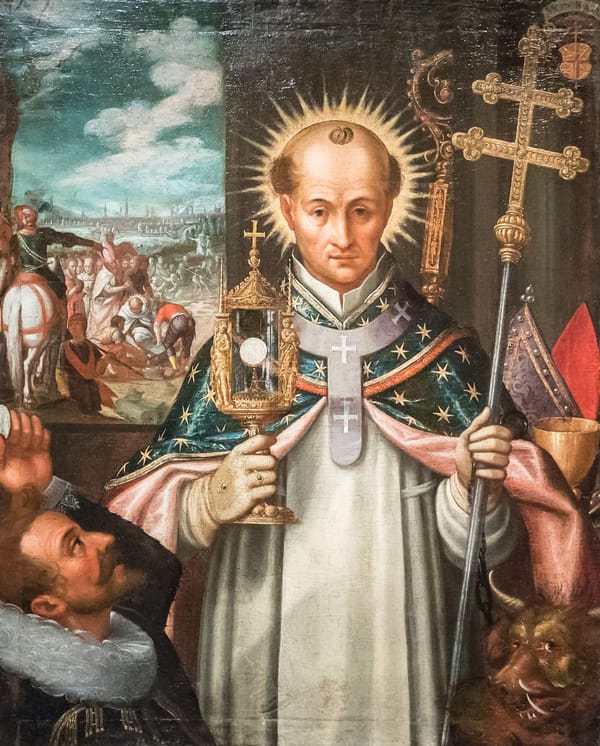 |
June 6: St. Norbert, Bishop and Confessor
THE helpful influence of the Holy Ghost is more and more multiplied along the Church's path. It seems as though he would show us to-day how the divine power of his action is not crippled by lapse of years: for here we have, twelve centuries after his first coming among us, miracles of grace and conversion quite as brilliant as those that marked his glorious descent upon earth.
Norbert, in whose veins flowed the blood of emperors and kings, was, from the very breast of his mother Hedwige, supernaturally invited to a nobility loftier still: yet did he devote to the unreserved enjoyment of pleasure three-and-thirty years of a life that was to number but fifty in all. The Holy Ghost at length hastened to the conquest. There burst a sudden storm, a thunderbolt falls right in front of the prodigal, throwing him to the ground and making a frightful chasm between him and the point whither, a moment ago, he was hastening in pursuit of new vanities, that needs must fail, as all others had done, to fill the hopeless void in his heart. Then, in the very depths of his soul resounds a voice, such as Saul once heard on his way to Damascus: ‘Norbert, whither goest thou?' Like another Paul he replies: ‘Lord, what wilt thou have me to do?' He is answered: ‘Depart from evil and do good; seek after peace and pursue it.' Twenty years later, Norbert is in heaven, seated amidst pontiffs, upon a glorious throne, and all radiant with that special brilliancy that distinguishes the founders of the great religious Orders, when they have reached the eternal home.
Deep are the traces left by him on earth of his few years of penitential life. Germany and France receive his preaching; Antwerp is delivered from a shameful heresy; Magdeburg is rescued, by her archbishop, from the irregularities that were sullying the house of God: such are his works; and though these alone would have sufficed to a long life of holiness, yet they are not the only claims, nor the most brilliant, which Norbert has to the Church's gratitude. Before being called, against his will, to the honours of the episcopate, this once gay courtier made choice of an uninhabitable solitude amidst the forests of the diocese of Laon where he devoted himself to prayer and to the maceration of his flesh. The renown of this holy penitent gained rapidly; and Prémontré soon beheld her swampy marshes invaded by a vast multitude, formed of the fairest names of the nobility, pressing thither to learn the science of salvation from the lips of the saintly anchorite. There, too, did our Lady show to him, in vision, the white habit wherewith his disciples were to be clothed; and St Augustine, in like manner, delivered to him his own rule. Thus was founded the most illustrious branch of the Order of Canons Regular. They add to the obligation of solemnizing the Divine Office the austerities of an uninterrupted penance; and devote themselves, moreover, to the service of souls, by preaching and the administration of parishes.
In the foregoing century, the episcopacy and papacy had been raised by the monks above the danger of feudal servitude; and Norbert was now raised up to give the needed completion to their work. Although, in principle, the monastic life excludes no sort of labour useful to the Church, the monks could not (however numerous they might be) quit their cloisters in order to undertake charge of souls. Yet great were the wants of the lambs of the flock at that time; for many unworthy pastors of secondary order, slaves to simony and immorality, still continued to lead astray the simple laity. The religious life was alone capable of raising the priesthood from such degradation, whether on the pinnacles of the hierarchy, or amongst the lowest degrees of sacred Orders. Norbert was the man chosen by God to effect, in part at least, this immense work; and the importance of his mission explains the sublime prodigality wherewith the Holy Ghost multiplied vocations to his standard. The number and rapidity of foundations permitted succour to be promptly and everywhere afforded. Even into the far east did the light of Prémontré reach, almost at its first dawn. In the eighteenth century, notwithstanding the devastations of the Turks and the ravages of the pretended Reformation, the Order, divided into twenty-eight provinces, still contained, in almost every one of its houses, as many as from fifty to one hundred and twenty canons, and the parishes that continued under their care might be counted by thousands.
Nuns, whose holy life and prayers are the ornament and aid of the Church militant, occupied from the very beginning the place deservedly their due in this numerous family. In the time of the founder, or soon after his death, there were more than a thousand of them at Prémontré alone. Such an incredible number gives us an idea of the prodigious propagation of the Order from its very origin. Norbert moreover extended his charity to persons who, like Thibault Count of Champagne, would gladly have followed him into the desert, but who were retained by God’s will in the world; he thus made a prelude to those pious associations, which we shall see St Francis and St Dominic organizing in the thirteenth century, under the name of Third Orders.
The liturgy thus condenses the life of this great servant of God:
Thou didst indeed know how to redeem the time,1 as was fitting in those evil days, wherein thou thyself, O Norbert, led away by the example of the senseless crowd, hadst for so long frustrated the designs of God's love. Those years, at first refused by thee to the true Master of the world, were at length returned unto him, multiplied a hundredfold, through those countless sons and daughters thou didst train up in sanctity. Even thy personal works, in but twenty years' space, filled the whole earth. Schism crushed; heresy confounded to the greater glory of the most holy Sacrament which it had already dared to attack; the rights of the Church intrepidly defended against worldly princes and unjust retentions; the priesthood restored to its primitive purity; the Christian life established on its true basis, of prayer and penance; such and so many victories achieved in so few years, are due to the generosity which prevented thee from looking back for one moment, once the Holy Ghost had touched thy heart. Do thou make all understand that it is never too late to begin to serve God. Were it even, as in thy case, the evening of life, what yet remains of time would suffice to make us saints, if we would but generously give that little fully to heaven.2
Faith and patience were thy cherished virtues; make them flourish once more in this sad world, which boasts of its disbelief, and with jibe and jeer hurries onward to the abyss of hell. Forget not, dear apostle, now that thou art in heaven, the countries thou didst formerly evangelize; we implore this of thee, in spite of their forgetfulness and deliberate return to the deceits of the devil.
Holy Pontiff, Magdeburg has lost her ancient faith, and with it the precious relics of thy body, which she no longer deserved to possess: Prague is now the favoured place of thy repose. But, whilst blessing this hospitable city, pray still for the ungrateful one that has cast aside her double treasure. O thou founder of Prémontré, smile once more on France, which derives from thee one of her fairest glories. Obtain of God that, for the salvation of these calamitous times, thine Order may recover something of its former splendour. Bless, few as they are, those sons and daughters of thine who, in spite of the hostility of the 'powers that be,' seek to shed once more their beneficent influence on France. May England benefit also by their return to her midst, and may their fruits be multiplied in every direction. Maintain thine own spirit among them; may they find in interior peace the secret of triumph over Satan and his crew; may the full magnificence of the divine worship solemnly carried out be ever to their souls as the dearly loved mount, whence, Moses-like, they may declare the will of the Lord to the new Israel, the Christian people.
Tuesday after Trinity Sunday
The history of the blessed Eucharist is one with that of the Church herself: the liturgical usages, which have varied in the celebration of the most august of all the Sacraments, have followed the great social phases of the Christian world. This was a necessity; for the Eucharist is the vital centre, here below, whither everything in the Church converges; it is the inner bond which unites together that society of which Christ is the Head, the society whereby He is to reign over the nations, which are to be His inheritance.1 Union with Peter, the Vicar of Christ, must always be the indispensable condition, the external mark, of the union of the members with the invisible Head; but supported, in an ineffable manner, on the rock which bears the Church, the divine mystery wherein Christ gives Himself to each one of His servants must ever be the essential mystery of union; and, as such, the centre, and the bond, of the great Catholic communion. Let us, to-day, get a clear notion of this fundamental truth, on which was based the very formation of the Church, at her commencement; and let us consider the influence it exercised on the forms of eucharistic worship during the first twelve centuries. To-morrow, we will continue the subject, by examining how subsequent loss of fervour, and heresy, and social degeneracy, induced the Church to gradually modify these forms, which, after all, are but accidental: they were admirably adapted to the favoured times they had served, but would scarcely suit the changed circumstances and requirements of later generations of the Church's children.
It was on the eve of His Passion that our Lord instituted the great Memorial, which was to perpetuate; in all places, the one Sacrifice, whereby are perfected for ever they that are sanctified.2 The cross was 'the altar of the world,’ as St. Leo calls it;3 and on that cross, says the same holy Doctor, was made, a few hours after the last Supper, 'the oblation of the whole human nature; for the whole human race was united with this last act of infinite adoration and reparation, offered by its Head, to the supreme Majesty of God.’4 The Church, issuing with the Blood and water from the side of her Saviour, was then but in her infancy; and the mystery of divine union—which Jesus had come upon the earth to produce, by Himself uniting to the Father, in the Holy Ghost, the members of His mystical body—was to have its immediate realization in those members only by its successive application to each. This was the object of the sublime institution of the Eucharist at the last Supper. It was a new Testament, which gave to the future Church the possession of the mystery, whereby each generation would be linked on to its predecessors by the unity of the one Sacrifice, and would find in that same unity the mutual bond of its members.
Immediately after instituting this new Passover, Jesus said to His disciples: ‘A new commandment I give unto you: that ye love one another, as I have loved you: and, by this shall all men know that ye are My disciples.’5 This was Jesus’ first injunction to His disciples after giving Himself to them in the Eucharist; this love of, and union with, each other, was to be the mark of the Covenant, which He then, through His apostles, contracted with all those who were to believe in Him through the word of their preaching.6 His very first prayer, after that first giving of His Body and Blood under the eucharistic species, is for that same union of His faithful one with another; a union admirable as is the mystery which produces and maintains it; a union so intimate, that its model is the union existing between Jesus and His eternal Father: May they all be one, as Thou, Father, in Me, and I in Thee; that they may be made perfect in one.7
Under the direction of the holy Spirit, the Church understood, from the very first, the intentions of her divine Master. The three thousand, who were converted on the day of Pentecost, are described, in the Acts, as persevering in the doctrine of the apostles, in the communication of the breaking of bread, and in prayers.8 And so great is the power of union derived from their all partaking of the heavenly Bread, that they were remarked by the Jews as a class of men forming a society distinct from every other, which won the esteem of all that beheld them, and drew others daily to join them.9
A few years later the Church, led on by the same holy Spirit, passed beyond the narrow limits of Judea, and carried her treasures to the Gentiles. It was a world of corruption, where all was discord between man and man, and where the only remedy for the outrages of individual egotism was the tyranny of a Cæsar. Into such a world the Christians came, and showed it, from east to west, the marvel of a new people, which, by the sole influence of its virtues, recruited its members from every class of society, and from every dime, and was stronger and more united than any nation that had ever appeared on earth. The pagans were in admiration at this strange and inexplicable novelty; without knowing what they were doing, without troubling themselves with any further inquiry, they bore testimony to the perfection wherewith these Christians fulfilled the dying wishes of their Founder; they thus spoke of them: ‘See how they love one another!’
It was, indeed, a mystery; but the faithful, the initiated, understood it; for it had been thus explained to them by the apostle: ‘We, being many, are one bread, one body, all that partake of one Bread.’10
This text is admirably commented by St. Augustine in a sermon he preached to the neophytes, a few hours after their Baptism: ‘I remember,’ he says, 'the promise I made, of explaining to you, who have been baptized, the mystery of the Lord’s Table, which you now see, and of which you were made partakers in the night just past . . . That Bread which you see on the altar, that Bread which has been sanctified by the word of God, is the Body of Christ: that chalice, or, rather, what that chalice contains, which has been sanctified by the word of God, is the Blood of Christ. By these did Christ our Lord will to give us His Body and His Blood, which He shed for us, unto the remission of our sins. If you have properly received them, you are what you have received, for the apostle says: “We, being many, are one bread, one body.” It is thus that he expounded the Sacrament of the Table of the Lord: We, being many, are one bread, one body. We are, by this Bread, instructed how we are to love unity. Was this Bread made out of one grain P Were there not many grains of wheat P But, before they came to be bread, they were separated one from the other; they became joined by means of water, and by a certain bruising: for, unless the wheat be ground, and be moistened with water, it could never take the form we call bread. It was the same with you, until you were, so to say, ground by the humiliation of fasting, and by the sacrament of exorcism. Baptism and water came to you; you were moistened, that so you might come to the state of bread. But, even so, there is no bread without fire. What, then, does fire signify P It is the chrism; for the oil which makes our fire is the Sacrament of the Holy Ghost . . . The Holy Ghost, therefore, comes; after water, comes fire; and you are made Bread, which is the Body of Christ . . . Christ willed that we should be His Sacrifice—the Sacrifice of God . . . Great, very great are these mysteries! . . Do you so receive them, as to take care that you have unity in your hearts.11 Be one, by loving one another, by holding one faith, one hope, and undivided charity. When the heretics receive this Bread, they receive testimony against themselves; for they are seeking to make division, whereas this Bread is the sign of unity.’12 The Scripture, speaking of the first Christians, says that they had but one heart and one soul;13 and it is the unity which is signified by the wine in the holy mysteries. ‘For,’ continues St. Augustine, ‘the wine was once in so many bunches of grapes; but now it is all one, one in the sweetness of the chalice; for it has gone through the crushing of the wine-press. So you, after those fastings, and labours, and humility, and contrition, have come, in the name of Christ, to the chalice of the Lord; and you are there on that table, and there in that chalice. You are there together with us, for we have eaten together, and drunk together, and that because we live together.14 Thus did Christ our Lord (by the wine made one out of many grapes) signify us, and He wished us to be one with Him, and, by His Table, consecrated the mystery of our peace and unity.’15 These admirable expressions of St. Augustine are but the substance of the doctrine regarding the holy Eucharist, held by the Church in the fourth century. They give us the very essence of that doctrine, in all its fulness and in all the clearness of its literal truth; no other could have been given to neophytes, who, up to that time, had been kept in complete ignorance of the august mysteries, of which they were henceforth to partake. Of the discipline of that secrecy we shall have to speak a little further on. The doctrine of the Eucharist here laid down by the great bishop of Hippo, is identical with that given by all the fathers. In Gaul, St. Hilary of Poitiers,16 and Saint Cesarius of Arles;17 in Italy, Saint Gaudentius of Brescia:18 at Antioch and Constantinople, St. John Chrysostom;19 at Alexandria, St. Cyril:20 all had the same way of putting this dogma of faith before their people. Christ is not divided: the Head and the members, the Word and His Church are inseparably one in the unity of the mystery instituted for the very purpose of producing that unity. And this unanimous teaching of the fathers, who lived in the golden age of Christian eloquence, was reproduced by Paschasius Radbert, in the ninth century,21 by Rupert in the twelfth,22 and by William of Auvergne in the beginning of the thirteenth.23
It would be too long to give the names, and still more to quote passages, in testimony of how all the Churches, for the first twelve centuries, looked upon the holy Eucharist in this same way, that is, as instituted for the purpose of union. If we follow this traditional teaching back to the apostolic source whence it originated, we shall find St. Cyprian, in the age of persecution, speaking to his people upon the union between the divine Head and His members, which is the necessary result of the holy Sacrament; he shows this, not only by the nature of bread and wine, the essential elements for the consecration of the mysteries, but likewise by the mingling of water with the wine in the eucharistic cup: the water, he says, signifies the faithful people; the wine denotes the Blood of Christ; their union in the chalice—union necessary for the integrity of the Sacrifice, union the most complete and inseparable—expresses the indissoluble alliance between Christ and His Church, which consummates the Sacrament.24 The same St. Cyprian shows that the unity of the Church by the Chair of Peter, which is the subject of one of his finest treatises, is divinely established on the sacred mysteries; he speaks enthusiastically of the multitude of believers, the 'Christian unanimity’ being held together, in the hoods of a firm and indivisible charity, by the Sacrifice of our Lord Jesus Christ.25 Christ in His Sacrament, and Christ in His Vicar, is, in reality, but the one same Rock that bears the building which is erected upon it; the one sole Head, visible in His representative, His Vicar, and invisible in His own substance in the Sacrament.
This sentiment of union, as the result of the Eucharist, was rooted in the soul of the early Church; her very mission was to bring about the union of all the children of God, that were dispersed throughout the world;26 and when the violence of her enemies obliged her to provide her children with some secret sign, whereby they might recognize each other, and not be recognized by pagans or persecutors or blasphemers, she gave them the mysterious icthus, the fish, which was the sacred symbol of the Eucharist. The letters which form the Greek word for fish (icthus) are the initials of a formula in the same language, which gives this sentence: Jesus Christ, Son of God, Saviour. The fish is shown to us in the Book of Tobias27 as a figure of Christ, who is the food of the wayfarer, casts out the devil by His virtues, and gives light to the world grown old in iniquity. Again: it is not without a prophetic and mysterious purpose, that the fish is mentioned in Genesis, as being blessed by the Creator, at the commencement of the world, just as man himself was.28 It is found with the bread miraculously multiplied in the Gospel, when our Lord prefigures the marvels of the Eucharist. It is brought again to our notice, after the Resurrection; it is found lying on hot coals, and is offered by Jesus, together with bread, as a repast to seven of His disciples, on the banks of lake Tiberias.29 Now, what is this fish, this bread? The fathers answer: Christ is the Bread of that mysterious repast; He is the Fish taken from the living water, and is roasted on the altar of the cross by the fire of His love, and feeds the disciples on His own substance, and offers Himself to the entire world as the true icthus.30 No wonder, then, that we find this sacred symbol on almost everything that the Christians of the first three centuries possessed; on precious stones, rings, lamps, inscriptions, paintings, there was the fish, in some shape or other. It was the watchword, the tessera of the Christians, in those days of persecution. An inscription of the second century, discovered in modern times at Autun, thus speaks of the Christians: ‘This divine race of the heavenly icthus, this noble-hearted race, receive from the Saviour of the saints the nourishment which is sweet as honey, and drink long draughts of the divine fount, holding icthus in their hands.’31 A holy bishop of Asia Minor of that same early period, by name Aberoius of Hierapolis, who was divinely led into various lands, everywhere recognizes the disciples of Christ by the holy fish, which makes all, however separated by distance, to be one. ‘I have,’ says he, shortly before the close of his life of travel, ‘I have seen Rome: I have beheld the queen city, in her robes and sandals of gold; I have made acquaintance with the people decked with bright rings. I have visited the country of Syria, and all her cities. Passing the Euphrates, I have seen Nisibis; and all people in the east were in union with me, for we all formed but one body; everywhere, faith presented to all, and gave as nourishment to all, the glorious and holy icthUs, which came from the only fount, and was taken by the most pure Virgin.’32
This, then, was the bond of that mighty union between Christians, which was such a puzzle to the pagan world; and the more the real cause of that unity was kept concealed from its eyes, so much the more violent was the fury wherewith it attacked the Church. Our Lord had said: ‘Give not that which is holy to dogs; neither cast ye your pearls before swine.’33 These words contained, in principle, the discipline of secrecy, which was observed in the Church till the conversion of the western world was completed. The holiness of the Sacraments, the sublimity of the Christian doctrines, necessitated an extreme reserve on the part of the faithful, living amongst people whose moral degradation and brutal corruption were such as our Saviour had foretold. But it was most of all imperative to hide from the stare and sacrilege of pagans the most holy Eucharist, that ‘great pearl of the sacred Body of the Lamb,’ as Venantius Fortunatus calls it.34 Hence the Christian assemblies, when they met for divine worship, were divided into two classes, the initiated and the uninitiated, i.e. the faithful and the catechumens. The distinction began with the apostolic age, and was kept up till the eighth century. A few weeks before the solemn administration of Baptism, there took place, as we have elsewhere explained,35 the giving, or as it was termed, the tradition,, of the Symbol, to the future members of the Church; but the eucharistic mystery, the arcanum by excellence, was, even then, kept back from the fortunate candidates for holy Baptism. This explains the varied precautional expressions, the reticence, the studied obscurity of phraseology, used by the fathers in their discourses to their flock, and this for years after the times of Constantine and Theodosius. The catechumens were admitted while the holy Scriptures were being read, or while the Psalms were being chanted; but as soon as the bishop had given his discourse on the portion which had been read, either of the Gospel or other passages of the sacred Volume, these catechumens were dismissed by the deacon; and this missa, or missio, gave its name to that first portion of the liturgy; it was called the Mass of the catechumens; just as the second part, from the oblation to the final dismissal, was called the Mass of the faithful.
And yet, though holy mother Church kept so jealous an eye on her treasure as not to let it be fully known except to her true children, made such by Baptism, with what delight did she, at the feasts of Easter and Pentecost, reveal to her new-born children, as soon as they came from the font, the ineffable secret hitherto kept in her heart as bride, the full mystery of the icthus! Having incorporated them into Christ by the saving waters, enrolled them in His army, and marked them with the sign of His soldiers by the anointing conferred by the bishop, with what maternal fondness did she lead them, from the baptistery first, and then from the chrismarium, to the hallowed precinct of the mysteries instituted by the Word Incarnate! There Jesus, their Head, was awaiting His new members, that He might draw all the more closely the bonds which already knit them to His mystic body, and unite them to Himself in the infinite homage of that one great Sacrifice, which He Himself was offering to the eternal Father.
This wondrous unity of the Eucharistic Sacrifice, which included in one oblation both Head and members; this unity of Sacrifice, which kept alive and strengthened the union of each Christian community and of the whole Church, was admirably expressed by the magnificent forms of the primitive liturgy. After the catechumens had been dismissed and the unworthy expelled, all the faithful, without exception, from the emperor and his court down to the poorest cottager whether man or woman, advanced towards the altar, each one offering bis share of bread and wine for the sacred mysteries. Themselves a kingly priesthood, as St. Peter calls them,36 a living victim figured by the gifts they brought, they assisted, standing, at the immolation of the divine Victim, whose members they truly were; then united in the kiss of peace, the external sign of their union of heart, they received in their hands, and still standing, the sacred Body, their spiritual nourishment; the deacons offered them the chalice, and they drank of the precious Blood. Even babes in their mothers’ arms were eager for the divine drink, and received some drops, at least, into their innocent mouths. The sick, who could not leave their rooms, and prisoners, were not deprived of being united with their brethren in the sacred banquet; they received the precious Gifts at the hands of ministers, who were sent to them for the purpose by the bishop. The anchorets in their deserts, Christians living in the country, and all such as could not be present at the next assembly, took the Body of our Lord with them, that thus they might not, because of distance, be deprived of uniting in the coming celebration of the mysteries of salvation. Those were ages when unity was continually being attacked by persecution, schism, and heresy, all three at once; and the Church, to counteract the danger, had no hesitation in facilitating, by every lawful means, the use and application of the venerable Sacrament, which is the sign of unity, and the innermost centre, and the strongest tie, of the Christian community.
It was from the same principle of unity, that, although there were generally several churches or centres in each city for the assemblies of the faithful, and a greater or less number of clergy, yet all the faithful and clergy came together for the collect or synaxis, into some one place, fixed upon by the bishop. ‘Where the bishop shall show himself,' says St. Ignatius of Antioch, ‘there let the multitude be; just as, where Christ Jesus is, there is the Catholic Church. It is not lawful, either to baptize, or to celebrate the agape (the Eucharist) without the bishop.37 Do all of you assemble, for prayer, in the one same place; let there be unity of common prayer, unity of mind, unity of hope . . . Do all of you come together, as though you were one man, into the temple of God, as to one altar, as to one Christ Jesus, the great high-priest of the unborn God.38 Let us enjoy the one Eucharist; for one is the Flesh of our Lord Jesus, and one His Blood which was shed for us; one also is the Bread which was broken to us all, and one the Cup which was distributed to all; one altar to the whole Church, and one bishop surrounded by the presbyterium and the deacons.’39
The presbyterium was the college of priests of each city; they kept near the bishop, were his council, and celebrated the sacred functions together with him. It would seem that, at the beginning, they were twelve in number, the more closely to represent the apostles; but in the great cities that number was soon doubled. We find that, towards the close of the first century, there were, in Rome, five and twenty priests, who were respectively set over twenty-five titles, that is, churches, of the metropolis. The pontiff took first one, and then another, of these titles, for the celebration of the mysteries. The twentyfour priests of the other titles united with the pontiff in the solemnity of one and the same Sacrifice, and concelebrated at one and the same altar. In their respective places, the seven deacons, and all the inferior clerics, each according to his rank, co-operated in the thrice holy mysteries. We have already seen the active part taken in the same by the faithful people.
It was the very time when the eagle of Patmos, St. John the Evangelist, was being favoured with his inspiration and vision of the gorgeous ritual of heaven. He beheld the Lamb that was slain, yet standing in the midst of the four and twenty Elders who were seated on thrones encircling the throne of God, which is also the throne of the eternal High Priest. Clad in white garments, and wearing golden crowns, these four and twenty Elders held harps in their hands, and golden vials full of odours, which are the prayers of saints. Then came the seven spirits, who were before the throne of God, like so many burning lamps; and then, thousands of thousands of angels, who were round about the throne, singing praise to the Sacrifice and triumph of the Lamb; and then, every creature, which is in heaven, and on the earth, and under the earth, and such as are in the sea, all cried out, giving benediction, and honour, and glory, and power, to Him that liveth for ever and ever.40 This admirable vision represented the fullness and unity of the Sacrifice, which was offered once, but to last for ever, end was offered by Him who is the Head of all created beings. The Church on earth, the exiled bride of Jesus, did her best, when offering that same Sacrifice, to repeat the sublime ritual of heaven. And as in heaven the divine Lamb, the eternal High Priest, drew after Him the celestial hierarchy, so likewise on earth all the Churches came round the officiating pontiff, and united with him in the holy Sacrifice, each one according to the sacred Order he held.
It was impossible for the universal Church, subject as she is to the conditions of place and time, to meet here below at one altar; but the unity of the Sacrifice, which was everywhere offered, was, like the unity of the Church herself, expressed by the mutual transmission, between the various bishops, of the sacred Species that had been consecrated by them; and these, each one put into the chalice from which he received the precious Blood. St. Irenæus,41 who lived in the second century, tells us that the supreme hierarch, the Pontiff of Rome, used to send these sacred gifts, not only to Churches in the west, but even into Asia, as emblems of the unity existing between the Churches there, and the Church, the mistress and mother of all others. So, too, when the number of the faithful became so great as to induce the Church to allow individual priests to celebrate the holy mysteries privately, the priests of the town where a bishop resided never thought of exercising this isolated function, until they had received from the bishop a fragment of the Bread he had consecrated, and which they mingled with their own Sacrifice. It was the fermentum, the sacred leaven of Catholic communion.
As an appropriate conclusion to the above subject, we append the following beautiful liturgical formula taken from the Apostolic Constitutions,42 a writing admitted by critics to have been completed in the third century.
Thanksgiving for the Mysteries
- Ps. ii. 8. ↩︎
- Heb. x. 14. ↩︎
- Serm, viii. de Pass. ↩︎
- Ibid. iv. ds Pass. ↩︎
- St. John xiii. 34, 35. ↩︎
- Ibid. xvii. 20. ↩︎
- Ibid. 21-23. ↩︎
- Acts ii. 42. ↩︎
- Acts ii. 47. ↩︎
- 1 Cor. x. 17. ↩︎
- Serm, ccxxvii. In die Paschæ. Ad Infantes, de Sacramentis. ↩︎
- Serm. ccxxix. Fer. ii. Paschæ, de Sacramentis fidelium. ↩︎
- Acts iv. 32. ↩︎
- Serm. ccxxix. ↩︎
- Ibid. cclxxii. In die Pentecost. Ad Infantes, de Sacramentis. ↩︎
- Lib. viii. de Trinit. ↩︎
- Hom. vii. ↩︎
- Serm. ii. ad Neoph. ↩︎
- In cp. i, ad Cor. Hom xxiv. ↩︎
- Lib. x. in Johan. ↩︎
- De corp. et sang. Domini., cap. x. ↩︎
- De div. Off., lib. ii., c. 2. ↩︎
- De Sacrament. Euchar. cap iv. ↩︎
- Ep. lxiii. ↩︎
- Ep. lxxvi. ↩︎
- St. John xi. 52. ↩︎
- Tob. vi. ↩︎
- Gen. i. 22, 28. ↩︎
- St. John xxi. 9. ↩︎
- St. Paulin. Ep. xiii; St. Aug. Confess, xiii. 23: St. Ambr. Hymn. Pasch; Proep. African. De promission. ↩︎
- Inscript. Augustod. Spicileg. Solesm. i. ↩︎
- Titul. Abercii. Spicileg Solesm. iii. ↩︎
- St. Matt. vii. 6. ↩︎
- Vernant. Fortun. lib. ii. carm. 25. ↩︎
- Volume for Lent; Wednesday of the fourth week. ↩︎
- 1 St. Pet. ii. 9. ↩︎
- Ad Smyrn. viii. ↩︎
- Ad Magnes. vii. ↩︎
- Ad Philadelph. iv. ↩︎
- Apoc. iv, v. ↩︎
- Ap. Euseb. Hist. Eccles. lib. v. cap. 14. ↩︎
- Lib. vii. cap. 25. ↩︎
| Previous Monday after Trinity Sunday | Next Tuesday after Trinity Sunday |