Daily reading
After Pentecost
Double · Movable from Easter · Temporal
June 14, 2023
From Dom Guéranger’s The Liturgical Year.
 |
Wednesday within the Octave of Corpus Christi
My days are vanished like smoke, and my bones are grown dry like fuel for the fire: I am smitten as grass, and my heart is withered: because I forgot to eat my bread. Thus sadly speaks the hundred and first Psalm, whose title is: Prayer of the poor man, when he was anxious, and poured out his supplication before the Lord.1 And who is this poor man? It is Adam; it is the whole human race, the inheritor of Adam’s miseries. God had given him His divine law, as his food; as the bread of his soul, He had given him the Word of God. Instigated by the old serpent, and led on by the woman, Adam took the forbidden fruit; he forgot the Word. Deservedly has he been blighted as the grass of the field: deservedly has his heart been withered; for he has despised the fruit of life, he has drunk poison, he has preferred to eat ashes,2 rather than the nourishment that was made for him.
But lo! there appeareth the true bread of heaven, He, in whose Flesh thou mayst, if thou wilt, find the Word thou hadst forgotten. Cry out, from the depths of thy poverty, to heaven; regain thy former plenty. Eat! for thou art member of Him who hath said: ‘I am the living Bread, which came down from heaven.’3 Thou hadst forgotten to eat thy bread; but now that Christ is crucified, all the ends of the earth shall remember, and shall be converted unto the Lord.4 Poor withered grass! thy flesh5 shall flourish again, because of the Saviour’s Blood;6 it shall become, as St. Bernard tells thee, like that holy herb of the virgin field, that lies in the crib for thy sake.7
Bird of the desert! bird of the night, that sattest moaning on the heap of ruins, thy loneliness was scoffed at by the enemy that had scared thee. But the Lord God, thy Redeemer, hath broken the captive’s chains. Peoples and kings, gathered together in Sion, declare His name in unity. It is their proclamation of His victory, the declaration of His greatness and His strength.8 ‘Jerusalem, then,’ says St. Augustine, ‘Jerusalem, our mother, having come back from exile, and surrounded by her many children, answereth Him, her God, in unity. That God is one; the Church is unity; unity alone can give response to the God who is One.’9 And Jesus, who is the Head of this triumphant unity, which overthrows the kingdom of Babylonish discord and disunion, gives Himself this response to His Father: ‘In the midst of the Church, will I praise Thee; in the sight of a great Church, I will pay My vows, I will offer the victim which is to save them; and the poor shall eat, and shall be filled; and their hearts, which before were parched up, shall become freshened unto life, and shall live for ever and ever.’10
Praise and glory be to this Christ, the Saviour, who thus, by His Flesh offered up in Sacrifice, restores to us the bread of life and understanding!11 O Body of Jesus! most august temple built by eternal Wisdom to Himself! From His side,12 opened by a spear, comes the sacred stream, which brings the Word to our parched lips. He hath visited the earth, and inebriated it; He hath prepared their food for the children of men. But the cup He proffers is a chalice of sacrifice; the table He sets up, is an altar: for so is the preparation of the food He gives.13 It is a Victim who gives us His own Flesh to eat, and His own Blood to drink; so that immolation, sacrifice, is the direct and necessary preparation of the banquet He puts before His guests.
Yea, are not they themselves Christ’s food at that sacred table? He gives Himself, but He intends to have these His guests in return, and make them all His own. We are those guests; and what other preparation can we make, but that Which He goes through—sacrifice? Such, such must be the preparation! Ita est præparatio ejus! Observe how, when Wisdom is shown us in Scripture as setting forth the table, and inviting the little ones to eat His bread and drink His wine, He does not slay one, but many victims: He hath slain His victims!14 After His Incarnation, He uses the same language; He sends His messengers, He invites us to the marriage-feast, saying: ‘I have prepared the feast; my beeves and fatlings are slain, my victims are ready; come! for all things axe ready!’15 What means this, but that, for the very members of Christ—who are the victims fattened, as our Invitatory expresses it, with the fatness of the Spirit—the true immediate preparation for the sacred banquet is immolation, that is sacrifice, that is the Mass, celebrated, or assisted at, in most perfect possible union with the great, the principal, Victim. Quoniam ita est præparatio ejus!
Christians! you have been brought around the one same Table, by the same love, the same thirst, which you have all for the strong living God;16 understand this well, then: He will give Himself to you the more completely and intimately, in proportion as the same Sacrifice, which gives Him to you, shall have made you become the food of His own longing love. The hour of the Sacrifice is that, wherein the bride finds her well Beloved under the tree of the cross, takes Him as a bunch of myrrh, and puts Him next her heart:17 it is the hour wherein the King takes her into His divine stores, and gives her to partake of the vine of Engaddi, after He has pressed out the precious drink in the wine-press of His love18 And for Him, the Spouse, what is this same hour? It is one of harvest, one of vintage. It is then that the south-wind, the holy Spirit who produces the sacred Mysteries, breathes upon the bride, who is the garden of Christ, and fills her with the fragrance of grace;19 the divine Spouse then comes down into this His garden, that He may eat the fruit of His trees, and gather the myrrh and spices that grow there, and drink the wine for which He so thirsted that it drew Him down from heaven;20 it is the love which we can so richly and warmly give Him;21 and He so loves our love, as to deign to call it the best of wine, worthy for the Beloved to drink, and for His divine lips to relish and enjoy.22
Then, let the soul prepare herself for the banquet of her Beloved, by making ready the feast which He expects from her. Let her rise early in the morning with this thought upon her, as He Himself does.23 Let her go down to the garden,24 to see if the flowers be in order, and the lilies He loves so much be fresh;25 let her go forth into the field, and gather for Him fruits both new and old;26 let her examine the vineyard, which the Spouse values so highly as to reserve the vintage to Himself;27 let her see if the vineyard be in flower, and if the flowers be ready to bring forth fruit,28 and give promise of those fragrant clusters which are so much sought after by her Lord.29 Then, finally, let her repair with Him into her mother’s house, the holy Church, and there in the Sacrifice receive from Jesus the precious lessons of how to love God;30 and, like a new Esther, let her, in her turn, give to her Assuerus that generous wine which induces the King to lend her His own power, grant her requests, and destroy her enemies.31 The psalmist tells us, in his bold language of inspiration, that there is an inebriation on God’s part, and that He is then terrible to the powers of hell;32 but there is mention made also, in the sacred volume, of a cup of choice wine presented by the bride, in her mother’s house, to the Spouse:33 it is the wine He Himself has left to His Church. For this purpose, wishing to proffer to her Spouse the wine which gladdens, and the bread which pleases His heart,34 the bride takes Him and leads Him to that house of her mother,35 yea, into that blessed spot where she first received the life of grace and truth.36
There, in that sanctuary of love, Rebecca, the mother of the two people that are hostile one to the other,37 prepares for her spouse Isaac the food he loves so much,38 which is to induce him to impart his blessing to her favourite child. Esau is a type of the stiff-necked and carnal Jew, who despises the Church, and heeds not the spirit of the promises; he dwells at a distance from home; he is in pursuit of wild beasts, an image of his own fierce instincts. Jacob, on the contrary, is a peaceful man, and keeps with his mother at home,39 and gives a helping hand to the valiant woman, who, with faith, carries out the design of heaven. Rebecca robes him in Esau’s garments, the precious garments of the first-born, which are in the mother’s keeping; they are the insignia of priesthood; and when Jacob is vested in them, he takes two kids from the flock, and immolates them. These, as the fathers tell us, are an image, both of the meekness of Christ,40 and of the two peoples, Jew and Gentile, which, by being made one in His Blood,41 have become the food of God.42 But it is Rebecca who guides Jacob in all he does; she receives from him the victim he has slain, and of it makes the food so loved by her spouse: in this, she represents the Church, who, in the holy Sacrifice, directs the priest and unites the people, and so prepares for her Lord the food she knows to be so dear to Him.43
The same great teaching had been given even earlier than this, and with as much dearness. It was under the oak of Mambre, and in the days of tent-life. Abraham, the father of believers, there received three guests; they represented the mystery of the holy Trinity. In the name of his countless children, he offers to the three mysterious guests a repast, which is full of symbolism, as it is described to us in the sacred volume.44 Penetrating into the mystery of Three in One, Abraham thus speaks to his three guests as though they were one: ‘Lord! if I have thus found favour in thy sight, pass not away from thy servant.' He then presses them to take food; and they readily consent. Then Abraham made haste into the tent to Sara, and said unto her: ‘Make haste! temper together three measures of flour, and make cakes upon the hearth.’ He is full of considerateness, says St. Ambrose; he cannot think of depriving his wife of a share in the work of religion he has in hand; he would have her join him in all things; she is a type of the Church. Let man then hasten and kill the fatted calf, in figure of the Lord’s Passion;45 the woman’s part is to prepare man himself, and make him the food of God; for the three measures of flour, taken by Sara, signify the threefold posterity of Noe, which forms the three races of the human family.46 They are again mentioned, and with the same import, in the Gospel;47 and the woman, the Church, again appears, making the bread of heavenly wheat out of them;48 it is the Bread which is the Body of Christ; it is eaten by man in the Eucharistic banquet; and thus Christ and man become the food of God and the joy of the holy Trinity.
Oh! exclaims St. Ambrose, how happy the man who thus becomes sweet food to divine Wisdom!49 But this holy zeal, this earnestness of faith, this fervour of devotion, which, as the same saint says, should transform us spiritually into a nourishment which will give pleasure to God50—where are we to get them, if not from the Church, whose special work it is to provide us with all this in the sacred mysteries? And this preparation, both for the Head and His members, being the Sacrifice, could the Christian do better than let himself be led, in all simplicity, by this mother of the living? She will lead him to God by her sacred liturgy. Surely, he may unreservedly commit his spiritual direction to this holy mother Church, seeing that our Lord Himself has left everything to her, in what regards the administration of this Sacrament of His love. She is to regulate the ceremonies, the solemnity, the preparations, everything, in a word, which is to accompany the great Sacrifice, of which Communion is to be the completion and the issue.
The whole of this feast, which we have been celebrating during these eight days, tells us very eloquently that Communion is not a work of private devotion. Private devotion is not an adequate preparation for man’s receiving this visit from his Lord—a visit whose scope is to bring us closer and closer into union with Christ our Head, and with all His members, who, in the immolation of the one universal Sacrifice, are all made one grand offering to the glory of the Father. For a soul that longs to be united to her Lord, and to gain that full Catholic point of view which is the one intended by God, by far the surest means is to have a clear understanding of what the sacred function is, and to follow attentively the holy ceremonies and formulas, as far as they come within the reach of the faithful. Let not that soul be afraid of having her recollection interfered with, or her love cooled, by taking the way of the Church for her own. She is quite right in being desirous to approach the holy table in the right dispositions; then let her do as the Church does. She will be all the more pleasing to Jesus who is coming to her, she will be all the better prepared for union with Him, as a member of His mystical body the Church, the more she is a faithful child of that Church; and if she be that, if she be a disciple of that great school, if she live under the mighty influence of the divine liturgy, she will never think of making her preparation for holy Communion by shutting her eyes and ears to what the Church does during the great Sacrifice; for she knows that unconscious egotism and narrow individualism are the ordinary results of private methods.
The apostles and their immediate disciples, the authorized founders of the liturgies of the first age of the Church, had no fear of lessening the devotion of the early Christians by the magnificent and gorgeous ceremonial, which they made inseparable from a participation in the sacred Mysteries. So was it also with our ancestors, the martyrs; when obliged by persecution to shelter in the catacombs, they had the Mass celebrated there with a solemnity such as we, now-a-days, never witness. Thus, when Pope Saint Xystus II. was martyred, he was seated on his throne in one of those glorious hiding-places; the Sacrifice of the Mass was being offered up, and the Pontiff, in apostolic majesty, was surrounded by the numerous ministers officiating in the holy function; they feared not to brave imperial edicts and persecutions, provided they could but keep up the solemnity of the Christian rites, for these gave the faithful to partake, in one same banquet, of the Bread of the strong, which united them all together, and gave each partaker courage. When the Church gained freedom by her triumph, she continued these solemn rites of her Sacrifice; nay, she even added to their solemnity, when gilded and brilliantly lighted basilicas had replaced the dark crypts and cemeteries. The fathers and holy doctors of the Church, the saints of the great times of her independence, all made this the habitual preparation for receiving the blessed Sacrament, viz: the magnificence of the liturgy, and the solemnity of the holy Sacrifice, at which all the people assisted, and all took that active participation in it which we have already described. And yet, we never hear that this obligatory crowded assistance, this exterior pomp, this sustained attention to the sacred ceremonies, ever impeded their fervour, or kept our Lord from having saints among His people. We never find anything to indicate that their appreciation of divine things was thereby dulled, or that their saintliness was impaired by it, or that society —of which they were the guides, respected and obeyed—was kept in a state of backwardness, or unfitted to bear comparison, in anything worth comparison, with our own times. But perhaps the Church of those ages would have shown more wisdom, and more spirituality, had she left these sons and daughters of hers all to themselves, to make their own meditations in silence and solitude? The thought would be a very untrue, not to say, a most impertinent one. Certainly, such an idea had not yet made way in the thirteenth, fourteenth, or fifteenth century, when faith and genius built those glorious cathedrals which are still the pride of our Europe. They were built that the ceremonies of religious worship might have a more worthy development, and attract more abundant witnesses, and produce holiness in the children of the Church, who then preferred her ways to any others.
But may not these times of ours be happier ones for piety? May not the time have come, when, being made independent of the senses by improved systems of asceticism scarcely dreamt of in those earlier ages, the human soul, when it would go to God, has no further need of those exterior helps which were all very well for centuries when Augustine, or Leo the Great, or Hildegarde, or Bernard, lived, but are quite unnecessary for a generation so highly spiritual as our own? The fruits of a tree must decide whether it be a good or a poor one.51 One should examine if there have been satisfactory results from abandoning the paths marked out by the Church, and so zealously kept to by our fathers in the faith.
The sixteenth century was made to witness hell triumphing over the ruins of altars in all the northern countries of Europe, especially in England. The long interruption of liturgical solemnity brought with it, amongst many of the faithful of these later times, a lowering, or even a total ignorance, of what the Mass is as a Sacrifice. The great mystery of the Eucharist seemed, to certain pious souls, to be nothing else than our Lord’s presence, who abides among us for the purpose of receiving our private visits, and of Himself occasionally coming to be our guest in holy Communion. That was all that the Eucharist meant, as far as the practical knowledge of these people wont! As to that part of the Eucharistic mystery, which consists in our Lord’s being mystically immolated by the wonderful words of Consecration, and thereby expiating for the sins of men, and paying to His eternal Father, in our name, the great debts of adoration and thanksgiving; as to His daily receiving thereby the fervent supplications of our mother the Church, and, because of her suppliant worship in union with His own Sacrifice, His warding off from this poor world the chastisements it deserves: in a word, as to the Mass—it says much less to the hearts of these good people, than does Exposition, or Benediction, or Forty-Hours, or even a mere visit to the blessed Sacrament made very privately and very quietly. For them, Mass is but a preliminary condition for having something else which they look forward to; Mass, in their minds, is but a means for producing the real Presence. On this account, though the Church has formally discountenanced the practice of having the blessed Sacrament exposed during a low Mass, the Christians of whom we are speaking would far prefer being present at such a Mass, than at one where the Church’s wishes are respected; and their reason is, that the Exposition gives them all they want, and all they expect from the Mass. As for High Mass, unless it happen to be one with Exposition, they would rather not go to it, for it is å distraction to them! Sometimes, however, they will go to a solemn Mass; but as to the powerful influence for good, which the heavenly agency of the liturgy would exercise upon them if they would but allow it, they have evidently no notion of such a fact; for you will see them giving all their attention to some book they have brought with them, and out of which they are taking reflections, which, though quite correct in themselves, have no relation to the great Sacrifice at which they are assisting. The Elevationbell tells them nothing but this—that our Lord has descended upon the altar; they, of course adore; but they never think of uniting themselves with the divine Victim, or of offering themselves, together with the Church, for the sublime intentions which she expresses in her liturgy of each feast or season. If they intend to go to Communion on that day, they will perhaps lay aside, for some moments previous to approaching the rails, the prayer-book which they had been using, that they may sweetly occupy themselves with the sentiments excited by its reading. And thus are they occupied up to the moment when, having admitted them to the Sacrament of unity, our Lord must seek in the distant grace of their Baptism, rather than in their sentiments and thoughts of the moment, that intimate fellowship with the Church, which Communion demands of us, and which it is intended to confirm within us.
Is it, then, to be wondered at that, with very many souls, religion, whose true basis is sacrifice, rests on little but a vague sentimentality? This gradually effaces the fundamental notions of God’s dominion, and sovereign justice; of worship, reparation, service, and homage, which are our first duties towards our Maker. Whence comes there, in so many Christians who are in the habit of going to the Sacraments, that weakness of faith, that total absence of the practical notion of the Church, which made itself so painfully felt to our bishops at the time of the Council? It is because, together with the grandeur of the liturgy, to which they are total strangers, public worship has lost its social character; Communion, consequently, has lost its full meaning, and leaves its receivers in their state of contented isolation; for it is not, as far as they are concerned, the bond of unity, through Christ the Head, with the whole body whereof they were made members by Baptism. To say nothing of those nominal Catholics, with whom the word Church seems to be a term one meets with in history, but which has no present objective existence, are there many, even among those who are frequent, or daily, communicants, who understand this axiom of Saint Augustine: 'The Eucharist is our daily Bread, for the virtue it implies is unity; and unity of the members in a body, is the health of that body, and the health of each member’?52
Twice already had two sons of St. Benedict taken up the defence of the adorable Sacrament against its adversaries,53 when, in the thirteenth century, there came forward in the same cause a monk of Cluny, by name Algerus. He composed a volume worthy of its two predecessors; and though its dogmatic character excludes everything approaching to hyperbole, yet we find this same truth expressed thus forcibly: ‘The Mystery of Christ’s true Flesh in the Sacrament of the altar, is a profit to those only who, in the same Sacrament, receive also the mystery of His members, that is, union with the entire body, which is the Church; because, just as the head has no vital influence, when separated from the body, so Christ confers life upon no man, unless there be unity of the body of the Church: for, as Christ is inseparable from His mystical body, so He is never received in His Sacrament save in His entirety, that is, as incorporated with us by the mystery of His and our union.’54
The doctrine here expressed is very profound. It enables us to appreciate the magnificence of such a sight as was to be seen, in former times, of the whole assembly of the faithful concluding the solemnity of the Sacrifice by all communicating of the divine Victim. This unanimous meeting at the holy table of all those who have been made members of the Church by Baptism, is a sight which we cannot expect to behold in an age like our own, which is so full of immorality, infidelity, and cowardly human respect. And those of the Church’s children whose fervent assiduity at the divine banquet is a consolation to her amidst the general neglect, cannot always wait for the late hour of High Mass, though it would bring them closer into the spirit of the mystery of Communion, and would be more in accordance with the desires of the Church. They are generally prevented from such a practice by their delicate health, or by other obstacles, which are, no doubt, very difficult to be removed; and our loving mother the Church is quite aware of the moral impossibility of anything like a general return to the ancient practice. Still, we cannot forbear regretting the difficulty, and envying those happy times, when each of the faithful partook sacramentally of the Sacrifice which was celebrated in the presence of the whole congregation.55 Yet she does not press her wishes in this regard, except for the sacred ministers, who are assistants at the Sacrifice; and even for them, she does not prescribe it as an express command: ‘Let them know,’ she says, in her Council of Trent, ‘that it is extremely becoming, that, at least on Sundays and solemn feasts, they should receive holy Communion at the altar where they give their ministry.’56 The fathers of the same Counoil thus admirably express the traditional teaching, which we have been putting before our readers: ‘The holy Council, with fatherly affection, admonishes, exhorts, begs and implores, by the bowels of the mercy of our God, that all and each of those who bear the name of Christians, will, at length, be united to each other in this sign of unity, in this bond of charity, in this symbol of concord. Let them be mindful of the infinite majesty, and the wonderful love, of our Lord Jesus Christ, who gave His beloved life as the price of our salvation, and His Flesh as our food. Let them believe and venerate these sacred mysteries of His Body and Blood with such constancy and resoluteness, with such devotion of soul, and love, and worship, as that they may frequently receive that supersubstantial Bread. May it be to them their true life, and the perpetual health of their soul! And being strengthened by its strength, may they go through the journey of this miserable life, and reach their heavenly country, where they may eat, unveiled, that same Bread of the angels, which they now receive under the sacred veils’ (of the sacramental Species).57
The Church of Armenia chants, even to this day, at the time of Communion, an admirable canticle, which is of the same character as the short, but sublime invitation to the sacred Table, which we gave yesterday from the ancient Church of Gaul.
Dum Communicant Qui Digni Sunt
(Chorus modulatur hoc Canticum)
Et thalamus sublimis!
Domus Sponsi immortalis
Qui te exornavit in æternum!
De gloria in gloriam excelsum.
Ad instar lucis nos parturis
Per filiale baptisterium.
Das ad bibendum sanguinem tuum tremendum,
Trahis ad supernum ordinem
Intelligibilium non factum.
Accedite ad Dominum nostrum cum sanctitate.
Gustate sed et videte
Quia suavis est Dominus Deus noster virtutum.
Tu mare peccatorum mundi;
Illa magnum ducem habuit Josue,
Tu Jesum Patri consubstantialem.
Altare supereminens.
Illa confregit portas adamantinas,
Tu inferni a fundamentis.
Hic calix Sanguinis novi Testamenti.
Occultum sacramentum nobis manifestatur,
Deus in hoc a nobis videtur.
Qui ad dexteram Patris sedet,
Et hic sacrificatur inter nos,
Tollit peccata mundi.
Una cum Patre et Spiritu,
Nunc et magis in futurum
Et sine fine semper in saecula.
and sublime nuptial couch of the marriage-feast!
O house of the immortal Spouse,
adorned by him with everlasting beauty!
whose majesty is from glory to glory!
Thou, as light produces light, bringest us forth,
by the font, which gives us to thee thy children.
thou art giving us to drink what thou possessest
—the adorable Blood; thou art drawing us
to that uncreated supernal order of things.
approach with holiness your Lord!
Yea, taste and see that our Lord,
the God of armies, is sweet.
thou breakest up the sea of sins;
she of old had Josue as her leader;
thou, Jesus, consubstantial with the Father.
was an ancient figure of thee:
it broke down the gates of adamant; thou,
those of hell, even to its foundations.
this the chalice of the Blood of the new Testament.
The hidden Sacrament is shown to us,
and herein God is seen by us.
who is sitting at the right hand of the Father:
and he is sacrificed in our presence,
and takes away the sins of the world.
together with the Father and the Spirit,
now and ever more for time to come,
and, without end, for everlasting ages.
Let us once more borrow from the liturgy of the Apostolic Constitutions (Book viii). The following formula of thanksgiving after Communion will tell us what is the spirit of the Church, and what she would have us do at that precious time. We find that she is intent upon the great interests of Jesus, her Spouse. In this ecstasy of her love, in this moment of her intimate union with her God, she strives to keep her children from having narrow-minded thoughts, and intentions which look to nothing beyond self, the result of private devotion, so unseasonable for such grand acts of the Christian life as are the Sacrifice of Mass and Communion in the universal Victim, as we have heard the fathers expressing it. Scarcely, then, have the sacred Species been distributed, than the deacon cries out: Surgamus, let us rise! Thereupon, all stand up, and unite in this prayer, which is read by the bishop:
Invocatio Post Communionem
- Ps. ci. 1, 4, 5. ↩︎
- Ibid. 10. ↩︎
- St. John vi. 51. ↩︎
- Ps. xxi. 28. ↩︎
- Is. xl .6-8. ↩︎
- St. Aug. in Ps. ci. ↩︎
- St. Bernard. ad mil. tempi. vi. ↩︎
- Ps. ci. 24. ↩︎
- In Ps. ci. ↩︎
- Ps. xxi. 23-27. ↩︎
- Ecclus. xv. 3. ↩︎
- Ezechiel xlvii. 2. ↩︎
- Ps. lxiv. 10. ↩︎
- Prov. ix. 2-5. ↩︎
- St. Matt. xxii. 4. ↩︎
- Ps. xli. 3. ↩︎
- Cant. i. 12. ↩︎
- Ibid. i. 3, 13; ii. 3, 4. ↩︎
- Ibid. iv. 16. ↩︎
- Ibid. v. 1. ↩︎
- Ibid. v. 6. ↩︎
- Ibid. vii. 9. ↩︎
- Ibid. vii. 12. ↩︎
- Ibid. vi. 10. ↩︎
- Cant.ii. 16. ↩︎
- Ibid. vii. 11-13. ↩︎
- Ibid. viii. 11, 12. ↩︎
- Ibid. vii. 12. ↩︎
- Ibid. 7, 8. ↩︎
- Ibid. viii. 2. ↩︎
- Esth. v. 4-8; vii. 1-10. ↩︎
- Ps. lxxvii. 65, 66. ↩︎
- Cant. viii. 2. ↩︎
- Ps. ciii. 14. ↩︎
- Cant. viii. 2. ↩︎
- Ibid. iii. 4. ↩︎
- Gen. xxv. 23. ↩︎
- Ibid. xxvii. 14. ↩︎
- Gen. xxv. 27. ↩︎
- St. Ambr. De Jacob et vit. beat. lib. ii., c. 2. ↩︎
- Eph. ii. 14-16. ↩︎
- Comm. in Gen., lib. ii. ap. Euch. ↩︎
- Gen. xxvii. ↩︎
- Ibid. xviii. 1-9. ↩︎
- Ambr. De Abr. lib. i. c. 5. ↩︎
- Ap. Euch. Comm. in Gen. lib. ii. ↩︎
- St. Matt. xiii. 33. ↩︎
- St John. xii. 24, Ap. Ambr. Serm. 13. ↩︎
- In ps. cxviii. Serm. 18. ↩︎
- Ibid. ↩︎
- St. Luke vi. 44. ↩︎
- St. Aug. Serm. 57, 137. ↩︎
- Paschasius Radbert and our Laufranc, against Scotus Erigena, and Berengarius. ↩︎
- De Sacram. Corp. et Sang. Dom. lib. i. c. 3. ↩︎
- Conc. Trid. Sessio. 22 de Sacrif. Miss. c. 6. ↩︎
- Sess. 23. de Reform. c. 13. ↩︎
- Sess. xiii. de Each. c. 8. ↩︎
June 14: St. Basil the Great, Bishop and Doctor of the Church
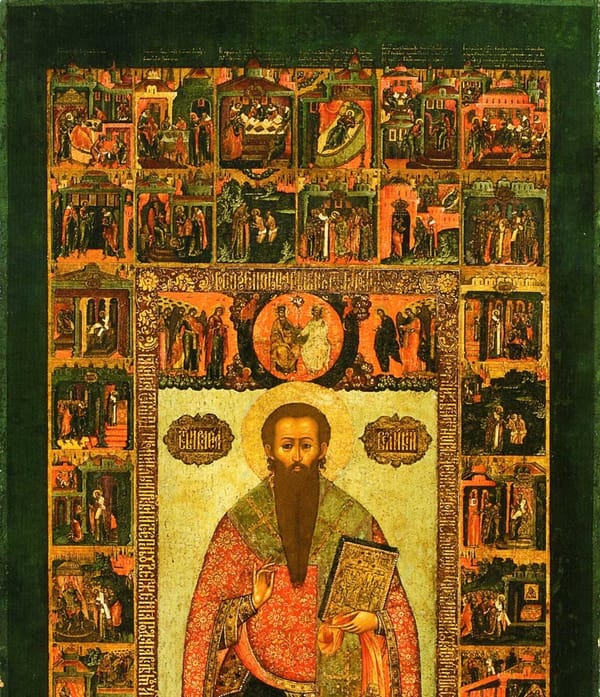 |
THE Doctors who form the fourfold glory of the Greek Church complete their sacred number in the cycle to day. John Chrysostom was the first to greet us with his radiant light during Christmastide; the glorious Pasch saw the rise of two resplendent luminaries, Athanasius and Gregory Nazianzen; Basil the Great, having checked his effulgent blaze till now, illumines the reign of the Holy Ghost. He well deserves so distinguished a place, by reason of his eminent doctrine and brave combats, which prepared the way for the triumph of the divine Paraclete over the blasphemies of the impious sect of Macedonius, who used against the third Person of the consubstantial Trinity the very same arguments invented by Arius against the divinity of the Word. The Council of Constantinople, putting the finishing stroke to that of Nicæa, formulated the faith of the Churches, in him who proceedeth from the Father, no less than doth the Word himself, who is adored and glorified conjointly with the Father and the Son.1 Basil was not there on the day of victory; prematurely exhausted by austerities and labours, he had been sleeping the sleep of peace for quite two years, when this great definition was promulgated. But it was his teaching that inspired the assembled council; his word remains as the luminous expression of tradition concerning the Holy Spirit, who is himself the divine loadstone attracting all in the vast universe that aspire after holiness, the potent breeze uplifting souls, the perfection of all things. Just as we hearkened to Gregory Nazianzen on his feast day, speaking magnificent truths concerning the great Paschal mystery, let us listen now to his illustrious friend, explaining that of the present season—sanctification effected in souls.
The union of the Holy Ghost and the soul is effected by estrangement from the passions, which having crept in had separated her from God. Whoso, therefore, would disengage himself from the deformity that proceedeth from vice, and return to that beauteousness which he holds of his Creator; whoso would restore within himself the primitive features of that royal and divine original, such a one doth verily draw nigh unto the Paraclete. But then also, even as the sun coming in contact with an unsullied eye illumines it, so the Paraclete reveals to such a one the image of him that cannot be seen; and in the blissful contemplation of this image, he perceiveth the ineffable beauty of the Principle, the Model of all. In this ascension of hearts, whereof the first tottering steps as well as the growing consummation are equally his work, the Holy Spirit rendereth them spiritual who are quit of all stain, by reason of that participation of himself into which he initiates them. Bodies that are limpid and translucent, pierced by a brilliant ray, become resplendent and shed light all around them; thus also souls bearing the Holy Spirit within them are all luminous with him, and becoming themselves spiritualized, shed grace all around. Hence the superior understanding possessed by the elect, and their converse with heaven; hence all fair gifts; hence thine own resemblance to thy God; hence, O truth sublime! thou thyself art a god.2 Wherefore it is that, properly and in very truth, by the illumination of the Holy Ghost we contemplate the splendour of God’s glory; yea, it is by the character of resemblance which he has imprinted in our soul that we are raised up even unto the loftiness of him whose full similitude he, the divine Seal, beareth with himself.3 He, the Spirit of wisdom, revealeth unto us (not as it were outside but within himself) Christ, the Wisdom of God. The path of contemplation leads from the Holy Ghost, by the Son, unto the Father; concurrently, the goodness, holiness, and royal dignity of the elect come from the Father by the Son to the Holy Ghost,4 whose temples they are; and he filleth them with his own glory, illuminating their brow with a radiance like to that of Moses at the sight of God.5 Thus likewise did he, in the case of our Lord’s humanity; thus doth he unto the Seraphim who cannot cry their triple Sanctus, save in him; so also unto all the choirs of angels, whose concerts he regulates, whose songs he vibrates.6 But the carnal man, who hath never exercised his soul in contemplation, but holdeth her captive in the mud and mire of the senses, cannot lift his eyes unto Light supernal; the Holy Spirit belongs not to him.7
The action of the Paraclete surpasses the power of any creature; therefore, in thus drawing attention to the operation of the spirit of love, St Basil is anxious to bring his adversaries to confess, of their own accord, the Divinity of the Holy Ghost. On the other hand, who can fail to recognize, in this burning exposition of doctrine, not merely the invincible theologian vindicating dogma, but, furthermore, the experienced guide of souls, the sublime ascetic, deputed by God to bring down within reach of all men such marvels of holiness as an Anthony or a Pachomius brought forth in the desert?
Even as the bee, humming amidst the flowers, avoids the thorn, and knows how to eschew empoisoned sap, so Basil in his youthful days had hovered amidst the schools of Athens and of Constantinople without sucking in aught of their poison. According to the advice he himself gave to youth at a later date in a celebrated discourse,8 his quick intelligence, unsullied by passions (too often found even in the most gifted), had succeeded in stealing from rhetoricians and poets all that could adorn as well as develop his mind, and discipline it for the struggle of life. The world smiled on the young orator, whose pure diction and persuasive eloquence recalled the palmy days of Greek literature; but the noblest gifts of glory earth could offer were far beneath the lofty ambition wherewith his soul was fired in reading the Holy Scriptures. Life's struggle, in his eyes, seemed a combat for truth alone. In himself, first of all, must divine Truth be victorious, by the defeat of nature and by the Holy Ghost's triumphant creation of the new man. Therefore, heedless to know, before God's own time, whether he might not be used in winning souls to God; never once suspecting how soon multitudes would indeed come pressing to receive the law of life from his lips, he turned his back upon all things, and fled to the wilds of Pontus, there to be forgotten of men in his pursuit after holiness. Nor did the misery of those times cause him to fall into the error, so common nowadays, of wishing to devote himself to others before having first regulated his own soul. Such is not the true way of setting charity in order; such is not the conduct of the saints. It is thyself God wants of thee before all things else; when thou hast become his, in the full measure he intends, he himself will know how to bestow thee upon others, unless perchance he prefer, for thy greater advantage, to keep thee all to himself. But in any case, he is no lover of all that hurry to become useful; he does not bless these would-be utilitarians who are all eagerness to push themselves into the service of his Providence. Anthony of Padua showed us this truth yesterday; and here we have it given to us a second time. Mark it well: that which really tends to the extension of our Lord's glory is not the amount of time given to the works, but the holiness of the worker.
According to a custom frequent in that century, owing to the fear entertained of exposing the grace of Baptism to woful shipwreck, Basil remained a simple catechumen until his youth had wellnigh matured to manhood. Of the years that followed his baptism, thirteen were spent in the monastic life and nine in the episcopate. At the age of fifty he died; but his work, carried on under the impulse of the Holy Ghost, far from dying with him, appeared more fruitful, and went on thus increasing during the course of succeeding ages.
While living the life of a humble monk on the banks of the Iris, whither his mother and sister had preceded him, his whole being was intent on the 'saving of his soul’9 from the judgement of God,10 and on 'running generously in the way that leads to the eternal recompense.’11 Later on others having begged him to form them also 'unto the warfare of Christ the King,’12 according to the simplicity of faith and the Scriptures,13 our saint would not have them embrace the life of solitaries, such isolation being not without danger for the many; but he preferred for them one that would join to the blissful contemplation of the solitary the rampart and completeness of community life, wherein charity and humility14 are exercised under the conduct of a head, who, in his turn, deems himself but the servitor of all.15 Moreover he would admit none into his monasteries without serious and prolonged trial, followed by a solemn engagement to persevere in this new life.16
At the remembrance of what he had admired amongst the solitaries of Egypt and Syria, Basil compared himself and his disciples to children who would strive in a puny way to mimic strong men; or unto beginners sticking at the first difficulties of the rudiments and scarce yet fairly started on the path of true piety.17 Yet the day would come when the ancient giants of the wilderness, and the hoary legislators of the desert, would see their heroic customs and their monastic codes cede the place of honour to the familiar conferences, to the unprepared answers given by Basil to his monks in solution of their proposed difficulties, and to form them to the practice of the divine counsels. Ere long the whole of the East ranged itself under his rule; whilst in the West St Benedict called him his father.18 His order, like a fruitful nursery of holy monks and virgins, bishops, doctors, and martyrs, has furnished heaven with saints. For a long time it served as a bulwark of the faith to Byzantium; and even of recent days it has beheld, despite the schism, its faithful children sparing not to render, under the savage persecution of the Tsar of Russia, their testimony of blood and suffering to holy mother Church.
Worthily also have they herein paid a personal testimony, as it were, to their intrepid father; for Basil too was the grandson of martyrs, the son and the brother of saints. Would that we might be allowed to devote a page to the praises of his illustrious grandmother Macrina the elder; who seems to have miraculously escaped from the hands of her executioners and from a seven years' exile in the wild forests, on purpose to be instrumental in infusing into Basil's young heart that faith firm and pure, which she had herself received from St Gregory Thaumaturgus. Suffice it to say that, towards the close of his life, the great Basil, doctor of the Church and patriarch of monks, was proud to appeal to Macrina's name as a guarantee for the orthodoxy of his faith, when this was called in question.19
Basil’s lifetime was cast in one of those periods exceptionally disastrous to the Church, when shipwrecks of faith are common, because darkness prevails to such an extent as to cast its shades even over the children of light;20 a period, in fact, when, as St Jerome expresses it, ‘the astonished world waked up, to bewail itself Arian.’21 Bishops were faltering in essentials of true belief and in questions of loyalty to the successor of Peter; so that the bewildered flock scarce knew whose voice to follow; for many of their pastors, some through perfidy and some through weakness, had subscribed at Rimini to the condemnation of the faith of Nicæa. Basil himself was assuredly not one of those ‘blind watchmen: dumb dogs not able to bark.’22 When but a simple lector, he had not hesitated to sound the horn of alarm, by openly separating himself from his bishop, who had been caught in the meshes of the Arians; and now himself a bishop, he boldly showed that he was not such indeed. For when entreated for peace' sake to make some compromise with the Arians, vain was every supplication, every menace of confiscation, exile, or death. He used no measured terms in treating with the prefect Modestus, the tool of Valens; and when this vaunting official complained that none had ever dared to address him with such liberty, Basil intrepidly replied: ‘Perhaps thou never yet hadst to deal with a bishop!’
Basil, whose great soul was incapable of suspecting duplicity in another, was entrapped by the guile of a false monk, a hypocritical bishop, one Eustathius of Sebaste, who, by apparent austerity of life and other counterfeits, long captivated the friendship of Basil. This unconscious error was permitted by God for the increase of his servant’s holiness; for it was destined to fill his declining days with utmost bitterness, and to draw down upon him the keenest trial possible to one of his mould—namely, that several, in consequence, began to doubt of his own sincerity of faith.
Basil appealed from the tongue of calumny to the judgement of his brother bishops;23 but yet he recoiled not from likewise justifying himself before the simple faithful.24 For he knew that the richest treasure of a church is the pastor’s own surety of faith and his personal plenitude of doctrine. Athanasius, who had led the battles of the first half of that century and had conquered Arius, was no more; he had gone to join, in the well-merited repose of eternity, his brave companions, Eusebius of Vercelli and Hilary of Poitiers. In the midst of the confusion that Valens’ persecution was then reproducing in the East, even holy men knew not how to weather the storm. Many such were to be seen adopting first the extreme measure of utter witdrawal, through mistaken excess of prudence; and then rushing into equally false steps of indiscreet zeal. Basil alone was of a build proportioned to the tempest. His noble heart, bruised in its most delicate feelings, had drunk the chalice to the dregs; but, strong in him who prayed the prayer of agony in Gethsemani, the trial crushed him not. With wearied soul and with a body wellnigh exhausted by the jading effects of chronic infirmities, already in fact a dying man,25 he nevertheless nerved himself up against death, and bravely faced the surging waves. From this ‘ship in distress,' as he termed the Eastern Church, ‘dashing against every rock amid the dense fog,’26 his pressing cry of appeal reached the ears of the Western Church seated in peace in her unfailing light27—reached Rome, whence alone help could come, yet whose wise slowness, on one occasion, made him almost lose heart. While awaiting the intervention of Peter's successor, Basil prudently repressed anything like untimely zeal, and, for the present, required of weak souls merely what was indispensable in matters of faith;28 just as under other circumstances, and with equal prudence, he had severely reproved his own brother, St Gregory of Nyssa, for suffering himself to be betrayed by simplicity into inconsiderate measures, motived indeed by love of peace.29
Peace is just what Basil desired as much as anybody:30 but the peace for which he would give his life could be only that true peace left to the Church by our Lord.31 What he so vigorously exacted on the grounds of faith proceeded solely from his very love of peace.32 And therefore, as he himself tells us, he absolutely refused to enter into communion with those narrow-minded men who dread nothing so much as a clear, precise expression of dogma; in his eyes their captious formulas and ungraspable shiftings were but the action of hypocrites, in whose company he would scorn to approach God's altar.33 As to those merely misled,
Let the faith of our fathers be proposed to them with all tenderness and charity; if they will assent thereunto, let us receive them into our midst; in other cases, let us dwell with ourselves alone, regardless of numbers; and let us keep aloof from equivocating souls, who are not possessed of that simplicity without guile, indispensably required in the early days of the Gospel from all who would approach to the faith. The believers, so it is written, had but one heart and one soul.34 Let those, therefore, who would reproach us for not desiring pacification, mark well who are the real authors of the disturbance, and so not point the question of reconciliation on our side any more.35
In another place he thus continues:
To every specious argument that would seem to counsel silence on our part, we oppose this other—namely, that charity counts as nothing either her own proper interests or the difficulties of the times. Even though no man is willing to follow our example, what then? Are we ourselves, just for that, to let duty alone? In the fiery furnace the children of the Babylonish captivity chanted their canticle to the Lord, without making any reckoning of the multitude who set truth aside: they were quite sufficient for one another, merely three as they were!36
He thus wrote to his monks, likewise pursued and vexed by a government that would not own itself a persecutor:
There are many honest men who, though they admit that you are being treated without a shadow of justice, still will not grant that the sufferings you are enduring can quite deserve to be called confessing the faith; ah! it is by no means necessary to be a pagan in order to make martyrs! The enemies we have nowadays detest us no less than did the idolaters; if they would deceive the crowd as to the motive of their hatred, it is merely because they hope thereby to rob you of the glory that surrounded confessors in bygone days. Be convinced of it; before the face of the just Judge, your confession is every whit as real. So take heart! under every stroke renew yourselves in love; let your zeal gain strength every day, knowing that in you are to be preserved the last remains of godliness which the Lord, at his return, may find upon the earth. Trouble not yourselves about treacheries, nor whence they come: was it not the princes among God’s priests, the scribes and the ancients among his own, that plotted the snares wherein our divine Master suffered himself to be caught? Heed not what the crowd may think, for a breath is sufficient to sway the crowd to and fro, like the rippling wave. Even though only one were to be saved, as in the case of Lot out of Sodom, it would not be lawful for him to deviate from the path of rectitude, merely because he finds that he is the only one that is right. No; he must stand alone, unmoved, holding fast his hope in Jesus Christ.37
Basil himself, from his bed of sickness, set an example to all. But what was the anguish of his soul when he realized how scant a correspondence his efforts received among the leading men in his own diocese! He sadly wondered at seeing how their ambition was in no wise quenched by the lamentable state of the Churches; how they still could listen to nothing but their own puny jealous susceptibilities, when the vessel was actually foundering; and could contend for the command of the ship, when she was already sinking.38 Others there were, even among the better sort, who would hold aloof, hoping to be forgotten in their silent inertia;39 quite ignoring that, when general interests are at stake, egotistic estrangement from the scene of struggle can never save an individual, nor absolve him from the crime of treason.40 It is curious to hear our Saint himself relating the following story to his friend Eusebius of Samosata, the future martyr: how once Basil’s death was noised abroad, and consequently all the bishops hurried at once to Caesarea to choose a successor. ‘But,’ Basil continues, 'as it pleased God that they should find me alive, I took this opportunity to speak to them weighty words. Yet vainly; for while in my presence, they feared me and promised everything; but scarce had they turned their backs, than they were just the same again.’41 In the meantime persecution was pursuing its course, and, sooner or later, the moment came for each in turn to choose between downright heresy and banishment. Many, unfortunately, consummated their apostasy; others, opening their eyes at last, took the road to exile, where they were able to meditate at leisure upon the advantages of keeping quiet and of keeping out of the struggle; or better still, where they could repair their past weakness, by the heroism wherewith they would henceforth suffer for the faith.
Basil’s virtue held even his persecutors at bay; and God preserved him in such wondrous ways, that at last he was almost the only one remaining at the head of his Church, although he had really exposed himself far more than anyone else to the brunt of every attack and to every peril. He profited hereby to the benefit of his favoured flock, upon whom he lavished the boon of highest teaching and wisest administration. This he did with such marvellous success, that so much could scarcely have been attainable by another bishop in times of peace, when exclusive attention could be devoted to those employments. Cæsarea responded splendidly to his pastoral care. His word excited such avidity amongst all classes, that the populace would hang upon his lips, and await his arrival the livelong day, in the ever more and more closely thronged edifice.42 We learn this from his remarks. For instance, once, when his insatiable audience would allow him no repose in spite of his extreme fatigue, he tenderly compares himself to a worn-out mother who gives her babe the breast, not so much to feed it as to stay its cries.43 The mutual understanding of pastor and flock in these meetings is quite delightful! If the great orator by inadvertence left some verse of Scripture unexplained, his sons, by discreet signs and half-suppressed mutterings, would recall his attention to the passage of the text, which they would not allow him to pass over in silence.44 On such occasions Basil would make charming excuses for his mistake, and then rectify it in such a way as to show that he was proud of his flock! When he was explaining, for example, the magnificence of the great ocean, amongst other wonders of the works of the six days, he suddenly paused, and casting a glance of ineffable pleasure over the vast crowd closely pressing around his episcopal chair, he thus continued: ‘If the sea is beauteous, and in God’s sight worthy of goodly praise, how far more beautiful is this immense assembly, whereof better than the waves that swell and roll and die away against the coast, the mingled voices of men, women, and children bear unto God our swelling prayer. O thou tranquil ocean, peaceful in thy mighty deep, because evil winds of heresy are impotent to rouse thy waves!’45
Happy people, thus formed by Basil to the understanding of the Scriptures, especially of the Psalms, whereof he inspired the faithful with so great love, that it was quite the custom for all to repair at night to the house of God, there in the solemn accents of alternate psalmody to pour out their souls in one united homage.46 Prayer in common was one of those fruits of his ministry which Basil, like a true monk, valued the most; the importance he attached to it has made him one of the principal fathers of the Greek liturgy. ‘Talk not to me,’ he cries out, ‘ of private homes, of private assemblies. Adore the Lord in his holy court, saith the psalmist; the adoration here called for is that which is paid not outside the Church, but in the court, the one only court of the Lord.’47
Time and space would fail us, were we to attempt to follow our saint through all the details of this grand family life which he lived so thoroughly with his whole people, and which formed his one consolation in the midst of his otherwise stormy career. It would behove us to show how he made himself all to all, in gladness and in sorrow, with a simplicity which is so admirably blended in him with lofty greatness; how he would reply to the humblest consultations, just as though he had nothing more urgent on hand than to satisfy the demands of the least among his sons; how he would cry out against every touch of injustice offered to one of his flock, and cease not till full compensation was made; and finally, how, with the aid of his faithful of Caesarea, rising up as one man to defend their bishop, he would oppose himself as a strong rampart to protect virgins and widows against the brutal oppression of men in power. Though himself poor and stripped of all things since the day when, about to enter the monastic state, he had distributed the whole of his rich paternal inheritance among the poor, he nevertheless found the secret of how to raise, in his episcopal city, an immense establishment, destined as an assured refuge for pilgrims and the poor, an asylum ever open and admirably organized to meet the requirements of every kind of suffering and the needs of all ages; or rather, a new city, built beside the great Caesarea, and named by the gratitude of the people after its sainted founder. Ever ready for any combat, Basil intrepidly maintained his rights as exarch, which he possessed by reason of his See, over the eleven provinces composing the vast administrative division known to the Romans by the generic name of the diocese of Pontus. Indefatigable in his zeal for the sacred canons, he both defended his clergy against all attempts aimed at their immunities, and reformed such abuses as had crept in during times less troubled than his own. Even in the very vortex of the storm, he knew how to bring back ecclesiastical discipline to the perfection of its best days.
At last the time came when the main interests of the faith, the perils of which seemed, up to this, to have suspended in his worn-out body the law of all flesh, now no longer demanded his presence so absolutely as before. On August 9, 378, the arrow of the Goth exercised justice on Valens; soon afterwards, Gratian's edict recalled the exiled confessors, and Theodosius appeared in the East. On January 1, 379, Basil, at last set free, slept in the Lord.
The Greek Church celebrates the memory of this great bishop on the day of his death, conjointly with the Circumcision of the Word made Flesh; and a second time, on the 30th of the same month of January, she unites him with two other doctors—namely, Saints Gregory Nazianzen and John Chrysostom—bringing all the magnificence of her gorgeous liturgy to give splendour to this grand solemnity of January 30, illumined as it is by a ‘triple sun, beaming glory concordantly to the Holy Trinity.’48 The Latin Church has chosen for her celebration of St Basil the day of his ordination, June 14.
The following is the notice she gives of his holy life:
To give thus a list of thine admirable works is in itself to sing thy praises, O mighty Pontiff! Would that nowadays thou hadst imitators; for history teaches us that saints of a build like thine are those who cause an epoch to be really great and who save society. No matter how tried, how abandoned even, a people may apparently be, if only blessed with a ruler docile in all things, docile unto heroism, to the inspirations of the Holy Ghost ever abiding in holy Church, this people will assuredly weather the storm and conquer at last; whereas, if the salt lose its savour,49 society necessarily falls away, without the need of any Julian or of any Valens to bring about its ruin. O Basil, do thou then obtain for our waning society leaders such as thou wert; may the astonishment of Modestus be justly renewed in these days; let prefects, Valens' successors, meet at the head of every church a bishop in the full sense of the term as used by thee; then will their astonishment be for us a signal of victory; for a bishop is never vanquished, even should he be exiled or put to death!
Whilst keeping up the pastors of the Church to the high standard of the state of perfection in which the sacred unction supposes them to be, lead the flock, likewise, to higher paths of sanctity, such as Christianity gives scope for. Not to monks alone is that word spoken: The kingdom of God is within you.50 Thou hast taught us that the kingdom of heaven,51 that beatitude which can be ours already, is the contemplation, accessible to us here below, of eternal realities, not indeed by clear and direct vision, but in that mirror whereof the apostle speaks. How foolish is it to cultivate and feed in man naught but the senses that crave for the material alone, and to refuse to the spirit its own proper food and action! Does not the spirit urge of its own nature towards intellectual regions for which it is created? If its flight be slow and heavy, the reason is that the senses, by prevailing, impede its ascent. Teach us, therefore, to furnish it more and more with increased faith and love, whereby it may become light and agile as the hart, to leap unto loftiest heights. Tell in our age, as thou didst formerly in thine, that forgotten truth—namely, how earnestness in maintaining an upright faith is no less necessary for this end than rectitude of life. Alas! how far have thy sons, for the greater part, forgotten that every true monk as well as every true Christian detests heresy, and all that savours thereof!52 Wherefore, dear saint, bless all the more particularly those few whom such a continuity of trials has, as yet, failed to shake in their constancy; multiply conversions; hasten the happy day when the East, casting off the yoke of schism and Islam, may resume her former glorious place in the one fold of the one Shepherd.
O doctor of the Holy Ghost, O defender of the Word, consubstantial with the Father, grant that we, now prostrate at thy feet, may ever live to the glory of the Holy Trinity. These are the words of thine own admirable formulary, ‘To be baptized in the Trinity, to hold one's belief according to one’s Baptism, to glorify God according to our faith’—such was the essential basis, set down by thee, for what a monk should be;1 but is it not equally essential to a Christian? Would that all might thoroughly understand this! Vouchsafe, dear saint, to bless us all.
- Symb. Constantinop. ↩︎
- Basil. Lib. de Sp. Sancto ix. ↩︎
- Ibid. xxvi. ↩︎
- Basil. Lib. de Sp. Sancto xviii. ↩︎
- Ibid. xxi. ↩︎
- Ibid. xvi. ↩︎
- Ibid. xxii. ↩︎
- De legend. libris gentil. ↩︎
- Sermo ascetic. ↩︎
- Proœm. de judicio Dei. ↩︎
- Prævia instit. ascetica. ↩︎
- Ibid. ↩︎
- De fide; Moralia. ↩︎
- Reg. brev. tractatæ, 160 etc., 114 etc. ↩︎
- Reg. fus. tract. 30. ↩︎
- Ibid. 10; Epist. 23, al. 383; 199, al. 2, can. xviii, xix. ↩︎
- Epist. 207, al. 63. ↩︎
- S. P. Bened. Reg., cap. lxxiii. ↩︎
- Epist. 204, al. 75; 223, al. 79. ↩︎
- 1 Thess. v 5. ↩︎
- Hieron. Dial. cont. Lucif. ↩︎
- Isa. lvi 10. ↩︎
- Epist. 203, al. 77. ↩︎
- Ibid. 204, al. 75, etc. ↩︎
- Epist. 136, al. 257. ↩︎
- Lib. de Sp. S. xxx. ↩︎
- Epist. 91, al. 324; 92, al. 69, etc. ↩︎
- Ibid. 113, al. 203. ↩︎
- Ibid. 58, al. 44. ↩︎
- Ibid. 259., al. 184. ↩︎
- Ibid. 128, al. 365. ↩︎
- Ibid. ↩︎
- Ibid. ↩︎
- Acts iv 32. ↩︎
- Epist. 128, al. 265. ↩︎
- Lib. de Sp. S. xxx. ↩︎
- Epist. 257, al. 303. ↩︎
- Epist. 141, al. 262. ↩︎
- Lib. de Sp. S. xxx. ↩︎
- Ibid. 136, al. 257. ↩︎
- Epist. 141, al. 262. ↩︎
- Homil. in Ps. cxiv. ↩︎
- In Ps. lix. ↩︎
- Hom, viii in Hexæmeron. ↩︎
- In Hexæm. ↩︎
- Epist. 207, al. 63. ↩︎
- In Ps. xxviii. ↩︎
- Acolothia triplicis festi. ↩︎
- St Matt. v 13. ↩︎
- St Luke xvii 21. ↩︎
- Basil Epist. 8, al. 111. ↩︎
- Sermo de ascetic, discipl. Quomodo mouachum ornari oporteat. ↩︎
| Previous June 13: St. Anthony of Padua, Confessor | Next June 14: St. Basil the Great, Bishop and Doctor of the Church |