Daily reading
After Pentecost
Double of the II Class · Movable from Easter · Temporal
July 2, 2023
From Dom Guéranger’s The Liturgical Year.

|
The Fifth Sunday after Pentecost
This Sunday, which, with the Greeks, is called the fifth of St. Matthew, was known by the Latins as the Sunday of the fishing; such was its name up to the time when the Church transferred to the previous Sunday the Gospel which suggested that title. The week which it commences is, in some ancient lectionaries, called the 'first after the feast of the apostles' or of St. Peter; in others it is the second or third after the same feast; these, and similar varieties of names, which it is no rare thing to find in the liturgical books of the Middle Ages, are due to the fact that Easter was kept earlier or later in the years when those books were written.
The Church began last night the reading of the second Book of Kings, which opens with the description of Saul's sad end and David's accession to the throne of Israel. The exaltation of Jesse’s son is the climax to the prophetic life of the ancient people. In David God had found His faithful servant,1 and He resolved to exhibit him to the world as the most perfect figure of the future Messiah. A solemn promise of Jehovah assured the new monarch as to the future of his race; his throne was to be everlasting,2 for at some future day it was to be the throne of Him who should be called the Son of the Most High, though, at the same time, He was to be Son of David.3
But whilst the tribe of Juda was hailing in Hebron the king elected by the Lord, there were dark clouds on the horizon. In her Vespers of yesterday the Church sang, as one of her finest antiphons, the funeral ode which inspiration dictated to David when he saw the regal crown that had been picked up from the dust and gore of the battlefield, whereon had fallen the princes of Israel: 'Ye mountains of Gelboe, let neither dew nor rain come upon you, for there was cast away the shield of the valiant, the shield of Saul, as though he had not been anointed with oil. How are the valiant fallen in battle! Jonathan slain on the high places! Saul and Jonathan exceedingly lovely and comely in their life; even in death they were not divided.'4
The proximity of the great solemnity of the apostles, June 29, to the Saturday when this antiphon is sung, has suggested to the Church to apply its last words to Saints Peter and Paul, during the octave of their feast : ‘Glorious princes of the earth! as they loved each other in their life, so even in their death they were not divided!'5 Like the Hebrew people at this period of their history, our Christian armies have often had to hail the accession of a king on the field reddened with the blood of his predecessor.
Mass
As on last Sunday, so again to-day, the Church seems to unite together the readings of the previous night and the solemn entrance of the sacrifice. The Introit for this fifth Sunday is taken from Psalm xxvi., which was composed by David on occasion of his coronation in Hebron. It expresses the humble confidence of him who has nothing here below to trust in; and yet he has the Lord as his light and salvation. In the events just referred to, nothing less than a blind faith in God's promises could have kept up the courage of the young shepherd of Bethlehem, and nothing less could have inspired the people who had made him their king. But we must see beyond this; we must understand that the kingship of Jesse's son and his descendants, in the ancient Jerusalem, represents, for our mother the Church, a grander royalty, and a more lasting dynasty—the kingship of Christ and the dynasty of the sovereign Pontiffs.
Introit
The blessings promised to David as recompense for his combats were but a poor figure of those which await in heaven the vanquishers of the world, the flesh, and the devil. They are to be kings for ever; on their thrones, they are to enjoy the fullness of those inebriating and heavenly delights, some drops of which are permitted by the divine Spouse to be tasted, here below, by souls that are faithful to Him. Let us, therefore, love Him, who thus recompenses our love; and since, of ourselves, we can do nothing, let us, through the Spouse, ask the giver of every best gift6 to bestow on us the perfection of divine charity.
Collect
The other Collects, as given above, in the Mass of the fourth Sunday, page 120.
Epistle
1 Cap. iii.Charissimi. Omnes unanimes in oratione estote, compatientes, fraternitatis amatores, misericordes, modesti, humiles: non reddentes malum pro malo, nec maledictum pro maledicto, sed e contrario benedicentes : quia in hoc vocati estis, ut benedictionem hereditate possideatis. Qui enim vult vitam diligere, et dies videre bonos, coerceat linguam suam a malo, et labia ejus ne loquantur dolum. Declinet a malo, et faciat bonmn: inquirat pacem, et sequatur eam. Quia oculi Domini super justos, et aures ejus in preces eorum : vultus autem Domini super facientes mala. Et quis est qui vobis noceat, si boni æmulatores fueritis? Sed et si quid patimini propter justitiam, beati. Timorem autem eorum ne timueritis, et non conturbemini. Dominum autem Christum sanctificate in cordibus vestris.
1 Ch. iii.Dearly beloved : Be ye all of one mind, having compassion one ofanother, being lovers of the brotherhood, merciful, modest, humble : not rendering evil for evil, nor railing for railing, but contrariwise, blessing : for unto this are you called, that you may inherit a blessing. For, he that will love life, and see good days, let him refrain his tongue from evil, and his lips that they speak no guile. Let him decline from evil, and do good: let him seek after peace, and pursue it : because the eyes of the Lord are upon the just, and his ears unto their prayers; but the countenance of the Lord upon them that do evil things. And who is he that can hurt you, if you be zealous of good? But if also you suffer any thing for justice' sake, blessed are ye. And be not afraid of their fear, and be not troubled. But sanctify the Lord Christ in your hearts.
The Gospel of last Sunday showed us the apostles gathering into their net the mystic fish, which represented the chosen souls called into the union of the Church. To-day we must look upon the faithful as the living stones of which that Church is built; for we are listening to the words of Peter, who is the rock and the foundation-stone. The Son of God came down from heaven for no other purpose than to found on earth a glorious city, in which God Himself might delight to dwell;7 He came, that He might build for His Father a temple of matchless beauty, where praise and love, ceaselessly sounding from the very stones which form its walls, might worthily proclaim it to be the sanctuary of the great sacrifice. He became Himself the foundation of the thrice holy structure, wherein was to burn the eternal holocaust.8 He communicated this character of foundation of the new temple to Simon, His vicar;9 and by giving him the name of Peter or rock. He as good as told all future generations, what was the one aim of all His divine labours, viz., to build, here on earth, a temple worthy of His eternal Father. Let us, with respectful gratitude, receive from this vicar of the Man-God the practical lessons which are involved in this master-truth. And, as we are just now in the period of the year when the calendar brings the prince of the apostles into such welcome prominence, let us be led by the Church nearer and nearer to this shepherd and bishop of our souls.10
Union of true charity, concord, and peace, which must, at every cost, be kept up as the condition for their being happy both now and for ever—such is the substance of the instructions addressed by Simon, now Peter, to those other chosen stones, which rest upon him, and constitute that august temple to be presented by the Son of Man to the glory of the Most High. Do not the solidity and duration of even earth’s palaces depend on the degree of union between the materials used in their structure? Again, it is union which gives strength and beauty to all the parts of this immense universe; let there be a cessation of that mutual attraction which combines them together in one harmonious whole, let there be a suspension of that cohesion which holds their atoms together, and the whole universe will return to dust. The Creator hath made peace in His high places;11 so that He asks: ‘Who can make the harmony of heaven to sleep?'12 And yet, as the earth, in its present condition, is to have an end, so, too, the heavens are to pass away as some worn-out garment.13 What, then, will be the cause of the stability, what the cement which is to hold together the house prepared for God to dwell in, which, when all else has crumbled into change, is to be ever the same? And that dwelling is the Church; the dwelling of the adorable Trinity, up to whose throne the fragrance which exhales from her divine Spouse will ascend for all eternity.
Here again it is the holy Spirit who must explain to us the mystery of this union, which makes up the holy city,14 and which is to last as long as eternity itself. The charity which is poured forth into our hearts at the moment of our Baptism is an emanation of the very love that reigns in the bosom of the blessed Trinity; for the workings of the holy Spirit in the saints have this for their aim : to make them enter into a participation in the divine energies. Having become the life of the regenerate soul, the divine fire penetrates her whole being with God, and communicates, to her created and finite love, the direction and the power of the flame that is everlasting and divine. So that, henceforward, the Christian must love as God loves; his charity is then only what it should be, when it takes in everything that God loves. Now, such is the ineffable friendship established by the supernatural order between God and His intellectual creatures, that He vouchsafes to love them with the love wherewith He loves Himself; and therefore, our charity should include and embrace, not only God Himself, but, moreover, all those beings whom He has called to share, if they will, in His own infinite happiness. This will give us to understand the grandeur and incomparable power of the union, in which the Holy Ghost has established the Church. We are not surprised that its bonds should be stronger than death, and its cohesion be proof against all the power of hell;15 for the cement, which joins the living stones of its walls together, partakes of the strength of God Himself, and imitates the stability of His eternal love. The Church is truly that tower built on the waters, which was shown to Hermas; it was formed of brightly polished stones, so closely joined one to the other that the eye could not perceive the joints.16
But let us also understand the importance and the necessity of mutual union for all Christians. There must be among them that love of the brotherhood which is so frequently and so strongly recommended by the apostles, the co-operators of the Spirit in the building up of the Church. The keeping aloof from schism and heresy, of whose terrible consequences we were told in last Sunday's Gospel; the repression of hatred and jealousy; no, these are not enough to make us become useful members of the Church of Christ : we must, moreover, have a charity which is effective, and devoted, and persevering, and brings all souls and hearts into true union and harmony; a charity, which, to be worthy of the name, must be warm-hearted and generous, for it must make us see God in our fellowmen, and that will bring us to look upon their happiness or misfortunes as though they were our own. We must have none of that phlegmatic egotism which finds satisfaction in never putting itself out of the way for anybody. Hateful as such a temperament is, it is far from being a rare one. It holds this peculiar view about charity, that the best way of observing it is to have a complete indifference for those who live with us! Souls of this stamp, it is evident, are not bedded in the divine cement; you could never make them part of the holy structure; the heavenly builder is compelled to reject them as unfit, or leave them to lie around the walls, a heap of unemployed material, which refused all adaptation, and all shaping to the general plan. If the building be finished before they have made up their minds not to be rubbish, woe to them! When it is too late, they will open their eyes, and understand that charity is one; so that, he does not love God who does not love his neighbour,17 and he who does not love, abideth in death.18 Let us, therefore, as St. John counsels us, measure the perfection of our love for God by the love we have for our neighbours : then only shall we have God abiding within us;19 then only shall we be enabled to enjoy the unspeakable mysteries of divine union with Him, who only unites Himself with His elect, in order to make both them and Himself one magnificent temple to the glory of His Father.
The Gradual, recurring to the ideas which inspired the Introit, implores the divine protection in favour of the people, who have the Lord’s anointed as their King. The Alleluia-versicle proclaims His victories, and the salvation which He brought to this our earth.
Gradual
Gospel
Cap. v.In illo tempore : Dixit Jesus discipulis suis : Nisi abundaverit justitia vestra plusquam scribarum et pharisæorum, non intrabitis in regnum cœlorum. Audistis quia dictum est antiquis : Non occides; qui autem occiderit, reus erit judicio. Ego autem dico vobis: quia omnis, qui irascitur fratri suo, reus erit judicio. Qui autem dixcrit fratri suo : Raca, rous erit concilio. Qui autem dixerit : Fatue, reus erit gehennae ignis. Si ergo offers munus tuum ad altare, et ibi recordatus fueris quia frater tuus habet aliquid adversum te; relinque ibi munus tuum ante altare, et vade prius reconciliari fratri tuo; et tunc veniens offeres munus tuum.
Ch. v.At that time : Jesus said to his disciples : Unless your justice abound more than that of the scribes and pharisees, you shall not enter into the kingdom of heaven. You have heard that it was said to them of old : Thou shalt not kill. And whosoever shall kill, shall be in danger of the judgment. But I say to you, that whosoever is angry with his brother, shall be in danger of the judgment. And whosoever shall say to his brother, Raca, shall be in danger of the council. And whosoever shall say, Thou fool, shall be in danger of hell fire. If, therefore, thou offer thy gift at the altar, and there remember that thy brother hath any thing against thee; leave there thy offering before the altar, and go first to be reconciled to thy brother : and then coming thou shalt offer thy gift.
The last days of the ancient Jerusalem are fast drawing to their close. In less than a month, we shall witness the frightful ruin of the city, that knew not the time of her Lord’s visitation.20 It is on the ninth Sunday after Pentecost, during these months of July and August, in which the armies of Vespasian beheld the destruction of Jerusalem, that the sacred liturgy commemorates the fulfilment of our Redeemer’s prophecies. During the intervening years, the ancient temple is still there, with its inner doors closed against all Gentiles. It gives out that, as of old, so now, it holds the Divinity beneath the veils of the old Testament, screening off, even from the children of Israel, its impenetrable Holy of holies. And yet, the five weeks we have had since Pentecost have shown us how gloriously the Church has been begun on Mount Sion. There, fronting the temple of the restricted and imperfect covenant of Sinaï, the holy Spirit has founded the Church, making her the place where all the nations of earth are to meet in gladness;21 she is the city of the great King, where all men shall henceforth live in the knowledge of God;22 and, from the very first moment of her existence, she has been showing herself to us as the abode where eternal Wisdom has made it His delight to dwell;23 she has proved herself to be the true Holy of holies, wherein God and we are to be brought into union.
The law of fear and bondage24 is, therefore, for ever abrogated by the law of love. A lingering remnant of regard for the once approved institution, which was the depository of divine revelations,25 permits the first generation of Jewish converts to observe, if it so please them, the practices of their forefathers; but the permission is to cease with the tempie, whose approaching destruction is to bury the Synagogue for ever. And even now, before that period of destruction, the prescriptions of the Mosaic law are insufficient to justify the sons of Jacob before God. The ritual ordinances, which aimed at keeping up the expectation of the future sacrifice by a ceremonial code of figurative representations, have become useless, now that the mysteries they foreshadowed have been accomplished. The very commandments of the Decalogue—those necessary commandments, which belong to all times and can never undergo change, because they pertain to the essence of the ties existing between creatures and their Creator — even these holy commandments have acquired such additional splendour from the teachings of Jesus, the Sun of all justice, that man's conscience now finds in them an almost immeasurable increase of moral responsibility and loveliness.
Independently of the positive precept concerning the fruit of the tree of knowledge, man had received from God, while yet in Eden, the knowledge of those eternal laws; they were written in the life there bestowed upon him. From that moment forward he would have to cease being a man before he could entirely divest himself of, or lose, that infused knowledge; for it had been given to him as part of his being, as the natural law of his practical judgments, and was thus, to a certain extent, identified with his reason. But man's reason having become greatly obscured by the fall, his soul had no longer the full and clear notion it previously had of the moral obligations resulting from his own nature as man. His will, too, was a sufferer by the same fall: it became depraved; it used the original weakness of reason as an excuse for its own malice; and that malice did but thicken the darkness which covered its own excesses. Voluntary or heedless victims of error, the Gentiles were seen adapting their conduct to false maxims, which were, at times, so contrary to the first principles of morality, that we who enjoy the blessings of faith can scarcely believe that men could ever be so wicked. Even the descendants of the Patriarchs, though singularly preserved through the benediction given by God to their fathers, were by no means free from the general corruption. When Moses, sent as he was by God, formed them into a nation, whose constitution was fidelity to that written law which was to restore the law of nature, several points had to be left unmentioned which, according to our Lord's expression, the hardness of Jewish hearts would never have taken in. After Moses' death, self-constituted teachers and peculiar sects rose up in the nation, and, by the aid of absurd traditions and false interpretations, corrupted the spirit, yea, at times the very letter, of the law of Sinaï.
The Jews looked upon the Law of God as the Magna Charta of their nation; as such, it was put under the protection of the civil power; various tribunals, with more or less of executive authority according to the importance of the cases that had respectively to be brought before them, were to pass sentence on the infractions committed, or the crimes perpetrated, against it. But—with the single exception of the sacred tribunal established under the law of grace, wherein God Himself acts and speaks in the person of the priest — every judgment passed by men, be their authority never so imposing, can only deal with exterior facts : so that Moses, in the legislative code he had drawn up, assigned no penalty for interior sins. These, however grievous they may be, are essentially beyond both the appreciation and cognizance of society and the human powers which govern it. Even now, under the new Law, the Church does not inflict her censures on interior faults, unless they be made manifest by some act which comes under the senses; just as Moses had done, who, whilst acknowledging the culpability of criminal thoughts or desires, yet left to God’s judgment what He alone can know.
But whereas every Christian child knows that a wicked thought or desire is unlawful, it was not so with the mass of the Hebrew people. The prophets were ever striving to get this privileged but grovelling race to raise their thoughts above this presentlife; and even supposing that much to be gained, there still remained the narrow-minded Jewish notion, that beyond the divinely inspired principles of its political constitution and the outward form of its legislation there was nothing worthy of their attention; they would have scouted the idea that there was a spiritual reality, of far greater and deeper importance, underlying the external code. We see all this strongly marked by what took place shortly after the return from captivity; the last prophets had disappeared, and free scope was given to doctrinal systems which fostered short-sighted theories. The Jewish casuists were not slow in drawing up their famous formula, that all moral goodness was guaranteed to him that had received circumcision! St. Paul, later on, told them how such a principle was a stumbling-block to the Gentiles, leading them to blaspheme the name of God.26 According to the moral theology of those Hebrew doctors, conscience meant only what the tribunal of public justice issued as its decisions; the obligations of the interior tribunal of a man's conscience were to be restricted to the rules followed by the assize-courts. The result of such teaching soon showed itself : the only thing people need care for was what was seen by men; if the fault were not one that human eyes could judge of, you were not to trouble about it. The Gospel is filled with the woes uttered by our Lord against these blind guides, who taught the souls they professed to direct how best to smother law and justice and love under the outward cover of the letter. Jesus never lost an opportunity of denouncing, and castigating, and holding up to execration, those hypocritical scribes and pharisees who took such pains to be ever cleaning the outside of the dish, but within were lull of impurity, and murder, and rapine.27
The divine Word, who Lad come down from heaven to sanctify men in truth, that is, in Himself,28 had to make this His first care : to restore what time had tarnished, to restore all the original brightness to the changeless principles of justice and right, which rest in Him as in their centre. No sooner had He called disciples around Him, and chosen twelve out of their number as apostles, than He began, with all possible solemnity, His divine work of moral restoration. The passage from the Sermon on the Mount, which the Church has selected for the Gospel of this fifth Sunday, follows immediately after His declaring that he had come, not to find fault with, or to destroy, the Law,29 but to restore it to its true meaning, of which the scribes had deprived it. He had come that He might give it all the fullness, which the very contemporaries of Moses were too hard to take in. One should read the whole chapter of St. Matthew from which our Gospel is taken; the explanations we have been giving will make it easily understood.
In the few lines put before us to-day by the Church, our Lord tells us not to make human tribunals the standard of the justiceneeded for entering into the kingdom of heaven. The Jewish law brought a man who was guilty of murder before the criminal court of judgment; and He, the master and author of the law, declares to us, that anger, which is the first step leading to murder, even though it lurk in the deepest recesses of the conscience, may bring death to the soul; and thus really incur, in the spiritual order, the capital punishment which human tribunals reserve to actual murder. If, without going so far as to strike the offender, our anger should vent itself in insulting language, such as worthless wretch (which in Syriac is Raca), the sin becomes so serious that, weighed in the balance of its real guilt as known by God, it would be a case, not of the ordinary criminal jurisdiction, but of the highest council of the nation. If the angry man pass from insulting to injurious language, there is no human tribunal which, be it as severe as it can be in its verdict, can give us an idea of the enormity of the sin committed. But the authority of the sovereign Judge is not, like that of a human magistrate, confined within certain limits; when fraternal charity is outraged, there is an avenger who will demand justice beyond the grave. Such is the importance of holy charity, which God demands should unite all men together! And so directly opposed to God's design is the sin, which, in whatever degree, endangers or troubles the union of the living stones of the temple, which has to be built up in concord and love here below, to the glory of the undivided and tranquil Trinity!
The longer it lives, the better does the chosen people appreciate and understand its happiness in having chosen real and solid goods for its inheritance. With its royal model, David, it sings, in the Offertory, the heavenly favours and the uninterrupted presence of God, who has vouchsafed to make Himself its support.
Offertory
In the Secret, let us beseech God graciously to receive the offering of our hearts, as He used to receive the offerings made to Him by the people of old. But if we would have this prayer of ours to be heard, we must remember the command given to us at the close of to-day's Gospel: God will not accept the hearts of those who are not—at least, as far as lies in their power—in peace with all men.
Secret
The other Secrets as on page 130.
The consoling presence of Goa, gratefully acknowledged in the Offertory anthem, was not the furthest condescension which God could bestow on His faithful ones. Won over by His inmute love in the ineffable union of the sacred mysteries, His people desire nothing, and ask for nothing, but that they may be permitted to fix their eternal abode in the house of the Lord.
Communion
The effects of the sacred mysteries are manifold : they cleanse the deepest recesses of our soul, and protect us externally, by enabling us to shun the snares laid for us along the path of life.
Postcommunion
The other Postcommunions as on page 131.
Vespers
The psalms, capitulum, hymn, and versicle, as above, pages 71-81.
Antiphon of the Magnificat
- Ps.lxxxviii. 21. ↩︎
- Ibid. 36-38. ↩︎
- St. Luke i. 32. ↩︎
- 2 Kings i. 21, 23, 25. ↩︎
- Ant. Oct. Apost. ad Benedictus. ↩︎
- St. James i. 17. ↩︎
- Apoc. xxi. 2, 3. ↩︎
- 1 St. Pet. ii. 4-7. ↩︎
- St. Matt. xvi. 18. ↩︎
- 1 St. Pet. ii. 25. ↩︎
- Job xxv. 2. ↩︎
- Ibid. xxxviii. 37. ↩︎
- Ps ci. 26-28. ↩︎
- Ps. cxxi. 3. ↩︎
- Cant. vili. 6. ↩︎
- Herm., Past. l. i; Visio, iii. 2. ↩︎
- 1 St John iv. 21. ↩︎
- Ibid. iii. 14. ↩︎
- Ibid. iv. 12. ↩︎
- St. Luke xix. 44. ↩︎
- Ps. xlvii. 8. ↩︎
- Jer. xxxi. 34. ↩︎
- Prov. viii. 31,ix.1. ↩︎
- Rom. viii. 15. ↩︎
- Ibid. iii 2. ↩︎
- Rom. ii 24. ↩︎
- St. Matt. xxii., etc. ↩︎
- St. John xvii. 17, 19. ↩︎
- St. Matt. v. 17. ↩︎
July 2: The Visitation of the Blessed Virgin Mary
|
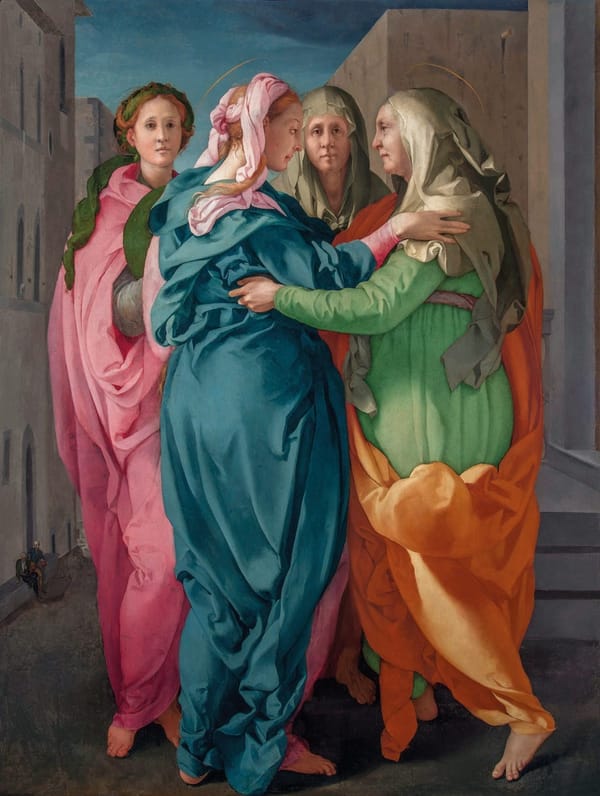
OUR Lady's visit to her cousin Elizabeth already engaged our attention whilst we were preparing for the Christmas festival. But it is only fitting to return again to an event so important in our Lady’s life; the mere commemoration of this mystery made on Ember Friday in Advent would be insufficient to bring forward all it contains of deep teaching and holy joy. Since in the course of centuries the holy liturgy has been gaining more and more completeness, it is but natural that this precious mine should come to be further opened in honour of the Virgin Mother. The Order of St Francis, it would seem, as well as certain particular churches, such as Rheims and Paris for example—had already taken the initiative, when Urban VI, in 1389, instituted to-day's solemnity. The Pope counselled a fast on the vigil of the feast, and ordered that it should be followed by an octave; he granted for its celebration the same indulgences as Urban IV had, in the previous century, attached to the festival of Corpus Christi. The Bull of promulgation, stopped by the Pontiff's death, was again taken up and published by Boniface IX, his successor on the Chair of Peter.
We learn from the lessons of the Office formerly composed for this feast, that the object of its institution was, as Urban conceived it, to obtain the cessation of the schism then desolating the Church. The Papacy, exiled from Rome for seventy years, had barely re-entered it, when hell, infuriated at a return which crossed all its plans, had taken revenge by ranging under two leaders the flock of the one sheepfold, So deep was the obscurity wherewith miserable intrigues contrived to cover the authority of the legitimate shepherd, that numbers of churches, in all good faith, began to hesitate, and ended at last in preferring the deceptive staff of a hireling. Thicker yet was the darkness to grow, till night should be so dense, that for a moment the conflicting mandates of three Popes would simultaneously spread through the world; whilst the faithful, struck with stupor, would be at an utter loss to discern accurately which was the voice of Christ's true Vicar. Never had the bride of the Son of God been in a more piteous situation. But our Lady, to whom the true Pontiff had turned at the first rising of the storm, did not betray the Church's confidence. During all those years whilst the unfathomable justice of the Most High let the powers of hell hold sway, she stood for the defence of holy Church, trampling the head of the old serpent so thoroughly under her victorious foot, that in spite of the terrific confusion he had stirred up, he was unable to sully the faith of the people. Their attachment was steadfast to the unity of the Roman See, whosoever might be, in this uncertainty, its veritable occupant. Thus the West, divided in fact, but in principle ever one and undivided, reunited herself spontaneously as soon as God's moment came for the return of light. The hour having arrived for the Queen of saints to assume the offensive, she would not content herself with merely re-establishing at its former post the army of the elect; Satan now must expiate his audacity by being forced to yield back to holy Church those conquests which for centuries had seemed his for ever. The dragon still raged at Basle, when Florence already beheld the heads of Greek schism, the Armenians and the Ethiopians, the cavillers of Jerusalem, of Syria and of Mesopotamia, all compensating by their unhoped-for adhesion to the Roman Pontiff for the anguish just suffered in the West.
It was now to be shown that such a return of nations, in the very midst even of the tempest, was indeed the work of her who had been called upon by the pilot, half a century before, to succour the bark of Peter. Even they of the factious assembly of Basle gave proof of this, in a way which has unfortunately been too much overlooked by historians who undervalue the high importance that liturgical facts hold in the history of Christendom. When about to separate, these last abettors of the schism devoted the forty-third session of their pretended council to the promulgation of this feast of the Visitation, in the establishment of which Urban VI had, from the outset, placed all his hopes. Notwithstanding the resistance of some of the more obstinate, the schism may, from that hour, be said to have ended. The storm was subsiding; the name of Mary, invoked thus by both sides, shone resplendent as the sign of peace amidst the clouds,1 even as the rainbow in its sweet radiance unites both extremities of the horizon. ‘Look upon it,’ says the Holy Ghost, ‘and bless him that made it: it is very beautiful in its brightness. It encompasseth the heaven about with the circle of its glory: the hands of the Most High have displayed it.’2
But, it may be asked, why was the feast of the Visitation specially chosen, more than any other, as the monument of restored peace? The answer seems to be suggested in the very nature of the mystery itself and in the manner of its accomplishment.
Here, more particularly, does Mary appear as the Ark of the Covenant, bearing within her the Emmanuel, the living testimony of a more true reconciliation, of an alliance more sublime between earth and heaven, than that limited compact of servitude entered into between Jehovah and the Jews, amidst the roar of thunder. By her means, far better than through Adam, all men are now brethren; for he whom she hides within her is to be the first-born of the great family of the sons of God. Scarcely is he conceived than there begins for him the mighty work of universal propitiation. Arise, then, O Lord, thou and the Ark which thou hast sanctified,3 whence thine own sanctity will pour down upon the earth! During the whole of her rapid passage from Nazareth to the mountains of Judea, she shall be protected by wings of Cherubim jealously eager to contemplate her glory. Amidst his truest warriors, amidst Israel's choirs of singing men, David conducted the figurative Ark from the house of Aminadab to that of Obed-edom;4 but better far is the escort deputed by the eternal Father for this sacred Ark of the new Covenant, troops of the noblest princes of the heavenly phalanx.
Favoured with benediction was that Levite’s house, while for three months it sheltered the Most High hidden on the golden propitiatory: more favoured still the home of the priest Zachary, harbouring, for the same lapse of time, eternal Wisdom enshrined in the virginal womb, wherein that union, so desired by his love, had just been accomplished. Yet beneath Zachary's roof, blessed as it was, the enemy of God and man was still holding one captive: the angelic embassy that had announced John's miraculous conception and birth could not exempt him from the shameful tribute that every son of Adam must pay to the prince of death, on entering into this life. As formerly at Azotus, so now Dagon may not remain standing erect in face of the Ark.5 Mary appears, and Satan, at once overturned, is subjected to utter defeat in John's soul, a defeat that is not to be his last; for the Ark of the Covenant will not stay its victories till the reconciliation of the last of the elect be effected.
Let us, then, hail this day with songs of gladness: for this mystery contains the germ of every victory gained by the Church and her sons: henceforth the sacred Ark is borne at the head of every combat waged by the new Israel. Division between man and his God is at an end, between the Christian and his brethren! The ancient Ark was powerless to prevent the division of the tribes; henceforth if schism and heresy do hold out for a few years against Mary, it shall be but to evince more fully her glorious triumph at last. In all ages, because of her, even as to-day under the eyes of the enemy now put to confusion, little ones shall rejoice, all shall be filled with benediction, and Pontiffs shall be perfected.6 Let us join the tribute of our songs to John’s exulting gladness, to Elizabeth’s sudden exclamations, to Zachary’s canticle; therewith let earth re-echo! Thus in bygone days was the Ark hailed as it entered the Hebrew camp. Hearing their shout, the Philistines learned that help had come from the Lord; and, seized with terror, they groaned aloud saying: 'Woe to us; for there was no such great joy yesterday and the day before: woe to us!’7 Verily this day the whole human race, together with John, leaps for joy and shouts with a great shout; verily this day has the old enemy good reason to lament: the heel of the woman,8 as she stamps him down, makes his haughty head to wince for the first time: and John, set free, is hereby the precursor of us all. More happy are we, the new Israel, than was the old, for our glory shall never be taken away; never shall be wrested from us that sacred Ark which has led us dry-shod across the river,9 and has levelled fortresses to the dust at its approach.10
Justly then is this day, whereon an end is put to the series of defeats begun in Eden, the day of new canticles for a new people! Yet who may intone the hymn of triumph but she to whom the victory belongs?‘Arise,arise, O Debbora, arise; arise and utter a canticle.11 The valiant men ceased and rested in Israel, until Mary arose, the true Debbora, until a mother arose in Israel.12 It is I, it is I,’ saith she, 'that will sing to the Lord. I will sing to the Lord the God of Israel.13 O magnify the Lord with me, as saith my grandsire David, and let us extol his Name together.14 My heart hath rejoiced, like that of Anna, in God my Saviour.15 For even as in his handmaid Judith, by me he hath fulfilled his mercy,16 so that my praise shall not depart out of the mouth of men who shall be mindful of the power of the Lord for ever.17 For mighty is he that hath done great things in me;18 there is none holy as he.19 Even as by Esther, he hath throughout all generations saved those who feared him;20 in the power of his arm,21 he hath turned against the impious one the projects of his own heart, driving proud Aman out of his seat and uplifting the humble; the bow of the mighty is overcome, and the weak are girt with strength; the abundance of them that were rich hath passed to the hungry, and they are filled;22 he hath remembered his people, and hath had pity on his inheritance.23 Such, indeed, was the promise that Adam received and our fathers have handed down unto us: and he hath done to them even as he had promised.’24
Daughters of Sion and all ye who groan in the thraldom of Satan, the hymn of deliverance has sounded in our land! Following in her train, who beareth within her the pledge of alliance, let us form into choirs; better than Mary, Aaron’s sister, and by yet juster title, she leads the concerts of Israel.25 So sings she on this day of triumph, and the burthen of her song gathers into one all the victorious chants which, in the ages of expectation, preluded this divine canticle of hers. But the past victories of the elect people were but figures of that which is gained by our glorious Queen on this day of her manifestation; for she, beyond Debbora, Judith or Esther, has truly brought about the deliverance of her people; in her mouth the accents of her illustrious predecessors pass from the burning aspiration of the prophetic age to the calm ecstasy which denotes that she is already in possession of the long-expected God. A new era is fitly inaugurated by sacred chants: divine praise receives from Mary that character which henceforth it is never to lose, even in eternity.
The preceding considerations have been suggested by the special motive which led the Church to institute this feast in the fourteenth century. Again, in our own day, has Mary shown that this date is indeed for her a day of victory. On the second of July, in the year 1849, Rome was restored to the exiled Pontiff Pius IX.26 But we should far exceed the limits of our present scope, were we to strive to exhaust the teachings of this vast mystery of the Visitation. Besides, some have been already given in our Advent volume; and others more recently on the feast and octave-day of St John’s Nativity. What we mean to add further on the subject is brought to light by the Epistle and Gospel of the Mass given below.
First Vespers
The antiphons used in the Office of this day are all taken from the Gospel, and reproduce historically the mystery we are celebrating.
Ps. Dixit Dominus, p. 35.
Ps. Laudate pueri, p. 39.
Psalm 121
Stantes erant pedes nostri: in atriis tuis, Jerusalem.
Jerusalem quæ aedifìcatur ut civitas: cujus participatio ejus in idipsum.
Illuc enim ascenderunt tribus, tribus Domini: testimonium Israel ad confìtendum nomini Domini.
Quia illic sederunt sedes in judicio: sedes super domum David.
Rogate quæ ad pacem sunt Jerusalem: et abundantia diligentibus te.
Fiat pax in virtute tua: et abundantia in turribus tuis.
Propter fratres meos et proximos meos: loquebar pacem de te.
Propter domum Domini Dei nostri: quæsivi bona tibi.
Our feet were standing in thy courts, O Jerusalem! Our heart loves and confides in thee, O Mary.
Mary is like to Jerusalem that is built as a city; which is compact together.
For thither did the tribes go up, the tribes of the Lord: the testimony of Israel, to praise the name of the Lord.
Because seats sat there in judgement; seats upon the house of David; and Mary is of a kingly race.
Pray ye, through Mary, for the things that are for the peace of Jerusalem; and may abundance be on them that love thee, O Church of our God!
The voice of Mary; Let peace be in thy strength, O thou new Sion! and abundance in thy towers.
I, a daughter of Israel, for the sake of my brethren and of my neighbours, spoke peace of thee.
Because of the house of the Lord our God, I have sought good things for thee.
Psalm 126
Nisi Dominus custodierit civitatem: frustra vigilat qui custodit eam.
Vanum est vobis ante lucem surgere: surgite postquam sederitis, qui manducatis panem doloris.
Cum dederit dilectis suis somnum: ecce hæreditas Domini, filii, merces, fructus ventris.
Sicut sagittæ in manu potentis: ita filii excussorum.
Beatus vir qui impievit desiderium suum ex ipsis: non confundetur cum loquetur inimicis suis in porta.
Unless the Lord keep the city, he watcheth in vain that keepeth it.
It is vain for you to rise before light; rise ye after you have sitten, you that eat of the bread of sorrow.
When he shall give sleep to his beloved: behold the inheritance of the Lord are children; the reward, the fruit of the womb.
As arrows in the hand of the mighty, so the children of them that have been shaken.
Blessed is the man that hath filled his desire with them; he shall not be confounded when he shall speak to his enemies in the gate.
Psalm 147
Quoniam confortavit seras portarum tuarum: benedixit filiis tuis in te.
Qui posuit fines tuos pacem: et adipe frumenti satiat te.
Qui emittit eloquium suum terræ; velociter currit sermo ejus.
Qui dat nivem sicut lanam: nebulam sicut cinerem spargit.
Mittit crystallum suam sicut buccellas: ante faciem frigoris ejus quis sustinebit?
Emittet verbum suum, et liquefaciet ea: flabit spiritus ejus, et fluent aquæ.
Qui annuntiat verbum suum Jacob: justitias et judicia sua Israel.
Non fecit taliter omni nationi: et judicia sua non manifcstavit eis.
Because he hath strengthened against sin the bolts of thy gates: he hath blessed thy children within thee.
Who hath placed peace in thy borders: and filleth thee with the fat of corn, with Jesus who is the Bread of life.
Who sendeth forth by thee his word to the earth: his word runneth swiftly.
Who giveth snow like wool: scattereth mists like ashes.
He sendeth his crystal like morsels: who shall stand before the face of his cold?
He shall send forth his word, by Mary, and shall melt them: his spirit shall breathe, and the waters shall run.
Who declareth his word to Jacob: his justices and his judgements to Israel.
He hath not done in like manner to every nation: and his judgements he hath not made manifest to them, as he hath in these our days.
The psalms have sung of the exalted greatness of him whom the humility of Mary has attracted to her, and by whom she has been manifested for the first time to the world, as the city of God, built by him with love; this she herself proclaims to-day while praising the Lord her God. The capitulum is borrowed, as also are the psalms and hymn, from the common Office of our Lady; it tells of that august predestination wherein, before all ages, were inseparably united eternal Wisdom and this Woman blessed above all those from whom she was one day to be born.
Capitulum (Ecclus. xxiv.)
Hymn
Dei Mater alma,
Atque semper Virgo,
Felix cœli porta.
Gabrielis ore,
Funda nos in pace,
Mutans Evæ nomen.
Profer lumen cæcis,
Mala nostra pelle,
Bona cuncta posce.
Sumat per te preces
Qui, pro nobis natus,
Tulit esse tuus.
Inter omnes mitis;
Nos culpis solutos,
Mites fac et castos.
Iter para tutum,
Ut videntes Jesum,
Semper collætemur.
Summo Christo decus,
Spiritui sancto,
Tribus honor unus.
Blessed Mother of God,
yet ever a Virgin!
O happy gate of heaven!
from Gabriel's lips,
confirm us in peace,
and so let Eva be changed into an Ave of blessing for us.
bring light to the blind,
drive from us our evils,
and ask all good things for us.
and offer our prayers to him,
who would be born of thee,
when born for us.
and meekest of the meek,
obtain us the forgiveness of our sins,
and make us meek and chaste.
and a safe pilgrimage;
that we may be united with thee
in the blissful vision of Jesus.
and to the Lord Jesus,
and to the Holy Ghost:
to the Three one self-same praise.
Every day the solemn evening Office borrows from Mary’s canticle its sweetest fragrance. Nor is Good Friday itself an exception: even on that day, at Vespers, holy Church throughout the world invites our Lady to sing it beside the Cross whereon the terrible drama has just been completed. The reason is, that this incomparable canticle has for its object the entire redemption. At the foot of the holy Rood, no less than on days such as this full of sweetness, that which predominates in Mary and overrules alike all her anguish and all her joy is the thought of God's glory being at last satisfied; of man’s salvation being at last secured. Now, on this feast, the mysteries of the entire cycle having so lately passed one by one before our eyes, the Magnificat resounds, as it were, in all its fullness of tone, whilst receiving, at the same time, from this solemnity itself all the freshness of the first day on which earth caught its notes.
Antiphon of the Magnificat
The Prayer is the Collect of the Mass, p. 407.
A commemoration is then made of the octave of St John the Baptist, p. 261.
Mass
The Introit is that of the Votive Masses of our Lady for this part of the year. It is taken from Sedulius,29 the Christian poet of the fifth century, from whom the holy liturgy borrowed so many graceful pieces at Christmas and Epiphany. Who can fail to recognize to-day, in the sublime Magnificat which is the glory of this festival, the good word of which our Introit verse sings, or, in other words, the work which the Virgin Mother offers to the King!
Introit
Peace is the precious gift which earth has been ceaselessly imploring since the original fall. Rejoice, then, now: for the Prince of peace this day reveals himself by Mary. The solemn commemoration of the mystery which we are celebrating will develop within us the work of salvation begun in that of Christmas at the opening of our cycle. Let us beg this grace, in the words of the Church in her Collect.
Collect
In private Masses, at the end of the Collect, Secret and Postcommunion of the feast, a commemoration is made of the holy martyrs Processus and Martinianus.
Epistle
Cant. ii.
The Church introduces us into the depth of the mystery. What she has just been reading to us is the explanation of that word of Elizabeth's which sums up the whole of to-day’s feast: 'When thy voice sounded in mine ear, the infant in my womb leaped for joy.’ O voice of Mary, voice of the turtledove, putting winter to flight, and announcing springtide flowers and fragrance! At this sweet sound John’s soul, a captive in the darkness of sin, casts off the badge of slavery, and suddenly developing germs of highest virtues, appears as beautiful as a bride decked in nuptial array: and, therefore, how Jesus hastes unto this well-beloved soul! Between John and the Bridegroom, oh! what ineffable outpourings! what sublime dialogues pass between them, from womb to womb of Mary and Elizabeth! Admirable mothers! Sons yet more admirable! In this happy meeting, the sight, the hearing, the voice of the mothers belong less to themselves than to the blessed fruit each bears within her; thus their senses are the lattices through which the Bridegroom and the friend of the Bridegroom see one another, understand one another, speak one to the other!
The animal man, it is true, understands not this language.30 'Father,’ the Son of God will soon exclaim: ‘ I give thee thanks for that thou hast hidden these things from the wise and prudent, and hast revealed them to little ones.31 Let him, therefore, that hath ears to hear, hear;32 but, Amen, I say unto you, unless ye become as little children, ye shall not enter into the kingdom of heaven,33 nor know its mysteries.’34 Wisdom shall nevertheless be justified by her children, as the Gospel says.35 The simple-hearted in quest of light, with all the straightforwardness of humility, let pass unheeded those mocking shadows playing over the marshes of this world; they know that the first ray of the eternal Sun will disperse these phantoms, leaving emptiness before those who run in pursuit of them. These wise little ones already feed upon that which eye hath not seen, nor ear heard,36 having a foretaste, here below, of eternal delights.
Ineffably is John the Baptist experiencing all this. Accosted by the divine Friend who has been beforehand in seeking him, his soul at once awakens to full ecstasy. Jesus, on his side, is now making his first conquest; for it is to John that is first addressed amongst all creatures (Mary of course excepted) the sacred nuptial-song uttered to the soul of the Word made Flesh, making his divine Heart throb with emotion. To-day the prophecy of the Magnificat was first uttered, and to-day also the divine union expressed by the Holy Ghost in the Canticle of Canticles is fully realized. Never more fully than on this happy day shall the sacred transports of the Spouse be justified; never shall they find a more faithful response! Let us warm ourselves at these celestial fires; let us join our enthusiasm to that of eternal Wisdom, who makes his first step, this day, in his royal progress towards mankind. Let us unite with our Lord in imploring the Precursor at last to show himself. Were it not ordered otherwise from on high, his inebriation of love would verily have made him at once break down the wall that held him from appearing, then and there, to announce the Bridegroom. For he knows that the sight of his countenance, preceding the face of the Lord himself, will excite the whole earth to transports; he knows that his own voice will be sweet when once it has become the organ of the Word calling the bride to him.
Together with Elizabeth let us extol, in the Gradual, the Blessed Virgin to whom we owe all these joys, and within whom love still encloses him whom the whole world could not contain. The distich which is sung in the verse was especially dear to the piety of the Middle Ages; it is to be found in different liturgies, either as the opening line of the hymn,37 or under the form of an antiphon, in the composition of Masses or of Offices.
Gradual
Gospel
Cap. i.In illo tempore: Exsurgens Maria, abiit in montana cum festinatione in civitatem Juda. Et intravit in domum Zachariæ, et salutavit Elisabeth. Et factum est, ut audivit salutationem Mariæ Elisabeth, exsultavit infans in utero ejus; et repleta est Spiritu sancto Elisabeth: et exclamavit voce magna, et dixit: Benedicta tu inter mulieres, et benedictus fructus ventris tui. Et unde hoc mihi ut veniat mater Domini mei ad me? Ecce enim utfacta est vox salutationis tuæ in auribus meis, exsultavit in gaudio infans in utero meo. Et beata quæ credidisti, quoniam perficientur ea quæ dicta sunt tibi a Domino. Et ait Maria: Magnificat anima mea Dominum, et exsultavit spiritus meus in Deo salutari meo.
Ch. i.At that time, Mary rising up went into a hill country with haste, into a city of Juda. And she entered into the house of Zachary, and saluted Elizabeth. And it came to pass that when Elizabeth heard the salutation of Mary, the infant leaped in her womb. And Elizabeth was filled with the Holy Ghost; and she cried out with a loud voice, and said: Blessed art thou among women, and blessed is the fruit of thy womb. And whence is this to me, that the Mother of my Lord should come to me? For behold, as soon as the voice of thy salutation sounded in my ears, the infant in my womb leaped for joy. And blessed art thou that hast believed, because those things shall be accomplished that were spoken to thee by the Lord. And Mary said: My soul doth magnify the Lord; and my spirit hath rejoiced in God my Saviour.
Mary, having learned from the archangel that Elizabeth was about to become a mother, is preoccupied with the thought of the services that will soon be needed for her cousin and the infant; she, therefore, starts at once on her journey across the mountains, amidst which stands the house of Zachary. Thus does the charity of Christ act, thus does it press,38 when it is genuine. There is no state of soul in which, under pretext of more exalted perfection, the Christian may be allowed to forget his brethren. Mary had just contracted the highest union with God; and our imagination might perhaps be inclined to picture her, as it were, in a state of powerlessness, lost in ecstasy during these days in which the Word, taking Flesh of her flesh, is inundating her in return with the floods of his Divinity. The Gospel, however, is explicit on this subject: it particularly says that it was in those days39 that the humble Virgin, hitherto quietly hidden in the secret of the Lord's face,40 rose up to devote herself to all the bodily as well as the spiritual needs of a neighbour in such condition. This does not mean to say that works are superior to prayer, and that contemplation is not the better part; for, indeed, never did our Lady so directly and so fully adhere to God with her whole being as at this time. But when the creature has attained the summits of the unitive life, he is all the more apt and fitted for exterior works, inasmuch as no lending of himself thereto can distract him from the immovable centre wherein he is fixed.
This is a signal privilege, resulting from that division of the spirit and the soul,41 to which all do not attain, and which marks one of the most decisive steps in the spiritual life; for it supposes a purification of man's entire being so perfect, that in very truth he is no other than one spirit with the Lord;42 it entails so absolute a submission of the powers that, without clashing one with the other, they yield, each in its particular sphere, obedience simultaneously to divine inspiration.
So long as the Christian has not yet crossed this last defile, defended with such obstinacy by nature to the end, so long as he has not yet won that holy liberty of the children of God,43 he cannot possibly turn to man, without in some way quitting God. Not that he ought, on that account, to neglect his duties towards his neighbour, in whom God wishes us to see no other than himself; nevertheless, blessed is he who, like Mary, loses naught of the better part, while he attends to his obligations towards others! Yet how few are such privileged souls, and what a delusion it is to persuade ourselves to the contrary!
We shall return to these thoughts on the day of our Lady's triumphant Assumption; but the Gospel to which we have just been listening makes it a duty for us to draw the attention of the reader to this point. Our Lady has especially on this feast a claim to be invoked as the model of those who devote themselves to works of mercy; and although it is not given to all equally to keep their spirits immersed in God, yet ought they constantly to strive to approach, by the practice of recollection and divine praise, to those luminous heights whereon their Queen shows herself this day in all the plenitude of her ineffable perfections.
The Offertory sings of the glorious privileges of Mary, Mother and Virgin, bringing forth him who made her.
Offertory
The Son of God, being bom of Mary, consecrated her virginal integrity. Let us beg of him in to-day's Secret to vouchsafe, in memory of his Mother, to purify us from every stain, and so render our offering acceptable to God on high.
Secret
Commemoration of SS Processus and Martinianus.
Preface
The Church possesses now within her, in the sacred Mysteries, the same Son of the eternal Father whom Mary bore for nine months in her blessed womb. Therein did he take flesh, in order to come to us all. Let us then hail, in our Communion antiphon, both the Mother and the Son.
Communion
The celebration of each one of the mysteries of our salvation, by the participation of the divine Sacrament which contains them all, is a means of obtaining that evil be kept far from us, both in this world and the next. This thought is expressed in the Postcommunion touching on to-day's mystery,
Postcommunion
Commemoration of SS Processus and Martinianus.
Second Vespers
The antiphons, psalms, capitulum, hymn, and versicle are the same as in First Vespers, p. 400.
Antiphon of the Magnificat
The fourteenth and fifteenth centuries have celebrated, in graceful compositions, the mystery of this day. The following hymn, by its warm expressions of tender piety towards the Mother of God, more particularly excited the rage of the pretended reformers. What specially roused their wrath was the call to unity which it addresses to the erring. According to what we were saying above as to the motive which prompted holy Church to establish this festival of the Visitation, Mary is in like manner invoked, in other formulas of this period, proper to the same feast, as the light which dissipates clouds,44 which puts an end to schisms.45
Sequence
Maria, tu nos visita,
Ægras mentes illumina
Per sacra vitæ munia.
Sordes aufer piaculi,
In visitando populum
Pœnæ tollas periculum.
Dele flammas reatuum,
Rege quemcumque devium,
Da vitam innocentium.
Maria, vires robores
Virtute sacri impetus,
Ne fluctuetur animus.
Infunde pacis radium,
Exsultet cor in gaudium
Joannis ante Dominum.
Reduc fluctus errantium
Ad unitatem fidei
In qua salvantur cœlici.
Sancti dona propensius,
Ut dirigamur rectius
In hujus vitæ actibus.
Laudemus Sanctum Spiritum
Laudemus Patrem unicum,
Qui nobis det auxilium.
O Mary, do thou visit us,
illumine our sickly souls by the example
of thy duties performed in life.
take away the filth of sin,
by visiting thy people,
remove their peril of chastisement.
extinguish the flames of the guilty,
rectify whatsoever is wrong,
give us to live innocently.
O Mary, fortify the strong
with the vigour of thy holy impetuosity,
so that brave courage droop not.
shed thy ray of peace upon us;
let the heart of John exult
with joy before the Lord.
lead back the crowd of erring ones
to the unity of the faith,
in which the heavenly citizens are saved.
the gifts of the Holy Ghost,
so that we may be directed
aright in the actions of this life.
let us praise the Holy Ghost,
let us praise the Father, one God,
who giveth us succour.
‘Who is she that cometh forth beautiful as the morning rising, terrible as an army set in array?'46 O Mary, this is the day on which thine exquisite brightness, for the first time, gladdens the earth. Thou bearest within thee the Sun of justice; and his early beams, striking first the mountain tops whilst the vales below are yet left in darkness, at once enlighten the Precursor, who is said to be the greatest ever born of woman. This divine Sun, swift in his ascending course, will soon bathe the lowly valleys in his radiant fires. But how full of grace and beauty are these his first gleams peering through the veiling cloud! For thou, O Mary, art the light cloud, the hope of earth, the terror of hell.47 Contemplating from afar, through its heavenly transparency, the mystery of this day, Elias, the father of prophets, and Isaias, their prince, did both of them descry the Lord. They beheld thee speeding thy way across the mountains, and they blessed God; 'for,’ saith the Holy Ghost, 'when winter hath congealed the waters into crystal, withered the valleys, and consumed as with fire the green mountains, a present remedy to all is the speedy coming of a cloud.'48
Haste, O Mary! Come thou to all of us; do not let the mountains alone enjoy thy benign influence; bend thee down to those lowly, ignoble regions wherein the greater part of mankind but vegetates, helpless to scale the mountain heights; let thy kindly visit reach down even to the deepest abyss of human perversity wellnigh bordering on the gulf of hell; let the beams of saving light reach even there. Oh! would that from the thraldom of sin, from the plain where the vulgar throng is swaying to and fro, we were drawn to follow in thy train! How beauteous are thy footsteps along our humble pathways,49 how aromatic the perfumes wherewith thou dost inebriate earth this day!50 Thou wast all unknown, nay, thou wast even an enigma to thyself, O thou fairest among the daughters of Adam, until thy first going forth led thee unto our poor hovels51 and manifested thy power. The desert, suddenly embalmed with heavenly fragrance, hails the passage, not of the figurative Ark, but of the 'litter of the true Solomon,' in these days of the sublime nuptials which he has vouchsafed to contract.52 What wonder, then, if at rapid pace thou dost speed across the mountains, since thou art bearing the Bridegroom who, as a giant, strideth from peak to peak?53
Far different art thou, O Mary, from her who is portrayed in the sacred Canticle as hesitating, in spite of the heavenly call, to betake herself to active work, foolishly captivated by the sweets of mystic repose in such a way as to dream of finding it elsewhere than in the absolute good pleasure of the Beloved! Thou art not one, at the voice of the Spouse, to make difficulties about clothing thyself again with the garment of toil, of exposing thy feet, were it never so much, to be soiled with the dusty roads of earth.54 Scarcely has he given himself to thee immeasurably as none else can know than, ever on thy guard against the mistake of remaining all absorbed in selfish enjoyment of his love, thou thyself dost invite him to begin at once the great work which brought him down from heaven to earth: 'Come, my Beloved, let us go forth into the fields, let us rise up early to see if the vineyard flourish, to hasten the budding of the fruits of salvation in souls; there it is, that I wish to be all thine.'55 And, leaning upon him, no less than he upon thee, without thereby losing aught of heavenly delights, thou dost traverse our desert;56 and the Holy Trinity perceiveth between Mother and Son sympathies, harmonious agreements, unknown until then even to thee; and the friends of the Bridegroom, hearing thy sweet voice,57 on their side also comprehend his love and partake in thy joy. With him, with thee, O Mary, age after age shall behold souls innumerable who, swift-footed even as the roe and the young hart, will flee away from the valleys and gain the mountain heights where, in the warm sunshine, heaven’s aromatic spices are ever fragrant.58
Bless, O Mary, those whom the better part so sweetly attracts. Protect that Order whose glory is to honour in a special manner thy Visitation. Faithful to the spirit of their illustrious founders they still continue to justify their sweet title by perfuming the Church on earth with the fragrance of that humility, gentleness and hidden prayer which made this day's mystery so dear to the angels eighteen hundred years ago. Finally, O Lady, forget not the crowded ranks of those whom grace presses, more numerous than ever nowadays, to tread in thy footsteps, mercifully seeking out every object of misery; teach them the way in which alone it is possible to devote themselves to their neighbour without in any way quitting God; for the greater glory of God and the happiness of man multiply such faithful copies of thee. May all of us, having followed in the degree measured out to us by him who divides his gifts to each one as he wills,59 meet together in our home yonder, to sing in one voice together with thee, an eternal Magnificat!
- Gen. ix 12-17. ↩︎
- Ecclus. xliii 12, 13. ↩︎
- Ps. cxxxi 8. ↩︎
- 2 Kings vi. ↩︎
- 1 Kings v. ↩︎
- Ps. cxxxi 8, 9, 14-18. ↩︎
- 1 Kings iv 5-8. ↩︎
- Gen. iii 15. ↩︎
- Josue iii, iv. ↩︎
- Ibid. vi. ↩︎
- Judg. v 12. ↩︎
- Ibid, 7. ↩︎
- Ibid. 3. ↩︎
- Ps. xxxiii 4. ↩︎
- 1 Kings iii. ↩︎
- Judith xiii 18. ↩︎
- Ibid. 25, 31; xv 11. ↩︎
- Exod. xv 2, 3, 11 ↩︎
- 1 Kings ii 2. ↩︎
- Esth. ix 28. ↩︎
- Judith ix 11. ↩︎
- 1 Kings ii 4, 5. ↩︎
- Esth. x 12. ↩︎
- Ibid. xiii 15; xiv 5 ↩︎
- Exod. xv 20, 21. ↩︎
- See above, Feast of the Precious Blood, p. 370. ↩︎
- Sainte Cecile et la Société romaine aux deux premiers siecles. ↩︎
- In Ev. Hom. xxxii 7-9. ↩︎
- Salve, sancta parens, enixa puerpera Regem,
Qui cœlum terramque tenet persæcula, cujus
Numen, et æterno complectens omnia gyro
Imperium sine fine manet; quæ ventre beato
Gaudia matris habens cum virgmitatis honore,
Nec primam similem visa es, nec habere sequentem:
Sola sine exemplo placuisti femina Christo!
Hail, holy Mother, who didst bring forth the King, who for ever ruleth heaven and earth, whose Godhead abideth without end, as doth his empire, embracing all things in eternal circuit. Hail thou, possessing in thy blessed womb, at once, both the joys of maternity and the honour of virginity, to whom was never seen the like before, nor shall there ever be! Alone, O Woman, thou without example wast pleasing unto Christ!
[Sedulius, Carmen Paschale, Lib. II, v 63-69.] ↩︎ - 1 Cor. ii 14. ↩︎
- St Matt. xi 25. ↩︎
- Ibid. 15; xiii 9. ↩︎
- Ibid. xviii 3. ↩︎
- Ibid. xiii 11. ↩︎
- Ibid. xi 19. ↩︎
- 1 Cor. ii 9. ↩︎
- Virgo Dei Genitrix, quem totus non capit orbis:
In tua se clausit viscera factus homo. Vera fides Geniti purgavit crimina mundi:
Et tibi virginitas inviolata manet.
O Virgin Mother of God, he whom the whole world is unable to contain, being made Man, enclosed himself in thy womb.
The true faith of Christ thy Son hath cleansed away the world’s guilt. And to thee virginity remains inviolate.
Te matrem pietatis, opem te clamitet orbis:
Subvenias famulis, O benedicta, tuis.
He proclaims thee Mother of tenderness and the succour of the world; come, then, to the aid of thy servants, O thou blessed one.
Gloria magna Patri, compar tibi gloria, Nate:
Spiritui Sancto gloria magna Deo. Amen.
Great glory be to the Father, and equal glory to thee, O Son; to the Holy Spirit, God, great glory also be. Amen.
[Hymnus Completorii in festis B. Mariœ. Antiphonar. Senoni. 552.] ↩︎ - 2 Cor. v 14. ↩︎
- St Luke i 39. ↩︎
- Ps. xxx 21. ↩︎
- Heb. iv 12. ↩︎
- 1 Cor. vi 17. ↩︎
- Rom. viii 21; 2 Cor. iii 17. ↩︎
- Hymn. O Christi mater fulgida. Dan. iv 276. ↩︎
- Hymn. O Christi mater cœlica. Dan. iv 236. ↩︎
- Cant. vi 9. ↩︎
- 3 Kings xviii 44; Isa. xix 1. ↩︎
- Ecclus. xliii 21-24. ↩︎
- Cant. vii 1. ↩︎
- Ibid. i 3. ↩︎
- Ibid. 7. ↩︎
- Ibid. in 6-11. ↩︎
- Ps. xviii 6, 7. ↩︎
- Cant. v 2-6. ↩︎
- Ibid. vii 10-13. ↩︎
- Ibid. viii 5. ↩︎
- Ibid. 13. ↩︎
- Ibid. 14. ↩︎
- Cor. xii 11. ↩︎
July 2 (the Same Day): Sts. Processus and Martinianus, Martyrs
On this day whereon Satan, for the first time, sees his infernal crew fall back in face of the sacred Ark, two warriors of the army of the elect take their rank in our Queen's cortège. Deputed by Peter himself, during this his glad octave, to wait upon Mary, they have earned this honour by reason of their faith, which taught them to recognize in Nero's condemned criminal the chief of God's people.
The prince of the apostles was awaiting his martyrdom in the dungeon of the Mamertine prison, when, led by divine mercy, there came to him two Roman soldiers, whose names have become inseparable from his own in the Church's memory. One was called Processus, the other Martinianus. They were struck by the dignity of the old man, confided for some hours to their ward, who would not see daylight again until he was led out to execution. Peter spoke to them of life eternal, and of the Son of God who so loved men as to give the last drop of his Blood for their ransom. Processus and Martinianus received with docile heart this unexpected instruction; they accepted it with simple faith, and craved the grace of regeneration. But water was wanting in the dungeon, and Peter was forced to make use of the power to command nature, bestowed by our Lord upon the apostles when he sent them into the world. At the word of the old man a fountain sprang up from the ground, and the two soldiers were baptized in the miraculous water. Christian piety still venerates this fountain, which never either brims over or dries up. Processus and Martinianus soon paid with their life for the honour conferred upon them of being thus initiated into the Christian faith by the prince of the apostles, and they are numbered among God's martyrs.27
Their cultus is as ancient as that of Peter himself. In the age of peace, a basilica was raised over their tomb. St Gregory pronounced there, on the solemn anniversary of their combat, his thirty-second homily on the Gospel. The great Pontiff therein renders testimony to the miracles which were operated on that holy spot, and he celebrates, in particular, the power which those two saints have of protecting their devout clients on the day of the Lord's justice.28 Later on, St Paschal I enriched the basilica of the prince of the apostles with their bodies. They now occupy the place of honour in the left arm of the Latin cross formed by the immense edifice, and they give their name to the whole of this side of the transept, wherein the Vatican Council held its immortal sessions; it was fitting that this august assembly should carry on its labours under the patronage of these two valiant warriors, who were not only St Peter's guards, but his conquest in the days of his own glorious confession. Let us not forget these illustrious protectors of holy Church. The feast of the Visitation, of more recent institution, has not lessened theirs; though their glory is now, so to say, lost in that of our Lady, their power can but have gained in strength by this approximation to the gentle Queen of earth and heaven.
| Previous July 1 (the Same Day): The Octave Day of St. John the Baptist | Next July 2: The Visitation of the Blessed Virgin Mary |