Daily reading
After Pentecost
Greater Double · Movable from Easter · Temporal
July 16, 2023
From Dom Guéranger’s The Liturgical Year.

|
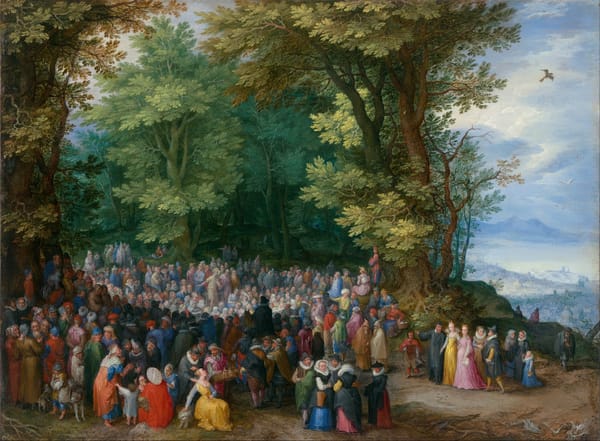
The Seventh Sunday after Pentecost
The dominical cycle of the Time after Pentecost completes to-day its first seven. Previous to the general adoption of the changes introduced into the Sunday Gospels for this portion of the year, the Gospel of the multiplication of the seven loaves gave its name to the seventh Sunday; and the mystery it contains is still evident in more than one section of to-day's liturgy.
As we have already seen, this mystery was that of the consummation of the perfect in the repose or rest of God Himself; it was the fruitful peace of the divine union. Nothing, then, could be more fitting than that Solomon, who is pre-eminently thepeaceful, the sacred and authorized chanter of the nuptial Canticle, should have been selected to come forward, on this day, to speak the praises of infinite Wisdom, and reveal her ways to the children of men. When Easter is kept as late in April as it is possible, the seventh Sunday after Pentecost is the first of the month of August; and the Church then begins, in her night Office, the lessons from the Sapiential Books. Otherwise, she continues the historic Scriptures, and that, in some years, for five weeks more; but even in that case eternal Wisdom maintains her rights to this Sunday, which the number of seven had already made hers in so special a way. For, when we cannot have the inspired instructions of Proverbs, we have Solomon's own example preaching to us in the third Book of Kings; we find him preferring Wisdom to all other treasures, and, on the throne of his father David, making her sit there with him as his inspirer and most noble Bride.
St. Jerome, who has been appointed by the Church herself as the interpreter of to-day's Scripture lessons,1 tells us that David, at the close of his life of wars and troubles, knew, as well as Solomon, the loveliness of this incomparable Bride of the Peaceful; the chill of his age was remedied by her caresses, whose very contact is purity.
‘Oh that this wisdom may be mine!’ exclaims the fervent solitary of Bethlehem; 'may she embrace me, and abide with me. She never grows old. She is ever the purest of virgins, fruitful, yet ever immaculate. I think the apostle means her when he speaks of a something that can make us fervent in spirit.2 So again, when our Lord tells us in the Gospel that, at the end of the world, the charity of many will grow cold,3 I believe it will be because wisdom will then grow rare.’4
The history of the two blind men, as related in the ninth chapter of St. Matthew, is the subject of to-day's Gospel in the Greek Church.
Mass
The Church, leaving the Synagogue in its cities which are to perish, has followed Jesus into the wilderness. Whilst the children of the kingdom5 are assisting at, without seeing it, this transmigration which is to be so fatal to them, the root of Jesse, now become the standard of nations,6 is rallying the people, and marshals them by thousands on towards the Church. From east and west, from north and south, they are pouring in, sitting down to the banquet of the kingdom,7 in company with Abraham and Isaac and Jacob. Here is our Introit; let us mingle our voices with these their glad chants.
Introit
All the opposition that men are capable of can never prevent divine Wisdom from compassing her ends. The Jewish people deny their King; but the Gentiles come forward and proclaim the Son of David. As we were just now singing in the Introit, His kingdom is extended the whole world over. In the Collect the Church asks that all evils may be removed, and that an abundance of blessings may consolidate in peace the power of the true Solomon.
Collect
The other Collects as on page 120.
Epistle
Cap. vi.Fratres, Humanum dico propter infirmitatem carnis vestræ : sicut enim exhibuistis membra vestra servire immunditiæ et iniquitati ad iuiquitatem; ita nunc exhibete membra vestra servire justifciæ in sanctificationem. Cum enim servi essetis peccati, liberi fuistis justitiæ. Quem ergo fructum habuistis tunc in illis, in quibus nunc erubescitis? Nam finis illorum mors est. Nunc vero liberati a peccato, servi autem facti Deo, habetis fructum vesferum in sanctificationem, finem vero vitam æternam. Stipendia enim peccati, mors. Gratia autem Dei, vita æterna : in Christo Jesu Domino nostro.
Ch. vi.Brethren : I speak a human thing, because of the infirmity of your flesh : for as you have yielded your members to serve uncleanness and iniquity unto iniquity; so now yield your members to serve justice, unto sanctification. For when you were the servants of sin, you were free from justice. What fruit therefore had you then in those things of which you are now ashamed? For the end of them is death. But now being made free from sin, and become servants to God, you have your fruit unto sanctification, and the end life everlasting. For the wages of sin is death; but the grace of God, life everlasting in Christ Jesus our Lord.
‘Reckon that ye are dead unto sin, but alive unto God, in Christ Jesus our Lord.’8 The apostle of the Gentiles enters to-day into the development of this leading formula of the Christian life. The Epistle of last Sunday aimed exclusively at putting it in language that could not be misunderstood; it showed us that it expresses what is meant by that Baptism which, when we are immersed in the water, unites us to Christ.
There, as in a sepulchre, the death of Jesus becomes ours, and delivers us from sin. Sold under sin9 by our first parents even before we had seen the day, and branded with its infamous stigma, our whole life belonged to the cruel tyrant. He is a master who is never satisfied with our service; he is a merciless exactor; there is scarce an hour that he does not make us feel his power over the members of our body; he does not allow us to forget that our body is his slave. But, if the life of a slave is under his master’s control, death comes at last and sets the soul free; and as to the body, the oppressor can claim nothing, once it is buried.10 Now, it was on the cross of the Man-God, who, as the apostle so strongly expresses it, was made sin11 because of our sins, that guilty human nature was considered by God's merciful justice to have become what its divine and innocent Head was. The old man that was the issue of Adam the sinner has been crucified; he has died in Christ; the slave by birth, affranchised by this happy death, has had buried under the waters of Baptism the body of sin, which carried in its flesh the mark of its slavery.
The body of sin was indeed our flesh; not that innocent flesh which originally came all pure from its Creator's hands, but the flesh which, generation after generation, was defiled by the transmission of a disgraceful inheritance. In Baptism, which the apostle calls the mysterious sepulchre, the sacred stream has not only washed away the defilement of this degraded body, but it has also set it free from those members of sin, which are the evil passions. These passions were powers of iniquity—that is, powers which deformed, and turned into uncleanness, those faculties and organs wherewith God had endowed us, that we might fulfil all justice, unto sanctification.12 At that moment of our Baptism the strong-armed tyrant forfeited his possession of us;13 that Baptism was a death which set his slave free. Sin being thus destroyed, the head of triple concupiscence has been severed, and the monster may writhe as he can; aided by grace, man thus liberated may always prevent, if he wishes, the coils of the serpent from again being joined with their head.
Yes, this is the manifold, yet single, work of holy Baptism: in the twinkling of an eye, and by its own power, it extirpates sin, and annihilates all its rights over us; but, once this is achieved, man must co-operate with the grace of the sacrament, that is, he must keep watch over his treacherous inclinations to sin, which come to life again by the slightest encouragement; he must be ever keeping up the work which his baptism-day began—that is, he must be ever cutting down the vile and noxious weeds which are ever cropping up. First, then, there is the death of sin, which, in its complete and sudden defeat of the old enemy, is the result of God's divine operation; but all this is to be followed up by a work which it belongs to the affranchised slave to do : the life-long work of mortification of the spirit and of the senses. It is the virtue of the first sacrament which is still telling on the Christian in this work of two-fold mortification; in his mortification, the sacrament is still pushing on its ceaseless work of vengeance against sin. Holy Baptism, having operated in the wretched slave of sin what God alone could empower it to achieve, summons man, now that his chains have fallen, to join it in the glorious work of maintaining his liberty; it invites him to share with it the honour of the divine victory over satan and his works.
The keeping down of the flesh will be again brought before us next Sunday, as the true indicator of liberty on this earth, and as the authentication of our being truly children of God. As the apostle says : 'Let not sin reign in your mortal body, so as to obey the lusts thereof. Neither yield ye your members as instruments of iniquity unto sin; but present yourselves to God as those that are alive from the dead, and your members as instruments of justice unto God. For sin shall not have dominion over you : for ye are not under the law, but under grace. Know ye not, that to whom ye yield yourselves servants to obey, his servants are ye whom ye obey, whether it be of sin unto death, or of obedience unto justice? But thanks be to God, that ye were the servants of sin; . . . but being freed from sin, we have been made servants of justice.'14
And shall we do less for justice than is being done everywhere in favour of our enemy, sin? Surely justice deserves that we should make greater efforts in her service than for that odious tyrant who requites his slaves with nothing but shame and death. And yet—oh admirable condescension of God to our weakness!—we have St. Paul telling us in to-day's Epistle, in the name of the Holy Ghost, that we shall be saints, we shall attain eternal life,15 if we will but serve justice with as much earnestness as we once served uncleanness and iniquity.
Let us humble ourselves at hearing such words; let us be honest, and we shall feel that they contain a reproach. Many of usmight ask : What has become of that intense ardour wherewith we once used to follow after sin? To say that we have converted our ways would be no answer, for a conversion does not paralyse our faculties; it enlists our natural energy in God's service, it even intensifies it by the very fact of its now being employed as originally intended. At all events, conversion does not lessen the activity which was in us before our conversion; it would be an insult to grace to accuse it of diminishing in us the gifts of God.
What lessons, then, may we learn by seeing how eager in the pursuit of honour, interest, or pleasure, are the votaries of the world! What earnestness, what toil, what perseverance, what frequent sufferings, what abnegation at every turn, what misplaced heroism—and all for the purpose of satisfying the seven heads of the beast, and tasting a lew drops of the poisoned cup of Babylon!16 There are many souls in hell who have gone through more fatigue and pain to procure their damnation than even the martyrs endured for Christ; and even with all that, never attaining the object they sought to obtain in this world! so true is it that the fools who are the most subservient to satan's wishes do not always succeed in enjoying, even for a single day, the vile rewards he promises his slaves.
Justice treats her followers in a very different way; she does not degrade, she does not deceive them that keep her. She blesses them with peace of mind at every step they take in duty-doing; she is ever enriching their treasure of merit; she leads them safely to the perfection of love. The life of divine union then grows, almost spontaneously, on that high ground of justice; it rests on justice, as a flower does on its stem. 'He that possesseth justice,' says the Scripture, 'shall lay hold on wisdom': he shall find delights in that divine wisdom, which surpasses all that earth could procure.17
Would it, then, be fair to hesitate to go through those toils which procure heaven for us, and are a preparation here on earth for the glories which are to be revealed in us in our eternal home? The present life, how long soever it may be, seems but momentary to a faithful soul; she is glad to give this proof of the love she bears to Him she longs for. 'Jacob,' says St. Augustine, 'gave his twice seven years of service18 for the sake of Rachel, whose name, they tell us, signifies vision of the Beginning, that is, of the Word, that is, of the Wisdom which shows us God. Every virtuous man on earth loves this Wisdom; it is for her he works and suffers, by serving justice. What he, like Jacob, aims at by his labours, is, not the fatigue for its own sake, but the possession of that which the fatigue is to bring him, namely, the fair Rachel, that is to say, rest in the Word, in whom we have the vision of the Beginning. Is there any true servant of God who can have any other thought, when he is under the influence of grace? Once converted, what is it that man wishes? What is in bis thoughts? What has he in his heart? What is it that he thus passionately loves and desires? It is the knowledge of Wisdom. Of course, man would, if he could, avoid all fatigue and suffering, and come straight to the delights which he knows are in the exquisitely beautiful and perfect Wisdom; but that cannot be in the land of the dying. "If thou desire Wisdom, keep justice; and God will give her unto thee."19 Justice here means the commandments; and the commandments prescribe works of justice, of that justice which comes of faith; and faith lives amidst the uncertainty of temptations; that by piously believing what it does not as yet understand, it may merit the happiness of understanding.
‘We are not, therefore, to find fault with the ardour of those who are desirous of possessing truth in its unveiled loveliness; what we must do, is to put order in their love, by telling them to begin with faith, and strive, by the exercise of good deeds, to arrive at the bliss they long for. Do thou love and desire, at the very outset, and above all things, this object which is so worthy of thy possession; but, let the ardour which burns within thee show itself, first of all, by its leading thee cheerfully to endure the fatigues of the road which leads to the prize, towards which thy love is all directed. Yea, and when thou has reached it, remember, thou wilt never enjoy beautiful truth in this life, without having, at the same time, still to cultivate labourious justice. How comprehensive and pure soever may be the sight granted to mortal men of the unchangeable Good, the corruptible body is a load upon the soul, and the earthly habitation presseth down the mind that museth upon many things.”20 One, then, is that to which we must tend; but many are the things we are to bear for that one’s sake.’21
In the Gradual, the Church keeps up the thought which pervades this seventh Sunday; she invites her sons to come and receive from her the knowledge of the fear of the Lord; for the fear of the Lord is the beginning of wisdom.22 The Alleluiaverse again calls upon the Gentiles, the heirs of Jacob, to celebrate in gladness the gift of God.
Gradual
Gospel
Cap. vii.In illo tempore : dixit Jesus discipulis suis : Attendite a falsis prophetis, qui veniunt ad vos in vestimentis ovium, intrinsecus autem sunt lupi rapaces : a fructibus eorum cognoscetis eos. Numquid colligunt de spinis uvas, aut de tribulis ficus? Sic omnis arbor bona fructus bonos facit : mala autem arbor malos fructus facit. Non potest arbor bona malos fructus facere : neque arbor mala bonos fructus facere. Omnis arbor, quæ non facit fructum bonum, excidetur, et in ignem mittetur. Igitur ex fructibus eorum cognoscetis eos. Non omnis, qui dicit mihi : Domine, Domine, intrabit in regnum cœlorum : sed qui facit voluntatem Patris mei, qui in cœlis est, ipse intrabit in regnum cœlorum.
Ch. vii.At that time : Jesus said to his disciples: Beware of false prophets, who come to you in the clothing of sheep, but inwardly they are ravening wolves. By their fruits you shall know them. Do men gather grapes of thorns, or figs of thistles? Even so every good tree bringeth forth good fruit, and the evil tree bringeth forth evil fruit. A good tree cannot bring forth evil fruit, neither can an evil tree bring forth good fruit. Every tree that bringeth not forth good fruit shall be cut down, and shall be cast into the fire. Wherefore by their fruits you shall know them. Not every one that saith to me, Lord, Lord, shall enter into the kingdom of heaven; but he that doth the will of my Father who is in heaven, he shall enter into the kingdom of heaven.
By rejecting the Gospel, the Jewish people have refused the light. Whilst the Sun of justice, hailed with delight by the Gentiles, is lighting up, in all splendour, the land that was once in the shadow of death,23 a black night is covering the heretofore blessed country of the patriarchs, and darkness is every hour thickening in Jerusalem. By the blindness which is leading her to destruction, the Synagogue is verifying our Lord’s words : ‘He that walketh in darkness, knoweth not whither he goeth.’24
False prophets and false Christs are numerous in Israel,25 ever since the true Messiah, whom the prophets foretold, has been ignored, and treated by His own people26 as the prophets themselves had been.27 His witnesses, the apostles, have vainly tried to induce Juda to retract the fatal denial made in the pretorium. And yet, Jada knows better than all the world beside, that the times are accomplished; for, has not the sceptre fallen from his hands?28 And Juda, who disdainfully disowns the spiritual royalty of the Saviour of men, is going on with his ceaseless expectation and search of the Christ of his own imagining,—a Messiah who will restore to him the power he has lost. The Jewish doctors have not as yet invented the sentence of Talmud, whereby they will endeavour to stifle the unpleasant prophecies which give them the lie: ‘Cursed be he, that calculates the times of the coming of Messiah!’29 What, then, must be the feelings of a people, which has for ages been living in the expectation of an event the most important that could be, now that it sees the time specified by prophecy to be fast expiring, when it will be compelled either to disavow the past, or to acknowledge, at the foot of the cross which it has set up, its most sinful error.
A strange anxiety has seized on the nation of deicides. The spirit of madness governs her determinations. In the scare of her feverish excitement, which is the very opposite of the calm and resigned expectation of her ancient patriarchs, she takes every rebel for a Christ. She, that would not have the Son of David, hails every upstart as her Messiah, and follows every adventurer that sets up the cry of war against Rome, or that cheats her with the promise of making her country independent. With such materials, Judea is soon turned into a kingdom of anarchy and confusion. The very sanctuary of the temple is made the scene of party quarrels and bloodshed. The daughter of Sion follows her false Christs into the desert;30 there organizes riot; and returns to the holy city, filling it with highwaymen, or with assassins imported from the wilderness. Long before these events, Ezechiel had thus spoken: 'Woe to the foolish prophets that see nothing! Thy prophets, O Israel, were like foxes in the deserts!’31 And Isaias had thus prophesied :
‘Therefore, the Lord shall have no joy in their young men; neither shall He have mercy on their fatherless and widows; for every one is a hypocrite and wicked, and every mouth hath spoken folly.'32
The time is close at hand : the hour is come, when they that are in Judea must flee to the mountains,'33 as our Lord had said. The Christians of Jerusalem will, as history records, soon be leaving the doomed city, under the guidance of Simeon, their bishop.34 With them departs Sion’s last hope; God is about to avenge His Christ. Already has the signal of destruction been heard, the whistle, as the prophet Isaias had foretold,35 has been heard from beyond the seas; and, as Balaam had seen it in vision, 'they are coming in galleys from Italy, to lay waste the Hebrews.'36 The leader, announced by Daniel, is approaching towards that which was once the land of promise; the appointed desolation and ruin shall remain there even after the end of the war.37
Let us leave the Jews to hurry on their own ruin; let us return to the Church, which, at the same time, is rising up, so grand and so beautiful, on the corner-stone that had been rejected by the Synagogue.38 Because of the absence of this stone, which the builders of Sion had not the wisdom to recognize as the basis indispensably necessary to their city, Jerusalem falls in Judea, but reappears, more than ever beauteous, on the hills,39 whither Cephas,40 prince of the apostles, has carried her everlasting foundation. Set firmly on the divine rock, she shall no longer fear the violence of the billows and winds, when they storm against her walls.41 False prophets, and all the workers of lies, who had so successfully sapped the walls of the ancient, will not leave the new Jerusalem in peace; for our Lord had plainly said : 'It is necessary that scandals should come';42 and the apostle, speaking of heresy (that greatest of all scandals), said : 'There must be heresies in order that they who are approved may be made manifest.’43
Indeed, for each individual Christian, as for the Church at large, the security of the spiritual building depends primarily on the firmness of the foundation, which is faith. The Holy Ghost will not build on a foundation that is unsound or unsafe. When, especially, He is to lead a soul to the higher degrees of divine union, He exacts from her, as the first condition, that her faith, too, be above the average, —a faith, that is, with heroism enough to fight successfully those battles which brace the soul, and so render her worthy of light and love. In every stage of the Christian life, however, it is faith that provides love with its enduring and substantial44 nourishment; it is faith that gives to the virtues their supernatural motives, and makes them fit to form a worthy court for their queen, charity. A soul's development never goes beyond the measure of her faith. The capaciousness of faith, and its ever-growing plenitude, and its certified conformity with truth, these are the guarantees of the progress which will be made by a just man; whereas all such holiness as affects to be guided by a faith which is cramped or false is holiness of a very dubious kind, and one that is exposed to most fearful illusions.
It was, therefore, a good and a wholesome thing that faith should be put to the test, for it grows brighter and stronger under trial. St. Paul, in his Epistle to the Hebrews, is enthusiastic in his praise of the triumphs won by the faith of our forefathers.45 Could there be denied to the new Covenant those glorious combats which constituted the eternal merit and honour of the saints who lived in the period of expectation and figures? It is by their victorious faith in the word of the promise, that all those worthy ancestors of the Christian people merited to have God Himself as their praise-giver.46 For us, who joyously have possession of that Messias who to them was but the object of heroic hope, our trial cannot be like theirs—the trial of expectation. This is quite true; and yet, heresy, which is the offspring of man's pride and hell's malice—heresy and its manifold outcomings, which are ever producing the diminution of truth in this world47—will give us occasions of merit even in our possession of what they beheld and saluted only afar off.48 Man is ever trying to intrude his foolish ideas into the truths of divine revelation; and, as to the prince of this world,49 he will do all in his power to encourage these audacious attempts at corrupting the purity of the word. But Wisdom, who is never overcome,50 will turn all these impious efforts into an occasion of glorious victories for her children. Here we have the reason why God permitted, from the very commencement of the Church’s existence, and still permits, that sects should be continually springing up. It is in the battlefield against error that the Church brings forth the armour of God,51 and shows herself all brilliant with that absolute truth which is the brightness of the Word, her Spouse;52 it is by his personal triumph over the spirit of lying, and by spontaneous adhesion to the teachings of Christ and His Church, that the Christian shows himself to be a true child of light,53 and becomes himself a light to the world.54
The combat is not without its dangers for the Christian who would hold, in all its integrity, the faith of his mother the Church. The tricks of the enemy, his studied and obstinate hypocrisy, the crafty skill wherewith he tries to stir up in the soul, almost without her knowing it, a score of little weaknesses of hers which more or less favour error—all this frequently ends in injuring the light, not perhaps in extinguishing it altogether, but in robbing it of some of us brilliancy. And yet, they who live on the teachings given us in our to-day's Gospel are sure to come off with the victory. Let us meditate upon them with gratitude and love; for it is by such teachings that eternal Wisdom grants us what we so ardently ask of Him, when in Advent we thus beseech Him : 'Come and teach us the way of prudence!'55 Prudence, the friend of a wise man,56 guardian of his treasures, and his surest defence, has no greater peril from which to keep him than shipwreck concerning the faith;57 if faith be lost, all is lost. No price is too great to give58 for that prudence of the serpent which, in a disciple of Christ, goes so admirably with the simplicity of the dove.59 If we are happy enough to possess prudence, we shall readily distinguish between those false teachers whom we must shun and those to whom we must hearken—between the falsifiers of the word and its faithful interpreters.
By their fruits shall ye know them, says our Gospel, and history confirms the words of our Redeemer. Under the sheep's clothing, which they wear that they may deceive simple souls, the apostles of falsehood ever betray their real nature. The artful language they use,60 and the flatteries they utter for gain's sake,61 cannot hide the hollowness of their works.62 They separate themselves from the flock of Christ,63 and flee from the light; for, as the apostle says : 'All things that are reproved, or deserve to be so, are made manifest by the light; and as to the things that are done by them in secret, it is a shame even to speak of them. Therefore, be ye not partakers with them.’64 The useless or rotten fruits of darkness, and 'the trees of autumn, twice dead,'65 which bear such fruits on their withered branches, both of them shall be cast into the fire. If you yourselves were heretofore darkness, now that you have become light in the Lord by Baptism, or by a sincere conversion, show yourselves to be so, and produce ‘the fruits of light, in all goodness, and justice, and truth.'66 On this condition alone can you hope to enter into the kingdom of heaven, and call yourselves disciples of that Wisdom of the Father, who, on this seventh Sunday, asks us to give Him our love.
St. James the apostle almost seems to be giving a commentary on the Gospel of this seventh Sunday, where he says : ‘Can the fig-tree, my brethren, bear grapes, or the vine figs? So neither can the salt water yield sweet. Who is a wise man and endued with wisdom among you, let him, by a good conversation (that is, by his good conduct) show his work in the meekness of wisdom.' . . . For there is a wisdom which is bitter, and misleads others; it 'descendeth not from above, but is earthly, sensual, devilish . . . . But the wisdom which is from above, first indeed is chaste, then peaceable, modest, easy to be persuaded, consenting to the good (and always sides with them), full of mercy and good fruits, without judging (the conduct of others), without dissimulation. And the fruit of justice is sown in peace to them that make peace.'67
The Offertory-anthem has been selected, according to Honorius of Autun,68 in allusion to the sacrifice of the thousand victims which were offered at Gabaon by Solomon, in the early days of his reign; when the sacrifice was ended, he was bidden to ask, what he would have God give to him : he desired and obtained wisdom, with the addition of riches and glory, for which he had not asked.69 It depends upon us, that the sacrifice which is here ready to be offered up, should be equally, and even more, accepted of God, for it is Incarnate Wisdom that is being offered to the most high God; He desires to obtain for us all the gifts of His eternal Father, and to give Himself also to us.
Offertory
Another circumstance which confirms what we have said regarding the mysterious character of this seventh Sunday, as to its being especially sacred to eternal Wisdom, is the fact that the verse of Scripture which formerly used to be joined to the present Offertory-anthem70 is the same as that which, in the Roman pontifical, opens the magnificent ceremony of the consecration of virgins : ‘And now we follow thee with all our heart, and we fear thee, and seek thy face; put us not to confusion, but deal with us according to thy meekness, and according to the multitude of thy mercies!’71 After being thrice called by the bishop, the affianced of the divine Spouse, singing these words, advance to the altar, where they are to be espoused to Him.
The Secret speaks to God of how the multiplied variety of the ancient sacrifices, such as those mentioned in the Offertory, were all made one in the oblation of our Christian sacrifice.
Secret
The other Secrets, as on page 130.
The Communion, says Honorius of Autun, gives us the prayer of Solomon, who asks wisdom of God, and obtains it.72 'If any of you,’ says St. James, 'want wisdom, let him ask of God, who giveth to all men abundantly, and upbraideth not : and it shall be given him.’73
Communion
Original sin has vitiated man to such a degree— he is so far from divine union, at his first coming into this life—that, of himself, he can neither cleanse the defilement that is on him, nor enter on the path which leads to God. It is requisite that our God, as a generous and patient physician, take our cure into His own hand; and, even when the cure is effected, should support and guide us. Let us then, in the Postcommunion, say with the Church:
Postcommunion
The other Postcommunions, as on page 131.
Vespers
The psalms, capitulum, hymn and versicle, as above, pages 71-81.
Antiphon of the Magnificat
- In II. Noct., ex Epist ad Nepotianum. ↩︎
- Rom. xii. 11. ↩︎
- St. Matt. xxiv. 12. ↩︎
- Ep. ad Nepot. 4. ↩︎
- St. Matt. viii. 12. ↩︎
- Isa. xi. 10. ↩︎
- St. Matt. viii. 11. ↩︎
- Rom. vi. 11. ↩︎
- Ibid. vii. 14. ↩︎
- Job iii. 18. ↩︎
- 2 Cor. v. 21. ↩︎
- Col. iii 5-9. ↩︎
- St. Luke xi. 21 ↩︎
- Rom. vi. 12-18. ↩︎
- Ibid. 19-23. ↩︎
- Apoc. xvii. 7. ↩︎
- Ecclus. xv. 1-8. ↩︎
- Gen. xxix. 18-30. ↩︎
- Ecclus. i. 33. ↩︎
- Wisd. ix. 15. ↩︎
- St. Augustine, Contra Faust, xxii. 50-58 (freely epitomized). ↩︎
- Ps. cx.10. ↩︎
- Isa. ix. 2. ↩︎
- St. John xii. 35. ↩︎
- St. Matt. xxiv. 24. ↩︎
- St. John i. 11. ↩︎
- St. Matt. xxiii 29-82. ↩︎
- Gen. xlix. 10. ↩︎
- Tract. Sanhedr., c. x. ↩︎
- St. Matt. xxiv. 26. ↩︎
- Ezech. xiii. 1-8. ↩︎
- Isa. ix. 17. ↩︎
- St. Matt. xxiv. 16. ↩︎
- Euseb., Hist. Eccl., iii. 5. ↩︎
- Isa. v. 26. ↩︎
- Num. xxiv. 24. ↩︎
- Dan. ix. 26, 27. ↩︎
- Ps. cxvii. 22. ↩︎
- Isa. ii. 2. ↩︎
- St. John i. 42. ↩︎
- St. Matt. vii. 24-27. ↩︎
- Ibid. xviii. 7. ↩︎
- 1 Cor. xi. 19. ↩︎
- Heb. xi. 1. ↩︎
- Ibid. 4-40. ↩︎
- Ibid. 2, 39. ↩︎
- Ps. xi. 2. ↩︎
- Heb. xi. 13. ↩︎
- St. John xvi. 11. ↩︎
- Wisd. vii. 30. ↩︎
- Eph. vi. 11-17. ↩︎
- Heb. i. 3. ↩︎
- St. John xii. 36. ↩︎
- St. Matt. v. 14. ↩︎
- First of the Great Antiphons. ↩︎
- Prov. vii. 4. ↩︎
- 1 Tim. i. 19. ↩︎
- Prov. iii. 13-19. ↩︎
- St. Matt. x. 16. ↩︎
- Eph. v. 6. ↩︎
- St. Jude. 16. ↩︎
- Eph. v. 11. ↩︎
- St. Jude 19 ↩︎
- Eph. v. 13, 12, 7. ↩︎
- St. Jude 12. ↩︎
- Eph. v. 8, 9. ↩︎
- St. James iii. 11-18. ↩︎
- Gemma Anim., iv. 57. ↩︎
- 3 Kings iii.; 2 Paralip. i. ↩︎
- Antiph. Gregor. ap. Thomasi, v. ↩︎
- Dan. iii. 40-42. ↩︎
- Honorius, ubi supra. ↩︎
- St. Jas. i. 5. ↩︎
July 16: Our Lady of Mount Carmel
|
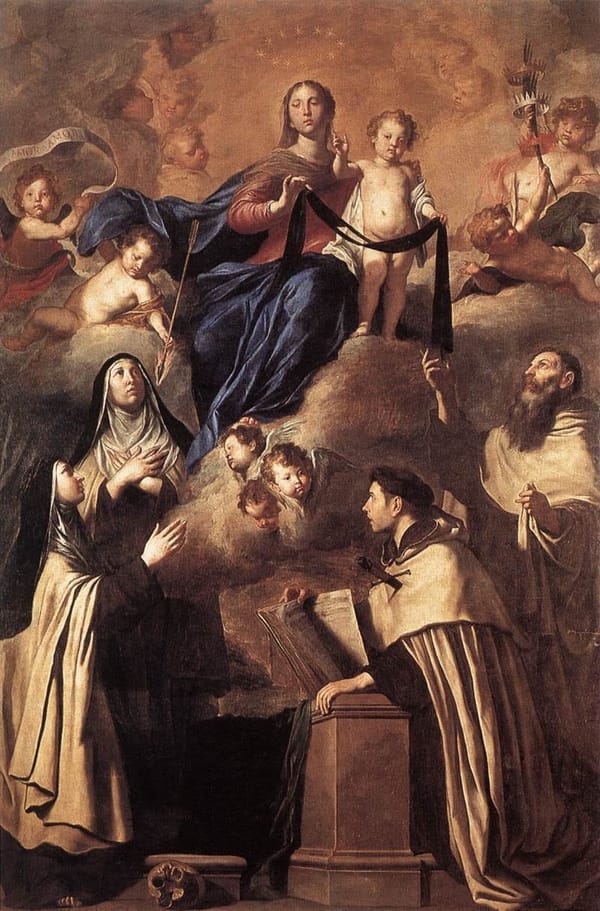
TOWERING over the waves on the shore of the Holy Land, Mount Carmel, together with the short range of the same name, forms a connecting link to two other chains, abounding with glorious memories, namely: the mountains of Galilee on the north, and those of Judea on the south.
‘In the day of My love, I brought thee out of Egypt into the land of Carmel,’1 said the Lord to the daughter of Sion, taking the name of Carmel to represent all the blessings of the Promised Land; and when the crimes of the chosen people were about to bring Judea to ruin, the prophet cried out: ‘I looked, and behold Carmel was a wilderness: and all its cities were destroyed at the presence of the Lord, and at the presence of the wrath of His indignation.’2 But from the midst of the Gentile world a new Sion arose, more loved than the first; eight centuries beforehand Isaias recognized her by the glory of Libanus, and the beauty of Carmel and Saron which were given her. In the sacred Canticle, also, the attendants of the Bride sing to the Spouse concerning His well-beloved, that her head is like Carmel, and her hair like the precious threads of royal purple carefully woven and dyed.3
There was, in fact, around Cape Carmel, an abundant fishery of the little shell-fish which furnished the regal colour. Not far from there, smoothing away the slopes of the noble mountain, flowed the torrent of Cison, that dragged the carcasses4 of the Chanaanites, when Debbora won her famous victory. Here lies the plain where the Madianites were overthrown, and Sisara felt the power of her that was called the Mother in Israel.5 Here Gedeon, too, marched against Madian in the name of the Woman terrible as an army set in array,6 whose sign he had received in the dew-covered fleece. Indeed, this glorious plain of Esdrelon, which stretches away from the foot of Carmel, seems to be surrounded with prophetic indications of her who was destined from the beginning to crush the serpent's head: not far from Esdrelon, a few defiles lead to Bethulia, the city of Judith, type of Mary, who was the true joy of Israel and the honour of her people;7 while nestling among the northern hills lies Nazareth, the white city, the flower of Galilee.8
When Eternal Wisdom was playing in the world, forming the hills and establishing the mountains, she destined Carmel to be the special inheritance of Eve's victorious daughter. And when the last thousand years of expectation were opening, and the desire of all nations was developing into the spirit of prophecy, the father of prophets ascended the privileged mount, thence to scan the horizon. The triumphs of David and the glories of Solomon were at an end: the sceptre of Juda, broken by the Schism of the ten tribes, threatened to fall from his hand; the worship of Baal prevailed in Israel. A long-continued drought, figure of the aridity of men's souls, had parched up every spring, and men and beasts were dying beside the empty cisterns, when Elias the Thesbite gathered the people, representing the whole human race, on Mount Carmel, and slew the lying prophets of Baal. Then, as the Scripture relates, prostrating with his face to the earth, he said to his servant: Go up, look towards the sea. And he went up, and looked and said: There is nothing. And again he said to him: Return seven times. And at the seventh time: Behold, a little cloud arose out of the sea like a man's foot.9
Blessed cloud! unlike the bitter waves from which it sprang, it was all sweetness. Docile to the least breath of heaven, it rose light and humble, above the immense heavy ocean; and screening the sun, it tempered the heat that was scorching the earth and restored to the stricken world life and grace and fruitfulness. The promised Messias, the Son of Man, set His impress upon it, showing to the wicked serpent the form of the heel that was to crush Him. The prophet, personifying the human race, felt his youth renewed; and while the welcome rain was already refreshing the valleys, he ran before the chariot of the king of Israel. Thus did he traverse the great plain of Esdrelon, even to the mysteriously-named town of Jezrahel, where, according to Osee, the children of Juda and Israel were again to have but one head in the great day of Jezrahel (i.e., of the seed of God), when the Lord would seal His eternal nuptials with a new people.10 Later on, from Sunam, near Jezrahel, the mother whose son was dead crossed the same plain of Esdrelon, in the opposite direction, and ascended Mount Carmel, to obtain from Eliseus the resurrection of her child, who was a type of us all.11 Elias had already departed in the chariot of fire, to await the end of the world, when he is to give testimony, together with Henoch, to the son of her that was signified by the cloud;12 and the disciple, clothed with the mantle and the spirit of his father, had taken possession, in the name of the sons of the prophets, of the august mountain honoured by the manifestation of the Queen of prophets. Henceforward Carmel was sacred in the eyes of all who looked beyond this world. Gentiles as well as Jews, philosophers and princes, came here on pilgrimage to adore the true God; while the chosen souls of the Church of the expectation, many of whom were already wandering in deserts and in mountains,13 loved to take up their abode in its thousand grottos; for the ancient traditions seemed to linger more lovingly in its silent forests, and the perfume of its flowers foretokened the Virgin Mother. The cultus of the Queen of heaven was already established; and to the family of her devout clients, the ascetics of Carmel, might be applied the words spoken later by God to the pious descendants of Rechab: There shall not be wanting a man of this race, standing before Me for ever.14
At length figures gave place to the reality; the heavens dropped down their dew, and the Just One came forth from the cloud. When His work was done and He returned to His Father, leaving His blessed Mother in the world, and sending His Holy Spirit to the Church, not the least triumph of that Spirit of love was the making known of Mary to the new-born Christians of Pentecost. ‘What a happiness,’ we then remarked, ‘for those neophytes who were privileged above the rest in being brought to the Queen of heaven, the Virgin Mother of Him who was the hope of Israel! They saw this second Eve, they conversed with her, they felt for her that filial affection wherewith she inspired all the disciples of Jesus. The liturgy will speak to us at another season of these favoured ones.’15 The promise is fulfilled to-day. In the lessons of the feast the Church tells us how the disciples of Elias and Eliseus became Christians at the first preaching of the apostles, and being permitted to hear the sweet words of the Blessed Virgin and enjoy an unspeakable intimacy with her, they felt their veneration for her immensely increased. Returning to the loved mountain, where their less fortunate fathers had lived but in hope, they built, on the very spot where Elias had seen the little cloud rise up out of the sea, an oratory to the purest of virgins; hence they obtained the name of Brothers of Blessed Mary of Mount Carmel.16
In the twelfth century, in consequence of the establishment of the Latin Kingdom of Jerusalem, many pilgrims from Europe came to swell the ranks of the solitaries on the holy mountain; it therefore became expedient to give to their hitherto eremitical life a form more in accordance with the habits of Western nations. The legate Aimeric Malafaida, patriarch of Antioch, gathered them into a community under the authority of St. Berthold, who was thus the first to receive the title of Prior-General. At the commencement of the next century, Blessed Albert, patriarch of Jerusalem and also apostolic legate, completed the work of Aimeric by giving a fixed Rule to the Order, which was now, through the influence of princes and knights returned from the Holy Land, beginning to spread into Cyprus, Sicily, and the countries beyond the sea. Soon, indeed, the Christians of the East being abandoned by God to the just punishment of their sins, the vindictiveness of the conquering Saracens reached such a height in this age of trial for Palestine, that a full assembly, held on Mount Carmel under Alan the Breton, resolved upon a complete migration, leaving only a few friars eager for martyrdom to guard the cradle of the Order. The very year in which this took place (1245) Simon Stock was elected General in the first Chapter of the West, held at Aylesford in England.
Simon owed his election to the successful struggle he had maintained for the recognition of the Order which certain prelates, alleging the recent decrees of the Council of Lateran, rejected as having been newly introduced into Europe. Our Lady had then taken the cause of the friars into her own hands, and had obtained from Honorius III the decree of confirmation, which originated to-day's feast. This was neither the first nor the last favour bestowed by the sweet Virgin upon the family that had lived so long under the shadow, as it were, of her mysterious cloud, and shrouded like her in humility, with no other bond, no other pretension than the imitation of her hidden works and the contemplation of her glory. She herself had wished them to go forth from the midst of a faithless people; just as, before the close of that same thirteenth century, she would command her angels to carry into a Catholic land her blessed house of Nazareth. Whether or not the men of those days, or the short-sighted historians of our own time, ever thought of it, the one translation called for the other, just as each completes and explains the other, and each was to be, for our own Europe, the signal for wonderful favours from heaven.
In the night between the 15th and 16th of July of the year 1251, the gracious Queen of Carmel confirmed to her sons by a mysterious sign the right of citizenship she had obtained for them in their newly adopted countries; as mistress and mother of the entire religious state she conferred upon them with her queenly hands the scapular, hitherto the distinctive garb of the greatest and most ancient religious family of the West. On giving St. Simon Stock this badge, ennobled by contact with her sacred fingers, the Mother of God said to him: ‘Whosoever shall die in this habit shall not suffer eternal flames.' But not against hell fire alone was the all-powerful intercession of the Blessed Mother to be felt by those who should wear her scapular. In 1316, when every holy soul was imploring heaven to put a period to that long and disastrous widowhood of the Church which followed on the death of Clement V, the Queen of Saints appeared to James d’Euse, whom the world was soon to hail as John XXII; she foretold to him his approaching elevation to the Sovereign Pontificate, and at the same time recommended him to publish the privilege she had obtained from her Divine Son for her children of Carmel—viz., a speedy deliverance from purgatory. ‘I, their Mother, will graciously go down to them on the Saturday after their death, and all whom I find in purgatory I will deliver and will bring to the mountain of life etemal.’ These are the words of our Lady herself, quoted by John XXII in the Bull which he published for the purpose of making known the privilege, and which was called the Sabbatine Bull on account of the day chosen by the glorious benefactress for the exercise of her mercy.
We are aware of the attempts made to nullify the authenticity of these heavenly concessions; but our extremely limited time will not allow us to follow up these worthless struggles in all their endless details. The attack of the chief assailant, the too famous Launoy, was condemned by the Apostolic See; and after, as well as before, these contradictions, the Roman Pontiffs confirmed, as much as need be, by their supreme authority, the substance and even the letter of the precious promises. The reader may find in special works the enumeration of the many indulgences with which the Popes have, time after time, enriched the Carmelite family, as if earth would vie with heaven in favouring it. The munificence of Mary, the pious gratitude of her sons for the hospitality given them by the West, and lastly, the authority of St. Peter’s successors, soon made these spiritual riches accessible to all Christians, by the institution of the Confraternity of the holy Scapular, the members whereof participate in the merits and privileges of the whole Carmelite Order. Who shall tell the graces, often miraculous, obtained through this humble garb? Who could count the faithful now enrolled in the holy militia? When Benedict XIII, in the eighteenth century, extended the feast of July 16 to the whole Church, he did but give an official sanction to the universality already gained by the cultus of the Queen of Carmel.
The holy liturgy gives the following account of the history and object of the feast:
Queen of Carmel, hear the voice of the Church as she sings to thee on this day. When the world was languishing in ceaseless expectation, thou wert already its hope. Unable as yet to understand thy greatness, it nevertheless, during the reign of types, loved to clothe thee with the noblest symbols. In admiration and in gratitude for benefits foreseen, it surrounded thee with all the notions of beauty, strength, and grace suggested by the loveliest landscapes, the flowery plains, the wooded heights, the fertile valleys, especially of Carmel, whose very name signifies 'the plantation of the Lord.' On its summit our fathers, knowing that Wisdom had set her throne in the cloud, hastened by their burning desires the coming of the saving sign: at length there was given to their prayers what the Scripture calls perfect knowledge, and the knowledge of the great paths of the clouds.17 And when He who maketh His chariot and His dwelling in the obscurity of a cloud had herein shown Himself, in a nearer approach, to the practised eye of the father of prophets, then did a chosen band of holy persons gather in the solitudes of the blessed mountain, as heretofore Israel in the desert, to watch the least movements of the mysterious cloud, to receive from it their guidance in the paths of life, and their light in the long night of expectation.
O Mary, who from that hour didst preside over the watches of God’s army, without ever failing for a single day: now that the Lord has truly come down through thee, it is no longer the land of Judea alone, but the whole earth that thou coverest as a cloud, shedding down blessings and abundance. Thine ancient clients, the sons of the prophets, experienced this truth when, the land of promise becoming unfaithful, they were forced to transplant into other climes their customs and traditions; they found that even into our far West the cloud of Carmel had poured its fertilizing dew, and that nowhere would its protection be wanting to them. This feast, O Mother of our God, is the authentic attestation of their gratitude, increased by the fresh benefits wherewith thy bounty accompanied the new exodus of the remnant of Israel. And we, the sons of ancient Europe, we too have a right to echo the expression of their loving joy; for since their tents have been pitched around the hills where the new Sion is built upon Peter, the cloud has shed all around showers of blessing more precious than ever, driving back into the abyss the flames of hell and extinguishing the fire of purgatory.
Whilst, then, we join with them in thanksgiving to thee, deign thyself, O Mother of divine grace, to pay our debt of gratitude to them. Protect them ever. Guard them in these unhappy times, when the hypocrisy of modem persecutors has more fatal results than the rage of the Saracens. Preserve the life in the deep roots of the old stock, and rejoice it by the accession of new branches, bearing, like the old ones, flowers and fruits that shall be pleasing to thee, O Mary. Keep up in the hearts of the sons that spirit of retirement and contemplation which animated their fathers under the shadow of the cloud; maytheir sisters, too, wheresoever the Holy Spirit has established them, be ever faithful to the traditions of the glorious past, so that their holy lives may avert the tempest and draw down blessings from the mysterious cloud. May the perfume of penance that breathes from the holy mountain purify the now corrupted atmosphere around; and may Carmel ever present to the Spouse the type of the beauties He loves to behold in His Bride!
- Cf. Jerem. ii. 2, 7. ↩︎
- Ibid. iv. 26. ↩︎
- Cant. vii. 5. ↩︎
- Judg. v. 21. ↩︎
- Ibid. 7. ↩︎
- Cant. vi. 3, 9. ↩︎
- Judith xv. 10. ↩︎
- Hieron. Epist. xlvi. Paulæ et Eustochii ad Marcellam. ↩︎
- 3 Reg. xviii. ↩︎
- Osee i. 11, and ii. 14-24. ↩︎
- 4 Reg. iv. 8-37. ↩︎
- Apoc. xi. 3, 7. ↩︎
- Heb. xi. 38. ↩︎
- Jerem. xxxv. 19. ↩︎
- Paschal Time, Vol. III., p. 314. ↩︎
- Lessons of 2nd Nocturn. ↩︎
- Job xxxvii. 16. ↩︎
| Previous July 15: St. Henry, Emperor | Next July 16: Our Lady of Mount Carmel |