Daily reading
After Pentecost
Double of the II Class · Movable from Easter · Temporal
August 6, 2023
From Dom Guéranger’s The Liturgical Year.

|
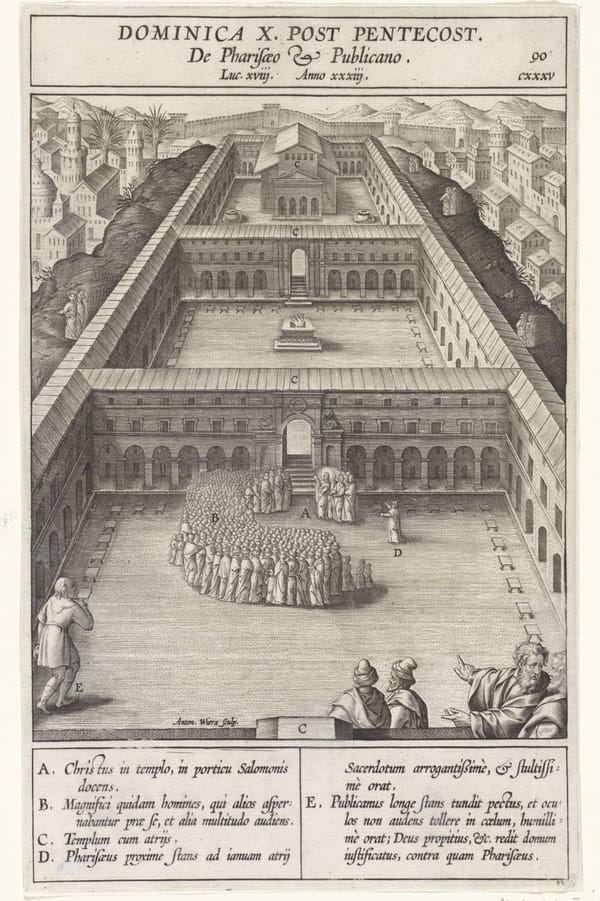
The Tenth Sunday after Pentecost
The destruction of Jerusalem has closed that portion of the prophetic Scriptures which was based on the institutions and history of the figurative period. The altar of the true God, built by Solomon on the summit of Moriah, was the authentic evidence of the true religion, to those who were then living under the Law of expectation. Even after the promulgation of the new Testament, the continued existence of that altar (the only one heretofore recognized by the Most High as His own1) was some sort of an excuse for such of the Jews as clung obstinately to the old order of things. That excuse was taken away when the temple was so destroyed as that not a stone was left on a stone; and the blindest partisans of the Mosaic system were compelled to acknowledge the total abrogation of a religion which was reduced by God Himself to the impossibility of ever offering the sacrifices essential to its existence.
The considerateness wherewith the Church had, so far, treated the Synagogue would henceforward be unmeaning. As the beautiful queen and bride, she was now at full liberty to show herself to all nations, subdue their wild instincts by the power of the Spirit, unify them in Christ Jesus, and put them by faith into the substantial, though not visible,2 possession of those eternal realities which had been foreshadowed by the Law of types and figures.
The new sacrifice, which is no other than that of the cross and of eternity, is now, more than ever, evidently the one sole centre, where her life is fixed in God with Christ her Spouse,3 and from which she derives her energy in labouring for the conversion and sanctification of all future generations of men. The Church, now more than ever fruitful, is more than ever receiving of that life of union which is the cause of her admirable fecundity.
We cannot, therefore, be surprised, that the sacred liturgy, which is the outward expression of the bride's inner life, will now more than ever reflect this closeness of her union with God. In the fifteen weeks we have still to spend of this Time after Pentecost, there is no such thing as gradation, no connexion, in the Proper of the Sundays' Masses. Even in the Lessons of the night-Office, dating from August, the historic Books have been replaced by those which are called the Sapiential; and these, in due time, will be followed by the Books of Job, Tobias, Judith and Esther. Here again there is no connexion, further than that of sanctity in precept or in example. So far, we have found more or less of oneness of idea between the Lessons of the Office and the Proper of the Mass; but, beginning with this tenth Sunday, these are independent of each other.
Henceforward, therefore, we must limit our commentary to the Proper of each Sunday's Mass; and in doing this, we shall be respectfully taking the teachings which the holy Spirit, 'who divideth as He willeth,'4 gives us, unitedly with the Church, in each portion of each Sunday's liturgy. Each Epistle and Gospel, especially; and then, each Introit and Collect, each Gradual and Offertory, each Secret, Communion and Postcommunion, will be a precious and exquisitely varied instruction. We shall see all this in the Epistle of this tenth Sunday.
The fall of Jerusalem—that great event, which told men how the prophecies were going to be gloriously fulfilled, now that the Jewish opposition was so completely removed—is one more solemn proclamation of the reign of the Holy Ghost throughout the entire earth; for, as we said of Him at the grand Pentecost solemnity, 'He hath filled the whole world.’5 We have much to learn from the tone our holy mother the Church puts in the liturgy of these remaining fifteen Pentecostal Sundays. In the admirable teachings she is now going to give to her children, there is no logical arrangement or sequel. She is as intent as ever on leading souls to holiness and perfection : yet it is not by following a method of any sort, but by applying to us the united power of the divine sacrifice and the word of the Scripture, to which she sweetly adds her own; and the holy Spirit of Love breathes upon it all, where He willeth, and when He willeth.6
This Sunday is, in some years, the second of the dominical series which opened with the feast of Saint Laurence, and took its name of Post Sancti Laurentii from the solemnity of the great deaconmartyr. It is also sometimes called the Sunday of humility, or of the pharisee and publican, because of the Gospel of the day. The Greeks count it as the tenth of Saint Matthew, and they read on it the episode of the lunatic, which is given in the seventeenth chapter of that Evangelist.
Mass
The humble and suppliant confidence which the Church reposes in the help given her by her Jesus will ever preserve her from those terrible humiliations wherewith were punished the persecuting jealousy and pride of the Synagogue. She exhorts her children to imitate her when they are in trouble; like her, they must let their prayers and supplications be ever sounding in God's ear.
Introit
Ever deeply impressed by the remembrance of the fearful, though most just, chastisements of the Jewish people, the Church reminds God that the marvels of His pardon and mercy are still stronger manifestations of His omnipotence; she, therefore, in her Collect, prays for an abundant effusion of this mercy upon the Christian people who are here assembled. But what grandeur, what sublimity —especially in the times immediately following Jerusalem’s ruin—there is in the Church’s attitude, when, in reply to the account given her by her Spouse of the severest justice ever shown by His eternal Father, she, bride and mother, has confidence and courage enough to begin with such words as these : Deus, qui omnipotentiam tuam parcendo maxime et miserando manifestas!
Collect
The other Collects, as on page 120.
Epistle
1 Cap. xii.Fratres : Scitis quoniam cum Gentes essetis, ad simulacra muta prout ducebamini euntes. Ideo notum vobis facio, quod nemo in Spiritu Dei loquens, dicit anathema Jesu. Et nemo potest dicere, Dominus Jesus, nisi in Spiritu sancto. Divisiones vero gratiarum sunt, idem autem Spiritus. Et divisiones ministrationum sunt, idem autem Dominus. Et divisiones operationum sunt, idem vero Deus, qui operatur omnia in omnibus. Unicuique autem datur manifestatio Spiritus ad utilitatem. Alii quidem per Spiritum datur senno sapientiæ : alii autem serino scientiæ secundumeumdem Spiritum : alteri fides in eodem Spiritu : alii gratia sanitatum in uno Spiritu : alii operatio virtutum, alii prophetia, alii discretio spirituum, alii genera linguarum, alii interpretatio sermonum. Hæc autem omnia operatur unus atque idem Spiritus, dividens singulis prout vult.
1 Ch. xii.Brethren : You know that when you were heathens, you went to dumb idols, according as you were led. Wherefore I give you to understand, that no man, speaking by the Spirit of God, saith anathema to Jesus. And no man can say the Lord Jesus, but by the Holy Ghost. Now there are diversities of graces, but the same Spirit. And there are diversities of ministries, but the same Lord. And there are diversities of operations but the same God who worketh all in all. And the manifestation of the Spirit is given to every man unto profit. To one, indeed, by the Spirit, is given the word of wisdom; and to another, the word of knowledge, according to the same Spirit; to another, faith in the same Spirit; to another, the grace of healing in ono Spirit; to another, the working of miracles; to another, prophecy; to another, the discerning of spirits; to another, divers kinds of tongues; to another, interpretation of speeches. But all these things one and the same Spirit worketh, dividing to every one according as he will.
The Synagogue has been rejected, has been cast out; and the Church is thereby declared the exclusive heir of the promises.7 She is now sole depositary of God’s gifts; and she leads her children to St. Paul, that he may put before them the principles which should guide them in the appreciation and use of those gifts. In our Epistle he is speaking of those absolutely gratuitous favours which, at the first commencement of the Church, were, more or less, enjoyed by every Christian assembly. Since then they are imparted to a few privileged souls, which, generally speaking, though not necessarily, are being guided in the extraordinary paths of mystic theology. If, in the immense majority of God's faithful servants, we do not meet with these infused graces of prophecy, of supernatural knowledge, of the gift of tongues, or of miracles properly so called, yet the lives of the saints are always the common patrimony of the children of the Church; and therefore we should not neglect to provide ourselves with the lights needed for understanding and profiting by a reading so important and so interesting. In this season of the liturgical year—which is so specially devoted to the celebration of the mysteries of divine union—it is very necessary to have certain clear ideas, without which we should be in danger of confounding in this higher Christian life the interior perfection of the soul and her real holiness with those exterior, and intermittent, and varied phenomena which are but the gratuitous radiations of the Spirit of love.
These are the motives which induced the Church to select, for to-day, this passage from the Epistle of St. Paul to the Corinthians. If we would fully enter into her design, we must not limit our attention to the few lines we have just been reading; the end of the chapter from which they are taken, as likewise the two subsequent chapters, are all one and the same piece of teaching, and must not be separated one from the other.8 In this important passage, besides the summary of the principles which are unchangeable, we have, also, an instructive account of what the Church’s assemblies were in those early times, when the omnipotence of the holy Spirit everywhere opened and made to flow in abundance the double spring of miracles and holiness.
The rapid conquest of the world, which from the very commencement was to give evidence to the catholicity of the Church, required a large effusion of power from on high; and, in order that the promulgation of the new Testament might be made authoritatively among men, it was necessary that God should give it all possible solemnity and authenticity. This He did, by accompanying it with signs and wonders, of which He alone could be the author. Hence, in those early days, the Holy Ghost took not possession of a soul by Baptism, without giving an external sign of His presence in that new Christian—without, that is, one of those manifestations which the apostle here enumerates. Thus the Witness of the Word9 fulfilled the twofold mission He had received : Ho sanctified in truth the faithful of Christ,10 and He convinced of sin the world which would not receive the word of the heralds of the Gospel.11
St. Paul12 mentions three proofs which were held out to the world as a sure guarantee of the divinity of Christ : these were, His Resurrection from the grave, the holiness of those who became His disciples, and, thirdly, the innumerable miracles which accompanied the preaching of the apostles, and the conversion of the Gentiles. As to the first of these proofs, we shall have it proposed to our consideration next Sunday. Let us pass to the second. The law given to the world by Jesus of Nazareth was abundantly proved to be of divine origin, by the admirable change of this earth, of which, when He was born in it for our salvation, we might say in the language of the Scripture, ‘all flesh had corrupted its way.’13 For men that knew how to use their reasoning powers, no demonstration could be plainer or more cogent than this, which showed that, from the sinks of corruption, there were everywhere coming forth harvests worthy of heaven, and that men who had degraded themselves to the level of the brute by the indulgence of their evil passions were now changed into angels of earth by their saintly morals and heavenly aspirations. To change the 'odour of death' into the 'good odour of Christ’14—that is, to livs as did the Christians—was it not to reveal God to men by showing that the very life of God was lived by men in human flesh?'15
But, for men who seem incapable of reasoning, who cannot see beyond the present, nor raise themabove the senses, who have become brutalized, who see in virtue, which scorns to share in their debaucheries, merely something to stare at and blaspheme,16 the holy Spirit had prepared a demonstration which was tangible and visible, and which all could take in, viz. : that exuberance of supernatural gifts, which were actively at work in every place where there was a Church. The gift of tongues, which had given such power to the preaching of the apostles on the day of Pentecost,17 was multiplied with such frequency, when men came near the baptismal font, that the beholders were astonished, or, as the full force of the sacred text gives it, they were stupefied;18 it continued to be the sign, the wonder, whose influence on the unbeliever, after first exciting his surprise, went on gradually inclining both his thoughts and his heart towards the word of faith.19 But the work of his conversion received a still greater impulse, when he was introduced into the assembly of the men of his own neighbourhood, whom hitherto he had known only in the simple intercourse of every-day life. He then found them transformed into prophets, who could see into the most hidden recesses of his unbelieving soul; all were his convincers, all were his judges; how was he to resist? He fell prostrate on the ground, he adored God, he could not but acknowledge that the Lord was indeed in such an assembly.20
The Corinthians to whom St. Paul wrote that Epistle were rich in these spiritual favours; nothing of this kind of grace was wanting to them; and the apostle gave thanks to God for having so abundantly endowed them, because thereby a strong testimony was given to the Christian religion.21 But it would be a great mistake, if, from this profusion bestowed upon them by the holy Spirit, we should conclude that the Corinthians were perfect. Jealousies, vanity, obstinacy, and other miseries, earned for them the name of carnal, and made the apostle tell them that he was compelled to treat them as children, incapable of receiving anything like sublime teaching.22 These privileged receivers of gratuitous graces pointed out very clearly, therefore, the difference between the importance the Christian should attach to these exceptionally great, but perhaps to the possessor's own soul unproductive, favours, and the value he should set on justifying and sanctifying grace which makes the soul pleasing to God.
This second—the regularly appointed result of the Sacraments, which were instituted by our Lord’s munificence for the use of all men—this sanctifying grace is the necessary basis of salvation; it is, also, the one sole measure of future glory, for its development and increase depend on the merit of each individual possessor. Gratuitous grace, on the contrary, is irregular and spontaneous both in its origin and its effects, and is quite independent of the dispositions or merits of the recipient. Like the authority given to one over the souls of others, like those several ministries mentioned in our Epistle, this gratuitous grace has for its aim, not so much the advantage of him who receives it as the advantage of his fellow-men; and this aim is realized, independently of the virtue, or the imperfection, of the one whom God has selected as His instrument. So that miracles and prophecy do not necessarily presuppose a certain amount of holiness in the thaumaturgus or the prophet. We have a proof of it in our Corinthians, and a still stronger one in Balaam and Judas. God, who had His own designs, which were not to be frustrated by their faults or sins, left them in possession of His own gifts, just as He does the priest, who may, perhaps, be anything but what he should be, and who, nevertheless, validly makes use of faculties and powers more divine than any of those others. We have it from our divine Master Himself : 'Many,' says He, 'will say to Me on that day ' [of judgment], "Lord! Lord! have we not prophesied in Thy name, and in Thy name cast out devils, and done many wonderful works in Thy name?” And then will I profess unto them, never knew you. Depart from Me, ye that work iniquity!"'23
In these days, when such manifestations of supernatural power are no longer needed for the promulgation of the Gospel, and are, therefore, less frequent—it is generally the case that, when they are found in a Christian, they are an indication of a real and sanctifying union existing between him and the Spirit of love. That holy Spirit, who raises such a Christian above the ordinary paths, takes pleasure in His own divine work, and wishes it to attract the attention either of all the faithful, or at least of some privileged souls, who, being moved by these extraordinary signs, give thanks to God for the favours He has bestowed on that soul. And yet, even in such a case, it would be a mistake to measure the holiness of that favoured soul by the number or greatness of such exterior gifts. The development of charity by the exercise of the several virtues is the only thing that makes men saints. Divine union— whether it be that degree of it which is attainable by all, or those grand heights of mystic theology which are reached by a few privileged ones—does not in any way depend on those brilliant phenomena. These, when they are bestowed upon a servant of God, are not generally deferred till he has reached perfection in divine love; though it is love alone that will give him, if he be faithful, the perfection of true holiness.
The practical conclusion we are to draw from all this is what the apostle makes the summary of his teaching on this subject : Have a great esteem for all these gifts; look on them as the work of the Holy Ghost, who thereby bestows manifold degrees of adornment on the whole body of the Church; do not despise any of these; but, when you see or hear of any of them, count those as the most precious which produce most edification in the Church and in souls.
Let us above all hearken to what St. Paul adds : ‘I have a way to show unto you more excellent than all these! If I should speak with the tongues of men and of angels; if I should have prophecy, and should know all mysteries, and all knowledge; if I should have all faith, so that I could remove mountains; if I have not charity, I am nothing, it profits me nothing. Prophecies will be made void, tongues will cease, knowledge will be destroyed and be replaced by the beatific vision; but charity will never fail, will never cease; of all things, charity is the greatest!’24
In the Gradual, the Church once more speaks of the confidence which, as bride, she puts in her Lord’s help; encouraged by the love she bears Him, and which keeps her in the paths of equity, she does not fear His judgments. The Alleluiaverse extols the Spouse's glory in Sion; but, this time, and henceforth, it is always the true Sion, the new Jerusalem, that is spoken of.
Gradual
Gospel
Cap. xviii.In illo tempore : Dixit Jesus ad quosdam, qui in se confidebant tamquam justi, et aspernabantur ceteros, parabolam istam : Duo homines ascenderunt in templum ut orarent: Unus pharisæus, et alter publicanus. Pharisæus stans, hæc apud se orabat; Deus, gratias ago tibi, quia non sum sicut ceteri hominum : raptores, injusti, adulteri, velut etiam bio publicanus. Je. juno bis in sabbato : decimas do omnium, quæ possideo. Et pnblicanus a longe stans, nolebat nec oculos ad cœlum levare : sed perçutiebat pectus suum, dicens : Deus, propitios esto mihi peccatori. Dico vobis : Descendit hic justifìcatus in domum suam ab illo : quis omnis qui se exaltat, humiliabitur : et qui se humiliat, exaltabitur.
Ch. xviii.At that time : Jesus spake this parable to some who trusted in themselves as just, and despised others. Two men went up into the temple to pray : the one a pharisee, and the other & publican. The pharisee standing, prayed thus with himself : O God, I give thee thanks that I am not as the rest of men, extortioners, unjust, adulterers, as also is this publican. I fast twice in the week : I give tithes of all that I possess. And the publican standing afar off would not so much as lift up his eyes towards heaven : but struck his breast, saying : O God, be merciful to me a sinner. I say to you, this man went down to his house justified rather than the other, because every one that exalteth himself, shall be humbled; and hethathumbleth himself, shall be exalted.
Commenting on this passage of St. Luke, Venerable Bede25 thus explains the mystery : 'The pharisee is the Jewish people, who boasts of the merits he has acquired to himself by observing the precepts of the law; the publican is the Gentile, who, being far off from God, confesses his sins. The pharisee, by reason of his pride, has to depart in humiliation; the publican by lamenting his miseries, merits to draw nigh to God—that is, to be exalted. It is of these two people, and of every man who is proud or humble, that it is written : The heart of a man is exalted before destruction, and it is humbled before he be glorified.’26
In the whole Gospel, then, there was no teaching more appropriate than this, as a sequel to the history of Jerusalem's fall. The children of the Church, who, in her early years, saw her humbled in Sion and persecuted by the insulting arrogance of the Synagogue, now quite understand that word of the Wise Man : 'Better is it to be humbled with the meek, than to divide spoils with the proud!'27 According to another Proverb, the tongue of the Jew—that tongue which abused the publican and ran down the poor Gentile—has become, in his mouth, as 'a rod of pride,'28 a rod which, in time, struck himself, by bringing on his own destruction. But, whilst adoring the justice of God's vengeance and giving praise to His mercy, the Gentiles must take care not to go into the path wherein was lost the unhappy people whose place they now occupy. Israel's offence, says St. Paul, has brought about the salvation of the Gentiles; but, his pride would be also their ruin; and whereas Israel is assured, by prophecy, of a return to God's favour when the end of the world shall be approaching,29 there is no such promise of a second call of mercy to the Gentiles, should they ever apostatize after their baptism. If, at present, the power of eternal Wisdom enables the Gentiles to produce fruits of glory and honour,30 let them never forget how once they were vile, barren trees : then, humility—which alone can keep them right, as formerly it alone drew upon them the eye of God,' mercy—will be an easy duty; and, at the same time, they will understand the regard they should always entertain for the people of Israel, in spite of all his sins.
While the original defect of their birth made the Gentiles as wild olive-trees, producing nothing but worthless fruits, the good, the genuine, the natural olive-tree, through whose branches flowed the sap of grace, was growing and flourishing, sucking sanctification into its branches from the holy root of the patriarchs, blessed of God.31 We must remember that this tree of salvation is ever the same. Some of its branches fell off, it is true, and others were substituted; but this accession of the Gentiles, who were permitted by grace to graft their branches into the holy stock, effected no change, either in the stock or in its root. The God of the Gentiles is not another, but the same, as the God of Isaac and Jacob; the heavenly olive-tree is one, and only one, and its roots rest in Abraham's bosom : it is from the faith of this the just man par excellence,32 from the blessing, promised to him33 and to his divine Bud,34 and to be imparted to all the nations of the earth, that flows the life-giving and rich sap, which will transform the Gentile world in all future ages. When, therefore, Christian nations are boasting of their origin and descent, let them not forget the one which is above all the rest. The founders of earthly empires are not, in God's way of counting, the true fathers of the people of those empires : in the order of supernatural, that is of our best, interest, Abraham the Hebrew,35 he that went forth from Chaldea at the call of God,36 is, by the fecundity of his faith, the truest father of nations.37
Now we can understand those words of the apostle : 'Boast not, O thou wild olive-tree, that, contrary to nature, wast ingrafted into the good olive-tree, boast not against the original branches. But if thou art tempted to boast, remember, thou bearest not the root, but the root beareth thee. Therefore, be not high-minded, but fear.'38
Humility, which produces within us this salutary fear, is the virtue that makes man know his right place, with regard both to God and to his fellow-men. It rests on the deep-rooted conviction, put into our hearts by grace, that God is everything, and that we, by nature, are nothingness, nay, less than nothingness, because we have degraded ourselves by sin. Reason is able, of herself alone, to convince anyone, who takes the trouble to reflect, of the nothingness of a creature; but such conviction, if it remain a mere theoretical conclusion, is not humility : it is a conviction which forces itself on the devil in hell, whose vexation at such a truth is the chief source of his rage. As faith, which reveals to us what God is in the supernatural order, does not come from mere reason, nor remain confined to the intellect alone, so neither does humility, which teaches us what we ourselves are: that it may be true, real virtue, it must derive its light from above, and, in the holy Spirit, must move our will also. At the same time that this holy Spirit fills our souls with the knowledge of their littleness and misery, He also sweetly leads them to the acceptance and love of this truth, which reason, if left entirely to herself, would be tempted to look on as a disagreeable thought.
When this holy Spirit of truth,39 this divine witness of hearts,40 takes possession of a soul, what an incomparably stronger light is there in the humility which He imparts, than in that which mere human reason forces on a man! We are bewildered at seeing to what lengths this sentiment of their own misery led the saints; it made them deem themselves inferior to every one; it drove them to act and speak in a way which, in our flippant judgment, outstepped the bounds of both truth and justice! But the Holy Ghost, who guided and ruled them, passed a very different judgment; and it is precisely because of His being the Spirit of all truth and all justice—in other words, because of His being the sanctifying Spirit—that, as He willed to raise them to extraordinary holiness, He gave them an extraordinary clearsightedness, both as to what they themselves were, and as to what God is. Satan, the spirit of wickedness, makes his slaves act just the opposite to the divine way. The way he makes them take, is the one he took for himself, from the very beginning; which our Lord thus expresses : ‘He tood not in the truth;41 he aimed at being like unto the Most High.'42 This pride of his succeeded in fixing him, for all eternity, in the hell of absurdity and lie. Therefore, humility is truth; and, as the same Jesus says: 'The truth shall make you free,'43 by liberating us from the tyranny of the father of lies;44 and then, having made us free, it makes us holy; it sanctifies us,45 by uniting us to God, who is living and substantial truth.
The nearer the stars are to the sun, the greater is the light they receive from him, although they seem to dwindle and disappear, overpowered by his splendour; whereas their light appears brighter and more their own, in proportion as they are farther from him. So man, as he approaches nigher to the infinite All, receives a marvellous increase of life and light; while he gradually loses both his life of self, and the artificial light that accompanied it.
There are men who, like satan, have done all in their power to throw themselves out of the orbit of the divine sun. Bather than acknowledge that they owe all they have to the most high God, they would sink back again into nothingness, if they could. To the heavenly treasures which the common Father opens out to all who own themselves to be His children, they prefer the pleasure of keeping to natural good things; for then, so they say, they owe what they get to their own cleverness and exertions. They are foolish men, not to understand that, do what they please, they owe everything they have to this their forgotten God.46 They are weak, sickly minds, mistaking these vapours of conceit in which their disordered brain finds delight for principles of which they may be proud. Their high-mindedness is but ignominy; their independence leads but to slavery; for, though they refuse to have God as their Father, they must of necessity have Him as their Master; and thus, not being His children, they must be His slaves. As slaves, they keep to the vile food, which they themselves preferred to the pure delights wherewith Wisdom inebriates them that follow her. As slaves, they have acquired the right to the scourge and the fetter. They chose to be satisfied with what they had, and would have neither the throne that was prepared for them,47 nor the nuptial robe;48 let them, if they will, prefer their prison, and there deck themselves in the finery which moths will soon be making their food! But, during these short years of theirs, they are branding their bodies with a deeper slavery than ever red-hot iron stamped on vilest bondsman. All this happens because, with all the empty philosophy which was their boast, they would not listen to the Christian teaching that real greatness consists in the truth, and that humility alone leads to it.
Not only does man not unman himself by humbling himself—for he thereby is but believing himself to be what he really is—but, according to the Gospel expression, the degree of that voluntary abasement is the measure of his exaltation in God's sight. The Holy Ghost is beyond measure liberal in bestowing His gifts on one, who is sure to refer all the glory of them to the divine Giver. It is to the little that the Lord of heaven and earth makes revelations, which He hides from the proudly wise and prudent.49 Or, rather, the truly wise are these same little ones, who understand and have experienced the mysteries of God's infinite love, and who have been invited to the banquet of divine Wisdom. They are nothing in their own eyes; and yet it is in them that, among all the children of men, the Son of God finds His delights.50 This is what the disciples could not understand when, after the words of our Lord, which are given in to-day's Gospel, they insisted, as St. Luke tells us, on keeping back the little ones who wanted to come near Him. But Jesus insisted on their being brought to Him, saying very much the same as He had already said in the old Testament pages : ‘Suffer little children to come to Me; forbid them not, for of such is the kingdom of God. Amen I say to you : whosoever shall not receive the kingdom of God as a child shall not enter into it.'51
In heaven the humility of the saints is far greater than it was while they were here on earth, because they now see the realities, which then they could only faintly perceive. Their happiness, yonder above, is to be gazing on and adoring that altitude of God, of which they will never have an adequate knowledge, and the more they look up at that infinite perfection, the deeper do they plunge into their own original nothingness. Let us get these great truths well into us, and we shall have no difficulty in understanding how it was that the greatest saints were the humblest creatures here below, and how the same beautiful fact is still one great charm of heaven. It must be so, for the light of the elect is in proportion to their glory. What, then, must all this exquisite truth be, when we apply it to the great Mother of God? The nearest to the throne of her divine Son, she is precisely what she was at Nazareth;52 that is, she is the humblest of all creatures, because she is the most enlightened of all, and therefore understands, better than even the Seraphim and Cherubim, the greatness of God and the nothingness of creatures.
It is humility which inspires the Church with the confidence she expresses in the following Offertory-anthem. The more this virtue enables a man to feel bis own weakness, the more, likewise, does it show him the power of God, who is ever ready to help them that call upon Him.
Offertory
The Mass is at once the highest worship which can be given to the divine Majesty, and the sovereign remedy of our miseries. The Secret tells us this.
Secret
The other Secrets, as on page 130.
The Communion-anthem sings the praise of this oblation, which is all pure and full of most perfect justice; it has replaced, on the altar of God, the victims prescribed by the Mosaic law.
Communion
The august Sacrament is ever repairing the losses we sustain through our many miseries; and yet this would not be of much profit to us, unless the divine benignity were to be continually bestowing on us those actual graces, which preserve and increase the treasures of the soul. We cannot get on without this special aid; let us ask for it, in the Postcommunion.
Postcommunion
The other Postcommunions, as on page 131.
Vespers
The psalms, capitulum, hymn, and versicle as above, pages 71-81.
Antiphon of the Magnificat
- Deut. xii.13, 14. ↩︎
- Heb. xi.1. ↩︎
- Col. iii. 3 ↩︎
- 1 Cor. xii.11. ↩︎
- Wisd. i 7. ↩︎
- St. John iii 8. ↩︎
- Gal. iv. 30. ↩︎
- 11 Cor. xii., xiii., xiv. ↩︎
- St. John XV. 26. ↩︎
- Ibid. xvii. 17. ↩︎
- Ibid. xvi. 8-11; 1 Cor. xiv. 22, 24, 25. ↩︎
- Rom. i. 4. ↩︎
- Gen. vi. 12. ↩︎
- 2 Cor. ii. 14-16. ↩︎
- Ibid. iv. 10, 11. ↩︎
- 1 St. Pet. iv. 4. ↩︎
- Acts ii. 6-11 ↩︎
- Ibid. x. 44-48. ↩︎
- 1 Cor. xiv. 22. ↩︎
- Ibid. 24, 25. ↩︎
- Ibid. i. 4-7. ↩︎
- Ibid. iii. 1-3. ↩︎
- St. Matt. vii. 22, 23. ↩︎
- 1 Cor. xii., xiii., xiv. ↩︎
- ℣. Bed., In Luc., v. ↩︎
- Prov. xviii.12. ↩︎
- Prov. xvi. 19. ↩︎
- Ibid. xiv. 3. ↩︎
- Rom. xi. 25-27. ↩︎
- Ecclus. xxiv. 23. ↩︎
- Rom. xi. 16-24. ↩︎
- Ibid. iv.11-18. ↩︎
- Gen. xii. 3. ↩︎
- Ibid. xxii: 18. ↩︎
- Ibid. xiv. 13. ↩︎
- Ibid. xii. 1-4. ↩︎
- Ibid. xvii. 4-7. ↩︎
- Rom. xi. 18, 20, 24. ↩︎
- St. John xiv. 17. ↩︎
- Wisd. i. 6. ↩︎
- St. John viii. 44. ↩︎
- Isa. xiv. 14. ↩︎
- St. John viii. 32. ↩︎
- Ibid. 44. ↩︎
- Ibid. xvii. 17. ↩︎
- Cor. iv. 7. ↩︎
- Wisd. vi. 22. ↩︎
- Ecclus. vi. 32. ↩︎
- St. Luke X. 21. ↩︎
- Prov. viii. 31. ↩︎
- St. Luke xviii. 15-17. ↩︎
- St. Luke i. 48. ↩︎
August 6: Transfiguration of Our Lord
|
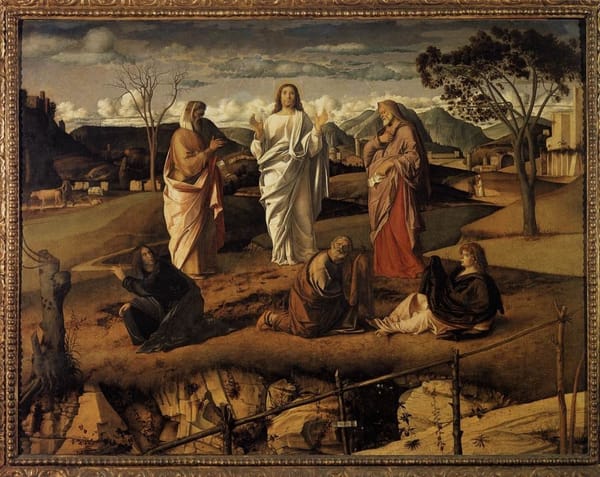
O GOD, who in the glorious Transfiguration of Thine only-begotten Son, didst confirm the mysteries of the faith by the testimony of the fathers: and who, in the voice which came from the bright cloud, didst in a wonderful manner fore-signify our adoption as sons: mercifully vouchsafe to make us fellow-heirs of that King of glory, and the sharers of His bliss.' Such is the formula which sums up the prayer of the Church and shows us her thoughts on this day of attestation and of hope.
We must first notice that the glorious Transfiguration has already been twice brought before us on the sacred cycle—viz., on the second Sunday of Lent, and on the preceding Saturday. What does this mean, but that the object of the present solemnity is not so much the historical fact already known, as the permanent mystery attached to it; not so much the personal favour bestowed on Simon Peter and the sons of Zebedee, as the accomplishment of the great message then entrusted to them for the Church? Tell the vision to no man, till the Son of Man be risen from the dead.1 The Church, born from the open side of the Man-God on the Cross, was not to behold Him face to face on earth; after His Resurrection, when He had sealed His alliance with her in the Holy Ghost sent down from heaven, it is on faith alone that her love was to be fed. But by the testimony which takes the place of sight, her lawful desires to know Him were to be satisfied. Wherefore, for her sake, giving truce, one day of His mortal life, to the ordinary law of suffering and obscurity He had taken upon Him for the world’s salvation, He allowed the glory which filled His blessed soul to transpire. The King of Jews and Gentiles revealed Himself upon the mountain, where His calm splendour eclipsed for evermore the lightnings of Sinai; the covenant of the eternal alliance was declared, not by the promulgation of a law of servitude engraven upon stone, but by the manifestation of the Lawgiver Himself, coming as Bridegroom to reign in grace and beauty over hearts. Elias and Moses, representing the prophets and the Law whereby His coming was prepared, from their different starting-points, met beside Him like faithful messengers reaching their destination; they did homage to the Master of their now finished mission, and effaced themselves before Him at the voice of the Father: This is My beloved Son! Three witnesses the most trustworthy of all assisted at this solemn scene: the disciple of faith, the disciple of love, and that other son of thunder who was to be the first to seal with His blood both the faith and the love of an apostle. By His order they kept religiously, as beseemed them, the secret of the King, until the day when the Church could be the first to receive it from their predestined lips.
But did this precious mystery take place on August 6? More than one doctor of sacred rites affirms that it did.2 At any rate, it was fitting to celebrate it in the month dedicated to Eternal Wisdom. It is she, the brightness of eternal light, the unspotted mirror and image of God's goodness,3 who, shedding grace upon the Son of man, made Him on this day the most beautiful amongst all His brethren, and dictated more melodiously than ever to the inspired singer the accents of the Epithalamium: My heart hath uttered a good word: I speak my works to the king.4
Seven months ago the mystery was first announced by the gentle light of the Epiphany; but by the virtue of the mystical seven here revealed once more, the ‘beginnings of blessed hope’5 which we then celebrated as children with the Child Jesus, have grown together with Him and the Church; and the latter, established in unspeakable peace by the full growth which gives her to her Spouse, calls upon all her children to grow like her by the contemplation of the Son of God, even to the measure of the perfect age of Christ. We understand, then, why the liturgy of to-day repeats the formulas and chants of the glorious Theophany: Arise, be enlightened, O Jerusalem: for thy light is come, and the glory of the Lord is risen upon thee:6 it is because on the mountain together with our Lord the Bride also is glorified, having the glory of God.
While the face of Jesus shone as the sun, His garments became white as snow.7 Now these garments so snowwhite, as St. Mark observes, that no fuller on earth could have bleached them so, are the just men, the royal ornament inseparable from the Man-God, the Church, the seamless robe woven by our sweet Queen for her Son out of the purest wool and most beautiful linen that the valiant woman could find. Although our Lord personally has now passed the torrent of suffering and entered for ever into His glory, nevertheless the bright mystery of the Transfiguration will not be complete until the last of the elect, having passed through the laborious preparation at the hands of the Divine Fuller and tasted death, has joined in the Resurrection of our adorable Head. O Face of our Saviour that dost ravish the heavens, then will all glory, all beauty, all love shine forth from Thee. Expressing God by the perfect resemblance of true Son by nature, Thou wilt extend the good pleasure of the Father to that reflection of His Word which constitutes the sons of adoption, and reaches in the Holy Ghost even to the lowest fringes of His garment which fills the temple below Him. According to the doctrine of the Angel of the schools, the adoption of sons of God, which consists in being conformable to the image of the Son of God by nature, is wrought in a double manner: first by grace in this life, and this is imperfect conformity; and then by glory in patria, and this is perfect conformity, according to the words of St. John: We are now the sons of God; and it hath not yet appeared what we shall be. We know that when He shall appear, we shall be like to Him: because we shall see Him as He is.8 The word of eternity, Thou art My Son, this day have I begotten Thee, has had two echoes in time, at the Jordan and on Thabor; and God, who never repeats Himself, did not herein make an exception to the rule of saying but once what He says. For although the terms used on the two occasions are identical, they do not tend, as St. Thomas says, to the same end, but show the different ways in which man participates in the resemblance of the eternal filiation. At the baptism of our Lord, where the mystery of the first regeneration was declared, as at the Transfiguration which manifested the second, the whole Trinity appeared: the Father in the voice, the Son in His Humanity, the Holy Ghost under the form, first of a dove, and afterwards of a bright cloud; for if in baptism this Holy Spirit confers innocence symbolized by the simplicity of the dove, in the Resurrection he will give to the elect the brightness of glory and the refreshment after suffering which are signified by the luminous cloud.
But without waiting for the day when our Saviour will renew our very bodies conformable to the bright glory of His own divine Body, the mystery of the Transfiguration is wrought in our souls already here on earth. It is of the present life that St. Paul says and the Church sings to-day: God, who commanded the light to shine out of darkness, hath shined in our hearts, to give the light of the knowledge of the glory of God, in the face of Christ Jesus.9 Thabor, holy and divine mountain rivalling heaven,10 how can we help saying with Peter: ‘It is good for us to dwell on thy summit P For thy summit is love; it is charity which towers above the other virtues, as thou towerest in gracefulness, and loftiness, and fragrance over the other mountains of Galilee, which saw Jesus passing, speaking, praying, working prodigies, but did not know Him in the intimacy of the perfect. It is after six days, as the Gospel observes, and therefore in the repose of the seventh which leads to the eighth of the resurrection, that Jesus reveals Himself to the privileged souls who correspond to His love. The Kingdom of God is within us; when, leaving all impressions of the senses as it were asleep, we raise ourselves above the works and cares of the world by prayer, it is given us to enter with the Man-God into the cloud: there beholding the glory of the Lord with open face, as far as is compatible with our exile, we are transformed into the same image from glory to glory, as by the Spirit of the Lord.11
‘Let us then,' cries St. Ambrose, ‘ ascend the mountain; let us beseech the Word of God to show Himself to us in His splendour, in His beauty; to grow strong and proceed prosperously, and reign in our souls. For behold a deep mystery! According to thy measure, the Word diminishes or grows within thee. If thou reach not that summit, high above all human thought, Wisdom will not appear to thee; the Word shows Himself to thee as in a body without brightness and without glory’12
If the vocation revealed to thee this day be so great and so holy, ‘reverence the call of God,’ says St. Andrew of Crete:13‘do not ignore thyself, despise not a gift so great, show not thyself unworthy of the grace, be not so slothful in thy life as to lose this treasure of heaven. Leave earth to the earth, and let the dead bury their dead; disdaining all that passes away, all that dies with the world and the flesh, follow even to heaven, without turning aside, Christ who leads the way through this world for thee. Take to thine assistance fear and desire, lest thou faint or lose thy love. Give thyself up wholly; be supple to the Word in the Holy Ghost, in order to attain this pure and blessed end: thy deification, together with the enjoyment of unspeakable goods. By zeal for the virtues, by contemplation of the truth, by wisdom, attain to Wisdom, who is the principle of all, and in whom all things subsist.'
The feast of the Transfiguration has been kept in the East from the earliest times. With the Greeks, it is preceded by a vigil and followed by an octave, and on it they abstain from servile work, from commerce, and from law-suits. Under the graceful name of Rose-flame, rosœ coruscatio, we find it in Armenia at the beginning of the fourth century supplanting Diana and her feast of flowers, by the remembrance of the day when the divine Rose unfolded for a moment on earth its brilliant corolla. It is preceded by a whole week of fasting, and counts among the five principal feasts of the Armenian cycle, where it gives its name to one of the eight divisions of the year. Although the Menology of this Church marks it on the sixth of August like that of the Greeks and the Roman Martyrology, it is nevertheless always celebrated there on the seventh Sunday after Pentecost; and by a coincidence full of meaning, they honour on the preceding Saturday the Ark of the Covenant of the Lord, a figure of the Church.
The origin of to-day's feast in the West is not so easy to determine. But the authors who place its introduction into our countries as late as 1457, when Callixtus III promulgated by precept a new Office enriched with indulgences, overlook the fact that the pontiff speaks of the feast as already widespread and ‘commonly called of the Saviour.’14 It is true that in Rome especially the celebrity of the more ancient feast of St. Sixtus II, with its double Station at the two cemeteries which received respectively the relics of the pontiff-martyr and those of his companions, was for a long time an obstacle to the acceptance of another feast on the same day. Some churches, to avoid the difficulty, chose another day in the year to honour the mystery. As the feast of our Lady of the Snow, so that of the Transfiguration had to spread more or less privately, with various offices and masses,15 until the supreme authority should intervene to sanction and bring to unity the expressions of the devotion of different Churches. Callixtus III considered that the hour had come to consecrate the work of centuries; he made the solemn and definitive insertion of this feast of triumph on the universal Calendar the memorial of the victory which arrested, under the walls of Belgrade in 1456, the onward march of Mahomet II, conqueror of Byzantium, against Christendom.
Already in the ninth century, if not even earlier, martyrologies and other liturgical documents16 furnish proofs that the mystery was celebrated with more or less solemnity, or at least with some sort of commemoration, in divers places. In the twelfth century Peter the Venerable, under whose government Cluny took possession of Thabor, ordained that ‘in all the monasteries or churches belonging to his order, the Transfiguration should be celebrated with the same degree of solemnity as the Purification of our Lady'; and he gave for his reason, besides the dignity of the mystery, the 'custom, ancient or recent, of many churches throughout the world, which celebrate the memory of the said Transfiguration with no less honour than the Epiphany and the Ascension of our Lord.’17
On the other hand at Bologna, in 1233, in the juridical instruction preliminary to the canonization of St. Dominic, the death of the saint is declared to have taken place on the feast of St. Sixtus, without mention of any other.18 It is true, and we believe this detail is not void of meaning, that a few years earlier, Sicardus of Cremona thus expressed himself in his Mitrale: 'We celebrate the Transfiguration of our Lord on the day of St. Sixtus.’19 Is not this sufficient indication that while the feast of the latter continued to give its traditional name to the eighth of the Ides of August, it did not prevent a new and greater solemnity from taking its place beside it, preparatory to absorbing it altogether? For he adds: ‘Therefore on this same day, as the Transfiguration refers to the state in which the faithful will be after the resurrection, we consecrate the Blood of our Lord from new wine, if it is possible to obtain it, in order to signify what is said in the Gospel: I will not drink from henceforth of this fruit of the vine, until that day when I shall drink it with you new in the kingdom of My Father.20 But if it cannot be procured, then at least a few ripe grapes are pressed over the chalice, or else grapes are blessed and distributed to the people.’21
The author of the Mitrale died in 1215; yet he was only repeating the explanation already given in the second half of the preceding century by John Beleth, Rector of the Paris University.22 We must admit that the very ancient benedictio uvœfound in the Sacramentaries on the day of St. Sixtus has nothing corresponding to it in the life of the great pope which could justify our referring to him. The Greeks, who have also this blessing of grapes fixed for August 6,23 celebrate on this day the Transfiguration alone, without any commemoration of Sixtus II. Be it as it may, the words of the Bishop of Cremona and of the Rector of Paris prove that Durandus of Mende, giving at the end of the thirteenth century the same symbolical interpretation,24 did but echo a tradition more ancient than his own time.
St. Pius V did not alter the ancient office of the feast, except the lessons of the first and second Nocturns, which were taken from Origen,25 and the three hymns for Vespers, Matins, and Lauds, which resembled somewhat in structure the corresponding hymns of the Blessed Sacrament.26 The hymn now used for Vespers and Matins, which we here give, is borrowed from the beautiful canticle of Prudentius on the Epiphany in his Cathemerinon:
Hymn
Oculos in aitimi tollite:
Illic licebit visere
Signum perennis gloriæ.
Quod nesciat finem pati,
Sublime, celsum, interminum,
Antiquius cœlo et chao.
Populique Rex Judaici,
Promissus Abrahæ patri,
Ejusque in ævum semini.
Iisdemque signatoribus
Testator et Pater jubet
Audire nos et credere.
Qui te revelas parvulis,
Cum Patre et almo Spiritu
In sempiterna sæcula.
lift up your eyes to heaven;
there ye may behold
the token of His eternal glory.
that knows no ending,
sublime, noble, interminable,
older than heaven and chaos.
and King of the Jewish people,
who was promised to Abraham our father,
and to his seed for ever.
and the Father, who testifies with them
for His witnesses, bids us
hear and believe Him.
who revealest Thyself to little ones,
with the Father and with the Holy Spirit,
through everlasting ages.
Adam of St. Victor has also sung of this glorious mystery:
Sequence
Ac devote celebremus hæc sacra solemnia;
Ad honorem summi Dei
Hujus laudes nunc diei personet Ecclesia.
Suæ dedit manifesta gloriæ indicia;
Ut hoc possit enarrali
Hic nos suos salutari Repleat et gratia!
Vitæ dator, victor mortis, verus sol justitiæ,
Quam assumpsit carnem de Virgine,
Transformatus in Thabor culmine, glorificat hodie.
Talis enim beatorum erit resurrectio.
Sicut fulget sol pleni luminis,
Fulsit Dei vultus et hominis, Teste Evangelio.
Deitatis fuit testis et futuræ gloriæ.
Mirus honor et sublimis:
Mira, Deus, tuæ nimis virtus est potentiæ.
Petro, natis Zebedæi majestatis gloriam
Demonstraret manifeste,
Ecce vident, Luca teste, Moysen et Eliam.
Quod loquentes erant Deo Dei Patris Filio:
Vere sanctum, vere dignum
Loqui Deo et benignum, plenum omni gaudio.
Quæ sacratur voce Dei, honor est eximius;
Nubes illos obumbravit,
Et vox Patris proclamavit: Hic est meus Filius.
Habet enim verba vitæ, Verbo potens omnia.
Hic est Christus, rex cunctorum.
Mundi salus, lux sanctorum, Lux illustrans omnia.
Per quem perdit jus acerbum quod in nobis habuit
Hostis nequam, serpens dirus,
Qui, fundendo suum virus Evæ, nobis nocuit.
Qui surgendo reparavit
Vitam Christus et damnavit Mortis magisterium.
Hic est Christus, pax æterna,
Ima regens et superna,
Cui de cœlis vox paterna confert testimonium.
Patres illi tres præfati
Et in terram sunt prostrati quando vox emittitur.
Surgunt tandem, annuente
Sibi Christo, sed intente
Circumspectant, cum repente Solus Jesus cernitur.
Non permisit enarrari,
Donec, vitæ reparator,
Hostis vitæ triumphator. Morte victa, surgeret.
Hæc est dies laude digna
Qua tot sancta fiunt signa;
Christus, splendor Dei
Patris Prece sancta suæ matris nos a morte liberet.
Sit cum summa potestate Laus et honor debitus!
and devoutly celebrate these sacred solemnities;
let the Church resound with the praises of this day
to the honour of the most high God.
give manifest signs of His great glory;
that we may recount the same,
may He give us His aid and fill us with His grace.
the giver of life, and conqueror of death, the true Sun of justice,
to-day transfigured on Thabor’s height,
did glorify the flesh He had taken of the Virgin.
For such will be the resurrection of the blessed.
As shines the sun in fulness of his light, so shone
the countenance of God and Man, as the Gospel testifieth.
gave testimony of His Godhead and of the glory to come.
Wondrous the honour and sublime;
wondrous exceedingly, O God, is the power of Thine almightiness.
to Peter and the sons of Zebedee did clearly show
the glory of His majesty, lo!
they beheld, as Luke doth testify, Moses and Elias.
that they were seen speaking with God, the Son of God the Father.
Oh! how noble and how holy,
how good and full of all joy, to speak to God!
consecrated by the voice of God, and exceeding is its honour;
a cloud did overshadow them,
and the Father’s voice proclaimed: 'This is my Son.'
for the words of life hath He, Who can do all things by His word.
This is Christ, the King of all,
the world’s salvation and the light of saints, the light enlightening all things.
by whom He destroys the bitter law set in us
by the wicked enemy, the cruel serpent,
who, pouring out his poison upon Eve, did work our ruin.
who by rising restored
our life and condemned the tyranny of death.
This is Christ, the eternal peace,
ruling both depths and height;
to whom from heaven the Father’s voice bore testimony.
those three aforesaid fathers
were afraid, and prostrated on the earth when the word was uttered.
At length they rise,
Christ bidding them;
they gaze around intently, but at once see none but Jesus.
suffers them not to be uttered,
until the restorer of life
and conqueror of life’s enemy should rise triumphant over death.
This is the day so worthy of praise,
whereon are wrought so many holy signs;
may Christ, the splendour of God the Father,
by the prayer of His holy Mother, deliver us from death.
be, together with highest power, the praise and honour due!
The Menæa of the Greeks offers us these stanzas from St. John Damascene:
Mensis Augusti Die VI
(In Matutino)
It will be well to borrow also from the Church of Armenia, which celebrates this feast with so much solemnity:
In Transfiguratione Domini
Let us conclude by addressing to God this prayer of the Ambrosian Missal:
Oratio Super Sindonem
- St. Matt. xvii. 9. ↩︎
- Sicard. Cremon. Mitrale, ix. 38; Beleth. Rationale, cxliv.; Durand, vii., xxii., etc. ↩︎
- Alleluia verse fr. Wisd. vii. 26. ↩︎
- Gradual fr. Ps. xliv. 2, 3. ↩︎
- Leon. in Epiph., Sermo ii. 4. ↩︎
- 1st Responsory of Matins from Isaias lx. 1. ↩︎
- St. Matt xvii. 2. ↩︎
- 1 John iii. 2. ↩︎
- 8th Responsory of Matins fr. 2 Cor. iv. 6. ↩︎
- Joan. Damasc. Orat. in Transfig. iii. ↩︎
- Capit of Sext, fr. 2 Cor. iii. 18. ↩︎
- Ambr. in Luc., lib. vii., 12. ↩︎
- Andr. Hibrosolymitani, Archiepisc. Cretensis, Oratio in Transfig. ↩︎
- Callixt. III Const. Inter Divinæ dispensationis arcana. ↩︎
- Schulting, on this date; Tommasi, Antiphoner. ↩︎
- Wandalbert; Eldefons. ↩︎
- Statuta Cluniac. V. ↩︎
- Deposition of the Prior of St Nicholas. ↩︎
- Sicard. Mitrale, ix., xxxviii. ↩︎
- St. Matt. xxvi. 29. ↩︎
- Sicard. Ibid ↩︎
- Beleth. Rationale, cxliv. ↩︎
- Eucholog. ↩︎
- Durand. Rationale, vii., xxii. ↩︎
- Homil. xii. in Exod. De vultu Moysi gloriflcato et velamine quod ponebat in facie sua. ↩︎
- Gaude, mater pietatis. Exultet laudibus sacrata concio. Novum sidus exoritur. ↩︎
August 6 (the Same Day): St. Sixtus II, Pope and Martyr; and Ss. Felicissimus and Agapitus, Martyrs
|
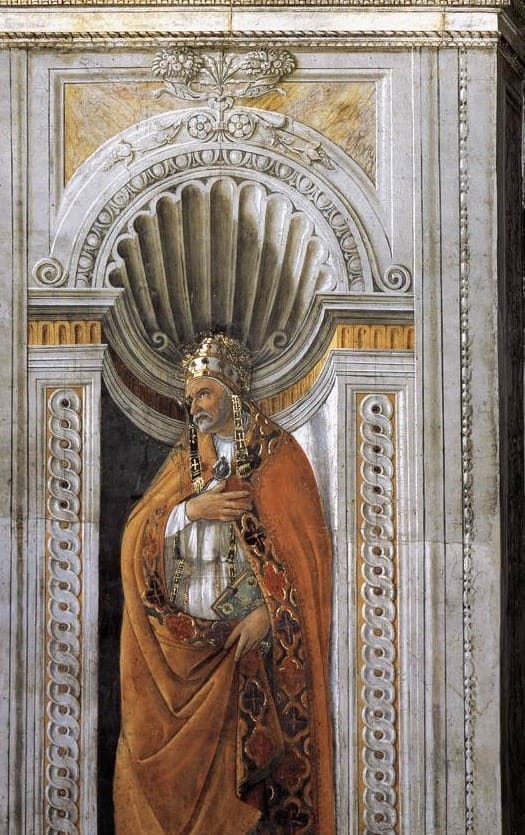
XISTUM in cimiterio animadversum sciatis octavo iduum augustarum die. Know that Sixtus has been beheaded in the cemetery on the eighth of the Ides of August.1
These words of St. Cyprian mark the opening of a glorious period, both for the cycle and for history. From this day to the feast of St. Cyprian himself, taking in that of the deacon Laurence, how many holocausts in a few weeks does the earth offer to the most high God! One would think that the Church, on the feast of our Lord’s Transfiguration, was impatient to join her testimony as Bride to that of the prophets, of the apostles, and of God Himself. Heaven proclaims Him well-beloved, the earth also declares its love for Him: the testimony of blood and of every sort of heroism is the sublime echo awakened by the Father’s voice through all the valleys of our lowly earth, to be prolonged throughout all ages.
Let us, then, to-day salute this noble pontiff, the first to go down into the arena opened wide by Valerian to all the soldiers of Christ. Among the brave leaders who, from Peter down to Melchiades, have headed the struggle whereby Rome was both vanquished and saved, none is more illustrious as a martyr. He was seized in the catacomb lying to the left of the Appian Way, in the very chair wherein, in spite of the recent edicts, he was presiding over the assembly of the brethren; and after the sentence had been pronounced by the judge, he was brought back to the sacred crypt. There in that same chair, in the midst of the martyrs sleeping in the surrounding tombs their sleep of peace, the good and peaceful pontiff2 received the stroke of death. Of the seven deacons of the Roman Church six died with him;3 Laurence alone was left, inconsolable at having this time missed the palm, but trusting in the invitation given him to be at the heavenly altar in three days’ time.
Two of the pontiff’s deacons were buried in the cemetery of Prætextatus, where the sublime scene had taken place. Sixtus and his blood-stained chair were carried to the other side of the Appian Way into the crypt of the Popes, where they remained for long centuries an object of veneration to pilgrims. When Damasus, in the days of peace, adorned the tombs of the saints with his beautiful inscriptions, the entire cemetery of Callixtus, which includes the burial-place of the Popes, received the title ‘of Cæcilia and of Sixtus,’ two glorious names inscribed by Rome upon the venerable diptychs of the Mass. Twice over on this day did the holy Sacrifice summon the Christians to honour, at each side of the principal way to the Eternal City, the triumphant victims of the eighth of the Ides of August.4
The following Preface from the Leonine Sacramentary breathes the freshness of the Church's triumph over persecution:
Preface
The Prayer now in use is that found in the Gregorian Sacramentary for Saints Felicissimus and Agapitus, the name of Saint Sixtus having been placed before theirs:
Prayer
| Previous August 5: Our Lady of the Snow | Next August 6: Transfiguration of Our Lord |