Daily reading
After Pentecost
Double · Movable from Easter · Temporal
August 20, 2023
From Dom Guéranger’s The Liturgical Year.

|
The Twelfth Sunday after Pentecost
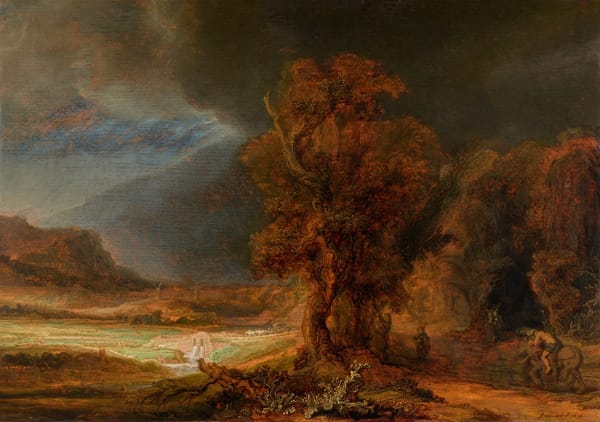
On this Sunday, which is their twelfth of Saint Matthew, the Greeks read in the Mass the episode of the young rich man who questions Jesus, given in the nineteenth chapter of the Saint’s Gospel. In the west, it is the Gospel of the Good Samaritan which gives its name to this twelfth Sunday after Pentecost.
The Introit begins with that beautiful verse of Psalm lxix. : 'Come to mine assistance, O God! O Lord, make haste to help me!’ Cassian, in his tenth Conference, has admirably drawn out the beauty of these words, and shows how they are appropriate for every circumstance of life, and how fully they respond to every sentiment of the Christian soul.1 Durandus applies this Introit to Job, because the lessons for the Divine Office, which are taken from that Book of Scripture, sometimes, though not often, coincide with this Sunday.2 Rupert looks on this Introit as the fitting prayer of the deaf and dumb man, whose cure was the subject of our reflexions this day last week. He says : 'The human race, in the person of our first parents, had become deaf to the commandments of God, and dumb in His praise; the first use he makes of his untied tongue, is to call upon the God who has healed him.'3 The same words are the Church’s first address, each morning, to her Creator, and her opening of each of the canonical hours, both day and night.
Introit
It frequently happens (and we have already explained the reason), that the Collect of the Masses for the Time after Pentecost contains an allusion to the Gospel of the foregoing Sunday. The one for to-day evidently does so. Eight days back, we were taught how man, who had rendered himself incapable of serving his Creator, finds by divine mercy, that his supernatural faculties are restored to him; and then, he gives forth the voice of praise, and that, too, rightly (loquebatur recte). The Church, taking up the idea here suggested, prays thus:
Collect
The other Collects, as on page 120.
Epistle
2 Cap. iii.
Fratres, Fiduciam talem habemus per Christum ad Deum : non quod sufficientes simus cogitare aliquid a nobis, quasi ex nobis : sed sufficientia nostra ex Deo est : qui et idoneos nos fecit ministros novi testamenti, non littera, sed spiritu : litter a enim occidit, spiritus autem vivificat. Quod si ministratio mortis litteris deformata in lapidibus, fuit in gloria, ita ut non possent intendere filii Israel in faciem Moysi, propter gloriam vultus ejus, quæ evacuatur : quomodo non magis ministratio spiritus erit in gloria? Nam si ministratio damnationis gloria est: multo magis abundat ministerium justitiæ in gloria.
2 Ch. iii.
The glorious promises mentioned in the concluding words of our Collect are described to us in the Epistle, which seems, at first sight, to be entirely in praise of the apostolic ministry; but the glory of the apostles is the glory of Him whom they announce; and this one glory, which is His, Christ, the Head, communicates to all His members, making it also their one glory. This divine glory flows, together with the divine life, from that sacred Head; and they both flow copiously through all the channels of holy Church.4 If they do not come to all Christians in the same proportions, such difference in no wise denotes that the glory and the life themselves are of a different kind for some from what they are for others. Each member of Christ's mystical Body is called upon to form his own degree of capacity for glory; not, of course, as the apostle says, that we are, of ourselves, sufficient even to think anything as of ourselves— but, what diversity there is in the way in which men turn to profit the divine capital allotted to each by grace!
Oh! if we did but know the gift of God!5 if we did but understand the supereminent dignity reserved, under the law of love, to every man of good will!6 Then, perhaps, our cowardice and sluggishness would, at last, go; then, perhaps, our souls would get fired with the noble ambition which turns men into saints. At all events, we should then come to realize that Christian humility, of which we were speaking on the last two Sundays, is not the vulgar grovelling of a low-minded man, but the glorious entrance upon the way which leads, by divine union, to the only true greatness. Are not those men inconsistent and senseless who, longing by the very law of their nature for glory, go seeking it in the phantoms of pride, and allow themselves to be diverted, by the baubles of vanity, from the pursuit of those real honours which eternal Wisdom7 had destined for them! And those grand honours were to have been heaped upon them, not only in their future heaven, but even here in their earthly habitation; and God and His saints were to have been admiring and applauding spectators!
In the name, then, of our dearest and truest interests, let us give ear to our apostle, and share his heavenly enthusiasm. We shall understand his exquisite teaching all the better, if we read the sequel to the few lines assigned for to-day’s Epistle. It is but fully carrying out the wishes of the Church, when her children, after or before assisting at her liturgical services, take the sacred Scriptures, and read for themselves the continuation of passages, which are necessarily abridged during the public celebrations. It were well, if they did this all through the year. What a fund of instruction they would thus acquire! To-day, however, there is an additional motive for the suggestion, inasmuch as this second Epistle to the Corinthians is brought before us for the first and only time during this season of the liturgy.
But let us examine what is this glory of the new Testament, which so fills the apostle with ecstasy, and, in his mind, almost entirely eclipses the splendour of the old. Splendour there undoubtedly was in the covenant of Sinai. Never had there been such a manifestation of God’s majesty, and omnipotence, and holiness, as on that day, when, gathering together, at the foot of the mount, the descendants of the twelve sons of Jacob, He mercifully renewed, with this immense family, the covenant formerly made with their fathers,8 and gave them His Law in the extraordinarily solemn manner described in the Book of Exodus. And yet, that Law, engraven as it was on stone by God’s own hand, was not, for all that, in the hearts of the receivers; neither did its holiness prevent, though it condemned, sin—sin which reigns in man’s heart.19 Moses, who carried the divine writing, came down from the mount, having the rays of God’s glory glittering on his face;10 but this glory was not to be shared in by the people of whom he was the head; it was for himself alone, as was likewise the privilege he had enjoyed of speaking with God face to face;11 it ceased with him, thus signifying, by its short duration, the character of that ministration, which was to cease on the coming of the Messiah, just as the night’s borrowed light vanishes when the day appears. And, as it were, the better to show that the time was not as yet come, when God would manifest His glory—the children of Israel were not able to gaze steadfastly on the face of Moses; so that, when he had to speak to the people, he had need to put on a veil. Though a mere borrowed light, the brightness of Moses’ face represented the glory of the future Covenant, whose splendour was to shine, not, of course, externally, but in the hearts of us all, by giving us 'the light of the knowledge of the glory of God, in the face of Christ Jesus.'12 Light, living and life-giving, which is none other than the divine Word,13 the Wisdom of the Father,14 and which the energy of the sacraments, seconded by contemplation and love, makes to pass from the Humanity of our divine Head to the very recesses of our souls.
We shall find our Sunday giving us a second reminder of Moses; but the true and enduring greatness of the Hebrew leader lies in what we have been stating. In the same way that Abraham was grander by the spiritual progeny which was the issue of his faith, than he was by the posterity that was his in the flesh—so the glory of Moses consisted not so much in his having been at the head of the ancient Israelites for forty long years, as in his having represented, in his own person, both the office of the Messiah King, and the prerogatives of the new people. The Gentile is set free from the law of fear and sin15 by the law of grace, which not only declares justice, but gives it; the Gentile, having been made a son of God,16 communes with Him in that liberty which comes of the Spirit of love.17 But, this privileged Gentile has no type which so perfectly represents him, in the first Covenant, as this the very lawgiver of Israel, this Moses who finds such favour with the Most High as to be admitted to behold His glory,18 and converse with Him with all the intimacy of friend to friend.19 Whereas God showed Himself to this His servant —as far, that is, as mortal man is capable of such sight20—and as He was seen by him without the intermediation of figures or images,21 so, when he approached thus to God, Moses took from his face the veil he wore at other times. The Jew persists, even to this very day, in keeping this veil between himself and Christ.22 The Christian, on the contrary, with the holy daring of which the apostle speaks,23 removes all intermediaries between God and himself, and draws aside the veil of all figures. ‘Beholding the glory of the Lord with face uncovered, we are transformed into the same image from glory to glory, as by the Spirit of the Lord,’24 for we become other christs, and are made like to God the Father, as is His Son Christ Jesus.
Thus is fulfilled the will of the almighty Father for the sanctification of the elect. God sees Himself reflected in these predestinated, who are become, in the beautiful light divine, conformable to the image of His Son.25 He could say of each one of them what He spoke at the Jordan and on Thabor: ‘This is my beloved son, in whom I am well pleased.’26 He makes them His true temple,27 verifying the word He spoke of old : ‘I will set my tabernacle in the midst of you: I will walk among you, and will be your God;28 I will bring thy seed from the east, and gather thee from the west; I will say to the north : “Give up!” and to the south: “Keep not back!” Bring my sons from afar, and my daughters from the ends of the earth!’29
Such are the promises, for whose realization we should, as the apostle says, be all earnestness in working out our sanctification, by cleansing ourselves from all defilement of the flesh and of the spirit, in the fear of God,30 and in His love. Such is that glory of the new Testament, that glory of the Church and of every Christian soul, which so immensely surpasses the glory of the old, and the brightness which lit up the face of Moses. As to our carrying this treasure in frail vessels, we must not, on that account, lose heart, but rather rejoice in this weakness, which makes God's power all the more evident; we must take our miseries, and even death itself, and turn them into profit, by giving the stronger manifestation of our Lord Jesus’ life in this our mortal flesh. What matters it to our faith and our hope, if our outward man is gradually falling to decay, when the inner is being renewed day by day? The light and transitory suffering of the present is producing within us an eternal weight of glory. Let us, then, fix our gaze, not on what is seen, but on what is unseen; the visible passes, the invisible is eternal.31
The human race, delivered from its long ages of dumbness, and blessed at the same time with God’s gifts, sings, in the Gradual, the hymn of its warmest gratitude.
Gradual
Gospel
Cap. x.In illo tempore : Dixit Jesus discipulis suis : Beati oculi, qui vident quæ vos videtis. Dico enim vobis, quod multi prophetæ, et reges voluerunt videre quæ vos videtis, et non viderunt : et audire quæ auditis, et non audierunt. Et ecce quidam legisperitus surrexit tentans illuni, et dicens: Magister, quid faciendo vitam æternam possidebo? At ille dixit ad eum : In lege quid scriptum est? quomodo legis? Ille respondens dixit : Diliges Domimim Deum tuum ex toto corde tuo, et ex tota anima tua, et ex omnibus viribus tuis, et ex omni mente tua : et proximum tuum sicut teipsum. Dixitque illi : Recte respondisti : hoc fac, et vives. Ille autem volens justificare seipsum, dixit ad Jesum: Et quis est meus proximus? Suscipiens autem Jesus, dixit: Homo quidam descendebat ab Jerusalem in Jericho, et incidit in latrones, qui etiam despoliaverunt eum : et plagis impositis abierunt, semivivo relicto. Accidit autem ut sacerdos quidam descenderet eadem via : et viso illo, præterivit. Similiter et Levita, cum esset secus locum, et videret eum, pertransiit. Samaritanus autem quidam iter faciens, venit secus eum : et videns eum, misericordia motus est. Et appropians, alligavit vulnera ejus, infundens oleum, et vinum : et imponens illum in jumentum suum, duxit in stabulum, et curam ejus egit. Et altera die protulit duos denarios, et dedit stabulario, et ait : Curam illius habe : et quodeumque supererogaveris, ego cum rediero, reddam tibi. Quia horum trium videtur tibi proximus fuisse illi, qui incidit in latrones? At ille dixit: Qui fecit misericordiam in ilium. Et ait illi Jesus: Vade, et tu fac similiter.
Ch. x.At that time : Jesus said to his disciples : Blessed are the eyes that see the things which you see. For I say to you, that many prophets and kings have desired to see the things that you see, and have not seen them : and to hear the things that you hear, and have not heard them. And behold, a certain lawyer stood up, tempting him, and saying: Master, what must I do to possess eternal life? But he said to him : What is written in the law? how readest thou? He answering said: Thou shalt love the Lord thy God with thy whole heart, and with thy whole soul, and with all thy strength, and with all thy mind : and thy neighbour as thyself. And he said to him : Thou hast answered right: this do and thou shalt live. But he willing to justify himself, said to Jesus : And who is my neighbour? And Jesus answering said: A certain man went down from Jerusalem to Jericho, and fell among robbers, who also stripped him, and having wounded him, went away, leaving him half dead. And it chanced that a certain priest went down the same way: and seeing him, passed by. In like manner also a levite, when he was near the place, and saw him, passed by. But a certain Samaritan, being on his journey, came near him; and seeing him, was moved with compassion. And going up to him, bound up his wounds, pouring in oil and wine; and setting him upon his own beast, brought him to an inn, and took care of him. And the next day, he took out two pence, and gave to the host, and said: Take care of him; and whatsoever thou shalt spend over and above, I at my return will repay thee. Which of these three in thy opinion was neighbour to him that fell among the robbers? But he said: He that showed mercy to him. And Jesus said to him: Go, and do thou in like manner.
The doctor and apostle of the Gentiles was speaking to us, in the Epistle, of the glory of the new Testament: Jesus, the Man-God, of whom Paul was but the servant, reveals to us, in the Gospel, the perfection of that Law, which He came to give to the world. And as though He would, in a certain way, unite His own divine teachings with those of His apostle, and justify that apostle’s enthusiasm, it is from the very depth of His own most holy soul, and in the Holy Ghost,32 that, having thanked His eternal Father for these great things, He cries out, turning to His disciples: Blessed are the eyes that see the things which ye see!
The same idea was expressed by the prince of the apostolic college, alluding to the unspeakable and glorious joy,33 which resulted from the new Alliance, wherein figures were to be replaced by realities. In his first Epistle to the elect of the holy Spirit,34 Peter speaks, in the same strain as his divine Master35 had done, of the unfulfilled aspirations of the saints of the old Testament,— those admirable men, whom St. Paul describes36 as being so grand in faith, as to be both heroic in combat and sublime in virtue. St. Peter then expresses, in inspired language, how the elect of the Church of expectation were continually looking forward to the grace of the time that was to come; how they were ever counting the years which were to intervene; how they were carefully searching (scrutinizing, as our Vulgate words it) the long ages, to find out when that happy time would be realized; although they were well aware, that the longed-for sight of the mysteries of salvation was never to be theirs, and that their mission was limited to prophesying those grandeurs to future generations.37
But, who are those kings spoken of in our Gospel, as uniting with the prophets in the desire to see the things we see? To say nothing of those holy ones who thought less of the throne they sat on, than of the divine Object of the world’s expectation,—may we not say, with the holy fathers,38 that those well deserved to be called kings, whom St. Paul describes as, by their faith, conquering kingdoms, vanquishing armies, stopping the mouths of lions, masters of the very elements, yea, what is more, masters of themselves? Heedless of the mockeries, as well as of the persecutions, of the world that was not worthy to possess such men, these champions of the faith were seen wandering in the deserts, sheltering in dens and caves, and yet happy in the love of One whom they knew they were not to see until long ages after their death.39
Do we, then, who are their descendants,—we for whom they were obliged to wait, in order to enjoy a share of those blessings which their sighs and vehement desires did so much to hasten,—appreciate the immense favour bestowed on us by our Lord? Our virtue scarcely bears comparison with that of the fathers of our faith; and nevertheless, by the descent of the holy Spirit of love, we have been more enlightened than ever were the prophets, for, by that holy Spirit, we have been put in possession of the mysteries which they only foretold. How is it, then, that we are so sadly slow to feel the obligation we are under of responding, by holiness of life,40 and by an ardent and generous love, to the liberality of that God, who has gratuitously called us from darkness to His admirable light?41 Having so great a cloud of witnesses over our heads, let us lay aside the burden of sin which impedes us, and run, by patience, in the fight proposed to us. Let us fix our eyes on Jesus, the author and finisher of faith, who, having joy set before Him, preferred to endure the cross, despising the shame, and now sitteth on the right hand of the throne of God.42 We know Him with greater certainty than we do the events which are happening under our eyes, for He Himself, by His holy Spirit, is ever within us, incorporating His mysteries into us.
The illumination of holy Baptism has produced within our souls that revelation of Christ Jesus which constitutes the basis of the Christian life, and on which the Man-God congratulated His disciples. It was of that revelation or knowledge that He spoke, rather than of the exterior sight of His human Nature, a sight which was common not only to His devoted followers, but to every enemy that chose to stare at Him. The apostle of the Gentiles makes this very clear, when, after the change produced in the disciples by the Holy Ghost’s coming upon them, he thus spoke : ‘If we once knew Christ according to the flesh, now we know Him so no longer.’43 It is literally in us, and no longer in the cities of Judea, that the kingdom of God is to be found.44 It is faith that shows us the Christ, who is dwelling in our hearts, that He may establish us in charity, and grow in us, by transforming us into Himself, and fill us with all the fullness of God.45 It is by fixing his eye on the divine image which silently lights up the soul that has been purified by Baptism that, as we were just now saying, the inner man is renewed from day to day, by incessant contemplation, and growing love, and persevering and, at last, perfect imitation, of his Creator and Saviour.46
How important it is, then, to let the supernatural light have such free scope and expansion within us, that not one of our acts or thoughts, not even the deepest recess of our hearts, may escape its sovereign influence and guidance! It is on this point, that the Holy Ghost works prodigies in faithful souls: the unrestrained development of His highest gifts, understanding and wisdom, gives such a predominance to the divine light, that the brightness of the sun’s rays pales before it. Breathing, in His omnipotent freedom, when and as He willeth, this holy Spirit does not always wait for the regular development of those gifts which He bestows upon all: the soul, drawn up to heights unreached by the ordinary paths of the Christian life, finds herself plunged in the deepest abyss of Wisdom;47 there she delightedly imbibes the rays which come to her from the eternal summits, and, in their tranquil and radiant simplicity which holds all in itself, she feels that she has the secret of all things. There are moments, when, raised up still higher,— above the region of the senses and the domain of human reasoning, or, as St. Denis the Areopagite words it, above all the intelligible,48—she is permitted to rest her wings on the summit, where dwells the uncreated light in its essence, and whence it streams down even to the furthest limits of creation, lending something of its divine splendour to every creature. Then it is, that mercifully acting on the soul, which cannot yet bear the direct infinite glory, the blessed Trinity shrouds her in that mysterious darkness, of which the saints speak as belonging to these highest degrees of mystical ascension. The darkness, beyond which is the very God of Majesty,49 is an obscurity which penetrates the soul with higher bliss than does light itself; it is a sacred night, whose silence is more eloquent than any sound that this earth could hear; it is a holy of holies, where adoration absorbs the soul; vision is not there, still less is science, and yet, it is in this sanctuary, that understanding and love, acting together in ineffable unison, take hold of the sublimest mysteries of theology.
It is quite true that such favours as these are imparted to but few; and no man can lay the slightest claim to them, be his virtue ever so great, or his fidelity ever so tried. Neither does perfection depend upon them. Faith, which guides the just man, is enough to make him estimate the life of the senses for what it really is,—miserable and grovelling. With the aid of ordinary grace, he easily lives in that intimate retirement of the soul, wherein he knows that the holy Trinity resides; he knows it, because he has it from the teaching of the Scripture.50 His heart is a kind of heaven, where his life is hidden in God, together with that Jesus upon whom are fixed all his thoughts:51 there he gives to his beloved Lord the only proof of love which is to be trusted, the only one that this Lord asks at our hands,—the keeping of the commandments.52 In spite of the ardent longings of his hope, he waits patiently and calmly for that final revelation of Christ, which, on the last day, will give him to appear together with Him in glory :53 for, as without seeing Him he believes in Him, so without seeing Him he knows that he loves Him.54 The ever-advancing growth in virtue, which men observe in such a man, is a more unmistakable proof of the power of faith, than can be those extraordinary manifestations of which we were just speaking, and in which the soul is so irresistibly subdued, that she has scarcely the power to refuse her love.
Hence, it is not without a reason and a connexion that the Gospel chosen for to-day passes at once, after the opening verses which we have been commenting, to the new promulgation of the great commandment, which includes the whole Law and the Prophets.55 Faith assures man that he may and must love the Lord his God with his whole heart, and with his whole soul, and his whole strength, and his whole mind, and his neighbour as himself. In the homily on the sacred text,56 the Church gives us the interpretation as far only as the question proposed by the Jewish lawyer: by this she insinuates that the latter portion of the Gospel, though by far the longer, is but the practical conclusion of the former, according to the saying of the apostle, that faith worketh by charity.57 The parable of the good Samaritan, though containing materials for the sublimest symbolic teaching, is spoken here in its literal sense by our Lord, for the one purpose of removing the restrictions put by the Jews on the great precept of love.
If all perfection be included in love,—if, without love, no virtue produces fruit for heaven,—it is important for us to remember, that love is not of the right kind unless it include our neighbour; and it is only after stating this particular, that St. Paul affirms that love fulfilleth the whole law,58 and that love is the plenitude of the law.59 Thus we find that the greater number of the precepts of the Decalogue concern our duties to our neighbour;60 and we are told, that the love we have for God is only then what it ought to be, when we love not only Him, but also what He loves, that is, when we love man whom He made to His own likeness.61 Hence, the apostle St. Paul does not explicitly distinguish, as the Gospel does, between the two precepts of love. He says:' All the law is fulfilled in one sentence: Thou shalt love thy neighbour as thyself.'62
Such being the importance of this love, it is necessary to have a clear understanding as to the meaning and extent of the word neighbour. In the mind of the Jews, it comprised only their own race; and in this they were following the custom of the pagan nations, to whom every stranger was an enemy. But, here in our Gospel, we have a representative of this Jewish diminished law63 eliciting, from Him who is the author of the law, an answer which declares the precept in all its fullness. This time, He does not make His voice heard amidst thunder and fire, as on Mount Sinaï. He, as Man living and conversing with men,64 reveals to them, and in the most intelligible way possible, the whole import of the eternal commandment which leads to life.65 In a parable (wherein, as many think, He is relating a fact which has really happened, and is known to those to whom He is addressing it), our Jesus describes how there was a man who went forth from the holy city, and how he fell in with a Samaritan, that is, with a stranger the most despised and the most disliked of all those whom an inhabitant of Jerusalem looked on as his enemies.66 And yet, the shrewd lawyer who questions Jesus, and, no doubt, all those who have been listening to the answer, are obliged to own that the neighbour, for the poor fellow who had fallen into the hands of robbers, was not so truly the priest, or the levite (though both of them were of his own race), as this stranger, this Samaritan, who forgets all national grudges as soon as he sees a suffering creature, and cannot look on him in any other light than as a fellow-man. Our Jesus made Himself thoroughly understood; and everyone present must have well learnt the lesson, that the greatest of all laws, the law of love, admits of no exception, either here or in heaven.
The Offertory is taken from the Book of Exodus, where Moses is described as striving with God, striving, that is, to induce Him to spare His people, after their crime of worshipping the golden calf. Moses was permitted to triumph, and God’s anger was appeased. It may sometimes happen that this Sunday falls close upon, or even on, the very day when the Church, in her Martyrology (September 4), makes a commemoration of the Jewish leader; and Honorius of Autun67 tells us, that this is the reason for such frequent mention being made in to-day’s liturgy of this glorious lawgiver of Israel.
Offertory
The Secret prays our Lord to accept graciously the offerings of the Sacrifice— offerings which are made for the purpose of winning pardon for us, and giving honour to His divine majesty.
Secret
The other Secrets, as on page 130.
As on last Sunday, so again to-day, the Communion-anthem evidently alludes to harvest-time and vintage. Bread, wine, and oil, are not only the supports of our material life; they are, also, the matter of the most august of our Sacraments. No moment is so suitable for speaking their praise as that of our having been made sharers in the sacred banquet.
Communion
The life imparted to us by the sacred mysteries, finds in them its perfection, and also its protection; for they are continually removing from us, gradually more and more, those remnants of the evil which had first brought death upon us. Such is the teaching expressed in the Postcommunion.
Postcommunion
The other Postcommunions, as on page 181.
Vespers
The psalms, capitulum, hymn, and versicle, as above, pages 71-81.
Antiphon of the Magnificat
- Cass., Collat., x. 10. ↩︎
- Dur., Rat., vi. 126. ↩︎
- Rup., De div. off., xii. 12. ↩︎
- Eph. iv. 15, 16. ↩︎
- St. John iv. 10. ↩︎
- St. Luke ii. 14. ↩︎
- Ecclus vi. 29-32. ↩︎
- Gen. xv. 18. ↩︎
- Rom. vii 12, 13. ↩︎
- Exod. xxxiv. 29-35. ↩︎
- Ibid. xxxiii. 11. ↩︎
- 2 Cor. iv. 6. ↩︎
- St. John i. 4-9. ↩︎
- Wisd. vii. 25, 26 ↩︎
- Rom. vii. 2. ↩︎
- Ibid. 15. ↩︎
- 2 Cor. iii. 17. ↩︎
- Exod xxxiii. 17-19. ↩︎
- Ibid. 11. ↩︎
- Ibid. 20. ↩︎
- Num. xii. 8. ↩︎
- 2 Cor. iii. 14. ↩︎
- Ibid. 12. ↩︎
- 2 Cor. iii. 18. ↩︎
- Rom. viii. 29. ↩︎
- St. Matt. iii. 17, xvii. 5. ↩︎
- 2 Cor. vi. 16. ↩︎
- Lev. xxvi. 12. ↩︎
- Isa. xliii. 5-7. ↩︎
- 2. Cor. vii. 1. ↩︎
- 2 Cor. iv. 7-18, etc. ↩︎
- St. Luke x. 21-23. ↩︎
- 1 St. Pet. i. 8. ↩︎
- Ibid. 1, 2. ↩︎
- St. Amb., in Luc., x. ↩︎
- Heb. xi. ↩︎
- 1 St. Pet. i. 10-12. ↩︎
- ℣. Beda, in Luc., iii. Homily for the day. ↩︎
- Heb. xi. 33-39. ↩︎
- 11 St. Pet. i. 13-16. ↩︎
- Ibid. ii. 9. ↩︎
- Heb. xii. 1, 2. ↩︎
- 2 Cor. v. 16. ↩︎
- St. Luke xvii. 21. ↩︎
- Eph. iii. 16-19. ↩︎
- Col. iii. 10. ↩︎
- St. Denis Areop., De div. nom., vii. 3. ↩︎
- De myst. theol., i. 1. ↩︎
- Ps. xvii. 12. ↩︎
- St. John xiv. 23. ↩︎
- Col. iii. 3. ↩︎
- St. John. xiv. 21. ↩︎
- Col. iii. 4. ↩︎
- 1 St. Pet. i. 8. ↩︎
- St. Matt. xxii. 36-40. ↩︎
- The Office of Matins. ↩︎
- Gal. v. 6. ↩︎
- Rom. xiii. 8. ↩︎
- Ibid. 10. ↩︎
- Ibid. 9 ↩︎
- 1 St. John iv. 20. ↩︎
- Gal. v. 14. ↩︎
- Ps. xi. 2. ↩︎
- Baruch iii. 38. ↩︎
- Ibid. iv. 1. ↩︎
- St. John iv. 9. ↩︎
- Gemm. anim., iv. 69. ↩︎
August 20: St. Bernard, Abbot and Doctor of the Church
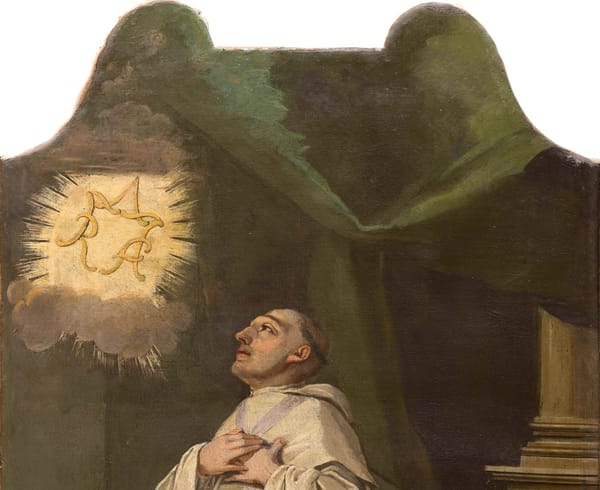 |
THE valley of wormwood has lost its bitterness; having become Clairvaux, or the bright valley, its light shines over the world; from every point of the horizon vigilant bees are attracted to it by the honey from the rock which abounds in its solitude. Mary turns her glance upon its wild hills, and with her smile sheds light and grace upon them. Listen to the harmonious voice arising from the desert; it is the voice of Bernard, her chosen one. 'Learn, O man, the counsel of God; admire the intentions of Wisdom, the design of love. Before bedewing the whole earth, he saturated the fleece; being to redeem the human race, he heaped up in Mary the entire ransom. O Adam, say no more: “The woman whom Thou gavest me offered me the forbidden fruit;" say rather: “The woman whom Thou gavest me has fed me with a fruit of blessing.”With what ardour ought we to honour Mary, in whom was set all the fulness of good! If we have any hope, any saving grace, know that it overflows from her who to-day rises replete with love: she is a garden of delights, over which the divine South Wind does not merely pass with a light breath, but sweeping down from the heights, He stirs it unceasingly with a heavenly breeze, so that it may shed abroad its perfumes, which are the gifts of various graces. Take away the material sun from the world: what would become of our day? Take away Mary, the star of the vast sea: what would remain but obscurity over all, a night of death and icy darkness? Therefore, with every fibre of our heart, with all the love of our soul, with all the eagerness of our aspirations, let us venerate Mary; it is the will of Him who wished us to have all things through her.'1
Thus spoke the monk who had acquired his eloquence, as he tells us himself, among the beeches and oaks of the forest,2 and he poured into the wounds of mankind the wine and oil of the Scriptures. In 1113, at the age of twenty-two, Bernard arrived at Citeaux, in the beauty of his youth, already ripe for great combats. Fifteen years before, on March 21, 1098, Robert of Molesmes had created this new desert between Dijon and Beaune. Issuing from the past, on the very feast of the patriarch of monks, the new foundation claimed to be nothing more than the literal observance of the precious Rule given by him to the world. The weakness of the age, however, refused to recognize the fearful austerity of these newcomers into the great family, as inspired by that holy code, wherein discretion reigns supreme;3 for this discretion is the characteristic of the school accessible to all, where Benedict 'hoped to ordain nothing rigorous or burthensome in the service of God.’4 Under the government of Stephen Harding, the next after Alberic, successor of Robert, the little community from Molesmes was becoming extinct, without human hope of recovery, when the descendant of the lords of Fontaines arrived with thirty companions, who were his first conquest, and brought new life where death was imminent.
'Rejoice, thou barren one that bearest not, for many will be the children of the barren.' La Ferté was founded that same year in Chalonnais; next Pontigny, near Auxerre; and in 1115 Clairvaux and Morimond were established in the diocese of Langres; while these four glorious branches of Citeaux were soon, together with their parent stock, to put forth numerous shoots. In 1119 the Charter of charity confirmed the existence of the Cistercian Order in the Church. Thus the tree, planted six centuries earlier on the summit of Monte Cassino, proved once more to the world that in all ages it is capable of producing new branches, which, though distinct from the trunk, live by its sap, and are a glory to the entire tree.
During the months of his novitiate Bernard so subdued nature that the interior man alone lived in him; the senses of his own body were to him as strangers. By an excess, for which he had afterwards to reproach himself, he carried his rigour, though meant for a desirable end, so far as to ruin the body, that indispensable help to every man in the service of his brethren and of God. Blessed fault, which heaven took upon itself to excuse so magnificently. A miracle (a thing which no one has a right to expect) was needed to uphold him henceforth in the accomplishment of his destined mission.
Bernard was as ardent in the service of God as others are for the gratification of their passions. 'You would learn of me,’ he says in one of his earliest works, 'why and how we must love God. And I answer you: The reason for loving God is God Himself; and the measure of loving Him is to love Him without measure.'5 What delights He enjoyed at Citeaux in the secret of the face of the Lord! When, after two years, he left this blessed abode to found Clairvaux, it was like coming out of paradise. More fit to converse with angels than with men, he began, says his historian, by being a trial to those whom he had to guide: so heavenly was his language, such perfection did he require surpassing the strength of even the strong ones of Israel, such sorrowful astonishment did he show on the discovery of infirmities common to all flesh.6
But the Holy Spirit was watching over the vessel of election called to bear the name of the Lord before kings and people; the divine charity which consumed his soul taught him that love has two inseparable, though sadly different, objects: God, whose goodness makes us love Him; and man, whose misery exercises our charity. According to the ingenious remark of William de Saint-Thierry, his disciple and friend, Bernard re-learnt the art of living among men.7 He imbued himself with the admirable recommendations given by the legislator of monks to him who is chosen Abbot over his brethren: "When he giveth correction, let him act prudently, and push nothing to extremes, lest whilst eager of extreme scouring off the rust, the vase be broken . . . . When he enjoineth work to be done, let him use discernment and moderation, and think of holy Jacob's discretion, who said: “If I cause my flocks to be overdriven, they will all die in one day." Taking, therefore, these and other documents regarding that mother of virtue, discretion—let him so temper all things as that the strong may have what to desire and the weak nothing to deter them.'8
Having received what the Psalmist calls 'understanding concerning the needy and the poor,' Bernard felt his heart overflowing with the tenderness of God for those purchased by the divine Blood. He no longer terrified the humble. Beside the little ones who came to him attracted by the grace of his speech might be seen the wise, the powerful, and the rich ones of the world, abandoning their vanities, and becoming themselves little and poor in the school of one who knew how to guide them all from the first elements of love to its very summits. In the midst of seven hundred monks receiving daily from him the doctrine of salvation, the Abbot of Clairvaux could cry out with the noble pride of the saints: ‘ He that is mighty has done great things in us, and with good reason our soul magnifies the Lord. Behold we have left all things to follow Thee: it is a great resolution, the glory of the great apostles; yet we, too, by His great grace have taken it magnificently. Perhaps, even if I wish to glory therein, I shall not be foolish, for I will say the truth: there are some here who have left more than a boat and fishing-nets.'9
‘What more wonderful,' he said on another occasion,‘than to see one who formerly could scarce abstain two days from sin preserve himself from it for years, and even for his whole life? What greater miracle than that so many young men, boys, noble personages—all those, in a word, whom I see here—should be held captive without bonds in an open prison by the sole fear of God, and should persevere in penitential macerations beyond human strength, above nature, contrary to habit? What marvels we should discover, as you well knew, were we allowed to seek out the details of each one's exodus from Egypt, of his passage through the desert, his entrance into the monastery, and his life within its walls.'10
But there were other marvels not to be hidden within the secret of the cloister. The voice that had peopled the desert was bidden to echo through the world; and the noises of discord and error, of schism and the passions, were hushed before it; at its word the whole West was precipitated as one man upon the infidel East. Bernard had now become the avenger of the sanctuary, the umpire of kings, the confidant of sovereign Pontiffs, the thaumaturgus applauded by enthusiastic crowds; yet, at the very height of what the world calls glory, his one thought was the loved solitude he had been forced to quit. 'It is high time,' he said, ' that I should think of myself. Have pity on my agonized conscience: what an abnormal life is mine! I am the chimera of my time; neither clerk nor layman, I have the habit of a monk and none of the observances. In the perils which surround me, at the brink of precipices yawning before me, help me with your advice, pray for me.'11
While absent from Clairvaux he wrote to his monks: ‘My soul is sorrowful and cannot be comforted till I see you again. Alas! Must my exile here below, so long protracted, be rendered still more grievous? Truly those who have separated us have added sorrow upon sorrow to my evils. They have taken away from me the only remedy which enabled me to live away from Christ; while I could not yet contemplate His glorious face, it was given me at least to see you, you His holy temple. From that temple the way seemed easy to the eternal home. How often have I been deprived of this consolation? This is the third time, if I mistake not, that they have torn out my heart. My children are weaned before the time; I had begotten them by the Gospel, and I cannot nourish them. Constrained to neglect those dear to me and to attend to the interests of strangers, I scarcely know which is harder to bear, to be separated from the former or to be mixed up with the latter. O Jesus, is my whole life to be spent in sighing? It were better for me to die than to live; but I would fain die in the midst of my family; there I should find more sweetness, more security. May it please my Lord that the eyes of a father, how unworthy soever of the name, may be closed by the hands of his sons; that they may assist him in his last passage; that their desires, if Thou judge him worthy, may bear his soul to the abode of the blessed; that they may bury the body of a poor man with the bodies of those who were poor with him. By the prayers and merits of my brethren, if I have found favour before Thee, grant me this desire of my heart. Nevertheless, Thy will, not mine, be done; for I wish neither to live nor to die for myself.’12
Greater in his Abbey than in the noblest courts, Bernard was destined to die at home at the hour appointed by God; but not without having had his soul prepared for the last purification by trials both public and private. For the last time he took up again, but could not finish, the discourses he had been delivering for the last eighteen years on the Canticle. These familiar conferences, lovingly gathered by his children, reveal in a touching manner the zeal of the sons for divine science, the heart of the father and his sanctity, and the incidents of daily life at Clairvaux. Having reached the first verse of the third chapter, he was describing the soul seeking after the Word in the weakness of this life, in the dark night of this world, when he broke off his discourses, and passed to the eternal face-to-face vision, where there is no more enigma, nor figure, nor shadow.
The following is the notice consecrated by the Church to her great servant:
Let us offer to St. Bernard the following hymn, with its ingenuous allusions; it is worthy of him by the graceful sweetness wherewith it celebrates his grandeurs:
Hymn
Ite, montes vos procul,
Ite, colles, fusa quondam
Unde mellis ilumina;
Israel, jactare late
Manna priscum desine.
Cujus ore profluunt
Dulciores lacte fontes,
Mellis amnes æmuli:
Ore tanto, corde tanto
Manna nullum dulcius.
Tanta lactis copia;
Unde favus, unde prompta
Tanta mellis suavitas;
Unde tantum manna fluxit,
Unde tot dulcedines.
Cœlitus puerpera:
Mellis amnes os leonis
Excitavit mortui:
Manna sylvæ, cœlitumque
Solitudo proxima.
Aucte cœli dotibus,
Lactis hujus, mellis hujus,
Funde rores desuper;
Funde stillas, pleniore
Jam potitus gurgite.
Summa laus et Filio:
Par tibi sit, sancte, manans
Ex utroque, Spiritus;
Ut fuit, nunc et per ævum
Compar semper gloria.
depart to a distance;
depart, ye hills that once
poured forth streams of honey;
Israel, cease to boast freely
of your ancient manna.
and from whose mouth
flow out sweeter fountains
of milk and rival rivers of honey:
than such a mouth,
than such a heart no manna could be sweeter.
such abundance of milk originated;
whence the honeycomb,
whence the swift-flowing sweetness of honey;
whence such manna;
and whence so many delights.
shed on him from heaven:
the mouth of the dead lion
was the source of the honeyed rivers:
the woods and the solitude
so nigh the heavens produced the manna.
with such gifts of heaven,
shed down upon us
the dews of this milk and of this honey;
give us the drops,
now that thou possessest the full sea.
and highest praise to the Son:
and be the like to Thee, O Holy Spirit,
proceeding from them both,
as it was, now is, and ever will be,
equal glory eternally.
It was fitting to see the herald of the Mother of God following so closely her triumphal car; entering heaven during this bright Octave, thou delightest to lose thyself in the glory of her whose greatness thou didst proclaim on earth. Be our protector in her court; attract her maternal eyes towards Citeaux; in her name save the Church once more, and protect the Vicar of Christ.
But to-day, rather than to pray to thee, thou invitest us to sing to Mary and pray to her with thee; the homage most pleasing to thee, O Bernard, is that we should profit by thy sublime writings and admire the Virgin who, ‘to-day ascending glorious to heaven, put the finishing touch to the happiness of the heavenly citizens. Brilliant as it was already, heaven became resplendent with new brightness from the light of the virginal torch. Thanksgiving and praise resound on high. And shall we not in our exile partake of these joys of our home? Having here no lasting dwelling, we seek the city where the Blessed Virgin has arrived this very hour. Citizens of Jerusalem, it is but just that, from the banks of the rivers of Babylon, we should think with dilated hearts of the overflowing river of bliss, of which some drops are sprinkled on earth to-day. Our Queen has gone before us; the reception given to her encourages us who are her followers and servants. Our caravan will be well treated with regard to salvation, for it is preceded by the Mother of mercy as advocate before the Judge her Son.'13
'Whoso remembers having ever invoked thee in vain in his needs, O Blessed Virgin, let him be silent as to thy mercy. As for us, thy little servants, we praise thy other virtues, but on this one we congratulate ourselves. We praise thy virginity, we admire thy humility; but mercy is sweeter to the wretched; we embrace it more lovingly, we think of it more frequently, we invoke it unceasingly. Who can tell the length and breadth and height and depth of thine, O blessed one? Its length, for it extends to the last day; its breadth, for it covers the earth; its height and depth, for it has filled heaven and emptied hell. Thou art as powerful as merciful; having now rejoined thy Son, manifest to the world the grace thou hast found before God: obtain pardon for sinners, health for the sick, strength for the weak, consolation for the afflicted, help and deliverance for those who are in any danger,14 O clement, O merciful, O sweet Virgin Mary!’15
- Bernard. Sermo. Nativ. B.M. ↩︎
- Vita Bernardi, L. iv. 23. ↩︎
- Greg. Dialogue II., xxxvi. ↩︎
- S. P. Benedict. in Reg. Prolog. ↩︎
- De diligendo Deo, I, 1. ↩︎
- Vita, I, vi. 27-30. ↩︎
- Vita, I, vi. 30. ↩︎
- S. P. Bened. Reg. lxiv. ↩︎
- Bern. De diversis, Sermo xxxvii. 7. ↩︎
- In Dedicat. Eccl, Sermo i. 2. ↩︎
- Epist, ccl. ↩︎
- Epist, cxliv. ↩︎
- Bernard. In Assumpt. B.M.V., Sermo i. ↩︎
- Bernard. In Assumpt B.M.V., Sermo iv. ↩︎
- A tradition of the cathedral of Spires attributes to St. Bernard the addition of this triple cry of the heart to the Salve Regina. ↩︎
| Previous August 19: Fifth Day within the Octave of the Assumption | Next August 20: St. Bernard, Abbot and Doctor of the Church |