Daily reading
After Pentecost
Double of the II Class · Movable from Easter · Temporal
October 1, 2023
From Dom Guéranger’s The Liturgical Year.

|
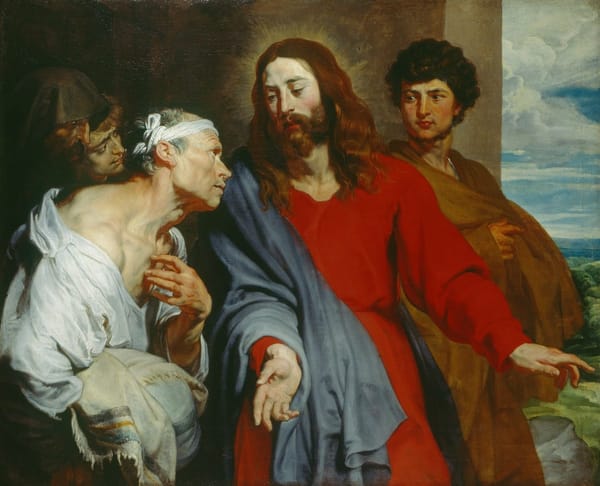
The Eighteenth Sunday after Pentecost
The paralytic carrying his bed is the subject of this day’s Gospel, and gives the eighteenth Sunday after Pentecost its title. This Sunday is inserted in the missal immediately after the Ember-days of autumn. We will not, like the liturgists of the Middle Ages,1 discuss the question of its having taken the place of the vacant Sunday, which formerly used always to follow the ordination of the sacred ministers,2 in the manner we have elsewhere described.3 Manuscript sacramentaries and lectionaries of very ancient date give it the name, which was so much in use, of Dominica vacat.4 Whatever may be the conclusion arrived at, there is one interesting point for consideration, viz., that in the Mass of this day the order of the lessons taken from St. Paul is broken. The Letter to the Ephesians, which has furnished the Epistles since the sixth Sunday after Pentecost, is to-day interrupted, and in its stead we have some verses from the first Epistle to the Corinthians, wherein the apostle gives thanks to God for the manifold gratuitous gifts granted, in Christ Jesus, to the Church. Now, the powers conferred by the imposition of the bishop’s hands on the ministers of the Church are the most marvellous gift that is known on earth, yea, in heaven itself. The other portions of the Mass, too, are, as we shall see further on, most appropriate to the prerogatives of the new priesthood. So that the liturgy of the present Sunday is particularly interesting when it immediately follows the Ember-days of September. But this coincidence is not of very frequent occurrence, at least as the liturgy now stands; nor can we dwell longer on these subjects without going too far into archæology, and exceeding our limits.
Mass
The Introits of the Sunday Masses since Pentecost have hitherto been taken from the Psalter. From Ps. xii. to Ps. cxviii. the Church, without ever changing the order of these sacred canticles, chose from each of them, as its own turn came, the verses most appropriate to the liturgy of each Sunday. But, dating from to-day, she is going to select her Introits elsewhere, with one exception, however, when she will again turn to this, the Book by excellence of divine praise. Her future opening anthems for the dominical liturgy to the end of the year will be taken from various other Books of the old Testament. For this eighteenth Sunday we have Jesus, son of Sirach, the inspired writer of Ecclesiasticus, asking God to ratify the fidelity of His prophets5 by the accomplishment of what they foretold. The present interpreters of the divine oracles are the pastors, whom the Church sends, in her own name, to preach the word of salvation and peace: let us, her children, pray with her that their words may never be void.
Introit
The surest way to obtain grace is to be ever humbly acknowledging to our God our deep conviction that, of ourselves, we cannot please His divine Majesty. The Church continues to give us, in her Collects, the most admirable expressions of such an avowal.
Collect
Epistle
1 Cap. i.Fratres, Gratias ago Deo meo semper pro vobis in gratia Dei, quæ data est vobis in Christo Jesu : quod in omnibus divites facti estis in illo, in omni verbo, et in omni scientia: sicut testimonium Christi confirmatum est in vobis : ita ut nihil vobis desit in ulla gratia, exspectantibus revelationem Domini nostri Jesu Christi, qui et confirmabit vos usque in finem sine crimine, in die adventus Domini nostri Jesu Christi.
1 Ch. i.Brethren: I give thanks to my God always for you, for the grace of God, that is given you in Christ Jesus; that in all things you are made rich in him, in all utterance, and in all knowledge, as the testimony of Christ was confirmed in you. So that nothing is wanting to you in any grace, waiting for the manifestation of our Lord Jesus Christ. Who also will confirm you unto the end without crime, in the day of the coming of our Lord Jesus Christ.
The other Collects, as on page 120.
The last coming of the Son of Man is no longer far off! The approach of that final event, which is to put the Church in full possession of her divine Spouse, redoubles her hopes; but the last judgment, which is also to pronounce the eternal perdition of so great a number of her children, mingles fear with her desire; and these two sentiments of hers will henceforth be continually brought forward in the holy liturgy.
It is evident that expectation has been, so to say, an essential characteristic of her existence. Separated from her Lord, she would have been sighing all day long in this vale of tears, had not the love which possesses her driven her to spend herself, unselfishly and unreservedly, for Him who is absolute Master of her whole heart. She, therefore, devotes herself to labour and suffering, to prayers and tears. But her devotedness, unlimited as it has been, has not made her hopes less ardent. A love without desires is not a virtue of the Church; she condemns it in her children as being an insult to the Spouse.
So just and, at the same time, so intense were, from the very first, these her aspirations that eternal Wisdom wished to spare His bride, by concealing from her the duration of her exile. The day and hour of His return is the one sole point upon which, when questioned by His apostles, Jesus refused to enlighten His Church.6 That secret constituted one of the designs of God's government of the world; but, besides that, it was also a proof of the compassion and affection of the Man-God; the trial would have been too cruel; and it was better to leave the Church under the impression, which after all was a true one, that the end was nigh in God’s sight, with whom a thousand years are as one day.7
This explains how it is that the apostles, the interpreters of the Church’s aspirations, are continually recurring to the subject of the near approach of our Lord’s coming. St. Paul has just been telling us, and that twice over in the same breath, that the Christian is he who waiteth for the manifestation of our Lord Jesus Christ, and for the day of His coming. In his Epistle to the Hebrews, he applies to the second coming the inflamed desires of the ancient prophets for the first, and says: ‘Yet a little, and a very little while, and He that is to come, will come, and will not delay.’8 The reason is that, under the new Covenant as under the old, the Man-God is called, on account of His final manifestation, which is always being looked for, He that is coming, He that is to come.9 The cry which is to close the world’s history is to be the announcement of His arrival: 'Behold! the Bridegroom is coming.’10
And St. Peter, too, says: 'Having the loins of your mind girt up, think of the glory of that day whereon the Lord Jesus is to be revealed! Hope for it, with a perfect hope!'11 The prince of the apostles foresaw the contemptuous way in which future false teachers would scoff at this long-expected, but always put-off, coming: ‘Where is His promise, or His coming? For, since the fathers slept, all things continue so, from the beginning of the creation!'12 Yes, he foresaw this, and forestalled their sarcasm, by answering it in the words which his brother Paul13 had previously used :14 ‘The Lord delayeth not His promise, as some imagine; but dealeth patiently, for your sake, not willing that any should perish, but that all should return to penance. But the day of the Lord shall come as a thief, in which the heavens shall pass away with great violence; and the elements shall be melted with heat; and the earth, and the works which are in it, shall be burnt up. Seeing, then, that all these things are to be dissolved, what manner of people ought you to be in holy conversation and godliness, looking for, and hastening unto, the coming of the day of the Lord, by which the heavens, being on fire, shall be dissolved, and the elements shall melt with the burning heat of fire? But we look for new heavens and a new earth according to His promises, in which justice dwelleth. Wherefore, dearly beloved, seeing that you look for these things, be diligent that ye may be found undefiled and unspotted to Him in peace . . . . Wherefore, brethren, knowing these things before, take heed lest, being led aside by the error of the unwise, you fall from your own steadfastness.'15
If, in those last days, the danger is to be so great that the very powers of heaven shall be moved,16 our Lord, as we are told in our Epistle, has providentially confirmed in us His testimony and our faith, by continual manifestations of His power. And, as if to verify that other word of the same Epistle, that He will thus confirm unto the end them that believe in Him, He redoubles His prodigies in these our times, as though they were precursors of the end. Miracles are forcing themselves on the world’s unwilling notice; and our modern facilities for propagating news are made to tell this glory of the Lord all over His earth! In the name of Jesus, in the name of one or other of His saints, but especially in the name of His Immaculate Mother, who is preparing the final triumph of the Church, the blind see, the lame walk, the deaf hear, every misery of both body and soul is suddenly made to yield. So incontestable, indeed, and so public, is the manifestation of supernatural power, that business-managers of all kinds, though they must, out of regard for incredulity, laugh at the facts, yet are most serious in turning the occasion to their profit. Such very material agencies as railway companies have been glad to accommodate the faithful thousands, and carry them as quickly as they could to the favoured sanctuaries, where the holy Mother of God has appeared. It is not in Catholic countries only that the divine power has made itself felt. Quite recently, in the very centre of Mohammedan infidelity, the city of the Sultans rejoiced at hearing of the marvels done by the Queen of heaven within its own walls. The water of the miraculous fountain has been carried even into the city of Mecca, where is the tomb of the founder of Islam, and into which, until but lately, it was death for any Christian to enter.
The infidel may say in his heart : 'There is no God!’17 If he hears not the divine testimony, it is because corruption, or pride, has more power over him than the light of reason, just as it had over the enemies of Jesus during His life upon earth. He is like to the asp of the Psalm,18 which maketh itself deaf; it stoppeth its ears, that it may never hear the voice of the divine Enchanter, who speaketh that He may save. His life is one piece of madness19 and folly;20 he has done his best to draw down vengeance upon himself.
Let us not be like him, but, with the apostle, let us thank God for the rich profusion of grace which He has so mercifully poured out upon us. Never were His gratuitous gifts more necessary than in these our miserable times. True, the Gospel does not now need to be promulgated; but the efforts of hell against it have become so violent that, in order to withstand them, there is need of a power from on high equal in some sense to that we read of as granted in the beginning of the Church. Let us beseech our Lord to bless us with men powerful in word and work. Let us, by the fervour of our fastings and prayers, obtain from His divine Majesty that the imposition of hands may produce, now more than ever, in them that are called to the priesthood, its full result: that it may make them rich in all things, and especially in all utterance, and in all knowledge. May these days, in which all principles are growing shadowy, find that the supernatural light is kept up, in full splendour and purity, by the zeal of the guides of Christ’s flock. May the compromises and flinchings of a generation, in which all truth is being etiolated and diminished, never lead our newly ordained priests, either themselves to shorten, or to permit anyone else to curtail, the measure of the perfect man,21 which was bestowed on them, in order that they might apply it to every Christian who is desirous of observing the Gospel! In spite of all threats, in spite of the noisy passions which are boisterous against any priest who dares to preach the truth, let their voice be what it should be—that is, an echo of the Word: let it vibrate with the holy firmness of the saints!
In the Gradual, the Church repeats the Introitverse, to celebrate once more the joy felt by the Christian people at hearing the glad tidings, that they are soon to go into the house of the Lord. That house is heaven, into which we are to enter on the last day, our Lord Jesus Christ leading the way. But the house is also the temple in which we are now assembled, and into which we are introduced by the representatives of that same Lord of ours, that is, by His priests.
Gradual
Gospel
Cap. ix.In illo tempore : Ascendens Jesus in naviculam, transfretavit, et venit in civitatem suam. Et ecce offerebant ei paralyticum jacentem in lecto. Et videns Jesus fìdem illorum, dixit paralytico : Confide, fili, remittuntur tibi peccata tua. Et ecce quidam de scribis dixerunt intra se : Hic blasphemat. Et cum vidisset Jesus cogitationes eorum, dixit : Ut quid cogitatis mala in cordibus vestris? Quid est facilius dicere : Dimittuntur tibi peccata tua : an dicere : Surge et ambula? Ut autem sciatis, quia filius hominis habet potestatem in terra dimittendi peccata, tunc ait paralytico : Surge, tolle le ctum tuum, et vade in domum tuam. Et surrexit, et abiit in doraum suam. Videntes autem turbæ timuerunt, et glorifica verunt Deum, qui dedit potestatem talem hominibus.
Ch. ix. At that time : Jesus entering into a boat, passed over the water and came into his own city. And behold they brought to him one sick of the palsy, lying on a bed. And Jesus seeing their faith, said to the man sick of the palsy: Be of good heart, son, thy sins are forgiven thee. And behold some of the scribes said within themselves; He blasphemeth. And Jesus seeing their thoughts, said; Why do you think evil in your hearts? Whether is it easier to say : Thy sins are forgiven thee; or to say : Arise and walk? But that you may know that the Son of man hath power on earth to forgive sins, (then said he to the man sick of the palsy,) Arise, take up thy bed, and go into thy house. And he arose and went into his house. And the multitude seeing it, feared and glorified God that gave such power to men.
In the thirteenth century, in many Churches of the west, the Gospel for to-day was that wherein our Lord speaks of the scribes and pharisees as seated on the chair of Moses.22 The Abbot Rupert, who gives us this detail in his book on the Divine Offices, shows how admirably this Gospel harmonized with the Offertory, which is the one we still have, and which alludes to Moses. ‘This Sunday’s Office,’ says he, ‘eloquently points out, to him who presides over the house of the Lord and has received charge of souls, the manner in which he should comport himself in the high rank, where the divine call has placed him. Let him not imitate those men, who unworthily sat on the chair of Moses; but let him follow the example of Moses himself, who, in the Offertory and its verses, presents the heads of the Church with such a model of perfection. Pastors of souls ought, on no account, to be ignorant of the reason why they are placed higher than other men: it is not so much that they may govern others, as that they may serve them.’23 Our Lord, speaking of the Jewish doctors, said: ‘All whatsoever they shall say to you, observe and do; but according to their works, do ye not: for they say, and do not.'24 Contrariwise to these unworthy guardians of the Law, they that are seated on the chair of doctrine ‘should teach, and act conformably to their teaching,' as the same Abbot Rupert adds. ‘Or, rather,' says he, ‘let them first do what it is their duty to do, that they may afterwards teach with authority; let them not seek after honours and titles, but make this their one object, to bear on themselves the sins of the people, and to merit to avert the wrath of God from those who are confided to their care. Such, we are told in the Offertory, is the example given them by Moses.'25 The Gospel which speaks of the scribes and pharisees who were seated on the chair of Moses has now been appointed for the Tuesday of the second week of Lent. But the one which is at present given for this Sunday equally directs our thoughts to the consideration of the superhuman powers of the priesthood, which are the common boon of regenerated humanity. The faithful, whose attention used formerly, on this Sunday, to be fixed on the right of teaching which is confided to the pastors of the Church, are now invited to meditate upon the prerogative which these same men have of forgiving sins and healing souls. Even if their conduct be in opposition to their teaching, it in nowise interferes with the authority of the sacred chair, from which, for the Church and in her name, they dispense the bread of doctrine to her children. Moreover, whatever unworthiness may happen to be in the soul of a priest, it does not in the least lessen the power of the keys which have been put into his hands to open heaven and to shut hell. For it is the Son of Man, Jesus, who, by the priest, be he a saint, or be he a sinner, rids of their sins His brethren and His creatures, whose miseries He has taken upon Himself, and whose crimes He has atoned for by His Blood.26
The miracle of the cure of the paralytic, which gave an occasion to Jesus of declaring His power of forgiving sins inasmuch as he was Son of Man, has always been especially dear to the Church. Besides the narration she gives us of it from St. Matthew in to-day’s Gospel, she again, on the Ember Friday of Whitsuntide, relates it in the words of St. Luke.27 The Catacomb frescoes, which have been preserved to the present day, equally attest the predilection for this subject, wherewith she inspired the Christian artists of the first centuries. From the very beginning of Christianity, heretics had risen up denying that the Church had the power, which her divine Head gave her, of remitting sin. Such false teaching would irretrievably condemn to spiritual death an immense number of Christians, who, unhappily, had fallen after their Baptism, but who, according to Catholic dogma, might be restored to grace by the sacrament of Penance. With what energy, then, would our mother the Church defend the remedy which gives life to her children! She uttered her anathemas upon, and drove from her communion, those pharisees of the new law, who, like their Jewish predecessors, refused to acknowledge the infinite mercy and universality of the great mystery of the Redemption.
Like to her divine Master, who had worked under the eyes of the scribes, His contradictors, the Church, too, in proof of her consoling doctrine, had worked an undeniable and visible miracle in the presence of the false teachers; and yet she had failed to convince them of the reality of the miracle of sanctification and grace invisibly wrought by her words of remission and pardon. The outward cure of the paralytic was both the image and the proof of the cure of his soul, which previously bad been in a state of moral paralysis; but he himself represented another sufferer, viz., the human race, which for ages had been a victim to the palsy of sin. Our Lord had already left the earth, when the faith of the apostles achieved this, their first prodigy, of bringing to the Church the world grown old in its infirmity. Finding that the human race was docile to the teaching of the divine messengers, and was already an imitator of their faith, the Church spoke as a mother, and said: Be of good heart, son! thy sins are forgiven thee! At once, to the astonishment of the philosophers and sceptics, and to the confusion of hell, the world rose up from its long and deep humiliation; and, to prove how thoroughly his strength had been restored to him, he was seen carrying on his shoulders, by the labour of penance and the mastery over his passions, the bed of his old exhaustion and feebleness, on which pride, lust, and covetousness had so long held him. From that time forward, complying with the word of Jesus, which was also said to him by the Church, he has been going on towards his house, which is heaven, where eternal joy awaits him! And the angels, beholding such a spectacle of conversion and holiness,28 are in amazement, and sing glory to God, who gave such power to men.
Let us also give thanks to Jesus, whose marvellous dower, which is the Blood He shed for His bride, suffices to satisfy, through all ages, the claims of eternal justice. It was at Easter time that we saw our Lord instituting, the great Sacrament, which thus in one instant restores the sinner to life and strength.29 But how doubly wonderful does its power seem, when we see it working in these times of effeminacy and of well-nigh universal ruin! Iniquity abounds; crimes are multiplied; and yet, the life-restoring pool, kept full by the sacred stream which flows from the open side of our crucified Lord, is ever absorbing and removing, as often as we permit it, and without leaving one single vestige of them, those mountains of sins, those hideous treasures of iniquity which had been amassed, during long years, by the united agency of the devil, the world, and man himself.
The Offertory speaks to us of the figurative altar, which was set up by Moses for the reception of the oblations of the figurative Law, which oblations, foreshadowed the great and only true sacrifice, at which we are now present. After the anthem which is still in use, we will append the verses which were anciently added. Moses is there represented as the type of those faithful prophets mentioned in the Introit; he is shown to us as the model of those true leaders of God’s people, who devote themselves in order to procure mercy and peace for those whom they guide.30 God sometimes seems to resist them, but He always suffers Himself to be overcome; and in return for their fidelity, He admits them into the most intimate manifestations of His light and His love. The first verse shows us the priest in his public life of intercession and devotedness for others; the second reveals to us his private life, of which prayer and contemplation are the main occupation. We shall not be surprised at the length of these verses—the singing of which would far exceed the time for offering the Host and chalice, such as is now the custom—if we remember how it was the ancient usage that the whole assembly of the faithful present at the holy Sacrifice took part in the oblation of the bread and wine needed for the liturgy. So likewise the Communion, which at present consists of only a few lines, was originally nothing but the antiphon to an entire psalm, which in the ancient antiphonaries was appointed for each day, when it was not the same as the Introit-psalm; the psalm was sung, repeating the antiphon after each verse, until all had communicated.
Offertory
Then Moses made an evening sacrifice.
℣. II. Moses prayed to the Lord and said: If I have found favour in thy sight, show me thyself openly, that I may see thee. And the Lord spake unto him, saying: For man shall not see me, and live; but be thou on the height of the rock, and my right hand shall protect thee, till I pass : whilst I pass I will take away my hand, and then shalt thou see my glory : but my face shall not be seen by thee; for I am God, showing wonderful things in the earth.
The sublime eloquence of the Secret is beyond all comment. Let us be thoroughly imbued with the high teaching here so admirably summed up in a few short words: let us come to understand that our life and conduct should have something divine about them, in response to the mysteries which are revealed to our understanding and incorporated into us by the venerable communication of this Sacrifice.
Secret
The other Secrets, as on page 130.
The Communion-anthem is addressed to the priests, and, at the same time, to us all: for if the priest offers the Victim, which is the holiest that can be, we should not think of accompanying him into the court of our God, without bringing up, that they may be united to the divine Host, other victims, that is ourselves. It is God’s injunction : Thou shalt not appear empty before me!31
Communion
Whilst giving thanks in the Postcommunion for the priceless gift of the sacred mysteries, let us beseech our God to perfect within us the grace of always receiving it worthily.
Postcommunion
The other Postcommunions, as on page 181.
Vespers
The psalms, capitulum, hymn, and versicle, as above, pages 71-81.
Antiphon of the Magnificat
- Berno Aug., cap. v., etc. ↩︎
- Microlog., cap. xxix. ↩︎
- Advent: Ember Saturday. ↩︎
- Thomasi Opp. Edit. Vezzosi, t. v., p. 148, 149, 309. ↩︎
- Ecclus. xxxvi. 18. ↩︎
- St. Matt. xxiv. 3, 36. ↩︎
- 2 St. Pet. iii. 8. ↩︎
- Hab. ii. 3; Heb. x. 37. ↩︎
- St. Matt. xi. 3; Apoc. i. 8. ↩︎
- St. Matt. xxv. 6. ↩︎
- 1 St. Pet. i. 5, 7, 13. ↩︎
- 2 St. Pet. iii. 3, 4. ↩︎
- Ibid. 15. ↩︎
- Rom. ii. 4. ↩︎
- 2 St. Pet. iii. 9-17. ↩︎
- St. Matt. xxiv. 29. ↩︎
- Ps. xiii. i. ↩︎
- Ps. lvii. 5, 6. ↩︎
- Ps. lvii. 5, 6. ↩︎
- Ps. xiii. 1. ↩︎
- Eph. iv. 13. ↩︎
- St. Matt. xxiii. 1-12. ↩︎
- Rup., Div. Off., xii. 18. ↩︎
- St. Matt. xxiii. 3. ↩︎
- Rup., ubi supra. ↩︎
- Heb. ii 10-18. ↩︎
- St. Luke v. 17-26. ↩︎
- St. Luke v. 26. ↩︎
- Wednesday of the fifth week after Easter. ↩︎
- Rup., ubi supra. ↩︎
- Exod. xxiii. 15. ↩︎
First Sunday of October: Feast of the Most Holy Rosary
|
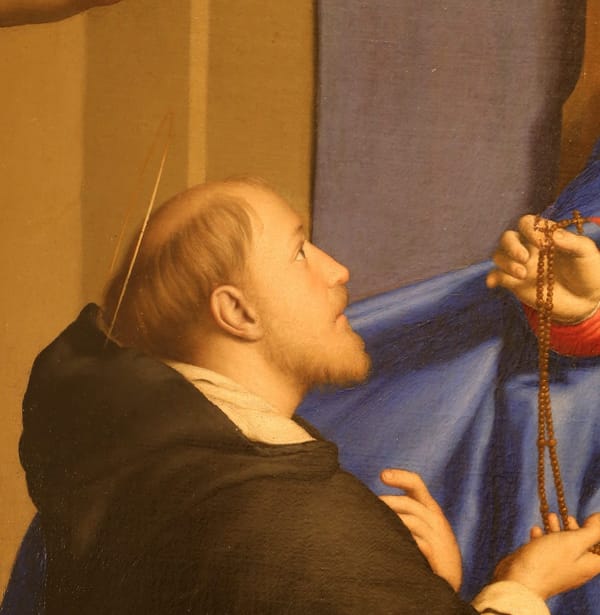
It is customary with men of the world to balance their accounts at the end of the year, and ascertain their profits. The Church is now preparing to do the same. We shall soon see her solemnly numbering her elect, taking an inventory of her holy relics, visiting the tombs of those who sleep in the Lord, and counting the sanctuaries, both new and old, that have been consecrated to her divine Spouse. But to-day’s reckoning is a more solemn one, the profits more considerable: she opens her balance-sheet with the gain accruing to our Lady from the mysteries which compose the cycle. Christmas, the cross, the triumph of Jesus, these produce the holiness of us all; but before and above all, the holiness of Mary. The diadem which the Church thus offers first to the august Sovereign of the world, is rightly composed of the triple crown of these sanctifying mysteries, the causes of her joy, of her sorrow, and of her glory. The joyful mysteries recall the Annunciation, the Visitation, the Birth of Jesus, Mary’s Purification, and the Finding of our Lord in the temple. The sorrowful mysteries bring before us the Agony of our blessed Lord, His being scourged, and crowned with thorns, the carrying of the cross, and the Crucifixion. While, in the glorious mysteries, we contemplate the Resurrection and Ascension of our Saviour, Pentecost, and the Assumption and Coronation of the Mother of God. Such is Mary’s rosary; a new and fruitful vine, which began to blossom at Gabriel’s salutation, and whose fragrant garlands form a link between earth and heaven.
In its present form, the rosary was made known to the world by St. Dominic at the time of the struggles with the Albigensians, that social war of such ill-omen for the Church. The rosary was then of more avail than armed forces against the power of satan; it is now the Church’s last resource. It would seem that, the ancient forms of social prayer being no longer relished by the people, the holy Spirit has willed by this easy and ready summary of the liturgy to maintain, in the isolated devotion of these unhappy times, the essential of that life of prayer, faith, and Christian virtue, which the public celebration of the Divine Office formerly kept up among the nations. Before the thirteenth century, popular piety was already familiar with what was called the psalter of the laity, that is, the angelical salutation repeated one hundred and fifty times; it was the distribution of these Hail Marys into decades, each devoted to the consideration of a particular mystery, that constituted the rosary. Such was the divine expedient, simple as the eternal Wisdom that conceived it, and far-reaching in its effects; for while it led wandering man to the Queen of Mercy, it obviated ignorance which is the food of heresy, and taught him to find once more ‘the paths consecrated by the Blood of the Man-God, and by the tears of His Mother.’1
Thus speaks the great Pontiff who, in the universal sorrow of these days, has again pointed out the means of salvation more than once experienced by our fathers. Leo XIII, in his encyclicals, has consecrated the present month to this devotion so dear to heaven; he has honoured our Lady in her litanies with a new title, Queen of the most holy rosary;2 and he has given the final development to the solemnity of this day, by raising it to the rank of a second class feast, and by enriching it with a proper Office explaining its permanent object.3 Besides all this, the feast is a memorial of glorious victories, which do honour to the Christian name.
Soliman II, the greatest of the Sultans, taking advantage of the confusion caused in the west by Luther, had filled the sixteenth century with terror by his exploits. He left to his son, Selim II, the prospect of being able at length to carry out the ambition of his race: to subjugate Rome and Vienna, the Pope and the emperor, to the power of the crescent. The Turkish fleet had already mastered the greater part of the Mediterranean, and was threatening Italy, when, on October 7, 1571, it came into action, in the Gulf of Lepanto, with the pontifical galleys supported by the fleets of Spain and Venice. It was Sunday; throughout the world the confraternities of the rosary were engaged in their work of intercession. Supernaturally enlightened, St. Pius V watched from the Vatican the battle undertaken by the leader he had chosen, Don John of Austria, against the three hundred vessels of Islam. The illustrious Pontiff, whose life’s work was now completed, did not survive to celebrate the anniversary of the triumph; but he perpetuated the memory of it by an annual commemoration of our Lady of Victory. His successor, Gregory XIII, altered this title to our Lady of the rosary, and appointed the first Sunday of October for the new feast, authorizing its celebration in those churches which possessed an altar under that invocation.
A century and a half later, this limited concession was made general. As Innocent XI, in memory of the deliverance of Vienna by Sobieski, had extended the feast of the most holy name of Mary to the whole Church; so, in 1716, Clement XI inscribed the feast of the rosary on the universal calendar, in gratitude for the victory gained by Prince Eugene at Peterwardein, on August 5, under the auspices of our Lady of the snow. This victory was followed by the raising of the siege of Corfu, and completed a year later by the taking of Belgrade.
Mass
The joys experienced on the other feasts of the Mother of God, are all gathered up and resumed in this one, for us, for the angels, and for our Lady herself. Like the angels, then, let us offer, together with Mary, the homage of our just delight to the Son of God, her Son, her King and ours.
Introit
The mysteries of the Son and of the Mother are our instruction and our hope. The Church prays in the Collect that they may also be our rule of life and our pledge of eternal happiness.
Collect
Then is made a commemoration of the occurring Sunday.
Epistle
Prov. cap. viii.Dominus possedit me in initio viarum suarum antequam quidquam faceret a principio. Ab æterno ordinata sum, et ex antiquis, antequam terra fieret, Nondum erant abyssi, et ego jam concepta eram. Nunc ergo, filii, audite me: Beati qui cnstodiunt vias meas. Audite disciplinam, et estote sapientes, et nolite abjicere eam. Beatus homo qui audit me, et qui vigilat ad fores meas quotidie, et observat ad postes ostii mei. Qui me invenerit, inveniet vitam, et hauriet salutem a Domino.
Prov. ch. viii.The Lord possessed me in the beginning of his ways, before he made anything from the beginning. I was set up from eternity, and of old before the earth was made. The depths were not as yet, and I was already conceived. Now therefore, ye children, hear me: Blessed are they that keep my ways. Hear instruction and be wise, and refuse it not. Blessed is the man that heareth mo, and that watcheth daily at my gates, and waiteth at the posts of my doors. He that shall find me, shall find life, and shall have salvation from the Lord.
Our Lady’s mysteries are before all time in God’s sight, like those of her divine Son; like these they will endure for all eternity; like them they rule the ages, which circle round the Word and Mary, preparing for both in the days of figures, perpetuating their presence by the incessant glorification of the most holy Trinity, in whose name all Christians are baptized. Now the rosary honours all this series of mysteries; to-day’s feast is a glance back upon the cycle as it draws to its close. From these mysteries, from this view of them, we must draw the conclusion formulated by our Lady herself in this passage from Proverbs, which the Church applies to her: ‘Now therefore, my children, consider my ways; imitate me, that you may find happiness.’ Blessed is he that watcheth at her gate! Let us pray to her, rosary in hand, considering her at the same time, meditating on her life and her greatness, and watching, were it but for a quarter of an hour, at the entrance to the palace of this incomparable Queen. The more faithful we are, the more assured will be our salvation and our progress in true life.
In the Gradual, let us congratulate the Queen of the holy rosary on her perfect life, all truth, and justice, and meekness, which won her the love of the supreme King. In the Alleluia verse, let us proclaim the nobility of her race, unequalled in the whole world.
Gradual
The Gospel is the same as on the feast of the most holy name of Mary (page 176). ‘At that time, the angel Gabriel was sent from God, into a city of Galilee, called Nazareth, to a Virgin espoused to a man whose name was Joseph, of the house of David; and the Virgin’s name was Mary. And the angel being come in, said to her: Hail, full of grace! the Lord is with thee; blessed art thou among women? Blessed art thou among women, repeated Elizabeth a few days later, and blessed is the fruit of thy womb. These two salutations, with the name of Mary added to the angel’s greeting and the name of Jesus to Elizabeth’s, constituted the Ave Maria in the time of St. Dominic, the promulgator of the rosary. The prayer, 'Holy Mary Mother of God’ which now so beautifully completes the formula of praise, received the sanction of the Church in the sixteenth century. No better Gospel could, then, have been chosen for to-day, for it gives the original text of the rosary, and describes the first of its mysteries.
All grace, all light, all life, are to be found in our Lady; by her holy rosary she, as we sing in the Offertory, has multiplied flowers and fruits in the garden of the Church. Every offering acceptable to God, comes from Mary, with and by Jesus.
Offertory
As the Secret tells us, the rosary, piously meditated, prepares us for the Sacrifice of the altar, that supereminent and august memorial of the mysteries which it imprints in the heart and mind of the Christian.
Secret
Then a commemoration of the Sunday.
The Preface as on September 8, substituting ‘in solemnitate, on the solemnity,’ for ‘in Nativitate, on the Nativity,’ of the blessed Virgin Mary.
After the sacred banquet, our soul must not remain barren. The fragrance of virtue’s flowers must embalm all that surrounds us, and prove to the Spouse that His visit has not been made in vain.
Communion
In the Postcommunion, the Church prays that our Lady may, by her intercession, second the effects of this Sacrifice, and-of the mysteries in which she played so great a part.
Postcommunion
Then is added the Postcommunion of the Sunday, and the Gospel of the same is read at the end of the Mass.
Vespers
A few days ago, the Church borrowed from the Servites of Mary her Office of the Seven Dolours; to-day she seeks her responsories, hymns, and antiphons from the noble family which claims the rosary as its birthright. The Christian world owes a new debt of gratitude to the sons of St. Dominic for enriching it with these beautiful liturgical formulæ. But as the Use of the Friars Preachers gives but one antiphon for the psalms in the Vespers of the saints, the following antiphons have been added for the Roman rite. The hymn, which so gracefully and yet concisely resumes the triple series of the mysteries, is the fourth of the entire Office: the first celebrates, at first Vespers, the joyful mysteries; the second, at Matins, the sorrowful; the third, at Lauds, the glorious. 'From these mysteries let us gather roses, and weave garlands for the Mother of fair love.’
Ps. Dixit Dominus, page 38.
Ps. Laudate pueri, page 41.
Ps.Lætatus sum, page 152.
Ps. Nisi Dominus, page 153.
Ps. Lauda Jerusalem, page 154.
Capitultum
Eccli. xxiv. xxxix.
Hymn
Te sauciam doloribus,
Te jugi amictam gloria,
O Virgo Mater pangimus.
Dum concipis, dum visitas,
Et edis, offers, invenis,
Mater beata, Filium.
In corde agonem, verbera,
Spinas, crucemque Filii
Perpessa, princeps martyrum.
In ignibus Paracliti,
In regni honore et lumine,
Regina fulgens gloria.
Ex his rosas mysteriis,
Et pulchri amoris inclytæ
Matri coronas nectite.
Qui natus es de Virgine,
Cum Patre et almo Spiritu,
In sempiterna sæcula.
thee wounded with the sword of sorrow,
thee girt with everlasting glory,
we sing, O Virgin Mother.
when thou conceivest; when thou visitest thy cousin;
when thou bringest forth thy Son, offerest him to God,
findest him in the temple, O happy Mother!
in thy inmost heart the agony, the scourging,
the thorns, and the cross of thy Son,
O first of martyrs!
in the triumphs of thy Son,
in the fires of the Paraclete,
in the honour and splendour of thy queenliness.
gather roses from these mysteries,
and wreathe therewith garlands
for the Mother of fair love.
born of the Virgin;
together with the Father and the holy Spirit,
through everlasting ages.
Antiphon of the Magnificat
The Prayer as on page 299.
Then is made a commemoration of the Sunday.
October 1: St. Remigius, Bishop and Confessor, Apostle of the Franks
Scarcely had two centuries elapsed since the triumph of the cross over Roman idolatry, when satan began to cry victory once more. While Eutychianism was crowned at Byzantium in the person of Anastasius the silent, Arianism was rife in the west. Throughout the whole ancient territory of the empire, heresy was supreme, and almost everywhere was persecuting the Church, who had now none but the vanquished for her sons.
‘But fear not; rather rejoice,’ says Baronius at this point of his Annals; ‘it is divine Wisdom still delighting to play in the world. The thoughts of men count for little before Him who holds the light in His hands, to hide it when He pleases, and, when He wills, to bring it forth again. The darkness, that now covers the earth, marks the hour when the dawn is about to break in the hearts of the Franks, and the Catholic faith is to shine there in all its glory.’1
Little known in our days is such a manner of writing history; yet this was the view taken by the first historian of the Church, and the greatest. On such a feast as this we could not do better than repeat summarily his account of the Franks. ‘How,’ says he, ‘can we help admiring the Providence which is never wanting to the Church? From the midst of tribes still pagan, on the morrow of the irremediable fall of the empire, God forms to Himself a new people, raises unto Himself a prince: against these must break the rising tide of heretics and barbarians. Such, in truth, appeared in the course of ages the divine mission of the Frankish kings.
What energy has faith to uphold kingdoms; and what fatal power has heresy to uproot every plant that is not set by our heavenly Father! In proof hereof, see how the principalities of the Goths, Vandals, Heruli, Alani, Suevi, and Gepidi have utterly disappeared; while the Franks behold their little spot of earth blessedly fertilized, and encroaching far upon the surrounding territories.’2
Henceforth appeared the might of the Franks, when preceded to battle by the cross. Hitherto obscure and struggling for existence, they were now everywhere victorious. They had only had to acknowledge Christ, in order to reach the highest summit of glory, honour, and renown. In so speaking I say nothing but what is known to the whole world. If they have been more favoured than other nations, it is because they were supereminent in faith, and incomparable in piety, so that they were more eager to defend the Church than to protect their own frontiers.3
Moreover, a privilege unique and truly admirable was theirs: never did the sins of kings bring upon this people, as upon so many others, subjection to a foreign yoke. The promise of the Psalm4 would seem to have been renewed in favour of this nation: If his children forsake My law . . . and keep not My commandments, I will visit their iniquities with a rod . . . but My mercy I will not take away from him.’5
All honour, then, to the saintly pontiff, who merited to be the instrument of such heavenly benefits! According to the expression of the holy Pope Hormisdas, ‘Remigius converted the nation, and baptized Clovis, in the midst of prodigies similar to those of the apostolic age.’6 The prayers of Clotilde, the labours of Genevieve, the penances of the monks who peopled the forests of Gaul, had doubtless a great share in a conversion which brought such joy to the angels. Did space allow, we might relate how it was also prepared by the great bishops of the fifth century, Germanus of Auxerre, Lupus of Troyes, Anian of Orleans, Hilary of Arles, Mamertus and Avitus of Vienne, Sidonius Apollinaris, and so many others who, in that age of darkness, held up the Church to the light of day, and commanded the respect of the barbarians. Remigius, contemporary and survivor of most of them, and their rival in eloquence, nobility, and holiness, seemed to personify them all on that Christmas night forestalled by so many desires, and prayers, and sufferings. In the baptistery of Saint Mary’s at Rheims, the Frankish nation was born to God; as heretofore on the banks of Jordan, the dove was again seen over the waters, honouring this time, not the Baptism of Jesus, but that of the Church's eldest daughter; it brought a gift from heaven, the holy vial containing the chrism which was to anoint the French kings in future ages into ‘the most worthy of all the kings of the earth.’7
Two churches in the city of Rheims claim the honour of these glorious souvenirs: the grand Church of our Lady, and the venerable basilica where Remigius lay, with the vial of chrism at his feet, and guarded by the twelve peers surrounding his splendid mausoleum. This church of St. Remigius bore the name of caput Franciæ,8 head of all France, until those days of October 1793, when, from its desecrated pulpit was proclaimed the word that the days of darkness were at an end; when the holy ampulla was broken, and the relics of the apostle of France were thrown into a common grave.9
After an episcopate of seventy-four years, the longest ever recorded in history, Remigius took his flight to heaven on January 13, the anniversary of his episcopal consecration and also of his birth. Yet in the same century, the first of October was chosen for his feast; this being the day whereon his relics were first translated to a more honourable place, in the midst of miracles such as those which had graced his life. The translation of St. Remigius is the name still given to this day by the church of Rheims, which, by a special privilege, celebrates on the Octave day of the Epiphany the principal festival of its glorious patron. We borrow the following lessons from the Office of that day.
Remigius, qui et Remedius, Lauduni natus est, parentibus nobilibus, Æmilio et sancta Cilinia ætate jam provectis, et gratia apud suos nominatissimis. Ortum ejus prædixerat solitarius quid, m cæcus, nomine Montanus, qui et visum postea recepit, admoto ad oculos lacte quo infans Remigius alebatur. Studiis et orationibus primos impendebat annos futurus Francorum apostolus, secessum colens; quo magis hominum frequentiam fugere conabatur, eo notior toti provinciæ fiebat. Annos natus duos et vigniti, post transitum Bennadii archiepiscopi Remensis, ob seniles in adolescentia mores, ad sedem Remensem omnium votis raptus, potius quam electus fuit. Onus episcopale effugere cupiens, divinis monitis suscipere cogitur. Ab episcopis provinciæ consecratus, se tamquam veteranum gessit ili regimine Ecclesiæ suæ. Vir eloquens, potens in Seripturis, exemplum erat fidelium. Quod ore docebat, implebat opere. Grege suo summo labore ac vigilantia mysteriis fidei imbuto, et disciplina in clero constituta, regnum Christi in Belgio promovendum suscepit; populis ad fidem conversis, novos episcopatus iustituit: Teruanæ, ubi sanctum Antiruundum; Atrebatis, ubi sanctum Vedastum; Lauduni, ubi sanctum Genebaldum præfecit.
Remigius, also called Remedius, was born at Laon, of noble parents by name Æmilius and St. Celinia. They were far advanced in age, and renowned among their own people for their virtue, when the birth of this child was foretold to them by a blind hermit named Montanus; who afterwards recovered his sight, by applying to his eyes some of the milk wherewith the infant Remigius was nourished. The future apostle of the Franks devoted his youth to prayer and study in retirement; but the more he shrank from the company of men, the more his fame spread throughout the province. On the death of Bennadius, archbishop of Rheims, Remigius, who though but twenty-two years of age had the mature character of an old man, was unanimously elected, or rather forcibly installed as archbishop. He endeavoured to escape the burden of the episcopate, but was obliged by the command of God to submit. Having been consecrated by the bishops of the province, he governed his church with the wisdom of an experienced veteran. He was eloquent, learned in the Scriptures; and a pattern to his people, fulfilling in deed what he taught by word. He carefully and laboriously instructed his own flock in the mysteries of faith, and established discipline among his clergy. Then he undertook to spread the kingdom of Christ in Belgium; and having converted the people to the faith, he founded several new bishoprics and appointed them pastors: at Terouanne St. Antimund or Aumont, at Arras St. Vedast, and at Laon St. Genebald.
Clodovei et Francorum animi cultui pagano adhuc dediti movebantur stupendis Remigii operibus, quæ ubique vulgabantur. Cura autem Clodoveus, Gallorum victor, Alemannos Tolbiaci, invocato Christi nomine, debellasset, Remigium ad se evocatum, de religione Christiana disserentem libenter audiit. Et instanti Remigio ut fidem profiteretur, cum respondisset, vereri se ne per populum sibi non liceret: id ubi rescivit populus, statim acclamavit: Mortales deos abigimus, pie rex: et Deum quem Remigius prædicat immortalem, sequi parati sumus. Tum Remigius jejunia secundum Ecclesiæ morem illis indixit, et regem quem fidei documentis coram sancta Clotilde regina imbuerat, baptizavit ipso die Natalis Domini, his eum verbis allocutus: Mitis, depone colla, Sicamber: adora quod incendisti; incende quod adorasti. Baptizatum sacro inunxit chrismate, cum signaculo crucis Christi. De exercitu autem ejus ter mille et amplius baptismo initiati sunt: simul et Albofledis Clodovei soror, quæ cum paulo post de vivis decessisset, regem per litteras consolatus est Remigius. Lanthildis quoque altera soror regis, ab Ariana hæresi revocata, sacro chrismate inuncta est, et Ecclesiæ reconciliata.
The wonderful works of Remigius, being divulged far and wide, filled with astonishment the minds of Clovis and his still pagan Franks. When Clovis, who had already conquered the Gauls, triumphed over the Alemanni also at the battle of Tolbiac by the invocation of the name of Christ; he sent for Remigius, and willingly listened to his explanation of the Christian doctrine. Remigius urged the king to embrace the faith, but he replied that he feared the opposition of his people. When this was reported to the Franks, they cried out with one voice: ‘We renounce mortal gods, O pious king, and are ready to follow the immortal God whom Remigius preaches.’ Then the bishop imposed a fast upon them, according to the custom of the Church, and having in the presence of the queen St. Clotilde, completed the king’s religious instruction, he baptized him on the day of our Lord’s Nativity, addressing him in these words: 'Bow down thy head in meekness, O Sicambrian; adore what thou hast hitherto burnt, burn what thou hast adored.’ After the Baptism, he anointed him with holy chrism with the sign of the cross of Christ. More than three thousand of the army were baptized, as also Albofleda Clovis’s sister, who died soon after; upon which occasion Remigius wrote to console the king. His other sister, Lanthilda, was reclaimed from the Arian heresy, anointed with sacred chrism, and reconciled to the Church.
Eximia fuit ipsius erga pauperes liberalitas, et clementia in pœnitentes singularis: neque enim, inquiebat, nos posuit Dominus ad iracundiam, sed ad hominum curam. Arianum episcopum in synodo, divina virtute mutum reddidit; eique per nutus veniam poscenti, vocem his verbis restituit: In nomine Domini nostri Jesu Christi, si sic de eo recte sentis, loquere; et de illo sicut catholica credit Ecclesia, confitere. Recepto ille vocis usu, credere se et in eadem fide moriturum pollicitus est. Sub finem vitæ oculorum usu orbatus est Remigius, quem tamen paulo ante mortem recuporavit. Transitus diem non ignorans, finitis Missarum solemniis, plebe sacro Christi corpore confirmata; valefaciens clero et populo, dans singulis pacem in osculo oris Domini, plenus dierum et operum ex hac vita decessit idibus Januarii, armo ætatis nonagesimo sexto, post Christum quingentesimo trigesimo tertio. Sepultus est in ædicula sancti Christophori; et mortuus sicut et vivus claruit miraculis.
Remigius was exceedingly liberal to the poor and merciful towards sinners. 'God has not placed us here,’ he would say, 'to exercise wrath, but to take care of men` During a council, he once by divine power struck an Arian bishop with dumbness, until he begged forgiveness by signs, when he restored him his speech with these words: 'In the name of our Lord Jesus Christ, if thou holdest the right belief concerning him, speak, and confess the faith of the Catholic Church.’ The bishop recovering his voice, protested that he believed, and would die in that faith. Towards the end of his life Remigius lost his sight, but recovered it shortly before his death. Knowing the day of his departure, he celebrated Mass, and fortified his flock with the sacred Body of Christ. Then he bade his clergy and people farewell, giving to each one the kiss of our Lord’s peace; and full of days and good works, he departed this life on the Ides of January, in the year of our Lord five hundred and thirty-three, being ninety-six years old. He was buried in the oratory of St. Christopher; and as in life, so also after death, he was famous for miracles.
This is a fitting occasion to bring forward the beautiful formula rightly called the Prayer of the Franks, which dates from the first ages of the monarchy.10
Prayer
St. Leo IX said to his contemporaries, and we echo his words, concerning the land of France: ‘Be it known to your charity that you must solemnly celebrate the feast of the blessed Remigius; for if to others he is not an apostle, he is such with regard to you at least. Pay such honour, then, to your apostle and father, that you may merit, according to the divine promise, to live long upon the earth, and, by his prayers, may obtain possession of eternal beatitude.’11 When he thus spoke, the sovereign Pontiff had just consecrated thy church, then for the third time rebuilt with the magnificence required by the growing devotion of the people. The nine centuries since elapsed have augmented thy claims to the gratitude of a nation, into which thou didst infuse such vigorous life, that no other has equalled it in duration. Accept our thanks, O thou who wast as a new Sylvester to a new Constantine.
Glory be to our Lord, who showed forth His wonders in thee! Remembering those gestes of God accomplished in all climes by her sons the Franks, the Church recognizes the legitimacy of applying to thee12 the beautiful words which announced the Messias: ‘Give ear, ye islands, and hearken, ye people from afar. The Lord hath called me from the womb . . . And He said: . . . Behold I have given thee to be the light of the Gentiles, that thou mayest be My salvation even to the farthest part of the earth.’ Truly it was a day of salvation, that Christmas day, whereon our Lord was pleased to bless thy labours and grant the desires of thy long episcopate. By the holy faith thou taughtest, thou wast then the ‘covenant of the people,' the new people composed of the conquerors and the conquered in that land of France, which, when once itself raised up, soon restored to God the inheritance that had been destroyed. O true Church, the one only bride, captive and destitute, behold Remigius rises to say to thy sons that are bound: ‘Come forth’, and to them that are in darkness: ‘Show yourselves’! From north and south, from beyond the sea, behold they come in multitudes: all these are come to thee. Therefore, give praise, O ye heavens, and rejoice O earth, because the Lord hath comforted His people; after a whole century of heresy and barbarity, God has once more demonstrated that they shall not be confounded that wait for Him.13
Our confidence in God will again be rewarded if thou, O Remigius, deign to present to our Lord the prayer of the Franks who have remained faithful in honouring thy memory. The renegades sold over to satan may tyrannize for a time over the deluded crowd; but they are not the nation. A day will come when Christ, who is ever King, will say to the angels of His guard those words of His lieutenant Clovis: ‘It displeases me that these Goths possess the good land of France; expel them, for it belongs to us.’14
- Baron. Annal. eccl. ad ann. 499, xv; the year 496 is now universally recognized as the date of the Baptism of Clovis. ↩︎
- Ibid, ad ann. 484, cxxxv. ↩︎
- Baron. Annal. eccl, ad ann. 514, xxiii. ↩︎
- Ps. lxxxviii. 31-34. ↩︎
- Baron. Annal. eccl. ad ann. 514, xxvii. ↩︎
- Hormisd. Epist. 1, ad Remigium. ↩︎
- Matth. Paris. ad ann. 1257: Archiepiscopus Remensis qui regem Francorum cælestt consecrat chrismats (quapropter rex Francorum regum censetur dignissimus) est omnium Franciæ parium primus et excellentissimus. ↩︎
- Mabillon. Annal. benedict. xlvii. 30: Diploma Gerbergæ reginæ. ↩︎
- They were, however, afterwards discovered and authentically recognized; and are, to this day, an object of the greatest veneration to pilgrims. ↩︎
- Titra. Hist. de S. Léger, Introduct. p. xxii, xxiii. ↩︎
- Leonix. Epist. xvii. ↩︎
- Lect. 1 Noct. in proprio Remensi et aliis. ↩︎
- Isaias xlix. ↩︎
- Greg. Turon. Histor. Franc, ii. 37; Hincmar. Vita S. Remigii, li. ↩︎
| Previous September 30: St. Jerome, Priest, Confessor and Doctor of the Church | Next First Sunday of October: Feast of the Most Holy Rosary |