Daily reading
After Pentecost
Double · Movable from Easter · Temporal
October 8, 2023
From Dom Guéranger’s The Liturgical Year.

|
The Nineteenth Sunday after Pentecost
The divine Leader of God’s people is their salvation in all their distress. Did we not last Sunday see Him prove Himself such, and in a very telling way, by curing both body and soul of the poor paralytic, who was a figure of the whole human race? Let us hear His voice, in the Introit, with love and gratitude; let us promise Him the fidelity He asks of us; His Law, if we will but observe it, will preserve us from a relapse.
The anthem which follows is made up of several passages of holy Writ, without being exactly that of any one of them. The verse is taken from Psalm lxxvii.
Introit
Free both in mind and body by the omnipotent word of the Son of Man, the human race can devote itself, with all activity, to the service of God. Let us obtain from His divine Majesty, by uniting our prayer with that of the Church in her Collect, that the fatal paralysis, which was once so cruel a tyrant over our souls and faculties, may never return.
Collect
The other Collecte, as on page 120.
Epistle
Cap. iv.Fratres, Renovamini spiritu mentis vestræ, et induite novum hominem, qui secundum Deum creatus est in justitia, et sanctitate veritatis. Propter quod deponentep mendacium, loquimini veritatem unusquisque cum proximo suo : quoniam sumus invicem membra. Irascimini, et nolite peccare : sol non occidat super iracundiam vestram. Nolite locum dare diabolo : qui furabatur, jam non furetur : magis autem laboret, operando manibus suis, quod bonum est, ut habeat unde tribuat necessitatem patienti.
Ch. iv.Brethren : be renewed in the spirit of your mind; and put on the new man, who, according to God, is created in justice, and holiness of truth. Wherefore, putting away lying, speak ye the truth every man with his neighbour: for we are members one of another. Be angry and sin not. Let not the sun go down upon your anger. Give not place to the devil. He that stole, let him now steal no more; but rather let him labour, working with his hands the thing which is good, that he may have something to give to him that suffereth need.
The Epistle to the Ephesians, which was interrupted last Sunday in the manner we then described, is continued to-day by the Church. The apostle has already laid down the dogmatical principles of true holiness; he now deduces the moral consequences of those principles.
Let us call to mind how the holiness, which is in God, is His very truth—truth living and harmonious, which is no other than the admirable concert of the Three divine Persons, united in love. We have seen that holiness, as far as it exists in us men, is also union, by infinite love, with the eternal and living Truth. The Word took a Body unto Himself in order to manifest in the Flesh this sanctifying and perfect truth,1 of which He is the substantial expression;2 His Humanity, sanctified directly by the plenitude of the divine life and truth, which dwell within Him,3 became the model, as well as the means, the way, of all holiness to every creature.4 It was not sin alone, but it was, moreover, the finite nature of man that kept him at a distance from the divine life;5 but he finds in Christ Jesus, just as in God, the two elements of that life: truth and love. In Jesus, as the complement of His Incarnation, Wisdom aspires at uniting with herself all the members, also, of that human race, of which He is the Head,6 and the First-born;7 by Him the Holy Ghost, whose sacred fount He is,8 pours Himself out upon man, whereby to adapt him to his sublime vocation, and to consummate, in infinite love (which is Himself), that union of every creature with the divine Word. Thus it is that we verily partake of that life of God, whose existence and holiness are the knowledge and love of His own Word; thus it is that we are sanctified in truth9 by the participation of that very holiness wherewith God is holy by nature.
The Son of Man, being God, participates for us His brethren in the life of union in the truth which constitutes the holiness of the blessed Trinity. But He communicates that life, that truth, that deifying union, to none save those who have truly become His members, and who, in Him, reproduce between one another, by the operation of the Spirit of truth10 and love, that unity of which that sanctifying Spirit is the almighty bond in the Godhead.
‘May they all be one, as Thou, Father, in Me, and I in Thee,' said Jesus to His eternal Father, ‘that they also may be one in us. I have given unto them the glory (that is to say, the holiness) which Thou hast given unto Me, that they may be one, as we also are one; I in them, and Thou in Me, that they may be consummated (that is, be made perfect) in unity.'11 Here we have, and formulated by our Lord Himself, the simple but fruitful axiom, the foundation of Christian dogma and morals. By that sublime prayer, He explained what He had previously been saying: 'I sanctify Myself for them, that they, also, may be sanctified in truth.'12
Let us now understand the moral doctrine given us by St. Paul in our to-day's Epistle. What does he mean by that justice, and that holiness of truth, which is that of Christ,13 of the new man, whom everyone must put on, that aspires to the possession of the riches spoken of in the passages already read to us from this magnificent Epistle? Let us re-read the Epistle for the seventeenth Sunday, and we shall find that all the rules of Christian asceticism, as well as of the mystic life, are to St. Paul’s mind summed up in those words: Be careful to keep unity!14 It is the principle he lays down for all, both beginners and the perfect. It is the crowning of the sublimest vocations in the order of grace, as well as the foundation and reason of all God's commandments; so truly so, indeed, that, if we are commanded to abstain from lying, and to speak the truth to them that live with us, the motive is that we are members one of another.
There is a holy anger, of which the Psalmist speaks,15 and which is the outcome, on certain occasions, of zeal for the divine law and charity; but the movement of irritation excited in the soul must, even then, be speedily calmed down; to foster it would be to give place to the devil, to give him an opportunity of weakening, or even destroying, within us, by bitterness and hatred, the structure of holy unity.16
Before our conversion our neighbour, as well as God, was grieved by our sins; we cared little or nothing for injustice, provided it was not noticed; egotism was our law, and it was proof enough of the reign of satan over our souls. Now that the Spirit of holiness has expelled the unworthy usurper, the strongest evidence of His being our rightful master is that not only the rights of others are sacred in our estimation, but our toil and our labours are all undergone for the purpose of being serviceable to our neighbour. In a word, as the apostle continues a little farther on, we walk in love, because, as most dear children, we are followers of God.17
It is by this means alone, says St. Basil, that the Church manifests the many and great benefits bestowed on the world by the Incarnation. The Christian family, which, heretofore, was split up into a thousand separate fragments, is now made one, one in itself, and one in God; it is the repetition of what our Lord did, by assuming Flesh and making it one with Himself.18
Our Jesus has restored to our hands, which once were paralyzed for every supernatural work, the full freedom of their movements; let us, then, raise them up spiritually in prayer, giving glory to God by this our homage, which He graciously accepts as a fragrant sacrifice. The Church gives us this teaching in the Gradual, and by her own example as well.
Gradual
Gospel
Cap. xxii.In illo tempore; Loquebatur Jesus principibus sacerdotum, et pharisæis in parabolis, dicens : Simile factum est regnum cœlorum homini regi, qui fecit nuptias fìlio suo. Et misit servos suos vocare invitatos ad nuptias, et nolebant venire. Iterum misit alios servos, dicens : Dicite invitatis : Ecce prandium meum paravi; tauri mei, et altilia occisa sunt, et omnia parata; venite ad nuptias. Illi autem neglexerunt, et abierunt, alius in villam suam, alius vero ad negotiationem suam : reliqui vero tenuerunt servos ejus, et contumeliis affectos occiderunt. Rex autem cum audisset, iratus est : et missis exercitibus suis, perdidithomicidas illos, et civitatem illorum succendit. Tunc ait servis suis : Nuptiæ quidem paratæ sunt, sed qui invitati erant, non fuerunt digni. Ite ergo ad exitus viarum, et quoscumque inveneritis, vocate ad nuptias. Et egressi servi ejus in vias, congregaverunt omnes, quos invenerunt, malos et bonos : et impletæ sunt nuptiæ discumbentium. Intravit autem rex ut videret discumbentes, et vidit ibi hominem non vestitum veste nuptiali. Et ait illi: Amice, quomodo huc filtrasti, non habens vestem nuptialem? At ille obmutuit. Tunc dixit rex ministris : Ligatis manibuset pedibus ejus, mittite eum in tenebras exteriores : ibi erit fletus et stridor dentium. Multi enim sunt vocati, pauci vero electi.
Ch. xxii.At that time : Jesus spoke to the chief priests and the pharisees in parables, saying: The kingdom of heaven is likened to a king, who made a marriage for his son. And he sent his servants, to call them that were invited to the marriage: and they would not come. Again he sent other servants, saying: Tell them that were invited: Behold, I have prepared my dinner : my beeves and fatlings are killed, and all things are ready: come ye to the marriage. But they neglected, and went their ways, one to his farm, and another to his merchandise. And the rest laid hands on his servants, and having treated them contumeliously, put them to death. But when the king had heard of it, he was angry, and sending his armies, he destroyed those murderers, and burnt their city. Then he saith to his servants : The marriage indeed is ready : but they that were invited were not worthy. Go ye therefore into the highways; and as many as ye shall find, call to the marriage. And his servants going forth into the ways, gathered together all that they found, both bad and good : and the marriage was filled with guests. And the king went in to see the guests: and he saw there a man who had not on a wedding garment. And he saith to him: Friend, how eamest thou in hither not having on a wedding garment? But he was silent. Then the king said to the waiters : Bind his hands and his feet, and cast him into the exterior darkness; there shall be weeping and gnashing of teeth. For many are called, but few are chosen.
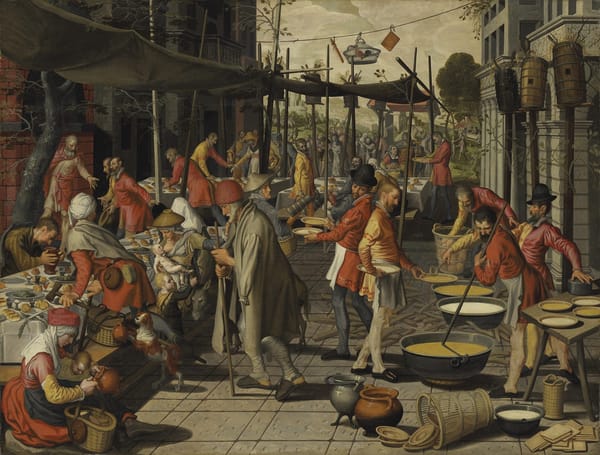
This Gospel has given to the present Sunday the name of the Sunday of the invited to the marriage. And yet, from the very opening of the dominical series, which began with the Descent of the Holy Ghost, the Church gave us the Gospel teaching which she offers to us, now a second time, for our consideration. On the second Sunday after Pentecost, she related to us, from St. Luke,19 the parable of the great supper, to which many were invited, and which St. Matthew, entering into fuller details, calls a marriage-feast.
Set thus before us, both at the beginning and at the close of the liturgical season over which the holy Spirit reigns supreme, this parable is, as it were, the interpreter of the whole portion of the year which it thus hems in : it is an additional revelation of the true aim of the Church. But how much has the light increased, since the first time we had these mystery-telling allegories! The certain man (homo quidam), who made a great supper, and invited many, has become the King, who makes a marriage for His Son, and, in this marriage, gives us an image of the kingdom of heaven. The world’s history, too, has been developing, as we gather from the terms respectively used by the two Evangelists. Those who were the first invited, and contented themselves with declining the kindness of the Master of the house, have grown in their impious ingratitude; laying hands on the messengers sent them by the loving kindness20 of the King, they treat them with contumely, and put them to death! We have seen the merited punishment inflicted on these deicides, by this Man, who was God Himself, the Father of Israel, now become King of the Gentiles : we have seen how He sent his armies to destroy them, and burn their city.21 And now at last, in spite of the refusal of the invited of Juda, in spite of the treacherous opposition put by them against the celebration of the nuptials of the Son of God, all things are ready for the marriage, and the banquet-hall is filled with guests.
Our heavenly King has confided, to the ministers of His love, the work of calling from every people the new guests. But now that His ambassadors, according to His command, have traversed the whole earth,22 bringing together all nations for this day of the joy of His heart,23 He Himself is coming in person, to see that nothing is wanting to the due preparation for the feast, and to give the signal for the eternal banquet of the divine nuptials. Now, for such a feast, and in such a place, if there be any deficiency, it can only be on the part of the guests. Let them, then, be careful not to draw down upon themselves, in this general and last examination, the displeasure of the great King, who has called them to an alliance with Himself. Though He has condescended to call them, notwithstanding their extreme poverty, from the public streets and highways, He has given them abundant time to lay aside their tatters; and knowing that they could not get ready of themselves, He has placed at their disposal, for the marriage-feast, the richest garments of His grace and virtues. Woe, then, to him who on the last day shall be found not having the wedding garment of charity! Such a want would admit of no excuse; and the King would justly punish it, by excluding the guilty man from the feast, as one that had insulted His Son.
Everything we have had on the preceding Sundays, has shown us how solicitous the Church ever is in preparing mankind for that wonderful marriage whose realization is the one object aimed at by the divine Word, in coming upon our earth. During her long exile, the bride of the Son of God has been a living model to her children; and, by her instructions, she has been unceasingly preparing them for the understanding of the great mystery of divine union. Three weeks ago,24 treating more directly than she had hitherto done on the great subject of her ambition as mother and bride, she reminded them of the great call. On the following Sunday, she gave them another lesson : she revealed to them the Bridegroom of the nuptials, to which they were invited, as the Man-God, the object of the twofold precept of love which embodies the whole Law. To-day, we have the teaching in all its perfection. It is condensed in the night Office, where we have St. Gregory explaining her whole teaching. The great doctor and the great Pope thus, in the name of the Church, explains our Gospel:
'The kingdom of heaven is the assembly of the just; for, the Lord says by a prophet: “Heaven is My throne";25 and Solomon says : “The soul of the just man is the throne of wisdom ”;26 and Paul calls Christ the Wisdom of God.27 If, therefore, heaven be the throne of God, we must evidently conclude that, as Wisdom is God, and the soul of the just man is the throne of Wisdom, this soul is a heaven . . . . The kingdom of heaven, then, is the assembly of the just . . . . If this kingdom is said to be like to a King, who made a marriage for his Son, your charity at once understands who is this King, who is the Father of a Son, King like Himself. It is He, of whom the psalmist says: “Give to the King Thy judgment, O God, and to the King’s Son Thy justice!”28 God the Father made the marriage of God His Son, when He wished that He, who had been God before all ages, should become Man towards the end of ages. But we must not, on that account, suppose that there are two persons in Jesus Christ, our God and our Saviour . . . . It is, perhaps, clearer and safer to say, that the King made a marriage for His Son, in that, by the mystery of the Incarnation, He united the Church to Him. The womb of the Virgin-Mother was the nuptial-chamber of that Bridegroom, of whom the psalmist says:29 He hath set His tabernacle in the sun : and He, as a Bridegroom, cometh out of His bride-chamber!'30
Notwithstanding her dignity of beloved bride of the Son of God, the Church is, none the less, subject to tribulations here below. The enemies of the Spouse, having ho longer any direct power to injure our Lord, turn all their rage against her. In these trials, endured as they are by the Church with love, Jesus sees a fresh trait of that resemblance which He wishes her to have to Himself; He, therefore, leaves her to suffer in this world, contenting Himself with ever upholding and saving her, as the Offertory says, in the midst of the evils which go on thickening around her.
Offertory
The august sacrifice, which is about to be offered, always obtains its effect, as far as the glory of the divine Majesty is concerned; but its virtue is applied to man in a greater or less degree, according to the dispositions of the creature, and depending on the divine mercy. Let us, in the Secret, beseech our heavenly Father, that we may experience abundantly the effects of the divine mysteries, which are so soon to be produced on our altar.
Secret
The other Secrets, as on page 130.
The Man-God, by His divine contact in the sacred banquet, has spiritually given vigour to our members; let us recall to mind that we must, henceforward, consecrate them to His service, and that our feet, now made sure, must run in the way of the divine commandments.
Communion
The Postcommunion, again, seems to be an allusion to the Gospel of the paralytic, which used formerly to be read on this Sunday. In it, we implore the assistance of the heavenly Physician, who sets man free from the palsy, which held him a prisoner; He also gives him the strength needed for fulfilling the law of God bravely and perseveringly.
Postcommunion
The other Postcommunions, as on page 181.
Vespers
The psalms, capitulum, hymn, and versicle, as above, pages 71-81.
Antiphon of the Magnificat
Oremus.
- St. John i. 14. ↩︎
- Heb. i. 3 ↩︎
- Col. ii. 3, 9, ↩︎
- St. John xiv. 6. ↩︎
- Eph. iv. 18. ↩︎
- Ibid. i. 10. ↩︎
- Col. i. 15-20. ↩︎
- Cf. St. John iv. 14; vii, 37, 39. ↩︎
- Ibid. xvii. 17. ↩︎
- Cf. St. John xv. 26. ↩︎
- Ibid. xvii. 21-23. ↩︎
- Ibid. 19. ↩︎
- Rom. xiii. 14. ↩︎
- Eph. iv. 3. ↩︎
- Ps. iv. 5. ↩︎
- S. Chrys., in ep. ad Eph. Hom., xiv. ↩︎
- Eph. v. 1, 2. ↩︎
- S. Basil, Const, mon., xviii ↩︎
- St. Luke xiv. 16-24. ↩︎
- See Time after Pentecost, vol. i., p. 358. ↩︎
- See Ninth Sunday after Pentecost. ↩︎
- Ps. xviii. 5. ↩︎
- Cant. iii. 11. ↩︎
- The Sixteenth Sunday after Pentecost. ↩︎
- Isa. lxvi. 1. ↩︎
- Wisd. vii. 27. ↩︎
- 1 Cor. i. 24. ↩︎
- Ps. lxxi. 2. ↩︎
- Ps. xviii. 6. ↩︎
- S. Greg., Hom, xxxviii. in Ev. ↩︎
October 8: St. Bridget, Widow
‘Who, O Lord, has treated Thee thus?’ ‘They that despise Me and forget My love.’ This was the first revelation of the Son of God to Bridget of Sweden. Francis of Assisi, raising before the world the standard of the cross, had announced that Christ was about to recommence the dolorous way; not now in His own Person, but in the Church, who is flesh of His flesh. The truth of this declaration Bridget experienced from the very opening of that fatal fourteenth century, during which such innumerable disasters, the results of crime, fell at once upon the west.
Born in the year when Sciarra Colonna, a new Pilate’s servant, dared to strike the Vicar of Christ, Bridget’s childhood was contemporaneous with those sad falls, which caused the Church to be despised by her enemies. There were no saints in Christendom comparable to the great ones of old; in the preceding age the Latin races had exhausted their vitality in producing flowers; but where were the promised fruits? Ancient Europe had nought but affronts for the Word of God; this feast, this apparition of Jesus in cold Scandinavia, seems to point to His flight from the habitual centre of His predilection. Bridget was ten years old, when the Man of sorrows sought a resting-place in her heart: and at that very time, the death of Clement V and the election of John XXII in a foreign land, fixed the papacy in its seventy years’ exile.
Rome meanwhile, widowed of her Pontiff, appeared the most miserable of cities: ‘The ways of Sion mourn, because there are none that come to the solemn feast.’1 Sacked by her own sons, she was daily losing some remnant of her ancient glory; her public roads were scenes of bloodshed; solitude reigned amid the ruins of her crumbling basilicas; sheep grazed in St. Peter’s and the Lateran. From the seven hills anarchy had spread throughout Italy, transforming the towns into haunts of brigands, and the country parts into deserts. France was doomed to expiate, in the horrors of a hundred years' war, the captivity of the sovereign Pontiff.
Unfortunately, the captivity was loved; the court of Avignon did not mourn like the Hebrews by the rivers in Babylon; richer in gold than in virtues, it were well, had they not, for a long time, shaken the influence of the Holy See over the nations. The German empire and Louis of Bavaria could easily refuse obedience to the ward of the Valois; the Fratricelli accused the Pope of heresy; while, countenanced by the doctors of the law, Marsillus of Padua attacked the very principle of the papacy. Benedict XII discouraged by the troubles of Italy, abandoned his design of returning to Rome; and built upon the rock of Doms the famous castle, at once fortress and palace, which seemed to fix the residence of the Popes for ever on the banks of the Rhone. The misery of Rome, and the splendour of Avignon, reached their height under Clement VI who entered into a contract with Jane of Naples, Countess of Provence, securing to the Church the definitive possession of Avignon. At that time the papal court surpassed all others in luxury and worldliness. God in His justice visited the nations with the scourge of the black death; while in His mercy He sent warnings from heaven to Pope Clement:
Arise; make peace between the kings of France and England; and go into Italy to preach the year of salvation, and to visit the places watered by the blood of saints. Consider how, in the past, thou hast provoked My anger, doing thy own will and not thy duty; and I have held My peace. But now ray time is at hand. If thou wilt not obey, I shall require of thee an account of the unworthiness wherewith thou hast passed through all the degrees by which I permitted thee to be exalted in glory. Thou wilt be answerable for all the avarice and ambition that have been rife in the Church in thy days. Thou couldst have done much towards a reformation, but being carnal-minded thou wouldst not. Repair the past by zeal during the rest of thy life. Had not My patience preserved thee, thou wouldst have fallen lower than any of thy predecessors. Question thy conscience, and thou wilt see that I speak the truth.2
This severe message, dictated by the Son of God to the prophetess Bridget of Sweden, came from that northern land where sanctity seemed to have taken refuge during the past half century. Though incurring such reproaches, the Pope still had great faith, and he accordingly received with generous courtesy the messengers from the princess of Nericia. But, though he promulgated the celebrated Jubilee of the half-century, Clement VI allowed the holy year to pass away without going himself to prostrate at the tombs of the apostles, to which he convoked the entire world. The patience of God was at an end. The judgment of that soul was revealed to Bridget; she saw its terrible chastisement, which however was not eternal, and was tempered by hope.3
Hitherto wholly engaged with the supernatural interests of her own country, Bridget suddenly found her mission embrace the whole world. In vain, by her prayers to God, by her warnings to princes, had the saint striven to avert from Sweden the trials that were to end in the union of Calmar. Neither Magnus II nor his consort Blanche of Dampierre, took to heart the menaces of their noble relative: ‘I saw the sun and the moon shining together in the heavens, until both having given their power to the dragon, the sky grew pale, reptiles filled the earth, the sun sank into the abyss, and the moon disappeared, leaving no trace behind.’4
The criminal coldness of the south had been the occasion of grace for the north; but the latter in its turn did not profit by the time of its visitation: and Bridget quitted it for ever. She herself was a city of refuge to our Lord. Taking up her abode in Rome, she there, by her holiness, prepared the way for the return of Christ’s vicar. There for twenty years she, as it were, personified the eternal city, enduring all its bitter sufferings, knowing all its moral miseries, presenting its tears and prayers to our Lord; continually visiting the tombs of the apostles and martyrs throughout the peninsula; and at the same time never ceasing to transmit to Pontiffs and kings the messages dictated to her by God.
At length the horizon appeared to be brightening: while the just and inflexible Innocent VI reformed the papal court, Albornoz was restoring peace in Italy. In 1367 Bridget had the great joy of receiving in the Vatican the blessing of Urban V. Unhappily, in three short years Urban quitted the threshold of the apostles to return to his native land; but, as Bridget foretold, he re-entered Avignon only to die. He was succeeded by the nephew of Clement VI, Roger de Beaufort, under the name of Gregory XI, who was destined to put an end to the exile and break the chains of the Roman Pontiffs.
But Bridget’s hour had come. Another was to reap in joy what she had sown in tears; Catharine of Siena was to bring back to the holy city the vicar of our Lord. As to the valiant Scandinavian, who had never lost courage or faltered in faith through the failure of her missions, she was inspired by her divine Spouse to visit the holy places, the scenes of His Passion. It was on her return from this last pilgrimage, that, far from her native land, in that desolate Rome whose widowhood she had striven in vain to terminate, she was called to her heavenly reward. Her body was carried back to Scandinavia by her daughter St. Catharine of Sweden. It was laid in the yet unfinished monastery of Vadstena, mother-house of that projected Order of our Saviour, the foundations of which, like all the undertakings imposed by God upon Bridget, was not to be completed until after her death. Twenty-five years before, she had received almost simultaneously the command to found, and the command to quit, this holy retreat; as though the Lord would give her a glimpse of its blessed peace, only to crucify her the more in the very different path into which He immediately led her. Such is God’s severity towards His dear ones, and such His sovereign independence with regard to His gifts. In the same manner, He had allowed the saint, in her early years, to be attracted by the beautiful lily of virginity, and had then signified His will that the flower should not be hers. 'When I cry,’ said the prophet, in a captivity figurative of that whereof Bridget felt all the bitterness, ‘when I cry and entreat, He hath shut out my prayer. He hath shut up my ways with square stones, He hath turned my paths upside down.’5
Before reading the liturgical legend, let us call to mind that St. Bridget died on July 23, 1373; October 8 is the anniversary of the first Mass celebrated in her honour by Pope Boniface IX on the day following her canonization.6 Martin V confirmed the Acts of Boniface IX in her honour; and approved her Revelations, which had been violently attacked in the Councils of Constance and Basle, only to come forth with a higher recommendation to the piety of the faithful. Many Indulgences are attached to the rosary which bears the saint's name. These are now, by the favour of the apostolic See, frequently applied to ordinary rosaries; but it must be remembered that the true rosary of St. Bridget is composed of the Ave Maria recited sixty-three times, the Pater noster seven times, and the Credo seven times, in honour of the supposed number of our Lady’s years on earth, and of her joys and sorrows. It was also from a desire of honouring our Lady, that the saint vested in the abbess the superiority over the double monasteries in the Order of our Saviour.
O valiant woman! support of the Church in most unhappy times, mayst thou now be blest by all nations! When the earth, grown poor in virtue, no longer paid its debts to the Lord, thou wast the treasure discovered and brought from the uttermost coasts to supply for the indigence of many. Thou didst earn the good-will of heaven for the hitherto despised north. Then the holy Spirit was moved by the prayers of apostles and martyrs to lead thee to the land which their blood had not sufficed to render fruitful for the Spouse; thou didst appear as the merchant's ship bringing bread from afar to countries wasted and barren. At thy voice, Rome took heart again; after thy example, she expiated the faults which had wrought her ruin; thy prayers and hers won back to her the heart of her Spouse and of His vicar.
Thine own portion was one of suffering and labour. When, to the joy of all, thy work was consummated, thou hadst already quitted this world. Thou didst resemble the heroes of the old Testament, saluting from afar the promises that others were to see fulfilled, and acknowledging themselves to be strangers and pilgrims on the earth. Like them thou didst seek, not the fatherland thou hadst abandoned and whither thou couldst have returned, but the only true home which is heaven. Moreover God made it a glory to be called thy God.
From the eternal city where thine exile is at an end, preserve in us the fruit of thy example and teachings. Thy Order of our Saviour perpetuates them in the countries where it still exists though so much diminished; may it revive at Vadstena in its primitive splendour! By it and its rivals in holiness, bring hack Scandinavia to the faith, now so unhappily lost, of its apostle Anscharius, and of Eric and Olaf its martyr kings. Lastly, protect Home, whose interests were so specially confided to thee by our Lord; may she never again experience the terrible trial which cost thee a life-time of labour and suffering!
October 8 (the Same Day) [October 7]: Sts. Sergius, Bacchus, Marcellus and Apuleius, Martyrs
Among the martyrs annually commemorated on this day, the names of Marcellus and Apuleius carry back the mind to apostolic times. They had been disciples of Simon Magus, but were convinced of his lying deceit by the miracles of St. Peter, and shed their blood in testimony of their faith in the true God.
St. Sergius is regarded in the east as one of the most glorious witnesses to our Lord. He suffered in the tenth and last persecution, with his companion St. Bacchus, a soldier like himself of the Roman army in Syria. So illustrious became his sepulchre, that a city sprang up around it, which was called Sergiopolis, and became a metropolitan See. The west soon joined the east in honouring these holy martyrs, and a church was dedicated to them in Rome. Saint-Serge at Angers, founded by Clovis II, testifies to the veneration in which they were held by the Franks.
Prayer
| Previous October 7: Our Lady of Victory | Next October 8: St. Bridget, Widow |