Daily reading
After Pentecost
Double · Movable from Easter · Temporal
October 15, 2023
From Dom Guéranger’s The Liturgical Year.

|
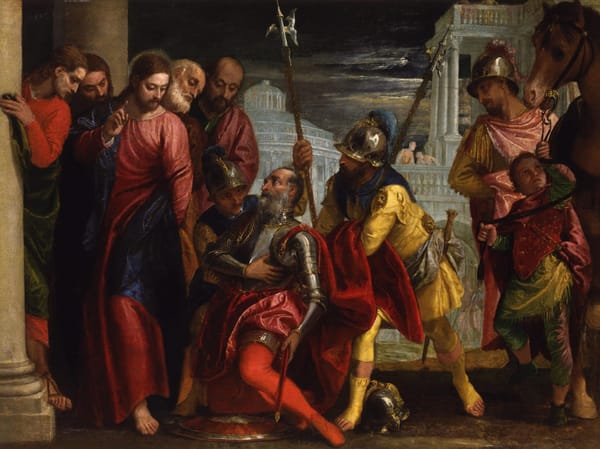
The Twentieth Sunday after Pentecost
The Gospel of last Sunday spoke to us of the nuptials of the Son of God with the human race. The realization of those sacred nuptials is the object which God had in view in the creation of the visible world; it is the only one He intends in His government of society. This being the case, we cannot be surprised, that the parable of the Gospel, whilst revealing to us this divine plan, has also brought before us the great fact of the rejection of the Jews, and the vocation of the Gentiles, which is not only the most important fact of the world’s history, but is also intimately connected with the consummation of the mystery of the divine union.
And yet, as we have already said,1 the exclusion of Juda is one day to cease. His obstinate refusal of the grace has caused it to be brought to us Gentiles by the messengers of God’s loving mercy. But, now that the fullness of the Gentiles2 has heard and followed the heavenly invitation, the time is advancing when the accession of Israel will complete the Church in her members, and give the bride the signal of the final call, which will put an end to the long labour of ages,3 by the appearance of the Bridegroom.4 The holy jealousy, which the apostle was so desirous to rouse in the people of his race by turning towards the Gentiles,5 will, at last, make itself felt by the descendants of Jacob. What joy will there be in heaven, when they, repentant and humble, shall unite before God in the song of gladness sung by the Gentiles, in celebration of the entrance of His countless Jewish people into the house of the divine banquet! That union of the two peoples will truly be a prelude to the great day mentioned by St. Paul, when, speaking in his patriotic enthusiasm of the Jews, he said : ‘If their offence (i.e., their fall) hath been the riches of the world, and their diminution be the riches of the Gentiles, how much more the fullness of them!’6 Now, the Mass of this twentieth Sunday after Pentecost gives us a foretaste of that happy day, when the new people will not be alone in singing hymns of praise for the divine favours bestowed on our earth. The ancient liturgists tell us that our Mass consists partly of the words of the prophets, giving to Jacob an expression of his repentance, whereby he is to merit a return of God’s favours, and partly of inspired formulas, wherein the Gentiles, who are already within the hall of the marriage-feast, are singing their canticles of love.7 The Gentile-choir takes the Gradual and Communion-anthem; the choir of the Jews, the Introit and Offertory.
The Introit is from the book of Daniel.8 Exiled to Babylon with his people, the prophet—in that captivity whose years of bitterness were a figure of the still longer and intenser sufferings of the present dispersion—laments with Juda in that strange land, and, at the same time, instructs his people how they may be readmitted into God’s favour. It is a secret which Israel had lost ever since his commission of the crime on Calvary; though, in the previous ages of his history, he knew the happy secret, and had continually experienced its efficacy. What it was, it still is and ever will be : it consists in the humble avowal of the sinner’s falls, in the suppliant regret of the culprit, and in the sure confidence that God’s mercy is infinitely above the sins of men, how grievous soever those may have been.
Introit
The divine forgiveness, which restores the soul to purity and peace, is the indispensable preparation for the sacred marriage-feast; for the wedding garment of its guests must, under pain of exclusion, be without a stain; their heart, too, must be without bitterness, lest it should cause the Bridegroom to be offended. Let us implore this precious pardon. Our Lord is all the more ready to grant it us, when we ask it through His beloved bride, the Church, our mother. Let us unite our voices with hers, and say her Collect.
Collect
Epistle
Cap. v.Fratres, Videte quomodo caute ambuletis : non quasi insipientes, sed ut sapientes : redimentes tempus, quoniam dies mali sunt. Propterea nolite fieri imprudentes, sed intelligentes quæ sit voluntas Dei. Et nolite inebrian vino, in quo est luxuria, sed implemini Spiritu sancto, loquentes vobismetipsis in psalmis, et hymnis, et canticis spiritualibus, cantantes, et psallentes in cordibus vestris Domino, gratias agentes semper pro omnibus, in nomine Domini nostri Jesu Christi Deo et Patri. Subjecti invicem in timore Christi.
Ch. v.Brethren: See, therefore, how you walk circumspectly, not as unwise, but as wise : redeeming the time, because the days are evil. Wherefore become not unwise, but understanding what is the will of God. And be not drunk with wine, wherein is luxury, but be ye filled with the holy Spirit, speaking to yourselves in psalms and hymns, and spiritual canticles, singing and making melody in your hearts to the Lord : giving thanks always for all things in the name of our Lord Jesus Christ to God and the Father. Being subject one to another in the fear of Christ.
The other Collects, as on page 120.
As the nuptials of the Son of God approach their final completion, there will be, also, on the side of hell, a redoubling of rage against the bride, with a determination to destroy her. The dragon of the Apocalypse,9 the old serpent who seduced Eve, will cast out water, as a river, from his mouth10—that is, he will urge on all the passions of man, that they may league together for her ruin. But, do what he will, he can never weaken the bond of the eternal alliance; and, having no power against the Church herself, he will turn his fury against the last children of the new Eve, who will have the perilous honour of those final battles, which are described by the prophet of Patmos.11
It is then, more than at all previous times, that the faithful will have to remember the injunction given to us by the apostle in to-day’s Epistle. They will have to comport themselves with that circumspection which he enjoins, taking every possible care to keep their understanding, no less than their heart, pure, in those evil days. Supernatural light will, in those days, not only have to withstand the attacks of the children of darkness, who will put forward their false doctrines; it will, moreover, be minimized and falsified by the very children of the light yielding on the question of principles; it will be endangered by the hesitations, and the human prudence, of those who are called far-seeing men. Many will practically ignore the master-truth, that the Church never can be overwhelmed by any created power. If they do remember that our Lord has promised to uphold His Church even to the end of the world,12 they will still believe that they do a great service to the good cause by making certain politically clever concessions, not weighed in the balance of the sanctuary. Those future worldly-wise people will forget that our Lord needs no shrewd schemes to help Him to keep His promise; they will entirely overlook this most elementary consideration, that the co-operation which Jesus deigns to accept at the hands of His servants in the defence of the rights of His Church, never could consist in the disguising of those grand truths which constitute the power and beauty of the bride. They will forget the apostle’s maxim, laid down in his Epistle to the Romans, that to conform oneself to this world, to attempt an impossible adaptation of the Gospel to a world that is unchristianized, is not the means for proving what is the good, and the acceptable, and the perfect will of God.13 So that it will be a thing of great and rare merit, in many an occurrence of those unhappy times, merely to understand what is the will of God, as our Epistle expresses it.
‘Look to yourselves,’ would St. John say to those men, 'that ye lose not the things which ye have wrought; make yourselves sure of the full reward,’ which is given only to the persevering thoroughness of doctrine and faith!14 Besides, it will be then, as in all other times, that, according to the saying of the Holy Ghost, the simplicity of the just shall guide them,15 and far more safely than any human ingenuity could do; humility will give them wisdom;16 and, keeping themselves closely united to this noble companion, they will be made truly wise by her, and will know what is acceptable to God.17 They will understand that, aspiring like the Church herself to union with the eternal Word, fidelity to the Spouse, for them as for the Church, is nothing else than fidelity to the truth; for the Word, who is the one same object of love to both of them, is, in God, no other than the splendour of infinite truth.18 Their one care, therefore, will ever be to approach nearer and nearer to their Beloved, by a continually increasing resemblance to Him— that is to say, by the completest reproduction, both in their words and works, of the beautiful truth. By so doing, they will be serving their fellowcreatures in the best possible way, for they will be putting in practice the counsel of Jesus, who bids them seek first the kingdom of God and His justice, and confide in Him for all the rest.19 Others may have recourse to human and accommodating combinations, fitted to please all parties; they may put forward dubious compromises, which (so their suggesters think) will keep back, for some weeks or some months perhaps, the fierce tide of revolution; but those who have God’s spirit in them will put a very different construction on the admonition given us by the apostle in to-day’s Epistle, where he tells us to redeem the time.
It was our Lord who bought time, and at a great price; and He bought it for us, that it might be employed by His faithful servants in procuring glory for God. By most men it is squandered away in sin or folly; but those who are united to Christ, as living members to the Spouse of their souls, will redeem it—that is, they will put such an intensity into their faith and their love that, as far as it is possible for human nature, not a moment of their time shall be anything but an earnest tribute of service to their Lord. To the insolent and blasphemous things which are then to be spoken by the beast,20 these determined servants of God will give, for their brave answer, the cry of St. Michael, which he uttered against satan, the helper of the beast :21 ‘Who is like unto God?’
These closing weeks of the year used, in olden times, to be called ‘Weeks of the holy Angel.'’ We have seen, on one of these Sundays,22 how the liturgy formerly announced the great Archangel’s coming to the aid of God’s people, according to the prophecy of Daniel.23 When, therefore, the final tribulations shall commence; when exile shall scatter the faithful, and the sword shall slay them,24 and the world shall approve all that, prostrate, as it then will be, before the beast and his image25— let us not forget that we have a leader chosen by God, and proclaimed by the Church; a leader who will marshal us during those final combats, in which the defeat of the saints26 will be more glorious than were the triumphs of the Church in the days when she ruled the world. For what God will then ask of His servants is not success of diplomatical arrangements, nor a victory won by arms, but fidelity to His truth—that is, to His Word; a fidelity all the more generous and perfect, as there will be an almost universal falling off around the little army fighting under the Archangel’s banner. Uttered by a single faithful heart, under such circumstances, and uttered with the bravery of faith and the ardour of love, the cry of St. Michael, which heretofore routed the infernal legions, will honour God more than the blasphemies uttered by the millions of degraded followers of the beast will insult Him.
Let us be thoroughly imbued with these thoughts which are suggested by the opening lines of our Epistle. Let us also master the other instructions it contains, and which, after all, differ but little from those we have been developing. As the Gospel of the nuptials of the Son of God and the invitation to His divine banquet was formerly read on this day, our holy mother the Church appropriately points out in the Epistle the immense difference there is between these sacred delights, and the joys of the world’s marriage-feasts. The calm, the purity, the peace of the just man, who is admitted into intimacy with God, are a continual feast to his soul;27 the food served up at that feast is Wisdom;28 Wisdom, too, is the beloved Guest, who is unfailingly there.29 The world is quite welcome to its silly, and often shameful, pleasures; the Word and the soul, which, in a mysterious way, He has filled with the holy Spirit,30 join together to sing to the eternal Father in admirable unison; they will go on for ever with their hymns of thanksgiving and praise, for the materials of both are infinite. The hideous sight of the earth’s inhabitants, who will then by thousands be paying homage to the harlot who sits on the beast, and offers them the golden cup of her abominations—no, not even that will interfere in the least with the bliss caused in heaven by the sight of those happy souls on earth. The convulsions of a world in its last agony, the triumphs of the woman drunk with the blood of the martyrs,31 far from breaking in on the harmony of a soul which is united with the Word, will but give greater fullness to the divine notes, and greater sweetness to the human music of her song. The apostle tells all this in his own magnificent way, where he says : ‘Who, then, shall separate us from the love of Christ? Shall tribulation? or distress? or famine? or nakedness? or danger? or persecution? or the sword? It is written : For thy sake we are put to death all the day long; we are accounted as sheep for the slaughter32—but in all these things we overcome, because of Him that hath loved us. For I am sure that neither death, nor life, nor angels, nor principalities, nor powers, nor things present, nor things to come, nor might, nor height, nor depth, nor any other creature, shall be able to separate us from the love of God, which is in Christ Jesus our Lord.33
In the Introit, the Jewish people sang its repentance and humble confidence; and now, in the Gradual, we have the Gentiles proclaiming, in music taught them by the Church, how, in the delights of the nuptial banquet, their hopes have been realized, yea, and surpassed.
Gradual
Gospel
Cap. iv.In illo tempore : Erat quidam regulus, cujus filius infirmabatur Capharnaum. Hic cum audisset, quia Jesus adveniret a Judæa in Galilæam, abiit ad eum: et rogabat eum ut descenderet, et sanaret filium ejus: incipiebat enim mori. Dixit ergo Jesus ad eum : Nisi signa, et prodigia videritis, non creditis. Dicit ad eum regulus: Domine, descende priusquam moriatur filius meus. Dicit ei Jesus: Vade; filius tuus vivit. Credidit homo sermoni, quem dixit ei Jesus, et ibat. Jam autem eo descendente, servi occurrerunt ei, et nuntiaverunt dicentes, quia filius ejus viveret. Interrogabat ergo horam ab eis, in qua melius habuerit. Et dixerunt ei: quia heri hora septima reliquit eum febris. Cognovit ergo pater, quia illa hora erat, in qua dixit ei Jesus: Filius tuus vivit: et credidit ipse, et domus ejus tota.
Ch. iv.At that time : There was a certain ruler whose son was sick at Capharnaum. He having heard that Jesus was come from Judea into Galilee, went to him, and prayed him to come down and heal his son, for he was at the point of death. Jesus therefore said to him: Unless you see signs and wonders you believe not. The ruler saith to him : Lord, come down before that my son die. Jesus saith to him: Go thy way, thy son liveth. The man believed the word which Jesus said to him, and went his way. And as he was going down, his servants met him: and they brought word, saying that his son lived. He asked therefore of them the hour wherein he grew better. And they said to him: Yesterday at the seventh hour the fever left him. The father therefore knew that it was at the same hour that Jesus said to him: Thy son liveth; and himself believed, and his whole house.
The Gospel for to-day is taken from St. John; it is the first and only time during the whole course of these Sundays after Pentecost. It gives the twentieth Sunday the name of ‘the Ruler of Capharnaum.’ The Church has selected this Gospel on account of its bearing a certain mysterious relation to the state of the world in those last days which the liturgy prophetically brings before us at the close of the year.
The world is drawing towards its end; like the ruler’s son, it begins to die. Tormented by the fever of the passions which have been excited in Capharnaum, the city of business and pleasure, it is too weak to go itself to the Physician who could cure it. It is for its father—for the pastors, who, by Baptism, gave it the life of grace, and who govern the Christian people as rulers of holy Church—to go to Jesus, and beseech Him to restore the sick man to health. St. John begins this account34 by mentioning the place where they were to find Jesus : it was at Cana, the city of the marriagefeast, where He first manifested His power35 in the banquet-hall; it is in heaven that the Man-God abides, now that He has quitted our earth, where He has left His disciples deprived of the Bridegroom,36 and having to pass a certain period of time in the field of penance. Capharnaum signifies the field of penance, and of consolation, which penance brings with it. Such was this earth intended to be, when man was driven from Eden; such was the consolation, to which, during this life, the sinner was to aspire; and, because of his having sought after other consolations, because of his having pretended to turn this field of penance into a new paradise, the world is now to be destroyed. Man has exchanged the life-giving delights of Eden for the pleasures which kill the soul, and ruin the body, and draw down the divine vengeance.
There is one remedy for all this, and only one: it is the zeal of the pastors, and the prayers of that portion of Christ’s flock which has withstood the torrent of universal corruption. But it is of the utmost importance that, on this point, the faithful and their pastors should lay aside all personal considerations, and thoroughly enter into the spirit which animates the Church herself. Though treated with the most revolting ingratitude, and injustice, and calumny, and treachery of every sort, this mother of mankind forgets all these her own wrongs, and thinks only of the true prosperity and salvation of the very countries which despise her.37 She is well aware that the time is at hand when God will make justice triumphant; and yet she goes on struggling, as Jacob did, with God,38 until the dawn of that terrible day, foretold by David and the sibyl.39 At the thought of the pool of fire,40 into which her rebellious children are to be plunged, she seems to have almost forgotten the approach of the eternal nuptials, and lost her vehement longings as a bride. One would say that she thinks of nothing but of her being a mother; and, as such, she keeps on praying as she has always prayed, only more fervently than ever, that the end may be deferred (pro mora finis).41
That we may fulfil her wishes, let us, as Tertullian says, ‘assemble together in one body, that we may, so to speak, offer armed force to God by our prayers. God loves such violence as that.'42 But that our prayer may have power of that kind, it must be inspired by a faith which is thorough, and proof against every difficulty. As it is our faith which overcometh the world,43 so it is, likewise, our faith which triumphs over God, even in cases which seem beyond all human hope. Let us do as our mother does, and think of the danger incurred by those countless men, who madly play on the brink of the precipice, into which, when they fall, they fall for ever. It is quite true they are inexcusable; it was only last Sunday that they were reminded of the weeping and gnashing of teeth, in the exterior darkness, which they will undergo that despise the call to the Kings marriage-feast.44 But they are our brethren, and we should not be quietly resigned to see them lose their souls. Let us hope against all hope. Did our Lord, who knew with certainty that obstinate sinners would be lost, hesitate, on that account, to shed all His Blood for them?
It is our ambition to unite ourselves to Him by the closest possible resemblance; let us, then, be resolved to imitate Him in that also, did occasion serve; at all events, let us pray without ceasing for the Church’s and our enemies, so long as we are not assured of their being lost. Such prayer is never useless, never thrown away; for, come what may, God is greatly honoured by our faith, and by the earnestness of our charity.
Only, let us be careful not to merit the reproach uttered by our Redeemer against the halting45 faith of the fellow-townsmen of the ruler of Capharnaum. We know that our Jesus has no need to come down from heaven to earth, in order to give efficiency to the commands of His gracious will. If He deign to multiply signs and wonders around us, we will rejoice at them, because of our brethren who are weak of faith; we will make them an occasion for exalting His holy name; but we will lovingly assure Him that our soul has no need of new proofs of His power, in order to believe in Him!
The Jewish people, whilst enduring its wellmerited captivity, and straying along the riverbanks of Babylon, has grown repentant, and, in our Offertory, joins our mother the Church, in singing the admirable hundred and thirty-sixth Psalm; there never was such a song of exile.
Offertory
The whole power of the God, who, with a word, cures both soul and body, resides in the mysteries which are about to be celebrated on our altar here. Let us, in the Secret, beseech Him, that their effects may tell on our hearts.
Secret
The other Secrets, as on page 130.
The word, spoken of in the Communion-anthem as having raised man up from the abyss of his misery, is that of the Gospel, which calls mankind, saying: Come to the marriage!46 But, although deified by his participation, here below, in the mystery of faith, man aspires to the perfect and eternal union, which is to be in the midday of glory.
Communion
A persevering fidelity in observing God’s commandments is the best preparation a Christian can make for approaching the holy Table, as the Postcommunion tells us.
Postcommunion
The other Postcommunions, as on page 181.
Vespers
The psalms, capitulum, hymn and versicle, as above, pages 71-81.
Antiphon of the Magnificat
- The Thirteenth Sunday after Pentecost. ↩︎
- Rom. xi. 25, 26. ↩︎
- Ibid. viii. 22. ↩︎
- Apoc. xxii. 17. ↩︎
- Rom. xi. 13, 14. ↩︎
- Ibid. 12. ↩︎
- Berno Aug., v.; Rup., De Div. Off., xii. 20; Durand., Ration., vi. 137. ↩︎
- Dan. iii. ↩︎
- Apoc. xii. 9. ↩︎
- Ibid. 15. ↩︎
- Ibid. 17 ↩︎
- St. Matt. xxviii. 20. ↩︎
- Rom. xii. 2. ↩︎
- 2 St. John 8, 9. ↩︎
- Prov. xi. 3. ↩︎
- Ibid. 2. ↩︎
- Wisd. ix. 10. ↩︎
- Ibid. vii. 25, 26. ↩︎
- St. Matt. vi. 33. ↩︎
- Apoc. xiii. 5, 6. ↩︎
- Ibid. 2. ↩︎
- The Seventeenth. ↩︎
- Dan. xii. 1. ↩︎
- Apoc. xiii. 7, 10. ↩︎
- Ibid. 3, 4, 8, 15. ↩︎
- Ibid. 7. ↩︎
- Prov. xv. 15. ↩︎
- Ecclus. xxiv. 29. ↩︎
- Wisd. viii. 16; Apoc. iii. 20. ↩︎
- Cant. i. 1. ↩︎
- Apoc. xvii. 1-6. ↩︎
- Ps. xliii. 22. ↩︎
- Rom. viii. 35-39. ↩︎
- St. John iv. 46. ↩︎
- Ibid. ii. 11. ↩︎
- St. Matt. ix. 15. ↩︎
- Allocutions of Leo XIII. ↩︎
- Gen. xxxii. 24-28. ↩︎
- The sequence Dies irœ. ↩︎
- Apoc. xxi. 8. ↩︎
- Tertull., Apol. xxxix. ↩︎
- Ibid. ↩︎
- 1 St. John v. 4. ↩︎
- St. Matt. xxii. 13. ↩︎
- Heb. xii. 13. ↩︎
- St. Matt. xxii. 4. ↩︎
October 15: St. Teresa, Virgin
'Although the Church triumphant in heaven, and the Church mourning here on earth, appear to be completely separated,' says Bossuet on this feast, ‘they are nevertheless united by a sacred bond. This bond is charity, which is found in this land of exile as well as in our heavenly country; which rejoices the triumphant saints, and animates those still militant; which, descending from heaven to earth, and from angels to men, causes earth to become a heaven, and men to become angels. For, O holy Jerusalem, happy Church of the first-born whose names are written in heaven, although the Church thy dear sister, who lives and combats here below, ventures not to compare herself with thee, she is not the less assured that a holy love unites her to thee. It is true that she is seeking, and thou possessest; that she labours, and thou art at rest; that she hopes, and thou rejoicest. But among all these differences which separate the two so far asunder, there is this at least in common: that what the blessed spirits love, the same we mortals love. Jesus is their life, Jesus is our life; and amid their songs of rapture, and our sighs of sorrow, everywhere are heard to resound these words of the sacred Psalmist: It is good for me to adhere to my God.’1
Of this sovereign good of the Church militant and triumphant, Teresa, in a time of decadence, was commissioned to remind the world, from the height of Carmel restored by her to its pristine beauty. After the cold night of the fourteenth and fifteenth centuries, the example of her life possessed a power of irresistible attraction, which survives in her writings, drawing predestined souls after her in the footsteps of the divine Spouse.
It was not, however, by unknown ways, that the holy Spirit led Teresa; neither did she, the humble Teresa, make any innovations. Long before, the apostle had declared that the Christian’s conversation is in heaven; and we saw, a few days ago, how the Areopagite formulated the teaching of the first century. After him we might mention St. Ambrose, St. Augustine, St. Gregory the Great, St. Gregory Nazianzen, and many other witnesses from all the churches. It has been said, and proved far more ably than we could prove it, that 'no state seems to have been more fully recognized by the fathers, than that of perfect union, which is achieved in the highest contemplation; and in reading their writings, we cannot help remarking the simplicity with which they treat of it; they seem to think it frequent, and simply look upon it as the full development of the Christian life.'2
In this, as in all else, scholasticism followed the fathers. It asserted the doctrine concerning these summits of Christian life, even at a time when the weakness of faith in the people scarcely over left full scope to divine charity, save in the obscurity of a few unknown cloisters, In its own peculiar form, the teaching of the School was unfortunately not accessible to all; and moreover the abnormal character of that troubled epoch affected even the mystics that still remained.
It was then that the virgin of Avila appeared in the Catholic kingdom. Wonderfully gifted by grace and by nature, she experienced the resistances of the latter, as well as the calls of God, and the purifying delays and progressive triumphs of love; the Holy Ghost, who intended her to be a mistress in the Church, led her, if one may so speak, by the classical way of the favours He reserves for the perfect. Having arrived at the mountain of God, she described the road by which she had come, without any pretension but to obey him who commanded her in the name of the Lord.3 With exquisite simplicity and unconsciousness of self, she related the works accomplished for her Spouse;4 made over to her daughters the lessons of her own experience;5 and described the many mansions of that castle of the human soul, in the centre of which, he that can reach it will find the holy Trinity residing as in an anticipated heaven.6 No more was needed: withdrawn from speculative abstractions and restored to its sublime simplicity, Christian mysticism again attracted every mind; light reawakened love; the virtues flourished in the Church; and the baneful effects of heresy and its pretended reform were counteracted.
Doubtless Teresa invited no one to attempt, as presumptuously as vainly, to force an entrance into the uncommon paths. But if passive and infused union depends entirely upon God’s good pleasure, the union of effective and active conformity to the divine will, without which the other would be an illusion, may be attained with the help of ordinary grace, by every man of good will. Those who possess it, ‘have obtained,’ says the saint, ‘what it was lawful for them to wish for. This is the union I have all my life desired, and have always asked of our Lord; it is also the easiest to understand, and the most secure.’7
She added however: ‘Beware of that excessive reserve, which certain persons have, and which they take for humility. If the king deigned to grant you a favour, would it be humility to meet him with a refusal? And when the sovereign Lord of heaven and earth deigns to honour my soul with His visit, and comes to load me with graces, and to rejoice with me; should I prove myself humble if I would not answer Him, nor keep Him company, nor accept His gifts, but fled from His presence and left Him all alone? A strange sort of humility is that! Look upon Jesus Christ as a Father, a Brother, a Master, or a Spouse; and treat Him in one or other of these ways; He Himself will teach you which is the one that best pleases Him and that it behoves you to choose. And then, be not so simple as to make no use of it.’8
But it is said on all sides: ‘This way is beset with snares: such a soul was lost in it; such an one went astray; and another, who ceased not to pray, could not escape a fall . . . See the inconceivable blindness of the world. It has no anxiety about those thousands of unfortunate creatures who, entirely strangers to the path of prayer, live in the most horrible excess; but if it happens, by a misfortune deplorable no doubt but very rare, that the tempter’s artifices seduce a soul that prays, they take advantage of this to inspire others with the greatest terror, and to deter them from the holy practices of virtue. Is he not the victim of a most fatal error, who believes it necessary to abstain from doing good in order to avoid doing evil? You must rise above all these fears. Endeavour to keep your conscience always pure; strengthen yourself in humility; tread under foot all earthly things; be inflexible in the faith of our mother the holy Church; and doubt not, after that, that you are on the right road.'9 It is too true that ‘when a soul finds not in herself that vigorous faith, and her transports of devotion do not strengthen her attachment to holy Church, she is in a way full of perils. The Spirit of God never inspires anything that is not conformable to holy Scripture; if there were the slightest divergence, that, of itself alone, would suffice to prove so evidently the action of the evil spirit, that, were the whole world to assure me it was the divine Spirit, I would never believe it.'10 But the soul may escape so great a danger by questioning those who can enlighten her. ‘Every Christian must, when he is able, seek out a learned guide, and the more learned the better. Such a help is still more necessary to persons given to prayer; and in the highest states they have most need of it. I have always felt drawn to men eminent for doctrine. Some, I grant, may not have experimental knowledge of spiritual ways; but if they have not an aversion for them, they do not ignore them; and by the assistance of holy Scripture, of which they make a constant study, they always recognize the true signs of the good Spirit. The spirit of darkness has a strange dread of humble and virtuous science; he knows it will find him out, and thus his stratagems will turn to his own loss . . . . I, an ignorant and useless creature, bless Thee, O Lord, for these faithful servants of Thine, who give us light.11 I have no no more knowledge than virtue; I write by snatches, and even then with difficulty; this prevents me from spinning, and I live in a poor house where I have no lack of occupations. The mere fact of being a woman and one so imperfect, is sufficient to make me lay down the pen.’12
As thou wilt, O Teresa: deliver thy soul; pass beyond that, and with Magdalene, at the recollection of what thou callest thine infidelities, water with thy tears the feet of our Lord, recognize thyself in St. Augustine’s confessions!13 Yes; in those former relations with the world, although approved by obedience; in those conversations, which were honourable and virtuous: it was a fault in thee, who wast called to something higher, to withhold from God so many hours which He was inwardly urging thee to reserve for Him alone. And who knows whither thy soul might have been led, hadst thou continued longer thus to wound thy Spouse? But we, whose tepidity can see nothing in thy ‘great sins’ but what would be perfection in many of us,14 have a right to appreciate, as the Church does, both thy life and thy writings; and to pray with her, on this joyful day of thy feast, that we may be nourished with thy heavenly doctrine and kindled with thy love of God.15
According to the word of the divine Canticle, in order to introduce Teresa into His most precious stores the Spouse had first to set charity in order in her soul. Having, therefore, claimed His just and sovereign rights, He at once restored her to her neighbour, more devoted and more loving than before. The Seraph’s dart did not wither or deform her heart. At the highest summit of perfection she was destined to attain, in the very year of her blessed death, she wrote: ‘If you love me much, I love you equally, I assure you; and I like you to tell me the same. Oh! how true it is, that our nature inclines us to wish for return of love! It cannot be wrong, since our Lord Himself exacts a return from us. It is an advantage to resemble Him in something, were it only in this.’16 And elsewhere, speaking of her endless journeys in the service of her divine Spouse, she says: ‘It cost me the greatest pain when I had to part from my daughters and sisters. They are detached from everything else in the world, but God has not given them to be detached from me; He has perhaps done this for my greater trial, for neither am I detached from them.’17
Grace never depreciates nature, which, like itself, is the Creator’s work. It consecrates it, makes it healthy, fortifies it, harmonizes it, causes the full development of its faculties to become the first and most tangible homage, publicly offered by regenerated man to Christ his Redeemer. Let any one read that literary master-piece, the Book of the Foundations, or the innumerable letters written by the seraphic mother amid the devouring activity of her life; there he will see whether the heroism of faith and of all virtues, whether sanctity in its highest mystical expression, was ever prejudicial—we will not say to Teresa’s constancy, devotedness, or energy—but to that intelligence, which nothing could disconcert, swift, lively, and pleasant; to that even character, which shed its peaceful serenity on all around; to the delicate solicitude, the moderation, the exquisite tact, the amiable manners, the practical good sense, of this contemplative, whose pierced heart beat only by miracle, and whose motto was: ‘To suffer or to die.’
To the benefactor of a projected foundation she wrote: ‘Do not think, sir, that you will have to give only what you expect; I warn you of it. It is nothing to give money; that does not cost us much. But when we find ourselves on the point of being stoned, you, and your son-in-law, and as many of us as have to do with this affair (as it nearly happened to us at the foundation of St. Joseph’s at Avila), Oh! then will be the good time!’18 It was on occasion of this same foundation at Toledo, which was in fact very stormy, that the saint said: ‘Teresa and three ducats are nothing; but God, Teresa, and three ducats, there you have everything.’
Teresa had to experience more than mere human privations: there came a time when God Himself seemed to fail her. Like Philip Benizi before her, and after her Joseph Calasanctius and Alphonsus Liguori, she saw herself, her daughters, and her sons, condemned and rejected in the name and by the authority of the Vicar of Christ. It was one of those occasions, long before prophesied, when it is given to the beast to make war with the saints and to overcome them.19 We have not space to relate all the sad circumstances;20 and why should we do so P The old enemy had then one manner of acting, which he repeated in the sixteenth, seventeenth, and eighteenth centuries, and will always repeat. In like manner, God has but one aim in permitting the evil, viz. to lead His chosen ones to that lofty summit of crucifying union, where He, who willed to be the first to taste the bitter dregs of the chalice, could say more truly and more painfully than any other: 'My God, My God, why hast Thou forsaken Me?’21
The Church thus abridges the life of the reformer of Carmel.
The Beloved, who revealed Himself to thee, O Teresa, at death, thou hadst already found in the sufferings of this life. If anything could bring thee back to earth, it would be the desire of suffering yet more.23 ‘I am not surprised,' says Bossuet speaking in thy honour on thy feast, ‘that Jesus willed to die: He owed that sacrifice to His Father. But why was it necessary that He should spend His days, and finally close them, in the midst of such great pains? It is because, being the Man of sorrows, as the prophet calls Him, He would live only to endure; or, to express it more forcibly by a beautiful word of Tertullian’s: He wished to be satiated, before dying, with the luxury of suffering: Saginari voluptate patientiædiscessurus volebat.24 What a strange expression! One would think, according to this father, that the whole life of our Saviour was a banquet, where all the dishes consisted of torments. A strange banquet in the eyes of men, but one which Jesus found to His teste! His death was sufficient for our salvation; but death was not enough to satisfy His wonderful appetite for suffering for us. It was needful to add the scourges, and that blood-stained crown that pierced His head, and all the cruel apparatus of terrible tortures; and wherefore? Living only to endure, He wished to be satiated, before dying, with the luxury of suffering for us. In so far that upon His cross, seeing in the eternal decrees that there was nothing more for Him to suffer, “Ah!” said He, “it is done, all is consummated; let Us go forth, for there is nothing more to do in this world;” and immediately He gave up His soul to His Father.’25
If such is the mind of Jesus our Saviour, must it not also be that of His bride, Teresa of Jesus? 'She too wished to suffer or to die; and her love could not endure that any other cause should retard her death, save that which deferred the death of our Saviour.’26 Let us warm our hearts at the sight of this great example. ‘If we are true Christians, we must desire to be ever with Jesus Christ. Now, where are we to find this loving Saviour of our souls? In what place may we embrace Him? He is found in two places: in His glory and in His sufferings; on His throne and on His cross. We must, then, in order to be with Him, either embrace Him on His throne, which death enables us to do; or else share in His cross, and this we do by suffering; hence we must either suffer or die, if we would never be separated from our Lord. Let us suffer then, O Christians; let us suffer what it pleases God to send us: afflictions, sicknesses, the miseries of poverty, injuries, calumnies; let us try to carry, with steadfast courage, that portion of His cross, with which He is pleased to honour us.'27
O thou, whom the Church proposes to her children as a mistress and mother in the paths of the spiritual life, teach us this strong and true Christianity. Perfection, doubtless, cannot be acquired in a day; and thou didst say: ‘We should be much to be pitied, if we could not seek and find God till we were dead to the world. God deliver us from those extremely spiritual people, who, without examination or discretion, would refer everything to perfect contemplation!'28 But God deliver us also from those mistaken devotions, which thou didst call puerile and foolish, and which were so repugnant to the uprightness and dignity of thy generous soul!29 Thou desiredst no other prayer, than that which would make thee grow in virtue. Convince us of the great principle in these matters, that 'the prayer best made and most pleasing to God, is that which leaves behind it the best results, proved by works; and not those sweetnesses which end in nothing but our own satisfaction.'30 He alone will be saved, who has kept the commandments and fulfilled the law; and heaven, thy heaven O Teresa, is the reward of the virtues thou didst practise, not of the revelations and ecstasies wherewith thou wast favoured.31
From the blessed abode where thy love feeds upon infinite happiness, as it was nourished on earth by sufferings, obtain that thy native Spain may carefully cherish, in these days of decadence, her beautiful title of the Catholic kingdom. Remember the part taken by France in determining thee to undertake the reform of Carmel.32 May thy sons be blessed with increase in members, in merit, and in holiness! In all the lands where the Holy Ghost has multiplied thy daughters, may their hallowed homes recall those ‘first dove-cotes of the blessed Virgin, where the Spouse delighted to show forth the miracles of His grace.’33 To the triumph of the faith, and the support of its defenders, thou didst direct their prayers and fasts;34 what an immense field now lies open to their zeal! With them and with thee, we ask of God ‘two things: first, that among so many men and so many religious, some may be found having the necessary qualities for usefully serving the cause of the Church, on the understanding that one perfect man can render more services than a great many who are not perfect. Secondly, that in the conflict our Lord may uphold them with His hand, enabling them to escape all dangers, and to close their ears to the songs of sirens . . . O God, have pity on so many perishing souls; stay the course of so many evils which afflict Christendom; and, without further delay, cause Thy light to shine in the midst of this darkness!’35
- Bossuet, Panegyric on St. Teresa. ↩︎
- Spiritual Life and Prayer according to holy Scripture and monastic tradition, ch. xix. (Translation by the Benedictines of Stanbrook). ↩︎
- Life of the saint written by herself. ↩︎
- Book of the Foundations. ↩︎
- The Way of Perfection. ↩︎
- The Interior Castle. ↩︎
- Interior Castle, 5th mansion. ↩︎
- Way of Perfection, ch. xxix. ↩︎
- Way of Perfection, ch. xxii. ↩︎
- Life, ch. xxv. ↩︎
- Life, ch. xiii. ↩︎
- Ibid. ch. x. ↩︎
- Ibid. ix. ↩︎
- Bolland. in Theres. 133. ↩︎
- Collect of the day. ↩︎
- To Mary of St. Joseph, prioress of Seville, Nov. 8, 1581. ↩︎
- Foundations, ch. xxvii. ↩︎
- To Alphonso Ramirez, Feb. 19, 1569. ↩︎
- Apoc. xiii. 7. ↩︎
- See the saint’s letters: to the prior of the Charterhouse at Seville, Jan. 1579; etc. ↩︎
- St. Matt. xxvii. 46. ↩︎
- In order to effect this correction, Gregory XIII had ordered that ten days of the year 1582 should be suppressed, and that the morrow of October 4 should be called the 15th of that month. It was during that historic night, between the 4th and 15th, that St. Teresa died. ↩︎
- Apparition to Father Gratian. ↩︎
- Tertull. De patientia, 3. ↩︎
- Bossuet, Panegyric on St. Teresa. ↩︎
- Ibid. ↩︎
- Bossuet, Panegyric on St. Teresa. ↩︎
- To the Bishop of Avila, March 1577, one of the saint’s most graceful letters. ↩︎
- Life, xiii. ↩︎
- To Father Gratian, Oct. 23, 1577. ↩︎
- Apparition to the Prioress of Veas. ↩︎
- Way of Perfection, i. ↩︎
- Foundations, iv. ↩︎
- Way of Perfection, i. 3. ↩︎
- Ibid. ↩︎
| Previous October 14: St. Callixtus I, Pope and Martyr | Next October 15: St. Teresa, Virgin |