Daily reading
Tuesday of the First Week of Advent
Cap. ii.Verbum, quod vidit Isaias filius Amos, super Juda et Jerusalem. Et erit in novissimis diebus praeparatus mons domus Domini in vertice montium, et elevabitur super colles: et fluent ad eum omnes Gentes. Et ibunt populi multi, et dicent: Venite, et ascendamus ad montem Domini et ad domum Dei Jacob: et docebit nos vias suas: et ambulabimus in semitis ejus, quia de Sion exibit lex, et verbum Domini de Jerusalem.
Ch. ii.The word that Isaias the son of Amos saw concerning Juda and Jerusalem. And in the last days the mountain of the house of the Lord shall be prepared on the top of mountains, and it shall be exalted above the hills: and all nations shall flow unto it. And many people shall go and say: Come and let us go up to the mountain of the Lord, and to the house of the God of Jacob: and he will teach us his ways: and we will walk in his paths, for the law shall come forth from Sion, and the word of the Lord from Jerusalem.
How the Church loves to hear and say these grand words of the prophet: Come, let us go up to the mountain of the Lord! She repeats them in the Lauds of every feria in Advent; and her children bless the Lord, who, that we might have no difficulty in finding Him, has made Himself like to a high mountain; high, indeed, yet can we all ascend it. It is true that, at first, this mountain is, as we learn from another prophet, a small stone which is scarcely perceptible, and this to show the humility of the Messias at His birth; but it soon becomes great, and all people see it, and are invited to dwell on its fertile slopes, yea, to go up to its very summit, bright with the rays of the Sun of justice. It is thus, O Jesus, that Thou callest us all, and that Thou approachest towards all, and the greatness and sublimity of Thy mysteries are put within the reach of our littleness. We desire to join, without delay, that happy multitude of people which is journeying on towards Thee; we are already with them; we are resolved to fix our tent under Thy shadow, O Mountain ever blessed! There shelter us, and let us be out of reach of the noise of the world beneath us. Suffer us to go so far up, that we may lose all sight of that same world’s vanities. May we never forget those paths which lead even to the blissful summit, where the mountain, the figure, disappears, and the soul finds herself face to face with Him, whose vision eternally keeps the angels in rapture, and whose delight is to be with the children of men!*
Hymn for the Time of Advent
(Composed in the ninth century, and taken from the hymnarium of B. Joseph-Maria Tommasi)
Adventum Dei altissimi,
Prolem excelsi germinis,
Dives et inops concrepent:
Partum puellæ inclytum,
Natum ante luciferum,
Dei potentis Filium.
Deum regnare regibus;
Hostem calcare improbum,
Mundum sanare languidum.
Omnes exsultent populi:
Excelsus venit humilis,
Salvare quod perierat.
Sanctaque regnat Trinitas;
Coævus Patri Filius,
Terris descendit Dominus.
Emmanuel jam prope est;
Mutorum linguæ jam sonent,
Claudi in occursum pergite.
Simul manducent paleas:
Agnoscat bos et asinus
Jacentem in præsepio.
Sacrum praecedit verticem;
Regali nato nobili,
Reges parate munera.
Virgo Maria audiit!
Credendo mater foeta fit,
Et virgo virum nesciit.
Magnum triumphum plaudite,
Cursu cervorum currite:
Redemptor ecce jam venit.
Clauso sedentes lumine,
Noctis tenebras solvere,
Lumen verum percipere.
Credat, Persa et India:
Dignando Deus homo fit,
Et Verbum cum Patre manet.
Deo Patri, et Filio,
Una cum sancto Spiritu,
In sempiterna sæcula.
Prayer from the Gallican Missal
(In Adventu Domini, Contestatio)
* Prov. viii. 31. ↩︎
December 5: St. Sabas, Abbot
|
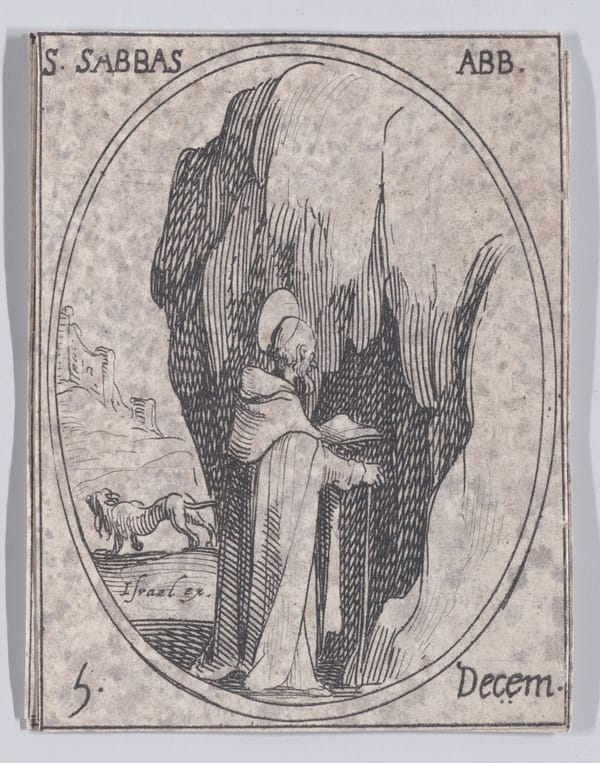
The Roman Church confines herself to-day to the Office of the feria: but to that she joins a commemoration of St. Sabas, abbot of the celebrated laura of Palestine which still exists under his name. This saint, who died in 533, is the only one of the monastic Order of whom the Church makes any mention in her liturgy during the whole period of Advent; we might even say that he is the only simple confessor whose name occurs in the calendar of this part of the year: for, as regards St. Francis Xavier, the glorious title of apostle of the Indies puts him in a distinct class of saints. Here, again, we should recognize divine Providence, which has selected for these days of preparation for Christmas, those saints whose characteristic virtues would make them our fittest models in this work of preparation. We have the feasts of apostles, pontiffs, doctors, virgins: Jesus, the Man-God, the King and Spouse of men, is preceded by this magnificent procession of the noblest of His servants: simple confession has but a single representative, the anchoret and cenobite Sabas, who, by his profession of the monastic life, is of that family of holy solitaries, which began with the prophet Elias under the old Testament, and continued up to the time of St. John the Precursor, who was one of its members, and will continue on, during the new Covenant, until the last coming of Jesus. Let us, then, honour this holy abbot, towards whom the Greek Church professes a filial veneration, and under whose invocation Rome has consecrated one of her churches. Let us beg his prayers by this Collect of the holy liturgy.
Collect
O Sabas, thou man of desires! in thy expectation of that Lord, who has bidden His servants watch until He come, thou didst withdraw into the desert, fearing lest the turmoil of this world might distract thy mind from its God. Have pity on us who are living in the world, and are so occupied in the affairs of that world, and yet who have received the commandment, which thou didst so take to heart, of keeping ourselves in readiness for the coming of our Saviour and our Judge. Pray for us, that when He comes we may be worthy to go out to meet Him. Kemember also the monastic state, of which thou art one of the brightest ornaments; raise it up again from its ruins; let its children be men of prayer and faith, as of old; let thy spirit be among them, and the Church thus regain, by thy intercession, all the glory which is reflected on her from the sublime perfection of this holy state.
Let us look again at the prophecy of Jacob. The holy patriarch not only foretells that the Messias will be the Expectation of nations; he adds that, when this promised Deliverer comes, the sceptre will have been taken away from Juda.1 This oracle is now fulfilled. The flag of Cæsar Augustus floats on the ramparts of Jerusalem. The temple is still untouched; the abomination of desolation stands not yet in the holy place; sacrifices are there still offered up to God; but then, the true temple of God, the Incarnate Word, has not yet been built; the Synagogue has not denied Him, who was her expectation; the Victim, that was to supersede all others, has not been immolated. Yet, Juda has no chief of her own race; Cæsar’s coin is current throughout all Palestine; and the day is not far off when the leaders of the Jewish people will own, in the presence of the Roman governor, that they have not the power to put any man to death.2 So that there is now no king upon the throne of David and Solomon, that throne which was to abide for ever. O Jesus! Son of David, and King of peace, now is the time when Thou must show Thyself and take possession of the sceptre which has been taken in battle from the hand of Juda, and put, for a time, into that of an emperor. Come! for Thou art King, and the psalmist, Thy ancestor, thus sang of Thee: 'Gird Thy sword upon Thy thigh, O Thou Most Mighty! With Thy comeliness and Thy beauty set out, proceed prosperously, and reign, because of truth and meekness and justice, and Thy right hand shall conduct Thee wonderfully. Thy arrows are sharp: under Thee shall people fall: Thy arrows shall go into the hearts of the King’s enemies. Thy throne is for ever and ever; the sceptre of Thy kingdom is a sceptre of uprightness . . . . God, Thy God, hath anointed Thee, O Christ! who takest thence Thy name, with the oil of gladness above Thy fellows, who have been honoured with the name of king.’3 When Thou hast come, O Messias! men will be no more as sheep going astray without a shepherd; there will be but one fold, in which Thou wilt reign by love and justice, for all power will be given unto Thee in heaven and on earth. When, in the hour of Thy Passion, Thy enemies shall ask Thee: ‘Art Thou King?’ Thou wilt answer them in all truth: ‘Verily, I am.’4 Come, dearest King, and reign over our hearts; come, and reign over this world, which is Thine because Thou didst create it, and will soon be Thine because Thou wilt have redeemed it. Reign, then, over this world, and delay not the manifestation of Thy royal power until the day of which it is written: 'He will break kings in the day of His wrath’;5 reign from this very hour, and let all people fall at Thy feet and adore Thee in one grand homage of love and obedience.
Sequence for the Time of Advent
(Composed in the eleventh century, and taken from the ancient Roman-French missals)
| Previous December 4 (the Same Day): Saint Barbara, Virgin and Martyr | Next December 5: St. Sabas, Abbot |