Daily reading
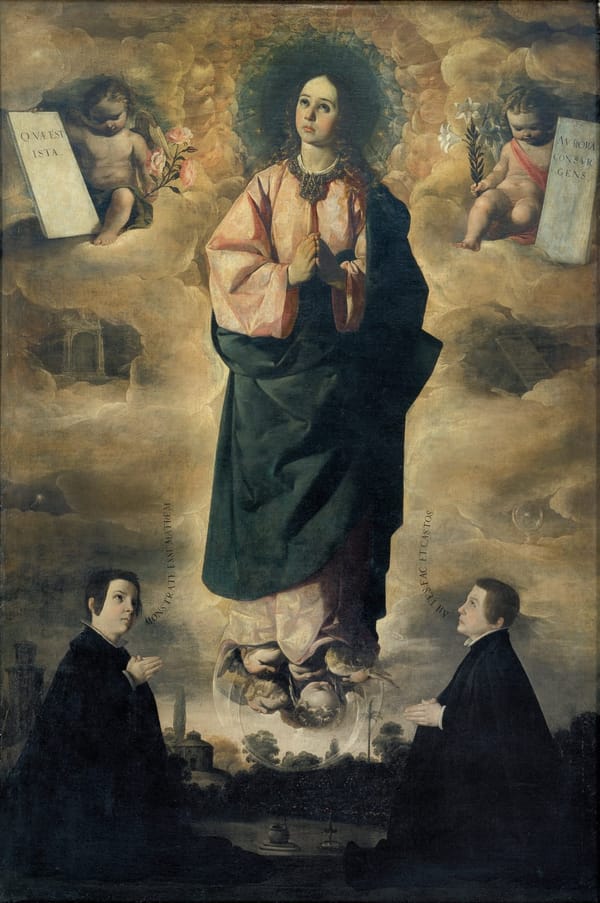
December 9: The Second Day within the Octave of the Immaculate Conception
Let us consider how the immaculate Mary came into this world nine months after her conception, and how each day of her life gave man fresh reason to hope for the great promises made him by God. Let us admire the fulness of grace which God has given to her, and contemplate the respect and the love wherewith the holy angels look upon her as the future Mother of Him who is to be their Head and King, as well as ours. Let us follow this august Queen to the temple of Jerusalem, where she is presented by her parents, St. Joachim and St. Anne. When but three years of age, she was initiated into all the secrets of divine love. 'I always rose at midnight (thus she spoke of herself, in a revelation to St. Elizabeth of Hungary), and went before the altar of the temple, where I besought of God that I might observe all the commandments of His Law, and be enriched with those graces which would render me pleasing to His Majesty. I most earnestly prayed Him, that I might live to see that most holy virgin who was to bring forth into this world His own divine Son. I asked Him to grant me to enjoy the use of my eyes that I might see her, of my tongue that I might praise her, of my hands that I might serve her, of my feet that I might go her errands, and of my knees that I might adore the Son of God resting in her arms.’
Thou, O Mary, thou thyself wast this Virgin, who was worthy of the praises of men and angels! But God had not yet revealed it to thee, and thy heavenly humility forbade thy thinking that the immense dignity, which thou didst so deeply venerate, could ever be thine. Nay, thou wast the first and the only one of the daughters of Israel that had renounced all hope of ever being the Mother of the Messias. To be Mother of the Messias was, indeed, an ineffable honour; but it seemed as though it could only be received on the condition of having another spouse besides God, and this thou wouldst not suffer; thou wouldst be united to God alone, and thy vow of virginity which made thee so, was dearer to thee than the possibility of any privilege, which would rob thee of even a tittle of that. Thy marriage with St. Joseph, therefore, was a fresh lustre added to thy incomparable purity, whilst, in the designs of God, it provided thee with the protection which thy coming honours would soon require. We follow thee, O bride of Joseph, into thy house at Nazareth, where is to be spent thy humble life. There we behold thee diligent in all thy duties, the valiant woman of the Scriptures,1 the object of the admiration of God and of His angels. Suffer us, O Mary! to unite our Advent devotions with the prayers which thou didst offer up for the coming of the Messias; with the veneration wherewith thou didst think upon her that was to be His Mother; and with the inflamed desires wherewith thou didst long for the divine Saviour. We salute thee as the Virgin2 foretold by Isaias; it is thyself, O blessed Mother, that deservest the praise and love of the holy people and city, the redeemed of the Lord.3
Sequence (Taken from the Cluny Missal of 1523)
Genitricem gratiæ,
Salutis dulcedinem,
Fontem Sapientiæ.
Regina prudentiæ,
Virgo plena gratia,
Aurora laetitiae.
Castitatis lilium;
Jaspide splendidior,
Mœroris solatium.
Fidei principium.
Mater admirabilis,
Vas virtutis pretium.
Mater honestissima,
Odor nardi pretiosi,
Rosa suavissima.
Stella fulgentissima,
Generosa Mater, gaude,
Virginum sanctissima.
Regina consilii,
Peperisti florem florum,
Christum fontem gaudii.
Donatrix auxilii,
Memor esto miserorum,
In die judicii.
Charitatis regula,
Victoris stipendium,
Aromatum cellula.
Virgo sine macula,
Honor et imperium,
Per aeterna saecula.
the Mother of grace,
the sweetness of salvation,
the fount of Wisdom.
the Queen of prudence,
the Virgin full of grace,
the aurora of joy.
the lily of chastity;
she is brighter than the jasper,
our solace in sorrow.
source whence came the author of our faith,
Mother most admirable,
precious vessel of virtue.
Mother of the beautiful King;
thou art the perfume of precious ointment;
thou art the sweetest rose.
O brightest of stars,
O noblest of mothers,
O Virgin most holy!
and Queen of counsel,
didst bring forth the flower of flowers,
Jesus the source of our joy.
help of the needy,
be mindful of us sinners
on the day of judgement.
the model of charity,
the encouragement to victory,
the treasury of every fragrance.
immaculate Virgin,
be queenly honour
for ever.
Prayer from the Gregorian Sacramentary
(In the daily Prayers for Advent)
Saturday of the First Week of Advent
Cap. vii.Et adjecit Dominus loqui ad Achaz, dicens: Pete tibi signum a Domino Deo tuo in profundum inferni, sive in excelsum supra. Et dixit Achaz: Non petam, et non tentabo Dominum. Et dixit: Audite ergo domus David: Numquid parum vobis est molestos esse hominibus, quia molesti estis et Deo meo? Propter hoc dabit Dominus ipse vobis signum: Ecce Virgo concipiet, et pariet Filium: et vocabitur nomen ejus Emmanuel.
Ch. vii.And the Lord spoke again to Achaz, saying: Ask thee a sign of the Lord thy God, either unto the depth of hell or unto the height above. And Achaz said: I will not ask, and I will not tempt the Lord. And he said: Hear ye, therefore, O house of David: Is it a small thing for you to be grievous to men, that you are grievous to my God also? Therefore, the Lord himself shall give you a sign. Behold, a Virgin shall conceive and bear a Son, and his name shall be called Emmanuel.
Let your hearts be filled with hope and joy at hearing this fair and sweet prophecy: A Virgin shall conceive and bear a Son. These words contain the salvation of the world, as these others express its perdition: ‘The woman took of the fruit of the tree, and did eat, and gave unto her husband.' This Virgin promised to us has at length come: the divine Fruit is in her womb. By her, Eve’s disobedience is repaired, the world is raised from its fall, the head of the serpent is crushed, God Himself is more glorified by the fidelity of this second Virgin, than He had been outraged by the disobedience of the first. The consent of Mary exercises an immense influence in the saving of the world. It is true that the Word Himself is coming; ‘but,’ says St. Bernard, 'Mary is the way whereby He comes; it is from her virginal womb He issues, as the Bridegroom from the nuptial chamber. Let us endeavour, therefore, to go up to Jesus by Mary, for Jesus came down to us by ner. By thee, O blessed one that didst find grace, O parent of life, O mother of salvation, may we have access to thy Son! May He, who was given to us by thee, receive us by thee. May He admit thy purity, and, for its sake, forgive our impurities: may He give us the pardon of our pride, because of the pleasure He took in thy humility. May thy abundant charity cover the multitude of our sins. May thy glorious fruitfulness get us fruitfulness of merit. Our Lady! our mediatrix! our advocate I reconcile us to thy Son, commend us to thy Son, present us to thy Son. By the grace thou didst find, by the prerogative thou didst merit, by the Mercy thou didst bring forth, grant, O blessed Virgin! that Jesus, who deigned to become, through thy maternity, partaker of our weakness and misery, may, through thy intercession, make us partakers of His glory and bliss.’*
Prose in Honor of the Blessed Virgin
(Composed by Abelard; it is found in all the Roman-French missals)
Non quemvis angelum:
Sed fortitudinem
Suum Archangelum,
Amator hominis.
Pro nobis nuncium,
Naturae faciat
Ut praejudicium
In partu Virginis.
Natus Rex gloriæ:
Regnet et imperet,
Et zyma scoriæ
Tollat de medio.
Terat fastigia:
Colla sublimium
Calcet vi propria,
Potens in prælio.
Mundanum principem;
Secumque faciat
Matrem participem
Patris imperii.
Haec dona dissere:
Revela veteris
Velamen litterae,
Virtute nuncii.
Dic: Ave, cominus.
Dic: Plena gratia:
Dic: Tecum Dominus:
Et dic: Ne timeas.
Dei depositum,
In quo perficias
Casta propositum
Et votum teneas.
Puella nuncium:
Credit et concipit
Et parit Filium,
Sed admirabilem,
Humani generis:
Deum et hominem
Et Patrem posteris,
In pace stabilem.
Nos reddat stabiles,
Ne nos labilitas
Humana labiles
Secum præcipitet,
Concessa venia,
Per Matrem gratiæ
Obtenta gratia,
In nobis habitet.
Peccati veniam:
Reatus deleat,
Donet et patriam
In arce siderum.
sends to the Virgin
no less an angel than him
who is called God’s strength,
the Archangel Gabriel.
be speedily at his work;
may he stay the rights
and laws of nature
in the Virgin’s delivery.
when born, triumph over nature;
may he reign and command;
may he take away from the midst of men
all leaven and rust.
may this God,
mighty in war,
trample in his power
on the necks of the haughty.
the prince of this world;
and make his Mother
share with him
the empire which his Father has given him.
announce these gifts;
lift up,
by the virtue of thy annunciation,
the veil of the ancient Scripture.
Say, when thou art in her presence: ‘Hail!’
Say: ‘O full of grace !"
Say: ‘The Lord is with thee!’
And then: ‘Fear not!’
the divine deposit;
by him fulfil
thy chaste purpose,
and keep thy vow.
and accepts the announcement;
she believes and conceives,
and brings forth a Son,
but he is the admirable,
of mankind,
God and Man,
Father of the world to come,
the Prince of peace.
render us firm,
lest human frailty
should make us stumble
into the abyss.
granting us pardon
and grace, obtained
by the Mother of grace,
dwell within us.
pardon of our sins,
wipe away all our guilt,
and give us the country
in the starry heaven.
Prayer from the Gallican Sacramentary
(Christmas Eve)
* Second Sermon of Advent. ↩︎
| Previous Friday of the First Week of Advent | Next Saturday of the First Week of Advent |