Daily reading
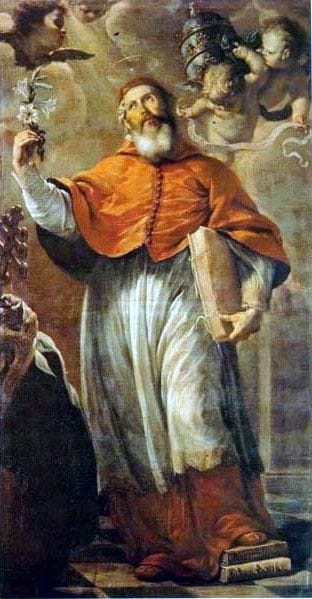
December 11: Saint Damasus, Pope and Confessor
This great Pontiff comes before us in the liturgical year, not to bring us tidings of peace as St. Melchiades did, but as one of the most illustrious defenders of the great mystery of the Incarnation. He defends the faith of the universal Church in the divinity of the Word, by condemning, as his predecessor Liberius had done, the acts and the authors of the celebrated Council of Rimini. With his sovereign authority, he bore witness to the teaching of the Church regarding the Humanity of Jesus Christ, and condemned the heretic Apollinaris, who taught that Jesus Christ had assumed only the flesh and not the soul of man. He commissioned St. Jerome to make a new translation of the new Testament from the Greek, for the use of the Church of Rome; here, again, giving a further proof of the faith and love which he bore to the Incarnate Word. Let us honour this great Pontiff, whom the Council of Chalcedon calls ‘the ornament and support of Rome by his piety.’ St. Jerome, too, who looked upon St. Damasus as his friend and patron, calls him ‘a man of the greatest worth; a man whose equal could not be found, well versed in the holy Scriptures, and a virgin doctor of the virgin Church.’ The legend of the breviary gives us a brief account of his life.
Prose
(Taken from the Cluny missal of 1523)
Holy Pontiff Damasus! during thy life on earth, thou wast the light, which guided the children of the Church; for thou didst teach them the mystery of the Incarnation, and didst guard them against those perfidious doctrines, wherewith hell ever strives to corrupt that glorious symbol of our faith, which tells us of God’s infinite mercy towards us, and of the sublime dignity of man thus mercifully redeemed. Seated on the Chair of Peter, thou didst confirm thy brethren, and thy faith failed not; for Jesus had prayed to His Father for thee. We rejoice at the infinite recompense with which this divine Prince of pastors has rewarded the unsullied purity of thy faith, O thou ‘virgin doctor of the virgin Church!’ Oh that we could have a ray of that light which now enables thee to see Jesus in His glory! Pray for us, that we may have light to see Him, and know Him, and love Him, under the humble guise in which He is so soon to appear to us. Obtain for us the science of the sacred Scriptures, in which thou wast so great a master; and docility to the teachings of the Bishop of Rome, to whom, in the person of St. Peter, Christ has said: ‘Launch out into the deep!’*
Obtain also for all Christians, O thou the successor of this prince of the apostles, that they be animated with those sentiments, which St. Jerome thus describes in one of his letters addressed to thee: ‘It is the Chair of Peter that I will consult, for from it do I derive that faith which is the food of my soul. I will search for this precious pearl, heeding not the vast expanse of sea and land which I must pass over. Where the body is, there shall the eagles be gathered together. It is now in the west that the Sun of justice rises. I ask the Victim of salvation from the priest, and from the shepherd the protection of the sheep. On that rock I know the Church is built. He that eats the Lamb in any house but this, is profane. He that is not in Noah’s ark, shall perish in the waters of the deluge. I know not Vitalis, I reject Meletius, I pass by Paulinus. He that gathers not with thee, Damasus, scatters; for he that is not of Christ, is of Antichrist.’
Let us contemplate our divine Saviour in the womb of His most holy Mother Mary. Let us, together with the holy angels, adore Him in this state of profound humiliation, to which His love for us has brought Him. See Him there offering Himself to His Father for the redemption of mankind, and commencing at once to fulfil the office of our Mediator, which He has taken upon Himself. What an excess of love is this of our Jesus, that He is not satisfied with having humbled Himself in assuming our nature,though that alone would have sufficed to redeem a million worlds! The eternal Son of God wills to remain, as other children, nine months in His Mother’s womb: after that, to be born in poverty, to live a life of labour and suffering, and to be obedient to death, even to the death of the cross. O Jesus! mayst Thou be praised and loved by all creatures for this Thy immense love of us! Thou hast come down from heaven the Victim that art to take the place of all those which were hitherto offered, but which could not efface man’s sin. At length, the earth possesses its Saviour, though as yet unseen. God will not curse the earth, which, though covered with crime, is rich in such a treasure as this. Still repose, O Jesus, in the chaste womb of Mary, that living ark which contains the true manna sent for the food of man. But the time is approaching for Thee to leave this loved sanctuary. The tender love which Thou hast received from Mary, must be changed for the malice wherewith men will treat Thee; yet it must needs be that Thou be born on the day which Thou Thyself hast decreed: it is the will of Thy eternal Father, it is the expectation of the world, it is the salvation of all who shall love Thee.
Prose in Honor of the Blessed Virgin
(Taken from the Cluny missal of 1523)
Prayer for the Time of Advent
(The Mozarabic breviary, Monday of the first week of Advent)
* St. Luke v. 4. ↩︎
Monday of the Second Week of Advent
Cap. xiii.Onus Babylonis, quod vidit Isaias filius Amos. Super montem caliginosum levate signum, exaltate vocem, levate manum, et ingrediantur portas duces. Ego mandavi sanctificatis meis, et vocavi fortes meos in ira mea, exsultantes in gloria mea. Vox multitudinis in montibus, quasi populorum frequentium: vox sonitus regum, gentium congregatarum. Dominus exercituum præcepit militiæ belli, venientibus de terra procul, a summitate cœli; Dominus, et vasa furoris ejus, ut disperdat omnem terram. Ululate, quia prope est dies Domini, quasi vastitas a Domino veniet. Propter hoc omnes manus dissolventur, et omne cor hominis contabescet, et conteretur. Torsiones et dolores tenebunt, quasi parturiens dolebunt: unusquisque ad proximum suum stupebit, facies combustæ vultus eorum. Ecco dies Domini veniet crudelis et indignationis plenus, et iræ, furorisque ad ponendam terram in solitudinem, et peccatores ejus conterendos de ea. Quoniam stellæ cœli, et splendor earum non expandent lumen suum: obtenebratus est sol in ortu suo, et luna non splendebit in lumine suo. Et visitabo super orbis mala, et contra impios iniquitatem eorum: et quiescere faciam superbiam infidelium, et arrogantiam fortium humiliabo.
Ch. xiii.The burden of Babylon, which Isaias the son of Amos saw. Upon the dark mountain lift ye up a banner, exalt the voice, lift up the hand and let the rulers go into the gates. I have commanded my sanctified ones, and have called my strong ones in my wrath, them that rejoice in my glory. The noise of a multitude in the mountains, as it were of many people: the noise of the sound of kings, of nations gathered together. The Lord of hosts hath given charge to the troops of war, to them that come from a country afar off, from the end of heaven: the Lord and the instruments of his wrath, to destroy the whole land. Howl ye, for the day of the Lord is near, it shall come as a destruction from the Lord. Therefore shall all hands be faint, and every heart of man shall melt, and shall be broken. Gripings and pains shall take hold of them, they shall be in pain as a woman in labour: every one shall be amazed at his neighbour, their countenances shall be as faces burnt. Behold, the day of the Lord shall come, a cruel day, and full of indignation, and of wrath, and fury, to lay the land desolate, and to destroy the sinners thereof out of it. For the stars of heaven, and their brightness shall not display their light: the sun shall be darkened in his rising, and the moon shall not shine with her light. And I will visit the evils of the world, and against the wicked for their iniquity: and I will make the pride of infidels to cease, and will bring down the arrogance of the mighty.
The Church puts before us again, in the Office of to-day, the terrible spectacle of the last coming of Jesus Christ. The sinful Babylon, of which Isaias speaks, is the world grown old in its crimes; the cruel day, full of indignation and wrath, is that on which the Messias will return to judge the world, with His sign glittering in the clouds. The words used by the prophet to describe the terror of the inhabitants of Babylon are so expressive, that it is difficult to meditate upon them seriously and not tremble. You, then, who, in this second week of preparation for the birth of our Saviour, are still wavering and undecided as to what you intend to do for the day of His coming, reflect upon the connection that there is between the two comings. If you receive your Saviour in the first, you need be in no fear for the second; but if you despise the first, the second will be to your destruction, nor will the cries of your despair save you. The Judge will come on a sudden, at midnight, at the very time when you persuade yourself that He is far off from you.
Say not that the end of the world is not yet come, and that the destinies of the human race are not filled up: it is not the world that is here in question, it is you individually. True the day of the Lord will be terrible, when this world shall be broken up as a vessel of clay, and the remnants of creation shall be a prey to devouring flames; but, long before that day of universal terror, your own day of judgement will come. The inexorable Judge will come to you, you will stand before His face, you will have none to defend you, and the sentence He will pass will be eternal; and though the nature of that sentence, whether for or against you, will not be known to the rest of the world until the last and general judgement, still is this His coming to you, at your own judgement, terrible above measure. Remember, therefore, that what will make the terror of the last day so great is, that then will be solemnly and publicly confirmed what was judged irrevocably, though secretly, between your own soul and her Judge; just as the favourable sentence, which the good receive at the happy moment of their death, will be repeated before the immense assembly of men and angels on the last day. Is it wise, then, Christians, to put off your conversion, on the plea of the day of the Lord not having to come for ages, when it might be this night that your soul were required of you?* The Lord is coming: lose no time; prepare to meet Him; a humble and contrite and converted heart is sure to find acceptance.
Canticle of the Last Judgment
(It is an interpolation of appropriate sentences into the Responsory Libera: it was occasionally so sung in the fifteenth and sixteenth centuries)
Nescio vos, cultores criminis: Vos decepit gloria sæculi; Descendite ad ima barathri, Cum Zabulon et suis ministris. O proh dolor! quanta tristitia! Quantus luctus! quanta suspiria!* Dum veneris judicare sæculum per ignem.℣. Jam festinat Rex ad judicium, Dies instat horrenda nimium; Et quis erit nobis refugium, Nisi Mater Virgo, spes omnium, Quæ pro nobis exoret Filium? O Jesu Rex, exaudi poscimus
Preces nostras, et salvi erimus;* Quando cœli movendi sunt et terra.℣. Creator omnium rerum Deus qui me de limo terræ formasti, et mirabiliter proprio sanguine redemisti, corpusque meum, licet modo putrescat, de sepulchro facies in die judicii resuscitari; exaudi, exaudi me, ut animam meam in sinu Abrahæ patriarchæ tui jubeas collocari;* Dum veneris judicaro saeculum per ignem.
Prayer from the Ambrosian Liturgy
(In the third week of Advent)
* St. Luke xii. 20. ↩︎
| Previous December 10 (the Same Day): St. Eulalia, Virgin and Martyr | Next Monday of the Second Week of Advent |