Daily reading
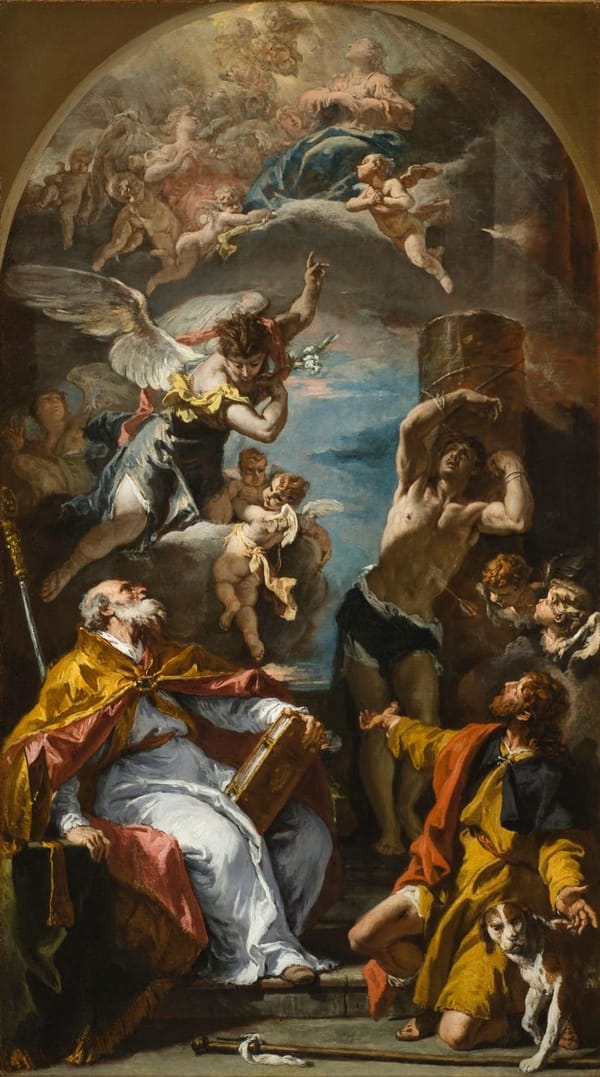
December 16: Saint Eusebius, Bishop of Vercelli and Martyr
When asked to tell the names of the saints who were foremost in defending the dogma of the Incarnation, we think at once of the intrepid Eusebius of Vercelli, as one of the glorious number. The Catholic faith, which was so violently attacked in the fourth century by the Arian heresy, was maintained at that time by the labours and zeal of four sovereign Pontiffs: Sylvester, who confirmed the decrees of the Council of Nicæa: Julius, the supporter of St. Athanasius; Liberius, whose faith failed not, and who, when restored to his liberty, confounded the Arians; and lastly, Damasus, who destroyed the last hopes of the heretics. One of these four Pontiffs appears on our Advent calendar—Damasus, whose feast we kept but a few days since. The four Popes have for their fellow-combatants, in this battle for the Divinity of the Incarnate Word, four great bishops, of whom it may be said that the defence of the dogma of the Consubstantiality of the Son of God was what they lived for, and that to say anathema to them was to say anathema to Christ Himself; all four most powerful in word and work, lights of the Churches of the world, objects of the people’s love, and the dauntless witnesses of Jesus. The first and greatest of the four is the bishop of the second See of Christendom, St. Athanasius, the Patriarch of Alexandria: the second is St. Ambrose of Milan, whose feast we kept on the seventh of this month; the third is the glory of Gaul, St. Hilary, bishop of Poitiers; the fourth is the ornament of Italy, St. Eusebius, bishop of Vercelli, whom we have to honour to-day. Hilary will come to us during Christmastide, and will stand at the crib of the Word, whose Divinity he so bravely confesses; Athanasius will meet us at Easter, and help us to celebrate, in the triumphant Resurrection, Him whom he proclaimed as God in those dark times, when human wisdom hoped to destroy, by fifty years of peace, that Church which had survived the storm of three centuries of persecution. St. Eusebius’ place is Advent; and divine Providence has thus chosen him as one of the patrons of the faithful during this mystic season. His powerful prayers will help us to come devoutly to Bethlehem, and see in the Child, that is lying there, the eternal Word of God. So great were the sufferings which St. Eusebius had to undergo for the Divinity of Jesus, that the Church awards him the honours of a martyr, although he did not actually shed his blood. Let us now listen to the admirable account which the Church gives us of his life.
That Council was held the following year, at Milan; Eusebius was invited by Constantius to be present at it, which was what the legates of Liberius had desired and begged. So far was he from being duped by the synagogue of the malicious Arians to side with them against St. Athanasius, that he openly declared from the first that several of those present were known to him to be heretics, and he therefore proposed that they should subscribe to the Nicene Creed before proceeding any further. This the Arians, infuriated with anger, refused to do; whereupon, he not only refused to subscribe to what was drawn up against Athanasius, but he also, by a most ingenious device, succeeded in having the name of St. Denis the martyr blotted out from the decree, which the craft of the Arians had induced him to sign. Wherefore, they being exceedingly angry against Eusebius, loaded him with injuries, and had him sent into banishment. The holy man, on his side, shaking off the dust from his feet, caring little either for the threats of the emperor, or the sword which was held over him, submitted to banishment as to something which belonged to his episcopal office. Being sent to Scythopolis, he there endured hunger, thirst, blows, and sundry other punishments; he generously despised his life for the true faith, feared not death, and gave up his body to the executioners.
Valiant soldier of Jesus, Eusebius, martyr and pontiff, how much labour and suffering thou didst undergo for the Messias! And yet, they seemed to thee to be little in comparison with what is due to this eternal Word of the Father, who, out of His pure love, has made Himself the Servant of His own creatures, by becoming Man for them in the mystery of the Incarnation. We owe the same debt of gratitude to this divine Saviour. He is born in a stable for our sake, as He was for thine; pray, therefore, for us that we may be ever faithful to Him both in war and in peace; and that we may resist our temptations and evil inclinations with that same firmness, wherewith we would confess His name before tyrants and persecutors. Obtain for the bishops of our holy mother the Church such vigilance, that no false doctrines may surprise them, and such courage that no persecution may make them yield. May they be faithful imitators of the divine Pastor, who gives His life for His sheep; and may they ever feed the flock entrusted to them in the unity and charity of Jesus Christ.
Let us consider how our blessed Lady, having returned to Nazareth, is overwhelmed with joy to feel living within her Him, who gives being to every created thing, and whom she loves with all the intensity of the Mother of God. Joseph, the faithful guardian of her virginity, tenderly loves this his spouse, and blesses God for having entrusted such a treasure to his keeping. The angels crowd round this favoured house wherein dwell their sovereign Lord, and she whom He has chosen to be His Mother. Never was there happiness like that which fills this little dwelling; and yet, God has decreed to visit it with a heavy trial, in order that He may give an occasion to Mary to exercise heroic patience, and to Joseph an occasion of meriting by his exquisite prudence. Let us listen to the Meditation of St. Bonaventure, in which he thus ponders the Gospel narrative:
'But while our Lady and Joseph her spouse were thus dwelling together, the Infant Jesus grew within His Mother’s womb. Then Joseph, perceiving that Mary was with Child, was above all measure grieved. Here give, I pray thee, all thine attention, for thou hast many fair things to learn. If thou wouldst know wherefore it was that our Lord wished that His Mother should have a husband, whereas He always wished that she should be a Virgin, I answer thee that He so wished on three accounts: firstly, that she might not be disgraced when it was seen that she was a Mother: secondly, that she might have Joseph’s aid and company; and thirdly, that the birth of the Son of God might be concealed from the devil.
‘Now, Joseph did look many times on Mary, and grief and trouble of heart fell upon him, and his displeasure was seen in his face, and he turned his eyes away from her as one that was guilty of that which he perforce suspected. See how God permits His servants to be afflicted and sorely tried, that they may so receive their crown. Now Joseph was minded to put her away privately. In very truth may it be said of this holy man, that his praise is in the Gospel, for the Gospel says of him that he was a just man, that is, a man of great virtue. For albeit they say that no shame, nor suffering, nor insult can befall a man so grievous as that of his wife’s unfaithfulness; yet did Joseph restrain himself withal, and would not accuse Mary, but bore this great injury patiently. He sought not how to avenge himself, but, overcome with pity, and wishing to forgive, he was minded to put her away privately. But herein also had our Lady her share of tribulation, for she took notice of Joseph’s trouble, and it sorely grieved her. Yet did she humbly hold her peace, and hide the gift of God. Better did it seem unto her that evil should be thought of her than that she should reveal the divine mystery, and say aught of herself which would come nigh to boasting. Therefore did she beseech our Lord that Himself would right this matter, and make pass this grief from Joseph and herself. Here thou mayst learn what great tribulation and anxiety was theirs. But God came unto their assistance.
‘He therefore sent His angel, who spake unto Joseph in his sleep, and told him that his spouse had conceived of the Holy Ghost, and that he was to abide with her in all surety and joy. Whereupon, the tribulation ceased, and they were both exceedingly comforted. So likewise would it befall us if we would suffer patiently, for after a storm God brings a calm. Neither oughtest thou to doubt this, for God suffereth not His servants to be afflicted save for their good. After this, Joseph requested our Lady to narrate unto him what had happened; and she faithfully narrated all unto him. Whereupon Joseph remains with his blessed spouse, and lives with her in all contentment, and loves her above what words can say, and diligently provides her with whatsoever she needed. So also our Lady continues to remain confidently with Joseph, and they live right joyfully in their poverty.’
Prayer for the Time of Advent
(The Mozarabic breviary, Wednesday of the first week of Advent, Capitula)
Saturday of the Second Week of Advent
Cap. xxv.Domine, Deus meus es tu, exaltabo te, et confitebor nomini tuo: quoniam fecisti mirabilia, cogitationes antiquas fideles. Amen. Quia posuisti civitatem in tumulum, urbem fortem in ruinam, domum alienorum, ut non sit civitas, et in sempiternum non aedificetur. Super hoc laudabit te populus fortis, civitas gentium robustarum timebit, te. Quia factus es fortitudo pauperi, fortitudo egeno in tribulatione sua: spes a turbine, umbraculum ab æstu.... Et faciet Dominus exercituum omnibus populis in monte hoc convivium pinguium, convivium vindemiae, pinguium medullatorum, vindemiae defæcatæ. Et praecipitabit in monte isto faciem vinculi colligati super omnes populos, et telam quam orditus est super omnes nationes. Præcipitabit mortem in sempiternum: et auferet Dominus Deus lacrymam ab omni facie, et opprobrium populi sui auferet de universa torra: quia Dominus locutus est. Et dicet in die illa: Ecco Deus noster iste, exspectavimus eum, et salvabit nos: iste Dominus, sustinuimus eum, exsultabimus et lætabimur in salutari ejus.
Ch. xxv.O Lord, thou art my God, I will exalt thee, and give glory to thy name: for thou hast done wonderful things, thy designs of old faithful. Amen. For thou hast reduced the city to a heap, the strong city to ruin, the house of strangers to be no city, and to be no more built up for ever. Therefore shall a strong people praise thee, the city of mighty nations shall fear thee. Because thou hast been a strength to the poor, a strength to the needy in his distress: a refuge from the whirlwind, a shadow from the heat And the Lord of hosts shall make unto all people, in this mountain, a feast of fat things, a feast of wine, of fat things full of marrow, of wine purified from the lees. And he shall destroy in this mountain the face of the bond with which all people were tied, and the web that he began over all nations. He shall cast death down headlong for ever: and the Lord God shall wipe away tears from every face. and the reproach of his people he shall take away from off the whole earth: for the Lord hath spoken it. And they shall say in that day: Lo, this is our God, we have waited for him, and he will save us: this is the Lord, wo have patiently waited for him, we shall rejoice and be joyful in his salvation.
Yet a little while, and the conqueror of death will appear, and then, in the joy of our hearts, we will say: Lo! this is our God; wo have waited for Him, and He will save us; we have patiently waited for Him; this is He, and we will rejoice and be joyful in His salvation. Let us, therefore, prepare the way of the Lord that wo may receive Him worthily; and in this work of our preparation, let us have recourse to Mary. Saturday is the day which is sacred to her; she will the more readily grant the prayers said to her upon it. Let us consider her in her grand privilege of being full of grace, carrying in her womb Him whom we so long to possess. If we ask her by what means she rendered herself worthy of such an immense favour, she will tell us that in her was simply fulfilled the prophecy, which the Church so continually repeats during these days of Advent: ‘Every valley shall be filled up.’ The humble Mary was the valley blessed by the Lord: a valley beautiful and fertile, in which God sowed the divine wheat, our Saviour Jesus: for it is written in the psalm, that the valleys shall abound with corn.* O Mary! it is thy humility that drew down upon thee the admiration of thy Creator. If, from the high heaven where He dwells, He had perceived a virgin more humble in her love, He would have chosen her in preference et thee: but no, it is thou that didst win His predilection, O mystic valley, ever verdant and lovely in thy flowers of grace. We that, like high hills, are so proud and such sinners, what shall we do? We must look on this our God, who comes to us in infinite humility, and then humble ourselves out of love and gratitude. O blessed Mother! obtain this grace for us. Pray for us that henceforth we may submit ourselves to the will of our Lord as thou didst, when thou didst speak those admirable words: ‘Behold the handmaid of the Lord: may it be done to me according to thy word!’
Prose in Honor of the Blessed Virgin
(Taken from the Cluny missal of 1523)
Verbi bajulus fidelis,
Sacris disserit loquelis
Cum beata Virgine.
Pandit intus in conclave,
Et ex Eva format Ave,
Evæ verso nomine.
Adest Verbum caro factum;
Semper tamen est intactum
Puellare gremium.
Et quam homo non deflorat,
Non torquetur nec laborat
Quando parit filium.
Crede solum, et est satis;
Non est nostræ facultatis
Solvere corrigiam.
Est in rubo et in igne:
Ne appropiet indigne
Calciatus quisquam.
Novo ritu, novo more,
Fructum protulit cum flore;
Sicque Virgo peperit.
Fructus gaudii, non luctus;
Non erit Adam seductus,
Si de hoc gustaverit.
Piæ Matris pium onus,
Cujus est in cœlo thronus
Nascitur in stabulo.
Nostros deleat reatus;
Quia noster incolatus
Hic est in periculo.
faithful bearer of the word,
holds sacred converse
with the holy Virgin.
he discloses the good and sweet word;
and inverting the name of Eve, Eva becomes Ave,
his salutation Hail!
instantly there was present the Word made flesh;
and yet the pure Maid
a Virgin still for ever.
Mother, yet not losing the treasure;
giving birth to her child,
yet not in pain or travail.
and all thou, my soul,
canst do is to believe it:
we have not power to loose the latchet.
of the burning bush;
let him that would approach,
take off the sandals from his feet.
once yielded a flower and fruit;
it was a new law, a new way:
so was it when the Virgin brought forth her Son.
a Fruit of joy, not of woe.
There will be no Adam deceived,
if men but eat of this.
lovely burden of a lovely Mother!
He who has a throne in heaven,
has a stable for his birth-place!
wipe away all our guilt;
for our sojourn
here is full of dangers.
Prayer from the Mozarabic Breviary
(For the Friday of the third week of Advent)
* Ps. lxiv. 14. ↩︎
| Previous Friday of the Second Week of Advent | Next Saturday of the Second Week of Advent |