Daily reading
Movable from Advent · Temporal
December 22, 2023
From Dom Guéranger’s The Liturgical Year.
Friday in Ember Week of Advent
The Church does not read anything from the prophet Isaias to-day; she merely gives, in the Office of Matins, a sentence of that chapter of St. Luke’s Gospel, which relates the mystery of our Lady’s Visitation: and to this she subjoins a fragment of St. Ambrose’s homily upon that passage. The considerations and affections with which this important event of our Lady’s life ought to inspire the faithful, will be given further on in the proper of the saints.
The Station for to-day is in the church of the Holy Apostles, which many suppose to have been first built by Constantine. The glorious bodies of the two holy apostles Philip and James the Less, lie buried under the altar, awaiting the second coming of Him who chose them as His co-operators in the work of the first, and who will give them, on the last day, to sit upon thrones near His own, judging the twelve tribes of Israel.*
That we may better conform to the intentions of our holy mother the Church, who offers to our contemplation the Visitation of the blessed Virgin, let us recite the following hymn, composed in honour of this mystery during the ages of faith.
A Prose in Honour of the Blessed Virgin
(Taken from the ancient Roman-French missals)
Virginis humilitas.
Ave, omni nodo carons,
Humilis virginitas.
Nec gravaris Filio:
Gaude quae sic oneraris
Onere gratissimo.
Virgula fructifera.
Salve, clausa templi porta,
Soli Deo pervia.
Rore madens Pneumatis.
Plaude, pellis Salomonis,
Pulchrior præ cæteris.
Circumlustrans maria.
Vale consignata cella,
Rubus in vi flammea.
Solem gignis stellula.
Euge, quod sis præelecta,
Scala cœli fulgida.
Luce novi sideris;
Pange, arca trina ferens
Charismata miseris.
Jesum Christum anima;
Eia! tecum ut laudemus
Ora, dulcis Maria.
of the divine Word!
Hail, most humble
and most spotless Virgin!
of a Son who supports thee!
Rejoice, thy burden is a burden
most sweet to bear!
Fruit-bearing branch!
Hail gate of the temple,
closed to all but God!
full of the dew of the holy Spirit!
Be glad, thou tent of Solomon,
of all the first in beauty!
lighting up the sea!
Hail, thou sealed-up sanctuary,
thou burning bush!
shouldst be clad with the Sun, and then bring forth the Sun!
What bliss is thine, that thou shouldst be elected
the bright ladder reaching up to heaven!
thou aurora rising in the light of the new Star!
Sing, thou ark of the covenant,
bearing unto us sinners thy three treasures.
and oh! sweet Mary,
pray that, with thee,
we too may magnify him.
Prayer from the Gallican Sacramentary
(In Adventu Domini, Collect)
* St. Matt. xix. 28. ↩︎
December 22: Sixth Antiphon
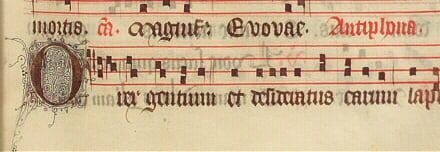
O King of nations! Thou art approaching still nigher to Bethlehem, where Thou art to be born, The journey is almost over, and Thy august Mother, consoled and strengthened by the dear weight she bears, holds an unceasing converse with Thee on the way. She adores Thy divine Majesty; she gives thanks to Thy mercy; she rejoices that she has been chosen for the sublime ministry of being Mother to God. She longs for that happy moment when her eyes shall look upon Thee, and yet she fears it. For, how will she be able to render Thee those services which are due to Thy infinite greatness, she that thinks herself the last of creatures? How will she dare to raise Thee up in her arms, and press Thee to her heart, and feed Thee at her breasts? When she reflects that the hour is now near at hand, in which, being born of her, Thou wilt require all her care and tenderness, her heart sinks within her; for, what human heart could bear the intense vehemence of these two affections—the love of such a Mother for her Babe, and the love of such a creature for her God? But Thou supportest her, O Thou the Desired of nations! for Thou, too, longest for that happy birth, which is to give to the earth its Saviour, and to men that corner-stone, which will unite them all into one family. Dearest King! be Thou blessed for all these wonders of Thy power and goodness! Come speedily, we beseech Thee, come and save us, for we are dear to Thee, as creatures that have been formed by Thy divine hands. Yea, come, for Thy creation has grown degenerate; it is lost; death has taken possession of it: take Thou it again into Thy almighty hands, and give it a new creation; save it; for Thou hast not ceased to take pleasure in and love Thine own work.
The Great Antiphon in Honour of Christ.
| Previous Thursday of the Third Week of Advent | Next December 22: Sixth Antiphon |