lyp.network

Daily reading

Movable from Advent · Temporal

December 23, 2023

From Dom Guéranger’s The Liturgical Year.

Saturday in Ember Week of Advent

Prope est jam Dominus; venite adoremus.
The Lord is now nigh: come, let us adore.

The lessons from the prophet Isaias are interrupted to-day also; and a homily on the Gospel of the Mass is read in their place. As this Gospel is repeated to-morrow, in the Mass of the fourth Sunday of Advent, we will, for the present, omit it, and be satisfied with mentioning the reason of the same Gospel being assigned to the two days.

The primitive custom, in the Roman Church, was to hold ordinations in the night between Saturday and Sunday, just as Baptism was administered to the catechumens in the night between Holy Saturday and Easter Sunday. The ceremony took place towards midnight, and Sunday morning was always far advanced before the termination; so that the Mass of ordination was considered as the Mass of Sunday itself. Later on, discipline relaxed, and these severe vigils were given up; the ordination Mass, like that of Holy Saturday, was anticipated; and, as the fourth Sunday of Advent and the second of Lent had not hitherto had a proper Gospel, since they had not had a proper Mass, it was settled, about the tenth or eleventh century, that the Gospel of the Mass of ordinations should be repeated in the special Mass of the two Sundays in question.

The Station is at St. Peter’s on account of the ordinations. This basilica was always one of the largest of the city of Rome, and was therefore the best suited for the great concourse of people.

Let us honour Mary upon this day of the week, which is consecrated to her; let us borrow a canticle from the oriental Church, ever profuse in its praise of the Mother of God.

Hymn Taken from the Anthology of the Greeks

(December 15)

Ut thronus purpuriformis Creatorem fers; ut animatus thalamus regem circumdas, Deo gratissima.
Virga virtutis germinasti Christum in quo stabilimur; te enim figurabat virga Aaron, olim germinans inculta; casta columba, semper Virgo.
Hymnificare modum superadmirabilem, et omnem sensum superantem extraordinariæ tuæ graviditatis nesciunt omnium hominum catervae; omnem enim mentem et cogitationem prætergreditur, ac intelligentias, omnium et verborum virtutem.
Miraculum inenarrabile conceptionis atque immemorandum gestationis tuæ prodigium videns Isaias, divina voce clamabat: Spiritus sanctus supervenit in te, Dei Mater! rubum to servans ut olim incombustum; et ideo cum angelo clamamus: Gaude, Dei tabernaculum.
As a royal throne, thou carriest the Creator; as a living couch, thou encirclest the King, O creature most dear to God:
Branch most vigorous, thou didst bud forth the Christ on whom we lean and are supported; for Aaron’s branch, which, of old, budded unplanted, was a type of thee, thou chaste dove, and ever a Virgin.
To sing the more than wonderful manner of thy extraordinary and incomprehensible maternity, is above the power of all the choirs of men: for no mind, no thought, no understanding, no words, can reach the mystery.
Isaias, seeing the unspeakable miracle, the ineffable miracle of thy maternity, spoke thus divinely: The holy Spirit hath come upon thee, O Mother of God! preserving thee, as heretofore he kept entire the burning bush: and, therefore, we cry out with the angel: Rejoice, O thou tabernacle of God!

Prayer from the Mozarabic Missal
(Fifth Sunday of Advent, Illatio)

Dignum et justum est nos tibi gratias agere, Domine sancte, Pater æterne, omnipotens Deus, per Jesum Christum Filium tuum Dominum nostrum. Ejus incarnatio salus facta est mundi, et passio exstitit redemptio hominis procreati. Ipse igitur nos, omnipotens Pater, quæsumus, perducat ad praemium, qui redemit de tenebris infernorum. Ipse carnem nostram a delictis emaculet, qui eam suscepit ex Virgine. Ipse nos læsos tuæ restituat majestati, qui nos tibi per sanguinem suum reconciliavit. Ipse nos secundi adventus examinatione justificet, qui in primo contulit donum gratiae suas. Ipse ad judicandum veniat mitis, qui olim apparuit humilis. Ipse in judicium ostendatur nobis mitissimus, qui dudum venit occultus.
It is meet and just that we give thee thanks, O holy Lord, eternal Father, almighty God, through Jesus Christ thy Son our Lord. His Incarnation was the salvation of the world, and his Passion the redemption of his creature man. Therefore we beseech thee, O almighty Father, may he lead us to heaven, who purchased us from dark hell. May he cleanse our flesh from its sins, who took to himself that flesh from the Virgin. May he again bring us from our treason to fidelity, who reconciled us to thee by his Blood. May he make and find us just in the judgement of his second coming, who conferred upon us the gift of his grace in the first. May he come to judge us in meekness, who heretofore came in humility to dwell with us. May he show himself in gentlest meekness when he judges us, who heretofore hid himself in deepest humility when he redeemed us.


December 23: Seventh Antiphon

THE Church sings this antiphon in to-day’s Lauds:
Ant. Ecce completa sunt omnia quæ dicta sunt per angelum, de Virgine Maria.
Ant. Lo! all things are accomplished that were said by the angel, of the Virgin Mary.

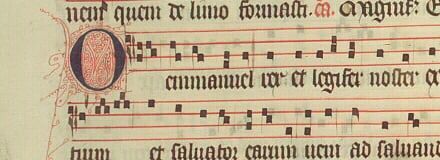
O Emmanuel, the illuminated opening in the Poissy Antiphonal, folio 31v
Poissy Antiphonal, c. 1335–1345, fol. 31v. State Library Victoria.
O Emmanuel, Rex et Legifer noster, exspectatio gentium, et salvator earum; veni ad salvandum nos, Domine Deus noster.
O Emmanuel, our King and Lawgiver, the Expectation and Saviour of the nations! come and save us, O Lord our God!

O Emmanuel! King of peace! Thou enterest today the city of Thy predilection, the city in which Thou hast placed Thy temple—Jerusalem. A few years hence the same city will give Thee Thy cross and Thy sepulchre: nay, the day will come on which Thou wilt set up Thy judgement-seat within sight of her walls. But to-day Thou enterest the city of David and Solomon unnoticed and unknown. It lies on Thy road to Bethlehem. Thy blessed Mother and Joseph her spouse would not lose the opportunity of visiting the temple, there to offer to the Lord their prayers and adoration. They enter; and then, for the first time, is accomplished the prophecy of Aggeus, that great shall be the glory of this last house more than of the first;* for this second temple has now standing within it an ark of the Covenant more precious than was that which Moses built; and within this ark, which is Mary, is contained the God whose presence makes her the holiest of sanctuaries. The Lawgiver Himself is in this blessed ark, and not merely, as in that of old, the tablet of stone on which the Law was graven. The visit paid, our living ark descends the steps of the temple, and sets out once more for Bethlehem, where other prophecies are to be fulfilled. We adore Thee, O Emmanuel! in this Thy journey, and we reverence the fidelity wherewith Thou fulfillest all that the prophets have written of Thee; for Thou wouldst give to Thy people the certainty of Thy being the Messias, by showing them that all the marks, whereby He was to be known, are to be found in Thee. And now, the hour is near; all is ready for Thy birth; come then, and save us; come, that Thou mayst not only be called our Emmanuel, but our Jesus, that is, He that saves us.

The Great Antiphon to Jerusalem

O Hierusalem! civitas Dei summi, leva in circuitu oculos tuos; et vide Dominum tuum, quia jam veniet solvere te a vinculis.
O Jerusalem! city of the great God: lift up thine eyes round about, and see thy Lord, for he is coming to loose thee from thy chains.

* Agg. ii. 10. ↩︎

Previous
December 22: Sixth Antiphon
Next
December 23: Seventh Antiphon