Daily reading
Christmas
Double · Movable from Advent · Temporal
December 31, 2023
From Dom Guéranger’s The Liturgical Year.
 |
Sunday within the Octave of Christmas or the Sixth Day within the Octave of Christmas
(If December 30 falls on a Saturday, it is called the Sixth Day within the Octave, and the third Mass of Christmas Day, page 202, is repeated, except for the Epistle and Gospel, which are taken from the second Mass, pages 191, 192, the extra prayers are given on page 415, and in this case the Office of the Sunday in the Octave is said on December 31, with a commemoration of St Silvester. But if December 30 falls on any other day of the week, the Office is of the Sunday within the Octave of Christmas.)
THIS is the only day within the Christmas Octave which is not a Saint’s Feast. During the Octaves of the Epiphany, Easter and Pentecost, the Church is so absorbed in the respective mysteries that she puts off everything that could share her attention; whereas during this of Christmas, there is only one day which does not celebrate the memory of some glorious Saint, and our Infant Jesus is surrounded by a choir of heroes who loved and served him. Thus the Church, or, more correctly, God—for God is the first author of the cycle of the year—shows us how the Incarnate Word, who came to save mankind, desires to give mankind confidence by this his adorable familiarity.
We have already shown that the Birth of our Lord took place on a Sunday, the Day on which, in the beginning of the world, God created Light. We shall find, later on, that his Resurrection also was on a Sunday. This the first day of creation, and the first of the week, was consecrated by the old Pagans to the Sun: with us Christians, it is most sacred and holy, on account of the two risings of our divine Sun of Justice—his Birth and his Resurrection. Whilst the solemnity of Easter is always kept on a Sunday, that of Christmas falls by turns on each of the days of the week—we have already had this difference explained to us by the Holy Fathers: but the mystery of Jesus’ Birth is more aptly and strongly expressed, when its anniversary falls on a Sunday. Other years, when the coincidence does not happen, the Faithful will at least be led by their Christian instincts, to give especial honour to the day within the Octave which falls on the Sunday. The Church has honoured it with a proper Mass and Office, and we of course insert them.
Mass
It was at midnight that the Lord delivered his people from bondage, by the Passage of his destroying Angel over the land of the Egyptians: so also was it in the still hour of midnight that Jesus, the Angel of Great Counsel, came down from his royal throne, bringing mercy to our earth. It is just, that whilst commemorating this second Passage, the Church should sing the praises of her Emmanuel, who comes, clad in his strength and beauty, to take possession of his Kingdom.
Introit
In the Collect the Church prays to be directed by that divine rule which was taught us by our Saviour, the Sun of Justice, who shone upon us in order to enlighten and guide our steps in the path of good works.
Collect
The Commemoration of the Octave of Christmas is given on page 228.
Epistle
Cap. IV.Fratres, quanto tempore hæres parvulus est, nihil differt a servo, cum sit dominus omnium: sed sub tutoribus et actoribus est usque ad præfinitum tempus a patre: ita et nos, cum essemus parvuli, sub elementis mundi eramus servientes. At ubi venit plenitudo temporis, misit Deus Filium suum factum ex muliere, factum sub lege, ut eos, qui sub lege erant, redimeret, ut adoptionem filiorum reciperemus. Quoniam autem estis filii, misit Deus Spiritum Filii sui in corda vestra, clamantem: Abba, Pater. Itaque jam non est servus, sed filius. Quod si filius: et hæres per Deum,
Ch. IV.Brethren: As long as the heir is a child, he differeth nothing from a servant, though he be lord of all: but is under tutors and governors, until the time appointed by the father: so we also, when we were children, were serving under the elements of the world. But when the fulness of the time was come, God sent his Son, made of a woman, made under the law, that he might redeem them who were under the law, that we might receive the adoption of sons. And because you are sons, God hath sent the Spirit of his Son into your hearts, crying: Abba, Father. Therefore now he is not a servant, but a son. And if a son, an heir also, through God.
The Child that is born of Mary and is couched in the Crib at Bethlehem, raises his feeble voice to the Eternal Father, and calls him, My Father! He turns towards us and calls us My Brethren! We, consequently, when we speak to his Father, may call him Our Father! This is the mystery of adoption, revealed to us by the great event we are solemnizing. All things are changed, both in heaven and on earth: God has not only one Son, he has many sons; henceforth we stand before this our God, not merely creatures drawn out of nothing by his power, but children that he fondly loves. Heaven is now not only the throne of his sovereign Majesty; it is become our inheritance, in which we are joint-heirs with our Brother Jesus, the Son of Mary, Son of Eve, Son of Adam, according to his Human Nature, and (in the unity of Person) Son of God according to his Divine Nature. Let us turn our wondering and loving thoughts first to this sweet Babe, that has brought us all these blessings, and then to the blessings themselves, to the dear inheritance made ours by him. Let our mind be seized with astonishment at creatures having such a destiny! and then let our heart pour out its thanks for the incomprehensible gift!
Gradual
Gospel
Cap. II.In illo tempore: Erat Joseph, et Maria mater Jesu, mirantes super his quæ dicebantur de illo. Et benedixit illis Simeon, et dixit ad Mariam matrem ejus: Ecce positus est hic in ruinam et in resurrectionem multorum in Israel: et in signum cui contradicetur: et tuam ipsius animam pertransibit gladius, ut revelentur ex multis cordibus cogitationes. Et erat Anna Prophetissa, filia Phanuel, de tribu Aser. Hæc processerat in diebus multis, et vixerat eum viro suo annis septem a virginitate sua. Et hæc vidua usque ad annos octoginta quatuor: quæ non discedebat de templo, jejuniis et obsecrationibus serviens nocte ac die. Et hæc, ipsa hora superveniens, confitebatur Domino, et loquebatur de illo omnibus, qui exspectabant redemptionem Israel. Et ut perfecerunt omnia secundum legem Domini, reversi sunt in Galilæam, in civitatem suam Nazareth. Puer autem crescebat, et confortabatur, pienus sapientia: et gratia Dei erat in illo.
Ch. II.At that time: Joseph, and Mary the Mother of Jesus, were wondering at those things which were spoken concerning him. And Simeon blessed them, and said to Mary his Mother: Behold, this Child is set for the fall and for the resurrection of many in Israel: and for a sign which shall be contradicted: and thine own soul a sword shall pierce, that out of many hearts thoughts may be revealed. And there was one Anna, a prophetess, the daughter of Phanuel, of the tribe of Aser: she was far advanced in years, and had lived with her husband seven years from her virginity. And she was a widow until fourscore and four years: who departed not from the temple, by fastings and prayers serving day and night. Now she at the same hour, coming in, confessed to the Lord, and spoke of him to all that looked for the redemption of Israel. And after they had performed all things according to the law of the Lord, they returned into Galilee, to their city Nazareth. And the Child grew and waxed strong, full of wisdom: and the grace of God was in him.
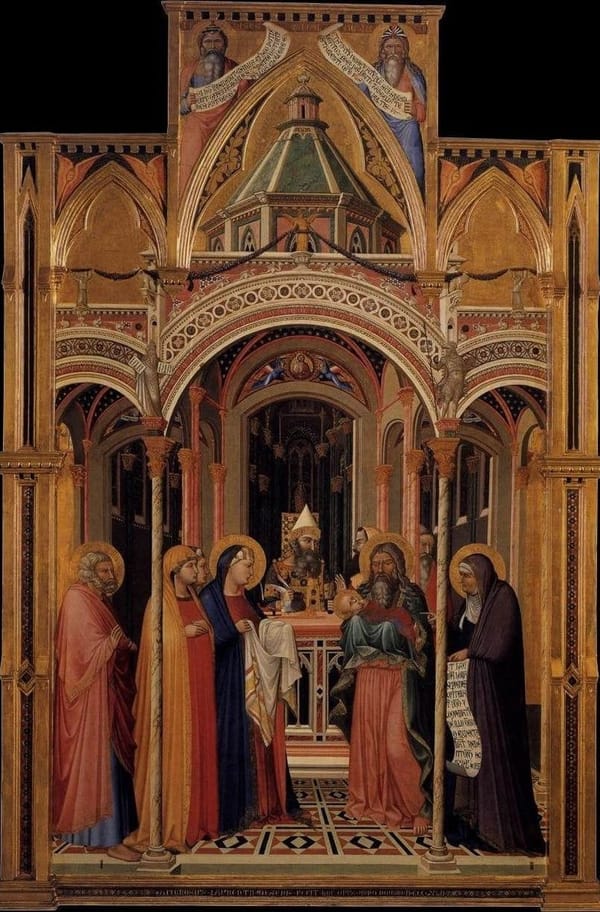
The passage of the Gospel selected for this Mass, though bearing on the Divine Infancy, yet gives us, we may almost say prematurely, the terrible prophecy of Simeon regarding the dear Babe of Bethlehem. The heart of Mary, that was overflowing with joy at the miraculous Birth of her Child, is here made to feel the sword spoken of by the venerable Priest of the temple. Her Son, then, is to be but a sign that shall he contradicted! The mystery of man's adoption by God is to cost this Child of hers his life! We that are the Re deemed in his Blood, we may not yet dwell on the fatigues and the Passion and the Death of our Emmanuel; the time will come for that; at present we are forbidden to think of him other than as the sweet Child that is born to us, the source of all our happiness by his having come among us. Let us catch up the words of Anna, who calls him the Redemption of Israel. Let our eye delight in the sight of the earth regenerated by the birth of its Saviour. Let us admire and study well this Jesus newly born among us, and adore in humble love the wisdom and grace that are in him.
During the Offertory, the Church celebrates the wonderful renovation wrought in the world, a renovation which saved it from destruction. She sings the praises of the great God who came down into the poor Stable of Bethlehem, yet left not his eternal throne.
Offertory
Secret
The Commemoration of the Octave is given above, p. 232.
The words chanted by the Church at the Communion are those spoken by the Angel to St Joseph. She has given this Divine Infant to her faithful children in Holy Communion, in order that they may carry him in their hearts, and bids them guard him against the snares laid for him by his and their enemies. Let the
Christian, therefore, take heed lest Jesus should be taken from him. Let him, by strict watchfulness and by good works, crush the tyrant sin that seeks the life of the Divine Guest of his soul. It is for this reason that, in the Postcommunion, the Church prays that our vices may be destroyed, and our desires for a virtuous life be blessed.
Communion
Postcommunion
The Commemoration of the Octave is given above, p. 233.
Vespers
If December 30 be kept as the Sunday in the Octave of Christmas, Vespers are as follows:
The Antiphons and Psalms are those of Christmas Day, p. 210.
Capitulum (Gal. iv)
Hymn, Jesu Redemptor omnium, p. 217.
Antiphon to the Magnificat
Commemoration of St Sylvester, Pope
Then Commemoration of Christmas Day, p.321.
But if the Sunday in the Octave be kept on December 31, Vespers are as above, except that the Antiphon to the Magnificat is Dum medium silentium, as on p.321; and commemorations are made of St Sylvester, as above, and of the Octave of Christmas, as on p. 321.
On this the sixth day since the Birth of our Emmanuel, let us consider how the Divine Infant lies in the Crib of a Stable, and is warmed by the breath of the Ox and the Ass, as Isaias had foretold: The ox knoweth his owner, and the ass his master's crib; but Israel hath not known me.1 Thus does the great God enter that world which his own hands have created! The dwellings of men are refused him, for man has a hard heart for his God, and an indifference which is a real contempt. The only shelter he can find to be born in is a Stable; and that necessitates his coming into the world in the company of poor dumb brutes.
At all events, these animals are his own work. When he created the irrational world of living things, he subjected it, as the inferior part of creation, to man; and man was to ennoble it, by referring it to the Creator. When Adam sinned, this subjection, this harmony, was broken. The apostle teaches us that the brute creation is not insensible to the degradation thus forced upon it by sinful man.2 It obeys him with reluctance; it not infrequently rebels against and deservedly punishes him; and on the day of judgement it will take the side of its Creator, and avenge itself of that wickedness of which man has made it the unwilling instrument.3
In the mystery of his Birth, the Son of God visits this part of his creation; men refused to receive him, and he accepts the hospitality of the dwelling of brutes. It is from their dwelling that he begins the divine career of the three and thirty years. The first human beings he invites into the company of his blessed Mother and his dear St Joseph, the first he admits into the Stable to see and adore himself, are shepherds, who were busy watching their flocks, and whose simple hearts have not been corrupted by the atmosphere of cities.
The Ox—which, as we learn from Ezechiel4 and St John,5 is one of the symbolic creatures standing round God’s throne—is the figure of the sacrifices of the Old Law. The blood of oxen has flowed in torrents upon the altar of the Temple: it was the imperfect and material offering prescribed to be made to God, until he should send the true Victim. The Infant Jesus, who lies in the Crib, is that Victim, and St Paul tells us what he says to his Eternal Father: Sacrifices and Oblations and Holocausts for sin thou wouldst not have, neither are they pleasing to thee; behold, I come!6
The Prophet Zachary,7 foretelling the peaceful triumph of the Meek King, says that he will make his entry into Sion riding upon an Ass. We shall assist, further on in the year, at the accomplishment of this prophecy. Now that we are at Bethlehem, in our Christmas mystery, let us observe how the heavenly Father places his Divine Son between the instrument of his peaceful triumph and the symbol of his Sacrifice on Calvary.
Ah! dear Jesus! Creator of heaven and earth! how strange is this thy entrance into thine own world! The whole universe should have given thee a welcome of love and adoration: and yet what motionless indifference! Not one house to take thee in! Men buried in sleep! And when Mary had placed thee in the Crib, thy first sight was that of two poor animals, the slaves of him who proudly rejected thee! Yet this sight did not displease thee, for thou dost not despise the work of thy hands. What afflicts thy loving Heart is the presence of sin in our souls, the sight of that enemy of thine which has so often caused thee to suffer. Oh! hateful sin! we renounce it, and wish, dear Jesus, to acknowledge thee for our Lord and Master, at did the Ox and the Ass. We will unite in that hymn of praise which creation is ever sending up to thee, by henceforth adding to it the homage of our adoration and gratitude; nay, we will lend speech to nature, and give it soul, and sanctify it, by referring all creatures to thy service.
The following Prose is the composition of Adam of St Victor, and is one of the most mystical of the Sequences in the Missals of the Middle Ages. It will serve us as a further tribute of praise to the Divine Infant.
Sequence
Se conformans homini,
Tandem lætus,
Novum promat canticum;
Et captivus,
Prodeat in publicum.
Vitae fructum
Virgo gaudens edidit.
Propter illum
Castitatis perdidit.
Atque soli sit objecta,
Scintillat igniculum:
Nec in partu solvitur
Pudoris signaculum.
Stupet usus et natura,
Deficitque ratio.
Tam pia, tam humilis
Christi generatio.
Virga profert, et pudica
Virgo Dei Filium.
Vellus rorem,
Creatura creatorem,
Creaturæ pretium.
Nucis, roris;
Pietati Salvatoris
Congruunt mysteria.
Protegendo;
Flos, dulcore;
Nux, pascendo:
Ros, cœlesti gratia.
Est Judæis scandalum,
Cum virga produxerit
Sicca sic amygdalum?
Nam prolata nux in lucem
Lucis est mysterium.
Tria confert, unctionem,
Lumen et edulium.
Circa carnem pæna crucis,
Testa, corpus osseum.
Et Christi suavitas
Signatur per nucleum.
Christus ægris, et fomentum
Piis animalibus.
Fœnum carnis in frumentum
Convertit fidelibus.
Jesu, pascis in præsenti,
Tuo vultu satia.
Nos hinc transfer ad paternæ
Claritatis gaudia.
taking to himself the likeness and nature of man,
is at length made glad,
and may sing a new canticle;
and captive
may now come before the world.
Mary, the glad Virgin,
brought forth the Fruit of Life.
thereby lose
the treasure of virginity.
up to the sun;
the spark glitters through,
so in the Birth of Jesus,
it injured naught of the Mother's purity.
at that divine Birth,
and reason was confounded.
is an ineffable mystery
—so full of love, and so humble!
yields leaf and flower and almond:
so does the chaste Virgin her Child, the Son of God.
bears the dew from heaven;
the creature bears the creature's ransom
—the Creator.
the almond and the dew,
are mystic emblems
of our Saviour’s love.
that shades us;
the sweet flower that regales us;
the almond-nut that feeds us;
the dew that waters us with heavenly grace.
should be a stumbling-block to the Jews?
Have they forgotten the dry branch of Aaron,
how it bore the almonds?
for, viewed in its true light,
it is the mystic emblem of him that is the Light.
and all three it gives to man:
unction, light and food.
he endured in the Flesh:
the shell is his Body—his Flesh and Bones.
which are sheathed within the Flesh,
are figured by the kernel.
and unction to the sick,
and soothing to holy souls.
He changes his Flesh, that lies as hay in the manger,
into the Wheat of the elect.
to be satiated
with the sight of thy holy Face in heaven.
take us hence to the joys
of thy Father's glory.
We borrow from the Syrian Church the following stanzas of one of its hymns, written by her sublime poet, St Ephrem the Deacon of Edessa.
Hymn
December 31: St. Sylvester, Pope and Confessor
SO far, the only ones we have seen standing round the Crib of our Jesus have been Martyrs: Stephen, overwhelmed with the shower of stones; John, the Martyr in heart, who survived his fiery torture; the Holy Innocents, massacred by the sword; Thomas, murdered in his cathedral; these are the champions of Christ, who keep guard in the palace of Bethlehem. Yet all Christians are not called to be Martyrs. Besides this countless battalion of the King's favourite soldiers, there are other troops of sainted heroes which form the heavenly army; and amongst these there are the Confessors, who conquered the world without shedding their blood in the combat. Though the place of honour in the service of the King belongs to the Martyrs, yet did the Confessors fight manfully for the glory of his name and the spreading of his Kingdom. The palm is not in their hands, but they are crowned with the crown of justice, and Jesus, who gave it to them, has made it be part of his own glory that they should be near his throne.
The Church would therefore grace this glorious Christmas Octave with the name of one of her children, who should represent at Bethlehem the whole class of her unmartyred Saints. She chose a Confessor—St Sylvester: a Confessor who governed the Church of Rome, and therefore the universal Church; a Pontiff whose reign was long and peaceful; a Servant of Jesus Christ adorned with every virtue, who was sent to edify and guide the world immediately after those fearful combats that had lasted for three hundred years, in which millions of Christians had gained victory by martyrdom, under the leadership of thirty Popes—predecessors of St Sylvester—and they, too, all Martyrs.
So that Sylvester is messenger of the Peace which Christ came to give to the world, of which the Angels sang on Christmas Night. He is the friend of Constantine; he confirms the Council of Nicæa; he organizes the discipline of the Church for the new era on which she is now entering: the era of Peace. His predecessors in the See of Peter imaged Jesus in his sufferings; Sylvester represented Jesus in his triumph. His appearance during this Octave reminds us that the Divine Child who lies wrapped in swaddling-clothes, and is the object of Herod's persecution, is, notwithstanding all these humiliations, the Prince of Peace, the Father of the world to come.1
Let us read the history of Sylvester's peaceful Pontificate, as related by the Church in her Breviary. The character of our work excludes purely critical discussions, and we, therefore, say nothing of the objections that have been raised against the Emperor Constantine’s having received Baptism in Rome at the hands of St Sylvester. It is sufficient for us to tell our readers that the Roman tradition regarding that event has been adopted by the most learned men, such as Baronius, Schelstrate, Bianchini, Marangoni, Vignoli, etc.
The ancient Liturgical Books of Italy had a Proper Office for St Sylvester. We have found, in the Breviary of the old Abbatial (now the Collegiate) Church of St Barbara, at Mantua, a very beautiful Office; and from this we extract the following Antiphons and Responsories:
Sylvester was a holy man, and led a life of heaven whilst on this earth: being a Pontiff of exceeding virtue, he governed the Church with heavenly prudence.
The Greek Church is enthusiastic in its hymns of praise to St Sylvester. In the stanzas we extract from her Menæa, she gives to this great Pope the whole honour of the Nicene Council, and honours him as the conqueror of the Arian heresy.
(In magno Vespertino, et passim)
Supreme Pastor of the Church of Christ! thou lendest to the beauty of the holy Octave of Christmas the lustre of thy glorious merits. There thou worthily representest the countless choir of Confessors, for it was thou didst steer the bark of Peter after the three hundred years' tempest, leading her with watchful love in her first hours of calm. The pontifical Diadem, reflecting heaven in its gems, sits on thy venerable brow. The Keys of the Kingdom of heaven are in thy hands; thou openest it for the admission of the Gentiles who embraced the faith of Christ; thou shuttest it against the Arians, in that august Council of Nicæa, where thou presidest by thy Legates, and to which thou givest authority, by confirming it with thy apostolic approbation. The furious storms will again soon rage against the Church, and the angry billows of heresy will beat against her; thou wilt then be in the bosom of God; but together with St Peter, thou wilt keep guard over the purity of the Faith of Rome. Thou wilt support Julius; thou wilt rescue Liberius; and Athanasius, aided by thy prayers, will find a shelter within the walls of Rome.
Under thy peaceful reign, Christian Rome receives the reward of her long-endured persecution. She is acknowledged as Queen of Christendom, and her empire becomes the sole empire that is universal. The son of thy pastoral zeal, Constantine, leaves the city of Romulus, which has now become the City of Peter; the imperial majesty would be eclipsed by that greater one of the Vicar of Christ; he makes Byzantium his capital, leaving Rome to be that of the Pontiff-King. The temples of the false gods become ruins, and make room for the Christian Basilicas, in which are enshrined the Relics of the Apostles and Martyrs. In a word, the Church has triumphed over the Prince of this world, and the victory is typified by the destruction of that Dragon which infected the air by its poisonous breath.
Honoured with all these wonderful prerogatives, saintly Vicar of Christ! forget not the Christian people, which was once thy flock. It asks thee, on this thy Feast, to make it know and love the mystery of the Birth of Jesus. By the sublime Symbol which embodies the Faith of Nicæa, and which thou didst confirm and promulgate throughout the whole Church, thou hast taught us to acknowledge this sweet Infant as God of God, Light of Light, begotten not made, Consubstantial with the Father. Thou biddest us to come and adore this little Child as he by whom all things were made. Holy Confessor of Christ! vouchsafe to present us to him, as the Martyrs have done, whose feasts have filled up the days since this Nativity. Pray to him for us, that our desires for true virtue may be fulfilled, that we may persevere in his holy love, that we may conquer the world and our passions, and that we may at length obtain the Crown of justice, which is to be the reward of our confessing him before men, and is the only object of our ambition.
Pontiff of Peace! from the abode of rest where thou now dwellest, look down upon the Church of God, surrounded as she is by implacable enemies, and beseech Jesus, the Prince of Peace, to hasten her triumph. Cast thine eye on that Rome which is so dear to thee, and which is so faithful in her love of thee. Protect and direct her Father, King and Pontiff. May she triumph over the wiles of political intrigue, the violence of tyranny, the craft of heretics, the perfidy of schismatics, the apathy of worldlings, and the cowardice of her own children. May she be honoured, loved, and obeyed. May the sublime dignity of the Priesthood be recognized. May the spiritual power enjoy freedom of action. May the civil authority work hand in hand with the Church. May the Kingdom of God now come, and be received throughout the whole world, and may there be but one Fold and one Shepherd.
Still watch, O holy Sylvester! over the sacred treasure of the Faith, which thou didst defend when on earth against every danger. May its light put out the vapours of man's proud dreams, those false and daring doctrines which mislead countless souls. May every mortal bow down his understanding to the obedience of faith in the divine Mysteries, without which all human wisdom is but folly. May Jesus, the Son of God and Son of Mary, be King, by his Church, over the minds and hearts of all men.
Pray for Byzantium, that was once called the New Rome, but which so soon became the capital of heresies, and the scene of everything that could degrade a Christian country. Pray that the days of her deep humiliation may be shortened; that she may again see herself united with Rome; that she may honour Christ and his Vicar; that she may obey, and by her obedience be saved. May the people, misled and debased by her influence and rule, recover their dignity as men, which can only subsist when men have faith, or be regained by a return to the faith.
And lastly, O Conqueror of Satan! keep this hellish monster in the prison whither thou didst drive him; confound his pride and his schemes; let him no longer seduce the people of God’s earth; but may all the Children of the Church, according to the word of Peter thy predecessor, resist him, by the strength of their faith.2
Let us, on this the Seventh Day within the Christmas Octave, consider the new-born Babe wrapped in the swaddling-clothes of Infancy. They are the indications of weakness; the Child that is swathed in them is helpless, and dependent on others; another’s hand must loosen his bands, and until then he is not free to move. It was in this infantine helplessness, and in the bondage of human weakness, that he who gives life and motion to every creature first appeared on our earth!
Let us contemplate our Blessed Lady wrapping the limbs of her Child, her God, in these swathing-bands: but who can picture to himself the respectful love wherewith she does it? She adores his humiliations—humiliations which he has taken upon himself in order that he may sanctify every period of man’s life, even that feeblest of all, infancy. So deep was the wound of our pride, that it needed a remedy of such exceeding efficacy as this! Can we refuse to become little children, now that he who gives us the precept sets us so touching an example? Sweet Jesus! we adore thee wrapped in thy Swaddling-Clothes, and our ambition is to imitate thy divine humility.
'Let not,' says the holy Abbot Guerric, 'let not the eye of your faith be offended or shocked, brethren, at these outward humble coverings. As the Mother of Jesus wrapped him in swaddling-clothes, so do Grace and Wisdom, your spiritual mother, veil over with certain material things the truth of our Incarnate God, and hide under the representation of symbolical figures the majesty of this same Jesus. When I, brethren, deliver to you, by my words, the Truth, which is Jesus, I am swathing Jesus in bands of exceeding great poverty. Happy the soul that loves and adores its Jesus not the less because he receives him thus poorly clad! Let us therefore most devoutly think upon our Lord clothed in the swathing-bands wherewith his Mother covered his infant limbs; that so, in the world of eternal happiness, we may see the glory and beauty wherewith his Father hath clad him; and this glory is that of the Only-Begotten Son of the Father.'3
Let us once more celebrate the joyous Birth of our Jesus, making use of this ancient Prose so redolent of the piety of the ages of Faith. It is found in the old Roman-French Missals.
Sequence
Pax et in terra:
Natus alma Virgine Qui exstat ante sæcula.
Ut tanto canore tremat alta
Poli machina.
Humana concrepant cuncta
Deum natum in terra.
Nunc lætentur omnia Nati per exordia.
Voce clara reddita.
Solus qui gubernat omnia,
Ipse sua pietate salvet omnia pacata regna.
* He that is eternal is born of the glorious Virgin!’
And earth, from pole to pole, thrill with the loud melodious song.
May he that alone governs all things—
In his mercy save all kingdoms, and give them Peace.
The saintly Abbot of Cluny, Peter the Venerable, is the author of the hymn we will now offer to the incomparable Mother. It is full of that scriptural unction which filled the writer’s fervent soul.
Sequence
Nemo mutus sit in laude:
Redit homo per Virginem.
Unde vetus perit rixa:
Succedit pax et gloria.
Cum in fœno jacet Deus.
Cœlestis escæ pabulum.
Ex se factum Redemptorem.
Divina Sapientia.
Lac fundunt nati viscera,
Per assumptum dat hominem.
Personemus, o Maria,
Et clamosis affectibus.
Quæ fugasti maledicta.
Agni Sponsa mitissimi.
Cujus caput contrivisti,
Ejus fuit interitus.
Tu terrarum reparatrix,
Quam nequam tremunt dœmones.
Aula, domus, templum, tellus:
Et rosa per martyrium:
Sordes lavans peccatorum.
Et mortuos vivificans.
Spes, post Deum, sæculorum.
Et deitatis solium.
Umbras fugans Occidentis,
Et dies noctis nescia.
Et genitrix nos gignentis.
Natos Patri concilia.
Nostrum solvat ut reatum,
Det gratiam et gloriam.
let no man keep his lips from praise.
that man was restored to the primeval state.
and the ancient anger ceased:
and Peace and Glory came in its stead.
when God lay on his Crib of straw.
the Food of heaven's own gift.
—the Redeemer, who had become her Child.
lay hid in childhood.
her Jesus feeds us with the milk of his tender mercy.
through the assuming our human nature.
give our Ave Maria
and with speaking hearts.
that didst destroy the curse.
and Spouse of the Lamb most meek.
and crush his head,
was the serpent's death.
and Reparatrix of the earth,
and the terror of the demons of hell.
Palace, House, Temple and Earth—all are fulfilled in thee.
thou art the Rose by thy martyrdom:
that cleansest the defilements of sin,
and bringest the dead to life.
and, after God, the Hope of mankind!
and the Throne of God.
that puttest to flight the shadows of the Western night.
and the Day that knowest not night.
thou givest life to him who giveth life to us.
reconcile him to us his children!
that he forgive us our sins,
give us grace and glory.
The Civil Year ends to-day. At Midnight, a New Year will begin, as the world counts time, and the present one will sink into the abyss of eternity. It is one step further on in our lives, and brings us nearer to that end of all things, which St Peter says is at hand4 The Liturgy, which begins a new ecclesiastical year on the First Sunday of Advent, has no special prayers, in the Roman Church, for the beginning of the year on the First of January; but her spirit, which takes an interest in everything affecting the well-being of individuals or of society at large—her spirit is that we should, sometime in the course of this last day of the year, make a fervent act of thanksgiving to God for the blessings he has bestowed upon us during the past twelve months.
Rome sets us the example. To-day the Sovereign Pontiff goes in state to the Gesu (or, as we should call it, Jesus Church) and there assists at a solemn Te Deum; the Benediction of the Blessed Sacrament follows it, blessing, as it were, the public act of thanksgiving, and giving a pledge of blessings for the coming year.
The only Church that has given a liturgical expression to the sentiments, which the close of the Year inspires, is that of the Mozarabic Rite, in which there occurs the following beautiful Preface, which we gladly offer to our readers. It is part of the Mass of the Sunday which immediately precedes the Feast of the Epiphany.
Illatio
| Previous December 29: St. Thomas, Archbishop of Canterbury and Martyr | Next December 31: St. Sylvester, Pope and Confessor |