Daily reading
Epiphanytide
Double · Temporal
January 14, 2024
From Dom Guéranger’s The Liturgical Year.

|
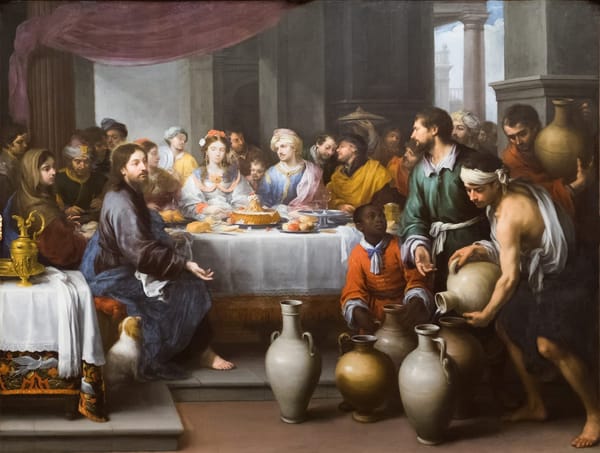
The Second Sunday after Epiphany
THE third Mystery of the Epiphany shows us the completion of the merciful designs of God upon the world, at the same time that it manifests to us, for the third time, the glory of our Lord and Saviour, Jesus Christ. The star has led the soul to faith; the sanctified Waters of the Jordan have conferred purity upon her; the Marriage-Feast unites her to her God. We have been considering, during this Octave, the Bridegroom revealing himself to the Spouse; we have heard him calling her to come to him from the heights of Libanus; and now, after having enlightened and purified her, he invites her to the heavenly feast, where she is to receive the Wine of his divine love.
A Feast is prepared;1 it is a Marriage-Feast; and the Mother of Jesus is present at it, for it is just that, having co-operated in the mystery of the Incarnation of the Word, she should take part in all that her Son does, and in all the favours he bestows on his elect. But, in the midst of the Feast, the Wine fails. Wine is the symbol of Charity or Love, and Charity had failed on the earth; for the Gentiles had never tasted its sweetness; and as to the Synagogue, what had it produced but wild grapes?2 The True Vine is our Jesus, and he calls himself by that name.3 He alone could give that Wine which gladdeneth the heart of man;4 he alone could give us that Chalice which inebriateth,5 and of which the Royal Psalmist prophesied.
Mary said to Jesus: They have no Wine. It is the office of the Mother of God to tell him of the wants of men, for she is also their Mother. But Jesus answers her in words which are apparently harsh: Woman! what is it to me and to thee? My hour is not yet come. The meaning of these words is, that, in this great Mystery, he was about to act, not as the Son of Mary, but as the Son of God. Later on, the hour will come when, dying upon the Cross, he will do a work, in the presence of his Mother, and he will do it as Man, that is, according to that human nature which he has received from her. Mary at once understands the words of her Son, and she says to the waiters of the Feast, what she is now ever saying to her children: Do whatsoever he shall say to you.
Now, there were six large waterpots of stone there, and they were empty. The world was then in its Sixth Age, as St Augustine and other Holy Doctors tell us. During these six ages, the earth had been awaiting its Saviour, who was to instruct and redeem it. Jesus commands these waterpots to be filled with water; and yet water does not suit the Feast of the Spouse. The figures and the prophecies of the ancient world were this water, and until the opening of the Seventh Age, when Christ, who is the Vine, was to be given to the world, no man had contracted an alliance with the Divine Word.
But, when the Emmanuel came, he had but to say, Now draw out, and the waterpots were seen to be filled with the wine of the New Covenant, the Wine which had been kept to the end. When he assumed our human nature—a nature weak and unstable as water—he effected a change in it; he raised it up even to himself, by making us partakers of the divine nature;6 he gave us the power to love him, to be united to him, to form that one Body, of which he is the Head, that Church of which he is the Spouse, and which he loved from all eternity, and with such tender love, that he came down from heaven to celebrate his nuptials with her.
St Matthew, the Evangelist of the Humanity of our Lord, has received from the Holy Ghost the commission to announce to us the Mystery of Faith by the star; St Luke, the Evangelist of Jesus' Priesthood, has been selected, by the same Holy Spirit, to instruct us in the Mystery of the Baptism in the Jordan; but the Mystery of the Marriage-Feast was to be revealed to us by the Evangelist John, the Beloved Disciple. He suggests to the Church the object of this third Mystery, by this expression: This beginning of miracles did Jesus in Cana of Galilee, and he manifested his glory.7 At Bethlehem, the Gold of the Magi expressed the Divinity of the Babe; at the Jordan, the descent of the Holy Ghost and the voice of the Eternal Father proclaimed Jesus (known to the people as a carpenter of Nazareth) to be the Son of God; at Cana, it is Jesus himself that acts, and he acts as God, for, says St Augustine, he who changed the water into wine in the waterpots could be no other than the same who, every year, works the same miracle in the vine. Hence it was that, from that day, as St John tells us, his disciples believed in him,8 and the Apostolic College began to be formed.
Mass
The Introit proclaims the joy of this day, which shows us human nature espoused to the Son of the eternal Father. Surely the earth will henceforth surrender itself wholly to the love and praise of this sacred Name which, in the Marriage Feast, has become that of the Sons of Adam.
Introit
This name of Sons of God which has become ours by right through the bond of the sacred nuptials is none other, as Jesus himself tells us in his Beatitudes, than Peace—the Peace of God, ours truly through the action of his grace ever working it out within us. In the Collect Peace again figures as the final end of God's government both in heaven and on earth, likewise as the supreme desire of the Church.
Collect
Commemoration is made, by their proper Collects, of the Saint whose feast may occur with this Sunday; the third prayer will be that of the Blessed Virgin.
Commemoration of the Blessed Virgin Mary
Epistle
Cap. XII.Fratres: Habentes donationes secundum gratiam, quæ data est nobis, differentes: sive prophetiam secundum rationem fidei, sive ministeriura in ministrando, sive qui docet in doctrina, qui exhortatur in exhortando, qui tribuit in simplicitate, qui præest in sollicitudine, qui miseretur in hilaritate. Dilectio sine simulatione. Odientes malum, adhærentes bono: Caritate fraternitatis invicem diligentes: Honore invicem prævenientes: Sollicitudine non pigri: Spiritu ferventes: Domino servientes: Spe gaudentes: In tribulatione patientes: Orationi instantes: necessitatibus sanctorum communicantes: Hospitalitatem sectantes. Benedicite persequentibus vos: benedicite et nolite maledicere. Gaudere cum gaudentibus, flere cum flentibus: idipsum invicem sentientes: non alta sapientes, sed humilibus consentientes.
Ch. XII.Brethren: Having different gifts, according to the grace that is given us, either prophecy, to be used according to the rule of faith: or ministry, in ministering; or he that teacheth, in doctrine; he that exhorteth in exhorting; he that giveth with simplicity; he that ruleth with carefulness; he that sheweth mercy with cheerfulness. Let love be without dissimulation. Hating that which is evil, cleaving to that which is good. Loving one another with the charity of brotherhood: with honour preventing one another. In carefulness not slothful, in spirit fervent: serving the Lord: rejoicing in hope: patient in tribulation: instant in prayer: communicating to the necessities of the saints: pursuing hospitality. Bless them that persecute you: bless and curse not. Rejoice with them that rejoice, weep with them that weep. Being of one mind one towards another, not minding high things, but consenting to the humble.
This peace which characterizes, in the abode of saints, the Sons of God, effects in like measure on earth the oneness of the Bride, that is of the Church: peace it is that makes her to be but one body wherein the many members find their multiplicity upheld and guided by the head, the one lord; their functions, so diverse in themselves, regulated and brought under the rule and love of the Bridegroom, Christ Jesus. The Epistle which has just been read sets before us the different operations of this peace which has as its ruling motive Charity, the Queen of virtues, and which is so essential to Christianity; the Apostle specifies in detail its forms and conditions and adapts its practice to every social condition and circumstance of life. Of such value does the Church judge these considerations, that, on the following Sunday, she resumes the text of the Apostle where today she has interrupted it.
Far from a divine life in the peace of God which was its precious gift, the human race incurred death with its penalty of separation. Let us then in the Gradual sing of this wonder that has been wrought in our midst, and with the angelic choirs exalt the Lord in praise and admiration.
Gradual
Gospel
Cap. II.In illo tempore: Nuptiæ factæ sunt in Cana Galilææ, et erat Mater Jesu ibi. Vocatus est autem et Jesus et discipuli ejus ad nuptias. Et deficiente vino, dicit Mater Jesu ad eum: Vinum non habent. Et dicit ei Jesus: Quid mihi et tibi est, mulier? nondum venit hora mea. Dicit Mater ejus ministris: Quodcumque dixerit vobis, facite. Erant autem ibi lapideæ hydriæ sex, positæ secundum purificationem Judæorum, capientes singulæ metretas binas vel ternas. Dicit eis Jesus: Implete hydrias aqua. Et impleverunt eas usque ad summum. Et dicit eis Jesus: Haurite nunc, et ferte architriclino. Et tulerunt. Ut autem gustavit architriclinus aquam vinum factam, et non sciebat unde esset, ministri autem sciebant qui hauserant aquam; vocat sponsum architriclinus, et dicit ei: Omnis homo primum bonum vinum ponit, et cum inebriati fuerint, tunc id quod deterius est; tu autem servasti bonum vinum usque adhuc. Hoc fecit initium signorum Jesus in Cana Galilææ, et manifestavit gloriam suam, et crediderunt in eum discipuli ejus.
Ch. II.At that time, there was a marriage in Cana of Galilee; and the Mother of Jesus was there. And Jesus also was invited, and his disciples to the marriage. And the wine failing, the Mother of Jesus saith to him, They have no wine. And Jesus saith to her, Woman, what is it to me and to thee? my hour is not yet come. His Mother saith to the waiters, Whatsoever he shall say to you, do ye. Now there were set there six waterpots of stone; according to the manner of the purifying of the Jews, containing two or three measures apiece. Jesus saith to them, Fill the waterpots with water. And they filled them up to the brim. And Jesus saith to them, Draw out now, and carry to the chief steward of the feast: and they carried it. And when the chief steward had tasted the water made wine, and knew not whence it was, but the waiters knew who had drawn the water; the chief steward calleth the bridegroom, and saith to him, Every man at first setteth forth good wine, and when men have well drunk, then that which is worse: but thou hast kept the good wine until now. This beginning of miracles did Jesus in Cana of Galilee, and manifested his glory, and his disciples believed in him.
O the wonderful dignity of man! God has vouchsafed, says the Apostle, to show the riches of his glory on the vessels of mercy, which had no claim to, nay, were unworthy of such an honour. Jesus bids the waiters fill them with water and the water of Baptism purifies us; but, not satisfied with this, he fills these vessels, even to the brim, with that heavenly and new Wine, which was not to be drunk save in the kingdom of his Father.9 Thus, divine Charity, which dwells in the Sacrament of Love, is communicated to us; and that we might not be unworthy of the espousals with himself, to which he called us, he raises us up even to himself. Let us, therefore, prepare our souls for this wonderful union, and, according to the advice of the Apostle, let us labour to present them to our Jesus with such purity as to resemble that chaste Virgin, who was presented to the spotless Lamb.10
During the Offertory, the Church resumes her songs of joy and gives free course to her holy transports. All faithful souls are invited by her to the celebration of this adorable Mystery, the intimate union of man with God.
Offertory
Secret
After the Secret of the Saint who is being commemorated today, that of the Blessed Virgin is said.
Commemoration of the Blessed Virgin Mary
The Communion Antiphon recalls once more the miracle of the changing of the water into wine. This was only a dim figure of that wondrous transformation which is accomplished on our altars, only a symbol of that divine Sacrament, the food of our souls whereby, in an unspeakable way, is realized our union with God.
Communion
Postcommunion
Commemoration of the Blessed Virgin Mary
Vespers
The Psalms, Capitulum, Hymn and Verse are given on pages 88-97.
Antiphon of the Magnificat
January 14: St. Hilary, Bishop, Confessor, and Doctor of the Church
 |
AFTER having consecrated the joyous Octave of the Epiphany to the glory of the Emmanuel who was manifested to the earth, the Church—incessantly occupied with the Divine Child and his august Mother, during the whole time from Christmas Day to that whereon Mary will bring Jesus to the Temple, there to be offered to God, as the law prescribes—the Church, we say, has on her Calendar of this portion of the year the names of many glorious Saints, who shine like so many stars on the path which leads us, from the joys of the Nativity of our Lord, to the sacred mystery of our Lady’s Purification.
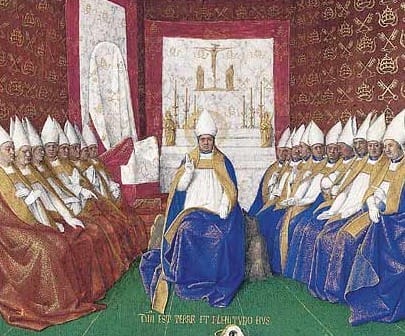
And firstly there comes before us, on the very morrow of the day consecrated to the Baptism of Jesus, the faithful and courageous Hilary—the pride of the Churches of Gaul, and the worthy associate of Athanasius and Eusebius of Vercelli in the battle fought for the Divinity of our Emmanuel. Scarcely were the cruel persecutions of paganism over, when there commenced the fierce contest with Arianism, which had sworn to deprive of the glory and honours of his divinity that Jesus who had conquered, by his Martyrs, the violence and craft of the Roman Emperors. The Church had won her liberty by shedding her blood, and it was not likely that she would be less courageous on the new battlefield into which she was driven. Many were the Martyrs that were put to death by her new enemies—Christian, though heretical, Princes: it was for the Divinity of that Lord, who had mercifully appeared on the earth in the weakness of human flesh, that they shed their blood. Side by side with these stood those holy and illustrious Doctors, who, with the martyr-spirit within them, defended by their learning and eloquence the Nicene Faith, which was the Faith of the Apostles. In the foremost rank of these latter we behold the Saint of to-day, covered with the rich laurels of his brave confessorship, Hilary: who, as St Jerome says of him, was brought up in the pompous school of Gaul, yet had culled the flowers of Grecian science, and became the Rhone of Latin eloquence. St Augustine calls him the illustrious Doctor of the Churches.
Though gifted with the most extraordinary talents, and one of the most learned men of the age, yet St Hilary's greatest glory is his intense love for the Incarnate Word, and his zeal for the liberty of the Church. His great soul thirsted after martyrdom, and, by the unflinching love of truth which such a spirit gave him, he was the brave champion of the Church in that trying period when Faith, that had stood the brunt of persecution, seemed to be on the point of being betrayed by the craft of Princes, and the cowardice of temporizing and unorthodox Pastors.
Let us listen to the short Life of our Saint, contained in the Lessons of his Office.
The ancient Gallican Liturgy, of which a few precious remnants have been handed down to us, thus celebrated the praise of the most illustrious of the Bishops of that great country. Our first extract is an Allocution addressed to the Faithful, taken from an ancient Sacramentary.
Allocution
This Preface, which extols the virtues and the miracles of St Hilary, was sung in the Church of Gaul, even after the introduction of the Roman Liturgy.
Preface
The following prayer has been culled out of several old manuscript missals.
Prayer
The Church of Poitiers has ever cherished with the utmost devotion the memory of her heroic Pontiff, and his Feast, as we may suppose, is kept there with great solemnity. She formerly sang in the Mass of this day the Preface of the Blessed Trinity, to express more forcibly her admiration of the zeal wherewith Hilary defended the master-dogma of our holy faith—the mystery of Three Persons in one God. It will be interesting to our readers to hear a few passages from the ancient liturgical books of this illustrious Church of Poitiers. The following Responsories are taken, in part, from the Life of the Saint, and were composed by St Venantius Fortunatus, one of St Hilary's successors.
Responsories
The same venerable Church of Poitiers sings these two Hymns in honour of her glorious Saint. They were composed by the pious Simon Gourdan, a Canon Regular of Saint Victor’s Abbey, that celebrated House in Paris where Adam of Saint-Victor wrote his admirable Sequences.
Hymn
Gallos addiderit Christianum gregi,
Quis par Hilario? quis generosius
Natum de Patre vindicat?
Dotes innumeras plebs sacra concinat:
Laus suprema fides, qua genitum
Deo Altis vocibus asserit.
Clara fronte micans infula nobilis,
Curis mille litat: martyrii decus
Supplet continuus labor.
Frustra tartareus concutit hanc furor;
Hic oris gladio fulgurat aureo,
Vastantes abigens lupos.
Quas post longa metit prælia laureas!
Te, Martine, docet quam pede strenuo
Virtutum rapias viam.
Fœcundo generat quem Pater in sinu,
Æquum Principio, numine comparem:
Sacro maxima Flamini.
united Gaul to the flock of Christ,
who is there that can be compared to Hilary?
who is there that ever defended more zealously than he the Son of the Eternal Father?
his majestic eloquence, and his innumerable gifts;
but his grandest praise is the faith wherewith he
so loudly proclaimed Christ to be the Son of God.
was not, indeed, purpled with the blood of martyrdom;
his sacrifice was that of a thousand cares,
and his ceaseless labours supply for the beauty of martyrdom.
which the fury of hell sought in vain to destroy.
The golden sword which came so brightly from his mouth
drives away the ravenous wolves.
How fair the laurels he reaped in the long campaigns for Christ!
He taught thee, O Martin!
to walk with vigour in the path of virtue.
begotten in the fruitful bosom of the Father;
to the Son, who is equal to the Father, and God like him.
To the Divine Spirit, too, be there infinite praise!
Hymn
Athletam quatiunt: jussa tyrannidis
Explens, Pastor oves linquere cogitur;
Quis jam contineat lupos?
Te parere facit, Gallia lacrymas
Fundat: terra Phrygum suscipiens patrem,
Verbi vindice gaudeat.
Spargit luce nova, fonteque vivido
Expurgat nocuis pascua fæcibus.
Gentes erudit efferas.
Pastores: redeunt mox ad ovilia,
Quos error timidos abstulerat procul,
Et vocem Patris audiunt.
Solem justitiæ cominus adspicis;
Verbum nos doceat, quæsumus, impetra.
Cujus dogmata prædicas.
Qui terram sapiunt: Cæsaris haud timet
Infensi furias pastor, et asserit
Christi liberius fidem.
Fœcundo generat quem Pater in sinu,
Æquum Principio, numine comparem:
Sacro maxima Flamini.
can move this highminded soldier of Christ.
He obeys the sentence of the tyrant, and the flock is deprived of its Shepherd
—oh! who will now defend them from the wolves?
makes thee submit to the sentence, but Gaul sheds floods of tears.
Phrygia receives thee on her land, happy to possess
the champion of the Word Incarnate.
and with a stream of living water
cleanses the pastures of the flock from all impurities.
Barbarous nations receive instruction at his hands.
then sends them back to the flocks they had,
in timid compromise to error, abandoned;
and thus the children hear their Father’s voice again.
seest the Sun of Justice face to face;
pray for us, we beseech thee, that he, the Incarnate Word,
whose nature thou didst preach to men, may teach us all truth.
fear if they will an Emperor’s tyranny:
Hilary heeds not the passion of an angry Cæsar,
but preaches, with holy liberty, the faith of Christ.
begotten in the fruitful bosom of the Father,
to the Son, who is equal to the Father, and God like him.
To the Divine Spirit, too, be there infinite praise!
Thus did the holy bishop, Hilary of Poitiers, receive the honours of the Church's love for his having so courageously, and even at the peril of his life, fought in defence of the great Mystery. Another of his glories is that he was one of the most intrepid champions of that principle, which cannot be compromised without the vitality and very existence of the Church being endangered—the principle of that Church’s liberty. A few days ago we were celebrating the Feast of our holy Martyr, St Thomas of Canterbury; to-day, we have the Feast of the glorious Confessor, whose example enlightened and encouraged him in the great struggle. Both Hilary and Thomas a Becket were obedient to the teaching left to the Pastors of the Church by the Apostles; who, when they were arraigned the first time before the authorities of this world, uttered this great maxim: We ought to obey God rather than men.* The Apostles and the Saints were strong in the battle against flesh and blood, only because they were detached from earthly goods, and were convinced that the true riches of a Christian and a Bishop consist in the humility and poverty of the Crib, and that the only victorious power is in the imitation of the simplicity and the weakness of the Child that is born unto us. They relished the lessons of the School of Bethlehem; hence no promise of honours, of riches, or even of peace, could make them swerve from the principles of the Gospel.
How dignified is this family of Soldiers of Christ, which springs up in the Church! If the policy of tyrants, who insist on being Christians without Christianity, carry on a persecution in which they are determined that no one shall have the glory of Martyrdom—these brave Champions raise their voice and boldly reproach the persecutors for their interference with that liberty which is due to Christ and his Ministers. They begin by telling them their duty, as Hilary did to Constantius, when he sent him his first Memorial: 'My Lord and most gracious Augustus! Your admirable prudence will tell you that it is unreasonable and impossible either to force submission on men who resist you with all their strength, or to compel them to take part with the sowers of the seed of false doctrine. The one end of your endeavours, wise counsels, government and vigilance should be that all your subjects may enjoy the sweets of liberty. There is no other means of settling the troubles of the state, or of uniting what discord has separated, than that every one be master of his own life, unconstrained by slavish compulsion. You should not turn a deaf ear to the voice of any subject who thus appeals to you for support: “I am a Catholic; I will not be a heretic: I am a Christian, and not an Arian: I would rather lose my life than allow the tyranny of any man to corrupt the purity of my faith.”'
When some people spoke to Hilary in favour of those who had been traitors to the Church, and had been disloyal to Jesus Christ, in order to keep in the good graces of the Emperor, they ventured to tell the Saint that their conduct was justifiable, on the ground that they had but obeyed the Law! The holy Pontiff was indignant at this profanation of the word, and, in his Book against Auxentius, courageously reminds his fellow Bishops of the origin of the Church: how her very establishment depended on the breaking of unjust human laws, and how she counts it one of her glories to infringe all such laws as would oppose her existence, her development, and her action.
We have a contempt for all the trouble that men of these days are giving themselves; and I am grieved to see them holding such mad opinions as that God needs man's patronage, and that the Church of Christ requires to be upheld by an ambition that curries favour with the world. I ask of you Bishops, what favour did the Apostles court, in order that they might preach the Gospel? Who were the princes that helped them to preach Christ, and convert almost the whole world from idolatry to God? Did they, who sang hymns to God in prisons and chains, and whilst bleeding from being scourged—did they accept offices from the state? Did Paul wait for a royal permission to draw men to the Church of Christ? Did he, think you, cringe for the patronage of a Nero, or a Vespasian, or a Decius, whose very hatred of our faith was the occasion of its being more triumphantly preached? These Apostles, who lived by the labour of their own hands, who assembled the Faithful in garrets and hiding-places, who visited villages and towns, and wellnigh the whole world, travelling over sea and land, in spite of the Senate's decrees and Imperial Edicts—these men, according to your principles, had not received the keys of the kingdom of heaven! What say you to all this manifestation of God's power in the very face of man's opposition, when the more there was a prohibition to preach Christ, the more that preaching was exercised?
But the time came at last to speak to the Emperor himself, and to protest against the system whereby he aimed at making the Church a slave; then did Hilary, who was exceedingly gentle in disposition, put on that holy indignation which our Lord himself had, when he scourged the profaners of his Father's House, and drove them out of the Temple. He braved every danger, and held up to execration the system invented by Constantius for insulting and crushing the Church of Christ. Let us listen to the language of his apostolic zeal.
The time for speaking is come, the time for silence is past. Let Christ now appear, for Antichrist has begun his reign. Let the Shepherds give the alarm, for the hirelings have fled. Let us lay down our lives for our sheep, for thieves have got into the fold, and a furious lion is prowling around it. Let us prepare for martyrdom . . ., for the angel of satan hath transformed himself into an angel of light . . . .
Why, O my God, didst thou not permit me to confess thy holy Name, and be the minister of thine Only Begotten Son, in the times of Nero or Decius? Full of the fire of the Holy Spirit, I would not have feared the rack, for I would have thought of Isaias, how he was sawn in two. I would not have feared fire, for I would have said to myself that the Hebrew Children sang in their fiery furnace. The cross and the breaking of every bone of my body should not have made me a coward, for the good thief would have encouraged me, who was translated into thy kingdom. If they had threatened to drown me in the angry billows of the deep ocean, I would have laughed at their threats, for thou hast taught us, by the example of Jonas and Paul, that thou canst give life to thy servants even in the sea.
Happy I, could I thus have fought with men who professed themselves to be the enemies of thy name; every one would have said that they who had recourse to tortures, and sword, and fire, to compel a Christian to deny thee, were persecutors; and my death would have been sufficient testimony to thy truth, O God! The battle would have been an open one, and no one would have hesitated to call by the honest name these men that denied thee, and racked and murdered us; and thy people, seeing that it was an evident persecution, would have followed their Pastors in the confession of their faith.
But nowadays, we have to do with a disguised persecutor, a smooth-tongued enemy, a Constantius who has put on Antichrist; who scourges us, not with lashes, but with caresses; who instead of robbing us, which would give us spiritual life, bribes us with riches, that he may lead us to eternal death; who thrusts us not into the liberty of a prison, but into the honours of his palace, that he may enslave us; who tears not our flesh, but our hearts; who beheads not with a sword, but kills the soul with his gold; who sentences not by a herald that we are to be burnt, but covertly enkindles the fire of hell against us. He does not dispute with us, that he may conquer; but he flatters us, that so he may lord it over our souls. He confesses Christ, the better to deny him; he tries to procure a unity which shall destroy peace; he puts down some few heretics, so that he may also crush the Christians; he honours Bishops, that they may cease to be Bishops; he builds up Churches, that he may pull down the Faith . . . .
Let men talk as they will, and accuse me of strong language, and calumny: it is the duty of a minister of the truth to speak the truth. If what I say be untrue, let me be branded with the name of an infamous calumniator: but if I prove what I assert, then I am not exceeding the bounds of apostolic liberty, nor transgressing the humility of a successor of the Apostles by speaking thus, after so long observing silence . . . . No, this is not rashness, it is faith; it is not inconsiderateness, it is duty; it is not passion, it is conscience.
I say to thee, Constantius, what I would have said to Nero, or Decius, or Maximian: You are fighting against God, you are raging against the Church, you are persecuting the saints, you are hating the preachers of Christ, you are destroying religion, you are a tyrant, not in human things, but in things that appertain to God. Yes, this is what I should say to thee as well as to them; but listen, now, to what can only be said to thyself: Thou falsely callest thyself a Christian, for thou art a new enemy of Christ; thou art a precursor of Antichrist, and a doer of his mystery of iniquity; thou, that art a rebel to the faith, art making formulas of faith; thou art intruding thine own creatures into the sees of the Bishops; thou art putting out the good and putting in the bad.... By a strange ingenious plan, which no one had ever yet discovered, thou hast found a way to persecute, without making Martyrs.
We owe much to you, Nero, Decius, and Maximian! your cruelty did us service. We conquered the devil by your persecutions. The blood of the holy Martyrs you made has been treasured up throughout the world, and their venerable relics are ever strengthening us in faith by their mute unceasing testimony . . . . But thou, Constantius, cruel with thy refinement of cruelty, art an enemy that ragest against us, doing us more injury, and leaving us less hope of pardon . . . . Thou deprives!: the fallen of the excuse they might have had with their Eternal Judge, when they showed him the scars and wounds they had endured for him, for perhaps their tortures might induce him to forgive their weakness. Whereas thou, most wicked of men! thou hast invented a persecution which, if we fall, robs us of pardon, and, if we triumph, does not make us Martyrs!
. . . We see thee, ravenous wolf, under thy sheep's clothing. Thou adornest the sanctuaries of God's temples with the gold of the State, and thou offerest to him what is taken from the temples, or taxed by edict, or extorted by penalty. Thou receivest his Priests with a kiss like that which betrayed Christ. Thou bowest down thy head for a blessing, and then thou tramplest on our Faith. Thou dispensest the clergy from paying tributes and taxes to Cæsar, that thou mayest bribe them to be renegades to Christ, foregoing thy own rights, that God may be deprived of his!
Glorious Hilary! thou didst well deserve that thy Church of Poitiers should, of old, address to thee the magnificent praise given by the Roman Church to thy illustrious disciple, St Martin: 'O blessed Pontiff! who with his whole heart loved Christ our King, and feared not the majesty of emperors! O most holy soul! which, though not taken away by the sword of the persecutor, yet lost not the palm of martyrdom!' If the Palm of a Martyr is not in thy hand, yet hadst thou a Martyr's spirit, and well might we add to thy other titles, of Confessor, Bishop, and Doctor, the glorious one of Martyr, just as our holy Mother the Church has conferred it upon thy fellow-combatant, Eusebius, who was but Martyr in heart like thyself. Yes, thy glory is great; but it is all due to thee for thy courage in confessing the Divinity of that Incarnate Word, whose Birth and Infancy we are now celebrating. Thou hadst to stand before a Herod, as had the Magi, and like them thou hadst no fear: and when the Cæsar of those times banished thee to a foreign land, thy soul found comfort in the thought that the Infant Jesus, too, was exiled into Egypt. Oh! that we could imitate thee in the application of these Mysteries to ourselves!
Now that thou art in heaven, pray for our Churches, that they may be firm in the Faith, and may study to know and love Jesus, our Emmanuel. Pray for thy Church of Poitiers, which still loves thee with the reverence and affection of a child; but since the ardour of thy zeal embraced all the world, pray also for all the world. Pray that God may bless his Church with Bishops powerful in word and work, profound in sacred science, faithful in the guardianship of that which is entrusted to them, and unswerving defenders of ecclesiastical liberty.
* Acts v 29. ↩︎
January 14 (the Same Day): St. Felix, Priest and Martyr
ENCIRCLED by the radiant splendours of the Epiphany, there comes before us to-day, in company with Hilary of Poitiers, a humble lover of the virtues of the Crib of our Emmanuel. Though withdrawn by God himself from the fury of his persecutors, and thus from a martyr's death which would have crowned his cruel torments and imprisonment, Felix nevertheless has won the right to his palm by the invincible courage he showed amidst all his sufferings. In heaven he was already accounted worthy of his reward, but he was yet for a long time to gladden and strengthen the Church on earth by those examples of wonderful poverty, humility, and ardent charity, which now claim for him a place in the sacred cycle near to the lowly manger of the King of Peace.
The Infant God, in all his hidden lowliness, was to Felix his one love and exemplar, hence to-day this King of angels and men who is now manifested to the world and adored by kings, hastens to share with him the honours of his triumphant Epiphany. To him that shall overcome, I will give to sit with me in my throne, saith the Lord (Apoc. iii 21), and in whom, other than Felix, has the realization of this blessed promise of the Divine Head to his members been more apparent? A poor tomb received the mortal remains of the humble priest of Campania, and in its silence and obscurity, emblems of his earthly desires, he seemed destined to await the blast of the angel's trumpet at the final Resurrection. But miracles, many and great, suddenly rendered this tomb illustrious; the name of Felix was carried far and wide, and everywhere wrought the like prodigies of grace. Hardly had peace been given to the Church and world by the accession of Constantine to the throne, when on all sides the people were aroused, and in countless flocks thronged to the martyr's tomb; on certain days Rome herself seemed deserted, and the ancient Appian Road, the very soil of which was worn away by the tramp of the pilgrims, appeared to have no other purpose than to carry to the feet of Felix the homage, gratitude, and love of the entire world. Five basilicas did not suffice for the immense concourse; a sixth was erected, and the lowly field where once the remains of the martyr lay hid was encircled by a new town. The fourth century, so rich in Christian developments, saw the beginning of pilgrimages, and the city of Nola in Campania was, after Rome, the principal centre of this devotion. ‘O happy city of Nola,' cries a contemporary, eyewitness of these wonders, ‘O happy city which through the merits of the blessed Felix has become second only to Rome herself, Rome ever the mistress, yesterday by her empire and victorious armies, to-day by the tombs of the Apostles! ' We have cited Paulinus, the illustrious consul whose name is inseparably linked with that of Felix, Paulinus whom we shall find, in the time after Pentecost, through the inspiration of the Holy Ghost, giving also admirable examples of renunciation to the world. In the flower of a brilliant youth and already surrounded by honours and glory, Paulinus once found himself by the tomb of Felix—here it was given to him to understand true greatness, to realize the emptiness of human ambitions and glory. The Roman Senator, the consul, the descendant of Paulus Amelius and of the Scipios, here vowed himself to Felix who had conquered. Riches, honours, country, he sacrificed all and aspired only to dwell near to this tomb. A poet of no small merit, whose talents had already won applause in Rome, his inspiration now found expression in singing the praises of the blessed Felix on his feast day and in proclaiming himself the slave and humble doorkeeper of the servant of Christ. Such then is the triumph of our Emmanuel in his saints, such is the glory of his members—does it not seem that the Divine Head, mindful of his promises, is desirous only of the glory which this feast of Manifestation brings, so that they, enthroned with him, may also receive the homage of peoples and kings?
Let us listen now to the abridged lesson of the life of our saint which the Church puts before us to-day.
O Felix, this day is the twentieth since the birth of our Emmanuel, the new sun, the vanquisher of cold and frosts, the restorer of light, the conqueror of darkness. His splendour is yours. Grant that, warmed by his life-giving rays, we may, like you, ever grow in him. Having become children once more at the crib, we possess within us the Seed of the Word; may the innocence of a new heart cause it ever to fructify. By you, Christ’s yoke becomes light to the weak, by you the Infant God is touched with pity and turns in love to penitent souls. This day, then, which witnesses your heavenly birth, should be dear to us, for we too die to the world and are born to our Emmanuel.
January 14 (the Same Day): St. Kentigern, Bishop and Confessor
ST KENTIGERN, whose feast is kept to-day in several dioceses of the North of England and in Scotland, stands out as one of the zealous monks of the sixth century who laboured incessantly for the conversion of the inhabitants of these islands. He was brought up in the monastery at Culross from early childhood, and was thus trained from his youth in all the practices of monastic observance. However, when he reached man's estate, feeling called to a more rigorous manner of life, he left Culross and took up his abode in a solitude in the neighbourhood of Glasgow, where he led a most mortified life, eating but once in three or four days, spending the night in prayer, and wearing a garment of haircloth. This manner of life gave the greatest edification to all who came in contact with him, and his virtue was such that at the age of twenty-five he was elected to the bishopric of Glasgow. He had grave misgivings as to the validity of his ordination on account of his age, but was forced to bow before the importunities of those who had chosen him for their pastor. He ruled his vast diocese, which was bordered by the North Sea on the east and by the Atlantic Ocean on the west, with wisdom and prudence, though his manner of living remained unchanged, and, moreover, each Lent it was his custom to retire into solitude, giving himself entirely to prayer and living upon roots and herbs. He was assiduous in visiting his flock, travelling always on foot, and the force of his preaching together with the mildness and sweetness of his character and the asceticism of his life was the means whereby innumerable pagans were brought into the Church and many Pelagian heretics converted to the true Faith. This devoted prelate was the father of many monks, a great number of whom he sent to evangelize the north of Scotland, the Orkney Isles, and even Norway and Iceland.
The enemy of mankind, however, would not suffer so many souls to be snatched from his grasp without molestation, and he caused the royal family to raise such a bitter persecution against the saint that he was forced to leave the country. He took refuge in Wales, first at Caerleon, now Usk, where he built a church, then with St David, and finally he settled at the junction of the Rivers Elwy and Cluid, where he built a monastery, now known as St Asaph's. One of the princes of the country opposed this undertaking, whereupon he was struck with blindness, but was cured by the intercession of St Kentigern and thereafter became his great benefactor.
The great crime committed against St Kentigern in Scotland was not permitted to remain unpunished. All those who had persecuted the saint were visited by the just vengeance of Almighty God, and a prince, virtuous and loyal to the Church, ascended the throne, and his first act was to recall St Kentigern, who returned bringing with him some monks from St Asaph's. In 593 the Saint visited Pope St Gregory the Great and unburdened his soul of the doubts he had always held regarding his ordination. The supreme Pontiff set his mind at rest, and confirming him in office sent him back to his see, which he governed in peace for eight years more. On January 13, 601, he was called to his eternal reward at the advanced age of eighty-five, and was buried in his Cathedral Church at Glasgow.
The following is an abridgement of the account given of St Kentigern in the Breviary lessons for his feast.
| Previous January 13: The Octave of the Epiphany | Next January 14: St. Hilary, Bishop, Confessor, and Doctor of the Church |