Daily reading
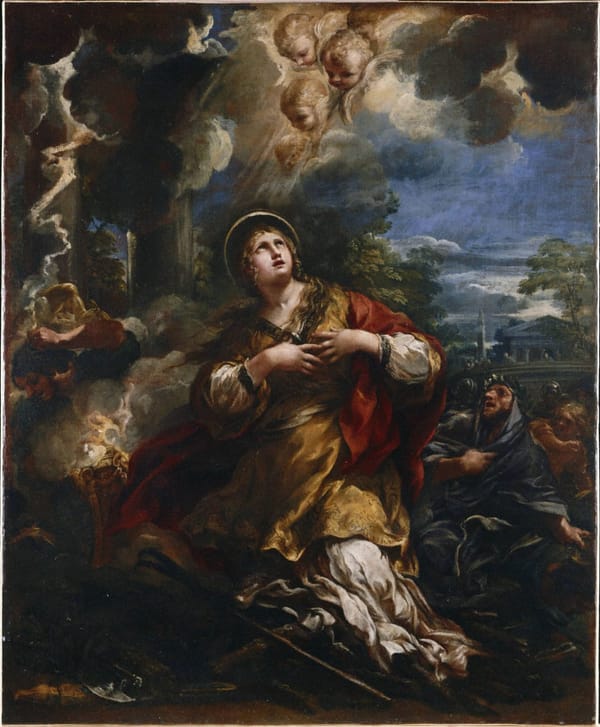
January 30: St. Martina, Virgin and Martyr
A FOURTH Roman Virgin, wearing on her brow a martyr’s crown, comes today to share the honours given to Agnes, Emerentiana, and Prisca, and offer her palm to the Lamb. Her name is Martina, which the pagans were wont to give to their daughters in honour of their god of war. Her sacred relics repose at the foot of the Capitoline hill, in the ancient temple of Mars, which has now become the beautiful Church of Saint Martina. The holy ambition to render herself worthy of him whom she had chosen as her divine Spouse, gave her courage to suffer torments and death for his sake; so that of her, as of the rest of the martyrs, we may say those words of the Liturgy, washed her robes in the Blood of the Lamb. Our Emmanuel is the Mighty God,1 the Lord that is mighty in war,2 not, like the Mars of the pagans, needing the sword to win his battles. He vanquishes his enemies by meekness, patience, and innocence, as in the martyrdom of today’s Saint, whose victory was grander than was ever won by Rome’s boasted warriors.
This illustrious Virgin, who is one of the Patrons of the City of Rome, is honoured by having her praises sung by one of the Popes. It was Urban the Eighth who wrote the Hymns which are recited on her feast, and which we subjoin to the Lessons which recount the glorious combats of our Saint.
We unite into one the three hymns of Urban the Eighth, in which the holy Church prays for the deliverance of Jerusalem. It is the last cry of the Crusades.
Hymn
Cives Romulei, plaudite gloriæ:
Insignem meritis dicite Virginem,
Christi dicite Martyrem.
Inter delicias, inter amabiles
Luxus illecebras, ditibus affluit
Faustæ muneribus domus.
Se rerum Domino, et munifica manu
Christi pauperibus distribuens opes,
Quærit præmia cœlitum.
Non virgæ horribili vulnere commovent :
Hinc lapsi e Superum sedibus Angeli
Cœesti dape recreant.
Se rictu placido projicit ad pedes;
Te, Martina, tamen dans gladius neci
Cœli coetibus inserit.
Quæ fumat, precibus jugiter invocat,
Et falsum perimens auspicium, tui
Delet nominis omine.
Da pacis requiem Christianum plagis;
Armorum strepitus, et fera prælia
In fines age Thracios.
Vexillo, Solymas nexibus exime,
Vindexque innocui sanguinis hosticum
Robur funditus erue.
Nostrarum obsequium respice mentium :
Romæ vota libens excipe, quæ pio
Te ritu canit, et colit.
Tu, qui Martyribus dexter ades, Deus
Une, et Trine, tuis da famulis jubar,
Quo clemens animos beas.
of the glorious Martina.
Sing the praises of this admirable Virgin
and Martyr of Christ.
and was brought up in every delicacy,
surrounded by all that could pamper nature,
and with riches of a princely house at her command.
dedicates herself to the Creator of all things,
and with a liberal hand distributes her riches to the poor of Christ,
that she may gain the riches of heaven.
or the cruel wound-inflicting rods.
Angels descend from heaven,
comforting her with divine food.
and tamely come crouching at her feet.
The sword, Martina! gave thee the wished-for death,
and death united thee to the choirs of heaven.
where clouds of incense shroud devotion's love;
and thy blessed name banishes
that of the false deity Mars.
and give to Christian countries the rest of holy peace,
driving unto Thracian coasts
the din of arms and war.
deliver Jerusalem from her chains.
Avenge innocent blood,
and once for all crush down the Turkish foe,
see this homage of our loving hearts.
Hear the prayers of thy Rome,
which on this festive day offers thee its hymns and reveres thy name.
take from us the pleasures which would make us fall.
O Triune God! give to thy servants the blessed light,
wherewith thy mercy crowns the soul with bliss.
Thus does Christian Rome hymn thy praises, O generous Martyr! and whilst praising, begs thee to protect her with thy loving care. She is safe from danger, if shielded by such watchfulness as thine. Hear her prayers, and drive far from the Holy City the enemies that would plot her ruin. She has foes more to be dreaded than they that attack her walls with the cannon of their fierce artillery; she has them who plot the destruction of her independence. Disconcert these plans of perfidy, and remember, O Martina! that the City which now asks thy aid was the mother that trained thee to be a martyr.
Obtain for us from Jesus, thy Spouse, the courage to destroy those idols of our affections, to which we are so prone to offer the sacrifice of our hearts. The enemies of our salvation are untiring in their attacks upon our frailty; oh! stretch out to us thy helping hand; that hand which made the idols of Rome tremble, is not less powerful now to stay the violence of the world that threatens to destroy our souls. Thy own brave combats have given thee a place of honour near our Redeemer’s Crib: if, like thee, we will but resist and conquer, this Mighty God will welcome us, too, and bless us. He came into this world that he might vanquish our enemies, but he requires of us to share with him the toils of the battle. Pray for us, O Martina! that our confidence in God may ever be accompanied by diffidence in ourselves, and we shall never be cowards in the great contest for heaven!
Tuesday of Septuagesima Week
The serpent’s promises had stifled, in Eve’s heart, every sentiment of love for the God that had created her and loaded her with blessings: she is ambitious to be God like Him! Her faith, too, is wavering; she is not sure that God may not have deceived her, by threatening her with death should she disobey His command. Flushed by pride, she looks up to the forbidden fruit; it seems good to eat, and it is fair to her eyes.* So that her senses too conspire against God, and against her own happiness. The sin is already committed in her heart; it needs but a formal act to make it complete. She cares for nothing but self; God is no more heeded than if He did not exist. She stretches forth her daring hand; she plucks the fruit; she puts it to her mouth, and eats!
God had said that if she broke His commandment she should die; she has eaten, she has sinned, and yet she lives as before! Her pride exults at this triumph, and, convinced that she is too strong for God’s anger to reach her, she resolves on making Adam a partner in her victory. Boldly she hands him the fruit, which she herself has eaten without any evil coming to her. Whether he was emboldened by the impunity of his wife’s sin, or, from a feeling of blind affection, wished to share the lot of her who was the 'flesh of his flesh and bone of his bones,’ our first father, also, forgets all he owes to his Creator, and, as though there had never been aught of love between him and his God, he basely does as Eve suggests: he eats of the fruit, and by that act ruins himself and all his posterity.
No sooner have they broken the tie which united them with God, than they sink into themselves. As long as God dwells in the creature, whom He has raised to the supernatural state, his being is complete; but, let that creature drive his God away from himself by sin, and he finds himself in a state worse than nothing—the state of evil. That soul which, a moment before, was so beautiful and pure, is a hideous wreck. Thus is it with our first parents: they stand alone; creatures without God; and an intolerable shame seizes them. They thought to become gods, they aspired at infinite being; see them now:—sinners, the prey of concupiscence. Hitherto, their innocence was their allsufficient garb; the world was obedient to them; they knew not how to blush, and there was nothing to make them fear; but now, they tremble at their nakedness, and must needs seek a place wherein to hide!
The same self-love that had worked their ruin, had made them forget the greatness and goodness of God, and despise His commandment. Now that they have committed the great sin, the same blindness prevents them from even thinking of confessing it, or asking the forgiveness of the Master they have offended. A sullen fear possesses them. They can think of nothing but how and where to hide!
In Dominica Tyrophagi
* Gen. iii. 6. ↩︎
| Previous Monday of Septuagesima Week | Next Tuesday of Septuagesima Week |