Daily reading
Septuagesima
Double · February 1 · Sanctoral
February 1, 2024
From Dom Guéranger’s The Liturgical Year.
A Double leads the weekday.Rubric
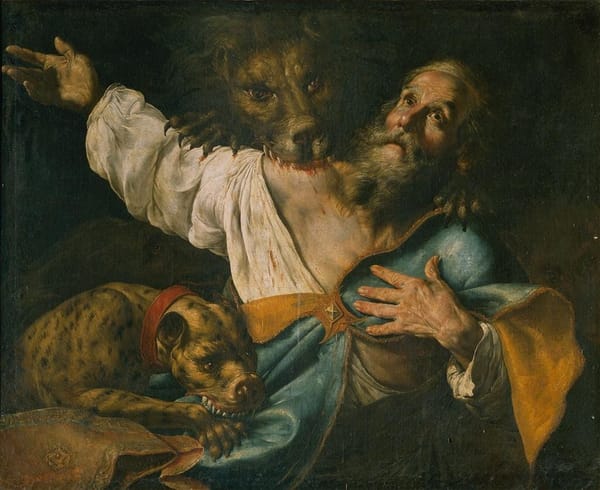 |
February 1: St. Ignatius, Bishop and Martyr
TWO days more, and the happy season of Christmas will be over! This is the vigil of its termination, and lo! there comes to gladden us one of the grandest Martyrs of the year—Ignatius surnamed the Theophorus,1 Bishop of Antioch. A venerable tradition tells us that this old man, who so generously confessed the faith before Trajan, was the child whom Jesus took into his arms, and showed to his Disciples as a model of that simplicity which we must all have if we would enter into the kingdom of heaven. Today he appears before us, standing near the Crib in which this same Jesus gives us his own divine lessons of humility and simplicity.
But, in this the Court of our Emmanuel, Ignatius stands near to Peter, the Feast of whose Chair we kept a few days since; for the Prince of the Apostles made him his second successor in his first See of Antioch. From so honoured a position Ignatius derived that courage which made him resist a powerful Emperor even to his face, defy the wild beasts of the amphitheatre, and triumph by a glorious martyrdom. As it were to show the supremacy of the See of Rome, Divine Providence willed that he, with his chains upon him, should go to see Peter,2 and finish his course in the Holy City, and thus mingle his blood with that of the Apostles. Rome would have been imperfect without the glory of Ignatius’ martyrdom, which is the pride of her Coliseum, rich as it is with the blood of so many thousands of martyrs.
His chief characteristic is impetuous love for God. He has but one fear—it is that the prayers of the Romans will stay the lions from devouring him, and his desire of being united to Christ be thus denied him. Let us admire this superhuman fortitude, which shows itself thus suddenly in the pagan world, and let us acknowledge that so ardent a love of God, and so vehement a longing to possess him, could only have come from the accomplishment of the Mysteries of our Redemption, which showed man how much God loved him. The Crib of Bethlehem, even had there never been the Sacrifice of Calvary, would of itself be sufficient to convince us of all this. God comes down from heaven for the sake of his creature, man; he himself becomes Man, nay, a Child, and is laid in a manger! Such miracles of love would have sufficed to save the guilty world; how then shall they not have power to prompt men to give their whole heart to their loving God? And would it be too much if we made a sacrifice of our very lives to repay Jesus for only that much of his love which he showed us by being born among us?
The Church gives us, in the Lessons of today's Office, the brief account of our Saint given by St Jerome in his Book On Ecclesiastical Writers. The holy Doctor has inserted a few sentences from the Martyr's admirable Epistle, written to the Faithful of Rome. We would have gladly offered the whole of this Epistle to our readers, had it not been for want of space. But the passages quoted by St Jerome are some of the finest.
We find the following stanzas in the Menæa of the Greek Church, for the Feast of St Ignatius.
All thy desires were satisfied, O glorious Martyr! Thou hast died for Jesus—thou art with Jesus. Rome's sons and daughters filled the Coliseum; their savage joy made it tremble with their cheers as they saw thee mangled by the lions. It was the hour thou hadst prayed for; thy sacrifice for him, who had sacrificed himself for thee, is over, and thy soul is buried in his divine embrace! Generous and impetuous lover of Christ! thou wast ambitious to pay thy debt to the Crucified—the debt of suffering. It seemed to thee that thou hadst no right to his kingdom until thou hadst repaid his Passion by some cruel tortures endured for him. O worthy companion of Stephen, Sebastian, Vincent and Agnes I how rich and verdant is the palm thou holdest over the Crib! Canst thou look upon us, weak Christian cowards, and not pity us? Pray for us that we may at least be faithful to our Lord when we are persecuted by the temptations of the world, the flesh and the devil; that we may at least give our hearts to his service, if we are not to be permitted to give our bodies to be tortured for his name. Thou wast chosen, when a little child, as the model of the simplicity which our Saviour was teaching to his Disciples, and this innocence never left thee: ask for us from him, who is the King of Little Children, that one of the graces of the Christmas we have been keeping may be this holy Simplicity of heart.
Successor of Peter in the See of Antioch! pray for the Churches of thy Patriarchate, that they may return to the true Faith and Catholic unity. Intercede for the holy City of Rome, which thou didst water with thy blood, and which is now in possession of thy sacred relics, that were saved from the lions’ jaws. Watch over the maintenance of ecclesiastical discipline and order, of which thou hast left such admirable rules in thy Epistles; and obtain for the Church that all the members of her hierarchy may be united in the bonds of duty and love, that thus she may be beautiful in the strength of her unity and terrible to the enemies of God, as an army set in array.3
Thursday of Septuagesima Week
Forgiveness is promised; but atonement must be made. Divine justice must be satisfied, and future generations be taught that sin can never pass unpunished. Eve is the guiltier of the two, and her sentence follows that of the serpent. Destined by God to aid man in peopling the earth with happy and faithful children, formed by this God out of man’s own substance 'flesh of his flesh, and bone of his bones,’ woman was to be on an equality with man. But sin has subverted this order, and God’s sentence is this: conjugal union, notwithstanding the humiliation of concupiscence now brought upon it, is to be, as before, holy and sacred; but it is to be inferior in dignity, before both God and man, to the state of virginity, which disdains the ambitions of the flesh.
Secondly, woman shall be mother still, as she would have been in the state of innocence; but her honour shall be a burden. Moreover, she shall give birth to her children amidst cruel pains, and sometimes even death must be the consequence of her infant’s coming into the world. The sin of Eve shall thus be memorialized at every birth, and nature shall violently resist the first claims of him, whom sin has made her unwelcome lord.
Lastly, she who was at first created to enjoy equality of honour with man, is now to forfeit her independence. Man is to be her superior, and she must obey him. For long ages, this obedience will be no better than slavery; and this degradation shall continue till that Virgin comes, whom the world shall have expected for four thousand years, and whose humility shall crush the serpent’s head. She shall restore her sex to its rightful position, and give to Christian woman that influence of gentle persuasiveness, which is compatible with the duty imposed upon her by divine justice, and which can never be remitted: the duty of submission.
In Dominica Tyrophagi
| Previous Wednesday of Septuagesima Week | Next Thursday of Septuagesima Week |