Daily reading
Lent
Double · March 9 · Sanctoral
March 9, 2024
From Dom Guéranger’s The Liturgical Year.
A Double leads the weekday.Rubric
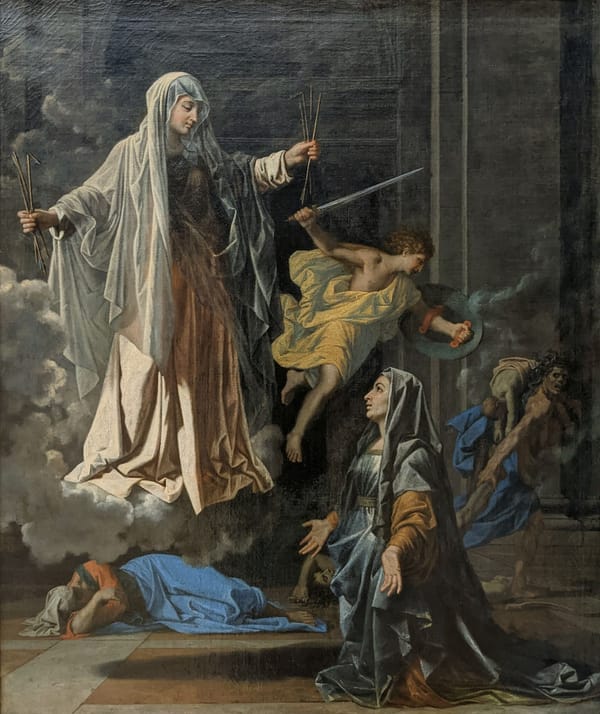 |
March 9: St. Frances of Rome, Widow
The period intervening between the Purification of our blessed Lady and Ash Wednesday (when it occurs at its latest date), gives us thirty-six days; and these offer us feasts of every order of saint. The apostles have given us St. Mathias, and St. Peter’s Chair at Antioch; the martyrs have sent us, from their countless choir, Simeon, Lucius, Blase, Valentine, Faustinus and Jovita, Perpetua and Felicitas, and the forty soldiers of Sebaste, whose feast is kept to-morrow; the holy pontiffs have been represented by Titus, Andrew Corsini, and also by Cyril of Alexandria and Peter Damian, who, like Thomas of Aquin, are doctors of the Church; the confessors have produced Romuald of Camaldoli, John of Matha, John of God, the Seven Founders of the Servites, and the angelic prince Casimir; the virgins have gladdened us with the presence of Agatha, Dorothy, Apollonia, and Scholastica, three wreathed with the red roses of martyrdom, and the fourth with the fair lilies of the enclosed garden* of her Spouse; and lastly, we have had a penitent saint, Margaret of Cortona. The state of Christian marriage is the only one that has not yet deputed a saint during this season, which is less rich in feasts than most of the year. The deficiency is supplied to-day by the admirable Frances of Rome.
Having, for forty years, led a most saintly life in the married state, upon which she entered when but twelve years of age, Frances retired from the world, where she had endured every sort of tribulation. But she had given her heart to her God long before she withdrew to the cloister. Her whole life had been spent in the exercise of the highest Christian perfection, and she had ever received from our Lord the sublimest spiritual favours. Her amiable disposition had won for her the love and admiration of her husband and children: the rich venerated her as their model, the poor respected her as their devoted benefactress and mother.
God recompensed her angelic virtues by these two special graces: the almost uninterrupted sight of her guardian angel, and the most sublime revelations. But there is one trait of her life, which is particularly striking, and reminds us forcibly of St. Elizabeth of Hungary, and of St. Jane Frances Chantal: her austere practices of penance. Such an innocent, and yet such a mortified, life is full of instruction for us. How can we think of murmuring against the obligation of mortification, when we find a saint like this practising it during her whole life? True, we are not bound to imitate her in the manner of her penance; but penance we must do, if we would confidently approach that God who readily pardons the sinner when he repents, but whose justice requires atonement and satisfaction.
The Church thus describes the life, virtues, and miracles of St. Frances.
O Frances, sublime model of every virtue! thou wast the glory of Christian Koine, and the ornament of thy sex. How insignificant are the pagan heroines of old compared with thee! Thy fidelity to the duties of thy state, and all thy saintly actions, had God for their one single end and motive. The world looked on thee with amazement, as though heaven had lent one of its angels to this earth. Humility and penance put such energy into thy soul, that every trial was met and mastered. Thy love for those whom God Himself had given thee, thy calm resignation and interior joy under tribulation, thy simple and generous charity, to every neighbour—all was evidence of God’s dwelling within thy soul. Thy seeing and conversing with thy angel guardian, and the wonderful revelations granted thee of the secrets of the other world, how much these favours tell us of thy merits! Nature suspended her laws at thy bidding; she was subservient to thee, as to one that was already face to face with the sovereign Master, and had the power to command. We admire these privileges and gifts granted thee by our Lord; and now beseech thee to have pity onus, who are so far from being in that path, in which thou didst so perseveringly walk. Pray for us, that we may be Christians, practically and earnestly; that we may cease to love the world and its vanities; that we may courageously take up the yoke of our Lord, and do penance; that we may give up our pride; that we may be patient and firm under temptation. Such was thy influence with our heavenly Father, that thou hadst but to pray, and a vine produced the richest clusters of fruit, even in the midst of winter. Our Jesus calls Himself the true Vine; ask Him to give us of the wine of His divine love, which His cross has so richly prepared for us. When we remember how frequently thou didst ask Him to let thee suffer, and accept thy sufferings for poor sinners, we feel encouraged to ask thee to offer thy merits to Him for us. Pray, too, for Rome, thy native city, that her people may be stanch to the faith, edifying by holiness of life, and loyal to the Church. May thy powerful intercession bring blessings on the faithful throughout the world, add to their number, and make them fervent as were our fathers of old.
* Cant. iv. 12. ↩︎
Saturday of the Third Week of Lent
The Station is in the church of Saint Susanna, virgin and martyr of Rome. The reason of this church having been chosen is that the history of the chaste Susanna, the daughter of Helcias, is read to-day.
Collect
Epistle
Cap. xiii.In diebus illis: Erat vir habitans in Babylone, et nomen ejus Joachim: et accepit uxorem nomine Susannam, filiam Helciæ, pulchram nimis, et timentem Deum: parentes enim illius, cum essent justi, erudierunt filiam suam secundum legem Moysi. Erat autem Joachim dives valde, et erat illi pomarium vicinum domui sues: et ad ipsum confluebant Judæi, eo quod esset honorabilior omnium. Et constituti sunt de populo duo senes judices in illo anno; de quibus locutus est Dominus: Quia egreesa est iniquitas de Babylone a senioribus judicibus, qui videbantur regere populum. Isti frequentabant domum Joachim, et veniebant ad eos omnes qui habebant judicia. Cum autem populus revertisset per meridiem, ingrediebatur Susanna, et deambulabat in pomario viri sui. Et videbant eam senes quotidie ingredientem et deambulantem: et exarserurrt in concupiscentiam ejus: et everterunt sensum suum, et declinaverunt oculos suos ut non viderent cœlum, neque recordarentur judiciorum justorum. Factum est autem, cum observarent diem aptum, ingressa est aliquando sicut heri et nudius tertius, cum duabus solis puellis, voluitque lavari in pomario: æstusquippe erat: et non erat ibi quisquam, præter duos senes absconditos et contemplantes eam. Dixit ergo puellis: Afferte mihi oleum, et smigmata, et ostia pomarii claudite, ut laver. Cum autem egressæ essent puellæ, surrexerunt duo senes, et accurrerunt ad eam, et dixerunt: Ecce ostia pomarii clausa sunt, et nemo nos videt, et nos in concupiscentia tui sumus: quamobrem assentire nobis, et commiscere nobiscum. Quod si nolueris, dicemus contra te testimonium, quod fuerit tecum juvenis, et ob hanc causam emiseris puellas a te. Ingemuit Susanna, et ait: Augustiæ sunt mihi undique: si enim hoc egero, mors mihi est: si autem non egero, non effugiam manus vestras. Sed melius est mihi absque opere incidere in manus vestras, quam peccare in conspectu Domini. Et exclamavit voce magna Susanna; exclamaverunt autem et senes adversus eam. Et cucurrit unus ad ostia pomarii, et aperuit. Cum ergo audissent clamorem famuli domus in pomario, irruerunt per posticum, ut viderent quidnam esset. Postquam autem senes locuti sunt, erubuerunt servi vehementer: quia numquam dictus fuerat sermo hujuscemodi de Susanna. Et facta est dies crastina. Cumque venisset populus ad Joachim virum ejus, venerunt et duo seniores pleni iniqua cogitations adversus Susannam, ut interficerent eam. Et dixerunt coram populo: Mittite ad Susannam filiam Helciæ uxorem Joachim. Et statim miserunt. Et venit cum parentibus, et filiis, et universis cognatis suis. Flebant igitur sui, et omnes qui noverant eam. Consurgentes autem duo seniores in medio populi, posuerunt manus suas super caput ejus. Quæ flens suspexit ad cœlum: erat enim cor ejus fiduciam habens in Domino. Et dixerunt seniores: Cum deambularemus in pomario soli, ingressa est hæc cum duabus puellis: et clausit ostia pomarii, et dimisit a se puellas. Venitque ad eam adolescens, qui erat absconditus, et concubuit cum ea. Porro nos, cum essemus in angulo pomarii, videntes iniquitatem, cucurrimus ad eos, et vidimus eos pariter commisceri. Et ilium quidem non quivimus comprehendere, quia fortior nobis erat, et apertis ostiis exilivit: hanc autem cum apprehendissemus, interrogavimus, quisnam esset adolescens, et noluit indicare nobis: hujus rei testes sumus. Credidit eis multitudo quasi senibus et judicibus populi, et condemnaverunt eam ad mortem. Exclamavit autem voce magna Susanna, et dixit: Deus æterne, qui absconditorum es cognitor, qui nosti omnia antequam fiant, tu scis quoniam falsum testimonium tulerunt contra me: et ecce morior, cum nihil horum fecerim, quæ isti malitiose composuerunt adversum me. Exaudivit autem Dominus vocem ejus. Cumque duceretur ad mortem, suscitavit Dominus spiritum sanctum pueri junioris, cujus nomen Daniel. Et exclama vit voce magna: Mundus ego sum a sanguine hujus. Et conversus omnis populus ad eum, dixit: Quis est iste sermo, quem tu locutus es? Qui cum staret in medio eorum, ait: Sic fatui, filii Israël, non judicantes, neque quod verum est cognoscentes, condemnastis filiam Israël? Revertimini ad judicium, quia falsum testimonium locuti sunt adversus eam. Reversus est ergo populus cum festinatione. Et dixit ad eos Daniel: Separate illos ab invicem procul, et dijudicabo eos. Cum ergo divisi essent alter ab altero, vocavit unum de eis, et dixit ad eum: Inveterate dierum malorum, nunc venerunt peccata tua, quæ operabaris prius, judicans judicia injusta, innocentes opprimens, et dimittens noxios, dicente Domino: Innocentem et justum non interficies. Nunc ergo si vidisti eam, dic sub qua arbore videris eos colloquentes sibi. Qui ait: Sub schino. Dixit autem Daniel: Recte mentitus es in caput tuum. Ecce enim angelus Dei, accepta sententia ab eo, scindet te medium. Et, amoto eo, jussit venire alium, et dixit ei: Semen Chanaan, et non Juda, species decepit te, et concupiscentia subvertit cor tuum: sic faciebatis filiabus Israël, et illæ timentes loquebantur vobis; sed filia Juda non sustinuit iniquitatem vestram. Nunc ergo die mihi, sub qua arbore comprehenderis eos loquentes sibi. Qui ait: Sub prino. Dixit autem ei Daniel: Recte mentitus es et tu in caput tuum: manet enim angelus Domini, gladium habens, ut secet te medium, et interficiat vos. Exclamavit itaque omnis cœtus voce magna, et benedixerunt Deum, qui salvat sperantes in se. Et consurrexerunt adversus duos seniores(convicerat enim eos Daniel ex ore suo falsum dixisse testimonium), feceruntque eis sicut male egerant adversus proximum, et interfecerunt eos; et salvatus est sanguis innoxius in die ilia.
Ch. xiii.In those days: There was a man that dwelt in Babylon, and his name was Joakim; and he took a wife whose name was Susanna, the daughter of Helcias, a very beautiful woman, and one that feared God. For her parents being just, had instructed their daughter according to the law of Moses. Now Joakim was very rich, and had an orchard near his house; and the Jews resorted to him, because he was the most honourable of them all. And there were two of the ancients of the people appointed judges that year, of whom the Lord said: Iniquity came out from Babylon from the ancient judges, that seemed to govern the people. These men frequented the house of Joakim, and all that had any matters of judgment came to them. And when the people departed away at noon, Susanna went in, and walked in her husband’s orchard. And the old men saw her going in every day, and walking; and they were inflamed with lust towards her; and they perverted their own mind, and turned away their eyes, that they might not look unto heaven, nor remember just judgments. And it fell out, as they watched a fit day, she went in on a time, as yesterday and the day before, with two maids only, and was desirous to wash herself in the orchard, for it was hot weather. And there was nobody there but the two old men, that had hid themselves and were beholding her. So she said to the maids: Bring me oil and washing balls, and shut the doors of the orchard, that I may wash me. Now when the maids were gone forth, the two elders arose, and ran to her, and said: Behold the doors of the orchard are shut, and nobody seeth us, and we are in love with thee; wherefore consent to us, and lie with us. But if thou wilt not, we will bear witness against thee, that a young man was with thee, and therefore thou didst send away thy maids from thee. Susanna sighed and said: I am straitened on every side; for if I do this thing, it is death to me, and if I do it not, I shall not escape your hands. But it is better for me to fall into your hands without doing it, than to sin in the sight of the Lord. With that Susanna cried out with a loud voice, and the elders also cried out against her; and one of them ran to the door of the orchard, and opened it. So when the servants of the house heard the cry in the orchard, they rushed in by the back door, to see what was the matter. But after the old men had spoken, the servants were greatly ashamed, for never had there been any such word said of Susanna. And on the next day, when the people were come to Joakim her husband, the two elders also came, full of their wicked device against Susanna, to put her to death. And they said before the people: Send to Susanna, daughter of Helcias, the wife of Joakim. And they presently sent; and she came with her parents, and children, and all her kindred. Therefore her friends and all her acquaintance wept. But the two elders, rising up in the midst of the people, laid their hands upon her head. And she weeping looked up to heaven, for her heart had confidence in the Lord. And the elders said: As we walked in the orchard alone, this woman came in with two maids, and shut the doors of the orchard, and sent away the maids from her. Then a young man that was there hid, came to her, and lay with her. But we that were in the corner of the orchard, seeing this wickedness, ran up to them, and we saw them lie together. And as for him we could not take him, because he was stronger than we, and opening the doors he leaped out; but having taken this woman, we asked who the young man was, but she would not tell us. Of this thing we are witnesses. The multitude believed them as being the elders and judges of the people, and they condemned her to death. Then Susanna cried out with a loud voice, and said: O eternal God, who knowest hidden things, who knowest all things before they come to pass, thou knowest that they have borne false witness against me; and behold I must die, whereas I have done none of these things, which these men have maliciously forged against me. And the Lord heard her voice. And when she was led to be put to death, the Lord raised up the holy spirit of a young boy, whose name was Daniel; and he cried out with a loud voice: I am clear from the blood of this woman. Then all the people turning towards him, said: What meaneth this word that thou hast spoken? But he standing in the midst of them, said: Are ye so foolish, ye children of Israel, that without examination or knowledge of the truth, ye have condemned a daughter of Israel? Return to judgment, for they have borne false witness against her. So all the people turned again in haste. And Daniel said to the people: Separate these two far from one another, and I will examine them. So when they were put asunder one from the other, he called one of them and said to him: O thou that art grown old in evil days, now are thy sins come out which thou hast committed before, in judging unjust judgments, oppressing the innocent, and letting the guilty go free, whereas the Lord saith: The innocent and the just thou shalt not kill. Now then, if thou sawest her, tell me under what tree thou sawest them conversing together. He said: Under a mastick tree. And Daniel said: Well hast thou lied against thy own head; for behold the angel of God, having received the sentence of him, shall cut thee in two. And having put him aside, he commanded that the other should come, and he said to him: O thou seed of Chanaan, and not of Juda, beauty hath deceived thee, and lust hath perverted thy heart; thus did you do to the daughters of Israel, and they for fear conversed with you; but a daughter of Juda would not abide yourwickedness. Now, therefore, tell me under what tree didst thou take them conversing together? And he answered: Under a holm tree. And Daniel said to him: Well hast thou also lied against thy own head; for the angel of the Lord waiteth with a sword to cut thee in two, and to destroy thee. With that all the assembly cried out with a loud voice, and they blessed God, who saveth them that trust in him. And they rose up against the two elders (for Daniel had convicted them of false witness by their own mouth), and they did to them as they had maliciously dealt against their neighbour, and they put them to death, and innocent blood was saved in that day.
Yesterday, we shared in the joy felt by our catechumens, as they listened to the Church describing that limpid and life-giving fountain, which flows from the Saviour; in these waters they were soon to receive a new life. To-day the instruction is for the penitents, whose reconciliation is drawing near. But how can they hope for pardon, who have sullied the white robe of their Baptism, and trampled on the precious Blood that redeemed them? And yet, they are really to be pardoned and saved. If you would understand the mystery, read and meditate upon the sacred Scriptures; for there you will leam that there is a salvation which comes from justice, and a salvation that proceeds from mercy. To-day we have an example of both. Susanna, who is unjustly accused of adultery, receives from God the recompense of her virtue; He avenges and saves her; another woman, who is really guilty of the crime, is saved from death by Jesus Christ Himself. Let the just, therefore, confidently and humbly await the reward they have merited; but let sinners also hope in the mercy of the Redeemer, who has come for them rather than for the just. Thus does the holy Church encourage her penitents, and call them to conversion, by showing them the riches of the Heart of Jesus, and the mercies of the new Covenant, which this same Saviour has signed with His Blood.
In this history of Susanna the early Christians saw a figure of the Church, which, in their time, was solicited by the pagans to evil, but remained faithful to her divine Spouse, even though death was the punishment of her resistance. A holy martyr of the third century, St. Hippolytus, mentions this interpretation.* The carvings on the ancient Christian tombs, and the frescoes of the Roman catacombs, represent this history of Susanna’s fidelity to God’s law in spite of the death that threatened her, as a type of the martyrs preferring death to apostasy; for apostasy, in the language of the sacred Scriptures, is called adultery, which the soul is guilty of by denying her God, to whom she espoused herself when she received Baptism.
Gospel
Cap. viii.In illo tempore: Perrexit Jesus in montem Oliveti: et diluculo iterum venit in templum, et omnis populus venit ad eum. Et sedens docebat eos. Adducunt autem scribæ et pharisæi mulierem in adulterio deprehensam: et statuerunt eam in medio, et dixerunt ei: Magister, hæo mulier modo deprehensa est in adulterio. In lege autem Moyses mandavit nobis hujusmodi lapidare. Tu ergo quid dicis? Hoc autem dicebant tentantes eum, ut possent accueare eum. Jesus autem inclinans se deorsum, digito scribebat in terra. Cum ergo perseverarent interrogantes eum, erexit se, et dixit eis: Qui sine peccato est vestrum, primus in illam lapidem mittat. Et iterum se inclinans, scribebat in terra. Audientes autem, unus post unum exibant, incipientes a senioribus: et remansit solus Jesus, et mulier in medio stans. Erigens autem se Jesus, dixit ei: Mulier, ubi sunt, qui te accusabant? Nemo te condemnavit? Quæ dixit: Nemo, Domine. Dixit autem Jesus: Nec ego te condemnabo. Vade, et jam amplius noli peccare.
Ch. viii.At that time: Jesus went to Mount Olivet. And early in the morning he came again into the temple, and all the people came to him, and sitting down he taught them. And the scribes and pharisees bring unto him a woman taken in adultery, and they set her in the midst, and said to him: Master, this woman was even now taken in adultery. Now, Moses in the law commanded us to stone such a one: but what sayest thou? And this they said tempting him, that they might accuse him. But Jesus, bowing himself down, wrote with his finger on the ground. When therefore they continued asking him, he lifted up himself, and said to them: He that is without sin among you, let him first cast a stone at her. And again stooping down, he wrote on the ground. But they hearing this, went out one by one, beginning at the eldest; and Jesus alone remained, and the woman standing in the midst. Then Jesus lifting up himself, said to her: Woman, where are they that accused thee? Hath no man condemned thee? Who said: No man, Lord. And Jesus said: Neither will I condemn thee. Go, and now sin no more.
This is the salvation that proceeds from mercy. The woman is guilty; the Law condemns her to be put to death; her accusers are justified in insisting on her being punished: and yet, she shall not die. Jesus saves her; and all He asks of her is, that she sin no more. What must have been her gratitude! How must she have desired to obey, henceforward, that God, who would not condemn her, and to whom she owed her life! Let us enter into the like dispositions towards our Redeemer, for we, too, are sinners. Is it not He that has stayed the arm of divine justice, when it was raised to strike us? Has He not turned the blow upon Himself? Our salvation, then, has been one of mercy; let us imitate the penitents of the primitive Church, and, during these remaining days of Lent, consolidate the foundations of the new life we have begun.
The answer made by Jesus to the pharisees, who accused this woman, deserves our respectful attention. It not only shows His compassion for the humble sinner, who stood trembling before Him; it contains a practical instruction for us. He that is without sin among you, let him be the first to cast a stone at her. During these days of conversion and repentance, let us recall to mind the detractions we have been guilty of against our neighbour. Alas! these sins of the tongue are looked upon as mere trifles; we forget them almost as soon as we have committed them; nay, so deeply rooted in us is the habit of finding fault with everyone, that we scarcely know ourselves to be detractors. If this saying of our Redeemer had made the impression it ought to have made upon us; if we had thought of our own numberless defects and sins; how could we have dared to criticize our neighbour, publish his faults, and pass judgment upon his very thoughts and intentions? Jesus knew what sort of life these men had led, who accused the woman; He knows what ours has been! Woe to us if, henceforth, we are not indulgent with others!
And lastly, let us consider the malice of Jesus’enemies; what they said, they said, tempting Him, that they might accuse Him. If He pronounce in the woman’s favour, they will accuse Him of despising the Law of Moses, which condemns her to be stoned: if He answer in conformity with the Law, they will hold Him up to the people as a man without mercy or compassion. Jesus, by His divine prudence, eludes their stratagem; but we can foresee what He will have to suffer at their hands, when, having put Himself in their power, that they may do with Him what they please, He will make no other answer to their calumnies and insults than the silence and patience of an innocent Victim condemned to death.
Let us offer to Mary, as we are accustomed to do on the last day of each week, some special expression of our love. Let us say, in her honour, the following sequence, which is taken from the ancient Roman-French missals:
Sequence
Serviat cum gaudio,
Fervens desiderio,
Verus amor.
Præsentetur Filio,
Matris in obsequio,
Cordis clamor.
Virgo decus virginum,
Te decet post Dominum
Laus et honor.
Cujus Dei Filium
Carnis ad connubium
Traxit odor.
Fons misericordiæ,
Vera mentis sauciæ
Medicina.
Tu lucerna gratiae,
Tu supemæ gloriæ
Es regina.
Speculum munditiæ,
Venuatans Ecclesiæ
Sacramentum.
Tu ver es lætitiæ,
Pacis et concordiæ
Condimentum.
Nostra pians scelera,
Jure Matris impera
Redemptori.
Da salutis opera,
Da in vitæ vespera
Bene mori.
joyous praise of Mary:
true and
fervent love.
as it sings in the Mother's honour,
be presented to her Son
as a tribute of love.
O Virgin, and Queen of virgins!
to thee, after God,
are due praise and honour.
whose fragrance drew
the Son of God to assume
our human nature.
fount of mercy!
Hail true balm
of the wounded heart!
the flame richly
fed with grace,
the Queen of matchless glory.
mirror of purity,
that givest beauty
to the holy Church of God!
there can be no sadness,
for thou art the spring-time of joy;
thou art the bond of peace and concord.
use a Mother’s right;
and bid thy Son, our Redeemer,
forgive us our sins.
firmness of faith,
works available to salvation,
and in the evening of life, a happy death.
* In Danielem, page 27. Edit Fabricius. ↩︎
| Previous Friday of the Third Week of Lent | Next Saturday of the Third Week of Lent |