Daily reading
Lent
Double · March 12 · Sanctoral
March 12, 2024
From Dom Guéranger’s The Liturgical Year.
A Double leads the weekday.Rubric
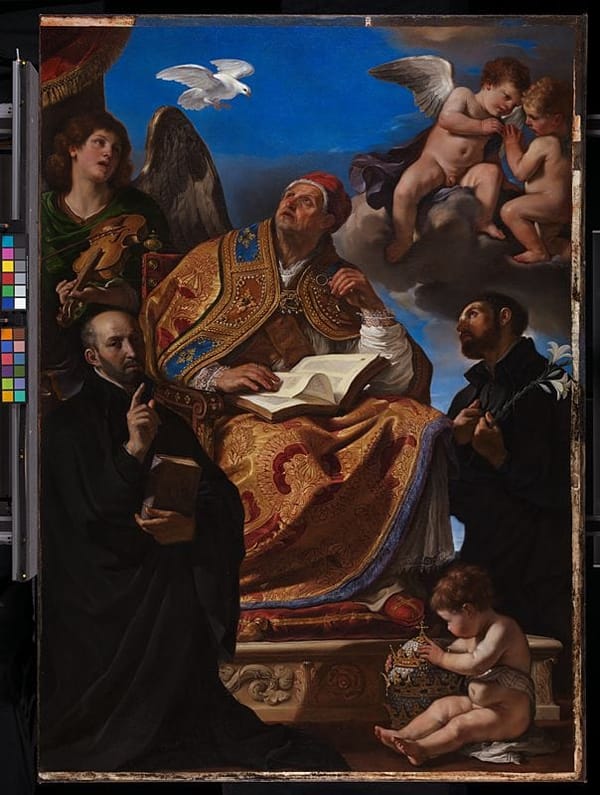 |
March 12: St. Gregory the Great, Pope and Doctor of the Church
Among all the pastors whom our Lord Jesus Christ has placed, as His vicegerents, over the universal Church, there is not one whose merits and renown have surpassed those of the holy Pope, whose feast we keep to-day. His name is Gregory, which signifies watchfulness; his surname is ‘the Great,’ and he was in possession of that title, when God sent the Seventh Gregory, the glorious Hildebrand, to govern His Church.
In recounting the glories of this illustrious Pontiff, it is but natural we should begin with his zeal for the services of the Church. The Roman liturgy, which owes to him some of its finest hymns, may be considered as his work, at least in this sense, that it is he who collected together and classified the prayers and rites drawn up by his predecessors, and reduced them to the form in which we now have them. He collected also the ancient chants of the Church, and arranged them in accordance with the rules and requirements of the divine Service. Hence it is, that our sacred music, which gives such solemnity to the liturgy, and inspires the soul with respect and devotion during the celebration of the great mysteries of our faith, is known as the Gregorian chant.
He is, then, the apostle of the liturgy, and this alone would have immortalized his name; but we must look for far greater things from such a Pontiff as Gregory. His name was added to the three, who had hitherto been honoured as the great Doctors of the Latin Church. These three are Ambrose, Augustine, and Jerome; who else could be the fourth but Gregory? The Church found in his writings such evidence of his having been guided by the Holy Ghost, such a knowledge of the sacred Scriptures, such a clear appreciation of the mysteries of faith, and such unction and authority in his teachings, that she gladly welcomed him as a new guide for her children.
Such was the respect wherewith everything he wrote was treated, that his very letters were preserved as so many precious treasures. This immense correspondence shows us that there was not a country, scarcely even a city, of the Christian world, on which the Pontiff had not his watchful eye steadily fixed; that there was not a question, however local or personal, which, if it interested religion, did not excite his zeal and arbitration as the Bishop of the universal Church. If certain writers of modern times had but taken the pains to glance at these letters, written by a Pope of the sixth century, they would never have asserted, as they have, that the prerogatives of the Roman Pontiff are based on documents fabricated, as they say, two hundred years after the death of Gregory.
Throned on the apostolic See, our saint proved himself to be a rightful heir of the apostles, not only as the representative and depositary of their authority, but as a fellow-sharer in their mission of calling nations to the true faith. To whom does England owe her having been, for so many ages, ‘the island of saints’? To Gregory, who, touched with compassion for those Angli, of whom, as he playfully said, he would fain make Angeli, sent to their island the monk Augustine with forty companions, all of them, as was Gregory himself, children of St. Benedict. The faith had been sown in this land as early as the second century, but it had been trodden down by the invasion of an infidel race. This time the seed fructified, and so rapidly that Gregory lived to see a plentiful harvest. It is beautiful to hear the aged Pontiff speaking with enthusiasm about the results of his English mission. He thus speaks in the twenty-seventh Book of his Morals: ‘Lo! the language of Britain, which could once mutter naught save barbarous sounds, has long since begun to sing, in the divine praises, the Hebrew Alleluia! Lo! that swelling sea is now calm, and saints walk on its waves. The tide of barbarians, which the sword of earthly princes could not keep back, is now hemmed in at the simple bidding of God’s priests.’*
During the fourteen years that this holy Pope held the place of Peter, he was the object of the admiration of the Christian world, both in the east and in the west. His profound learning, his talent for administration, his position, all tended to make him beloved and respected. But who could describe the virtue of his great soul? That contempt for the world and its riches, which led him to seek obscurity in the cloister; that humility, which made him flee the honours of the papacy, and hide himself in a cave, where, at length, he was miraculously discovered, and God Himself put into his hands the keys of heaven, which he was evidently worthy to hold, because he feared the responsibility; that zeal for the whole flock, of which he considered himself not the master, but the servant, so much so indeed that he assumed the title, which the Popes have ever since retained, of ‘servant of the servants of God’ that charity which took care of the poor throughout the whole world; that ceaseless solicitude, which provided for every calamity, whether public or private; that unruffled sweetness of manner, which he showed to all around him, in spite of the bodily sufferings which never left him during the whole period of his laborious pontificate; that firmness in defending the deposit of the faith, and crushing error wheresoever it showed itself; in a word, that vigilance with regard to discipline, which made itself felt for long ages after in the whole Church? All these services and glorious examples of virtue have endeared our saint to the whole world, and will cause his name to be blessed by all future generations, even to the end of time.
Let us now read the abridged life of our saint, as given us in the liturgy.
To these admirable lessons we subjoin a selection of antiphons and responsories, which are taken from an Office approved of by the holy See, for this feast of so great a saint.
Antiphons and Responsories*
St. Peter Damian, whose feast we kept a few days back, composed the following hymn in honour of our apostle:
Nunc angelorum eocius,
Ut tunc, Gregori, gentibus
Succurre jam credentibus.
Omnemque mundi gloriam
Spernis, ut inops inopem
Jesum sequaris principem.
Dum stipem petit angelus;
Tu munus jam post geminum,
Præbes et vas argenteum.
Suæ præfert Ecclesiæ:
Sic Petri gradum percipis,
Cujus et normam sequeris.
Lux et decus Ecclesiæ,
Non sinas in periculis,
Quos tot mandatis instruis.
Tua distillant labia,
Fragrantum vim aromatum
Tuum vincit eloquium.
Mire solvis ænigmata,
Theorica mysteria
Te docet ipsa Veritas.
Vicem simul et gloriam,
Nos solve culpæ nexibus,
Redde polorum sedibus.
Sit decus Unigenito,
Sit utriusque pariti
Majestas summa Flamini.
and now art a companion of the angels!
protect now, as of old, the nations
that believe in Christ.
and all the glory of the world,
that so thou, being poor,
mayst follow the Lord Jesus, who was poor.
in the garb of one that was shipwrecked, and asks an alms;
thou first makest him a double gift,
and then thou givest him a silver vase.
for thou didst imitate the virtues,
and now thou hast
the honours, of Peter.
Light and ornament of the Church!
Thou hast so richly instructed us,
assist us in our dangers.
that brings sweetness to the heart.
Thy words are more fragrant
than the richest perfume.
the obscure figures of sacred Writ.
The divine mysteries are taught thee
by him that is the very Truth.
the office and the glory of the apostles,
pray for us, that we may be loosed from the bonds of sin,
and obtain the thrones prepared for us above.
and to his only-begotten Son,
and to the Spirit of them
both be praise and highest kingship.
Father of the Christian people! Vicar of the charity, as well as of the authority, of Christ! O Gregory, vigilant Pastor! the Church, which thou hast so faithfully loved and served, turns to thee with confidence. Thou canst not forget the flock, which keeps up such an affectionate remembrance of thee; hear the prayer she offers thee on this thy solemnity. Protect and guide the Pontiff, who now holds the place of Peter, as thou didst; enlighten and encourage him in the difficulties wherewith he is beset. Bless the hierarchy of the pastors, which has received from thee such magnificent teachings and such admirable examples. Assist it to maintain inviolate the sacred trust of faith; bless the eSorts it is now making for the restoration of ecclesiastical discipline, without which all is disorder and confusion. God chose thee as the regulator of the divine service, the holy liturgy; foster, by thy blessing, the zeal which is now rising up among us for those holy traditions of prayer, which have been so neglected; teach us the long-forgotten secret, that the best way of praying is to use the prayers of the Church. Unite all Churches in obedience to the apostolic See, which is the ground and pillar of faith, and the fountain of spiritual authority.
But there is one country which was most dear to thee—our own native land. O apostle of England! look down with aSection on this island, which has now rebelled from Rome, and has become the resort of countless false religions. But now, after three centuries of apostasy from the true faith, the hand of God’s mercy is pressing her to conversion. She is thine own child in Christ Jesus: wilt thou not aid her to return to Him? Wilt thou not guide her, by thy prayers, to come forth out of the darkness, which still so thickly clouds her, and follow the light which heaven holds out to her? Oh! if England were once more Catholic, who can tell the good she would do? For what country is there that can do grander things for the propagation of the faith? Pray for her, then; she may regain her glorious title of Isle of Saints, for she has thee for her apostle!
These are the days of salvation; pray for the faithful, who have entered on their career of penance. Obtain for them compunction of heart, love of prayer, and an appreciation of the liturgy and its mysteries. The solemn ami devout homilies which thou didst address, at this season, to the people of Rome, are still read to ns; may they sink into our hearts and fill them with fear of God’s justice, and hope in His mercy, for His justice and mercy change not to suit the time. We are weak and timid, and this makes us count as harsh the laws of the Church which oblige us to fasting and abstinence; get us brave hearts, brave with the spirit of mortification. Thy holy life is an example to us, and thy writings are our instruction; what we still want is to be made true penitents, and this thy intercession must do for us: that so we may return, with the joy of a purified conscience, to the divine Alleluia, which thou hast taught us to sing on earth, and which we hope to chant together with thee in heaven.
* We may be permitted to express a hope, that the day is not far distant, when the Proper Offices, approved of by the holy See, will be adopted in England, for those saints in whom England has a special interest. Proper hymns, &c., have been composed and approved for St. Augustine of Canterbury and St. Anselm. [TRANSULATOR.]
* Moral, in Job. Lib. xxvii. Cap. xi. ↩︎
Tuesday of the Fourth Week of Lent
The Station is in the church of Saint Laurence in Damaso; so called, because it was built, in the fourth century, in honour of the glorious archdeacon of Rome, by Pope St. Damasus, whose body rests here.
Collect
Epistle
Cap. xxxii.In diebus illis, locutus est Dominus ad Moysen, dicens: Descende de monte: peccavit populus tuus, quem eduxisti de terra Ægypti. Recesserunt cito de via, quam ostendisti eis: feceruntque sibi vitulum conflatilem, et adoraverunt, atque immolantes ei hostias, dixerunt: Isti sunt dii tui, Israël, qui te eduxerunt de terra Ægypti. Rursumque ait Dominus ad Moysen: Cemo quod populus iste duræ cervicis sit: dimitte me, ut irascatur furor meus contra eos, et deleam eos, faciamque te in gentem magnam. Moyses autem orabat Dominum Deum suum, dicens: Cur, Domine, irascitur furor tuus contra populum tuum, quem eduxisti de terra Ægypti in fortitudine magna, et in manu robusta? Ne, quæso, dicant Ægyptii: Callide eduxit eos, ut interficeret in montibus, et deleret e terra: quiescat ira tua, et esto placabilis super nequitia populi tui. Recordare Abraham, Isaac, et Israël, servorum tuorum, quibus jurasti per temetipsum, dicens: Multiplicabo semen vestrum sicut Stellas cceli; et universam terram hanc, de qua locutus sum, dabo semini vestro, et possidebitis eam semper. Placatusque est Dominus ne faceret malum, quod locutus fuerat adversus populum suum,
Ch. xxxii.In those days, the Lord spoke to Moses saying: Go, get thee down from the mountain: thy people, which thou hast brought out of the land of Egypt, hath sinned. They have quickly strayed from the way which thou didst show them; and they have made to themselves a molten calf, and have adored it, and sacrificing victims to it, have said: These are thy gods, O Israel, that have brought thee out of the land of Egypt. And again the Lord said to Moses: I see that this people is stiff-necked: let me alone that my wrath may be kindled against them, and that I may destroy them, and I will make of thee a great nation. But Moses besought the Lord his God, saying: Why, O Lord, is thy indignation enkindled against thy people, whom thou hast brought out of the land of Egypt, with great power, and with a mighty hand? Let not the Egyptians say, I beseech thee: He craftily brought them out, that he might kill them in the mountains, and destroy them from the earth; let thy anger cease and be appeased upon the wickedness of thy people. Remember Abraham, Isaac and Israël thy servants, to whom thou swarest by thy own self, saying: I will multiply your seed as the stars ofheaven; and this whole land that I have spoken of, I will give to your seed, and you shall possess it for ever. And the Lord was appeased from doing the evil which he had spoken against his people.
When the world first received the preaching of the Gospel, idolatry was the prevailing crime. For many centuries after, all the catechumens, who were instructed in the true faith, were tainted with it. It was in order to inspire them with a horror of their past lives, that the Church read to them, on this day, the terrible words of God, who, had not Moses interceded, was about to exterminate His people, because they had relapsed into idolatry; and this, after He had worked in their favour the most unheard-of miracles, and had come in person to give them His Law. The worship of false gods is no longer to be found amongst us; but it exists in all those countries, where the Gospel has been preached and rejected. Strange as it may sound, yet it is most true: Europe, with all its civilization, would return to idolatry, were it to lose the faith of our Lord Jesus Christ. Not much more than a centqry ago, an idol was erected to reason; it had its altar, its decorations and its incense; and they who paid homage to it were Europeans! Individuals or peoples, once slaves to Satan, are not their own masters to say, ‘We will go thus far in sin, and no farther’The descendants of Noe, notwithstanding the terrible lesson given to them by the deluge, fell into idolatry; nay, Abraham was called by God from the rest of men, lest he should be led away by the almost universal corruption. Let us be grateful to the Church, who, by her teachings of faith and morals, preserves us from this degrading abomination; and let us resist our passions, which, if the light of faith were taken from us, would lead us to idolatry.
Gospel
Cap. vii.In illo tempore: Jam die festo mediante, ascendit Jesus in templum, et docebat. Et mirabantur Judæi, dicentes: Quomodo hic litteras scit, cum non didicerit? Responds eis Jesus, et dixit: Mea doctrina non est mea, sed ejus qui misit me. Si quis voluerit voluntatem ejus facere, cognoscet de doctrina, utrum ex Deo sit an ego a meipso loquar. Qui a semetipso loquitur, gloriam propriam quærit: qui autem quærit gloriam ejus qui misit eum, hic verax est, et injustitia in illo non est. Nonne Moyses dedit vobis legem? et nemo ex vobis facit legem. Quid me quæritis interficere? Respondit turba, et dixit: Dæmonium habes: quis te quærit interficere? Respondit Jesus, et dixit eis: Unum opus feci, et omnes miramini. Propterea Moyses dedit vobis circumcisionem (non quia ex Moyse est, sed ex patribus): et in Sabbato circumciditis hominem. Si circumcisionem accipit homo in Sabbato, ut non solvatur lex Moysi: mihi indignamini quia totum hominem sanum feci in Sabbato? Nolite judicare secundum faciem, sed justum judicium judicate. Dicebant ergo quidam ex Jerosolymis: Nonne hic est quem quærunt interficere? Et ecce palam loquitur, et nihil ei dicunt. Numquid vere cognoverunt principes quia hic est Christus? Sed hunc scimus unde sit: Christus autem cum venerit, nemo scit unde sit. Clamabat ergo Jesus in templo docens, et dicens: Et me scitis, et unde sim scitis: et a meipso non veni, sed est verus qui misit me, quem vos nescitis. Ego scio eum: quia ab ipso sum, et ipse me misit. Quærebant ergo cum apprehendere: et nemo misit in ilium manus, quia nondum venerat hora ej us. De turba autem multi crediderunt in eum.
Ch. vii.At that time: About the midst of the feast, Jesus went up into the temple and taught. And the Jews wondered, saying: How doth this man know letters, having never leamed? Jesus answered them, and said: My doctrine is not mine, but his that sent me. If any man will do the will of him, he shall know of the doctrine whether it be of God, or whether I speak of myself. He that speaketh of himself, seeketh his own glory; but he that seeketh the glory of him that sent him, he is true, and there is no injustice in him. Did not Moses give you the law? And yet none of you keepeth the law. Why seek you to kill me? The multitude answered and said: Thou hast a devil: who seeketh to kill thee? Jesus answered, and said to them: One work I have done, and you all wonder. Therefore Moses gave you circumcision (not because it is of Moses, but of the fathers); and on the Sabbath-day you circumcise a man. If a man receive circumcision on the Sabbath-day that the law of Moses may not be broken, are you angry at me, because I have healed the whole man on the Sabbath-day? Judge not according to the appearance, but judge just judgment. Some therefore of Jerusalem said: Is not this he whom they seek to kill? And behold he speaketh openly, and they say nothing to him. Have the rulers known for a truth that this is the Christ? But we know this man whence he is. But when the Christ cometh, no man knoweth whence he is. Jesus therefore cried out in the temple, teaching and saying: You both know me, and you know whence I am; and I am not come of myself, but he that sent me is true, whom you know not; I know him because I am from him, and he hath sent me. They sought therefore to apprehend him; and no man laid hands on him, because his hour was not yet come. But of the people many believed in him.
This Gospel carries our thoughts to the sacrifice of ihe divine Lamb, which is to be offered up in Jerusalem. The hour has not yet come, but it is fast approaching. His enemies are already seeking how they may put Him to death. So blinded are they by their passions, that they accuse Him of being a violater of the Sabbath, because He healed the sick, by the simple act of His will, on the Lord’s day! In vain does Jesus refute their prejudices, by reminding them that they themselves have no scruple in fulfilling the law of circumcision on this day, or (as He said to them, on another occasion) in drawing out of the pit an ass or an ox that may have fallen in.1 They are deaf to all He says; they are men of one idea, and it is, that their victim shall not escape death. His miracles are incontestable, and all are wrought out of a motive of mercy and love. The only time He refuses to work one, is when His enemies ask Him to satisfy their curiosity and pride by letting them see a sign. This exercise of His power of working miracles, far from exciting them to admiration and gratitude, only incites them to envy, and in their envy, they declare, not only that He acts by Beelzebub,2 but that He has a devil within Him. We shudder at such a blasphemy. Yet, such is the pride of these Jewish doctors that they care neither for common sense nor for religion, and their hearts thirst more and more for the Blood of Jesus. Whilst some of the people allow themselves to be seduced by their leaders into the same feelings against Jesus, others, who affect to be indifferent, reason about Him, and then declare it to be their opinion that this Jesus does not realize in Himself the character of the promised Messias! They argue that, when the Christ cometh no one will know whence He is. But have not the prophets declared that He is to be of the family of David? Now every Jew knows well enough that Jesus is of that royal race. Besides, they own that there is to be something mysterious about the Messias, and that He is to come from God. Had they listened with docile attention to the teachings of Jesus—teachings which He had confirmed by numerous miracles—they would have been enlightened both as to His temporal birth, and to His being the Son of God. But indifference and the perversity of the human heart keep them in culpable ignorance; and, perhaps, on the day of His death, they will join in the cry: ‘Let His Blood be upon us and upon our children!’3
The Greek liturgy supplies us with the following humble act of contrition. We take it from the hymn composed by St. Andrew of Crete.
Canon Magnus
(Feria V. Hebdomadæ V. Jejuniorum)
| Previous Monday of the Fourth Week of Lent | Next Tuesday of the Fourth Week of Lent |