Daily reading
Passiontide
Double of the I Class · March 19 · Sanctoral
March 19, 2024
From Dom Guéranger’s The Liturgical Year.
A Double of the I Class leads the weekday.Rubric

|
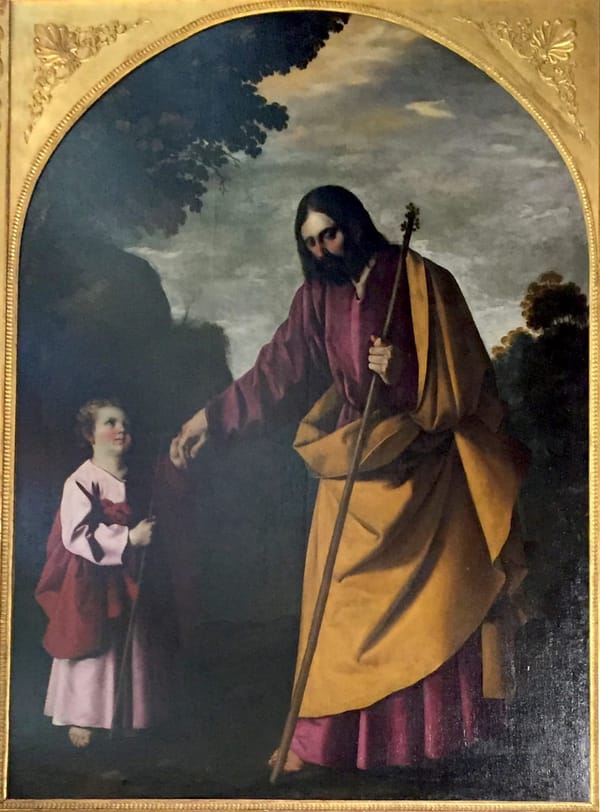
March 19: St. Joseph, Spouse of the Blessed Virgin
To-day, Joseph, the spouse of Mary, the fosterfather of the Son of God, comes to cheer us by his dear presence. In a few days hence, the august mystery of the Incarnation will demand our fervent adoration: who could better prepare us for the grand feast, than he that was both the confidant and thd faithful guardian of the divine secret?
The Son of God, when about to descend upon this earth to assume our human nature, would have a Mother; this Mother could not be other than the purest of Virgins, and her divine maternity was not to impair her incomparable virginity. Until such time as the Son of Mary were recognized as the Son of God, His Mother’s honour had need of a protector: some man, therefore, was to be called to the high dignity of being Mary’s spouse. This privileged mortal was Joseph, the most chaste of men.
Heaven designated him as being the only one worthy of such a treasure: the rod he held in his hand in the temple suddenly produced a flower, as though it were a literal fulfilment of the prophecy of Isaias: ‘There shall come forth a rod from the root of Jesse, and a flower shall rise up out of his root.’1 The rich pretenders to an alliance with Mary were set aside; and Joseph was espoused to the Virgin of the house of David, by a union which surpassed in love and purity everything the angels themselves had ever witnessed.
But he was not only chosen to the glory of having to protect the Mother of the Incarnate Word; he was also called to exercise an adopted paternity over the very Son of God. So long as the mysterious cloud was over the Saint of saints, men called Jesus the Son of Joseph and the carpenter's Son. When our blessed Lady found the Child Jesus in the temple, in the midst of the doctors, she thus addressed Him: ‘Thy father and I have sought Thee sorrowing’;2 and the holy evangelist adds that Jesus was subject to them, that is, that He was subject to Joseph as He was to Mary.
Who can imagine or worthily describe the sentiments which filled the heart of this man, whom the Gospel describes to us in one word, when it calls him the just man?3 Let us try to picture him to ourselves amidst the principal events of his life: his being chosen as the spouse of Mary, the most holy and perfect of God’s creatures; the angel’s appearing to him, and making him the one single human confidant of the mystery of the Incarnation, by telling him that his Virgin bride bore within her the fruit of the world’s salvation: the joys of Bethlehem, when he assisted at the birth of the divine Babe, honoured the Virgin Mother, and heard the angels singing; his seeing first the humble and simple shepherds, and then the rich eastern magi, coming to the stable to adore the new-born Child; the sudden fears which came to him, when he was told to arise, and, midnight as it was, to flee into Egypt with the Child and the Mother; the hardships of that exile, the poverty and the privations which were endured by the hidden God, whose foster-father he was, and by the Virgin, whose sublime dignity was now so evident to him; the return to Nazareth, and the humble and laborious life led in that village, where he so often witnessed the world's Creator sharing in the work of a carpenter; the happiness of such a life, in that cottage where his companions were the Queen of the angels and the eternal Son of God, both of whom honoured, and tenderly loved him as the head of the family—yes, Joseph was beloved and honoured by the uncreated Word, the Wisdom of the Father, and by the Virgin, the masterpiece of God’s power and holiness.
We ask, what mortal can justly appreciate the glories of St. Joseph? To do so, he would have to understand the whole of that mystery, of which God made him the necessary instrument. What wonder, then, if this foster-father of the Son of God was prefigured in the old Testament, and that by one of the most glorious of the patriarchs? Let us listen to St. Bernard, who thus compares the two Josephs: ‘The first was sold by his brethren, out of envy, and was led into Egypt, thus prefiguring our Saviour’s being sold; the second Joseph, that he might avoid Herod’s envy, led Jesus into Egypt. The first was faithful to his master, and treated his wife with honour; the second, too, was the most chaste guardian of his bride, the Virgin Mother of his Lord. To the first was given the understanding and interpretation of dreams; to the second, the knowledge of, and participation in, the heavenly mysteries. The first laid up stores of corn, not for himself, but for all the people; the second received the living Bread that came down from heaven, and kept It both for himself and for the whole world.’4
Such a life could not close save by a death that was worthy of so great a saint. The time came for Jesus to quit the obscurity of Nazareth, and show Himself to the world. His own works were henceforth to bear testimony to His divine origin; the ministry of Joseph, therefore, was no longer needed. It was time for him to leave this world, and await, in Abraham’s bosom, the arrival of that day, when heaven’s gates were to be opened to the just. As Joseph lay on his bed of death, there was watching by his side He that is the master of life, and that had often called this His humble creature, father. His last breath was received by the glorious Virgin-Mother, whom he had, by a just right, called his bride. It was thus, with Jesus and Mary by his side, caring for and caressing him, that Joseph sweetly slept in peace. The spouse of Mary, the fosterfather of Jesus, now reigns in heaven with a glory which, though inferior to that of Mary, is marked with certain prerogatives which no other inhabitant of heaven can have.
From heaven, he exercises a powerful protection over those that invoke him. In a few weeks from this time, the Church will show us the whole magnificence of this protection; a solemn feast will be kept in his honour in the third week after Easter. To-day the Liturgy sets before us his glories and privileges. Let us unite with the faithful throughout the world, and ofier to the spouse of Mary the hymns which are this day sung in his praise.
Hymn I
Te cuncti resonent Christiadum chori,
Qui clams meritis junctus es inclytæ
Casto fœdere Virgini.
Admirans, dubio tangeris anxius,
Afflatu superi Flaminis angelus
Conceptum puerum docet.
Ægypti profugum tu sequeris plagas:
Amissum Solymis quæris, et invenis,
Miscene gaudia fletibus.
Palmamque emeritos gloria suscipit;
Tu vivens, Superis par, frueris Deo,
Mira sorte beatior.
Da Joseph meritis sidera scandere:
Ut tandem liceat nos tibi perpetim
Gratum promere canticum.
May the choirs of Christendom resound with thy name,
for great are thy merits,
who wast united by a chaste alliance to the holy Virgin.
a cruel doubt afflicts thy heart; but an angel visits thee,
telling thee that she had conceived of the Holy Ghost
the Child she bore in her womb.
and go with the little fugitive to Egypt’s distant land.
When he was lost in Jerusalem, thou didst seek after him;
and having found him, thy tears were mingled with joy.
has crowned their life; they receive their glory, when they have won the palm:
but thou, by a strange, happy lot, hadst, even during life,
what the blessed have in heaven—thou hadst the sweet society of thy God.
and may the intercession of Joseph aid us to reach heaven:
that there we may sing to thee
our eternal hymn of grateful love.
Hymn II
Certa spes vitæ, columenque mundi,
Quas tibi læti canimus, benignus
Suscipe laudes.
Virginia sponsum, voluitque Ver bi
Te patrem dici, dedit et ministrum
Esse salutis.
Quem chorus vatum cecinit futurum,
Aspicis gaudens, humilisque natum
Numen adoras.
Cujus ad nutum tremit inferorum
Turba, cui pronus famulatur æther,
Se tibi subdit.
Quæ tibi præbens superos honores,
Det tuis nobis meritis beatæ
Gaudia vitae.
the sure hope of our life, and the pillar of the world!
Receive, in thy kind love,
the praises we now joyfully sing to thee.
the spouse of the holy Virgin;
willed thee to be called the father of the Word;
and gave thee to be an instrument of our salvation.
on the Redeemer lying in the stable,
him that the prophets had foretold was to come;
and seeing him, thou didst humbly adore the new-born King.
at whose bidding hell trembles
and before whom heaven prostrates ready to do his will,
yea, even he makes himself subject to thee.
May he that has conferred such high honours upon thee,
grant us, through the merits of thine intercession,
to come to the joys of heavenly life.
Hymn III
Cujus excelsos canimus triumphos,
Hac die, Joseph meruit perennis
Gaudia vitæ.
Cujus extremam vigiles ad horam
Christus et Virgo simul adstiterunt,
Ore sereno.
Camis, ad sedes placido sopore
Migrat æternas, rutilisque cingit
Tempora sertis.
Adsit ufc nobis, veniamque nostris
Obtinene culpis, tribuat supernæ
Munera pacis.
Trine qui regnas, Deus; et coronas
Aureas servo tribuis fideli,
Omne per ævum.
whose praises we, the faithful,
now gladly tell, and whose high triumph we sing,
deserved to receive the joys of eternal life.
thrice blessed saint,
at whose last hour Jesus and Mary
stood watching in tender love.
and Joseph, sweetly sleeping,
passed to the eternal home,
and received upon his brott the glittering crown.
let us beseech him to help us,
obtain us the pardon of our sins,
and procure us the gift of heavenly peace.
O God, O blessed Trinity,
who art our sovereign Lord!
who givest to thy faithful servant an everlasting crown of gold.
The Greek liturgy, which honours St. Joseph on the Sunday following the feast of Christmas, thus hymns his praise in the Menæa:
Hymn (Dominica post Natale Domini)
We praise and glorify thee, O happy saint! We hail thee as the spouse of the Queen of heaven, and foster-father of our Redeemer. These titles, which would seem too grand for any human being to enjoy, are thine; and they are but the expression of the dignities conferred on thee by God. The Church of heaven admires the sublime favours thou hast received; the Church on earth joyfully celebrates thy glories, and blesses thee for the favours thou art so unceasingly bestowing upon her.
Though born of the kingly race of David, thou wast the humblest of men; thy spirit led thee to seek obscurity, and a hidden life was thine ambition: but God chose thee to be an instrument in the sublimest of all His works. A noble Virgin of the same family of David, the object of heaven’s admiration, and the glory and hope of the world, is to be thy bride. The Holy Ghost is to dwell within her as in a most pure tabernacle; it is to thee, the just and chaste, that He entrusts her as an inestimable treasure. Espouse, then, to thyself her whose beauty the very King of heaven so greatly desires.5
The Son of God comes down to this earth, that He may live the life of man; He comes that He may sanctify the ties and affections of kindred. He calls thee father; He obeys thy orders. What strange emotions must have filled thy heart, O Joseph! when, knowing the prerogatives of thy bride and the divinity of thy adopted Son, thou hadst to be the head of this family, which united heaven and earth into one! What respectful and tender love for Mary, thy blessed bride! What gratitude and profound worship of Jesus, who obeyed thee as thy Child! Oh mysteries of Nazareth! a God dwells among men, and permits Himself to be called the Son of Joseph!
O sublime minister of the greatest of blessings, intercede for us with God made Man. Ask Him to bestow humility upon us, that holy virtue which raised thee to such exalted dignity, and which must be the basis of our conversion. It is pride that led us into sin, and made us prefer our own will to that of God: yet will He pardon us if we offer Him the sacrifice of a contrite and humble heart.6 Get us this virtue, without which there can be no true penance. Pray also for us, O Joseph, that we may be chaste. Without purity of mind and body we cannot come nigh the God of all sanctity, who suffers nothing defiled to approach Him. He wills to make our bodies, by His grace, the temples of His holy Spirit: do thou, great saint, help us to maintain ourselves in so exalted a dignity, or to recover it if we have lost it.
And lastly, O faithful spouse of Mary! recommend us to our Mother. If she cast a look of pity upon us during these days of reconciliation, we shall be saved: for she is the Queen of mercy, and Jesus, her Son, will pardon us and change our hearts, if she intercede for us, O Joseph! Remind her of Bethlehem, Egypt, and Nazareth, in all of which she received from thee such marks of thy devotedness. Tell her that we, also, love and honour thee; and Mary will reward us for our devotion to him who was given her by heaven as her protector and support.
Tuesday in Passion Week
The Station in Rome was formerly the church of the martyr St. Cyriacus, and as such it is still given in the Roman missal; but this holy sanctuary having been destroyed, and the relics of the holy deacon translated to the church of St. Mary in Via lata, it is here that the Station is now held.
Collect
Epistle
Cap. xiv.In diebus illis: Congregati sunt Babylonii ad regem, et dixerunt ei: Trade nobis Danielem, qui Bel destruxit, et draconem interfecit; alioquin interficiemus te et domum tuam. Vidit ergo rex quod irruerent in eum vehementer: ut necessitate compulsus tradidit eis Danielem. Qui miserunt eum in lacum leonum, et erat ibi diebus sex. Porro in lacu erant leones septem, et dabantur eis duo corpora quotidie, et duæ oves: et tunc non data sunt eis, ut devorarent Danielem. Erat autem Habacuc propheta in Judæa, et ipse coxerat pulmentum, et intriverat panes in alveolo: et ibat in campum ut ferret messoribus. Dixitque angelus Domini ad Habacuc: Fer prandium quod habes in Babylonem Danieli, qui est in lacu leonum. Et dixit Habacuc: Domine, Babylonem non vidi, et lacum nescio. Et apprehendit eum angelus Domini in vertice ejus, et portavit eum capillo capitis sui, posuitque eum in Babylone supra lacum in impetu spiritus sui. Et clamavit Habacuc, dicens: Daniel, serve Dei, tolle prandium quod misit tibi Deus. Et ait Daniel: Recordatus es mei Deus, et non dereliquisti diligentes te. Surgensque Daniel comedit. Porro angelus Domini restituit Habacuc confestim in loco suo. Venit ergo rex die septimo, ut lugeret Danielem: et venit ad lacum, et introspexit, et ecce Daniel sedens in medio leonum. Et exclamavit voce magna rex, dicens: Magnus es, Domine Deus Danielis! Et extraxit eum de lacu leonum. Porro illos qui perditionis ejus causa fuerant, intromisit in lacum, et devorati sunt in momento coram eo. Tunc rex ait: Paveant omnes habitantes in universa terra Deum Danielis; quia ipse est Salvator, faciens signa et mirabilia in terra: qui liberavit Danielem de lacu leonum.
Ch. xiv.In those days: The people of Babylon gathered together against the king: and said to him: Deliver up to us Daniel, who hath destroyed Bel, and killed the dragon, otherwise we will destroy thee and thy house. And the king saw that they pressed upon him violently; and being constrained by necessity, he delivered Daniel to them. And they cast him into the den of lions, and he was there six days. And in the den there were seven lions, and they had given to them two carcasses every day, and two sheep: but then they were not given unto them, to the intent that they might devour Daniel. Now there was in Judea a prophet called Habacuc, and he had boiled pottage, and had broken bread in a bowl; and was going into the field to carry it to the reapers. And the angel of the Lord said to Habacuc: Carry the dinner which thou hast, into Babylon, to Daniel, who is in the lions’ den. And Habacuc said: Lord, I never saw Babylon, nor do I know the den. And the angel of the Lord took him by the top of his head, and carried him by the hair of his head, and set him in Babylon, over the den, in the force of his spirit. And Habacuc cried, saying: O Daniel, thou servant of God, take the dinner that God hath sent thee. And Daniel said: Thou hast remembered me, O God, and thou hast not forsaken them that love thee. And Daniel arose and ate. And the angel of the Lord presently set Habacuc again in his own place. And upon the seventh day the king came to bewail Daniel: and he came to the den, and looked in, and behold Daniel was sitting in the midst of the lions. And the king cried out with a loud voice, saying: Great art thou, O Lord, the God of Daniel. And he drew him out of the lions’ den. But those that had been the cause of his destruction, he cast into the den, and they were devoured in a moment before him. Then the king said: Let all the inhabitants of the whole earth fear the God of Daniel: for he is the Saviour, working signs and wonders in the earth; who hath delivered Daniel out of the lions den.
This lesson was intended, in an especial manner, as an instruction to the catechumens. They were preparing to enroll themselves as Christians; it was, therefore, necessary that they should have examples put before them, which they might study and imitate, Daniel, oast into the lions’ den for having despised and destroyed the idol Bel, was the type of a martyr. This prophet had confessed the true God in Babylon; he had put to death a dragon, to which the people, after Bel had been destroyed, had given their idolatrous worship; nothing less than Daniel’s death could appease their indignation. The holy man full of confidence in God, allowed himself to be thrown into the lions’ den, thus setting an example of courageous faith to the future Christians: they would imitate him, and for three centuries would nobly shed their blood for the establishment of the Church of Christ. In the Roman catacombs we continually meet with the representation of Daniel surrounded by lions, and many of these paintings date from the ages of persecution. Thus the eyes of the catechumens could see what their ears heard; both told them to be ready for trial and sacrifice. It is true, the history of Daniel showed them the power of God interfering and delivering him from death; but they were fully aware that, in order to merit a like deliverance, they would have to show a like constancy, and be ready to suffer death rather than deny their faith. From time to time, a Christian was led to the amphitheatre, and the wild beasts would fawn at his feet: but such miracles only put off the martyr’s sacrifice, and perhaps won others to the faith.
It was the prophet’s courage, and not his victory over the lions, that the Church proposed to her catechumens. The great thing for them to bear in mind was this maxim of our Lord: Fear not them that kill the body, and are not able to kill the soul; but rather fear Him that can destroy both soul and body into hell.* We are the descendants of these early Christians; but our faith has not cost us what it cost them. And yet we have a tyrant to try even ours: we have to confess our faith, not indeed before pro consuls and emperors, but before the world. Let the example of the brave martyrs send us forth from our Lent with a courageous determination to withstand this tyrant, with his maxims, his pomps, and his works. There has been a truce between him and us, during these days of retirement and penance; but the battle will soon be renewed, and then we must stand the brunt, and show that we are Christians.
Gospel
Cap. vii.In illo tempore: Ambulabat Jesus in Galilæam, non enim volebat in Judæam ambulare, quia quærebant eum interficere. Erat autem in proximo dies festus Judæorum, Scenopegia. Dixerunt autem ad eum fratres ejus: Transi hinc, et vade in Judæam, ut et discipuli tui videant opera tua quæ facis. Nemo quippe in occulto quid facit, et quærit ipse in palam esse: si hæc facis, manifesta teipsum mundo. Neque enim fratres ejus credebant in eum. Dicit ergo eis Jesus: Tempus meum nondum advenit: tempus autem vestrum semper est paratum. Non potest mundus odisse vos; me autem odit: quia ego testimonium perhibeo de illo, quod opera ejus mala sunt. Vos ascendite ad diem festum hunc, ego autem non ascendo ad diem festum istum: quia meum tempus nondum impletum est. Hæc cum dixisset, ipse mansit in Galilæa. Ut autem ascenderunt fratres ejus, tunc et ipse ascendit ad diem festum non manifeste, sed quasi in occulto. Judæi ergo quærebant eum in die festo, et dicebant: Ubi est ille? et murmur multum erat in turba de eo. Quidam enim dicebant: Quia bonus est. Alii autem dicebant: Non, sed seducit turbas. Nemo tamen palam loquebatur de illo, propter metum Judæorum
Ch. vii.At that time: Jesus walked in Galilee: for he would not walk in Judea, because the Jews sought to kill him. Now the Jews’ feast of tabernacles was at hand. And his brethren said to him: Depart from hence, and go into Judea, that thy disciples also may see thy works which thou dost. For there is no man that doth anything in secret, and he himself seeketh to be known openly; if thou do these things, manifest thyself to the world. For neither did his brethren believe in him. Then Jesus said to them: My time is not yet come: but your time is always ready. The world cannot hate you; but me it hateth: because I give testimony of it, that the works thereof are evil. Go you up to this festival day, but I go not up to this festival day; because my time is not accomplished. When he had said these things, he himself staid in Galilee. But after his brethren were gone up, then he also went up to the feast, not openly, but as it were in secret. The Jews therefore sought him on the festival day, and said: Where is he? And there was much murmuring among the multitude concerning him. For some said: He is a good man. And others said: No, but he seduceth the people. Yet no man spoke openly of him, for fear of the Jews.
The facts here related refer to an earlier part of our Lord’s life; but the Church proposes them to our consideration to-day, on account of their connexion with those given us in the Gospels read to us during the last few days. We learn from these words of St. John, that the Jews were plotting the death of Jesus, not only when this the last Pasch for the Synagogue was approaching, but even so far back as the feast of tabernacles, which was kept in September. The Son of God was reduced to the necessity of going from place to place as it were in secret; if He would go to Jerusalem, He must take precautions! Let us adore these humiliations of the Man-God, who has deigned to sanctify every position of life, even that of the just man persecuted and obliged to hide himself from his enemies. It would have been an easy matter for Him to confound His adversaries by working miracles, such as those which Herod’s curiosity sought for; He could have compelled them to treat Him with the reverence that was due to Him. But this is not God’s way: He does not force man to duty; He acts, and then leaves man to recognize his Creator’s claims. In order to do this, man must be attentive and humble, he must impose silence on his passions. The divine light shows itself to the soul that thus comports herself. First, she sees the actions, the works, of God; then, she believes, and wishes to believe: her happiness, as well as her merit, lies in faith, and faith will be recompensed in eternity with light, with the vision.
Flesh and blood cannot understand this; they love show and noise. The Son of God, having come down upon this earth, could not subject Himself to such an abasement as that of making a parade of His infinite power before men. He had to work miracles, in order to give a guarantee of His mission; but, as Man, not everything He did was to be a miracle. By far the longest period of His life was devoted to the humble duties of a creature; had it not been so, how should we have learned from Him what we so much needed to know? His brethren (the Jews gave the name of brothers to all who were collaterally related) wished Jesus to make a display of His miraculous power, for some of the glory would have accrued to them. This their ambition caused our Lord to address them in these strong words, upon which we should meditate during this holy season, for, later on, we shall stand in need of the teaching: 'The world cannot hate you; but Me it hateth.’ Let us, therefore, for the time to come, not please the world; its friendship would separate us from Jesus Christ.
The following devout hymn, taken from the ancient Roman-French missals, may serve us as an expression of the sentiments we entertain towards our loving Redeemer.
Hymn
Redemptor et credentium:
Placare votis supplicum
Te laudibus colentium.
Crucis per alma vulnera,
Virtute solvit ardua
Primi parentis vincula.
Tegmen subisti carneum:
Dignatus es vilissimam
Pati doloris formulam.
Mundi mentis complices:
Per probra tergens crimina
Quæ mundus auxit plurima.
Terram sed omnem concutis:
Tradis potentem spiritum,
Nigrescit atque sæculum.
Victor resplendens culmine;
Cum Spiritus munimine
Defende nos, Rex optime.
Redeemer, too, of believers,
be appeased by the prayer
and praise of thy humble suppliants.
by the dear wounds of the cross,
broke so powerfully the fetters
forged by our first parents.
didst deign to assume
a body of flesh, and endure
the most humiliating sufferings.
accomplices of a world condemned:
thou didst suffer shame, so to cleanse away
the manifold sins of the world.
but thou movest the whole earth:
thou breathest forth thy mighty Spirit,
and the world is buried in darkness.
triumphantly on the high throne of thy Father’s glory:
do thou, O best of kings,
defend us by the protection of the holy Spirit.
Let us pay our homage to the holy cross, in these words of the Greek liturgy.
Hymn (Feria IV mediæ Septimanæ)
* St. Matt. X. 28. ↩︎
| Previous Monday in Passion Week | Next Tuesday in Passion Week |