Daily reading
Paschal Time
Double of the I Class · Movable from Easter · Temporal
April 2, 2024
From Dom Guéranger’s The Liturgical Year.
A Double of the I Class leads; St. Francis of Paula and St. Mary of Egypt are commemorated.Rubrics

|
Easter Tuesday
OUR Pasch is the Lamb, and we meditated upon the mystery yesterday: now let us attentively consider those words of sacred Scripture, where, speaking of the Pasch, it says: 'It is the Phase, that is, the passage of the Lord.' God himself adds these words: 'I will pass through the land of Egypt that night, and will kill every first-born in the land of Egypt, both man and beast; and against all the gods of Egypt I will execute judgements.’1 So that the Pasch is a day of judgement, a day of terrible justice upon the enemies of God; but for that very reason, it is a day of deliverance for Israel. The lamb is slain; but his immolation is the signal of redemption to the holy people of the Lord.
The people of Israel are slaves to the cruel Pharaoh. Their bondage is the heaviest that can be. Their male children are to be put to death. The race of Abraham, on which repose the promises of the world’s salvation, is doomed. It is time for God to interpose: the Lion of the tribe of Juda, he whom none can resist, must show himself.
But in this, the Israelites are a type of another and a far more numerous people, the whole human race; and it is the slave of Satan, a tyrant worse than Pharaoh. Its bondage is at its height. It is debased by the vilest idolatry. It has made every base thing its god; and the God that made all things is ignored or blasphemed. With a few rare exceptions out of each generation, men are the victims of hell. Has God's creation of man, then, been a failure? Not so. The time is come for him to show the might of his arm: he will pass over the earth, and save mankind.
Jesus, the true Israelite, the true Man come down from heaven, he too is made a captive. His enemies have prevailed against him, and his bleeding, lifeless Body has been laid in the tomb. The murderers of the just One have even fixed a seal upon the sepulchre, and set a guard to watch it. Here again the Lord must pass, and confound his enemies by his triumphant passage.
In that Egypt of old, each Israelite family was commanded to slay and eat the Paschal Lamb. Then at midnight the Lord passed, as he had promised, over this land of bondage and crime. The destroying angel followed, slaying with his sword the first-born of the Egyptians, 'from the first-born of Pharaoh, who sat on his throne, unto the first-born of the captive woman that was in prison, and all the first-born of the cattle.’2 A cry of mourning resounded through Mesraïm: but God is just, and his people was made free!
The same victory was gained in the Resurrection which now gladdens us. The midnight was over, and the last shades of darkness were fleeing from before the rising light: it was then that our Lord passed through the sealed stone of his tomb, unperceived by his guards. His Resurrection was a stroke of death to his first-born people, who had refused to receive him as their Messias, or to ‘know the time of their visitation.’3 The Synagogue was hard of heart, like Pharaoh; it would fain have held captive him of whom the prophet had said, that he would be 'free among the dead.’4 Hereupon a cry of impotent rage was heard in Jerusalem: but God is just, and Jesus made himself free!
And oh! what a happiness was this passage of our Lord for the human race! He had adopted us as his brethren, and loved us too tenderly to leave us slaves of Satan: therefore, he would have his own Resurrectionbe ours too, and give us light and liberty. The firstborn of Satan were routed by such a victory; the power of hell was broken. Yet a little while, and the altars of the false gods shall everywhere be destroyed; yet a little while, and man, regenerated by the preaching of the Apostles, shall acknowledge his Creator and abjure his idols: for this is the day which the Lord hath made: ‘it is the Phase, that is, the passage of the Lord’!
But observe how the two mysteries—the Lamb and the Passover—are united in our Pasch. The Lord passes, and bids the destroying angel slay the first-born in every house, the entrance of which is not marked with the blood of the lamb. This is the shield of protection; where it is, there divine justice passes by and spares. Pharaoh and his people are not signed with the blood of the lamb: yet have they witnessed the most extraordinary miracles, and suffered unheard-of chastisements. All this should have taught them that the God of Israel is not like their own gods, which have no power; but their heart is hard as stone, and neither the works nor the words of Moses have been able to soften it. Therefore does God strike them and deliver his people.
But this very people, this Israel, ungratefully turns against his deliverer; he is content with the types of the good things promised; he will have no other lamb but the material one. In vain do the prophets tell him that ‘a Lamb is to be sent forth, who shall be King of the earth; that he shall come from the desert to the mount of the daughter of Sion.’5 Israel refuses to acknowledge this Lamb as his Messias; he persecutes him and puts him to death; and persists in putting all his confidence in the blood of victims that have no longer the power to propitiate the anger of God. How terrible will be the Passage of the Lord over Jerusalem, when the sword of the Roman legions shall destroy a whole people!
Satan, too, and his wicked angels, had scoffed at this Lamb; they had despised him, as being too meek and humble to be dreaded; and when they saw him shedding his Blood on the Cross, a shout of exultation rang through the regions of hell. But what was their dismay, when they saw this Lamb descending like a lion into limbo, and setting free from their bondage the countless prisoners of the four thousand previous years? and after this returning to our earth, and inviting all mankind to receive 'the liberty of the glory of the children of God’?6
O Jesus! how terrible is thy Passover to thine enemies! but how glorious for them that serve thee! The people of Israel feared it not, because their houses were marked with the blood of the figurative lamb. We are more favoured than they: our Lamb is the Lamb of God, and thy Blood is signed, not upon our dwellings, but upon our souls. Thy prophet foretold the great mystery when he said that on the day of thy vengeance upon Jerusalem, they would be spared whose foreheads should be marked with the Tau.7 Israel despised the prophecy, which is our joy. The Tau is the sign of thy Cross, dear Jesus! It is thy Cross that shields, and protects, and gladdens us in this Pasch of thy Passover, wherein thy anger is all for thine enemies, and thy blessings all for us!
At Rome, the Station for to-day is in the basilica of St Paul. The church is impatient to lead her white-robed troop of neophytes to the Apostle of the gentiles. Though he is not the foundation of the Church, yet is he companion of Peter's labours in Rome, his fellow-martyr, and the preacher of the Gospel to the gentiles. As he says of himself,8 he has laboured to form children in God—who could tell the number he has given to Christ? How must he rejoice to see these newly made Christians approach his sacred shrine, there to receive instruction from his epistles, wherein he still speaks to all generations!
Mass
The Introit, taken from the Book of Ecclesiasticus, celebrates the sublime wisdom of St Paul, who is the ever pure source whereat the people of God drink instruction and strength, and so prepare their souls for eternal life.
Introit
In the Collect, the Church gives thanks to God for rendering her fruitful, and thus giving her, every Easter, a mother's joy. She then prays for her new children, that they may have the grace to persevere in the imitation of their risen Lord.
Collect
Epistle
Cap. xiii.In diebus illis: Surgens Paulus, et manu silentium indicens, ait: Viri fratres, filii generis Abraham, et qui in vobis timent Deum, vobis verbum salutis hujus missum est. Qui enim habitabant Jerusalem, et principes ejus ignorantes Jesum, et voces prophetarum, quæ per omne sabbatum leguntur, judicantes impleverunt, et nullam causam mortis invenientes in eo, petierunt a Pilato, ut interficerent eum. Cumque consummassent omnia quæ de eo scripta erant, deponentes eum de ligno, posuerunt eum in monumento. Deus vero suscitavit eum a mortuis tertia die; qui visus est per dies multos his, qui simul ascenderant eum eo de Galilæa in Jerusalem: qui usque nunc sunt testes ejus ad plebem. Et nos vobis annuntiamus eam, quæ ad patres nostros repromissio facta est: quoniam hanc Deus adimplevit filiis nostris, resuscitans Jesum Christum Dominum nostrum.
Ch. xiii.In those days: Paul standing up, and with his hand bespeaking silence, said: Men, brethren, children of the stock of Abraham, and whosoever among you fear God, to you the word of this salvation is sent. For they that inhabited Jerusalem, and the rulers thereof, not knowing him nor the voices of the prophets which are read every Sabbath, judging him have fulfilled them, and finding no cause of death in him, they desired of Pilate that they might kill him. And when they had fulfilled all things that were written of him, taking him down from the tree, they laid him in a sepulchre. But God raised him up from the dead the third day: who was seen for many days by them who came up with him from Galilee to Jerusalem, who to this present are his witnesses to the people. And we declare unto you, that the promise which was made to our fathers, this same God hath fulfilled to our children, raising up Jesus Christ our Lord.
This discourse, which was made at Antioch in Pisidia, in the synagogue, shows us that the Doctor of the gentiles followed the same method in his instructions as did the prince of the Apostles. The great subject of their preaching was the Resurrection of Christ; for it is the fundamental truth, it is the fact above all others, which proves the divine mission of the Son of God upon earth. It is not enough to believe in Christ crucified; we must also believe in Christ risen. The Resurrection is not only the indisputable fact on which rests the whole certainty of our faith, but it is also the dogma which energizes the whole Christian world. Nothing ever happened on this earth which produced a like impression. See how throughout the whole world it is now celebrated by millions of men of every race and nation! Nineteen centuries have passed away since the relics of St Paul were first laid in this tomb on the Ostian Way: during that time, how many events have happened which in their time were looked on as of momentous importance, and are now completely forgotten? For more than two hundred years the storm of persecution was almost ceaseless over Christian Rome; it even became necessary, in the third century, to remove these sacred remains, and hide them, for a time, in the catacombs. After this came Constantine, who built this basilica, and erected the triumphal arch near the altar, under which lies the body of the Apostle. Since then, how many changes have taken place in the world! Dynasties, empires, forms of government, have succeeded each other, and only one institution has stood unchanged—the Church. Every year, during these fifteen centuries, she has gone to the basilica of St Paul, and there, near his tomb, has read this discourse in which the Apostle proclaimed the Resurrection of Christ to the Jews. Seeing such perpetuity, such unchangeableness, even in things like this, we cannot help exclaiming: Oh! truly, Christ is risen! He is the Son of God! for man could never have given duration to any work of his hand. Our Pasch alone tells us who Jesus is. Let us learn from the circumstance suggested to us by to-day’s Epistle how the dazzling beauty of our risen Jesus is reflected even in the minutest details of our happy worship, the Liturgy.
Gradual
The Sequence, Victimæ Paschali, p. 145.
Gospel
Cap. xxiv.In illo tempore: Stetit Jesus in medio discipulorum suorum, et dixit eis: Pax vobis: ego sum, nolite timere. Conturbati vero, et conterriti, existimabant se spiritum videre. Et dixit eis: Quid turbati estis, et cogitationes ascendunt in corda vestra? Videte manus meas, et pedes, quia ego ipse sum: palpate et videte: quia spiritus carnem et ossa non habet, sicut me videtis habere. Et cum hoc dixisset, ostendit eis manus et pedes. Adhuc autem illis non credentibus, et mirantibus præ gaudio, dixit: Habetis hic aliquid, quod manducetur? At illi obtulerunt ei partem piscis assi, et favum mellis. Et cum manducasset coram eis, sumens reliquias, dedit eis. Et dixit ad eos: Hæc sunt verba, quæ locutus sum ad vos, cum adhuc essem vobiscum, quoniam necesse est impleri omnia, quæ scripta sunt in lege Moysi, et prophetis, et Psalmis de me. Tunc aperuit illis sensum ut intelligerent Scripturas. Et dixit eis: quoniam sic scriptum est, et sic oportebat Christum pati, et resurgere a mortuis tertia die: et prædicari in nomine ejus pœnitentiam et remissionem peccatorum in omnes gentes.
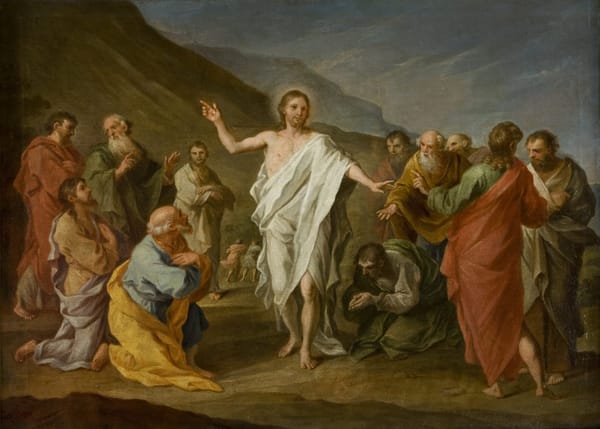
Ch. xxiv.At that time: Jesus stood in the midst of his disciples, and said to them: Peace be to you: it is I, fear not. But they being troubled and frighted, supposed they saw a spirit. And he said to them: Why are you troubled, and why do thoughts arise in your hearts? See my hands and my feet, that it is I myself; handle me and see: for a spirit hath not flesh and bones, as you see me to have. And when he had said this, he showed them his hands and his feet. But while they yet believed not, and wondered for joy, he said: Have you here anything to eat? And they offered him a piece of broiled fish, and a honey-comb. And when he had eaten before them, taking the remains he gave to them. And he said to them: These are the words which I spoke to you while I was yet with you, that all things must needs be fulfilled, which are written in the law of Moses, and in the prophets, and in the Psalms, concerning me. Then he opened their understanding, that they might understand the Scriptures. And he said to them: thus it is written, and thus it behoved Christ to suffer, and to rise again from the dead the third day: and that penance and remission of sins should be preached in his name unto all nations.
Jesus shows himself to all his Apostles, on the evening of the day on which he rose from the grave; and he greets them with the wish of peace. He wishes the same to us, during this feast of the Pasch. He desires to establish peace among us—peace between man and God, peace in the conscience of the repentant sinner, peace between man and man by the forgiveness of injuries. Let us welcome this wish of our risen Lord, and jealously preserve the peace he thus deigns to bring us. At his birth in Bethlehem, the angels announced this peace to men of good will; but now it is Jesus himself who brings it to us, for he has accomplished his work of pacification by dying for us on the Cross. The first word he addresses to his Apostles, and through them to us, is Peace! Let us lovingly accept the blessing, and show ourselves to be, in all things, children of peace.
The conduct of the Apostles, on this occasion, deserves our attention. They believe in their Lord's Resurrection; they eagerly announced the great event to the two disciples of Emmaus: but how weak is their faith! They are troubled and frighted at Jesus' sudden apparition; and when he graciously permits them to handle him, they are overpowered with joy, and yet there is a certain inexplicable doubt still lingering in their minds. Our Lord has to condescend even to eat in their presence, in order fully to convince them that it is really himself and not a phantom. What a strange inconsistency there is in all this! Had they not already believed and confessed the Resurrection of their Master, before receiving this visit? We have a lesson to learn here: it is, that there are some people who believe, but their faith is so weak that the slightest shock would endanger it; they say they have faith, but it is of the most superficial kind. And yet, without a lively and vigorous faith, what can we do in the battle we have to be incessantly waging against the devil, the world, and our own selves? He who wrestles with an enemy is desirous to have a sure footing; if he stand on slippery ground, he is sure to be thrown. Nothing is so common nowadays as unstable faith, which believes as long as there is nothing to try it: but let it be put to the test, and it gives way.
One principal cause of this weakness of faith is that subtle naturalism, which now fills the atmosphere in which we live, and which it is so difficult not to imbibe. Let us earnestly pray for an invincible and supernatural faith, which may be the ruling principle of our conduct, which may never flinch, and may triumph over both our internal and external enemies. Thus shall we be able to apply to ourselves those words of the Apostle St John: ‘This is the victory which overcometh the world, our faith.’9
In the Offertory, the Church speaks to us, in the words of the royal prophet, of the fountains of water which sprang up at the thunder of God’s bidding. This voice of the Most High was made known to the earth by the preaching of the Apostles, and, in a special manner, by that of St Paul. The fountains are the baptismal fonts, from which our neophytes came regenerated unto life everlasting.
Offertory
The Church prays, in the Secret, that the Sacrifice she is about to offer may aid us to pass safely on to that infinite glory to which Baptism first opened to us the way.
Secret
In the Communion Anthem we have St Paul himself speaking to the neophytes, and telling them what manner of life they must henceforth lead, in order to resemble their divine model, their risen Jesus.
Communion
The Church makes the above words of the Apostle the subject of her concluding Prayer: she begs that her new children, who have just partaken of the Paschal Mystery, may persevere in the new life of which this holy Sacrament is the chief support.
Postcommunion
Vespers
The Vespers are the same as on Easter Sunday, excepting the Magnificat Antiphon, and the Collect, which are as follows:
Antiphon of the Magnificat
The Collect is given above, in the Mass, p. 200.
On the third day of the creation, the waters, which covered the earth, were gathered together at the word of the Son of God, and flowed into the hollows prepared for them. The seas thus formed, the surface of the earth became habitable for those beings that were soon to be called forth from nothingness. On this day, then, the angels first beheld the place where we are to have a temporary sojourn. The time will come when this very Son of God, who now separates the waters from the earth, will himself inhabit it, after having assumed our human nature. Let us offer him our earth, as his rightful domain, over which, as also over heaven, all power has been given to him.10 The Mozarabic breviary gives us the following beautiful prayer, in which are explained the mysteries hidden under the text that describes this third day’s creation:
Capitula
Let us again borrow from the ancient Liturgies the formulas used in the celebration of Easter. We find in the Missal of the Gothic Church of Spain this magnificent Preface; it is an eloquent and fervent summary of all the grand things said by the Fathers regarding the Pasch.
Illatio
We subjoin to this Mozarabic Preface a hymn taken from the Roman-French Missal of the Middle Ages. It was a favourite Easter hymn with the people of those days; and though somewhat unpolished, is full of vigour. The chant that accompanied it, and which would fatigue any singer of modem times, is, in spite of its occasional want of smoothness, very melodious and expressive.
Sequence
Rutilat per orbem
Hodie dies in qua
Christi lucida
Narrantur ovanter prælia.
Quem Christus triumphavit pulchre,
Castra
Illius perimens teterrima.
Qua caruimus omnes vita.
Felix proles Mariæ,
Qua epulamur modo una.
Sit celsa
Regina illa,
Generans regem
Spoliantem tartara,
Pollentem
Jam in æthera.
Suscipe benignus
Præconia nostra
Sedule tibi canentia.
Victor ubique,
Morte superata,
Polorum possidens
Gaudia.
O celsa,
O pulchra dementia
Christi melliflua,
O alma.
Qui nostram antiquam
Leviasti sarcinam.
Agni benignissimi
Empta,
Florida
Micat hæc aula.
Qui lavit facinora,
Tribuit dona fulgida.
Jam miror hodierna,
Tanta
Indignus pandere
Modo sacramenta.
Ortus de tribu Juda,
Leo potens surrexisti in gloria.
Agnus visus es in terra.
Regna petens supera:
Justis reddens præmia,
In sæcula
Dignantur ovantia.
Quid valet nunc fraus tua?
Igneis nexus loris
A Christi victoria.
Quis audivit talia
Miracula?
Ut mors mortem sic superaret:
Rei perciperent talem gratiam?
Cur manes adhuc inverecunda?
Respice christicolas,
Qualiter læti canunt inclyta
Redemptori carmina.
Nobis laxans crimina,
Solve nexorum vincula.
Fac tecum resurgere
Ad beatam gloriam,
Digna rependens merita.
through the world
the bright fair day,
whereon are triumphantly told
the splendid combats of Christ.
the haughty enemy,
and routed his most
wicked hosts.
whereby we were all deprived of life!
Happy the fruit of Mary,
whereon we all now feed together!
be that noble
Queen,
The mother of the King,
who robbed hell
of its prey,
And now reigns in heaven above.
graciously receive
the hymns
we devoutly sing to thee.
Universal Conqueror!
thou didst vanquish death,
and enter into the joys
of heaven.
how sublime,
how beautiful,
how sweet,
how tender art thou!
that didst lighten
our heavy weight of old!
of the infinitely merciful Lamb,
the Church glitters
with the ruby flowers
of her redemption.
washed away our sins,
loads us with precious gifts.
of this day's wonders,
I am unworthy
to proclaim
its great mysteries.
Child of the tribe of Juda!
thou didst rise in glory, a lion in strength.
Thou wast seen on earth as a gentle lamb.
Thou hast ascended to the kingdom above:
And there thou mercifully rewardest
the just with the rewards
of everlasting joy.
what now hath thy craft profited thee?
The victory of Christ
has bound thee fast in fetters of fire.
Who hath heard
of miracles like these?
That death should so conquer death?
That criminals should receive favour like unto this?
hast thou no shame, that thou canst continue so?
See how the Christians rejoice,
singing to the Redeemer
their holy hymns.
forgive us our sins,
loosen our fetters.
may rise with thee to heavenly glory,
and to their just merits
give recompense.
April 2: St. Francis of Paula
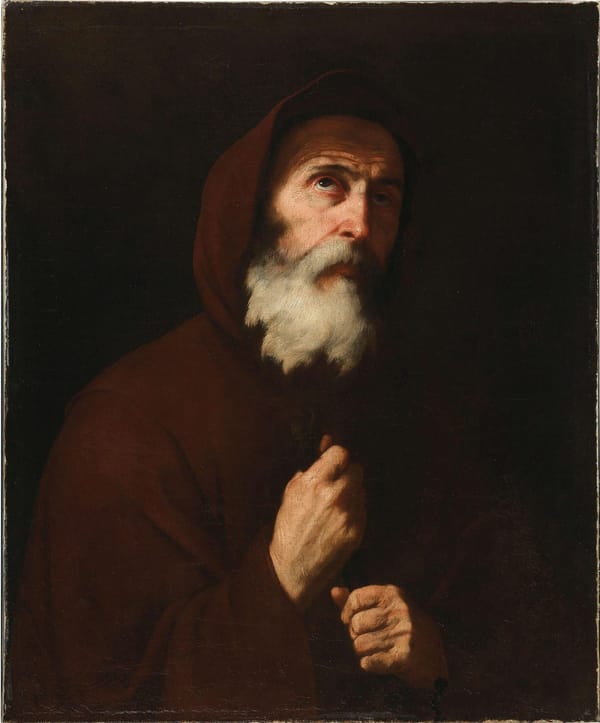 |
The founder of a religious Order, whose distinguishing characteristics were humility and penance, comes before us to-day; it is Francis of Paula. Let us study his virtues and beg his intercession. His whole life was one of great innocence; and yet we find him embracing, from his earliest youth, mortifications which, nowadays, would not be expected from the very worst sinners. How was it that he could do so much? and we, who have so often sinned, do so little? The claims of divine justice are as strong now as ever they were; for God never changes, nor can the offence we have committed against Him by our sins be pardoned, unless we make atonement. The saints punished themselves, with life-long and austere penances, for the slightest sins; and the Church can scarcely induce us to observe the law of Lent, though it is now reduced to the lowest degree of severity.
What is the cause of this want of the spirit of expiation and penance? It is that our faith is weak, and our love of God is cold, because our thoughts and affections are so set upon this present life, that we seldom if ever consider things in the light of eternity. How many of us are like the king of France, who having obtained permission from the Pope that St. Francis of Paula should come and live near him, threw himself at the saint's feet, and besought him to obtain of God, that he, the king, might have a long life! Louis XI. had led a most wicked life; but bis anxiety was, not to do penance for his sins, but to obtain, by the saint's prayers, a prolongation of a career which had been little better than a storing up of wrath for the day of wrath. We, too, love this present life; we love it to excess. The laws of fasting and abstinence are broken, not because the obeying them would endanger life, or even seriously injure health—for where either of these is to be feared, the Church does not enforce her lenten penances—but people dispense themselves from fasting and abstinence, because the spirit of immortification renders every privation intolerable, and every interruption of an easy comfortable life insupportable. They have strength enough for any fatigue that business or pleasure calls for; but the moment there is question of observing those laws which the Church has instituted for the interest of the body as well as of the soul, all seems impossible; the conscience gets accustomed to these annual transgressions, and ends by persuading the sinner that he may be saved without doing penance.
St. Francis of Paula was of a very different way of thinking and acting. The Church gives us the following abridged account of his life:
Apostle of penance: thy life was always that of a saint, and we are sinners: yet do we presume, during these days, to beg thy powerful intercession, in order to obtain of God that this holy season may not pass without having produced within us a true spirit of penance, which may give us a reasonable hope of receiving His pardon. We admire the wondrous works which filled thy life—a life that resembled, in duration, that of the patriarchs, and prolonged the privilege the world enjoyed of having such a saint to teach and edify it. Now that thou art enjoying in heaven the fruits of thy labours on earth, think upon us, and hearken to the prayers addressed to thee by the faithful. Gain for us the spirit of compunction, which will add earnestness to our works of penance. Bless and preserve the Order thou hast founded. Thy holy relics have been destroyed by the fury of heretics; avenge the injury thus offered to thy name, by praying for the conversion of heretics and sinners, and drawing down upon the world those heavenly graces, which will revive among us the fervour of the ages of faith.
April 2 (the Same Day, in Some Dioceses): St. Mary of Egypt, Penitent
One of the most striking examples of penance ever witnessed, is this day proposed for our consideration: Mary, the sinner and penitent of Egypt, comes to animate us to persevere in our lenten exercises. Like Magdalene and Margaret of Cortona, she had sinned grievously; like them she repented, atoned for her guilt, and is now the associate of angels. Let us adore the omnipotence of our God, who thus changed a vessel of dishonour into one of honour; let us lovingly contemplate the riches of His mercy, and hope for our own participation in them. At the same time, let us remember that pardon is not granted save where there is repentance; and that repentance is not genuine, unless it produce an abiding spirit and deeds of penance. Mary of Egypt had the misfortune to lead a life of sin for seventeen years; but her penance lasted forty: and what kind of penance must hers have been, living alone in a desert, under a scorching sun, without the slightest human consolation, and amidst every sort of privation! The pledge of pardon—the holy Communion —which we received so soon after our sins, was not granted to Mary, till she had done penance for nearly half a century. That pledge of Jesus' forgiveness, which He has given us in the Sacrament of His love, and which was communicated to us so promptly, was withheld from this admirable penitent, so that she received it for the second time only at the moment when death was on the point of separating her soul from her body which was worn out by austerities! Let us humble ourselves at such a comparison; let us think with fear on this great truth—that God’s justice will require an exact account of all the graces He has heaped upon us; and with this thought, let us rouse ourselves to a determination to merit, by the sincerity of our repentance, a place near the humble penitent of the desert.
We take the lessons of the Office of St. Mary of Egypt from the ancient Roman-French breviaries:
In praise of our incomparable penitent, we offer to the reader the following beautiful sequence, taken from the ancient missals of Germany:
Sequence
In amplexum Salomonis
Nostri transit filia;
Ex abjecta fit electa,
Ex rugosa fit formosa,
Ex lebete phiala.
Ad dilectum quam conduxit
Pacia nectens fædera;
Matre Dei mediante,
Peccatrici, Christo dante,
Sunt dimissa scelera.
Pervenit in Jerusalem,
Nuptura Pacifico;
Hinc excluso adultero
Maritatur Sponso vero
Ornata mirifico.
Dum laborat, mox redire
Necdum digna cogitur;
Ad cor suum revertitur,
Fletu culpa submergitur,
Fletu culpa teritur.
Leviathan conteritur,
Mundus, caro vincitur,
Domus patris postponitur,
Vultus mentis componitur,
Decor camis spernitur.
Tuia ornata tympanis,
Lauda quondam sterilis,
Gaude, plaude, casta, munda,
Virtutum prole fœcunda,
Vitis meri fertilis.
Umbilicus est præcisus
Tuus continentia;
Aquis lotam, pulchram totam
Te salivit, te condivit
Sponsi sapientia.
Intus tota delibuta
Oleo lætitiæ;
Croco rubene charitatis;
Bysso cincta castitatis,
Zona pudicitiæ.
Dum superna contemplaris,
Mutatis affectibus;
Vestiris discoloribus,
Cubile vernat floribus,
Fragat aromatibus.
Decoravit et amavit
Sic te Christi gratia,
Memor semper peccatorum,
Et cunctorum populorum,
Plaude nunc in gloria.
to the espousals with Jesus,
our true Solomon.
She that was abject, is made a chosen one;
she that was deformed, is made fair;
the vessel of dishonour is made one of honour.
and leading her to her beloved Son,
has knit the bond of peace.
The Mother of God interceded;
Christ forgave;
the sinner’s sins are pardoned.
came to Jerusalem,
to be espoused to the King of peace;
leaving her false lover,
she is united to the true Spouse,
honoured by the wonderful One.
but her unworthiness forbids it;
she is compelled to retire.
Then does she return to her own heart;
she weeps for her sins,
and her weeping blots them out.
tramples on Leviathan;
conquers the world and the flesh;
forgets her father’s house:
neglects the beauty of the body,
that her spirit may be made comely.
Thou, that once wast barren,
take up thy harp, and sing.
Exult and be joyful, for now thou art chaste and pure,
fruitful in virtue,
a vine that yields a precious fruit.
the shame of thy disorders
is effaced by the merit of thy purity.
The wisdom of thy heavenly Spouse has given thee,
cleansed and all fair,
the incorruption of his grace.
thou wast anointed with the oil of gladness.
The scarlet of charity,
the lily of chastity,
the girdle of modesty
—all were upon thee.
for thy affections were changed
from earthly to heavenly things.
Thy vesture was of every richest hue,
and thy couch was decked with flowers,
sweeter than those of spring.
in that Christ so loved thee,
and beautified thee with grace.
Be mindful of us sinners;
pray for all mankind;
feast now in thy eternal glory!
Thou wilt sing for all eternity, O Mary, the mercies of the Lord, who changed thee from a sinner into so glorious a saint; we join thee in thy praises, and we give Him thanks for having shown us so evidently, in thy person, that a true penitent, whatever and how great soever may have been his sins, may not only avoid eternal torments, but merit everlasting bliss. How light must now appear to thee, O Mary, that forty years’ penance, the very thought of which terrifies us! How short a time, when compared with eternity! How insignificant its austerity, if we think of hell! And how rich must its reward seem to thee, now that thou art face to face with infinite Beauty! We, too, are sinners; dare we say that we are penitents? Aid our weakness, O Mary! Thou wast made known to the world at the close of thy hidden life, in order that Christians might learn from thee the grievousness of sin, of which they make so little account; the justice of God, of which they are so apt to form so false an idea; ¿md the goodness of that Father, whom they cease not to offend. Pray for us, O Mary, that we may profit by the instructions given to us so profusely during this holy season. Pray that our conversion may be complete; that we may leave our pride and our cowardice; that we may appreciate the grace of reconciliation with our Maker; and, lastly, that we may ever approach to the holy Table with compunction and love such as thou hadst, when, in thy last happy Communion, Jesus gave Himself to thee in His Sacrament, and then took thee to Himself in the kingdom of everlasting rest and joy.
| Previous Easter Monday | Next April 2: St. Francis of Paula |