Daily reading
Paschal Time
Double · April 11 · Sanctoral
April 11, 2024
From Dom Guéranger’s The Liturgical Year.
A Double leads the weekday.Rubric
 |
April 11: St. Leo the Great, Pope and Doctor of the Church
ONE of the grandest Saints in the Church’s Calendar is brought before us to-day. Leo, the Pontiff and Doctor, rises on the Paschal horizon, and calls for our admiration and love. As his name implies, he is the Lion of Holy Church; thus representing, in his own person, one of the most glorious of our Lord’s titles. There have been thirteen Popes who have had this name, and five of the number are enrolled in the catalogue of Saints; but not one of them has so honoured the name as he whose feast we keep to-day: hence he is called ‘Leo the Great.’
He deserved the appellation by what he did for maintaining the faith regarding the sublime mystery of the Incarnation. The Church had triumphed over the heresies that had attacked the dogma of the Trinity, when the gates of hell sought to prevail against the dogma of God having been made Man. Nestorius, a bishop of Constantinople, impiously taught that there were two distinct Persons in Christ the Person of the Divine Word, and the Person of Man. The Council of Ephesus condemned this doctrine, which, by denying the unity of Person in Christ, destroyed the true notion of the Redemption. A new heresy, the very opposite of that of Nestorianism, but equally subversive of Christianity, soon followed. The monk Eutyches maintained that in the Incarnation the human nature was absorbed by the Divine. The error was propagated with frightful rapidity. There was needed a clear and authoritative exposition of the great dogma, which is the foundation of all our hopes. Leo arose, and, from the Apostolic Chair, on which the Holy Ghost had placed him, proclaimed with matchless eloquence and precision the formula of the ancient faith—ancient indeed, and ever the same, yet ever acquiring greater and fresher brightness. A cry of admiration was raised at the General Council of Chalcedon, which had been convened for the purpose of condemning the errors of Eutyches. ' Peter,' exclaimed the Fathers, ‘Peter has spoken by the mouth of Leo!’ As we shall see further on, the Eastern Church has kept up the enthusiasm thus excited by the magnificent teachings given by Leo to the whole world.
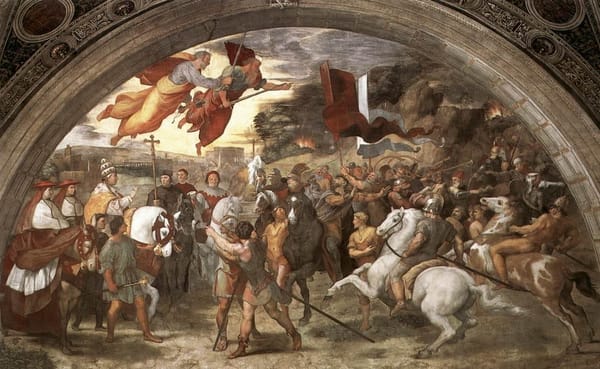
The barbarian hordes were invading the West; the Empire was little more than a ruin: and Attila, ‘the Scourge of God,’ was marching on towards Rome. Leo's majestic bearing repelled the invasion, as his word had checked the ravages of heresy. The haughty king of the Huns, before whose armies the strongest citadels had fallen, granted an audience to the Pontiff on the banks of the Mincio, and promised to spare Rome. The calm and dignity of Leo—who thus unarmed confronted the most formidable enemy of the Empire, and exposed his life for his flock—awed the barbarian, who afterwards told his people that, during the interview, he saw a venerable person standing in an attitude of defence, by the side of Rome’s intercessor: it was the Apostle St Peter. Attila not only admired, he feared the Pontiff. It was truly a sublime spectacle, and one that was full of meaning—a priest, with no arms save those of his character and virtues, forcing a king, such as Attila, to do homage to a devotedness which he could ill understand, and recognize by submission the influence of a power which had heaven on its side. Leo, singlehanded and at once, did what it took the whole of Europe several ages to accomplish in later times.
That the aureole of Leo’s glory might be complete, the Holy Ghost gifted him with an eloquence which, on account of its majesty and richness, might deservedly be called papal. The Latin language had at that time lost its ancient vigour; but we frequently come across passages in the writings of our Saint which remind us of the golden age.
In exposing the dogmas of our holy faith, he uses a style so dignified and so impregnated with the savour of sacred antiquity, that it seems made for the subject. He has several admirable sermons on the Resurrection; and speaking of the present season of the liturgical year, he says: ‘The days that intervened between our Lord's Resurrection and Ascension were not days on which nothing was done: on the contrary, great were the sacraments then confirmed, and great were the mysteries that were revealed.'1
Let us now read the sketch of the Saint’s life given by the Church in the Matins of the feast.
The Greek Church, in her Memea, has an office in honour of St Leo: we take from it the following stanzas. As they were composed before the Schism, they show us that the ancient Church of Constantinople believed the supremacy of the Roman Pontiff, and that it is not the Latins that have changed the faith. The Greeks keep the Feast of St Leo on February 18.
Hymn (Die XVIII Februarii)
Glory be to thee, O Jesus, Lion of the Tribe of Juda! that hast raised up in thy Church a Lion to defend her in those dark times, when holy Faith was most exposed to danger. Thou didst charge Peter to confirm his brethren2 and we have seen Leo, in whom Peter lived, fulfil his office with sovereign authority. We have heard the acclamation of the holy Council, which, in admiration at the heavenly teachings of Leo, proclaimed the signal favour thou didst confer on thy flock, when thou badest Peter feed both sheep and lambs.
O holy Pontiff Leo! thou worthily didst represent Peter in his Chair, whence thy apostolic teaching ceased not to flow, ever beautiful in its truth and majesty. The Church of thine own day honoured thee as the great teacher of faith; and the Church of every succeeding age has recognized thee as one of the most learned Doctors and preachers of the divine word. From thy throne in heaven, where now thou reignest, pour forth upon us the understanding of the great mystery, which thou wast called on to defend. Under thy inspired pen, this mystery grows clear; we see how sublimely it harmonizes with all other mysteries; and faith delights at gaining so close a view of the divine object of its belief. Oh! strengthen this faith within us. The Incarnate Word is blasphemed in our own times; avenge his glory, by sending us men of thy zeal and learning.
Thou didst triumph over barbarian invaders: Attila acknowledged the influence of thy sanctity and eloquence, by withdrawing his troops from the Christian land they infested. In these our days, there have risen up new barbarians—civilized barbarians, who would persuade us that religion should be eliminated from education. and that the State, in its laws and institutions, should simply ignore our Lord Jesus Christ, the King to whom all power has been given, not only in heaven but on earth also.3 Oh! help us by thy powerful intercession, for our danger is very great. Many are seduced, and have fallen into apostasy, whilst flattering themselves that they are still Christians. Pray that the light that is left within us may not be extinguished, and that the public scandals which now exist may be brought to an end. Attila was but a pagan; our modem statesmen and governments are, or at least call themselves, Christians: have pity cn them, and gain for them light to see the precipice to which they are hurrying society.
These days of Paschal Time remind thee, O holy Pontiff! of the Easters thou didst once spend here on earth, when, surrounded by the neophytes, thou gavest them the nourishment of thy magnificent discourses: pray for the faithful, who have this Easter risen to a new life with Christ. What they most need is a fuller and better knowledge of this their Saviour, in order that they may cling more closely to him, and persevere in his holy service. Thy prayers must obtain for them this knowledge; by thy prayers thou must teach them what he is both in his Divine and Human Nature: that as God he is their Last End, and their Judge after death; as Man, their Brother, their Redeemer, their Model. Bless, O Leo! and help the Pontiff who is now thy successor on the Chair of Peter. Show now thy love for that Rome whose sacred and eternal destinies were so frequently the subject of thy glowing and heavenly eloquence.
Thursday of the Second Week after Easter
THE Apostles and holy women are not the only ones to enjoy the presence of our Risen Jesus: a countless people of the just made perfect claim and have the happiness of seeing and reverencing the sacred humanity of their beloved King. The magnificence of the Resurrection has caused us somewhat to forget those venerable captives of Limbo, with whom the soul of our Redeemer spent the hours that elapsed between his Death and Resurrection. They were the friends of God, and were awaiting in Abraham's bosom (as the Scripture expresses it) the dawning of light eternal. From the hour of None (three o'clock) of the great Friday till the daybreak of Sunday, the soul of our Emmanuel abode with these holy prisoners, who were thus put in possession of infinite happiness. But when the hour of his triumph came, how was the Conqueror of Death to leave behind him these souls whom he had enfranchised by his Death and Resurrection? At the moment fixed by the eternal decree, Jesus' Soul passes from Limbo to the sepulchre, and is reunited to his Body; but he is accompanied by a jubilant choir of other souls—the souls of the long-imprisoned Saints.
On the day of the Ascension, they will form his court, and rise together with him; but Heaven’s gate is not yet open, and they must needs wait for these forty days to pass, during which our Redeemer will organize his Church. They are invisible to the eyes of men, but they dwell in the space above this lowly earth, where once they passed their days, and merited an eternal recompense. Adam again sees the land which he had tilled in the sweat of his brow; Abel is in admiration at the power of the divine Blood, which has sued for mercy, whereas his prayed but for vengeance;1 Noe looks upon this globe, and finds it covered with an immense multitude of men, all of whom are descendants of his three sons; Abraham, the father of believers, Isaac also, and Jacob, hail the happy moment when is to be fulfilled the promise which was made to them, that all generations should be blessed in him who was to be bom of their race; Moses recognizes his people, in whose midst the Messias (whom he had announced,2 and who is greater than he),3 has found so few followers and so many enemies; Job, who represents the elect among the Gentiles, is filled with joy at seeing his Redeemer living,4 in whom he had hoped in all his trials; David, fired with holy enthusiasm, is preparing canticles for heaven, grander far than those he has left us, to be sung in praise of the Incarnate God, who has espoused our human nature; Isaias and the other Prophets behold the literal fulfilment of all they had foretold; in a word, this countless army of saints, formed from the elect of all times and countries, is grieved at finding the earth a slave to the worship of false gods; they beseech our Lord, with all the earnestness of prayer, that he would hasten the time for the preaching of the Gospel, which is to rouse from their sleep them that are seated in the shadow of death.
As the elect, when they rise from their graves on the last day, will ascend through the air to meet Christ5 as eagles who gather together wheresoever the body may be;6 so now these holy souls cluster around their divine Deliverer. He is their attraction; seeing him, speaking with him, is truly a heaven on earth to them. Jesus indulges these Blessed of his Father, who are soon to possess the Kingdom prepared for them from the foundation of the world;7 he allows them to follow and accompany him; and thus does he pass the days which are to be spent before that glorious one of his triumphant Ascension.
What must not have been the happiness of the faithful and chaste Joseph in being thus near his adopted Son—his Creator? with what affection must he not have looked upon his virginal Spouse, who has been made, at the foot of the Cross, the Mother of men! Who could describe the delight wherewith Anne and Joachim gaze upon their daughter, the august Mother whom all generations shall call ‘blessed’?8 And John, the Precursor—how must he not have exulted at seeing her, at whose voice he was sanctified in his Mother’s womb, and who has given to the world the Lamb that taketh all sin away! How affectionately must not these ransomed souls have looked upon the Apostles, those future conquerors of the world, who are now being prepared for the combat by their divine Master! It is through them that the earth once brought to the knowledge of the true God will be ever sending up elect ones to heaven until time shall give place to eternity.
Let us to-day honour these hidden but august witnesses of what God's mercy is preparing for the world’s salvation. We shall soon see them ascending to heaven, of which they will take possession in the name of mankind, that has been redeemed by Christ. Let us not forget how, on their way from Limbo to Heaven, they rested with Jesus for forty days on this earth of ours, where they themselves had once lived and merited an eternal crown. Their visit brought a blessing with it; and their departure was the signal for us to follow them—it opened the way to the blissful home, which is one day to be ours!
The following sequence, taken from the Cluny Missal of 1523, is appropriate to the reflections we have just been making:
Sequence
Concio cantica,
Organa subnectens
Hypodorica.
Deo tartarea
Rumpenti, decanta
Nunc symphonia.
Resurgens, gaudia
Mundo gestat colenda.
Mirantes perdita
Cocyti confinia,
Intrante illo
Vita beata.
Tremescit daemonum
Plebs valida.
Fletuum alta:
Repagula
Quis sic audax fregerit,
Mirantur nunc fortia.
Redit cum turma
Gloriosa,
Et timida
Refovet discipulorum corda.
Hujus trophæa
Admirantes,
Flagitamus nunc
Voce decliva.
Mereamur pretiosa
Colere ut pascha:
In qua sacrata
Prae fulgore contueri
Lucis exordia.
O holy choir,
mourning,
but full of hope.
to the divine King,
who has broken down
the gates of hell.
and rising from the tomb,
brings festive joy to the world.
wonder
at the strange event.
he is Eternal Life,
and they see his power.
of demons
tremble with fear,
and weep,
asking each other,
who this may be that dares to break
the massive bolts.
our Lord returns to earth,
surrounded by a glorious troop;
and hastens to console
the timid hearts of his disciples.
who celebrate
his noble victory,
beseech him
in humble prayer,
to celebrate the great Pasch,
in the choir of Virgins.
sanctified by light,
to see
the Source of Light.
| Previous Wednesday of the Second Week after Easter | Next Thursday of the Second Week after Easter |