Daily reading
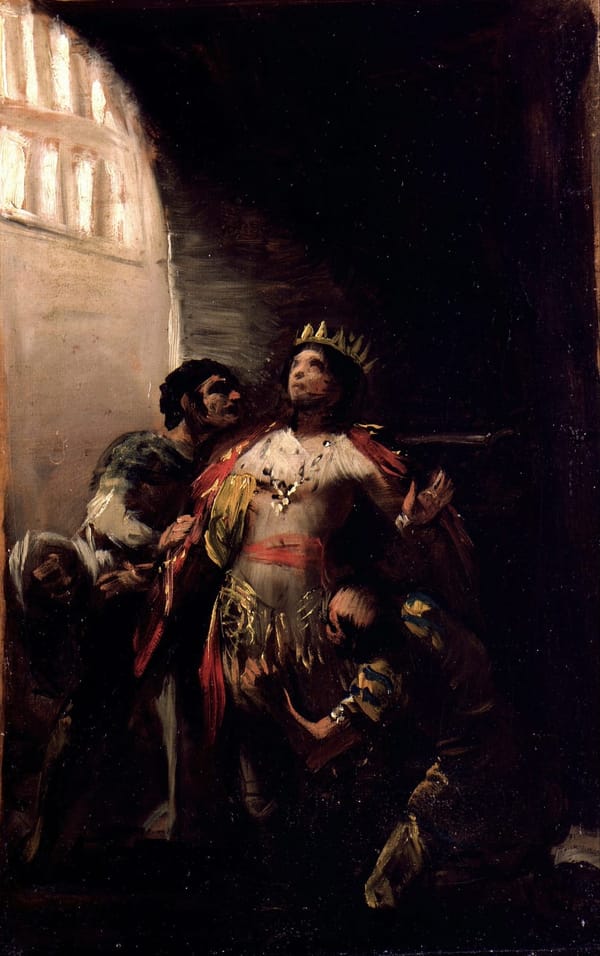
April 13: St. Hermenegild, Martyr
IT is through a martyr's palm-branch that we must to-day see the Paschal Mystery. Hermenegild, a young Visigoth prince, is put to death by his heretical father, because he courageously refused to receive his Easter Communion from an Arian bishop. The martyr knew that the Eucharist is the sacred symbol of Catholic unity; and that we are not allowed to approach the Holy Table in company with those who are not in the true Church. A sacrilegious consecration gives heretics the real possession of the divine Mystery, if the priestly character be in him who dares to offer sacrifice to the God whom he blasphemes; but the Catholic, who knows that he may not so much as pray with heretics, shudders at the sight of the profanation, and would rather die than share by his presence in insulting our Redeemer in that very Sacrifice and Sacrament which were instituted that we might all be made one in God.
The blood of the martyr produced its fruit: Spain threw off the chains of heresy that had enslaved her, and a Council, held at Toledo, completed the work of conversion begun by Hermenegild's sacrifice. There are very few instances recorded in history of a whole nation rising up as one man to abjure heresy; but Spain did it, for she seems to be a country on which heaven lavishes exceptional blessings. Shortly after this she was put through the ordeal of the Saracen invasion; she triumphed here again by the bravery of her children; and ever since then, her faith has been so staunch and so pure as to merit for her the proud title of The Catholic Kingdom.
St Gregory the Great, a contemporary of St Hermenegild, has transmitted to us the following account of the martyrdom. The Church has inserted it in her Lessons of today's Matins.
Pope Urban VIII composed the two following hymns for the feast of the holy martyr: we unite them under one conclusion.
Hymn
Hermenegilde jubar, gloria Martyrum,
Christi quos amor almis
Cœli cœtibus inserit.
Deo Servans obsequium! quo potius tibi
Nil proponis, et arces
Cautus noxia, quæ placent.
Surgentis vitii, non dubios agens
Per vestigia gressus
Quo veri via dirigit!
Non vitæ caperis divitis otio,
Gemmarumve nitore,
Regnandive cupidine.
Nec terret perimens carnificis furor:
Nam mansura caducis
Præfers gaudia cœlitum.
Clemens, atque preces, dum canimus tua
Quæsitam nece palmam,
Pronis auribus excipe.
Et natum celebrent ora precantium,
Divinumque supremis
Flamen laudibus efferant.
Hermenegild, as one of its glories:
so, too, do the martyrs,
whose love of Christ has numbered them among the blessed of heaven.
He was dear to thee above all things else;
and as to the dangerous pleasures of this world,
thou wisely didst reject them.
which excite and foster vice,
and march onwards, with unfaltering step,
whither the path of truth leads.
The luxuries of a life of ease and wealth,
the glitter of diamonds, the prospect of a throne
—they could not allure thee.
nor by the executioner's merciless rage;
for the everlasting joys of heaven
were dearer to thee than those of time.
from thy heavenly throne,
and graciously receive the prayers we present to thee
whilst celebrating the palm made thine by martyrdom.
Let the faithful assembled here in prayer, glorify the Son;
let them sing forth endless praise
to the Holy Ghost.
We offer thee, O brave witness to the truth of our holy faith! our admiration and gratitude. Thy courageous death was proof of the love thou hadst for Christ; and thy contempt of earthly honours teaches us to despise them. Though thou wert heir to a throne, a prison was thy abode here below. It was thence that thou didst ascend to heaven, wearing on thy brow the laurels of martyrdom, a crown far brighter than that which was offered thee on condition of thy apostatizing from the faith. Pray now for us: the Church asks it of thee, by inserting thy name in the Calendar of her Saints. The Pasch was the day of thy triumph; obtain for us that this may be a true Pasch to us, a real resurrection. which may lead us to the heaven above, where we may enjoy with thee the sight of our Risen Jesus. Intercede for us, that we may be firm in the faith, obedient to the teachings of holy Church, and enemies of every error and innovation. Protect Spain, thy fatherland, which owes to thy martyrdom long centuries of loyalty to the true faith. Pray for her, that she may ever continue to merit her glorious title of Catholic Kingdom.
Saturday the Second Week after Easter
THIS being Saturday, let us once more think of Mary, and of the joy she feels at the Resurrection of her Son. She had been his companion in his sufferings; there was not one that she had not endured, and suffered as far as a mere creature could suffer: so, too, there is not a single glory or gladness of the Resurrection in which she is not now made to participate. It was meet that she, to whom God had granted the grace and merit of sharing in the work of the Redemption, should take her part in the prerogatives which belong to her Jesus, now that he is risen. Her soul is raised to a higher state of perfection; grace loads her with new favours; her actions and sentiments become more than ever heavenly.
She was the first to receive a visit from Jesus after his Resurrection—the first, consequently, to receive from him his own new life. Can we be astonished at her receiving it when we remember that every Christian, who, being purified by his having compassionated with Jesus in his Passion, unites himself afterwards with holy Church, in the sublime mystery of the Pasch, becomes a sharer in the life of his risen Lord? This transformation, which in us is weak, and often, alas! of short duration, was perfect in Mary, for her high vocation and her incomparable fidelity deserved that it should be so; of her, then, far more truly than of us, it may be said that she was indeed risen in her Jesus. The thought of these forty days, during which Mary still possesses her divine Son on this earth, reminds us of those other forty of Bethlehem, when we paid our affectionate homage to the young Virgin-Mother who fed her divine Babe at her breast; we heard the angels singing their Gloria, we saw the shepherds and the Magi; all was exquisite sweetness. What mainly impressed us then was the humility of our Emmanuel; we recognized him as the Lamb that had come to take away the sins of the world; there was nothing that betokened the Mighty God. What changes have happened since that dear time! What sorrows have pierced Mary's heart before her reaching this blissful season of Paschal joy! The sword foretold by Simeon is now, indeed, sheathed, yea, broken for ever, but oh! how sharp and cruel have been its thrusts! Well may Mary now say with the Psalmist: According to the multitude of my sorrows in my heart, thy comforts, O Lord, have given joy to my soul!1 The Lamb, the gentle little Lamb, has become the Lion of the tribe of Juda; and Mary, the Mother of the Babe of Bethlehem, is equally the Mother of the glorious Conqueror.
With what delight does he not show the glories of his victories to his Mother! His work is done, and now he is the beautiful crowned King of Ages; yes, this is he whom she held for nine months within her womb, whom she fed at her breast, and who, for all eternity, will honour her as his Mother. He honours her during these last forty days on earth with every possible mark of affection; he satisfies her maternal love by frequently visiting her. How admirable must not these interviews be between such a Son and Mother! How delightedly must not Mary look upon her Jesus now? the same dear one, it is true, but oh! so changed from what he was a few days ago! That face, so familiar to Mary, beams with a light which is new even to her. The Wounds that remain in his hands, feet, and side, dart forth a brightness which effaces every recollection of sadness. But how shall we speak of the joy wherewith Jesus gazes upon Mary, his Immaculate Mother—his companion in the work of man’s salvation—the creature who is more perfect and more worthy of love than all other creatures put together? Who could describe the conversations of such a Son with such a Mother, during these days preceding his Ascension, when another long separation is to follow? Eternity will tell us what they were; but, even now, if we love the Son and the Mother, we can imagine some little of what passed between them. Jesus would offer to Mary some compensation for the prolongation of her stay on earth, which is required of her by her ministry as Mother of men; more privileged than was heretofore Martha’s sister, she hears his every word, and feeds on its sweetness in an ecstasy of love. O happy hours, to be followed by long years of absence, flow slowly by! Give this blessed Mother time to satiate her love with the sight and caresses of this dearest and most beautiful of the sons of men! O Mary! by these hours of joy which repaid thee for those long bitter ones of thy Jesus’ Passion, pray to him for us, that he permit us to feel and relish his presence in our hearts during this our exile, wherein we are absent from him.2 Thus shall we persevere in our devoted service until the arrival of that blissful moment when we are to be united with him in heaven, never again to be separated from him.
Let us offer to the blessed Mother this beautiful sequence, wherewith the Churches of Germany used formerly to celebrate her Seven Joys, of which the Resurrection was one of the grandest.
Sequence
Deus summæ bonitatis et misericordiæ,
Qui tuae humilitatis
Et dulcorem suavitatis vidit et fragrantiæ.
Cum per angelum mandatur tibi salus gratiæ;
Modum quæris, demonstratur,
Dum consentis, incarnatur confestim rex gloriæ.
Ut hunc regem mereamur habere propitium,
Et ab eo protegamur,
Protecti recipiamur in terra viventium.
Quod tu solem stella paris, velut luna radium;
Pariendo non gravaris,
Virgo manes, non mutaris propter puerperium.
Suum non perdit decorem, cum odor emittitur;
Sic nec propter creatorem
Virginitatis candorem tu perdis, cum nascitur.
Esto nobis recta via apud tuum fiilium,
Atque pro tua gratia
Repelle nostra vitia per secundum gaudium.
Stella monet, quam morari vides super filio
Cum a magis adorari
Ipsum cernis et ditari munere tam vario.
Tresque reges trinitatem in dicto sacrificio;
Aurum mentis puritatem,
Myrrha carnis castitatem, thus est adoratio.
A peccatis simus mundi per te, Virgo Maria,
Et virtutibus fœcundi,
Læti tecum et jocundi, lætemur in patria.
Cum a morte suscitatur Christus die tertia.
Per hoc fides roboratur,
Spes redit et mors fugatur per te, plena gratia;
Homo captus liberatur,
Et ab humo sublevatur
Sursum ad coelestia.
Funde preces cunctis horis, ut per istud gaudium,
Post cursum hujus laboris,
Beatis jungamur choris supernorum civium.
Ascendentem dum vidisti filium in gloria.
Tunc aperte cognovisti
Quod tu mater exstitisti, cujus eras filia.
Via, per quam ascendatur ad cœli palatia;
Ergo surgat et sequatur
Istam viam, qui moratur in mundi miseria.
Ne subjici valeamus dæmonis imperio;
Sed ad coelos ascendamus,
Ubi semper gaudeamus, tecum et cum filio.
De supernis qui descendit in linguis Paraclitus,
Dum confirmat et defendit,
Replet, mundat et accendit Apostolos penitus,
Ut per ignem sit sanatus homo linguis perditus,
Et per ignem emendatus
Qui fuerat maculatus per peccatum primitus.
Ora, Virgo, tuum natum, ut in hoc exilio
Nostrum deleat reatum,
Ne sit in nobis peccatum in magno judicio.
Cum de mundo te vocavit Christus ad coelestia,
Super thronos exaltavit,
Exaltatam honoravit speciali gratia.
Qui nemini reservatur in coelesti curia;
Nec virtutibus ditatur,
Nisi cui per te datur virtutum custodia.
Sentiamus bonitatis tuæ beneficia;
Et nos serves a peccatis,
Et perducas cum beatis ad aeterna gaudia.
A peccatis nos emunda per haec septem gaudia;
Et fœcunda nos fœcunda,
Et duc tecum ad jocunda Paradisi gaudia.
the God of all goodness and mercy,
being pleased with the loveliness of thy humility,
meekness, and purity, is announced as having to be born of thee.
by the angel who hails thee full of grace.
Thou askest how? and thou art told.
Thou consentest: and the King of glory instantly becomes incarnate in thy womb.
that we may deserve to receive mercy from this King,
be protected by him, and, thus protected,
be admitted into the land of the living.
the Star, givest birth to the Sun, as the Moon emits its ray.
This birth injures thee not;
thou remainest a Virgin as before.
by sending forth its fragrance;
so neither losest thou the bloom of thy Virginity
by giving birth to thy Creator.
be to us the way that leads to thy Son;
and, by thy second Joy,
graciously intercede for us, that we be converted from our sins.
Thou seest a star resting over thy Child,
the Magi adoring him,
and offering their varied gifts.
three Kings, Trinity;
the gold signifies purity of soul;
the myrrh, chastity of body; the incense, adoration.
pray for us, that we may be cleansed from our sins,
enriched with virtue, and united with thee
in the happiness and bliss of the heavenly Country.
when Jesus rose from the tomb, on the third day.
By this Mystery, faith is strengthened, hope restored, and death put to flight;
and thou, O full of grace, hadst thy share in effecting these wonders.
Man, who had been made captive, is set free,
and raised from earth
to heaven above.
pray hourly for us, that, by this Joy,
we may be associated with the choirs of the heavenly citizens,
after this life’s labours are over.
when thou wast present at thy Son’s Ascension into heaven.
Then didst thou clearly know
that he whose Mother thou wast was thy Creator.
the path whereby we are to ascend to heaven.
Let us then, who dwell in this miserable world,
arise, and follow this path.
to pray that we may never be made subject to Satan’s power;
but that we ascend to heaven,
where, with thee and thy Son, we may rejoice for all eternity.
was when the Holy Ghost descended, in the form of fiery tongues, from heaven,
strengthening, defending,
filling, cleansing, and inflaming the Apostles.
that man, who owed his perdition to a tongue,
might be saved by such fire; and that he who, at the beginning,
had been defiled by sin, might by fire be purified.
intercede for us to thy Son,
that he pardon us our sins, now in this our exile,
lest there be found guilt upon us at the great judgement.
when he called thee out of this world to heaven,
placed thee on thy throne,
and honoured thee with special favours.
such as none of the blessed in heaven enjoy;
nor can any mortal attain to the perfection of virtue,
unless by thine intercession he receive the safeguard of virtue.
give us to feel the proofs of thy loving intercession,
which will preserve us from sin,
and lead us to eternal joys, in the company of the Blessed.
pray that we may be purified from our sins;
and, being made fruitful in good works,
lead us, O fruitful Mother, to the blissful joys of heaven.
| Previous Friday of the Second Week after Easter | Next Saturday the Second Week after Easter |