Daily reading
Paschal Time
Double · Movable from Easter · Temporal
April 14, 2024
From Dom Guéranger’s The Liturgical Year.

|
Second Sunday after Easter
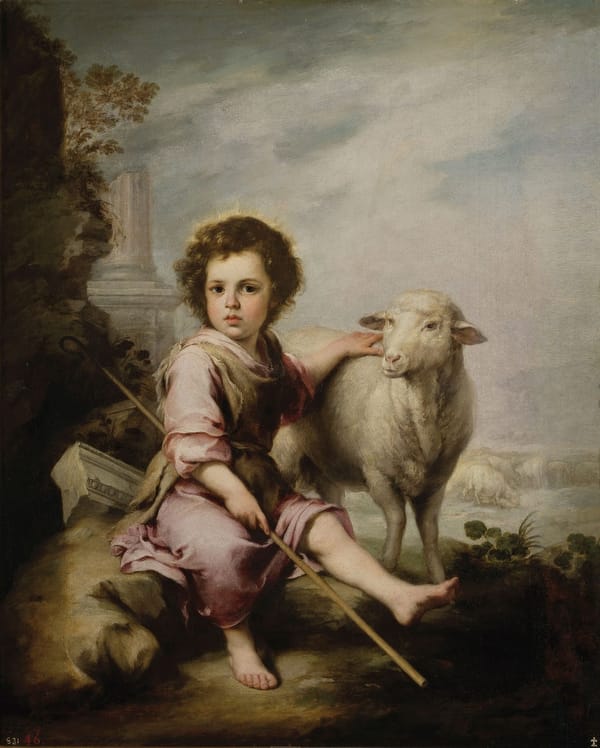
THIS Sunday goes under the name of Good Shepherd Sunday, because in the Mass there is read the Gospel of St John, wherein our Lord calls himself by this name. How very appropriate is this passage of this Gospel to the present season, when our divine Master began his work of establishing and consolidating the Church, by giving it the pastor, or shepherd, who was to govern it to the end of time!
In accordance with the eternal decree, the Man-God, on the fortieth day after his Resurrection, is to withdraw his visible presence from the world. He is not to be again seen upon the earth till the last day, when he will come again to judge the living and the dead. And yet he could never abandon mankind, for which he offered himself on the Cross, and delivered from death and hell by rising triumphantly from the grave. He will continue to be its Head after his Ascension into heaven: but what shall we have on earth to supply his place? We shall have the Church. It is to the Church that he will leave all his own authority to rule us; it is into the hands of the Church that he will entrust all the truths he has taught; it is the Church that he will make the dispenser of all those means of salvation which he has destined for the world.
This Church is a society, unto which all mankind is invited. It is composed of two classes of members; the governing and the governed; the teaching and the taught; the sanctifying and the sanctified. This society is the Spouse of Christ; it is by her that he produces his elect. She is the one only Mother of the elect; out of her bosom there is no salvation.
But how is this society to subsist? how is it to persevere through the long ages of time, even to the last day? who is to give it unity and adhesion of its parts? what is to be the visible link between its members—the palpable sign of its being the true Spouse of Christ, in the event of other societies rising up and disputing her titles? If Jesus himself could have remained with us we should have had nothing to fear, for where he is, there also are truth and life; but, as he says, he is going, and we may not as yet follow him. Give ear, then, and learn what is the primary quality of the true Spouse of Christ.
Jesus was one day, previous to his Passion, in the country of Cesarea Philippi; his Apostles were standing around him, and he began questioning them about what they thought of him. One of them, Simon the son of John or Jonas, and brother to Andrew, answered in the name of all, and said: Thou art Christ, the Son of the living God!1 Jesus expressed his pleasure at receiving Simon’s testimony, which was not the result of any human knowledge, but the expression of a divine revelation there and then granted to him; and he immediately told this Apostle that from that time forward he was to be, not Simon, but Peter (which means a rock). Christ had been spoken of by the prophets under the name of a Rock, or Stone;2 by thus solemnly conferring upon his disciple a title so characteristically that of the Messias, Jesus would give us to understand that Simon was to have something in common with himself which the other Apostles were not to have. After saying to him: ‘Thou art Peter (that is, thou art the rock), he added:' And upon this rock I will build my Church.’3
Let us weigh the force of these words of the Son of God: I will build my Church. He has, then, a project in view—he intends to build a Church. It is not now that he will build it, but at some future period; but one thing we already know as a certainty—it is that this Church will be built on Peter. Peter will be its foundation; and whosoever is not on that foundation will not belong to the Church. Let us again give ear to the text: And the gates of hell shall not prevail against my Church. In scriptural language gates signify powers: the Church of Christ, therefore, is to be proof against all the efforts of hell. And why? Because the foundation which Jesus is to give to it shall be one that no power can shake. The Son of God continues: And I will give to thee the keys of the kingdom of heaven. In the language of the Jews, keys signify the power of governing; and in the Gospel Parables the kingdom of heaven is the Church built by Christ. By saying to Peter (which is henceforth to be Simon’s name), I will give to thee the keys of the kingdom of heaven, Jesus implied this: ‘I will make thee the King of my Church, of which thou art to be the foundation!’ Nothing could be clearer. But let us remember that all these magnificent promises regard the future.4
That future has now become the present. We are now come to the last days of Jesus’ visible presence here below. The time is come for him to make good his promise, and found the kingdom of God—that Church which he was to build upon the earth. The Apostles, in obedience to the order sent them by the angels, are come into Galilee. Our Lord appears to them on the shore of the lake of Tiberias: after providing them with a mysterious repast, and whilst they are all attentive to his words, he suddenly addresses himself to Peter: Simon, son of John, lovest thou me?5 Observe, he does not call him Peter; he, as it were, goes back to the day when he said to him: Simon, son of Jonas, thou art Peter; he would have his disciples note the connection between the promise and its actual fulfilment. Peter, with his usual eagerness, answers his Master’s question: Yea, Lord, thou knowest that I love thee. Jesus resumes, with a tone of authority: Feed my lambs! Then repeating the question, he says: Simon, son of John, lovest thou me? Peter is surprised at his Master’s urging such an inquiry; still he answers with the same simplicity as before: Yea, Lord, thou knowest that I love thee: and as soon as he has given answer, Jesus repeats the words of investiture: Feed my lambs!
The disciples respectfully listen to this dialogue; they see plainly that, here again. Peter is made an object of Jesus’ partiality, and is receiving something which they themselves are not to receive. They remember what happened at Cesarea Philippi and how. ever since that day, Peter has been treated by their Master with especial honour. And yet there is another privilege or office to be added to this of feeding the lambs. A third time, then, Jesus says to Peter: Simon, son of John, lovest thou me? This is too much for the Apostle. These three questionings of his love bring to his mind the three denials he had so sinfully made to the servant girl of Caiphas. He feels the allusion to his recent infidelity; and this third time, his answer implies a prayer for forgiveness; his reply bespeaks humility rather than assurance: Lord! says he, thou knowest all things! Thou knowest that I love thee! Then, making Peter’s authority complete, Jesus pronounces these imposing words: Feed my sheep!6
Here, then, we have Peter made shepherd by him who says of himself: I am the good Shepherd. Firstly, our Lord gives his Apostle, twice over, the care of his lambs; this does not make him the complete shepherd: but when he bids him feed his sheep too, the whole flock is subjected to his authority. Now, therefore, let the Church show herself, let her take her stand, let her spread herself through the length and breadth of the nations; Simon, the son of John, is proclaimed its visible head. Is the Church a building? he is the foundation-stone, the Petra, the rock. Is she a kingdom? he holds the keys, that is, the sceptre. Is she a fold? he is the shepherd.
Yes, this Church, which Jesus is now organizing, which is to be proclaimed to the world on the day of Pentecost, is to be a fold. The Word, the Second Person of the blessed Trinity, is come down from heaven, that he may gather together in one the children of God that were dispersed;7 and the time is at hand when there shall he but one fold and one shepherd.8 O Jesus! our divine Shepherd! we bless thee, we give thee thanks. It is by thee that the Church thou art now founding subsists and lives through every age, congregating and saving all that put themselves under her guidance. Her authority, her strength, her unity, all come from thee, her infinitely powerful and merciful shepherd! We likewise bless and thank thee that thou hast secured this authority, this strength, this unity, by giving us Peter as thy Vicar, Peter our shepherd in and by thee, Peter to whom all, both sheep and lambs, owe obedience, Peter in whom thou, our divine Head, wilt be for ever visible, even to the end of the world!
In the Greek Church, the second Sunday after Easter, which we call Good Shepherd Sunday, goes under the appellation of the Sunday of the holy Myrophorœ, that is Perfume-Bearers. The Office celebrates the devotion of the holy women who brought their perfumes to the sepulchre, that they might embalm the Body of Christ. Joseph of Arimathea is also commemorated in the Greek Liturgy of this week.
The Roman Church reads the Acts of the Apostles in her Matins, from last Monday to the third Sunday after Easter exclusively.
Mass
The Introit takes a tone of triumph. It celebrates in the words of the Royal Psalmist the mercy of the Lord, which by the foundation of the Church has filled the whole earth. The heavens (by which, in the mysterious language of the Scripture, is frequently meant the Apostles), were firmly established by the Word of the Lord, when Jesus (the Word) gave them Peter as their shepherd and their rock.
Introit
Ps. Exsultate justi in Domino: rectos decet collaudatio.℣. Gloria Patri.
Misericordia.
Ps. Rejoice in the Lord, O ye just! Praise becometh the upright.℣. Glory, etc.
The earth, etc.
In the Collect, the Church asks the grace of holy Joy for her children: it is the spirit of Eastertide. Surely, it is a duty to rejoice at our having been saved from death by our Jesus' Resurrection! Moreover, these Paschal joys are a preparation for those of eternity.
Collect
To this are added two of the following Collects:
Of the Blessed Virgin
Against the Persecutors of the Church
For The Pope
Epistle
1 Cap. ii.Charissimi, Christus passus est pro nobis, vobis relinquens exemplum, ut sequamini vestigia ejus. Qui peccatum non fecit, nec inventus est dolus in ore ejus: qui quum malediceretur, non maledicebat, quum pateretur, non comminabatur: tradebat autem judicanti se injuste: qui peccata nostra ipse pertulit in corpore suo super lignum: ut peccatis mortui, justitiae vivamus: cujus livore sanati estis. Eratis enim sicut oves errantes, sed conversi estis nunc ad pastorem et episcopum animarum vestrarum.
1 Ch. ii.Dearly beloved: Christ also suffered, leaving you an example, that you should walk in his steps. Who did no sin, neither was guile found in his mouth. Who, when he was reviled, did not revile; when he suffered, he threatened not: but delivered himself to him that judged him unjustly: who his own self bore our sins in his body upon the tree: that we being dead to sins, should live to justice: by whose stripes you were healed. For you were as sheep going astray; but you are now converted to the shepherd and bishop of your souls.
It is the prince of the Apostles, the visible shepherd of the universal Church, who addresses these words to us. Observe how he ends by turning our thoughts to the invisible shepherd, whose Vicar he is; and how carefully he avoids any allusion to himself. So, also, when assisting his disciple Mark to write his Gospel, he would not allow him to relate the history of Christ's having made him the shepherd of the whole flock; whereas, he insisted on his telling every circumstance of his thrice denying Jesus to be his Master. See, too. how feelingly the Apostle here speaks of his Saviour—of the sufferings he endured, of his patience, of his devotedness for those poor straying sheep of whom he was to form his fold! These words will one day be verified in Peter himself. The hour will come when, like his Master, he will be fastened to a cross, and patiently endure every insult and cruelty. Jesus told him that it was to be so. After entrusting him with the care of the sheep and lambs, our Lord told him that when he should have grown old, he would stretch forth his hands upon a cross, and suffer violence from men.9 This is to happen not merely to Peter, but to a considerable number of his successors, who are one with himself, and whom future generations are to see continually persecuted, exiled, imprisoned, and put to death. Let us also follow Jesus' steps, by cheerfully suffering for justice’ sake: we owe it to him who from all eternity, being equal in glory to God the Father, deigned to come down to our earth that he might be the shepherd and bishop of our souls.
The first Alleluia Versicle commemorates the repast at Emmaus: in a few moments we also shall know Jesus in the breaking of the Bread of Life.
The second proclaims, in Jesus’ own words, the dignity and qualities of a shepherd, his love for his sheep, and the eagerness wherewith his sheep recognize him as their Master.
Alleluia.℣. Ego sum Pastor bonus; et cognosco oves meas, et cognoscunt me meæ, alleluia.
Alleluia.℣. I am the good Shepherd, and I know my sheep, and my sheep know me, alleluia.
Gospel
Cap. x.In illo tempore: Dixit Jesus Pharisæis: Ego sum Pastor bonus. Bonus pastor animam suam dat pro ovibus suis. Mercenarius autem et qui non est pastor, cujus non sunt oves propriae, videt lupum venientem, et dimittit oves, et fugit: et lupus rapit et dispergit oves: mercenarius autem fugit, quia mercenarius est, et non pertinet ad eum de ovibus. Ego sum Pastor bonus: et cognosco oves meas, et cognoscunt me meae. Sicut novit me Pater, et ego agnosco Patrem: et animam meam pono pro ovibus meus. Et alias oves habeo, quæ non sunt ex hoc ovili: et illas oportet me adducere, et vocem meam audient, et fiet unum ovile, et unus pastor.
Ch. x.At that time: Jesus said to the Pharisees: I am the good Shepherd. The good shepherd giveth his life for his sheep. But the hireling, and he that is not the shepherd, whose own the sheep are not, seeth the wolf coming, and leaveth the sheep, and flieth, and the wolf catcheth, and scattereth the sheep: and the hireling flieth, because he is a hireling: and he hath no care for the sheep. I am the good Shepherd: and I know mine, and mine know me. As the Father knoweth me, and I know the Father: and I lay down my life for my sheep. And other sheep I have, that are not of this fold: them also I must bring, and they shall hear my voice, and there shall be one fold, and one shepherd.
Divine Shepherd of our souls! how great is thy love for thy sheep! Thou givest even thy life to save them. The fury of wolves does not make thee flee from us; thou becomest their prey, that we may escape. Thou didst die in our stead, because thou wast our Shepherd. We are not surprised at thy requiring from Peter a greater love than thou didst require from his brother Apostles: thou didst will to make him their and our shepherd. Peter answered thee without hesitation, that he loved thee; and thou didst confer upon him thine own name, together with the reality of thine office, in order that he might supply thy place after thy departure from this world. Be thou blessed, O divine Shepherd! for thy having thus provided for the necessities of thy fold, which could not be one, were it to have many shepherds without one supreme shepherd. In obedience to thy command, we bow down before Peter, with love and submission; we respectfully kiss his sacred feet; for it is by him that we are united to thee; it is by him that we are thy sheep. Preserve us, O Jesus, in the fold of Peter, which is thine. Keep far from us the hireling who usurps the place and rights of the shepherd. He has intruded himself, or been intruded by violence, into the fold, and would have us take him as the master; but he knows not the sheep, and the sheep do not know him. Led, not by zeal, but by avarice and ambition, he flieth at the approach of danger. He that governs through worldly motives is not a man to lay down his life for others. The schismatic pastor loves himself; he does not love thy sheep; how could he give his life for them? Protect us, O Jesus, from this hireling! He would separate us from thee, by separating us from Peter, whom thou hast appointed thy Vicar; and we are determined to recognize no other. Anathema to him who would command as in thy name, and yet not be sent by Peter! Such a pastor could be but an impostor; he would not rest on the foundation; he would not have the keys of the kingdom of heaven; to follow him would be our ruin. Grant, then, Good Shepherd, Jesus! that we may ever keep close to thee and to Peter; that as he rests upon thee, we may rest upon him; and thus we may defy every tempest, for thou, dear Lord, hast said: A wise man built his house upon a rock; and the rain fell, and the floods came, and the winds blew, and they beat upon that house, and it fell not; for it was founded on a rock.10
The Offertory is an aspiration to God. taken from the royal Prophet.
Offertory
In the Secret, the Church prays that the divine energy of the Mystery, about to be consummated on the Altar may produce within us the effect for which we long—death to sin. and resurrection to grace.
Secret
To this the priest adds two of the following Secrets.
Of the Blessed Virgin
Against The Persecutors Of The Church
For the Pope
The Communion Anthem speaks to us of the beautiful Mystery of to-day—the Good Shepherd. Let us once more offer our homage to the Son of God, who deigns to assume this endearing character; and let us ever be his devoted sheep.
Communion
Jesus, the Good Shepherd, has given himself, in this divine banquet, to his sheep: holy Church prays, in the Postcommunion, that we may ever be penetrated with sentiments of love for this august Sacrament; we ought to glory in it, as being the food that prepares us for immortality.
Postcommunion
To this the priest adds two of the following Postcommunions.
Of the Blessed Virgin
Against the Persecutors of the Church
For the Pope
Vespers
The Psalms, Hymn and Versicle are given on pages 81-90.
Antiphon of the Magnificat
Oremus.
We will close the day with this beautiful preface taken from the Mozarabic Missal. It commemorates the Resurrection.
Illatio
(Feria vi Paschœ)
April 14: St. Justin Martyr
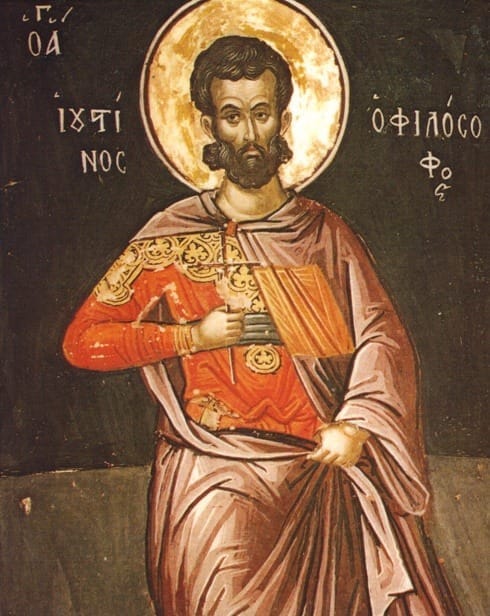 |
YESTERDAY Spain sent one of her princes to represent her at the court of the Conqueror of Death. To-day Christ receives with equal honour the representative of learning in the service of religion. The philosopher’s mantle worn by Justin is as splendid as the royal purple of Hermenegild, for both prince and philosopher have washed their robes in their own blood, mingled with that of the Lamb, and these robes have become the insignia of their eternal glory. But the victory of Christ’s champions is not felt in heaven only—the blood of the martyrs makes the very earth fruitful. In spite of heresy, Catholic Spain was born from the royal blood of Hermenegild, and paganism, by sacrificing Justin to its own hatred, inspired new vigour into the seed sown in Rome by SS Peter and Paul. On this very day the sacred cycle brings before us SS Valerian, Tiburtius, and Maximus, the glorious triumvirate won to Christ by the immortal Cecily, who embodies so nobly the Roman faith defended with such love and learning by Justin. When she was born. Justin’s public disputations with the adversaries of Christianity were filling Rome with his victorious refutations of paganism. His writings, which he boldly caused to penetrate even to the imperial throne, carried the light to regions which he could not reach by his spoken word. The lictor’s axe, in striking off the head of the apologist, gave more force to his demonstrations than had been given by his powerful logic, when for the first time he overcame the powers of hell and put an end to a fierce persecution.
The world, courted on all sides by a thousand different schools, which by their contradictions seemed bent on making the discovery of truth impossible, was now in a position to recognize sincerity. Marcus Aurelius had succeeded Antoninus Pius, and he claimed to enthrone philosophy in his own person. His ideal of perfection was the satisfaction of self and the contempt of others, and he passed from dogmatic scepticism to the establishment of the Moral Law, delivering his ‘Thoughts ‘to the admiration of his courtiers without caring for the reformation of their morals. Justin, had been seeking truth from boyhood, in order to find justice. He was not discouraged by the ill-success of his early efforts, and did not make the delay of the dawn an excuse for denying the existence of the light. When, at God's chosen time, he found Wisdom, he longed to communicate her to all, little and great, and devoted his life to the work, making naught of the labours and sufferings by which he solemnly confessed his faith before the world. What man of good faith could hesitate to choose between the Christian hero and the crowned sophist who put him to death? Who would not, like Cecily, pour scorn upon the pretensions of those false philosophers who have made themselves masters of the world and who give no proof of their love for wisdom beyond their determination to shut the mouths of those who preach it?
Philosophy, baptized in the blood of this convert, is henceforward Christian for ever. Her distressing sterility is at an end. The testimony of martyrdom which she has now given to truth in token of faithful service, atones for all the monstrous offences of her early years. She will always be distinct from faith, but henceforth she will be the helpmeet of this heavenly virtue. Human reason will be strengthened by the alliance and will be able to arrive at trustworthy conclusions. But woe to reason if she forgets her consecration to Christ, ignores the mystery of the Incarnation, and declares herself satisfied with a purely natural explanation of the origin of man, the end of creation, and the Moral Law. The natural light, which enlightens every man that comes into the world, is unquestionably from the Word, and that is its glory. But since the divine Word, in addition to the honour thus done to reason, has given to humanity a higher and more direct manifestation of himself, he does not intend that man should divide his gifts, leave on one side the faith which prepares the way for vision, and content himself with the gleam of light which would have been sufficient for the state of pure nature. The Word is one, as man, to whom he manifests himself, is one; and this manifestation is made at one and the same time, though in different ways, namely, by reason and faith. If man withdraws himself from the supernatural light, he will be rightly punished by the withdrawal of that natural light, which he thought to be his own, and the world will be plunged into unreasoning foolishness.
Let us read the account given by the Church of the martyr philosopher and give glory to our Risen Lord, whose triumph is enhanced by the consecration to him of all the glory gained by men.
We hail in thee, O Justin, one of the noblest trophies of the divine Conqueror of Death. Thou wast bom in the kingdom of darkness, but thou didst early seek to break the chains of falsehood which bound thee like so many others. Thou didst love Wisdom even before thou didst know her, and she too had chosen thee.1 But she ‘will not enter into a malicious soul, nor dwell in a body subject to sins.’2 Many men seek to hide their self-love under the beautiful name of Philosophy, and to find in her an excuse for all their vices; but thou didst seek for knowledge out of a desire to know and love the truth and obey her laws. This purity of heart and mind brought thee near to God and made thee worthy to meet in the ways of life the living Wisdom whom thou art now enjoying in the full light of eternity.3 The Church has honoured thee, and rightly, with the name of the Admirable Philosopher, for thou wast the first to realize that a Philosophy which is worthy of the name—a true love of wisdom—cannot confine its researches within the abstract domain of pure reason; for reason is only the gateway into those higher regions where Wisdom reveals herself in person to the love that seeks her with a sincere heart.
It is written of souls like thee that ‘the multitude of the wise is the welfare of the whole world.’4 But true philosophers who, like thee, understand that the aim of the wise man is to attain to the vision of God5—to reach the most holy God by the way of obedience6—are rare in .these days. The independence of reason is the only dogma on which the sophists of the present day are agreed. Their sect is characterized by a false eclecticism, which allows each one to make his own system and choose what most appeals to him out of the positive affirmations of different schools and religions. Thus they proclaim that reason, though supreme in their eyes, has so far produced no trustworthy conclusions, and that the last word of science is scepticism or universal doubt. It is hardly becoming for such men to reproach the Church with despising reason. On the contrary, the Church has but lately, in the Vatican Council,7 emphasized and exalted the mutual help rendered by faith and reason in leading men to God, and she casts out of her fold those who deny to human reason the power to affirm with certainty the existence of God our Lord and Creator. When seeking to define in these days the respective value of faith and reason, without either separating or confusing them, the Church had but to listen to the testimony of Christian philosophers in all centuries, beginning with thee, for their works, which complete one another, are full of this dcctrine.
Thou wast as faithful as thou wert brave, O valiant martyr! In thy day the Church had not been forced by contests with heresy to seek for new terms of expression whose very precision soon became indispensable, but thy writings prove to us that the doctrine was the same though the phraseology was less clear. Be thou blessed by all the children of the Church for this demonstration of the identity of our belief with that of the second century. Be thou blessed for thy careful distinction between that which was dogma to be held by all, and those private opinions on lesser points to which the Church in thy day left liberty as she has ever done.
Do not disappoint the confidence of the Mother of all mankind. Though so many centuries have passed since thy martyrdom, she wishes her children to pay thee greater honour to-day than they have done in past ages. She was once recognized as queen of the nations, but now her situation is what it was in the days when thou didst defend her against hostile powers. Raise up new apologists. Teach them that the assaults of hell may be repelled by zeal, firmness and eloquence. But they must not have false ideas as to the nature of the combat entrusted to their honour by the Church. They have to defend a queen. The Spouse of the Son of God could never permit her champions to solicit for her the protection accorded to a slave. Truth has its rights—or, rather, it is truth alone that has the right to claim liberty. Our apologists, O Justin, must, like thee, make the State ashamed not to grant to the Church a liberty accorded to all sects. But Christian champions may not rest satisfied with a toleration extended equally to Christ and Satan, They must cry with thee, even when fresh violence is threatened: ‘Our cause is just, for we, and we alone, speak the truth.’8
April 14 (the Same Day): Sts. Tiburtius, Valerian and Maximus, Martyrs
LET us affectionately welcome the brave triumvirate of martyrs, presented today to our Risen Jesus by the Roman Church of the second century. The first is Valerian, the chaste and noble spouse of Cecily; he wears on his brow a wreath of roses and lilies. The second is Tiburtius, Valerian's brother, and like him, a convert of Cecily; he shows us the triumphant palm he won so speedily. Maximus is the third; he witnessed the combat and the victory of the two brothers, imitated their example, and followed them to heaven. The immortal Cecily is the queen of this holy group; she taught them to be martyrs; she has a right to our remembrance on this day of their feast. She herself shared in their glorious privilege of suffering and dying for the name of Christ. She won the crown five months later, on September 16, according to the most ancient calendars; her feast, however, is no longer kept on that day. The solemnity of November 22, formerly preceded by a vigil, is marked in the Roman breviary as the day of her martyrdom; it is, in reality, the anniversary of the dedication of her magnificent basilica in Rome.
The Church makes a commemoration of our three great martyrs to-day.
The following lesson is extremely short. The reason is, that this feast is very ancient; and in the early ages of the Church, simple offices, as they are called, were extremely frequent; and it was only for great feasts that three nocturns were said each with three lessons.
Holy and precious fruits of the great Cecily's apostolate! we this day unite with the blessed Spirits in celebrating your entrance into the court of heaven. Thou, O Valerian, wast led to faith, and to the sublimest of all virtues, by thy noble spouse; thou wast the first to enter into the joy of the Lord; but in a few days thy Cecily followed thee, and the love begun on earth was made eternal in heaven. Speaking of thee and her, an angel said that your roses and lilies should never fade; their fragrance of love and purity is sweeter by far now than when they bloomed here below. Thou, O Tiburtius! brother of these two angels of earth! thou owest to them thy beautiful palm; thou art a sharer in their eternal happiness, and the three names, Cecily, Valerian, and Tiburtius, are to be for ever united in the admiration of angels and men. The sight of the two brothers suffering so bravely for Christ inflamed thy ambition, O Maximus, to imitate them; the God of Cecily became thine; thou didst shed thy blood for him; and he, in return, has placed thee in heaven near Cecily, Valerian and Tiburtius, to whom, whilst on earth, thou wast so inferior by birth and position.
Now, therefore, O holy martyrs, be our protectors, and hear the prayers we address unto you. Speak in our favour to the immortal King, for whom you so bravely fought and died; ask him to fill our hearts with his love, and make us generous like you. You despised this fleeting life; we too must despise it, if we would share in the happiness you now enjoy, the sight of our Risen Lord. The battle we have to fight may, perhaps, be different from yours; but the reward that awaits us is, like your own, everlasting. Rather than betray Christ, you laid down your lives; our duty is the same—we must die rather than sin. Pray for us, O holy martyrs, that our lives may henceforward be such as will honour this year's Pasch. Pray also for the Church of Rome, your Mother; her days of trial have returned; she has a right to count upon your intercession for the help she needs.
| Previous Saturday the Second Week after Easter | Next April 14: St. Justin Martyr |