Daily reading
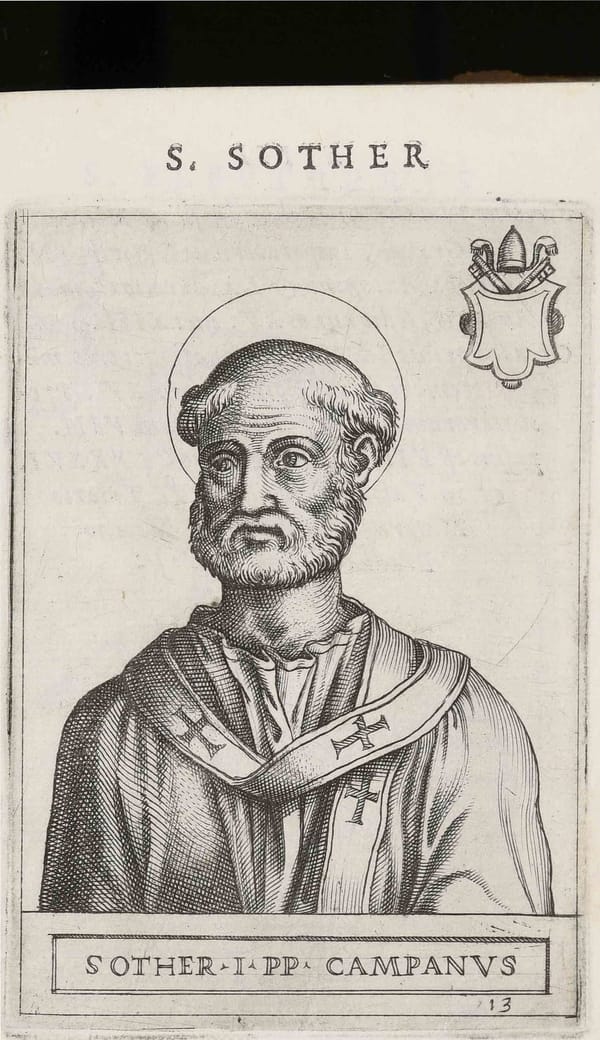
April 22: Sts. Soter and Caius, Popes and Martyrs
THE palms of two martyred Popes are intertwined and grace this day of the Calendar. Soter suffered for Christ in the second, and Caius in the third century; a hundred years separate them; and yet we have the same energy of faith, the same jealous fidelity to keep intact the depositum left by Christ to his Church. What human society ever existed that produced heroes for century after century? The Society, however, which was founded by Christ—in other words, the Church—is based on that traditional devotedness which consists in laying down one's life for the faith. And if so, we may be sure that the spirit of martyrdom would show itself in them that were the Heads and Fathers of this Society. The first thirty successors of St Peter paid dearly for the honour of the Supreme Pontificate; they were martyrs. How grand the throne of our Risen Jesus, surrounded as it is by all these Kings clad in their triumphant scarlet robes!
Soter was the immediate successor of Anicetus, whose feast we kept on the 17th of this month. Time has effaced the details of his life. Eusebius, however, gives us a fragment of a letter written by St Dionysius, bishop of Corinth, wherein thanks are expressed to the Pontiff for the alms he sent to the faithful of that Church, during a famine. An Apostolic Letter was sent with these alms; and St Dionysius tells us that it was read in the assemblies of the faithful, together with the one addressed to the same Church, in the preceding century, by St Clement. The Roman Pontiffs have ever united charity to their fidelity in preserving pure the deposit of our faith. With regard to Caius, he suffered death in the terrible persecution under Diocletian: and little more than a mere mention of his name is given in the annals of Christian Rome. We cannot, therefore, be surprised at the brevity wherewith the Liturgy speaks of these two martyred Popes. We subjoin the Lessons given in the Breviary.
O holy Pontiffs! you are of the number of those who went through the great tribulation,1 and passed, through fire and water,2 to the eternal shores of heaven. The thought of Jesus’ victory over death gave you courage: you remembered how his Passion was followed by a glorious Resurrection. By imitating him in laying down your lives for your sheep, you have taught us how we also should think no sacrifice too great to be made for our faith. Obtain for us this heroic courage. Baptism has numbered us among the soldiers of Christ; confirmation has given us the spirit of fortitude; we must then be ready for battle. It may be that, even in our own times, a persecution may rage against the Church; at all events, we have to fight against ourselves, the spirit of the world, and Satan; support us by your prayers. You were once the Fathers of the Christian people; you are still animated with the pastoral charity which then filled your hearts. Protect us, and make us loyal to the God, whose cause was so dear to you when here on earth.
Monday of the Fourth Week after Easter
OUR Risen Jesus is not satisfied with establishing his Church and constituting the hierarchy which is to govern it in his name to the end of time; he also confides in his disciples his divine word, that is, the truths he is come to reveal to mankind, into which truths he has given them an insight during the three years preceding his Passion. The word of God, which is also called revelation, is, together with grace, the most precious gift that heaven could bestow upon us. It is by the word of God that we know the mysteries of his divine essence, the plan according to which he framed the creation, the supernatural end he destined for such of his creatures as he endowed with understanding and free-will, the sublime work of redemption by the Incarnation of the Second Person of the Blessed Trinity—in a word, the means whereby we are to honour and serve him, and attain the end for which we were made.
From the very commencement of the world, God revealed his word to man; later on, he spoke by the prophets; but when the fulness of time came, he sent upon the earth his Only Begotten Son, that he might complete this first revelation. We have seen how, for three years, Jesus has been teaching men, and how, in order that he might make them the more easily understand his words, he has stooped to their littleness. Though his teaching was of the sublimest possible character, yet did he make it so intelligible that no instruction could be compared to his in clearness. It was for this reason that he made use of simple parables, whereby he conveyed his divine truths to the mind of his hearers. His Apostles and disciples, who were afterwards to preach his Gospel to the world, received from him frequent special instructions; although, until the accomplishment of the mysteries of his Death and Resurrection, they were slow in understanding his teaching. Since his Resurrection, they are better able to appreciate his instructions, for not only are his words more telling now that he is in the glory of his triumph over death, but the minds of his hearers have become more enlightened by the extraordinary events that have occurred. If he could say to them at the Last Supper: I will not now call you servants; but I have called you my friends: because all things whatsoever I have heard from my Father, I have made known unto you;1 how must he not treat them now that he has repeated to them the whole of his teaching, given them the whole word of God, and is on the eve of sending the Holy Spirit upon them, in order to perfect their understanding, and give them power to preach the Gospel to the entire world?
O holy word of God! O holy revelation! through thee are we admitted into divine mysteries, which human reason could never reach. We love thee, and are resolved to be submissive to thee. It is thou that givest rise to the grand virtue, without which it is impossible to please God;2 the virtue which commences the work of man's salvation, and without which this work could neither be continued nor finished. This virtue is faith. It makes our reason bow down to the word of God. There comes from its divine obscurity a light far more glorious than are all the conclusions of reason, how great soever may be their evidence. This virtue is to be the bond of union in the new society which our Lord is now organizing. To become a member of this society, man must begin by believing; that he may continue to be a member, he must never, not even for one moment, waver in his faith. We shall soon be hearing our Lord saying these words: He that believeth and is baptized shall be saved; but he that believeth not shall be condemned.3 The more clearly to express the necessity of faith, the members of the Church are to be called by the beautiful name of the faithful: they who do not believe are to be called infidels.
Faith, then, being the first link of the supernatural union between man and God, it follows that this union ceases when faith is broken, that is, denied; and that he who, after having once been thus united to God, breaks the link by rejecting the word of God, and substituting error in its place, commits one of the greatest of crimes. Such a one will be called a heretic, that is, one who separates himself; and the faithful will tremble at his apostasy. Even were his rebellion to the revealed word to fall upon only one article, still he commits enormous blasphemy; for he either separates himself from God as being a deceiver, or he implies that his own created, weak, and limited reason is superior to eternal and infinite Truth.
As time goes on, heresies will rise up, each attacking some dogma or other; so that scarcely one truth will be left unassailed; but all this will serve for little else than to bring out the revelation purer and brighter than before. There will, however, come a time, and that time is our own, when heresy will not confine itself to some one particular article of faith; but will proclaim the total independence of reason, and declare revelation to be a forgery. This impious system will give itself the high-sounding name of rationalism, and these are to be its leading doctrines: Christ's mission a failure and his teaching false; his Church an insult to man's dignity; the eighteen centuries of Christian civilization a popular illusion! The followers of this school, the so-called philosophers of modem times, would have subverted all society, had not God come to its assistance, and fulfilled the promise he made, of never allowing his revealed word to be taken away from mankind, nor the Church, to whom he confided his word, to be destroyed.
Others go not so far as this. They do not pretend to deny the benefits conferred on the world by the Christian religion; the facts of history are too evident to be contested: still, as they will not submit their reason to the mysteries revealed by God, they have a way peculiar to themselves for eliminating the clement of faith from this world. As every revealed truth, and every miracle confirmatory of divine interposition, is disagreeable to them, they attribute to natural causes every fact which bears testimony to the Son of God being present among us. They do not insult religion, they simply pass it by; they hold that the supernatural serves no purpose; people, they say, have taken appearances for realities. The laws of history and common sense count for nothing. Agreeably to their system, which they call naturalism, they deny what they cannot explain; they maintain that the people of the past eighteen centuries have been deceived, and that the Creator cannot suspend the laws of nature, just as the rationalists teach that there is nothing above reason.
Are reason and nature, then, to be obstacles to our Redeemer’s love for mankind? Thanks be to his infinite power, he would not have it so! As to reason, he repairs and perfects her by faith; and he suspends the laws of nature, that we may cheerfully believe the word whose truth is guaranteed by the testimony of miracles. Jesus is truly risen; let reason and nature rejoice; for he has ennobled and sanctified them by the glad mystery.
Let us proclaim the triumph of the Redeemer whom we adore. Let us make our own this sequence of the Cluny Missal of 1523.
Sequence
Leo de tribu Juda.
Mors vicit mortem,
Et mors nostra est vita.
Mira bella, et stupenda satis
Inter oves victoria.
Ut moriens superaret fortem
Cum callida versutia.
Domum ejus ingressus
Est Rex aeternus,
Et averni confregit vasa.
Drachmam secum quæ perierat
Asportavit, et patefecit regni claustra.
Paradisi porta
Quæ clausa fuerat
Per lignum vetitum
Et lethale in primaevo.
Quam clauserat Eva conditori,
Clauseratque cunctis
Postmodum natis
De stirpe sua.
Quæ commisit protoplastus,
Reseravit dextra per stirpis materiam.
Susceperat mors indemnem,
Quem tenere numquam potuerat propter culpam.
Dum ambiit illicita.
Quæ tenebat juste
Perdidit acquisita.
Ampliare voluerat in secessu,
Et remansit evacuata.
Hic verus est agnus legalis
Qui multis se manifestavit figuris,
Tandem se hostiam pro mundo
Dedit Patri ut redimeret membra sua.
Hic lapis est angularis,
Quem reprobaverunt aedificantes.
Jam factus est in caput anguli
Super omnes in excelso.
Regnum ejus magnum
Et potestas ejus prima per sæcula.
the Lion of the Tribe of Juda, hath conquered.
Death hath conquered death;
and that Death is our Life.
Strange was the war, and stupendous the victory
that was seen by the flock of Christ.
When he, by his Death,
vanquished the strong and crafty enemy.
The Eternal King
forced the enemy’s house,
and broke the armour of hell.
He brought back the groat that was lost,
and opened the gates of heaven.
Heaven’s gate,
that had been shut, at the beginning of the world,
by the forbidden fruit,
which brought death;
The gate, which Eve had closed
against him from whom she had been formed
and against all the children
that were to be born of her race;
Yea, what our first parent thus sinfully closed,
was thrown open by the right hand of the God that assumed our flesh.
Death laid hands on him
on whom it had no claim because he was free from sin;
And by thus coveting
what was not its own,
it lost what it hitherto had justly held.
By wishing to add to its prey,
it was made to yield up what it had devoured.
Christ is the true Lamb,
that was foretold in the Law under manifold figures,
and who, at length, offered himself to the Father
as a Victim for the world's redemption.
This is the Corner-Stone,
rejected by the builders.
He is now the Head of the Corner,
set high above all the rest.
His kingdom is great, and his power supreme:
they are for ever and ever.
| Previous April 21: St. Anselm, Bishop, and Doctor of the Church | Next Monday of the Fourth Week after Easter |