Daily reading
Paschal Time
Double · April 29 · Sanctoral
April 29, 2024
From Dom Guéranger’s The Liturgical Year.
A Double leads the weekday.Rubric
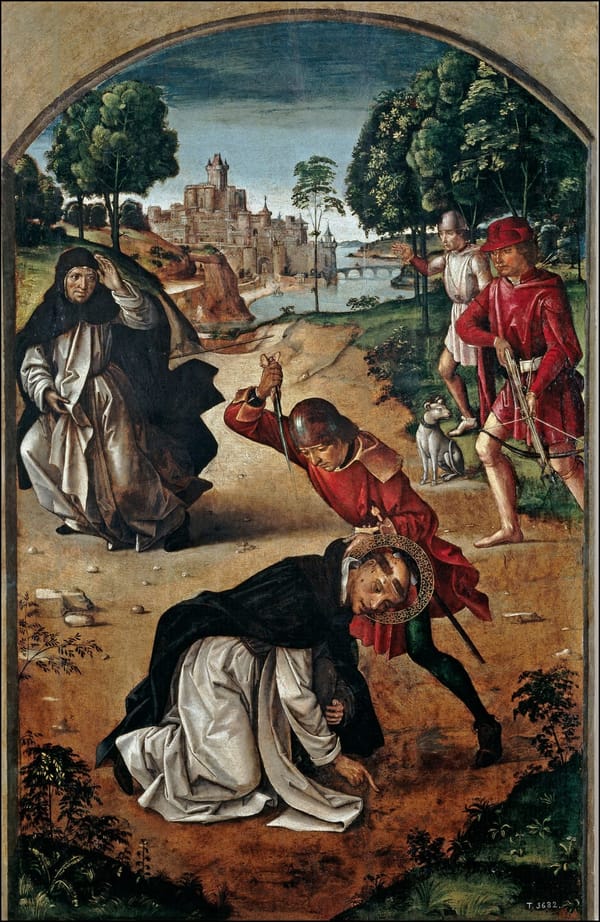 |
April 29: St. Peter, Martyr
THE hero deputed this day by the Church to greet our Risen Lord was so valiant in the good fight that martyrdom is part of his name. He is known as Peter the Martyr; so that we cannot speak of him without raising the echo of victory. He was put to death by heretics, and is the grand tribute paid to our Redeemer by the thirteenth century. Never was there a triumph hailed with greater enthusiasm than this. The martyrdom of St Thomas of Canterbury excited the admiration of the faithful of the preceding century, for nothing was so dear to our forefathers as the liberty of the Church; the martyrdom of St Peter was celebrated with a like intensity of praise and joy. Let us hearken to the fervid eloquence of the great Pontiff, Innocent IV, who thus begins the Bull of the martyr's canonization: ‘The truth of the Christian faith, manifested, as it has been, by great and frequent miracles, is now beautified by the new merit of a new Saint. Lo! a combatant of these our own times comes, bringing us new and great and triumphant signs. The voice of his blood shed (for Christ) is heard, and the fame of his martyrdom is trumpeted, through the world. The land is not silent that sweateth with his blood; the country that produced so noble a warrior resounds with his praise; yea, the very sword that did the deed of parricide proclaims his glory . . . . Mother Church has great reason to rejoice, and abundant matter for gladness; she has cause to sing a new canticle to the Lord, and a hymn of fervent praise to her God; . . . the Christian people has cause to give forth devout songs to its Creator. A sweet fruit, gathered in the garden of faith, has been set upon the table of the eternal King: a grape-bunch taken from the vineyard of the Church has filled the royal cup with new wine . . . . The flourishing Order of Preachers has produced a red rose, whose sweetness is most grateful to the King; and from the Church here on earth there has been taken a stone, which, after being cut and polished, has deserved a place of honour in the temple of heaven.'1
Such was the language wherewith the supreme Pontiff spoke of the new martyr, and the people responded by celebrating his feast with extraordinary devotion. It was kept as were the ancient festivals, that is, all servile work was forbidden upon it. The churches served by the Fathers of the Dominican Order were crowded on his feast; and the faithful took little branches with them, that they might be blessed in memory of the triumph of Peter the Martyr. This custom is still observed; and the branches blessed by the Dominicans on this day are venerated as being a protection to the houses where they are kept.
How are we to account for all this fervent devotion of the people towards St Peter? It was because he died in defence of the faith; and nothing was so dear to the Christians of those days as faith: Peter had received the charge to seize all the heretics who at that time were causing great disturbance and scandal in the country round about Milan. They were called Cathari, but in reality were Manicheans; their teachings were detestable, and their lives most immoral. Peter fulfilled his duty with a firmness and equity which soon secured him the hatred of the heretics; and when he fell a victim to his holy courage, a cry of admiration and gratitude was heard throughout Christendom. Nothing could be more devoid of truth than the accusations brought by the enemies of the Church and their indiscreet abettors against the measures formerly decreed by the public law of Catholic nations, in order to foil the efforts made by evil-minded men to injure the true faith. In those times, no tribunal was so popular as that whose office it was to protect the faith, and to put down all them that attacked it. It was to the Order of St Dominic that this office was mainly entrusted; and well may they be proud of the honour of having so long held one so beneficial to the salvation of mankind. How many of its members have met with a glorious death in the exercise of their stem duty! St Peter is the first of the martyrs given by the Order for this, holy cause: his name, however, heads a long list of others who were his brethren in religion, his successors in the defence of the faith, and his followers to martyrdom. The coercive measures that were once, and successfully, used to defend the faithful from heretical teachers have long since ceased to be used: but for us Catholics, our judgement of them must surely be that of the Church. She bids us to-day honour as a martyr one of her Saints, who was put to death whilst resisting the wolves that threatened the sheep of Christ’s fold; should we not be guilty of disrespect to our Mother if we dared to condemn what she so highly approves? Far, then, be from us that cowardly truckling to the spirit of the age, which would make us ashamed of the courageous efforts made by our forefathers for the preservation of the faith! Far from us that childish readiness to believe the calumnies of Protestants against an institution which they naturally detest! Far from us that deplorable confusion of ideas which puts truth and error on an equality, and, from the fact that error can have no rights, concludes that truth can claim none!
The following is the account given us by the Church of the virtues and heroism of St Peter the Martyr:
The following Antiphons and Responsory are taken from the Dominican Breviary:
The victory was thine, O Peter! and thy zeal for the defence of our holy faith was rewarded. Thou didst ardently desire to shed thy blood for the holiest of causes, and by such a sacrifice to confirm the faithful of Christ in their religion. Our Lord satisfied thy desire; he would even have thy martyrdom be in the festive season of the Resurrection of our divine Lamb, that his glory might add lustre to the beauty of thy holocaust. When the death-blow fell upon thy venerable head, and thy generous blood was flowing from the wounds, thou didst write on the ground the first words of the creed, for whose holy truth thou wast giving thy life.
Protector of the Christian people! what other motive hadst thou, in all thy labours, but charity? What else but a desire to defend the weak from danger induced thee not only to preach against error, but to drive its teachers from the flock? How many simple souls, who were receiving divine truth from the teaching of the Church, have been deceived by the lying sophistry of heretical doctrine, and have lost the faith? Surely the Church would do her utmost to ward off such dangers from her children; she would do all she could to defend them from enemies, who were bent on destroying the glorious inheritance which had been handed down to them by millions of martyrs! She knew the strange tendency that often exists in the heart of fallen man to love error; whereas truth, though of itself unchanging, is not sure of its remaining firmly in the mind, unless it be defended by learning or by faith. As to learning, there are but few who possess it; and as to faith, error is ever conspiring against it, and, of course, with the appearance of truth. In the Christian ages it would have been deemed not only criminal, but absurd, to grant to error the liberty which is due only to truth; and they that were in authority considered it a duty to keep the weak from danger, by removing from them all occasions of a fall; just as the father of a family keeps his children from coming in contact with wicked companions who could easily impose on their inexperience, and lead them to evil under the name of good.
Obtain for us, O holy martyr, a keen appreciation of the precious gift of faith—that element which keeps us in the way of salvation. May we zealously do everything that lies in our power to preserve it, both in ourselves and in them that are under our care. The love of this holy faith has grown cold in so many hearts; and frequent intercourse with heretics or free-thinkers has made them think and speak of matters of faith in a very loose way. Pray for them, O Peter, that they may recover that fearless love of the truths of religion which should be one of the chief traits of the Christian character. If they be living in a country where the modem system is introduced of treating all religions alike—that is, of giving equal rights to error and to truth—let them be all the more courageous in professing the truth, and detesting the errors opposed to the truth. Pray for us, O holy martyr, that there may be enkindled within us an ardent love of that faith without which it is impossible to please God.2 Pray that we may become all earnestness in this duty, which is of vital importance to salvation; that thus our faith may daily gain strength within us, till at length we shall merit to see in heaven what we have believed unhesitatingly on earth.
Monday of the Fifth Week after Easter
JESUS bestows an inestimable gift upon his Apostles; and from this gift there proceed two sacraments. On the sixth day of the creation, the divine Word infused his breath into man, whose body he had formed out of the slime of the earth; and immediately this body was animated by a soul, bearing upon it the image of God. On the evening of the day of his Resurrection, the same divine Word, then made visible in the flesh he had assumed, suddenly appeared in the midst of his Apostles, and said to them: Peace be to you! As the Father hath sent me, I also send you.1 Then breathing upon them, he added, in a tone of command: Receive ye the Holy Ghost!2 What is this Breath, which is not given to all men but only to a few chosen ones? Jesus himself explains it, by the words he speaks: this Breath imparts the Holy Ghost to them that receive it. The Holy Ghost is given to the Apostles, because they are sent by Jesus, as Jesus is sent by the Father.
The Apostles, then, receive this divine Spirit, in order that they may communicate him to men, just as they themselves have had him given to them by Jesus. The Church's tradition fills up the brief account of the Gospel. Two sacraments, as we have already stated, take their origin from this act of our Risen Jesus, who afterwards instructed his Apostles as to the rites wherewith each of the two was to be administered.
The first of these two sacraments is Confirmation, for whose institution we will return our humble thanks to-day; the other is Holy Orders, which we will explain further on in the week; both of them belong, in their administration, to the episcopal character, which is the source whence flow the gifts conferred upon the Apostles for man’s sanctification.
Such is the importance of the sacrament of confirmation, that until such time as we have received it, we cannot be considered as perfect Christians. It is true that, by virtue of our baptism, we are children of God, members of Christ and his Church; but, as Christians, we are soldiers: we have to confess our faith, sometimes before tyrants, and even to the shedding of our blood; sometimes before the world, whose false seductive maxims are the occasion of so many apostasies; sometimes against Satan and his wicked angels, whose power is so justly feared by the servants of Christ. The seal of the Holy Ghost confers on us a degree of strength which baptism does not give. Baptism made us citizens of the Church; confirmation makes us soldiers of God and of his Christ. Again, it is true that we can fight and conquer with the armour of baptism; such is God’s will, who knows that the sacrament which perfects the Christian is oftentimes an impossibility; but, woe to them that neglect to receive the completion of their baptism I Hence, after administering the sacrament of regeneration on Holy Saturday, the bishop at once proceeded to give the Holy Ghost to all those who had been just bom in the Son, and had been adopted by the Father.
Yes, confirmation is administered by a bishop, it is for him to say to the baptized: Receive ye the Holy Ghost! It was just that this divine Spirit should be thus honoured. Even when, in cases of necessity, a priest is delegated, by the Pope, to administer this sacrament, he cannot validly do so except on the condition of his using chrism consecrated by a bishop: and thus the episcopal power is always uppermost in the conferring of the Holy Ghost.
What a solemn moment is that, wherein the Spirit of power, who strengthened the Apostles, descends upon the neophytes kneeling before the bishop! The pontiff stretches his hands over them: he pours out upon them the Spirit he has received in order to communicate him to others; and that he may give all possible solemnity to the gift he is about to bestow, he cites the words of Isaias, which prophesy the descent of the Spirit on the Branch that was to spring up from the root of Jesse—a prophecy which was fulfilled in our Jesus, when he received baptism in the river Jordan, from the hands of St John the Baptist:’ O Almighty and Eternal God! who hast vouchsafed to regenerate these thy servants by water and the Holy Ghost; send forth from heaven upon them thy sevenfold Spirit, the Holy Paraclete: the Spirit of wisdom and understanding; the Spirit of counsel and fortitude; the Spirit of knowledge and godliness; fill them with the Spirit of thy fear, and sign them with the sign of the Cross of Christ.’3
Then is brought the sacred chrism, of whose virtue we heard so much on Maundy Thursday. Confirmation was anciently called the Sacrament of Chrism—of chrism in which dwells the power of the Holy Ghost. The pontiff anoints with it the foreheads of the neophytes, and, at the same instant, the Holy Ghost imprints on their souls the sign of a perfect Christian. They are confirmed, and for ever. Let them but listen to the voice of the sacrament which is now within them, and no trial, no danger can master them. The holy oil wherewith the cross has been signed on their forehead has imparted to them that firmness of adamant which was given to the Prophet Ezechiel, and enabled him to withstand all his enemies.4
To a Christian, strength is salvation; for man's life on earth is a warfare.5 Glory, then, be to our Risen Jesus, who, foreseeing the attacks that would be made against us, has armed us for the battle, and, in this admirable sacrament of confirmation, has given us the divine Spirit, who proceeds from himself and the Father, that we might be strong and invincible! Let us thank him, with all our hearts, for his having thus completed the grace already given us in baptism. The Father, who so graciously adopted us, has delivered up his Only Begotten Son for us; the Son gives us the Spirit, that he may dwell within us; oh! how wonderful a creature is man, who is so loved by the Trinity! And yet man is a sinner and an unfaithful creature: and but too frequently, all these graces are rendered fruitless by his negligence or malice! Let us at least be faithful, by keeping ourselves closely united to Holy Church, and by devoutly celebrating, with her, the mysteries of God’s goodness which the liturgical year brings successively before us.
Let us adore our Risen Jesus, our divine Benefactor. In the name of his Church, enriched as she is by such precious gifts, let us offer him this beautiful Paschal canticle, taken from the ancient Missal of Saint Gall.
Sequence
Carmina comparibus
Ecclesia dilecto pangat suo,
Illius gaudens
Reditus triumpho.
Tergens gena lacrymulam,
Læta nunc excipiat regressum,
Quem nuper flebat
Ademptum.
Hujus et affectu ardens,
Tersit suo vulnere
Ab illa nævum
Parentis primulae.
Procul de nuptae gaudio
Synagoga pellatur,
Colore obfuscata nigerrimo.
Alta confixus crucis arbore
Sacravit lateris
Illam flumine.
Viri cum fabricatur a costa,
Et Noe arcula
Aquis levata.
Nuper tyrannus
Misere afflictam,
Atque suis a sedibus
Translatam,
Favens plorati,
Atque sternens Babylonem,
Revocasti Sion tuum
Ad montem.
Ovantem gaudiis
Gratia figurat
Mundi florentis,
Consortes nos esse
Fac Jesu redemptos
Tuo cruore;
Canopicos afflixisti
Morte principes,
Ut nos inde solveres,
Praesta in eremo
Hujus vitæ,
Viperas
Conteramus igneas.
Te duce, promissam
Veniamus ut ad terram.
rejoicing in the triumphant
return of her Beloved,
sing to him her canticles,
with voice well attuned.
from her beautiful cheeks,
and gladly welcome back her Jesus,
for whom she wept
when he was taken from her.
out of burning love for her;
and, by his Blood,
cleansed her
from the stain of Eve’s offence.
clad in robes of blackest hue,
is driven, by the Bridegroom’s piercing rays,
from the Marriage Feast.
Jesus was nailed to the lofty Tree of the Cross,
and he sanctified her by the stream
that flowed from his Side.
was a figure of the Church;
so, too, was Noe's Ark,
when it sailed on the waters.
cruelly treated thy Spouse,
O Christ,
and sent her
into exile:
on her sorrow,
and, destroying Babylon,
didst bring her back
to thy holy Mount of Sion.
decked in her flowers of spring,
is a figure of thy Church’s
triumphant joy.
to imitate her loveliness,
for thou hast redeemed us
by thy Blood.
and for our deliverance,
didst bring death
upon the princes of Egypt;
grant that we may safely walk through
the desert of this life
beneath our feet,
And, having thee
for our leader,
reach the Promised Land.
| Previous April 28 (the Same Day): St. Vitalis, Martyr | Next Monday of the Fifth Week after Easter |