Daily reading
Paschal Time
Double · May 2 · Sanctoral
May 2, 2024
From Dom Guéranger’s The Liturgical Year.
A Double leads the weekday.Rubric
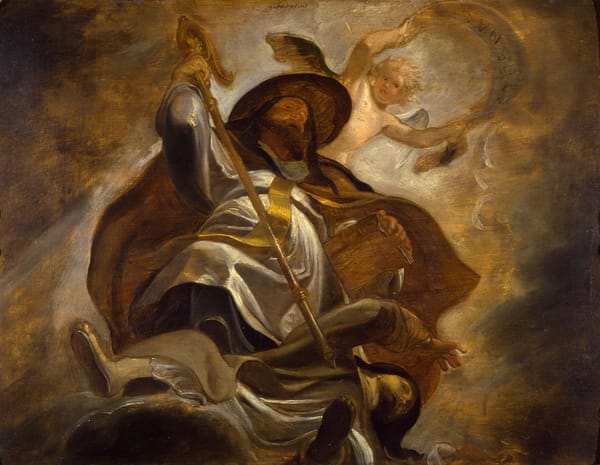 |
May 2: St. Athanasius, Bishop and Doctor of the Church
THE court of our divine King, during this grandest of seasons, is brilliant beyond measure; and, to-day, it is gladdened by the arrival of one of the most glorious champions that ever fought for his holy cause. Among the guardians of the word of truth, confided by Jesus to the earth, is there one more faithful than Athanasius? Does not his very name remind us of dauntless courage in the defence of the sacred deposit, of heroic firmness and patience in suffering, of learning, of talent, of eloquence—in a word, of everything that goes to form a Saint, a Bishop, and a Doctor of the Church? Athanasius lived for the Son of God; the cause of the Son of God was that of Athanasius: he who blessed Athanasius, blessed the eternal Word; and he who insulted Athanasius insulted the eternal Word.
Never did our holy faith go through a greater ordeal than in the sad times immediately following the peace of the Church, when the bark of Peter had to pass through the most furious storm that hell has, so far, let loose against her. Satan had vainly sought to drown the Christian race in a sea of blood; the sword of persecution had grown blunt in the hands of Diocletian and Galerius; and the Cross appeared in the heavens, proclaiming the triumph of Christianity. Scarcely had the Church become aware of her victory when she felt herself shaken to her very foundation. Hell sent upon the earth a heresy which threatened to blight the fruit of three hundred years of martyrdom. Arius began his impious doctrine, that he who had hitherto been adored as the Son of God was only a creature, though the most perfect of all creatures. Immense was the number, even of the clergy, that fell into this new error; the Emperors became its abettors; and had not God himself interposed, men would soon have set up the cry throughout the world that the only result of the victory gained by the Christian religion was to change the object of idolatry, and put a new idol, called Jesus, in place of the old ones.
But he who had promised that the gates of hell should never prevail against his Church, faithfully fulfilled his promise. The primitive faith triumphed; the Council of Nicæa proclaimed the Son to be consubstantial with the Father; but the Church stood in need of a man in whom the cause of the consubstantial Word should be, so to speak, incarnated—a man with learning enough to foil the artifices of heresy, and with courage enough to bear every persecution without flinching. This man was Athanasius: and everyone that adores and loves the Son of God, should love and honour Athanasius. Five times banished from his See of Alexandria by the Arians, who even sought to put him to death, he fled for protection to the West, which justly appreciated the glorious confessor of Jesus' divinity. In return for the hospitality accorded him by Rome, Athanasius gave her of his treasures. Being the admirer and friend of the great St Antony, he was a fervent admirer of the monastic life, which, by the grace of the Holy Ghost, had flourished so wonderfully in the deserts of his vast patriarchate. He brought the precious seed to Rome, and the first monks seen there were the ones introduced by Athanasius. The heavenly plant became naturalized in its new soil; and though its growth was slow at first, it afterwards produced fruit more abundantly than it had ever done in the East.
Athanasius, who has written so admirably upon that fundamental dogma of our faith—the divinity of Christ —has also left us most eloquent treatises on the mystery of the Pasch: they are to be found in the Festal Letters which he addressed each year to the churches of his patriarchate of Alexandria. The collection of these Letters, which were once thought to have been irretrievably lost, was found, a few years back, in the monastery of St Mary of Scete, in Egypt. The first, for the year 329, begins with these words, which beautifully express the sentiments we should feel at the approach of Easter: ' Come, my beloved brethren, celebrate the feast; the season of the year invites you to do so. The Sun of justice, by pouring out his divine rays upon you, tells you that the time of the solemnity is come. At such tidings, let us keep a glad feast; let not the joy slip from us with the fleeting days, without our having tasted of its sweetness.’ During almost every year of his banishment, Athanasius continued to address a Paschal Letter to his people. The one in which he announces the Easter of 338, and which he wrote at Treves, begins thus: ' Though separated from you, my brethren, I cannot break through the custom which I have always observed, and which I received from the tradition of the Fathers. I will not be silent; I will not omit announcing to you the time of the holy annual feast, and the day on which you must keep the solemnity. I am, as you have doubtless been told, a prey to many tribulations; I am weighed down by heavy trials; I am watched by the enemies of truth, who scrutinize everything I write, in order to rake up accusations against me and thereby add to my sufferings; yet notwithstanding, I feel that the Lord strengthens and consoles me in my afflictions. Therefore do I venture to address to you the annual celebration; and from the midst of my troubles, and despite the snares that beset me, I send you, from the furthermost part of the earth, the tidings of the Pasch, which is our salvation. Commending my fate into God’s hands, I will celebrate this feast with you; distance of place separates us, but I am not absent from you. The Lord who gives us these feasts, who is himself our feast, who bestows upon us the gift of his Spirit—he unites us spiritually to one another, by the bond of concord and peace.’
How grand is this Pasch, celebrated by Athanasius, an exile on the Rhine, in union with his people who keep their Easter on the banks of the Nile! It shows us the power of the Liturgy to unite men and make them, at one and the same time, and despite the distance of countries, enjoy the same holy emotions and feel the same aspirations to virtue. Greeks or Barbarians, we have all the same mother-country, the Church; but that which, after faith, unites us all into one family, is the Church’s Liturgy. Now there is nothing in the whole Liturgy so expressive of unity as the celebration of Easter. The unhappy Churches of Russia and the East, by keeping Easter on a different day from that on which it is celebrated by the rest of the Christian world, show that they are not a portion of the One Fold of which our Risen Jesus is the One Shepherd.
We will now read the sketch of the life of St Athanasius, given in the Breviary.
The Greek Church, which celebrates the feast of our Saint at another season of the year, is enthusiastic in her admiration of his virtues. The following stanzas are from the hymn she sings in his praise:
Hymn (Die XVIII Januarii)
Thou wast throned, O Athanasius! on the Chair of Mark in Alexandria; and thy name is emblazoned near his on the sacred cycle. He left Rome, sent by Peter himself to found the second patriarchal See; and thou, three centuries later, didst visit Rome, as successor of Mark, to seek protection from Peter's successor against them that were disturbing thy venerable See by injustice and heresy. Our Western Church was thus honoured by thy presence, O intrepid defender of the faith. She looked on thee with veneration as the glorious exile, the courageous confessor; and she has chronicled thy sojourning in her midst as an event of the greatest interest.
Intercede for the country over which was extended thy patriarchal jurisdiction; but forget not this Europe of ours, which gave thee hospitality and protection. Rome defended thy cause; she passed sentence in thy favour, and restored thee thy rights; make her a return, now that thou art face to face with the God of infinite goodness and power. Protect and console her Pontiff, the successor of that Julius who so nobly befriended thee fifteen hundred years ago. A fierce tempest is now raging against the Rock on which is built the Church of Christ; and our eyes have grown wearied looking for a sign of calm. Oh! pray that these days of trial be shortened, and that the See of Peter may triumph over the calumnies and persecutions which are now besetting her, and endangering the faith of many of her children.
Thy zeal, O Athanasius! checked the ravages of Arianism; but this heresy has again appeared, in our own times, and in almost every country of Europe. Its progress is due to that proud superficial learning which has become one of the principal perils of the age. The Eternal Son of God, consubstantial with the Father, is blasphemed by our so-called philosophers, as being only Man—the best and greatest of men, they say, but still only Man. They despise all the proofs which reason and history adduce of Jesus' divinity; they profess a sort of regard for the Christian teaching which has hitherto been held, but they have discovered (so they tell us) the fallacy of the great dogma which recognizes in the Son of Mary the Eternal Word who became incarnate for man’s salvation. O Athanasius, glorious Doctor of holy Mother Church! humble these modem Arians; expose their proud ignorance and sophistry; undeceive their unhappy followers, by letting them see how this false doctrine leads either to the abyss of the abominations of pantheism, or to the chaos of scepticism, where all truth and morality are impossibilities.
Preserve within us, by the influence of thy prayers, the precious gift of faith, wherewith our Lord has mercifully blessed us. Obtain for us that we may ever confess and adore Jesus Christ as our eternal and infinite God; ' God of God; Light of Light; True God of True God; Begotten, not made; who, for us men, and for our salvation, took Flesh, of the Virgin Mary.’ May we grow each day in the knowledge of this Jesus, until we join thee in the face-to-face contemplation of his perfections. Meanwhile, by means of holy faith, we will live with him on this earth that has witnessed the glory of his Resurrection. How fervent, O Athanasius, was thy love of this Son of God, our Creator and Redeemer! This love was the very life of thy soul, and the stimulus that urged thee to heroic devotedness to his cause. It supported thee in the combats thou hadst to sustain with the world, which seemed leagued together against thy single person. It gave thee strength to endure endless tribulations. Oh! pray that we may obtain this love—a love which is fearless of danger, because faithful to him for whom we suffer—a love which is so justly due, seeing that he, though the Brightness of his Father's glory, and Infinite Wisdom, emptied himself, taking the form of a servant, and humbled himself, becoming obedient unto death, even to the death of the Cross.* How else can we make him a return for his devotedness to us except by giving him all our love, as thou didst, O Athanasius! and by ever singing his praise in compensation for the humiliations which he endured in order to save us?
* Philipp, ii 7, 8. ↩︎
Thursday of the Fifth Week after Easter
BY the first four sacraments, our Saviour provided for the several spiritual necessities of man during this mortal life. Baptism gives him spiritual birth, Confirmation arms him for the battle, the Eucharist is his food, Penance is his cure. But the last moment of life—that most important and terrible of all, on which depends eternity—does it not seem to require a special sacramental aid? Could it be that our Redeemer, after so lovingly supplying us with a sacrament to meet our other wants, would leave us unprovided when we are dying, that is, when we are passing from this to another life, and are weighed down with bodily and mental sufferings? No: he has provided a sacrament for the dying; the grace of redemption puts on a new form, that it may visit and fortify us in our last struggle.
Even before his Passion, he gave us some idea of the sacrament he intended to institute for the help of the dying. When he sent his disciples before him, that they might prepare the people for his preaching, he commanded them to anoint the sick with oil: they did so, and the result was the cure of them that were thus anointed.1 But after his Resurrection, when our Redeemer was preparing the dowry of his Church, he gave her a sacrament wherewith this Mother was to administer special grace and consolation to her children when in danger of death.
Oil is the symbol of strength; hence, the wrestlers of old used it as a means for acquiring activity and nerve. Our Saviour chose it as the matter of the sacrament of confirmation, whereby our souls, after being regenerated by baptism, are strengthened for their future combats. The hour of death is a combat, but one so terrible that it stands apart by itself. It is then that Satan, seeing how the long-coveted prey is soon to be beyond his reach, redoubles his efforts to make it his own for ever. The dying Christian, standing as he does on the brink of eternity, is exposed to two temptations: presumption and despair. In a few moments he will be before the Judge, whose sentence is irrevocable. The remnants of sin are still upon him, and clog his soul. How will he comport himself in that last combat, on which depends the final success of all the previous ones of his life? Is not this an occasion for a special sacrament, whereby our Jesus may provide his combatant with the help so urgently needed? Yes; and here again it is oil. The first anointing was that of confirmation, and it gave strength; and the last, or as it is called, extreme unction, is equally rich in power: it is the last application made to mankind of the Redeemer’s blood,’which flows in such abundance with this holy oil.’2
Let us consider the effects of extreme unction, of which the Apostle St James speaks to us in his Epistle. What he there tells us, he had received from Jesus’ own lips. First of all, this sacrament brings forgiveness of sins;3 forgiveness of those sins which the conscience, however diligent it may have been in its examination, had overlooked; but which, nevertheless, injure the soul: and forgiveness of those remnants of sin, which continue after the guilt of sin has been remitted; like wounds which, though cured, are not quite closed, and keep the patient weak. The holy oil anoints each of the senses; each has been the source of sin; each now receives its special purification. These doors, which up to this moment had been open to the world, are now closed; so that the soul can be all intent upon eternal things. Let the enemy come now, if he will; his attacks can do no harm. He expected to find his adversary the poor earthly-minded creature of old, on whom he had inflicted hundreds of wounds; but lo! he finds a soldier of Christ, vigorous and brave. It is extreme unction that has worked the change.
But the effects of this sacrament do not stop here. Though primarily instituted for imparting strength to the soul, yet it has the power of restoring health to the body too. We learn this from the Apostle St James. His words are these: Is any man sick among you? Let him bring in the priests of the Church, and let them pray over him, anointing him with oil in the name of the Lord. And the prayer of faith shall save the sick man, and the Lord shall raise him up.4 The sacred formula, which accompanies each anointing in this sacrament, has therefore the power of restoring bodily health, at the same time that it drives away the remnants of sin, which is the chief cause of all man's miseries, whether of soul or body. Such is the interpretation put by the Church on the words of St James; and we have continual proofs that our divine Master has not forgotten the promise of twofold efficacy which he gave to this sacrament. Hence it is, that after having anointed the several senses of the sick person, the priest addresses God in earnest prayer, that he would restore strength of body to him or her whose soul has received the efficacy of the heavenly remedy. Nay, the Church looks upon the restoration to bodily health as so truly a sacramental effect of extreme unction, that she does not consider as miracles, properly so called, the cures produced by its administration.
Let us, then, offer to the conqueror of death the homage of our thanks for this fresh proof of his compassionate love. He would himself experience all our miseries, not excepting even death or the agony that precedes it. When on his Cross, and enduring every anguish, as though he were a poor dying sinner, and not the Saint of saints, he thought of our deaths, and mercifully blessed our last agony with an outpouring of his precious Blood. This was the origin of the beautiful sacrament of extreme unction, which he gave to his Church, after his Resurrection, and for which we offer him to-day our humble thanks.
The following hymn—composed by St Ambrose, and used during Paschal Time in the Church of Milan—celebrates with the Saint's characteristic vigour of style the thoroughness of the salvation wrought by the Death of Christ, as was made evident in the conversion of the Good Thief.
Hymn
Sanctus sereno lumine,
Quo diluit sanguis sacer
Probrosa mundi crimina.
Cæcosque visu illuminans:
Quem non gravi solvet metu
Latronis absolutio?
Jesum brevi acquirit fide,
Justusque praevio gradu
Pervenit in regnum Dei.
Pænam videntes corporis,
Christoque adhaerentem reum
Vitam beatam carpere.
Ut abluat mundi luem,
Peccata tollit omnium,
Camis vitia mundans caro.
Ut culpa quærat gratiam,
Metumque solvat charitas,
Reddatque mors vitam novam?
Suisque se nodis liget:
Moriatur vita omnium,
Resurgat ut vita omnium.
Omnes resurgunt mortui:
Consumpta mors ictu suo
Perisse se solam gemit.
Qui surrexisti a mortuis,
Cum Patre et Sancto Spiritu,
In sempiterna sæcula.
holy with its unclouded light,
whereon the sacred Blood washed away
the world’s infamous crimes.
it gives sight to the blind.
Oh! who would not cease to despair at the thought
of the pardon granted to the Thief?
he gained Jesus by a brief act of faith;
and, being justified, was the first
to enter into the kingdom of God.
they behold the criminal suffering bodily tortures,
yet united with Christ, and culling
the flower of life everlasting.
Jesus takes upon himself the sins of the world,
that he may cleanse it from its filth:
Flesh washes away the sins of flesh.
—sin seeking for grace,
love expelling fear,
and death giving a new life.
let him be caught in his own net!
Let him but die, who is the Life of all,
and all will rise to life.
and all the dead rise again to life:
death’s blow falls on himself,
and none die but he.
who didst rise again from the dead!
and to the Father, and to the Holy Ghost,
for everlasting ages.
| Previous Wednesday of the Fifth Week after Easter | Next Thursday of the Fifth Week after Easter |