Daily reading
Paschal Time
Double · May 4 · Sanctoral
May 4, 2024
From Dom Guéranger’s The Liturgical Year.
A Double leads the weekday.Rubric
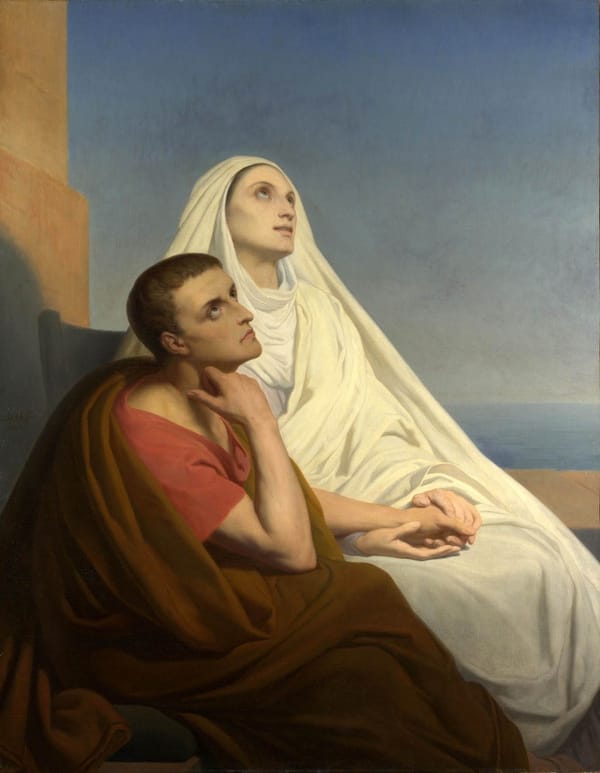 |
May 4: St. Monica, Widow
IN the company of our Risen Lord there are two women, two mothers, of whom we have often had to speak during the last few weeks: they are Mary, mother of James the Less and Thaddeus, and Salome, mother of 'James the Great and John the beloved disciple. They went with Magdalen to the Sepulchre on the Resurrection morning; they carried spices to anoint the Body of Jesus; Angels spoke to them; and, as they returned to Jerusalem, our Lord appeared to them, greeted them, and allowed them to kiss his sacred feet. Since that day, he has repaid their love by frequently appearing to them; and on the day of his Ascension from Mount Olivet, they will be there, together with our blessed Lady and the Apostles, to receive his farewell blessing. Let us honour these faithful companions of Magdalen, these models of the love we should show to our Lord in his Resurrection; let us also venerate them as mothers who gave four Apostles to the Church.
But lo! on this fourth morning of beautiful May, there rises, near to Mary and Salome, another woman, another mother. She, too, is fervent in her love of Jesus. She, too, gives to Holy Church a treasure—the child of her tears, a Doctor, a Bishop, and one of the grandest Saints of the New Law. This woman, this mother, is Monica, doubly mother of Augustine. This masterpiece of God's grace was produced on the desert soil of Africa. Her virtues would have been unknown till the day of judgement, had not the pen of the great bishop of Hippo, prompted by the holy affection of his filial heart, revealed to us the merits of this woman, whose life was humility and love, and who now, immortalized in men’s esteem, is venerated as the model and patroness of Christian mothers.
One of the great charms of the book of Confessions is Augustine’s fervent praise of Monica’s virtues and devotedness. With what affectionate gratitude he speaks, throughout his whole history, of the untiring constancy of this mother who, seeing the errors of her son, 1 wept over him more than other mothers weep over the dead body of their children.’1 Our Lord, who from time to time consoles with a ray of hope the souls he tries, had shown to Monica in a vision the future meeting of the son and mother; she had even heard a holy bishop assure her that the child of so many tears could never be lost: still the sad realities of the present weighed heavily on her heart; and both her maternal love and her faith caused her to grieve over this son, who kept away from her, yea, who kept away from her because he was unfaithful to his God. The anguish of this devoted heart was an expiation which would at a future period be applied to the guilty one; fervent and persevering prayer, joined with suffering, prepared Augustine’s second birth; and, as he himself says, ‘she went through more when she gave me my spiritual than when she gave me my corporal birth.’2
At last, after long years of anxiety, the mother found at Milan this son of hers who had so cruelly deceived her, when he fled from her roof to go and risk his fortune in Rome. She found him still doubting the truth of the Christian religion, but tired of the errors that had misled him. Augustine was not aware of it, but he had really made an advance towards the true faith. ‘She found me,’ says he, ‘in extreme danger, for I despaired of ever finding the truth. But when I told her that I was no longer a Manichean, and yet not a Catholic Christian, the announcement did not take her by surprise. She leaped for joy at being made sure that one half of my misery was gone. As to the other, she wept over me, as dead indeed, but to rise again; she turned to thee, O my God, and wept, and in spirit brought me and laid the bier before thee, that thou mightest say to the widow's son: Young man! I say to thee, arise! Then would he come to life again, and begin to speak, and thou couldst give him back to his mother! . . . Seeing then that although I had not yet found the truth, I was delivered from error, she felt sure that thou wouldst give the other half of the whole thou hadst promised. She told me in a tone of gentlest calm, but with her heart full of hope, that she was confident, in Christ, that before leaving this world, she would see me a faithful Catholic.’3
At Milan, Monica formed acquaintance with the great St Ambrose, who was the instrument chosen by God for the conversion of her son. ‘She had a very great affection for Ambrose,' says Augustine, ' because of what he had done for my soul; and he too loved her, because of her extraordinary piety, which led her to the performance of good works, and to fervent assiduity in frequenting the Church. Hence, when he saw me, he would frequently break out in her praise, and congratulate me on having such a mother.’4 The hour of grace came at last. The light of faith dawned upon Augustine, and he began to think of enrolling himself a member of the Christian Church; but the pleasures of the world, in which he had so long indulged, held him back from receiving the holy sacrament of baptism. Monica's prayers and tears won for him the grace to break this last tie. He yielded and became a Christian.
But God would have this work of his divine mercy a perfect one. Augustine, once converted, was not satisfied with professing the true faith; he aspired to the sublime virtue of continence. A soul favoured as his then was could find no further pleasure in anything that this world had to offer him. Monica, who was anxious to guard her son against the dangers of a relapse into sin, had been preparing an honourable marriage for him; but Augustine came to her one day, accompanied by his friend Alypius, and told her that he was resolved to aim at the most perfect life. Let us listen to the Saint's account of this interview with his mother; it was immediately after he had been admonished by the voice from heaven: ‘We (Augustine and Alypius) go at once to my mother's house. We tell her what has taken place; she is full of joy. We tell her all the particulars; she is overpowered with feelings of delight and exultation. She blessed thee, O my God, who canst do beyond what we ask or understand. She saw that thou hadst done more for me than she had asked of thee, with her many piteous and tearful sighs . . . . Thou hadst changed her mourning into joy even beyond her wishes, yea, into a joy far dearer and chaster than she could ever have had in seeing me a father of children.’5 A few days after this, and in the Church of Milan, a sublime spectacle was witnessed by angels and men: Ambrose baptized Augustine in Monica's presence.
The saintly mother had fulfilled her mission: her son was regenerated to truth and virtue, and she had given to the Church the greatest of her Doctors. The evening of her long and laborious life was approaching and she was soon to find eternal rest in the God for whose love she had suffered so much. The son and mother were at Ostia, waiting for the vessel that was to take them back to Africa. ‘I and she were alone,’ says Augustine, ‘and were standing near a window of our lodging, which commanded a view of the garden. We were having a most charming conversation. Forgetting the past, and stretching forward to the things beyond, we were talking about the future life of the Saints, which eye hath not seen, nor ear heard, nor hath it ascended into man's heart . . . . And whilst thus talking about it and longing for it, our hearts seemed to bound forward and reach it. We sighed, and left the first-fruits of our spirit there, and returned to the sound of our own voice . . . . Then my mother said to me: “ My son! as far as I am concerned, there is nothing now that can give me pleasure in this life. I know not what I can do, or why I should be here, now that I have nothing to hope for in this world. There was one thing for which I desired to live somewhat longer, and it was to see thee a Catholic Christian before my death. My God has granted me this and more, for I see that thou hast despised earthly pleasures and become his servant. What do I here?”’6
She had not long to wait for the divine invitation. She breathed forth her pure soul a few days after this incident, leaving an indelible impression upon the heart of her son, a name most dear and honoured to the Church, and a perfect example of the purest and holiest maternal affection to Christian mothers.
The life and virtues of St Monica are thus briefly portrayed in to-day’s Liturgy:
The Middle Ages have left us several liturgical pieces composed in honour of St Monica; but most of them are poor. The sequence we select is not without merit; it has even been attributed to Adam of Saint-Victor.
Sequence
Atque suæ piæ matris laudes et præconia
Decantemus, venerantes
Et optata celebrantes hodie solemnia.
Vita clara, Christo chara, hæc beata Monica
De profano propagatum,
Jam nunc parit suum natum in fide catholica.
Quo effulsit tam præclarum lumen in Ecclesia!
Multo fletu seminavit,
Germen ubi reportavit metens in lætitia.
O quam miro tunc gestivit Spiritus tripudio,
Cernens natum fide ratum,
Sed et Christo jam sacratum toto mentis studio!
Et in eis Christum pavit, mater dicta pauperum;
Curam gerens infirmorum,
Lavit, stravit, et eorum tersit sordes vuinerum.
Quam transfigunt amorosa crucifixi stigmata!
His accensa sic ploravit,
Lacrymis quod irrigavit pavimenti schemata.
Stat a terris elevata cubiti distantia;
Mente rapta exsultavit:
‘Volitemus,’ exclamavit, ‘Ad cœli fastigia.’
Advocata et patrona sis pro tuis filiis,
Ut dum carne exuemur,
Nato tuo sociemur paradisi gaudiis.
and of his holy mother.
Let us devoutly celebrate
the beloved solemnity of this day.
well instructed in the faith, edifying in her conduct, and dear to Christ.
Her son was born of a pagan father;
but she gave him a second birth—she brought him to the Catholic faith.
through which shone forth so bright a light within the Church!
Monica sowed in much weeping,
but she reaped her fruit in joy.
Oh! how grand was the gladness that filled her soul,
when she saw her son staunch in faith,
yea, and devoted with his whole heart to Christ!
for she ministered to them in their necessities, and gave to Christ the food she gave to them.
She took care of the sick,
washed them, nursed them, and dressed their wounds.
with compassion for the dear Wounds of her crucified Lord!
She wept for love when she thought upon them,
and her tears bedewed the spot on which she prayed.
she was raised from the ground
and in her rapture exclaimed with joy:
‘Let us fly to heaven above!'
be to us thy children an advocate and patroness,
that so, when we quit the flesh, we may be united to Augustine,
thy son, in the joys of paradise.
O thou model of mothers! Christendom honours thee as one of the most perfect types of human nature regenerated by Christ. Previous to the Gospel, during those long ages when woman was kept in a state of abjection, a mother’s influence on her children was feeble and insignificant; her duties were generally limited to looking after their bodily well-being; and if some mothers of those times have handed their names down to posterity, it is only because they taught their sons to covet and win the passing glory of this world. But we have no instance in pagan times of a mother training her son to virtue, following him from city to city that she might help him in the struggle with error and the passions, and encourage him to rise after a fall; we do not meet with one who devoted herself to continual prayer and tears, with a view to obtain her son's return to truth and virtue. Christianity alone has revealed a mother's mission and power.
What forgetfulness of thyself, O Monica, in thine incessant endeavour to secure Augustine's salvation! After God, thou livest for him, and to live for thy son in such a way as this, is it not living for God, who deigns to use thee as the instrument of his grace? What carest thou for Augustine's glory and success in this world when thou thinkest of the eternal dangers and of the eternal separation from God and thee to which he is exposed. There is no sacrifice which thy maternal heart is not ready to make in order to satisfy the divine justice: it has its rights and thou art too generous not to satisfy them. Thou waitest patiently, day and night, for God's good time to come. The delay only makes thy prayer more earnest. Hoping against all hope, thou at length feelest within thy heart the humble but firm conviction that the object of all these tears can never be lost. Moved with mercy towards thee, as he was towards the sorrowing mother of Naim, he speaks with that voice which nothing can withstand: ‘Young man! I say to thee, arise!’ and he gives him to his mother,’7 he gives thee the dear one whose death thou hadst so bitterly bewailed, but from whom thou couldst not tear thyself.
What a recompense of thy maternal love is this! God is not satisfied with restoring thee Augustine full of life; this son of thine rises at once from the very depths of error and sin to the highest virtue. Thou hadst prayed that he might become a Catholic and break certain ties which were both a disgrace and danger to him; when lo! one single stroke of grace has raised him to the sublime state of the Evangelical Counsels. Thy work is more than done, O happy mother! Speed thee to heaven; where till thy Augustine joins thee, thou art to gaze on the saintly life and works of this son, whose salvation is due to thee and whose glory, even while he sojourns here below, sheds a bright halo over thy venerated name.
From the eternal home where thou art now happy with this son who owes to thee his life both of earth and heaven, cast a loving look, O Monica, on the many Christian mothers who are now fulfilling on earth the hard but noble mission which was once thine. Their children are also dead with the death of sin; and they would restore them to true life by the power of their maternal love. After the Mother of Jesus, it is to thee that they turn, O Monica, whose prayers and tears were once so efficacious and so fruitful. Take their cause in hand; thy tender and‘devoted heart cannot fail to compassionate them in the anguish which was once thine own. Maintain their courage; teach them to hope. The conversion of these dear ones is to cost them many a sacrifice; procure them the generosity and fortitude to pay the price thus asked of them by God. Let them remember that the conversion of a soul is a greater miracle than raising a dead man to life; and that divine justice demands a compensation which they, the mothers of these children, must be ready to make. This spirit of sacrifice will destroy that hidden egotism which is but too frequently mingled with what seems to be affection of the purest kind. Let them ask themselves if they would rejoice as thou didst, O Monica, at finding that a vocation to the Religious life was the result of the conversion they have so much at heart. If they are thus disinterested, let them not fear; their prayers and sufferings must be efficacious; sooner or later, the wished-for grace will descend upon the prodigal, and he will return to God and to his mother.
Saturday of the Fifth Week after Easter
ON this day, which is sacred to Mary, let us open the holy Gospel according to St John. There, in the second chapter, we find these words: There was a marriage in Cana of Galilee, and the Mother of Jesus was there.1 The sacred text goes on to say that Jesus also and his disciples were among the guests; but the Holy Spirit, who guided the Evangelist's hand, would have him first make mention of Mary. It was to teach us that this our blessed Mother extends her protection to those who enter upon the married life with worthy dispositions, that is, with such dispositions as to draw down upon themselves the blessing of her divine Son.
Marriage is a sacred state, for it was instituted by God. The first marriage was celebrated in the earthly Paradise between Adam and Eve, when yet they were innocent. It was God himself who dictated the conditions of marriage. Unity was to be its very basis; in other words, the wife was to have but one husband, the husband was to have but one wife. It was the type of a still more glorious unity, which was not to be revealed till a later period. The mystery of unity typified by marriage being part of the Christian revelation, we deem it a duty to put it before our readers by the following considerations.
The angels were all created at one and the same time: but the members of the human race were to be bom, each indeed from their respective parents, but yet so as that Adam and Eve were to be the common parents to whom all were to owe their origin. Such was our Creator’s design, and marriage was the means he selected for its fulfilment. An immense multitude of the angels having fallen, the places destined for them in heaven were to be filled up by the elect of earth; again, it was marriage that was to provide these citizens for heaven. Hence, God blessed marriage at the very commencement of the world, and with a blessing which was to be permanent, for, as the Church teaches us in the Liturgy,’it was not recalled, either by the punishment inflicted on original sin, or by the sentence which destroyed the world by the deluge.’2
Even before this second great chastisement came upon the earth, all flesh hud corrupted its way,3 and marriage had fallen from the elevated dignity given to it by the Creator. The end for which he instituted it was forgotten; it was debased into a mere sensual gratification; it lost the sacred unity, which was its glory. Polygamy and divorce destroyed its primitive character, and two frightful evils ensued: family ties were at an end, and woman’s position was degraded into that of a being which must minister to man’s passions. The lesson intended to be conveyed by the Deluge was soon lost sight of; the world again became depraved, so much so indeed, that when the Mosaic Law came with its reforms, it had not power to restore to marriage the dignity of its first institution.
To effect this, it was requisite that God himself should descend upon the earth. When the miseries of humanity had reached their height, the Word, the second Person of the blessed Trinity, assumed our human nature, and dwelt amongst us. He called himself the Bridegroom.4 The prophets and the Canticle of Canticles had foretold that he would take to himself a Spouse from among mortals. This Spouse is the Church—that is, the human race purified by baptism and enriched with supernatural gifts. As a dowry, he gave her his own precious Blood and merits; and then united her to himself for ever. This Spouse is One: he affectionately calls her his Only One.5 On her part, she has no other but him. Here we have revealed to us the divine type on which marriage was formed, which, as the Apostle teaches us, derives its holiness and dignity from its resemblance to the union existing between Christ and his Church.6 The two unions are for the same end, and bear a mutual relation to each other. Jesus loves his Church with the tenderest affection; but his Church is the issue of human marriage, for it is marriage that provides the Church with her children, and thus perpetuates her existence upon the earth. Let us not be surprised, therefore, that Jesus restored marriage to its primitive condition, and that he honours it as being his powerful aid in the accomplishment of his designs.
We have already seen, on the second Sunday after the Epiphany, how he selected the nuptial feast at Cana as the occasion of his working his first public miracle. By his accepting the invitation to assist, in company with his blessed Mother, at the marriage, it is evident that he wished to honour, by his divine presence, the sacred engagement which was to unite the two spouses; it is evident that he intended to renew, in their persons, the ancient blessing given in Paradise. Having, by his miracle at Cana, proved himself to be truly the Son of God, he began his public life and preaching. His object being to reform fallen man to the noble end for which he had been created, he frequently made marriage the subject of his instructions. He spoke of its being divinely instituted on the basis of unity. He authoritatively repeated the command given at its first institution: They shall be two in one flesh:7 two, and only two. Speaking of the indissolubility of the marriage tie, he told his hearers that no power on earth, not even the unfaithfulness, however criminal, of the husband or wife, could sever the bond. These were his words: What God hath joined together, let no man put asunder.8 Thus did he restore marriage to its normal state; thus did he abrogate the degrading liberty, or more correctly, the libertinism, of polygamy and divorce—those sad proofs of the hardness of man’s heart,9 and of the need he had of a Redeemer. Thus did the New Law bring back to marriage its primal blessing, and make it once more a holy state, which, so far from being an obstacle, is a means to virtue, and peoples both earth and heaven with the elect.
But our Risen Jesus would do more than repair the injuries brought upon marriage by human frailty. He raised to the dignity of a sacrament the solemn and irrevocable contract whereby a man and woman take each other for husband and wife. The moment that two Christians are thus irrevocably united, a sacramental grace descends upon them, and cements their union, which there and then becomes a sacred thing. The Apostle, speaking of Christian marriage, says: It is a great sacrament; but I speak in Christ, and in the Church.10 The meaning of these words is that marriage is the type of the union which exists between Christ and his Spouse the Church. There is one and the same object and end in the two unions—in that of Christ with the Church, and in that of the husband with his wife: this object, this end, is to people heaven with the elect. Hence it is that the Holy Ghost puts his divine seal upon both these unions.
But the grace of the seventh sacrament does more than cement the indissoluble union of husband and wife. It gives them every help they stand in need of for the fulfilment of their sacred mission. First of all, it infuses into their hearts a mutual love, which is strong as death, and which many waters cannot quench,11 so long as they make religion the ruling principle of their lives. This love is mingled with a sentiment of chaste respect, which serves as a check upon evil concupiscence. It is a love which time, far from impairing, makes purer and stauncher. It is a love calm like that which is found in heaven. When sacrifices are to be made, it makes them almost without an effort, and is intensified by the making. The sacramental grace also fits the husband and wife for the great duty of educating their children. It gives them an untiring devotedness for their welfare; an affectionate patience with their faults; a supernatural discernment for treating them according to their age and dispositions; a ceaseless remembrance of the fact that these dear ones were created for heaven; and, finally, a deep-rooted sentiment that they belong to God more truly than to the parents, through whom he gave them life.
Thus was the married state transformed by the grace of the sacrament of matrimony. The Christian Law restored to it the dignity of which the vile egotism of pagan passion had deprived it. After so long a period of degradation, mankind was again brought to the knowledge of what marriage really is—namely, love surrounded by sacrifice, and sacrifice prompted and aided by love. Truly a sacrament was needed for bringing about such a change as this! The change came, and admirable indeed it was. Two centuries had not elapsed since the promulgation of the Gospel, and paganism was still powerful; and yet we find a writer of those days giving the following description of a Christian husband and wife.’How shall I find words to describe the happiness of a marriage, whose tie is formed by the hands of the Church, which is confirmed by the sacred oblation, sealed by the blessing, proclaimed by the angels, and ratified by the heavenly Father? How wonderful a yoke is that which is taken up by two of the faithful united together in the same hope, in the same law, in the same duty! They have the same God for their Father, they serve the same Master, they are two in one flesh, they are one heart and soul. They pray together, they prostrate together, they fast together; they instruct each other, they exhort each other, they encourage each other. You see them together in the Church, and at the holy Table. They share in each other's trials, persecutions, and joys. There are no secrets between them; no such thing as shunning each other, or being wearied of each other's company. They have not to hide from each other, in order to visit the sick or the needy. Their alms excite no disputes; they approve of each other’s sacrifices; they interfere not with each other’s practices of piety. They have no need to make the sign of the Cross stealthily; neither are they afraid to give way, in each other’s presence, to feelings of love and gratitude for their God. They sing together the psalms and canticles: and if there be any rivalry between them, it is which of them shall best sing the praises of God. Oh! these are the marriages which gladden the eyes and ears of Christ. These are the marriages to which he imparts his blessing of peace. He has said, that he would be where two are united together; therefore, he is in such a house as the one we are describing; and the enemy of man is not there.’12
What a picture! and how great must be the sacrament which can bring about such results as this! Here is the secret of the world’s regeneration: it was our Lord Jesus Christ himself who created the beautiful existence of a Christian family, and implanted it on our earth. Long ages passed, and this was the type which, in spite of human frailty, was the only one acknowledged either by the conscience of individuals or by the public laws of nations. But the pagan element, which may be repressed, but which never dies, strove to regain what it had lost; and at length the time came when it succeeded in falsifying, in the majority of Christian countries, the notion of marriage. Faith teaches us, that this contract, now become a sacrament, comes under the jurisdiction of the Church, in what regards the bond, which constitutes its very essence: but the modem world looks on the Church as a power incompatible with the progress of liberty and enlightenment; and therefore the State takes the Church’s place, as often as it is deemed good for society! and marriage has been debased into a civil act. The immediate consequence of this has been, that the State can legalize divorce, and therefore paganize Society. The influence exercised over the world by the long predominance of the Christian spirit has not been entirely removed by this iniquitous secularization of marriage; still, from the principles laid down by our modem Governments we have this logical and practical result: that a marriage may be indissoluble and sacramental in the eyes of the Church, and null in the eyes of the civil power; and again, a marriage held to be legal by the State may be counted as invalid by the Church, and therefore not binding on the conscience. The rupture between Church and State is, therefore, consummated.
And yet that which Christ has appointed cannot be effaced by man. What Jesus has instituted is to last to the end of time. Therefore let Christians fear not: let them continue to receive from their mother, the Church, the doctrine of the sacraments; let them continue to look upon marriage as a divine institution, such as we have been describing it to be; and thus, they may save Society and re-Christianize it, or, if that cannot be, they will save their own and their children's souls.
The close of this week, and these reflections upon the divine sacrament of matrimony, lead us to think of thee, dear Mother of Jesus! The marriage feast at Cana, which was honoured by thy presence and blessing, is one of the great facts of the holy Gospel. Why, O thou purest of Virgins, who wouldst have refused the dignity of being Mother of God had it called for the sacrifice of the treasure already conferred on thee—why wast thou present at these nuptials, if not to teach a sublime lesson? This lesson is that holy and perfect continency is a state far superior to that of marriage. It is a lesson which exercises an immense influence upon the married life, inasmuch as it secures to it its Christian dignity and happiness. Who, then, could have been more appropriately chosen by God than thou, to bless a union which is so holy in itself, and instituted for so sublime an end? Shield it with thy protection now more than ever, for the world's laws have legislated for its ruin, and sensualism has destroyed in thousands of Christians the sense of right and wrong. There are exceptions: there are some who receive this sacrament with the holiest of dispositions: upon these, O Mary, lavish thy blessing. They are the inheritance of thy divine Son; they are the salt of the earth, to keep it from universal corruption; they are the pledge of a better future. They are thy children, sweet Mother! then watch over them, add to their number, that so the world may not perish.
To Mary, the Virgin of virgins, and Protectress of Christian Marriage: to Mary, who was the Spouse of the Eternal Word before she became his Mother by the Incarnation: let us, to-day, offer this beautiful sequence of the Catholic Germany of the Middle Ages; let us devoutly present it to her as the ring of her chaste nuptials.
Sequence
Desponsari habilis
Summo Regi, annulum,
Arrhabonis titulum, Suscipe, Maria.
Paranympho credula,
Concipis, quam Jaspidis
Color monstrat viridis plenam fide pia.
Numquam in te labilis
Fuit neque veritas,
Signat ut serenitas cœlica Sapphiri.
Sed sub divo pulchrius,
Pandit te eximio
Charitatis radio fervide igniri.
Monstrat et viriditas,
Mente cunctis purior
Es, et elegantior actu virtuali.
Ruber, niger, candidus,
Te designat limpide
Conversatam placide gestu virginali.
Indicat apertius,
Mortis Christi gladium
Sauciasse nimium spiritum Mariae.
Præ fulgore inclytus,
Flammeis scintillulis,
Claram te miraculis ac dono sophiæ.
Sed nitenti fulgido,
Humilis in animo,
Et benigna proximo rite comprobaris.
Cunctis gemmis gratior,
Asserit Topazius,
Cunctis quod limpidius Deum contemplaris.
Guttas jacit aureas
Chrysoprasus, nimii
Æstu desiderii refert te fervere.
Se conformat aetheri,
Sic fers opem anxiis,
Tuis quos auxiliis cernis indigere.
Deo et hominibus,
Prædilectam, roseus
Color et purpureus probat Amethysti.
Margarita cœlica
Es mercantum omnium;
Felix qui commercium consequitur Christi!
Venis albis cingitur.
Qui te vere humilem
Hinc et acceptabilem reseret Achates.
Mixtus fert, quod
Dominus Piis te virtutibus
Adornavit omnibus, quam optarunt vates.
Adamas, qui firmiter
Cunctis obstat ictibus,
In adversis omnibus fortem, patientem.
Te Crystallus frigida
Mente, carne virginem,
Nostræque originem spei existentem.
Ac timoris gratia
Ornant, ut egregius
Aperit Ligurius similis Electro.
Attrahit celerius:
Virgo pœnitentium
Chordas tangit mentium pietatis plectro.
Lucens nocte oculus,
Longe, late, largiter
Laudis tuae jugiter famam dilatari.
Ornata virtutibus,
Munda nos a vitiis,
Et de tuis nuptiis facias laetari.
Exsultat Arabia,
Ophir, Saba pariter,
Tharsis dat similiter aurum affluenter.
Sit gemmatus annulus,
Quem oblatum hodie
Per nos, sponsa gloriae suscipe clementer.
called to be the Spouse of the great King!
Receive, O Mary, this ring
as the expression of our loving congratulation.
the angel’s word and conceive
Jesus, the fresh Flower.
The green-coloured Jasper shows thy fervent faith.
was changeless and unwavering.
Its emblem is the Sapphire,
with its heavenly blue.
whose beauty doubles in the light of day,
signifies the burning flame of charity
that glowed within thy heart.
tells us that thou surpassest all creatures
in the purity of thy soul
and in the loveliness of thy holy deeds.
with its veins of red and black and white,
bespeaks thy innocent
and peaceful and modest bearing.
plainly tells us that thy soul, O Mary,
was wounded through and through
by the sword of the death of Christ.
with its sparkling golden rays,
denotes thy admirable miracles,
and the wisdom wherewith thou wast gifted.
Beryl reminds us
aptly of thy humility,
and of thy love of thy neighbour.
that richest and loveliest of gems,
tells us that no creature enjoyed so clearly as thou
the contemplation of our God.
What say its red golden drops,
but that thy soul burned
with exceeding love?
which adapts its colour to the air around it,
thou helpest them
that are in trouble and need thy aid.
with its ruddy and purple colour,
symbolizes thy being beloved
by God and Man.
after which all are in search.
Oh! happy they that find
the merchandise of Christ!
a large black stone with white veins,
speaks to us of thy humility, which
makes thee so dear to God.
tells us that God enriched
thee with every virtue,
O thou whom the prophets longed to behold!
which is proof against every blow,
loudly proclaims thy courage
and patience in all adversities.
makes us think of thee,
who wast a Virgin in mind and body,
and the commencement of our hope.
reminds us of the grace
of temperance and fear
that beautified thy soul.
attracts iron to itself;
so thou, O Virgin! touchest with the wand of devotion
the heart-strings of them that repent.
like a bright eye glistening in the gloom,
tells us that, far and wide,
thy praise is loudly and ever proclaimed.
O rich in every virtue!
cleanse us from vice,
and give us to rejoice in thy nuptials.
Saba and Tharsis,
yield an abundance
of gold.
this jewelled ring.
O glorious Spouse of Jesus!
deign to accept the offering we this day present unto thee.
| Previous Friday of the Fifth Week after Easter | Next Saturday of the Fifth Week after Easter |