Daily reading
Paschal Time
Double · May 10 · Sanctoral
May 10, 2024
From Dom Guéranger’s The Liturgical Year.
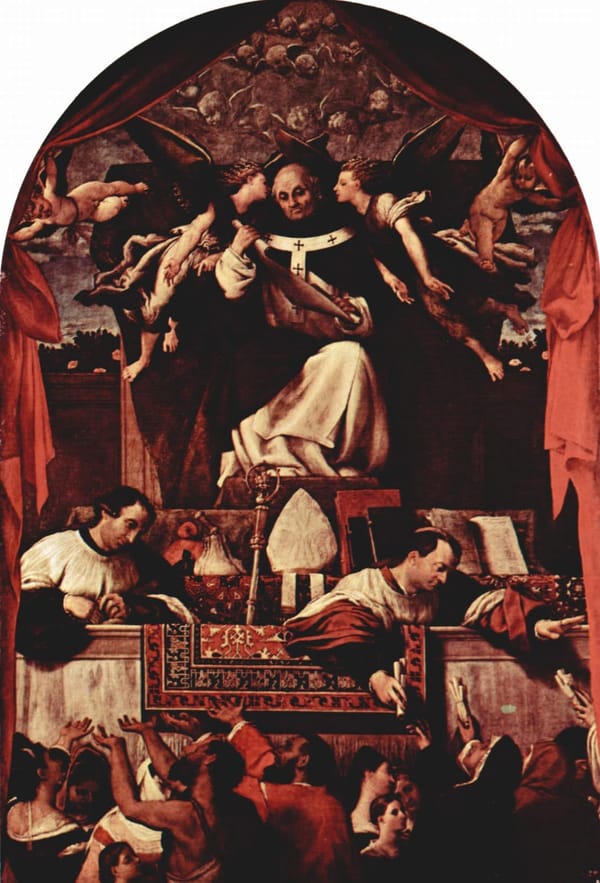 |
May 10: St. Antoninus, Bishop and Confessor
THE Order of St Dominic, which has already presented to our triumphant Jesus Peter the Martyr and Catharine the seraph of Siena, offers him to-day one of the many bishops trained and formed in its admirable school. It was in the fifteenth century, a period when sanctity was rare on the earth, that Antoninus realized in his own person the virtues of the greatest bishops of ancient times. His apostolic zeal, his deeds of charity, his mortified life, are the glory of the Church of Florence, which was confided to his care. Heaven blessed that illustrious city with temporal prosperity on account of its saintly archbishop. Cosmo de Medici was frequently heard to say that Florence owed more to Antoninus than to any other man. The holy prelate was also celebrated for his great learning. He defended the Papacy against the calumnies of certain seditious bishops in the Council of Basle: and, at the General Council of Florence, he eloquently asserted the truth of the Catholic faith, which was assailed by the abettors of the Greek schism. How beautiful is our holy Mother the Church, who produces such children as Antoninus, and has them in readiness to uphold what is true and withstand what is false!
She thus speaks the praises of the Saint of to-day:
Disciple of the great Dominic, inheritor of his burning zeal, protect the holy order which he founded, and of which thou art so bright an ornament. Show that thou still lovest it. Give it increase, and procure for its children the holiness that once worked such loveliness and fruit in the Church. Holy Pontiff, be mindful of the faithful, who implore thine intercession at this period of the year.
Thy eloquent lips announced the Pasch, so many years, to the people of Florence, and urged them to share in the Resurrection of our divine Head. The same Pasch, the immortal Pasch, has shone once more upon us. We are still celebrating it; pray that its fruits may be lasting in us, and that our Risen Jesus, who has given us life, may, by his grace, preserve it in our souls for all eternity.
May 10 (the Same Day): Sts. Gordian and Epimachus, Martyrs
TWO more martyrs ascend from our earth on this day and are admitted to share in Jesus’ glory. Again it is Rome that deputes them to bear her homage to the Conqueror of Death. Gordian was one of the magistrates who were commissioned, under Julian the Apostate, to persecute the Christians. One day, whilst exercising his office, he suddenly descended from the tribunal and took his place among the criminals. He was soon called upon to shed his blood for the faith. His martyrdom, together with that of the illustrious brothers, John and Paul, whose feast we shall keep in June, closes the period of the pagan persecutions in the West. The fact of his being buried in the crypts on the Latin Way awakened the memory of another martyr, whose relics, half consumed by fire, had long before been brought thither from Alexandria. His name was Epimachus; and on this day the two martyrs were inseparably united in the devotion of the faithful. Neither the place nor the period of their combat was the same; but both of them fought for the one cause and won the same victory. The two conquerors are buried in peace in the Eternal City; but he, for whose name they delivered their bodies to death, is mindful of their precious remains. Yet a little while, and he will fulfil, in their regard, the promise he made when he said: I am the Resurrection and the Life. He that believeth in me, although he he dead, shall live.1
Sleep your sleep of peace, O holy martyrs! Rest yet a little time, till your fellow-servants and brethren, who are to be slain even as you, shall be filled up.2 The number has been added to in every century; but the world is now near its end, and its last period is to be rich in martyrdom. When the reign of the man of sin3 begins its course, and the final tempest rages against the bark of holy Church, then, O martyrs of Christ, protect the Christian people, in return for the yearly tribute of honour that it has paid to your venerable names. Pray also for those living during these sad times, whose miseries seem like the distant howling of the storm that is to precede the end of the world. Strengthen our hearts, O holy martyrs! and whatever may be the lot prepared for us by Providence, obtain for us that we may be faithful to him, who would be to us what he has been to you—the Resurrection and the Life.4
Friday within the Octave of the Ascension
|
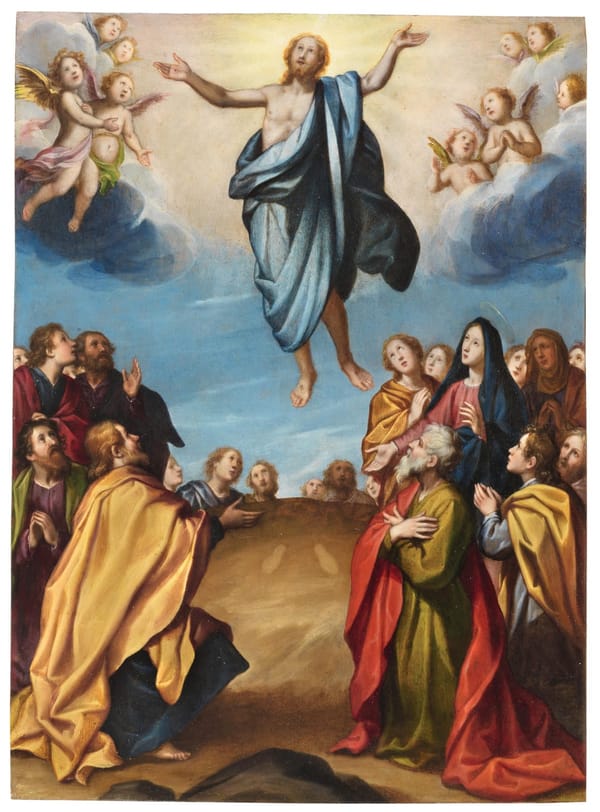
The feast of the Ascension shows us the work of God in its completion. Hence it is that the Church, in her daily offering of the holy sacrifice, thus addresses the eternal Father: the words occur immediately after the consecration, and contain the motives of her confidence in the divine mercy: ‘Wherefore, O Lord, we Thy servants, as also Thy holy people, calling to mind the blessed Passion of Christ Thy Son our Lord, His Resurrection from the dead, and His admirable Ascension into heaven, offer unto Thy most excellent Majesty a pure, holy, and unspotted Host.’ It is not enough for man to hope in the merits of his Redeemer’s Passion, which cleansed him from his sins; it is not enough for him to add to the commemoration of the Passion that of the Resurrection, whereby our Redeemer conquered death; man is not saved, he is not reinstated, except by uniting these two mysteries with a third: the Ascension of the same Jesus who was crucified and rose again. During the forty days of His glorified life on earth, Jesus was still an exile; and, like Him, we also are exiles until such time as the gate of heaven, which has been closed for four thousand years, shall be thrown open, both for Him and for us.
God, in His infinite goodness, made man for a nobler end than that of being mere lord of creation; He gave him a higher destiny than that of knowing such truths as his natural powers could grasp, and of practising virtues that were within the reach of his moral capabilities, and of paying to his Creator an imperfect worship. In His omnipotence and love, He gave to this frail creature an end far above his nature. Though inferior to the angel, and uniting in himself the two natures of matter and spirit, man was created to the same end as the angel. Both were to dwell for eternity in heaven; both were to be eternally happy in the face-to-face vision of God, that is, in the closest union with the sovereign Good. Grace—that wondrous and divine power—was to fit them for the supernatural end prepared for them by the gratuitous goodness of their Creator. This was the design which God had decreed from all eternity: to raise up to Himself these creatures that He had drawn out of nothingness, and to enrich them, agreeably to their sublime destiny, with the treasures of His love and His light.
We know the history of the fallen angels. They revolted against the commandment given them by God as a test of their fidelity, and as a condition of their being admitted into eternal happiness. Rebels were found in each of the choirs. They fell; but the fall and its punishment were personal, and injured none but the actual transgressors. The angels who remained faithful were at once rewarded with the beatific vision and possession of the sovereign Good. Thus did God vouchsafe to make created beings partake in His own infinite happiness: the first elect were the good angels of the nine choirs.
Man was created after the angels; he too fell, and his sin severed the link which united him with God. The human race was, at that time, represented by one man and woman; when they fell, all fell. The gate of heaven was then shut against mankind, for the fall of Adam and Eve implicated us their children; neither could they transmit to us an inheritance which they themselves had lost. Instead of a quick and happy passage through this world, and then a glorious ascension into heaven, we were to have a life short indeed but full of misery, a grave, and corruption. As to our soul, even had she aspired to the supernatural happiness for which she was created, she could never have attained to it. Man had preferred earth for his portion, and the earth was given to him; but this only for a few short years, after which others would take his place, disappear in their turn, and so on to the end, as long as it should please God to perpetuate this fallen portion of His creation.
Yes, it is thus we deserved to be treated; but our merciful Creator had compassion upon us. He hated sin; but He had created us that He might make us partakers of His own glory, and He would not have His design frustrated. The earth was not to be an abode for man to be merely born, live a few days, and then die. When the fulness of time should come, there was to appear in the world a Man, not indeed the first of a new creation, but one like ourselves and of our own race, or, as the apostle expresses it, ‘made of a woman.’1 This Man, who was to be heavenly and yet of earth, would share our misfortunes with us; He would die like us; He would be buried like us; but, on the third day, He would rise again, and men would see Him resplendent with glory and immortality. What a joy for us, who have within us ‘the answer of death,’ to see such a victory gained by One, who is one of ourselves, ‘flesh of our flesh!’
Thus were the divine intentions to be realized in our regard. Our earth presents to our Creator a new Adam. He cannot stay here, for He has conquered death; He must ascend to heaven, and if her gates be closed, she must open them and receive Him. ‘Lift up your gates, O ye princes! and be ye lifted up, O eternal gates! and the King of glory shall enter in!'2 Oh that He would take us thither with Him, for He is our brother, and He assures us that His ‘delight is to be with the children of men’!3 But what a joy it is for us to see our Jesus ascend to heaven! He is the holiest, the purest, the loveliest, of our race; He is the Son of a spotless Mother: let Him go and represent us in the kingdom of our inheritance. It is our own earth that sends Him; she is no longer a desert, now that she has produced such a flower, and such a fruit, for heaven. A flood of light poured into this lowly vale of tears, when the gates of heaven were raised up to receive Him. ‘Be Thou exalted, O Lord, in Thine own strength! and we, who are still on the earth, will sing and praise Thy power ’!4 Receive, O eternal Father, the brother whom we send to Thee; sinners though we are, this brother of ours is infinitely holy and perfect. Where is the curse that once fastened on our earth?’The earth hath given her fruit’!5 And if we may presume so far as to see in Him the first-fruits of a future harvest to be gathered into Thy house, may we not rejoice in the thought that the Ascension of our Jesus was the day whereon Thy primal work was restored to Thee?
Let us, to-day, borrow from the Armenian Church one of her sweetest hymns. Let us unite with her in sharing in the joy felt by the holy angels, when they saw the God-Man rising from earth, and taking possession of the highest throne in heaven.
| Previous May 9: St. Gregory Nazianzen, Bishop, and Doctor of the Church | Next May 10 (the Same Day): Sts. Gordian and Epimachus, Martyrs |