Daily reading
Paschal Time
Double of the II Class · May 1 · Sanctoral
May 11, 2024
From Dom Guéranger’s The Liturgical Year.

|
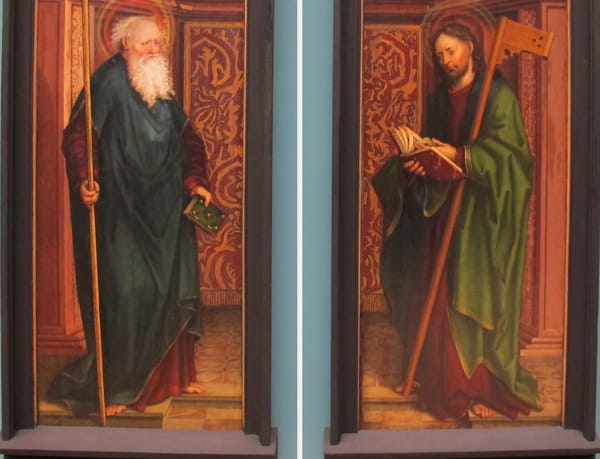
May 11 [May 1]: Sts. Philip and James the Less, Apostles
[This feast day, previously kept on May 1, was moved to May 11 when the feast of St. Joseph the Worker was established on May 1. The Solemnity of St. Joseph, which was replaced by St. Joseph the Work, was originally celebrated on the Third Sunday after Easter, as it was in the time of Dom Guéranger, whose article on that feast can be found here.-Ed.]
From Dom Guéranger's The Liturgical Year.
TWO of the favoured witnesses of our beloved Jesus' Resurrection come before us on this first day of May. Philip and James are here, bearing testimony to us that their Master is truly risen from the dead, that they have seen him, that they have touched him, that they have conversed with him,1 during these forty days. And, that we may have no doubt as to the truth of their testimony, they hold in their hands the instruments of the martyrdom they underwent for asserting that Jesus, after having suffered death, came to life again and rose from the grave. Philip is leaning upon the cross to which he was fastened, as Jesus had been; James is holding the club wherewith he was struck dead.
Philip preached the Gospel in the two Phrygias, and his martyrdom took place at Hierapolis. He was married when he was called by our Saviour; and we learn from writers of the second century that he had three daughters, remarkable for their great piety, one of whom lived at Ephesus, where she was justly revered as one of the glories of that early Church.
James is better known than Philip. He is called, in the sacred Scripture, Brother of the Lord,2 on account of the close relationship that existed between his own mother and the blessed Mother of Jesus. He claims our veneration during Paschal Time, inasmuch as he was favoured with a special visit from our Risen Lord, as we learn from St Paul.3 There can be no doubt but that he had done something to deserve this mark of Jesus’ predilection. St Jerome and St Epiphanius tell us that our Saviour, when ascending into heaven, recommended to St James’s care the Church of Jerusalem, and that he was accordingly appointed the first bishop of that city. The Christians of Jerusalem, in the fourth century, had possession of the chair on which St James used to sit when he assisted at the assemblies of the faithful. St Epiphanius also tells us that the holy Apostle used to wear a lamina of gold upon his forehead as the badge of his dignity. His garment was a tunic made of linen.
He was held in such high repute for virtue that the people of Jerusalem called him ' The Just and when the time of the siege came, instead of attributing the frightful punishment they then endured to the deicide they or their fathers had .committed, they would have it to be a consequence of the murder of James, who, when dying, prayed for his people. The admirable Epistle he has left us bears testimony to the gentleness and uprightness of his character. He there teaches us, with the eloquence of an inspired writer, that works must accompany our faith if we would be just with that justice which makes us like our Risen Lord.
The bodies of SS Philip and James repose in the Basilica of the Holy Apostles at Rome. These relics are counted as one of the richest treasures of the Holy City, and there is reason to believe that this first of May is the real anniversary of their translation. For a long period the Church of Rome kept special feasts in honour of four only of the Apostles: SS Peter and Paul, St John the Evangelist, and St Andrew (Peter’s brother): the rest were united in the solemnity of June 29, and a vestige of this is still to be found in the office of that day, as we shall see later on. The reception of the bodies of SS Philip and James, which were brought from the East somewhere about the sixth century, gave rise to the institution of to-day's feast; and this led gradually to the insertion into the Calendar of special feasts for the other Apostles and Evangelists.
Let us now read the brief account given of St Philip in the Liturgy.
The Breviary then gives the two following Lessons upon St James:
The Greek Church celebrates the memory of these two Apostles on distinct days, which are the anniversaries of their martyrdom. The following stanzas are from the hymn in honour of St Philip:
Hymn (Die XIV Novembris)
Let us now make a selection from the Menæa in honour of St James, whose memory is so affectionately cherished by the Eastern Churches:
Hymn (Die XXIII Octobris)
Holy Apostles! you saw our Risen Jesus in all his glory. He said to you on the evening of that great Sunday: Peace be to you! He appeared to you during the forty days following, that he might make you certain of his Resurrection. Great indeed must have been your joy at seeing once more that dear Master, who had admitted you into the number of his chosen Twelve; and his return made your love of him more than ever fervent. We address ourselves to you as our special patrons during this holy season, and most earnestly do we beseech you to teach us how to know and love the great mystery of our Lord’s Resurrection. May our hearts glow with Paschal joy, and may we never lose the new life that our Jesus has now given unto us.
Thou, O Philip! wast devoted to him, even from the first day of his calling thee. Scarcely hadst thou come to know him as the Messias, than thou didst announce the great tidings to thy friend Nathanael. Jesus treated thee with affectionate familiarity. When about to work the great miracle of the multiplication of the loaves, it was to thee that he addressed himself, and said to thee: Whence shall we buy bread, that these may eat?4 A few days before the Passion of thy divine Master, some of the Gentiles wished to see this great Prophet, of whom they had heard such wonderful things, and it was to thee that they applied. How fervently didst thou not ask him, at the Last Supper, to show thee the Father! Thy soul longed for the divine light; and when the rays of the Holy Ghost had inflamed thy spirit, nothing could daunt thy courage. As a reward of thy labours, Jesus gave thee to share with him the honours of the Cross. O holy Apostle! intercede for us, that we may imitate thy devotedness to Jesus; and that, when he deigns to send us the Cross, we may reverence and love it.
We also honour thy love of Jesus, O thou that art called the brother of the Lord, on whose venerable features was stamped the likeness of our Redeemer. If, like the rest of the Apostles, thou didst abandon him in his Passion, thy repentance was speedy and earnest, for thou wast the first, after Peter, to whom he appeared after his Resurrection. We affectionately congratulate thee, O James, for the honour thus conferred upon thee; do thou, in return, obtain for us that we may taste and see how sweet is our Risen Lord.5 Thy ambition was to give him every possible proof of thy gratitude; and the last testimony thou didst bear, in the faithless city, to the divinity of thy dear Master (when the Jews took thee to the top of the Temple) opened to thee, by martyrdom, the way that was to unite thee to him for eternity. Pray for us, O thou generous Apostle, that we also may confess his holy Name with the firmness which befits his disciples; and that we may ever be brave and loyal in proclaiming his rights as King over all creatures.
O holy Apostles! we beseech you to unite your prayers, and intercede for the Churches of the East, to which you preached the Gospel. Have compassion on Jerusalem, the dupe of schism and heresy; obtain her purification and her liberty; and rid her Holy Places of the sacrileges that have so long polluted them. Lead back the Christians of Asia Minor to union with the fold governed by the one supreme pastor. And lastly, pray for Rome, the city where your bodies repose, awaiting their glorious Resurrection. In return for the long hospitality she has given you, shield her with your protection; and permit not that the city of Peter, your venerable Head, should be deprived of its grandest glory—the presence of the Vicar of Christ.
Saturday within the Octave of the Ascension
|
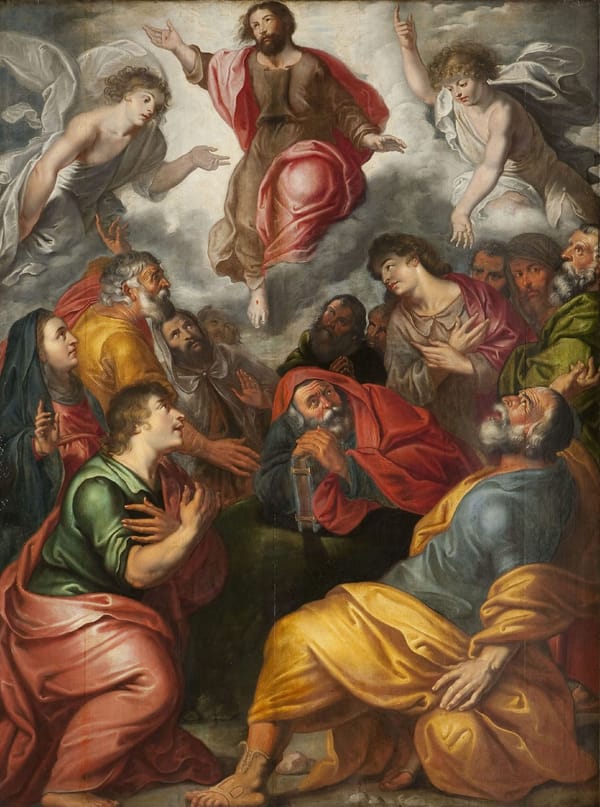
Jesus, then, the Man who dwelt on the earth and was perfect in all holiness, has ascended into heaven. This earth, accursed of God as it was, has produced the fairest fruit of heaven; and heaven with its gates shut against our race, has had to open them for the entrance of a Son of Adam. It is the mystery of the Ascension; but it is only a part, and it behoves us to know the mystery in its fulness. Let us give ear to the apostle of the Gentiles: ‘God who is rich in mercy, through His exceeding charity wherewith He loved us even when we were dead in sins, hath quickened us together with Christ: and hath raised us up together with Him, and hath made us sit in the heavenly places together with Him.’1 We have celebrated the Pasch of our Saviour’s Resurrection as our own resurrection; we must, agreeably to the apostle’s teaching, celebrate also His Ascension as our own. Let us weigh well the expression: ‘God hath made us sit in the heavenly places together with Christ.’ So then in the Ascension, it is not Jesus alone who ascends into heaven; we ascend thither with Him. It is not He alone that is enthroned there in glory; we are enthroned through and together with Him.
That we may the better understand this truth, let us remember that the Son of God did not assume our human nature with a view to the exclusive glorification of the Flesh which He united to His own divine Person. He came to be our Head. We, consequently, are His members; and where He is, we also are to be; at least, such is His intention, as He implied at the last Supper, when He said: ‘Father! I will that where I am, they also whom Thou hast given Me may be with Me, that they may see My glory which Thou hast given Me.’2 And what is the glory given to Him by His Father? Let us hearken to the royal prophet, who, speaking of the future Ascension, says: ‘The Lord said to my Lord: Sit Thou at My right hand!’3
It is, then, on the very throne of the eternal Father, it is at His right hand, that we shall see Him whom the apostle calls our forerunner.4 We shall be united with Jesus, as members to our Head; so that His glory will be ours; we shall be kings, with His kingship; He will make us partake of all that He Himself has, for He tells us that we are His joint-heirs.5
From this it follows that the august mystery of the Ascension, which began on the day of Jesus’ entrance into heaven, will continue, until His mystical body has received its completion by the ascension of the last of the elect. Look at that countless host of holy souls who were the earliest companions of His triumph: foremost are our first parents; then the patriarchs, the prophets, and the just of every generation of the preceding four thousand years! They had been imprisoned in limbo, but He liberated them, gave them of His own brightness, and made them His partners in the glory of His Ascension. They were His trophy; they formed His court, as He passed from earth to heaven. Well did we exclaim in the words of holy David: ‘Sing to God, ye kingdoms of the earth! Sing ye to the Lord. Sing ye to God, who mounteth above the heaven of heavens, towards the east.’6
The angels were ready to receive our Emmanuel; and then began that sublime dialogue, which the royal psalmist was permitted to hear and prophesy. The glad countless legion of the holy souls, who escorted the divine conqueror, cried out to the guardians of the heavenly Jerusalem: ‘Lift up your gates, O ye princes! Be ye lifted up, O eternal gates! and the King of glory shall enter in.’ The faithful angels replied: ‘Who is this King of glory?’ ‘It is the Lord,’ responded the elect of earth: ‘It is the Lord who is strong and mighty; the Lord mighty in battle.’ Well might they say this of our Jesus, who had vanquished satan, death and hell, and brought themselves to the city’s gate as a sample of His stupendous conquest. The angels repeated their question; the saints re-echoed their reply; the eternal gates were thrown open, and the King and His courtiers entered into heaven.7
The gates, then, are opened to receive our Redeemer, and opened He would have them remain for us to follow Him. Admirable Ascension! oh, let us linger in its contemplation! Jesus inaugurates the grand mystery by His own entrance into heaven, and then perpetuates it by the ascension of His elect of each successive generation. There is a ceaseless procession up to heaven; for some happy souls are ever finishing their purification in purgatory, while some still happier ones are winging their rapid flight direct from this earthly vale of sorrows. Hail, then, O glorious mystery! fruit of the flowers of so many mysteries; term, fulfilment, perfection of our Creator’s decree! Alas! thou hadst a long interruption by Adam’s sin; but Jesus’ triumph restored thy reign on earth, and this earth shall live in thy beauty and grace till that word shall be uttered by the angel: ‘Time shall be no more!’8 O mystery of joy and hope, be thou accomplished in me!
Permit us, then, O Jesus, to apply to ourselves what Thou saidst to Thine apostles: ‘I go to prepare a place for you!’9 This has been Thy aim in all Thou hast done for us: Thou camest into this world to open heaven for us. Thy holy bride, the Church, bids us fix our eyes on heaven; she points to its opened gates, and shows us the bright track through which is passing up from earth an unbroken line of souls. We are still in exile; but the eye of our faith sees Thee in that land above, Thee the Son of Man throned at the right hand of the Ancient of days.10 How are we to reach Thee, dear Jesus? We cannot, as Thou didst, ascend by our own power: Thou must needs fulfil Thy promise, and our desire, of drawing us to Thyself.11 It was the object after which Thy blessed Mother also sighed, when Thou didst leave her on earth; she longed for the blissful hour of Thy taking her to Thyself, and awaited Thy call with faith, labouring meanwhile for Thy glory, and living with Thee, though not seeing Thee. Give us to imitate the faith and love of this Thy Mother, that so we may apply to ourselves those words of Thine apostle: ‘We are already saved, by hope.’12 Yes, we shall be so, if Thou send us, according to Thy promise, the holy Spirit whom we so ardently desire to receive; for He is to confirm within us all that Thy mysteries have produced in our souls; He is to be to us a pledge of our future glorious ascension.
In presenting our petitions this day to heaven, let us take, as addressed to ourselves, the sublime instructions given by the Gothic Church of Spain, on the Ascension feast, to her children.
Missa
| Previous Friday within the Octave of the Ascension | Next Saturday within the Octave of the Ascension |