Daily reading
Semidouble · May 15 · Sanctoral
May 15, 2024
From Dom Guéranger’s The Liturgical Year.
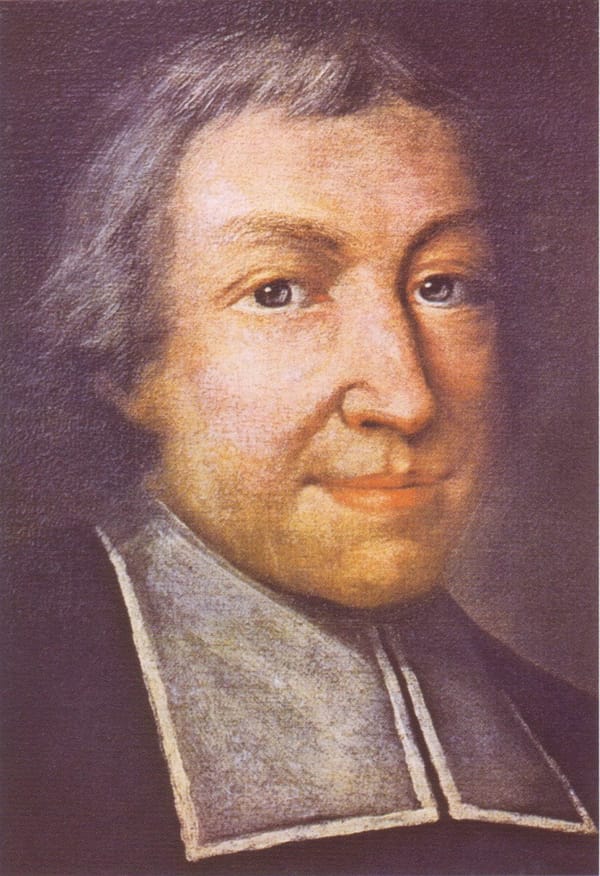
May 15: St. John Baptist de la Salle, Confessor
JOHN Baptist de la Salle, the teacher of the humble, takes his place to-day beside Leo the Great, Athanasius, and Gregory of Nazianzum. He has no fear. The victor of Paschal Time is the same Jesus who said during his mortal life: ‘Suffer the little children to come unto me,'1 and ‘unless you be converted and become as little children, you shall not enter into the kingdom of heaven,'2 that kingdom of heaven which, after entering into his glory, he manifests so fully upon earth. On the other hand, the Lion of Juda is never more terrible in his anger than when he beholds evil men conspiring to keep from him the little ones of whom he forms his court.3
The promise made in Holy Scripture that ' they that instruct many to justice shall shine as stars for all eternity'4 is addressed not only to the great doctors of the science of salvation, but also to the humblest Christian teacher, and the supreme Pontiff, when inscribing the name of the saint of to-day among those of the blessed, declared that the inspired words ' apply in an especial manner to those who, like him, have left all things and devoted themselves to the instruction of the baptized from earliest infancy in the teaching of the Gospel and the precepts which lead to life eternal.’5
John Baptist de la Salle was a true disciple of our blessed Lord, and entered so fully into the thought of his Master that no sacrifice was too great for him if only he might carry it out, and no suffering, humiliation, or persecution could hinder him from persevering in the accomplishment of his works of love. He suffered from misunderstanding and lack of support all through his life, but is he less great in heaven to-day on that account?
The following account of him is given in the Breviary:
O God, who hast raised up the holy Confessor John Baptist to promote the Christian education of the poor and to confirm the young in the way of truth, and, through him, hast gathered together a new family within thy Church: mercifully grant through his intercession and example that we may bum with zeal for thy glory in saving souls, and may share his crown in heaven. Through Christ our Lord.
Thus, O father of Christian schools, does Holy Church pray to-day in thy honour. She is as full of confidence as though the trials of thy mortal life had been sufficient to guard thy sons against similar sufferings; as serene as though the future of thy work were assured. And yet, might we not say that the culminating point of thy glorification on earth seems to have given the signal for the triumph of hell over thy labours? But the Church is strong in her experience of twenty centuries, and she fears no persecution. She knows that if the tree be planted by God, the hurricane will but strengthen its roots, and that a house built upon a rock can brave the wind and the floods. We too, like the Church, are full of hope, trusting in thy merits and thy intercession. Even if min seem complete, the divine Head of all who suffer persecution assures us that the tomb itself, though sealed by the powers of this world, cannot guarantee to Death the secure possession of his victim.
Wednesday within the Octave of the Ascension
|
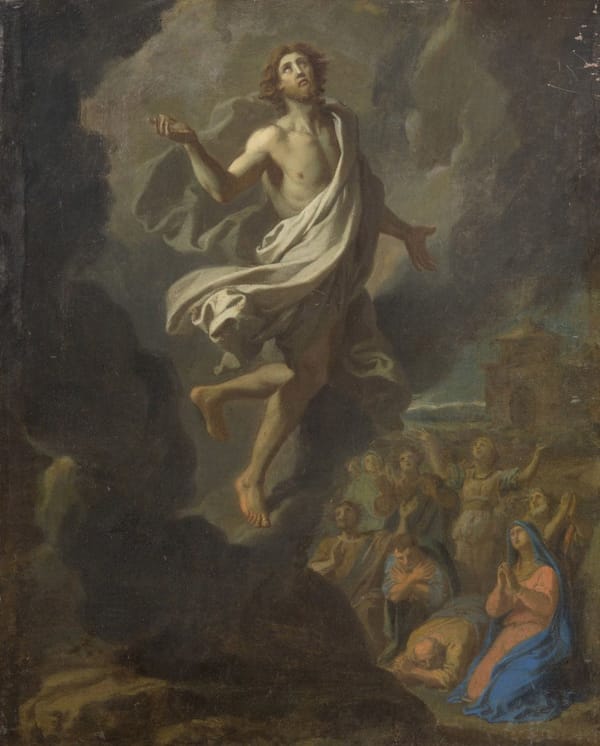
Let us now look upon the earth, for our eyes have hitherto been riveted upon the heaven into which our Jesus has entered. Let us see what effects the mystery of the Ascension has produced on this land of our exile. These effects are of the most extraordinary nature. This Jesus, who ascended into heaven unknown to the city of Jerusalem, and whose departure, when it did become known, excited neither regret nor joy among the men of that generation,—now, eighteen hundred years after His departure from us, finds the whole earth celebrating the anniversary of His glorious Ascension. Our age is far from being one of earnest faith; and yet there is not a single country on the face of the globe, where, if there be a church or chapel or even a Catholic home, the feast of Jesus’ Ascension is not being now kept and loved.
He lived for three-and-thirty years on our earth. He, the eternal Son of our God, dwelt among His creatures, and there was only one people that knew it. That one favoured people crucified Him. As to the Gentiles, they would have thought Him beneath their notice. True, this beautiful’light shone in the darkness; but the darkness did not comprehend it; He came unto His own, and His own received Him not.’1 He preached to His chosen people; but His word was that seed which falls on stony ground, and takes no root, or is cast among thorns and is choked; it could with difficulty find a plot of good ground, wherein to bring forth fruit.2 If, thanks to His infinite patience and goodness, He succeeded in keeping a few disciples around Him, their faith was weak and hesitating, and gave way when temptation came.
And yet, ever since the preaching of these same apostles, the name and glory of Jesus are every where; in every language, and in every clime, He is proclaimed the Incarnate Son of God; the most civilized, as well as the most barbarous nations, have submitted to His sweet yoke; in every part of the universe men celebrate His birth in the stable of Bethlehem, His death on the cross whereby He ransomed a guilty world, His resurrection whereby He strengthened the work He came to do, and His Ascension, which gives Him, the Man-God, to sit at the right hand of His Father. The great voice of the Church carries to the uttermost bounds of the earth the mystery of the blessed Trinity, which He came to reveal to mankind. This holy Church, founded by Him, teaches the truths of faith to all nations, and in every nation there are souls who are docile to her teaching.
How was this marvellous change brought about? What has given it stability during these eighteen hundred years? Our Saviour Himself explains it to us, by the words He spoke to His apostles after the last Supper: ‘It is,’ said He,’expedient to you that I go.’3 What means this, but that there is something more advantageous to us than having Him visibly present amongst us? This mortal life is not the time for seeing and contemplating Him, even in His human Nature. To know Him, and relish Him, even in His human Nature, we stand in need of a special gift; it is faith. Now, faith in the mysteries of the Incarnate Word did not begin its reign upon the earth, until He ceased to be visible here below.
Who could tell the triumphant power of faith? St. John gives it a glorious name; he says:’It is the victory which overcometh the world.’4 It subdued the world to our absent King; it subdued the power and pride and superstitions of paganism; it won the homage of the earth for Him who has ascended into heaven, the Son of God and the Son of Mary, Jesus.
St. Leo the Great, the sublime theologian of the mystery of the Incarnation, has treated this point with his characteristic authority and eloquence. Let us listen to his glorious teaching.’Having fulfilled all the mysteries pertaining to the preaching of the Gospel and to the new Covenant, our Lord Jesus Christ ascended into heaven, in the sight of His disciples, on the fortieth day after His Resurrection; hereby withdrawing His corporal presence, for He was to remain at the right hand of His Father until should be filled up the measure of time decreed by God for the multiplication of the children of the Church, and He (Jesus) should again come, and in the same Flesh wherewith He ascended, to judge the living and the dead. Thus, therefore, that which in our Redeemer had hitherto been visible passed into the order of mysteries. And to the end that faith might be grander and surer, teaching took the place of sight; which teaching was to be accepted by the faithful with hearts illumined by heavenly light.
This faith, increased by our Lord’s Ascension, and strengthened by the gift of the Holy Ghost, was proof against every trial; so that neither chains, nor prisons, nor banishment, nor hunger, nor fire, nor wild beasts, nor all the ingenuity of cruelty and persecution, could affright it. For this faith, not only men, but even women, not only beardless boys but even tender maidens, fought unto the shedding of their blood, and this in every country of the world. This faith cast out devils from such as were possessed, cured the sick, and raised the dead to life. The blessed apostles themselves,—who, though they had so often witnessed their Master’s miracles and heard His teachings, turned cowards when they saw Him in His sufferings, and hesitated to believe His Resurrection,—these same, I say, were so changed by His Ascension, that what heretofore had been a subject of fear, then became a subject of joy. And why? Because the whole energy of the soul’s contemplation was raised up to Jesus’ Divinity, now seated at the right hand of His Father; the vigour of the mind’s eye was not dulled by the bodily vision, and they came to the clear view of the mystery, namely, that He neither left the, Father when He descended upon the earth, nor left His disciples when He ascended into heaven.
Never, then, was Jesus so well known, as when He withdrew Himself into the glory of His Father’s majesty, and became more present by His Divinity in proportion as He was distant in His Humanity. Then did faith, made keener, approach to the Son coequal with His Father; she needed not the handling of the bodily substance of her Christ,—that bodily substance, whereby He is less than His Father, The substance of His glorified Body is the same; but our faith was to be of so generous a kind, that we were to go to the coequal Son, not by a corporal feeling, but by a spiritual understanding. Hence, when Mary Magdalene, who represented the Church, threw herself at the feet of the risen Jesus, and would have embraced them, He said to her: Touch Me not, for I am not yet ascended to My Father; as though He would say: I will not that thou come to Me corporally, or that thou know Me by the testimony of thy senses. I have a sublimer recognition in store for thee; I have prepared something far better for thee. When I shall have ascended to My Father, then shalt thou feel Me in a higher and truer way; for thou shalt grasp what thou touchest not, and believe what thou seest not.’5
The departure of our Emmanuel was, therefore, the opening of that reign of faith, which is to prepare us for the eternal vision of the sovereign Good; and this blessed faith, which is our very life, gives us, at the same time, all the light compatible with our mortal existence, for knowing and loving the Word consubstantial with the Father, and for the just appreciation of the mysteries which this Incarnate Word wrought here below in His Humanity. It is now eighteen hundred years since He lived on the earth; and yet we know Him better than His disciples did before His Ascension. Oh! truly it was expedient for us that He should go from us; His visible presence would have checked the generosity of our faith; and it is our faith alone that can bridge over the space which is to be between Himself and us until our ascension comes, and then we shall enter within the veil.
How strangely blind are those who see not the superhuman power of this element of faith, which has not only conquered, but even transformed, the world! Some of them have written long treatises to prove that the Gospels were not written by the evangelists: we pity their ravings. But these great discoverers have another difficulty to get over, and so far they have not attempted to grapple with it; we mean the living Gospel which is the production of the unanimous faith of eighteen centuries, and is the result of the courageous confession of so many millions of martyrs, of the holiness of countless men and women, of the conversion of so many both civilized and uncivilized nations. Assuredly He,—who after having spent a few short years in one little spot of earth, had but to disappear in order to draw men’s hearts to Himself so that the brightest intellects and the purest minds gave Him their faith,—must be what He tells us He is: the eternal Son of God. Glory, then, and thanks to Thee O Jesus! who to console us in Thine absence, hast given us faith, whereby the eye of our soul is purified, the hope of our heart is strengthened, and the divine realities we possess tell upon us in all their power! Preserve within us this precious gift of Thy gratuitous goodness; give it increase; and when our death comes,—that solemn hour which precedes our seeing Thee face to face,—Oh, give us the grand fullness of our dearest faith!
One of the most northern of the Churches, now, alas! a slave to Lutheranism, shall provide us to-day with a hymn in honour of the mystery we are celebrating. It is a sequence taken from the last missal of Abo, in Finland. It was composed in the fourteenth or fifteenth century.
Sequence
Festos choros ducite,
Christo triumphante;
Redit cum victoria,
Capta ducens spolia,
Tuba jubilante.
Hodie dominicum
Germen gloriatur!
Terrae fructus hodie
Super thronos curiæ
Cœli sublimatur.
Moyses, et populum
Trahit ad spectaculum
Stant suspensis vultibus,
Intendentes nubibus
Jesum subducentibus,
Viri Galilaei.
Elisaeo duplex datur
Spiritus et pallium:
Alta Christus dum conscendit,
Servis suis mnas appendit
Gratiarum omnium.
Luctum gerens non inanem,
Crucis usus baculo;
Redit turmis cum duabus,
Angelis et animabus,
Et thesauri sacculo.
Qui de mortis
Victor portis
Introit cum gloria;
Rex virtutum,
Cujus nutum
Et obtutum
Trina tremit regia.
Ad consessus solium,
Donec suppedaneos,
Victos vel spontaneos,
Ponat inimicos.
Fruitur potissimis;
Redit ex novissimis,
Judicans ex intimis
Justos et iniquos.
Veni cum clementia:
Dum sistemur ante thronum
Tua in præsentia:
Fac misericordiam;
In perennem transfer vitam
Ad futuram gloriam.
and sing your festive songs,
for it is the triumph of Christ!
He returns to heaven, leading thither
the trophies he has won; and as he ascends,
the jubilant sound of the trumpet is heard.
that is this day conferred on the Son of God!
The fruit of our earth
is this day exalted
above all the thrones
of the heavenly court.
and people flock to see
the grandeur of the mystery:
stand looking up
to the cloud
that received him
out of their sight.
he gave his twofold
spirit and his mantle to Eliseus:
when Jesus ascended into heaven,
he gave to his servants
the talents of his grace.
enduring sufferings of wondrous avail to us,
and the staff he used was the cross.
He returned to heaven with two troops,
—of angels, and of souls (set free from limbo),
—and laden with treasures.
who, having conquered
the gates of death,
entered heaven with glory.
He is the King of hosts,
at whose bidding
and presence
the triple creation trembles.
to sit with him on his throne,
until he make his enemies
bow down before him,
vanquished by force or love.
he receives supreme honour;
he is to come again upon our earth
to judge the consciences of all,
saints and sinners.
come in thy mercy,
when we are to appear
before thee seated on thy throne.
and give us to ascend
to the endless life
of future glory.
Again the Mozarabic breviary offers us one of its beautiful prayers for this octave.
Prayer
| Previous Tuesday within the Octave of the Ascension | Next Wednesday within the Octave of the Ascension |