Daily reading
Paschal Time
Double · May 17 · Sanctoral
May 17, 2024
From Dom Guéranger’s The Liturgical Year.
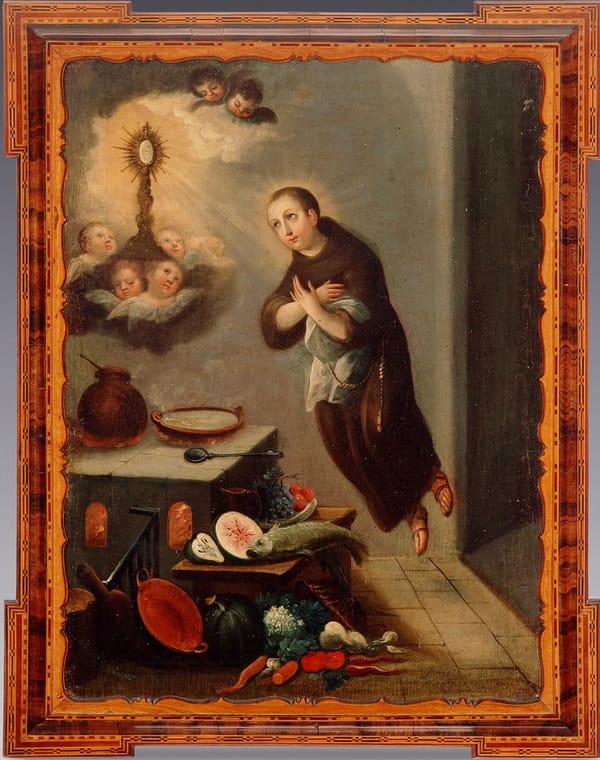 |
May 17: St. Paschal Baylon, Confessor
THE Seraph of Assisi was sure to depute some of his children to pay their court to his Risen Master. The one he sends to-day is the humblest and most obscure of men; another will follow, three days hence, powerful in word and work, and holding a palm in his hands, as a most devoted preacher of the Gospel. Paschal Baylon was a simple peasant. He was a shepherd-boy; and it was in tending his flock that he found the Lord Jesus. He had a great love for contemplation. Forests and fields spoke to him of their great Creator; and, in order that he might be the more closely united with him, he resolved to seek him in the highest paths of perfection. He was ambitious to imitate the humble, poor and suffering life of the Man-God; the Franciscan Cloister offered him the opportunity of satisfying this desire and he flew to it. On that blessed soil, he grew to be one of heaven's choicest plants, and the whole earth has now heard the name of the humble lay-brother of a little convent in Spain. Holy Church brings him before us to-day enraptured in the contemplation of Jesus' Resurrection. He had trod the path of humiliation and the cross; it was but just that he should share in his Master's triumph. It was of him, and of such as he, that this divine Saviour spoke, when he said: Ye are they that have continued with me in my temptations; and I dispose to you, as my Father hath disposed to me, a kingdom; that ye may eat and drink at my table in my kingdom, and may sit upon thrones, judging the twelve tribes of Israel.1
The account given by the Liturgy of the angelic life of this illustrious son of St Francis is as follows:
Heaven opened to receive thee, O Paschal! Even when here below, the fervour of thy contemplation often gave thee a foretaste of the delights of eternal bliss; but now every veil is drawn aside, and thou art face to face with him whom thou didst so ardently desire to possess. Thou hast no further need to unite thyself with him by humiliation and suffering; thou enjoyest his own glory, his own happiness, his own triumph, and he will have thee enjoy it for all eternity. Deign to cast an eye of pity on us, who have not thy eagerness to walk in our Redeemer’s footsteps, and who, as yet, have but the hope of being united to him for eternity. Gain for us courage. Gain for us that love which leads straight to Jesus, which surmounts every obstacle of flesh and blood, and gives to man an admirable resemblance to his divine Model. The pledge of this happy transformation has been given to us by our being permitted to partake of the Paschal Mystery; may it be perfected by our fidelity in keeping close to our divine conqueror and Lord! Though he leave us some time further in this vale of tears, his eye is ever upon us, he longs to see us persevere in our loyalty to him. Yet a little while, and we shall see him! Behold! says he, I come quickly; hold fast that which thou hast. Behold! I stand at the gate and knock. If any man shall hear my voice, and open to me the door, I will come in to him, and will sup with him, and he with me.2 Thus will the Pasch of time be changed into the Pasch of eternity. Pray for us, O Paschal, that like thee, we may hold fast that which, by the grace of our Risen Jesus, we already possess.
Friday after the Octave of the Ascension
|
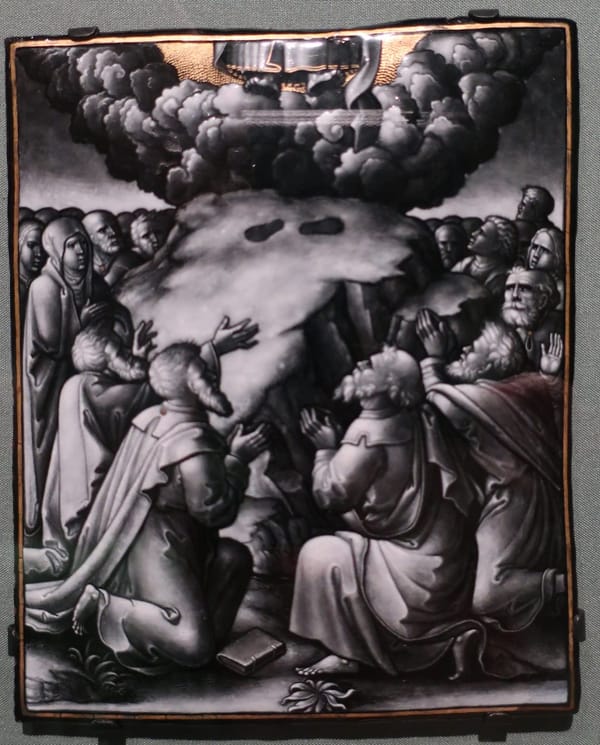
The octave is over; the mystery of the glorious Ascension is completed; and our Jesus is never again to be seen upon this earth, until He comes to judge the living and the dead. We are to see Him only by faith; we are to approach Him only by love. Such is our probation; and if we go well through it, we shall, at last, be permitted to enter within the veil, as a reward for our faith and love.
Let us not complain of our lot; rather let us rejoice in that hope, which, as the apostle says, confoundeth not.1 And how can we be otherwise than hopeful, when we remember that Jesus has promised to abide with us even to the consummation of the world?2 He will not appear visibly; but He will be always really with us. How could He abandon His bride the Church? And are not we the children of this His beloved bride?
But this is not all: Jesus does something more for us. One of His last words was this, which shows us how dearly He loved us: ‘I will not leave you orphans.’3 When He used those other words, upon which we have been meditating during the last few days, ‘It is expedient for you that I go’, He added: ‘For if I go not, the Paraclete will not come to you.’4 This Paraclete, this comforter, is the Holy Ghost, the Spirit of the Father and of the Son; He is to descend upon us a few short hours hence; He will abide with us, making us feel His presence by His works, until Jesus shall again come from heaven that He may take His elect from a world which is to be condemned to eternal torments for its crimes. But the Holy Ghost is not to come until He be sent; and as the sacred text implies, He is not to be sent, until ‘Jesus shall have been glorified.’5 He is coming that He may continue the great work, which was to be begun by the Son of God, and carried on by Him as far as the eternal decrees had ordained.6
Jesus laboured in this work, and then entered into His rest, taking with Him our human nature, which, by assuming it, He had exalted to the divine. The Holy Ghost is not to assume our humanity; but He is coming to console us during Jesus’ absence; He is coming to complete the work of our sanctification. It was He that produced those prodigies which we have been admiring: the faith and love of man in and for Jesus. Yes, it is the Holy Ghost who produces faith in the soul; it is the Holy Ghost who ‘pours the charity of God into our hearts.’7
So, then, we are about to witness fresh miracles of God’s love for man! A few hours hence, the reign of the Holy Ghost will have begun on earth. There is but the interim of this one short day, for to-morrow evening the solemnity of Pentecost will be upon us. Let us then linger in our admiration of our Emmanuel. The holy liturgy has daily gladdened us with His presence, beginning with those happy weeks of Advent, when we were awaiting the day on which the Virgin Mother was to give us the ever blessed Fruit. And now He is gone! O sweet memories of the intimacy we enjoyed with our Jesus, when we were permitted to follow Him day by day, we have you treasured within us! Yea, the holy Spirit Himself is coming to impress you still deeper on our hearts; for Jesus told us that, when the Paraclete should come to us, He would help us to remember all that we have heard, and seen, and felt in the company of the God who deigned to live our life that so He might teach us to live His for all eternity.8
Neither let us forget how, when quitting this His earthly home,—where He was conceived in Mary’s womb, where He was born, where He spent the three and thirty years of His mortal life, where He died, where He rose from the grave, and from which He ascended to the right hand of His Father—He left upon it an outward mark of His love. He left the impress of His sacred feet upon Mount Olivet, as though He felt separating Himself from the earth to which so many years and mysteries had endeared Him. St. Augustine, St. Paulinus of Nola, Saint Optatus, Sulpicius Severus, and the testimony of subsequent ages, assure us of the prodigy.
These venerable authorities tell us that when the Roman army, under Titus, was encamped on Mount Olivet while besieging Jerusalem, divine Providence protected these holy marks, the farewell memorial left by our Lord to His blessed Mother, to His disciples, and to us: it is here that He stood when last seen on earth, it is here that we shall again see Him when He comes to judge mankind. Neither the rude tramp of the soldiers, nor the ponderous chariots, nor the horses’ hoofs, were permitted to efface or injure the sacred footprints. Yes, it was on this very mount, forty years after the Ascension, that the Roman banner was first unfurled, when the time of God’s vengeance came upon the city of deicide. Let us call to mind, firstly, how the angels announced that the same Jesus, who had just ascended, would again come to judge us; and secondly, how our Lord Himself had compared the two awful events, the destruction of Jerusalem, and the end of the world. These sacred marks of Jesus’ feet are, therefore, the memorial of His affectionate farewell, and the prophecy of His return as our terrible Judge. At the foot of the hill lies the valley of Josaphat, the valley of the judgement; and the prophet Zacharias has said: ‘His feet shall stand, in that day, upon the mount of Olives, which is over against Jerusalem, towards the east.’9 Let us humbly give admission to the feeling of fear, wherewith our Lord thus inspires us, that we may be more solidly grounded in His love; and let us affectionately venerate the spot on which our Emmanuel left the impress of His feet. The holy empress, St. Helen, was entrusted with the sublime mission of finding and honouring the objects and places that our Redeemer had sanctified by His visible presence. Mount Olivet was sure to elicit her devoted zeal. She ordered a magnificent church of circular form to be built upon it; but when the builders came to pave the church with rich marble, they were prevented, by a miraculous power, from covering the spot on which were imprinted the holy footmarks. The marble broke into a thousand pieces, which struck them on the face; and after several attempts, they resolved to leave that part of the rock uncovered.
This fact is attested by many holy and creditable authors, several of whom lived in the fourth century, when it occurred. But our Lord would do more than keep open to our view these His last footprints, which seem to be ever saying to us: ‘Your Jesus is but now gone, and will soon return.’ He would, moreover, have them teach us that we are to follow Him to heaven. When the time came for roofing the church, the men found that they had not power to do it; the stones fell as often as they attempted to put them up, and the building was left roofless, as though it had to be our reminder that the way opened by Jesus on the summit of Mount Olivet is ever open for us, and that we must be ever aspiring to rejoin our divine master in heaven.
In his first sermon for the feast of the Ascension, St. Bernardine of Siena relates an edifying story, which is in keeping with the reflections we have been making. He tells us that a pious nobleman, desirous of visiting the places that had witnessed the mysteries of our Redemption, passed the seas. Having reached Palestine, he would begin his pilgrimage by visiting Nazareth, and there, on the very spot where the Word was made Flesh, he gave thanks to the infinite love that had drawn our God from heaven to earth, in order that He might save us from perdition. The next visit was to Bethlehem, where our pilgrim venerated the place of our Saviour’s birth. As he knelt on the spot where Mary adored her new-born Babe, the tears rolled down his cheeks, and, as St. Francis of Sales says (for he also has related this affecting story), ‘he kissed the dust whereon the divine Infant was first laid.’10
Our devout pilgrim, who bravely travelled the country in every direction, went from Bethlehem to the banks of the Jordan; he stopped near Bothabara, at a little place called Bethany, where St. John baptized Christ. The better to honour the mystery, he went down into the bed of the river, and entered with much devotion into the water, thinking within himself how that stream had been sanctified by its contact with Jesus’ sacred Body. Thence he passed to the desert, for he would follow, as nearly as might be, the footsteps of the Son of God; he contemplated the scene of our Master’s fasting, temptation, and victory. He next went on towards Thabor; he ascended to the top, that he might honour the mystery of the Transfiguration, whereby our Saviour gave to three of His disciples a glimpse of His infinite glory.
At length, the good pilgrim entered Jerusalem. He visited the cenacle; and we can imagine the tender devotion wherewith he meditated on all the great mysteries that had been celebrated there, such as Jesus’ washing His disciples’ feet, and the institution of the Eucharist. Being resolved to follow his Saviour in each station, he passed the brook Cedron, and came to the garden of Gethsemani, where his heart well-nigh broke at the thought of the bloody sweat endured by the divine Victim of our sins. The remembrance of Jesus’ being manacled, fettered, and dragged to Jerusalem, next filled his mind. ‘He at once starts off,’ says the holy bishop of Geneva, whom we must allow to tell the rest of the story: ‘treading in the footsteps of his beloved Jesus; he sees Him dragged to and fro, to Annas, to Caiphas, to Pilate, to Herod: buffetted, scoffed at, spit upon, crowned with thorns, made a show of to the mob, sentenced to death, laden with a cross, and meeting, as He carries it, with His heart-broken Mother and the weeping daughters of Jerusalem.
The good pilgrim mounts to the top of Calvary, where he sees in spirit the cross lying on the ground, and our Saviour stretched upon it, while the executioners cruelly nail Him to it by His hands and feet. He sees them raise the cross and the Crucified in the air, and the Blood gushing from the wounds of the sacred Body. He looks at the poor Mother, who is pierced through with the sword of sorrow; he raises up his eyes to the Crucified, and listens with most loving attention to His seven words; and, at last, sees Him dying, and dead, and His side opened with a spear, so that the sacred Heart is made visible. He watches how He is taken down from the cross, and carried to the tomb; and as he treads along the path all stained with his Redeemer’s Blood, he sheds floods of tears. He enters the sepulchre, and buries his heart side by side with his Jesus’ Corpse.
After this, he rises again together with Him; he visits Emmaus, and thinks on all that happened between Jesus and the two disciples. Finally, he returns to Mount Olivet, the scene of the Ascension; and seeing there the last footprints of his dear Lord, he falls down and covers them with untiring kisses. Then, like an archer stretching his bowstring to give his arrow speed, he concentrates into one intense act the whole power of his love, and stands with his eyes and hands lifted up towards heaven: “Jesus!” he says, “O my sweet Jesus! where else am I now to go on earth seeking thee? Ah Jesus! my dearest Jesus, let this heart of mine follow thee yonder!” Saying this, his heart kept darting upwards to heaven, for the brave archer had taken too sure an aim, to miss his divine object.’11
St. Bernadine of Siena tells us, that the companions and attendants of the noble pilgrim, seeing that he was sinking under the vehemence of his desire, hastened to call a physician, that they might bring him to himself again. But it was too late: the soul had fled to her God, leaving us an example of the love that the mere contemplation of the divine mysteries can produce in man’s heart. And have not we been following these same mysteries, under the guidance of the holy liturgy? God grant that we may now keep within us the Jesus whom we have had so truly given to us! And may the holy Spirit, by His coming visit, maintain and intensify in our souls the resemblance to our divine King which we have thus received!
In order the more worthily to celebrate the great mystery which closed yesterday, and the equally glorious one which begins to-morrow, we place between the two the sublime canticle, wherein the royal psalmist prophesies both the Ascension and the Christian Pentecost. The sixty-seventh Psalm (composed for the reception of the Ark of the Covenant on Mount Sion) is, as St. Paul himself has interpreted it,12 a prophecy of Jesus’ triumphant Ascension into heaven. It begins by celebrating the victory gained by Christ over His enemies by His Resurrection; it proceeds to speak of the favours bestowed upon the Christian people; it shows us the combats and triumphs of the Church; in a word, it puts before us the commencement of the work by our Emmanuel, and its consummation by the Holy Ghost. With a view to facilitating the understanding of this mysterious psalm, we give a commentary rather than a translation; and in doing so, we offer to our readers the interpretation given by the early fathers.
Psalm 67
Etenim non credentes, inhabitare Dominum Deum.
Ut intingatur pes tuus in sanguine: lingua canum tuorum ex inimicis, ab ipso.
| Previous Thursday within the Octave of the Ascension | Next Friday after the Octave of the Ascension |