Daily reading
Semidouble · Movable from Easter · Temporal
May 24, 2024
From Dom Guéranger’s The Liturgical Year.
Friday in Whitsun Week
So far, we have considered the action of the Holy Ghost in the Church; we must now study His workings in the soul of the Christian. Here, also, we shall find fresh motives for admiration and gratitude towards this divine Paraclete, who so graciously condescends to minister to us in all our necessities, and lead us to the glorious end for which we were created.
As the Holy Ghost, who was sent that He might abide with us for ever,1 exercises His power in upholding and guiding the Church, that thus she may be the faithful bride of Jesus; so, likewise, does He work in each one of us, that He may make us worthy members of our divine Head. This is His mission: to unite us so closely with Jesus, that we may be made one body with Him. His office is, to create us in the supernatural order, to give and maintain within us the life of grace, by applying to us the merits acquired for us by Jesus, our Mediator and our Saviour.
Let us begin by considering how sublime is this mission given by the Father and the Son to the Holy Ghost. In the Godhead, the Holy Ghost is produced, and does not produce. The Father begets the Son; the Father and the Son produce the Holy Ghost. This difference is founded on the divine Nature itself, which is not and cannot be but in three Persons. Hence, as the holy fathers teach, the Holy Ghost has received a fecundity outside, having none within, the Godhead. Thus, when the Humanity of the Son of God was to be produced in Mary’s womb, it was the Holy Ghost that achieved the mystery. Again, when the Christian is to be formed in the creature corrupted by original sin, it is the same holy Spirit who produces the new being. St. Augustine thus forcibly expresses himself: ‘The same grace that produced Christ when He first became Man, produces the Christian when He first becomes a believer; the same Spirit of whom Christ was conceived, is the principle of the new birth of the Christian.’2
We have dwelt at some length on the action of the Holy Ghost in the formation and government of the Church, because the chief work of this divine Spirit is to produce, here upon the earth, the bride of the Son of God, and because it is through her that all blessings come to us. She is the depository of a portion of the Paraclete’s graces, inasmuch as He is ever ready to serve her for our salvation and sanctification’s sake. It is for us, also, that He made her Catholic and visible to the world; and this, to the end that we might the more easily find her. It is for us that He maintains her in truth and holiness, that so we may drink our fill at these two sources of life-giving water. Coming now to consider what He does in the souls of men, the first marvel that demands our attention is His creative power. Is it not a veritable creation, when He raises a soul from the abyss of original sin, or from the still deeper fall of actual guilt, and instantly makes her an adopted child of God, and a member of the Son of God? The Father and the Son look with complacency upon this work of the Spirit, who is their own mutual love. They sent Him into the world that He might work, yea, work with sovereign authority; and wheresoever He reigns, there do They also reign.
This elect soul has been eternally present to the mind of the blessed Trinity. The time fixed by the divine decree having come, the Holy Ghost descends, and takes possession of this object of His love. Swifter than ever eagle to his prey, the Dove of infinite mercy flies to His destined habitation. If no hindrance be offered to His action by the creature’s free-will, there happens in her what St. Paul describes as happening in the Church herself: the things that were not become superior to the things that were,3 and where sin abounded, grace is made to dwell in rich superabundance.4
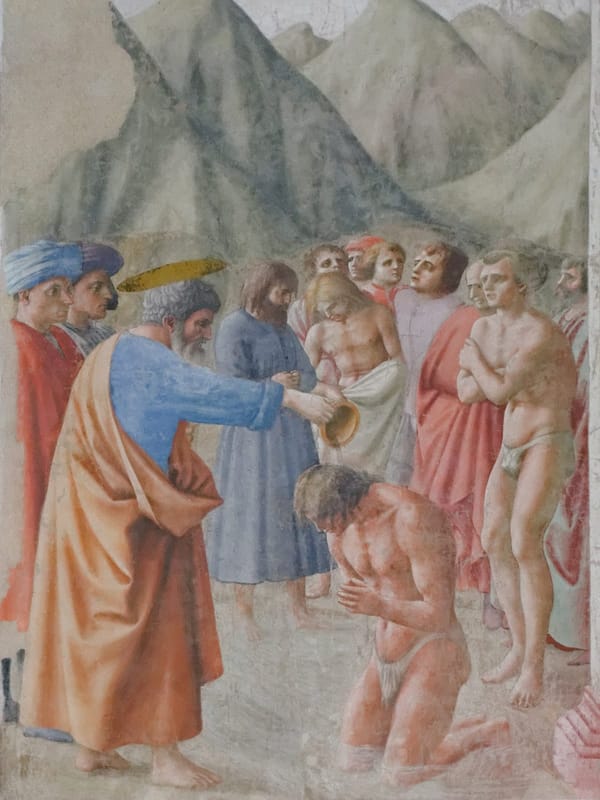
We have already seen how our Emmanuel gave to water the power of purifying the soul; but we also remember how, when He went down into the Jordan stream, the Dove rested upon Him; hereby showing that He, the Spirit of God, took possession of the element of regeneration. The font of Baptism is His domain.’The water of Baptism,’ says the great St. Leo,’is like the virginal womb (that conceived Jesus) it gives to man a spiritual regeneration; for the same holy Spirit that gave fecundity to the Virgin, gives fecundity to the font, to the end that sin, of which there could be no question in the sacred conception (of the Son of God in Mary’s womb), may be washed away by the mystic font.’5
What tongue could describe the fond delight wherewith the holy Spirit looks upon the new creature that rises from the font, or the impetuosity of love wherewith He comes into such a soul? He is’the Gift of the Most High,’ sent that He may dwell within us. He takes up His abode in the new-born soul, be it that of an infant but one day old, or that of an adult advanced in years. He is well-pleased with the dwelling He has, from all eternity, longed to possess; He fills it with His glowing and His light; and being, by nature, one with the other divine Persons, He brings thither with Him the presence of the Father and the Son, and all Three abide in that happy soul!6
But the Holy Ghost has here His own special action, His mission of sanctification: and in order that we may understand the full effect of His presence in the Christian, we must know that it is not confined to the soul. The body, too, is part of man, and had its share in the regeneration. The apostle tells us that the soul is the dwelling of the Holy Ghost;7 but he also assures us that our bodies are the temple of the same divine Spirit,8 who bids us make them serve justice unto sanctification.9 He graces them with a germ of immortality, which will rest upon them even in the tomb, and give them to rise again, at the last day, spiritualized,10 and bearing on them the seal of the divine Paraclete, who deigned to be their Guest during the term of their mortality.
After having thus made the Christian to be His dwelling-place, the Holy Ghost bestows upon him what may fit him for this high destiny. Think, for a moment, of the beauty of the theological virtues! Faith puts us into the certified and real possession of the divine truths which our mind cannot, in this present life, understand; hope gives us both the divine assistance we stand in need of, and the eternal happiness we look forward to; charity unites us to God by the strongest and sweetest of ties. Now it is to the indwelling of the Holy Ghost within him, that the Christian is indebted for these three virtues, these three means whereby regenerated man is made capable of attaining the end of his creation. The holy Spirit marked His first entrance into the soul by this triple gift, which surpasses all the creature’s merits, past, present, or future.
Over and above the three theological virtues, He bestows on the soul four other virtues, which are the hinges whereon the rest of the moral virtues turn, and hence their name of cardinal; they are, justice, fortitude, prudence, and temperance. Though, in themselves, natural qualities, the Holy Ghost transforms them by making them serve the supernatural end of the Christian. Finally, as a finish to the beauty of His abode, He infuses His seven gifts, which are to impart movement and life to the seven virtues.
But though the virtues and gifts relate to God, yet do they need that element, which is the essential means of union with Him: an element which is indispensable, for which nothing can serve as substitute, the soul of the soul, the life-giving principle, without which man can neither see nor possess God, viz. sanctifying grace. The Holy Ghost exultingly plants it in the soul; it becomes part of herself, and makes her an object of delight to the blessed Trinity. So close is the union between this grace and the presence of the holy Spirit, that when it is lost by mortal sin, He, that same instant, ceases to dwell in the soul.
He watches most carefully over His inheritance. He is ceaselessly working for the interests of His much-loved dwelling. The virtues He has infused into her are not to remain inert; they must elicit virtuous acts, and by the merits they thus produce, must increase, strengthen, and develop the fundamental element of sanctifying grace, which unites the Christian to his God. The Holy Ghost is, therefore, ever exciting the soul to action, either interior or exterior, by means of those divine influences, which theologians call actual graces. He thus enables the soul to raise herself higher and higher in virtue, add to her riches, strengthen her strength, and, in a word, become the instrument of glory to her Maker, who created her that she might serve Him, labour for Him, and yield Him fruit.
To this end, the Spirit, after giving Himself to her, and dwelling within her with devoted love, urges her to prayer, whereby she may procure every blessing: light, strength, and success in what she undertakes. But how are we to know what to pray for? The apostle solves the difficulty, by telling us the truth, of which he himself had such experience. He says: ‘The Spirit Himself asketh for us with unspeakable groanings’.11 Yes, the Holy Ghost makes our wants His own. God as He is, He unites His own speakings with the voice of our prayer, and, with His dove-like moaning, cries in our hearts to the Father.12 He thus, by His presence and His workings, makes us feel that we are children of God.13 Could there be intimacy greater than this? And who, after this, can be surprised at our Jesus’ saying that we have but to ask, and we shall receive?14 Is it not His own Spirit that asks within us?
So that He is the author of our prayer, when we pray: He is, also, the great co-operator with us in the good actions we do. So intimate is His union with the soul, that He leaves her no liberty of her own save what is necessary for her to have merit; but it is He that does the rest: that is, He inspires her, He supports her, He directs her. All she has to do, is to co-operate in what He does in and by her. It is by this mark, that is, by the united action of the Holy Ghost and the soul, that our heavenly Father knows who are His. Hence that saying of the apostle: Whosoever are led by the Spirit of God, they are the sons of God.15 O glorious union! which brings the Christian to life everlasting, and makes Jesus triumph in him, Jesus, whose likeness is imprinted by the Holy Ghost in the creature, that the creature may become worthy to be united with his divine Head!
Alas! this union may be severed, as long as we are on earth. Our free-will is not confirmed in good, until we reach heaven; and meanwhile, it may, and frequently does, lead to a rupture between the Spirit that sanctifies, and the creature that is sanctified. The unhappy love of independence, and the passions, which we cannot master, save when we are docile to the divine Spirit, excite the unguarded heart to the desire of what is unworthy of her. Satan is jealous of the reign of the Holy Ghost, and seeks to make us disloyal, by holding out to us the lying promise of happiness and good, other than those we can find in God. The world, too, which is a spirit of evil, sets itself up as a rival of the holy Spirit of God. Wily, audacious, and active, it excels in the art of seduction, and its victims are countless, although our Saviour has put us on our guard against it, by telling us that He excluded it from any share in His prayers;16 and the apostle tells us, that we have received, not the spirit of the world, but the Spirit that is of God.17
And yet, how many there are who bring about in themselves a cruel separation of their soul from the Holy Ghost! The separation is generally preceded by a certain coolness of the creature for his divine Benefactor. A want of respect, a slight disobedience, are the preliminaries of the rupture. This occasions in the holy Spirit a displeasure, which proves the tender love He bears to a faithful soul. The apostle describes the nature of this displeasure, where he says: ‘Grieve not the holy Spirit, who put His seal upon you on the day of your redemption.’18 There is a deep meaning in these few words, and, among other truths, they reveal to us the effects of venial sins: the Holy Ghost is grieved, He finds but little pleasure in that soul; there is danger of a separation; and though, as St. Augustine tells us, ‘He does not leave us, unless we leave Him,’ and though, consequently, such a soul still possesses sanctifying grace, yet actual grace becomes less frequent and less powerful.
But, when mortal sin—that act of the creature’s boldest malice and worst ingratitude—enters the soul, it breaks the sacred compact which closely united the Christian and the Holy Ghost. He, the Spirit of love, is driven from the dwelling He had chosen for Himself and had enriched with so many graces. A greater outrage cannot be offered to God by man; for, as the apostle so strongly expresses it, he hath trodden under foot the Son of God, and hath esteemed the Blood of the testament unclean, by which he was sanctified, and hath offered an affront to the Spirit of grace.19
And yet, this miserable state of the sinner may excite the compassion of the Holy Ghost, who has been sent that He might ever be our Guest. Could anything be imagined more sad, than the wretchedness of a Christian, who, by having cast out the divine Spirit, has lost the soul of his soul, forfeited the treasure of sanctifying grace, and robbed himself of all past merits? But—O mystery of mercy, worthy of eternal praise!—the Holy Ghost longs to return to the dwelling whence sin has driven Him. Yes, such is the fulness of the mission given by the Father and the Son to the Holy Ghost: He is love, and in His love He abandons not the poor ungrateful worm, but would restore him to his former dignity, and make him, once more, a partaker of the divine nature.20
This divine Spirit of love labours to regain possession of His dwelling. He begins by exciting within the soul a fear of divine justice; He makes her feel the shame and anguish of spiritual death. He thus detaches her from evil, by what the holy Council of Trent calls ‘impulses of the Holy Ghost, not indeed as yet dwelling within the soul, but moving her.’21 Dissatisfied and unhappy, the soul sighs after a reconciliation; she breaks the chains of her slavery; the sacrament of Penance then comes, bringing life-giving love, and her justification is completed. Who could describe the triumphant joy wherewith the divine Spirit re-enters His dear abode? The Father and the Son return to the dwelling that for days, or perhaps for years, had been defiled with sin. The soul is restored to life. Sanctifying grace returns to her, just as it was on the day of her Baptism. As we have already said, she had lost, by mortal sin, that fund of merit which had developed the power of grace; it is now restored to her fully and entirely, for the power of the holy Spirit is equal to the vehemence of His love.
This admirable raising from death to life is going on every day, yea every hour. It is part of the mission given to the Holy Ghost. He does the work He came for—the sanctification of man. The Son of God came down from heaven, and gave Himself to us. He found us slaves to satan; He ransomed us at the price of His Blood; gave us everything that could lead us to Himself and His heavenly Father; and, when He returned to heaven, there to prepare a place for us, He sent us His own Spirit to be our second Comforter, until He Himself should return to us. We have seen how strenuously this divine Helper undertakes His work. Let us fervently celebrate the love wherewith He treats us, and the wisdom and power wherewith He accomplishes His glorious mission. May He be blessed and glorified! May He be known throughout the whole world, for it is through Him that all blessings are imparted unto men! He is the soul of the Church; may she render Him the homage of her praise! And may He be tenderly loved by those countless millions of hearts, wherein He desires to dwell that He may give them eternal salvation and happiness.
This is the second of the three days’ fast prescribed for this week. To-morrow is the day for the ordination of the priests and other sacred ministers. It behoves us to redouble our efforts to obtain from God that the abundance of His grace may be in keeping with the sacred and ever-abiding character, which the divine Spirit is to imprint on these aspirants to Holy Orders.
At Rome, to-day’s Station is in the church of the twelve apostles, where repose the bodies of St. Philip and St. James the Less. This allusion to the favoured ones of the cenacle is most appropriate, for they were the first guests of the Holy Ghost.
The Armenian Church again lends us its beautiful hymn, in praise of the coming of the Paraclete.
Hymn (Canon sextæ diei)
implevisti apostolos; precibus horum miserere.
The following is taken from the Mozarabic missal. It is an address made to the faithful by the bishop, during the Mass of Whit Sunday. He exhorts them to receive with devotion the divine Spirit, who is about to visit them.
Missa
- St. John, xiv. 16. ↩︎
- De Prædestinatione Sanctorum, cap. xv. ↩︎
- 1 Cor. i. 28. ↩︎
- Rom. v. 20. ↩︎
- Serm. xxiv. In Nativitate Domini, iv. ↩︎
- St. John, xiv. 23. ↩︎
- Rom. viii. 11. ↩︎
- 1 Cor. vi. 19. ↩︎
- Rom. vi. 19. ↩︎
- 1 Cor. xv. 44. ↩︎
- Rom. viii. 26. ↩︎
- Gal. iv. 6. ↩︎
- Rom. viii. 16. ↩︎
- St. Luke, xi. 9. ↩︎
- Rom. viii. 14. ↩︎
- St. John, xvii. 9. ↩︎
- 1 Cor. ii. 12. ↩︎
- Eph. iv. 30. ↩︎
- Heb. x. 29. ↩︎
- 2 St. Peter, i. 4. ↩︎
- Sess. xiv. cap. iv. De Pœitentia. ↩︎
Friday in Whitsun Week: The Gift of Understanding
This sixth gift of the Holy Ghost raises the soul to a still higher state. The first five gifts all tend to action. The fear of God keeps man in his right place, for it humbles him; godliness opens his heart to holy affections; knowledge enables him to discern the path of salvation from that of perdition; fortitude arms him for the battle; counsel directs him in his thoughts and works:—thus gifted, he can act, and pursue his journey with the sure hope of coming at length to his heavenly home. But the Holy Ghost has other favours in store for him. He would give him a foretaste, here below, of the happiness that awaits him in the next life: it will give him confidence, it will encourage him, it will reward his efforts. Contemplation—this is the blissful region thrown open to him, and the Holy Ghost leads him thither by the gift of understanding.
There will be a feeling of surprise and hesitation arising in the minds of many at hearing this word, contemplation. They have been taught to look on contemplation as an element of the spiritual life which is rarely to be hoped for, and almost impossible for persons who are in the ordinary walks of life. We must begin, then, by telling them that such an idea is a great and dangerous error, and one that checks the progress of the soul. No: contemplation is a state to which, more or less, the soul of every Christian is called. It does not consist in those extraordinary effects which the Holy Ghost occasionally produces in some privileged souls, and by which He would convince the world of the reality of the supernatural life. It is simply a relation of close intimacy existing between God and a soul that is faithful to Him in action. For such a soul, unless she herself put an obstacle, God reserves two favours: the first is the gift of understanding, which consists in a supernatural light granted to the mind of man.
This light does not remove the sacred obscurity of faith: but it enlightens the eye of the soul, strengthens her perception, and widens her view of divine things. It dispels clouds, which were occasioned by the previous weakness and ignorance of the soul. The exquisite beauty of the mysteries is now revealed to her, and the truths which hitherto seemed unconnected, now delight her by the sweetness of their harmony, It is not the face-to-face vision which heaven gives, but it is something incomparably brighter than the feeble glimmer of former days, when all was mist and doubt. The eye of her spirit discovers analogies and reasons, which do something more than please—they bring conviction. The heart opens under the influence of these bright beams, for they feed faith, cherish hope, and give ardour to love. Everything seems new to her. Looking at the past, and comparing it with the present, she wonders within herself, how it is that truth, which is ever the same, has a charm and a power over her now which once it had not.
The reading or hearing of the Gospel produces an impression far deeper than formerly: she finds a relish in the words of Jesus, which, in times past, she never experienced. She can understand so much better the object of the institution of the Sacraments. The holy liturgy, with its magnificent ceremonies and sublime formulas, is to her an anticipation of heaven. She loves to read the lives of the saints; she can do so, and never feel a temptation to carp at their sentiments or conduct: she prefers their writings to all others, and she finds in these communications with the friends of God a special increase of her spiritual good. No matter what may be the duties of her station in life, she has, in this glorious gift, a light which guides her in each of them. The virtues required from her, however varied they may be, are so regulated, that one is never done to the detriment of another; she knows the harmony that exists between them all, and she never breaks it. She is as far from scrupulosity as from tepidity; and when she commits a fault, she loses no time in repairing it. Sometimes the Holy Ghost favours her with an interior speaking, which gives her additional light for some special emergency.
The world and its maxims are mere vanities in her estimation; and when necessity obliges her to con- form to what is not sinful in either, she does so without setting her heart upon it. Mere natural grandeur or beauty seems unworthy of notice to her whose eye has been opened, by the holy Spirit, to the divine and the eternal. To her, this outward world which the carnal-minded man loves to his own destruction, has but one fair side, viz: that the visible creation, with the impress of God’s beauty upon it, can be turned to its Maker’s glory. She gives Him thanks when she uses it; she elevates it to the supernatural order, by praising, as did the royal prophet, Him who shadowed the likeness of His own beauty on this world of created things, which men so often abuse to their perdition, but which were intended as so many steps to lead us to our God.
The gift of understanding teaches the Christian a just appreciation of the state of life in which God has placed Him. It shows him the wisdom and mercy of those designs of Providence which have, at times, disconcerted his own plans, and led him in a direction the very opposite to his wishes. He sees that had he been left to arrange things according to his own views, he would have gone astray; whereas now, God has put him in the right place, though the workings of His fatherly wisdom were, at first, hidden from him. Yes, he is so happy now! he enjoys such peace of soul! he knows not how sufficiently to thank his God for having brought him where he is, without consulting his poor fancies! If such a Christian as this be called upon to give counsel, if either duty or charity require him to guide others, he may safely be trusted; the gift of understanding teaches him to see the right thing for others as well as for himself. Not that he ever intrudes his counsel upon others, or makes himself adviser-general to all around him; but if his advice be asked, he gives it, and the advice is a reflex of the inward light that burns within him.
Such is the gift of understanding. It is the true life of the soul, and it is weaker or stronger according to the measure of her correspondence with the other gifts. Its safeguards are humility, restraint over the desires of the heart, and interior recollection. Dissipation of mind would dim its brightness, or even wholly put out the light. But where duty imposes occupations, not only busy and frequent, but even distracting, let the Christian discharge them with a pure intention, and his soul will not lose her recollection. Let him be single-hearted, let him be little in his own eyes, and that which God hides from the proud and reveals to the humble,1 will be manifested to him and abide with him.
It is evident from all this, that the gift of understanding is of immense importance to the salvation and sanctification of the soul. It behoves us, therefore, to beg it of the Holy Ghost with all the earnestness of supplication; for we must not forget that it is obtained rather by the longings of our love, than by any efforts of the intellect. True, it is the intellect that receives the light; but it is the heart, the will, inflamed with love, that wins the radiant gift. Hence that saying of Isaias: ‘Unless ye believe, ye shall not understand!’2 Let us, then, address ourselves to the holy Spirit in these words of the psalmist: ‘Open Thou our eyes, and we will consider the wondrous things of Thy law! Give us understanding and we shall live!’3 Let us beseech Him in these words of the apostle, wherein he is praying for his Ephesians: ‘Give us the Spirit of wisdom and revelation, whereby we may have the knowledge of our God! Enlighten the eyes of our heart, that we may know what is the hope of our calling, and what the riches of the glorious inheritance prepared for the saints!’4
May 24: Feast of Our Lady, Help of Christians
EVER since our entrance upon the joys of the Paschal season, scarcely a day has passed without offering us some grand mystery or Saint to honour; and all these have been radiant with the Easter sun. But there has not been a single feast of our blessed Lady to gladden our hearts by telling us of some mystery or glory of this august Queen. The feast of her Seven Dolours is sometimes kept in April—that is, when Easter Sunday falls on or after the 10th of that month; but May and June pass without any special solemnity in honour of the Mother of God. It would seem as though Holy Church wished to honour, by a respectful silence, the forty days during which Mary enjoyed the company of her Jesus, after his Resurrection. We, therefore, should never separate the Mother and the Son, if we would have our Easter meditations be in strict accordance with truth—and that we surely must wish. During these forty days, Jesus frequently visits his disciples, weak men and sinners as they are: can he, then, keep away from his Mother, now that he is so soon to ascend into heaven, and leave her for several long years here on earth? Our hearts forbid us to entertain the thought. We feel sure that he frequently visits her, and that when not visibly present with her, she has him in her soul, in a way more intimate and real and delicious than any other creature could have.
No feast could have given expression to such a mystery; and yet the Holy Ghost, who guides the spirit of the Church, has gradually led the faithful to devote in an especial manner to the honour of Mary the entire month of May, the whole of which comes, almost every year, under the glad season of Easter. No doubt, the loveliness of the month would, some time or other, suggest the idea of consecrating it to the holy Mother of God; but if we reflect on the divine and mysterious influence which guides the Church in all that she does, we shall recognize, in this present instance, a heavenly inspiration, which prompted the faithful to unite their own happiness to that of Mary, and spend this beautiful month, which is radiant with their Easter joy, in commemorating the maternal delight experienced, during that same period, by the immaculate Mother when oh earth.
To-day, however, we have a feast in honour of Mary. True, it is not one of those feasts which are entered on the general Calendar of the Church; yet is it so widely spread, with the consent of the Holy See, that our Liturgical Year would have been incomplete without it. Its object is to honour the Mother of God as the Help of Christians—a title she has justly merited by the innumerable favours she has conferred upon Christendom. Dating from that day whose anniversary we are soon to celebrate, when the Holy Ghost descended upon Mary in the Cenacle, in order that she might begin to exercise over the Church Militant her power as Queen—who could tell the number of times that she has aided, by her protection, the kingdom of her Son on earth?
Heresies have risen up, one after the other; they were violent; they were frequently supported by the great ones of this world; each of them was resolved on the destruction of the true faith; and yet, one after the other, they have dwindled away, or fallen into impotency; those of the present day are gradually sinking by internal discord; and Holy Church tells us that it is Mary who ' alone destroys all heresies throughout the whole world.'1 If public scandals or persecutions, or the tyranny of secular interference, have at times threatened to stay the progress of the Church, Mary has stretched forth her arm, the obstacles were removed, and the Spouse of Jesus continued her onward march, leaving her foes and her fetters behind her. All this was vividly brought before the mind of the saintly Pontiff, Pius V, by the victory of Lepanto, gained by Mary’s intercession, over the Turkish fleet, and he resolved to add one more title to the glorious list given to our Lady in the Litany: it was Auxilium Christianorum, Help of Christians.
The nineteenth century had the happiness of seeing another Pontiff, also named Pius, institute a feast under this same title—a feast which is intended to commemorate the help bestowed on Christendom in all ages by the Mother of God. Nothing could be happier than the choice of the day on which this feast was to be kept. On May 24, in the year 1814, there was witnessed in Rome the most magnificent triumph that has yet been recorded in the annals of the Church. That was a grand day, whereon Constantine marked out the foundations for the Vatican Basilica in honour of the Prince of the Apostles; Sylvester stood by, and blessed the Emperor, who had just been converted to the true faith: but important as was this event, it was but a sign of the last and decisive victory won by the Church in the then recent persecution of Diocletian. That was a grand day whereon Leo III, Vicar of the King of kings, crowned Charlemagne with the imperial diadem, and by his apostolic power gave continuance to the long interrupted line of Emperors: but Leo III, by this, did but give an official and solemn expression to the power which the Church had already frequently exercised in the newly constituted nations, which received from her the idea of Christian government, the consecration of their rights, and the grace that was to enable them to fulfil their duties. That was a grand day, whereon Gregory IX restored to the city of Peter the Papal Throne, which had been transferred to Avignon for seventy sad years: but Gregory IX, in this, did but fulfil a duty, and his predecessors, had they willed it. might have effected this return to Rome for which the necessities of Christendom so imperatively called.
Yes, all these were glorious days; but May 24 of 1814 surpasses them all. Pius VII re-entered Rome amidst the acclamations of the holy City, whose entire population went forth to meet him, holding palm branches in their hands, and greeting him with their hosannas of enthusiastic joy. He had been a captive for five years, during which the spiritual government of the Christian world had suffered a total suspension. It was not the Powers allied against his oppressor who broke the Pontiff’s fetters; the very tyrant who kept him from Rome had given him permission to return at the close of the preceding year; but the Pontiff chose his own time, and did not leave Fontainebleau till January 25. Rome, whither he was about to return, had been made a part of the French Empire, five years previously, by a decree in which was cited the name of Charlemagne! The city of Peter had been made the head town of a Department, with a prefect for its administrator; and, with a view to making men forget that it was the city of the Vicars of Christ, the tyrant gave its name as a title to the heir-presumptive of the Imperial crown of France.
What a day was that 24th of May, which witnessed the triumphant return of the Pontiff into the holy City, whence he had been dragged during the night by the soldiers of an ambitious tyrant! He made the journey in short stages, meeting, on his way, the allied armies of Europe, who recognized his right as King. This right is superior, both in antiquity and dignity, to that of all other monarchs; and all, no matter whether they be heretics, schismatics, or Catholics, must admit it, were it only on the strength of its being an historical fact.
But what we have said so far is not sufficient to give an adequate idea of the greatness of the prodigy thus achieved by our Lady Help of Christians. In order to have a just appreciation of it, we must remember that the miracle was not wrought in the age of Sylvester and Constantine, or of St Leo III and Charlemagne, or of the great prophetess Catharine of Siena, who made known the commands of God to the people of Italy and to the Popes of Avignon. The century that witnessed this wondrous event was the nineteenth. Europe was under the degrading influence of Voltairism, and there were still living the authors and abettors of the crimes and impieties that resulted from the principles taught in the eighteenth century. Everything was adverse to such a glorious and unexpected triumph; Catholic feeling was far from being roused as it now is; the action of God's providence had to show itself in a direct and visible manner; and to let the Christian world know that such was the case, Rome instituted the annual feast of May 24, as an offering of acknowledgement to Mary, Help of Christians.
Let us now weigh the importance of the twofold restoration which was wrought on this day by the intercession of the holy Mother of God. Pius VII had been forcibly taken from Rome and dethroned; on this May 24 he was reinstated in Rome, both as Pope and as temporal sovereign. On the Feasts of St Peter’s Chair at Rome and at Antioch, we gave our readers the doctrine of the Church, which teaches us that the succession to the rights conferred by Christ upon St Peter belongs to the Bishop of Rome. From this it follows that residence in the city of Rome is both the right and the duty of the successor of St Peter, save in the case of his deeming a temporary absence to be demanded by circumstances. Whosoever, therefore, by means of physical force, keeps the Sovereign Pontiff out of Rome, or prevents him from residing there, is acting in opposition to the Divine Will; for the pastor ought to be in the midst of his flock: and Rome having been made by Christ the head of all Churches, these have a right to find in Rome him who is both the infallible doctor of faith and the source of all spiritual jurisdiction. The first blessing, therefore, for which we are indebted to Mary on this day, is that she brought back the pastor to his flock, and restored the supreme government of Holy Church to its normal state.
The second is her having reinstated the Pontiff in possession of his temporal power, the surest guarantee of his being independent in the exercise of his spiritual power. We have but to consult history, and we shall learn what miseries and dangers have followed from the Popes being the subjects of any earthly monarch. The experience of the past shows us that the city of Rome, if under any other government than that of the papacy, excites the mistrust of Christendom as to the liberty necessary for the due election of the supreme Pontiff. God, in his all-seeing wisdom, provided against what would have been a perpetual source of anarchy in the Church. From the earliest commencement of the Christian era, he prepared the foundation of the temporal dominion of the papacy over Rome and its territory, even before the sword of the Franks was drawn for the defence, the establishing and increasing this precious domain, which is the property of Christendom. Whosoever dares to invade it, attacks the liberty of the entire Church; and we know, as St Anselm says, that ‘there is nothing in this world more loved by God than the liberty of his Church’: hence the severe punishments that have ever followed such as offered violence to it.
The pontifical sovereignty over Rome and the States belonging to the Church has arisen from necessity—but that necessity belongs to the supernatural order of things. It follows that this sovereignty surpasses all others in dignity, and that, in consequence of its being consecrated to God’s service on earth, it is to be considered as a sacred thing. He that dares to lay hands upon it, is guilty not only of spoliation, but of sacrilege; and the anathemas of the Church lie heavily upon him.
Here again history tells us how terrible has been the lot of all those who, despising the anathema, refused to make restitution to the Church, and dared to defy the justice of him who conferred on Peter the power of binding and loosing.
Finally, authority being the basis of every society, and its maintenance being of the utmost importance to the preservation of order and justice, it should be respected and upheld first and foremost in the Roman Pontiff, for he is the highest representative of authority on earth, his temporal power is by far the oldest in existence, and his kingly character is enhanced by the union of supreme spiritual power. He, therefore, who attacks or overthrows the temporal sovereignty of the Pope is an enemy to every Government; for there is no other that can bear comparison with this in merit and rightful possession; and if it be not spared, no other is safe.
Let us then give thanks to the blessed Mother of God, on this feast of the twenty-fourth day of May, which has been instituted in commemoration of the twofold blessing she thus brought upon the world—the preservation of the Church, and the preservation of society. Let us unite in the fervent acclamations of the then loyal citizens of Rome, and like them sing with all the glad joy of our Easter Alleluia, our greetings of Hosanna to the Vicar of Christ, the father of that dear land, our common country. The remembrance of St Peter's deliverance from prison, and his restoration to liberty, must have been vividly on the minds of that immense concourse of people, whose love for their Pontiff was redoubled by the sufferings he had gone through. As the triumphal chariot on which he had been placed came near the Flaminian Gate, the horses were unyoked, and the Pontiff was conveyed by the people to the Vatican Basilica, where a solemn thanksgiving was made, over the tomb of the Prince of the Apostles.
But let us not close the day without admiring the merciful intervention of our Lady, Help of Christians. If the protection she gives to the faithful sometimes necessitates her showing severity to tyrants, her maternal heart is full of compassion for the vanquished, and she extends her Help even to them. Thus it was with the haughty Emperor, over whom she triumphed on May 24; she would then bring him back to humble repentance and to the practice of his religious duties. A messenger from the island of Saint Helena was one day ushered into the presence of Pius VII. The exiled Napoleon, whom he had consecrated Emperor in the Cathedral of Notre Dame, and whose conduct in later years brought him under the ban of excommunication, now besought the Pontiff, the true and only King of Rome, to allow him to be readmitted to those spiritual blessings of which he had been justly deprived. Our Lady was preparing a second victory.
Pius VII, whose name the fallen Emperor could never pronounce without emotion, and whom he called ‘a lamb'2—Pius VII, who had so courageously braved public opinion by giving hospitality at Rome to the members of Napoleon’s unfortunate family—readily complied with the request thus made to him; and the holy Sacrifice of the Mass was shortly afterwards offered up in the presence of the illustrious exile of Saint Helena. Our Lady of Help was advancing her conquest.
But before granting pardon, the justice of God had required a full and public expiation. He who had been the instrument of salvation to millions of souls by restoring religion to France, was not to be lost; but he had impiously imprisoned the sovereign Pontiff in the castle of Fontainebleau; and it was in that very castle that he had afterwards to sign the deed of his own abdication. For five years he had held captive the Vicar of Christ; for five years he himself had to endure the sufferings and humiliation of captivity. Heaven accepted the retribution and left Mary to complete her victory. Reconciled with the Church, and fortified by the holy sacraments which prepare the Christian for eternity, Napoleon yielded up his soul into the hands of his Maker, on May 5, the month that is sacred to Mary, and gives us the feast we are keeping to-day. The day chosen by God from all eternity for Napoleon’s death was the Feast of St Pius V; on which same feast, Pius VII was receiving the congratulations of his faithful Romans. The name Pius signifies compassion and mercy. It is one of the names given to God in the sacred Scripture: PIUS et misericors est Deus: God is compassionate and merciful.3 Mary, too, is compassionate; it is the title we give her in one of our favourite prayers: O demens, O Pia, O dulcis Virgo Maria! She is ever ready with her aid, be the danger one that affects the Church at large, or a single individual soul; she is the Help of Christians, and as such we honour her on this feast. God has willed her to be so; and we are but complying with his wishes, when we have an unreserved confidence in the protection of this powerful Queen, this loving Mother.
Let us now read the account, as given in to-day’s Liturgy, of the great event that prompted the institution of our feast:
The two beautiful hymns which follow are from the Office of this feast. They admirably express the gratitude we should feel towards the blessed Mother whose intercession has so often wrought the Church’s deliverance.
First Hymn
Hostis infensi premeretur armis,
Venit adjutrix pia Virgo coelo
Lapsa sereno.
Templa testantur spoliis opimis
Clara, votivo repetita cultu
Festa quotannis.
Cantici laetis modulis referre
Pro novis donis, resonante plausu
Urbis et Orbis.
Qua Petri sedes fidei magistrum
Triste post lustrum reducem beata
Sorte recepit!
Gestiens clerus, populusque grato
Corde Reginae celebrare cœli
Munera certent.
Mater, haec auge bona; fac, precamur,
Ut gregem pastor pius ad salutis
Pascua ducat.
Trinitas, summo celebranda plausu;
Te fide mentes, resonoque linguae
Carmine laudent.
by the blood-stained sword of a ruthless foe,
the compassionate Virgin came down
from bright heaven as their Help.
it is attested by the sacred edifices which are enriched
with the trophies taken from our enemies,
and by the yearly recurrence of our solemn feasts.
a new canticle of grateful and glad thanks to Mary:
it is the favour that made both Rome
and the world resound with joy.
whereon the See of Peter was blessed
with the return of the teacher of faith,
after a sad exile of five years.
and the glad clergy, and the people,
vie with each other in celebrating with grateful hearts
the favours granted by the Queen of heaven.
add favours still to these: pray, we beseech thee,
that the good pastor may lead the flock
to the pastures of salvation.
grant that we may praise thee through eternal years.
May our souls by their faith,
and our lips by their hymns, laud thy holy name.
Second Hymn
Dicimus Matrem, speciosa Virgo,
Christianorum decus, et levamen
Rebus in arctis.
Hostis antiquus fremat, et minaces,
Ut Deo sacrum populetur agmen,
Suscitet iras.
Mentibus castis, prece quas vocata
Annuens Virgo fovet, et superno
Robore firmat.
Bellici cessat sceleris tumultus,
Mille sternuntur, fugiuntve turmae,
Mille cohortes.
Turris, arx firmo fabricata muro,
Civitas David, clypeis et acri
Milite tuta.
Dextera, cœli cumulata donis,
A piis longe famulis repellit
Dæmonis ictus.
Trinitas, summo celebranda plausu;
Te fide mentes, resonoque linguae
Carmine laudent.
to be the Mother of our Saviour and God;
but thou art, too, the solace
and Help of Christians in their adversities.
the old enemy may, in his wrath,
stir up anger which may threaten
to destroy the people of God;
can do no hurt to those pure souls,
whose prayers have won protection and heavenly strength
from the Virgin ever blessed.
the din of wicked war must cease,
and our enemies must fail by thousands,
or be put to flight.
there was a tower and citadel with its well-built wall,
and the city of David was safe
with its shields and valiant men:
and laden with heaven’s gifts,
wards off from her devoted clients
the blows of Satan.
grant that we may praise thee through eternal years.
May our souls by their faith,
and our lips by their hymns, laud thy holy name.
O holy Trinity, to whom all praise is due! grant that we may praise thee through eternal years. May our souls by their faith, and our lips by their hymns, laud thy holy name. Amen.
I have lifted up mine eyes to the mountains, from whence help shall come to me: my help is from the Lord, who made heaven and earth.4 Thus prayed the Israelites of old: thus also prays the Church: though for her the help is nigher and comes more speedily. The Psalmist’s petition has been granted: the heavens have bowed down, and the divine help is now close by our side. This help is Jesus, Son of God and Son of Mary. He is unceasingly fulfilling the promise made us by his Prophet: In the day of thy salvation I have helped thee.5 But this King of kings has given us a Queen, and this Queen is Mary, his Mother. Out of love for her he has given her a throne on his right hand, as Solomon did for his mother Bethsabee;6 and he would have her also be the Help of Christians. The Church teaches us this, by inserting this beautiful title in the Litany; and Rome invites us, on this day, to unite with her in giving thanks and praise to our blessed Lady of Help for one of the most signal of her favours.
O Queen of heaven! our Paschal joy is increased on this the anniversary of thy giving back to Rome her pastor and her king. Yes, it was thy intercession that achieved the grand victory, and we offer thee the homage of our grateful rejoicings. This month is thine in an especial manner; but its twenty-fourth day makes us redouble our devotion. It encourages us to entreat thee, with all the earnestness of our souls, that thou wouldst protect Rome and its Pontiff, for new dangers have arisen. The Rock set by thy Jesus has again become a sign of contradiction, and the billows of impiety and violence are beating against it. We know the great promise: the Rock can never be swept away, and on it safely stands the Church; but we know, too, that this Church is one day to be taken up to heaven, and then the Judgement! Meanwhile, thou, Mary, art our Help: oh! stretch forth that arm of thine, which nothing can resist. Be mindful of Rome, where thou art so devoutly honoured, and where thy glory is proclaimed by so many sumptuous sanctuaries. The end of the world is not yet come; the holiest of causes requires thine aid. Never permit the holy City to be desecrated by her falling into the power of impious men; suffer her not to be deprived of the presence of her Pontiff; and restore the independence which the Vicar of Christ must possess, if the Church is to be rightly governed.
But Rome is not the only spot on earth that needs thy powerful help, O Mary! The vineyard of thy Son is everywhere being laid waste by the wild beast.7 Vice and error and seduction are everywhere. There is not a country where the Church is not persecuted, and her liberty trampled upon. Society has lost its Christian traditions; it is at the mercy of revolutions against which it has no power. O thou that art the Help of Christians, aid the world in these its perils! Thou hast the power to save it from danger! Wilt thou permit the people to be lost who were redeemed by the blood of Jesus, and whom he from his Cross entrusted to thy care?
Thou, O Mary, art the Help of each Christian soul, as well as of the entire world. That same enemy, who is bent on the destruction of the whole human race, is seeking to drag each one of us into perdition. He hates the image of thy Son, which he sees reflected in our human nature. Oh! come to our assistance; save us from this roaring lion of hell. He knows thy power, and that thou canst procure our deliverance, so long as we are left in this present life. Thou hast gained the most stupendous victories for the salvation of thy clients; tire not, we beseech thee, in aiding poor sinners to return to their God. When Jesus spoke of them that were invited to the marriage feast, and told us how the king said to his servants: Compel them to come in,8 it was thee that he had mainly in view. Lead us then to our King!
Our supplications to thee, O Help of Christians, are thus earnest, because our wants are great; but we are not on that account the less mindful of the special honour that we owe thee at this holy season of Easter, when the Church contemplates the joy thou hadst in the presence of thy Risen Jesus. She congratulates thee on the immense happiness that thus repaid thee for thine anguish on Calvary and at the Sepulchre. It is to the Mother consoled by and exulting in her Son’s triumphant Resurrection that we offer this sweet month, whose loveliness is so in keeping with her own incomparable beauty. In return for this homage of our devotion, pray for us, dear Mother, that our souls may persevere in the beauty of grace given to them by this year’s union with our Jesus! and that we may be so well prepared for the Feast of Pentecost as to merit to receive the gifts of the Holy Ghost, who comes that he may perfect the work of our Paschal regeneration.
| Previous Thursday in Whitsun Week: The Gift of Counsel | Next Friday in Whitsun Week: The Gift of Understanding |