Daily reading
After Pentecost
Simple · Movable from Easter · Temporal
June 9, 2024
From Dom Guéranger’s The Liturgical Year.
The Sunday leads; Sts. Primus and Felician are commemorated.Rubrics

|
The Third Sunday after Pentecost
The faithful soul has now witnessed in the holy liturgy the close of the mysteries of our redemption. The Holy Ghost has come down to support her during this second portion of her career, by forming and developing within her the fullness of the Christian life as taught by her divine Saviour when on earth. He begins by teaching her how to pray. Prayer, said our Lord, must be continual: we ought always to pray, and not to faint.1 We know not what we should pray for as we ought; but the holy Spirit helpeth our infirmity, and Himself asketh for us with unspeakable groanings.2
In the Introit and the whole Mass for this Sunday, we are taught that prayer must have, amongst its other requisite qualities, that of humble repentance for our past sins, and of confidence in God’s infinite mercy.
This is the Third Sunday after Pentecost; it is the first that has no rubrical connexion with the great feasts we have been solemnizing; it is a Sunday with all the simplicity of the Office of the Time.
Introit
Ps. Ad te, Domine, levavi animam meam: Deus meus, in te confido, non erubescam.
Gloria Patri. Respice.
Ps. To thee, O Lord, have I lifted up my soul: in thee, O my God, I place my trust, let me not be ashamed.
Glory, etc. Look thou.
Collect
Second Collect
The third Collect is left to the priest’s own choice.
Epistle
I. Cap. v.Carissimi, humiliamini sub potenti manu Dei, ut vos exaltet in tempore visitationis: omnem sollicitudinem vestram projicientes in eum, quoniam ipsi cura est de vobis. Sobrii estote, et vigilate: quia adversarius vester diabolus tanquam leo rugiens circuit, quærens quem devoret: cui resistite fortes in fide; scientes eamdem passionem ei, quæ in mundo est, vestræ fraternitati fieri. Deus autem omnis gratiae, qui vocavit nos in aeternam suam gloriam in Christo Jesu, modicum passos ipse perficiet, confirmabit, solidabitque. Ipsi gloria, et imperium in saecula sæculorum. Amen.
I. Ch. v.Dearly beloved: be ye humbled under the mighty hand of God, that he may exalt you in the time of visitation. Casting all your care upon him, for he hath care of you. Be sober and watch: because your adversary the devil, as a roaring lion, goeth about, seeking whom he may devour: whom resist ye, strong in faith; knowing that the same affliction befalls your brethren who are in the world. But the God of all grace, who hath called us unto his eternal glory in Christ Jesus, after you have suffered a little, will himself perfect you, and confirm you, and establish you. To him be glory and empire for ever and ever. Amen.
The miseries of this present life are the test to which God puts His soldiers; He passes judgment upon them, and classifies them, according to the degree of courage they have shown. Therefore is it, that we all have our share of suffering. The combat has commenced. God is looking on, watching how each of us comports himself. The day is not far off, when the Judge will pass sentence on the merits of each combatant, and award to each one the recompense he has won. Combat now; peace and rest and a crown, then. Happy they who, during these days of probation, have recognized the mighty hand of God in all the trials they have had, and have humbled themselves under its pressure, lovingly and confidingly! Against such Christians, who have been strong in faith, the roaring lion has not been able to prevail. They were sober, they were watchful, during this their pilgrimage. They were fully convinced of this, that every one has to suffer in the present life; they therefore never sighed and moaned, as though they were the only sufferers; they did not assume the attitude of victims, and call it resignation; but they took each trial as it came, and, without talking to every one about it, they quietly and joyously united it with the sufferings of Christ. O true Christians! you will be joyous for all eternity, when there will be made the manifestation of that eternal glory in Christ Jesus, which He will pass on to you, that you may share it with Him for ever!
The Gradual keeps up the same strain: it encourages the faithful soul to confidence. Let her cast all her care upon her heavenly Father; has He not always graciously heard her in all her troubles and necessities? As to enemies, let her cast away the thought; God will think of that, and, if it so please Him, will avenge the soul they persecuted.
Gradual
Gospel
Cap. xv.In illo tempore, erant appropinquantes ad Jesum publicani et peccatores, ut audirent illum. Et murmurabant pharisæi, et scribae, dicentes: Quia hic peccatores recipit, et manducat cum illis. Et ait ad illos parabolam istam, dicens: Quis ex vobis homo, qui habet centum oves: et si perdiderit unum ex illis, nonne dimittit nonaginta novem in deserto, et vadit ad illam, quae perierat, donec inveniat eam? Et cum invenerit eam, imponit in humeros suos gaudens: et veniens domum, convocat amicos, et vicinos, dicens illis: Congratulamini mihi quia inveni ovem meam quae perierat! Dico vobis quod ita gaudium erit in coelo super uno peccatore poenitentiam agente, quam super nonaginta novem justis, qui non indigent poenitentia. Aut quae mulier habens drachmas decem, si perdiderit drachmam unam, nonne accendit lucernam, et everrit domum, et quaerit diligenter donec inveniat? Et cum invenerit, convocat amicas et vicinas, dicens: Congratulamini mihi quia inveni drachmam, quam perdideram? Ita dico vobis, gaudium erit coram angelis Dei super uno peccatore pœnitentiam agente.
Ch. xv.At that time: the publicans and sinners drew near unto him to hear him. And the pharisees and scribes murmured, saying: This man receiveth sinners and eateth with them. And he spoke to them this parable, saying: What man of you that hath a hundred sheep, and if he shall lose one of them, doth he not leave the ninety-nine in the desert, and go after that which was lost until he find it? And when he hath found it, lay it upon his shoulders rejoicing: and coming home call together his friends and neighbours, saying to them: Rejoice with me, because I have found my sheep that was lost? I say to you, that even so there shall be joy in heaven upon one sinner that doth penance, more than upon ninety-nine just who need not penance. Or what woman having ten groats: if she lose one groat, doth not light a candle, and sweep the house, and seek diligently until she find it? And when she hath found it, call together her friends and neighbours, saying: Rejoice with me, because I have found the groat which I had lost? So I say to you there shall be joy before the angels of God upon one sinner doing penance.
The parable of the sheep that is carried back to the fold on the shepherd’s shoulders was a favourite one with the early Christians; and they made representations of it at almost every turn. The same is put before us in to-day’s Gospel, that our confidence may be strengthened in God’s infinite mercy. It reminds us, in its own beautiful way, of our Lord Jesus; whom we contemplated, a few weeks back, ascending triumphantly into heaven, carrying thither, in His arms, the lost human family, which He had won back from satan and death and sin. For, as St. Ambrose says, ‘who is the Shepherd of our parable? It is Christ, who carries thee, poor man, in His own Body, and has taken all thy sins upon Himself. The sheep is one, not by number, but by its kind. Rich Shepherd this, of whose flock all we human beings form but the hundredth part! for He has the Angels, and Archangels, and Dominations, and Powers, and Thrones, and all the rest; all those other countless flocks, whom He has left yonder up the mountain, that He might run after the one sheep He had lost.’3
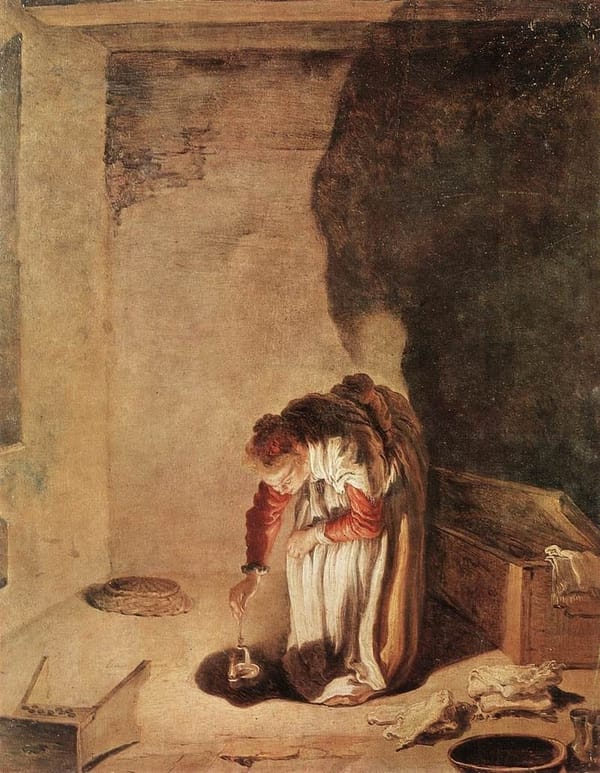
But it is from St. Gregory the Great that the Church, in her Matins of this Sunday, took the commentary on this Gospel. And in the sequel of his homily, the holy doctor gives us the explanation of the parable of the woman and the ten groats. ‘He,’ says St. Gregory, ‘that is signified by the shepherd is also meant by the woman. Jesus is God; He is the Wisdom of God. And because good coin must bear the image of the king upon it, therefore was it that the woman lost her groat, when man, who had been created after God’s image, strayed from that image by committing sin. But the woman lights a lamp; the Wisdom of God hath appeared in human flesh. A lamp is a light which burns in a vessel of clay; and Light in a vessel of clay, is the Divinity in our flesh. It is of the vessel of His Body, that this Wisdom says: My strength is dried up like a potsherd.4 For, just as day is made hard by the fire, so His strength was dried up like a potsherd, because it has strengthened unto the glory of His resurrection, in the crucible of sufferings, the Flesh which He (Wisdom) had assumed . . . . Having found the groat she had lost, the woman calleth together her friends and neighbours, saying: Rejoice until me! because I have found the groat which I had lost. Who are these friends and neighbours, if not the heavenly spirits, who are so near to divine Wisdom by the favours they enjoy of the ceaseless vision? But we must not, meanwhile, neglect to examine why this woman, who represents divine Wisdom, is described as having ten groats, one of which she loses, then looks for, and again finds. We must know, then, that God made both angels and men, that they might know Him; and that having made both immortal, He made both to the image of God. The woman, then, had ten groats, because there are nine orders of angels, and man, who is to fill up the number of the elect, is the tenth groat; he waslost by his sin, but was found again, because eternal Wisdom restored him, by lighting the lamp, that is, by assuming his flesh, and through that working wonderful works, which led to his recovery.’5
The Offertory is an outpouring of gratitude and love for the God who dwelleth in Sion; He does not abandon them that seek Him; He does not forget the poor man's prayer.
Offertory
Secret
Second Secret
The third Secret is left to the priest’s own choice.
The Preface is that appointed for all Sundays during the year, page 45; unless a feast is being kept which has a proper one assigned to it.
The Communion-anthem recalls to our minds, and with much appropriateness, the merciful teaching of to-day’s Gospel, now that eternal Wisdom has regained full possession of the lost groat, by means of the sacred Banquet, which He Himself had given to the repentant prodigal.
Communion
Postcommunion
Second Postcommunion
The third Postcommunion is left to the priest’s own choice.
Vespers
The psalms, capitulum, hymn, and vesicle, as above, pages 71-79.
Antiphon of the Magnificat
June 9: Sts. Primus and Felician, Martyrs
ROSES and lilies are exquisitely alternated in the wreath woven by centuries for the bride of the Son of God. Though the world be heedless of the fact, it is none the less true that everything here below has but one object, namely to bedeck the Church with the attractive charms of heaven, to adjust her jewelled robes formed of the virtues of her saints, that she may be fitted to take her seat beside her divine Spouse, in the highest heavens, for all eternity.1 The sacred cycle, in its yearly course, presents an image of those ceaseless labours whereby the Holy Ghost continues to form, up to the day of the eternal nuptials, that varied robe of holy Church, by diversifying the merits of God's servants, her members here below. To-day we have two martyrs becrimsoned with their own blood, setting off the dazzling whiteness of Norbert's works, or of William's innocence; and to-morrow we may contemplate with delighted gaze the softer light beamed upon our earth by Margaret, Scotland's pearl.
Primus and Felician, wealthy Romans, had already attained maturity of age, when our Lord made his voice heard inviting them to forsake their vain idols. Brothers according to the flesh, they now became more really such by fidelity to the same call of grace. Together they proved themselves intrepid helpers of the confessors of Christ amidst the atrocious persecution which raged against the Church during the latter half of the third century. In the same combat were they to fall side by side, exchanging this frail life here below for that into which, at one birth, they were to enter for ever in heaven. They furthermore were honoured by having their precious relics placed in the celebrated sanctuary consecrated to St Stephen, the Proto-Martyr, on Monte Cœlio; and they form its richest treasure.
The holy liturgy relates their triumph in these few lines:
O ye brave veterans of the Lord's battles, teach us what energy we must bring to the service of God, whatsoever be our age. Less favoured than we are, ye came late in life to the knowledge of the Gospel and of those inestimable treasures promised to the Christian. But in holy Baptism your youth was renewed as that of the eagle,2 and for thirty years the Holy Ghost continued to produce rich fruits in you. When, in extreme old age, the hour of final victory at last sounded, your courage was equal to that of the most vigorous warriors. You were nerved up to such heroism and sustained therein, through prayer constantly kept alive within you by the words of the psalms, as your Acts attest. Revive then amongst us faith in the word of God; his promises will make us despise, as ye did, this present life. Lead our piety back to those true sources which strengthen the soul: the knowledge and daily use of those sacred formulas which bind our earth unfailingly to heaven, whence they were brought down to us.
| Previous June 8: St. William, Bishop and Confessor | Next June 9: Sts. Primus and Felician, Martyrs |