Daily reading
After Pentecost
Semidouble · Movable from Easter · Temporal
August 18, 2024
From Dom Guéranger’s The Liturgical Year.

|
The Thirteenth Sunday after Pentecost
The dominical series—which formerly counted from the feast of Saint Peter, or of the apostles—never went beyond this Sunday. The feast of Saint Laurence gave its name to those which follow; though that name began with even the ninth Sunday, for the years when Easter was further from the Spring equinox. And when that solemnity was kept at its latest date, the weeks began from to-day to be counted as the weeks of the seventh month (September).
The Ember-days of the autumn quarter sometimes occur even this week; whilst, other years, they may be as late as the eighteenth. We will speak of them when we come to the seventeenth Sunday, for it is in the week following that, that the Roman missal inserts them.
In the western Church, the thirteenth Sunday takes its name from the Gospel of the ten lepers, which is read in the Mass; the Greeks, who count it as the thirteenth of Saint Matthew, read on it the parable of the vineyard, whose labourers, though called at different hours of the day, all receive the same pay.;1
Mass
Now that she is in possession of the promises so long waited for by the world, the Church loves to repeat the words wherewith the just men of the old law used to express their sentiments. Those just men were living during the gloomy period, when the human race was seated in the shadow of death. We are under incomparably happier circumstances; we are blessed with graces in abundance : eternal Wisdom has spared us the trials our forefathers had to contend with, by giving us to live in the period which has been enriched by all the mysteries of salvation. There is a danger, however, and our mother the Church does her utmost to avert us from falling into it; it is the danger of forgetting all these blessings. Ingratitude is the necessary outcome of forgetfulness, and to-day’s Gospel justly condemns it. On this account, the Epistle, and here our Introit, remind us of the time when man had nothing to cheer him but hope: a promise had, indeed, been made to him of a sublime covenant which was, at some distant future, to be realized; but, meanwhile, he was very poor, was a prey to the wiles of satan, his cause was to be tried by divine justice, and yet he prayed for loving mercy.
Introit
This day last week we were considering how important are faith and charity to a Christian who is living under the Law of grace. There is another virtue of equal necessity: it is hope; for, although he already have the substantial possession of the good things which will constitute his future happiness, the Christian is prevented by the gloom of this land of exile from seeing them. Moreover, this mortal life being essentially a period of trial, wherein each one is to win his crown,2 the struggle makes even the very best feel, and that right to the end, the weight of incertitude and anguish. Let us, therefore, pray with the Church, in her Collect, for an increase of the three fundamental virtues of faith, hope, and charity; and, that we may deserve to reach the perfection of the good which is promised us in heaven, let us sue for the grace of devotedness to the commandments of God, which lead us to our eternal home. Let us remember how the Gospel of Sunday last included them all in love.
Collect
The other Collects, as on page 120.
Epistle
Cap. iii.Fratres, Abrahæ dictæ sunt promissiones, et semini ejus. Non dicit : Et seminibus, quasi in multis, sed quasi in uno : Et semini tuo, qui est Christus. Hoc autem dico, testamentum confirmatum a Deo : quæ post quadringentos et triginta annos facta est lex, non irritum facit ad evacuandam promissionem. Nam si ex lege hæreditas, jam non ex promissione. Abrahæ autem per repromissionem donavit Deus. Quid igitur lex? Propter transgressiones posita est, donec veniret semen, cui promiserat, ordinata per angelos in manu mediatoris. Mediator autem unius non est : Deus autem unus est. Lex ergo adversus promissa Dei? Absit. Si enim data esset lex, quæ posset vivificare, vere ex lege esset justitia. Sed conclusit Scriptura omnia sub peccato, ut promissio ex fide Jesu Christi daretur credentibus.
Ch. iii.Brethren: To Abraham were the promises made and to his seed. He saith not, and to his seeds as of many: but as of one, and to thy seed which is Christ. Now this I say, that the testament which was confirmed by God, the law which was made after four hundred and thirty years, doth not disannul, or make the promise of no effect. For if the inheritance be of the law, it is no more of promise, But God gave it to Abraham by promise. Why then was the law? It was set because of transgressions, until the seed should come, to whom he made the promise, being ordained by angels in the hand of a mediator. Now a mediator is not of one : but God is one. Was the law then against the promises of God? God forbid! For if there had been a law given which could give life, verily justice should have been by the law. But the Scripture hath concluded all under sin, that the promise by the faith of Jesus Christ might be given to them that believe.
‘Look up to heaven, and number the stars, if thou canst! So shall thy seed be!’3 Abraham was almost a hundred years old,4 and Sara’s barrenness deprived him of all natural hope of posterity, when these words were spoken to him by God, Abraham, nevertheless, believed God, says the Scripture, and it was reputed to him unto justice.5 And when, later on, that same faith6 would have led him to sacrifice, on the mount, that son of the promise, his one only hope, God renewed His promise, and added: ‘In thy seed shall all the nations of the earth be blessed.’7
It is now that the promise is fulfilled; the event justifies Abraham’s faith. He believed against all hope, trusting to that God who quickeneth the dead, and calleth those things that are not, as those that are;8 and, according to the expression of John the Baptist, from the very stones of the gentile world there rise up, in all places, children to Abraham.9
His faith, firm and, at the same time, so simple, gave to God the glory10 which He looks for from His creatures. Man can add nothing to the divine perfections; but—agreeably to God’s own words— though he sees them not directly here below, he acknowledges those perfections by adoring and loving them; he makes his faith tell upon his whole life; and this use which he freely makes of his faculties—this voluntary devotedness of an intelligent being—magnifies God, by adding to His extrinsic glory.
Following in Abraham’s steps,11 there have come those multitudes, born for heaven, the children of his faith. They live by faith;12 and thereby in all their acts they give to God the homage of confession and praise, through His Son Christ Jesus; and, like Abraham, they receive in return the blessing of an ever-increasing justice.13 The magnificent development of the Church, which gives this new posterity to Abraham, is greater and more visible since the fall of Israel. In countries the remotest, in the midst of cities that once were all pagan, we see crowds of men, women, and children imitating Abraham,14 that is, leaving at heaven’s call, if not their country, at least everything that once made earth dear to them; and like him, trusting in the fidelity and power of God to fulfil His promises,15 they live as strangers amidst their neighbours, yea, and in their very homes, using this world as though they did not use it. In the tumult of cities as in the desert, in the midst of the vain pleasures of the world, whose fashion and figure passeth away,16 they have no other thought than that of the unseen realities,17 no other care than that of pleasing God.18 They take to themselves the word that was spoken to their father: ‘Walk before me, and be perfect!’19 In truth, it was spoken to all of them; it was the condition in the alliance, concluded by God with those His faithful servants of all ages, in the person of the grand patriarch, who was not only their progenitor, but their model too. And God responds also to their faith, either by private manifestations, or by the still surer voice of His Scriptures,20 saying: ‘Fear not! I am thy protector, and thy reward exceeding great!'21
Truly, then, the benediction of Abraham has been poured forth on the Gentiles.22 Christ Jesus, the true Son of the promise, the only seed of salvation, has, by faith in His Rsurrection,23 assembled from every nation24 them that are of a good will,25 making them all one in Him, making them, like Himself, children of Abraham,26 and, what is better still, children of God.27 For the benediction that was promised, at the beginning of the alliance, was the Holy Ghost Himself,28 the Spirit of adoption of children that came down into our hearts, to make us all heirs of God and joint-heirs of Christ.29 O mighty power of faith, which breaks down the former walls of division, unites nations together,30 and substitutes the love and freedom of children of the Most High for the law of bondage and fear!31
And yet, grand as was this spectacle of the Gentiles becoming incorporated into the chosen race, and being made sharers, in Christ, of the holy promises,32 it did not please all people. The carnal Jew, who boasts of having Abraham for his father, though he cares little about imitating his works33—the circumcised who vaunts the bearing in his flesh the sign of a faith which dwells not in his heart34— these men who have rejected Christ now reject His members, and would fain destroy His Church, or, at least, trammel it. They are enraged at seeing crowding in, from every portion of the globe,35 that immense concourse, which their vile jealousy has vainly sought to keep back. Whilst their wounded pride kept them from going in,36 the Gentiles were sitting down with Abraham, Isaac, Jacob, and all the prophets, at the banquet of God’s kingdom;37 the last became the first.38 Even to the end of time, Israel—who, by his own obstinacy, has forfeited his ancient glory—will continue to be the enemy of this spiritual posterity of Abraham, which has supplanted him39 but his persecutions against the children of the promise and of the lawful Bride will but result in showing that he is, as St. Paul says, the son of Agar, the son of the bondwoman, who, together with her child, is excluded from the inheritance and from the kingdom.40
He prefers to refuse the liberty offered him by the Lord, rather than acknowledge the definitive abrogation of his now dead Law. Be it so! His hatred will not induce the children of the Church (who are prefigured by Sara, the freewoman) to reject the grace of their God, for the sake of pleasing their enemy; it will not induce them to abandon the justice of faith, and the riches of the Spirit, and the life in Christ, in order to go back again to the yoke of slavery,41 which, let the Jew do what he will, was broken into pieces by the cross he himself set up on Calvary.42 Up to the last, the true Jerusalem, the free city, our mother—she that was once the barren woman, but now is so glad a bride with her children around her—will meet the superannuated, yet ever busy, pretensions of the Synagogue by reading to her assembled sons and daughters the Epistle we are having to-day. Up to the last St. Paul, in her name—speaking of the law of Sinai, which was made known to its subjects through the mediation of Moses and the angels—will prove its inferiority as compared to the covenant made by Abraham directly with God; each year, as emphatically as on the day he wrote his Epistle, Paul will declare the transient character of that legislation, which came four hundred and thirty years after a promise which could not be changed; neither was such legislation to continue, when the time should come for that Son of Abraham to appear, from whom the world was waiting to receive the promised benediction.
But what is to be said of the incapability of the Mosaic ministration to give man strength, and enable him to rise up from his fall? The Gospel on which we were meditating eight days back, and which formerly was assigned to this present Sunday, gave a symbolical and striking commentary on the uselessness of the old Law in regard to this; at the same time, it showed us the remedial power which resided in Christ, and was by Him transmitted to the ministers of the new Law. ‘Every portion of the Office of the thirteenth Sunday,' says Abbot Rupert, 'bears on the history of that Samaritan, whose name signifies keeper; it is our Lord Jesus Christ who, by His Incarnation, comes to the rescue of man, whom the old Law was not able to keep from harm; and when Jesus leaves the world, He consigns the poor sufferer to the care of the apostles and apostolic men, in the house of the Church. The intentional selection of this Gospel for to-day throws a great light on our Epistle, as also on the whole letter to the Galatians, from which it is taken. Thus, the priest and the levite of the parable are a figure of the Law; and their passing by the half-dead man, seeing him, indeed, but without making an attempt to heal him, is expressive of what that Law did. True, it did not go counter to God’s promises; but, of itself, it could justify no man. A physician who does not himself intend to visit a patient will sometimes send a servant who is expert in the knowledge of the causes of the malady, yet who has not the skill needed for mixing the remedy required, but can merely tell the sick man what diet and what drinks he must avoid, if he would prevent his ailment from causing death. Such was the law, set, as the Epistle tells us, because of transgressions, as a simple safeguard, until such time as there should come the good Samaritan, the heavenly physician. Having, from his very first coming into this world, fallen among robbers, man is stripped of his supernatural goods, and is covered with the wounds inflicted on him by original sin; if he did not abstain from actual sins, from those transgressions against which the law was set as a monitor, he runs the risk of dying altogether.’43
It is on this account that the Gradual repeats the supplication of the Introit: Respice Domine, in testamentum tuum; for, as Rupert observes, it was the cry of the ancient people, who, sighing at the weakness of the powerless Law of Sinaï, besought God to fulfil the covenant He had promised to Abraham's faith. They cried out to Christ, as the poor creature might have done to the good Samaritan, after he had seen the priest and the levite pass him by, without an effort made to save him.
Gradual
Gospel
Cap. xvii.In illo tempore : Dum iret Jesus in Jerusalem, transibat per mediam Samariam et Galilæam. Et cum ingrederetur quoddam castellum, occurrerunt ei decem viri leprosi, qui steterunt a longe : et levaverunt vocem, dicentes : Jesu præceptor, miserere nostri. Quos ut vidit, dixit : Ite, ostendite vos sacerdotibus. Et factum est dum irent, mundati sunt. Unus autem ex illis, ut vidit quia mundatus est, regressus est, cum magna voce magnificans Deum, et cecidit in faciem ante pedes ejus, gratias agens : et hic erat Samaritanus. Respondens autem Jesus, dixit : Nonne decem mundati sunt? et novem ubi sunt? Non est inventus qui redir et, et daret gloriam Deo, nisi hic alienigena. Et ait illi : Surge, vade : quia fides tua te salvum fecit.
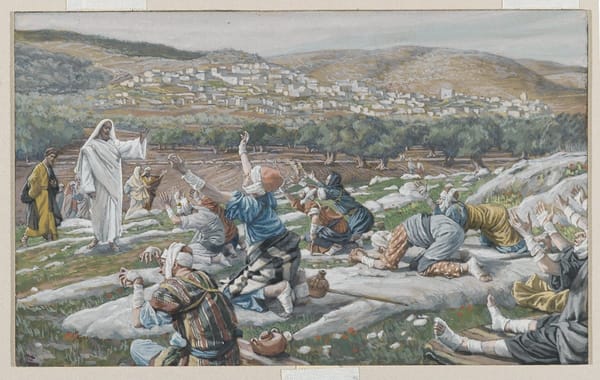
Ch. xvii.At that time: As Jesus was going to Jerusalem, he passed through the midst of Samaria and Galilee. And as he entered into a certain town, there met him ten men that were lepers, who stood afar off; and lifted up their voice, saying: Jesus, Master, have mercy on us. Whom when he saw, he said; Go, show yourselves to the priests. And it came to pass, that as they went they were made clean. And one of them, when he saw that he was made clean, went back, with a loud voice glorifying God. And he fell on his face, before his feet, giving thanks: and this was a Samaritan. And Jesus answering, said: Were not ten made clean, and where are the nine? There is no one found to return and give glory to God, but this stranger. And he said to him: Arise, go thy way; for thy faith hath made thee whole.
The Samaritan leper, cured of that hideous malady which is an apt figure of sin, in company with nine lepers of Jewish nationality, represents the despised race of Gentiles, who were at first admitted, by stealth, so to say, and by extraordinary privilege, into a share of the graces belonging to the lost sheep of the house of Israel.44 The conduct of these ten men, on occasion of their miraculous cure, is in keeping with the attitude assumed by the two peoples they typify, regarding the salvation offered to the world by the Son of God. It is a fresh demonstration of what the apostle says: ‘All are not Israelites that are of Israel; neither are all they who are the seed of Abraham, children; “but,” says the Scripture,45 “ in Isaac shall thy seed be called ”; that is to say, not they who are the children of the flesh are the children of God : but they that are the children of the promise are counted for the seed;'46 they are born of the faith of Abraham, and are, in the eyes of the Lord, His true progeny.
Our holy mother the Church is never tired of this subject, the comparison of the two Testaments, and the contrast there is between the two peoples. We deem it our duty, before proceeding further, to explain how this is; for there are many persons who cannot understand what benefit can come to us Christians from hearing this subject preached to us. The kind of spirituality which, with many of us, has nowadays been substituted for the liturgical life so thoroughly lived by, and so precious to, our Catholic ancestors, gives a certain disrelish for the ideas which the Church perseveringly brings before them during so many of her Sundays. They have become habituated to live in an atmosphere of very limited truth; it is all subjective, as well as little; and they consider it a very excellent thing, to forget all other teaching, except what they happen to possess, and beyond which it is a trouble to go. It is not surprising that Christians of this class feel puzzled at finding the Church continually urging them to take an interest in a long past, which they consider of ho practical utility to them! But the interior life, truly worthy of the name, is not what these good people imagine. No school of spirituality either now makes, or ever made, the ideal of virtue consist in indifference for those great historic facts which are evidently so precious in the eyes of the Church, and of God Himself. And what is the usual result of thus isolating themselves from their mother’s most cherished appreciations? It is, that by thus determinedly shutting themselves up in their own private prayers, they, by a just punishment, lose sight of the true end of prayer, which is union with, and love of, God. Their meditation is deprived of that element of intimate and fruitful converse with God, which is assigned it by all the masters of the spiritual life; it soon becomes an unproductive exercise of analysis and reasoning, in which there is nothing but abstract conclusions.
Now, when God mercifully invited men to the divine nuptials by manifesting to them His Word, it was not by abstraction that He gave to our earth this the Son of His own eternal Substance. As to His Divinity, men could not, in their present state, see it in a direct way. Had God shown us, in this pretended abstract way, that eternal Son of His, in whom are found all beauty, and warmth, and life, the revelation would have been imperfect and cold. This He did not do; but, as St. Paul tells us, He manifested the great mystery of godliness in the flesh;47 the Word became a living soul;48 eternal Truth assumed to Himself a Body, that so He might converse with men,49 and grow up like one of themselves.50 And when that Body, which eternal Truth was to hold as His own for ever, was taken up in glory,51 the Church, the bride of this Man-God, continued in the world this manifestation of God, by the members of Christ; she continued that historic development52 of the Word, which is only to cease when time is no more. This manifestation, this development, surpasses all human calculations, and reveals fresh aspects of the Wisdom of God even to the angels themselves.53 Let due respect be paid to the axioms of learned men, who have arranged the principles of science in logical order, independently of history and of facts: but this lifeless reasoning has nothing in common with substantial truth which is ever fruitful and necessarily active. In the Church, as in God, truth is life and light,54 not a mere collection of formulæ. If our Credo rings out so triumphantly through the aisles of our churches, and seems to force the very gates of heaven, it is because each of its articles is presented before God steeped in the blood of martyrs; from age to age it has gathered ever fresh lustre from the labours and struggles of so many holy confessors, chosen out of the human race to complete the body of Christ on earth.55
The subject is too full to be treated of here; but this we must say: after the master-fact of the Incarnation of the Word, who came upon our earth to manifest God, through the ages of time, by Christ and His members,56 there is not one which is more important, not one which has been and still is so dear to God, as the vocation of the two peoples whom He successively called to the blessing of an alliance with Him. The gifts and vocations of God are, as the apostle expresses it, without repentance or regret on His part. Those Jews, who are now His enemies because they reject the Gospel, are still called charissimi; they are still the beloved and dearly beloved, because of their fathers.57 For the same reason, a time will come —and the whole world is waiting for it—when the denial of Juda being revoked and his iniquities blotted out, the promises made to Abraham, Isaac, and Jacob, will be literally fulfilled.58 Then the divine unity of the two Testaments will be made evident; and the two peoples themselves will be made one, under their one Head, Christ Jesus.59 The covenant of God with man being then fully realized, such as He had designed it in His eternal wisdom—the earth having yielded its fruit,60 the world having done its work, the sepulchres will give back their dead,61 and history will cease here on earth, leaving glorified human nature to bloom in unreserved fullness of life, under God's complacent eye.
The truths, then, which are again brought before our notice by to-day’s Gospel, are anything but dry or old-fashioned; nothing is so grand; and, we must add—though superficial minds will wonder at it—there is nothing more practical in this season of the year, for it is the season consecrated to the mysteries of the unitive life. After all, in what, primarily, does union between God and man consist, but in unanimity of the divine and the human minds? Now, we know that the divine mind has manifested all its designs in the respective histories of the two Testaments and the two peoples; and that the final result which is to bring these two histories to their close, is the one only end which infinite love was in the beginning, and is now, and will for ever be, proposing to fulfil. The Church, therefore, far from showing herself to be behind the age by recurring continually to truths such as these, is but clearly proving herself to be the most intelligent bride of Jesus, and evincing the changeless lovely youthfulness of a heart, which ever beats in unison with that of her Spouse.
Let us now resume the literal explanation of our Gospel. As we were observing on a previous Sunday, our Jesus here, again, wishes rather to give us a useful teaching, than to manifest His divine power. It is for this purpose that He does not cure at once these ten lepers who beseech Him to have mercy on them, as, on another occasion, He cured one who was suffering from the same misery. To this latter, who besought Him, He restored cleanliness by a few words. He said: 'Be thou made clean!' and forthwith the leprosy was cleansed.62 This was at the beginning of His public life. But the event of our Gospel took place in the latter portion of our Lord’s sojourn amongst men. The lepers are made clean only while on their way to show themselves to the priests. Jesus sends them to the priests, just as He had done in the previous case; and thus, from the beginning to the close of His mortal life, He gave an example of the respect which was to be paid to the old Law, so long as it was not abrogated. That Law gave to the sons of Aaron the power, not of curing, but of discerning leprosy, and passing judgment on its being cured or not.63
The time, however, has now come for a Law far above that of Sinai. It has a priesthood, whose judgments are not to concern the state of the body, but, by pronouncing the sentence of absolution, are to effectually remove the leprosy of souls. The cure which the ten lepers felt coming upon them before they had reached the priests, ought to have sufficed to show them, in Jesus, the power of the new priesthood, which had been foretold by the prophets;64 the power which thus forestalls and surpasses the authority of the ancient ministration is sufficient evidence of the superior dignity of Him who exercises it. If only they were in suitable dispositions for the sacred rites, which are going to be used in the ceremony of their purification,65 the Holy Ghost, who heretofore had inspired the prophetic details of the mysterious function, would enable them to understand the signification of the expiatory sparrow, whose blood, being sprinkled upon the living water, sets free, by the wood, its fellow sparrow. That first bird typifies our Lord Jesus Christ, who likens Himself, in the psalm, to the lonely sparrow;66 His immolation on the cross, which gives to water the power of cleansing souls, communicates to the other sparrows, His brethren,67 the purity of the divine Blood.
But the Jew is far from being ready to understand these great mysteries. And yet the Law had. been given to him that it might serve him as a hand leading him to Christ, and without exposing him to err.68 It was a signal favour granted him, not from any merits of his own, but because of his fathers.69 The favour was all the more precious, inasmuch as it was bestowed at a time when the tradition regarding a future Redeemer was almost entirely lost by the bulk of mankind. Gratitude should have been uppermost in the heart of Juda; but pride took its place. He was so taken up with the honour that had been put on him, that it made him lose all desire for the Messiah. He could not endure the thought that a time would come, when the Sun of justice having risen for the whole earth, the limited advantage which was given to a few during the hours of night was to be eclipsed by the bright noon of a light which all might enjoy. He, therefore, proclaimed that the old Law was definitive, though the Law declared itself to be but transitory; he, therefore, insisted on the perpetuity of the reign of types and shadows. He laid it down as a dogma that no divine intervention can ever equal that made on Sinai; that every future prophet, everyone sent by God, must be inferior to Moses; that all possible salvation is in the Law, and that from it alone flows every grace.
This explains to us how it was, that of the ten men cured of leprosy by Jesus, nine have not even the remotest thought of coming to their Deliverer to thank Him: these nine are Jews. Jesus, to their minds, is a mere disciple of Moses, a bare instrument of favours, holding His commission from Sinaï, and as soon as they have gone through the legal formality of their purification they take it that all their obligations to God are paid. The Samaritan, the despised Gentile, whose sufferings have given him that humility which makes the sinner clear-sighted, is the only one who recognizes God by His divine works, and gives Him thanks for His favours. How many ages of apparent abandonment, of humiliation and suffering, must pass over Juda too, before he will recognize and adore His God, and confess to Him his sins, and give Him his devoted love, and, like this stranger, hear Jesus pronounce his pardon, and say: Arise! Go thy way! thy faith hath made thee whole and saved thee!
Let us, by our fervent prayers, hasten the time which will be so glorious for the two peoples, when, united in the same faith by the consciousness of the same hopes then realized, they will cry out to our Redeemer these words of our Offertory:
Offertory
It is the oblation now on the altar that is to obtain for us from God the pardon of our past offences, and the graces we hope for, for the time to come. Let us, in the Secret, beseech Him to accept for the sacrifice these gifts which the Church, in the name of us all, has presented to Him.
Secret
The other Secrets, as on page 180.
Oh! when will the children of Juda come and experience for themselves the superiority of the Bread of the new Testament over the manna of the old? Let us Gentiles, the last-comers, but who have preceded our elder brethren at the banquet of love, sing all the more fervently in our Communion-anthem the divine sweetness of this true Bread of heaven.
Communion
As the Postcommunion expresses it, the work of our redemption by Jesus our Lord is confirmed and grows within us as often as we assist at these sacred mysteries. The Church prays that her children may be blessed with the grace of this fruitful frequentation of the mysteries of salvation.
Postcommunion
The other Postcommunions, as on page 131.
Vespers
The psalms, capitulum, hymn, and versicle, as above, pages 71-81.
Antiphon of the Magnificat
O almighty and eternal God, grant unto us an increase of faith, hope, and charity: and, that we may deserve what thou promisest, make us to love what thou commandest. Through, etc.
- Matt. xx. ↩︎
- 1 Cor. ix. 25. ↩︎
- Gen. xv. 5. ↩︎
- Rom. iv. 19. ↩︎
- Gen. xv. 6. ↩︎
- Heb. xi. 17-19. ↩︎
- Gen. xxii. 18. ↩︎
- Rom. iv. 17, 18. ↩︎
- S. Matt. iii. 9. ↩︎
- Rom. iv. 20. ↩︎
- Rom. iv. 12. ↩︎
- Ibid. i. 17. ↩︎
- Ibid. iv. 23, 24; Gal. iii. 9. ↩︎
- Gen. xii. 1. ↩︎
- Rom. iv. 20, 21. ↩︎
- 1 Cor. vii. 31. ↩︎
- Heb. xi. 1. ↩︎
- 1 Cor. vii. 32. ↩︎
- Gen. xvii. 1. ↩︎
- 2 St. Pet. i. 19. ↩︎
- Gen. xv. 1. ↩︎
- Gal. iii. 14. ↩︎
- Rom. iv. 24. ↩︎
- Gal. iii. 28. ↩︎
- St. Luke ii. 14. ↩︎
- Gal. iii. 29. ↩︎
- Ibid. iv. 5-7. ↩︎
- Ibid. iii. 14. ↩︎
- Rom. viii. 15-17. ↩︎
- Eph. ii. 14-18. ↩︎
- Rom. viii. 2. ↩︎
- Eph. iii. 6. ↩︎
- St. John viii. 39. ↩︎
- Rom. iv. 11. ↩︎
- St. Luke xiii. 29. ↩︎
- St. Luke xv. 28. ↩︎
- Ibid. xiii. 28. ↩︎
- Ibid. 30. ↩︎
- Gen. xxvii. 36. ↩︎
- Gal. iv. 22-31. ↩︎
- Ibid. v. 1. ↩︎
- Ibid. ii. 19-21. ↩︎
- Rup., De Div. Off., xii. 13. ↩︎
- St. Matt. xv. 24. ↩︎
- Gen. xxi. 12. ↩︎
- Rom. ix. 6-8. ↩︎
- 1 Tim. iii. 16. ↩︎
- Gen. ii. 7. ↩︎
- Baruch iii. 38. ↩︎
- St Luke ii. 52. ↩︎
- 1 Tim. iii 16. ↩︎
- Eph. i. 23. ↩︎
- Ibid. iii. 10. ↩︎
- St. John i. 4. ↩︎
- Col. i. 24, ii. 19. ↩︎
- 2 Cor. iv. 10, 11. ↩︎
- Rom. xi. 28, 20. ↩︎
- Ibid. 25-27. ↩︎
- Eph. ii. 14. ↩︎
- Ps. lxvi. 7. ↩︎
- Rom. xi. 15. ↩︎
- St Matt. viii. 3. ↩︎
- Lev. xiii. ↩︎
- Isa. lxvi. 21-23. ↩︎
- Lev. xiv. 1-32. ↩︎
- Ps. ci. 8. ↩︎
- Ps. lxxxiii. 4. ↩︎
- Gal. iii. 24. ↩︎
- Deut. iv. 37, ix. 4-6. ↩︎
August 18: Fourth Day within the Octave of the Assumption
IN the eternal decrees Mary was never separated from Jesus; together with Him, she was the type of all created beauty. When the Almighty Father prepared the heavens and the earth, His Son, who is His Wisdom, played before Him in His future humanity as first exemplar, as measure and number, as starting point, centre, and summit of the work undertaken by the Spirit of Love; but at the same time the predestined Mother, the woman chosen to give to the Son of God from her own flesh His quality of Son of Man, appeared among mere creatures as the term of all excellence in the various orders of nature, of grace, and of glory. We need not, then, be astonished at the Church putting on Mary’s lips the words first uttered by Eternal Wisdom: ‘From the beginning and before the world was I created.’
The divine ideal was realized in her whole being, even in her body. To form out of nothing a reflection of the divine perfections is the purpose of creation and the law even of matter. Now, next to the face of the most beautiful of the sons of men, nothing on earth so well expressed God as the Virgin's countenance. St. Denis is said to have exclaimed on seeing our Lady for the first time: 'Had not faith revealed to me thy Son, I should have taken thee for God.’ Whether it be authentic or not to place it in the mouth of the Areopagite,1 this cry of the heart expresses the feeling of the ancients. We shall be the less surprised at this, if we remember that no son ever, resembled his mother as Jesus did; it was the law of nature doubled in Him, since He had no earthly father. It is now the delight of the angels to behold in the glorified bodies of Jesus and Mary new aspects of eternal beauty, which their own immaterial substances could not reflect.
Now the unspeakable perfection of Mary’s body sprang from the union of that body with the most perfect soul that ever was, excepting, of course, the soul of our Lord her Son. With us, the original Fall has broken the harmony that ought to exist between the two very different elements of our human being, and has generally displaced, and sometimes even destroyed, the proportions of nature and grace. It is very different where the divine work has not thus been vitiated from the beginning; so that in each blessed spirit of the nine choirs, the degree of grace is in direct relation to His gifts of nature.2 Exemption from sin allowed the soul of the Immaculate One to inform the body of its own image with absolute sway, while the soul itself, lending itself to grace to the full extent of its exquisite powers, suffered God to raise it supernaturally above all the Seraphim, even to the steps of His own throne.
For in the kingdom of grace, as in that of nature, Mary's supereminence was such as became a Queen. At the first moment of her existence in the womb of St. Anne, she was set far above the highest mountains; and God, who loves only what He has made worthy of His love, loved this entrance, this gate of the true Sion, above all the tabernacles of Jacob. It was indeed impossible that the Word, who had chosen her for His Mother, should, even for an instant, love any creature more, as being more perfect. Throughout her life there was never in Mary the least want of correspondence with her preventing graces; so great perfection could not brook the least failing, the least interruption, the least delay. From the first moment of her most holy Conception till her glorious death, grace operated in her without hindrance, to the utmost of its divine power. Thus, starting from heights unknown to us, and doubling her speed at each stroke of her wings, her powerful flight bore her up to that nearness to God, where our admiring contemplation follows her during these days.
Our Lady, moreover, is not only the first-born, the most perfect, the most holy, of creatures and their Queen—or rather she is all this, only because she is also the Mother of the Son of God. If we wish only to prove that she alone surpasses all the united subjects of her vast empire, we may compare her with men and with angels, in the order of nature and of grace. But all comparison is out of the question if we try to follow her to the inaccessible heights, where, still the handmaid of the Lord, she participates in the eternal relations which constitute the Blessed Trinity. What mode of divine charity is that whereby a creature loves God as her Son? But let us listen to the Bishop of Meaux, not the least of whose merits is to have understood as he did the greatness of Mary: ‘To form the holy Virgin's love, it was necessary to mingle together all that is most tender in nature and most efficacious in grace. Nature had to be there, for it was love of a son; grace had to act, for it was love of a God. But what is beyond our imagination is that nature and grace were insufficient; for it is not in nature to have God for a son; and grace, at least ordinary grace, cannot love a son as God: we must therefore rise higher. Suffer me, O Christians, to raise my thoughts to-day beyond nature and grace, and to seek the source of this love in the very bosom of the Eternal Father. The divine Son, of whom Mary is Mother, belongs to her and to God. She is united with God the Father by becoming the Mother of His only begotten Son, who is common to her and the Eternal Father by the manner of His conception. But to make her capable of conceiving God, the Most High had to overshadow her with His own power—that is, to extend to her His own fecundity. In this way Mary is associated in the eternal generation. But this God, who willed to give her His Son, was obliged also, in order to complete His work, to place in her chaste bosom a spark of the love He himself bears to His only Son, who is the splendour of His glory and the living image of His substance. Such is the origin of Mary’s love: it springs from an effusion of God’s heart into hers; and her love of her Son is given to her from the same source as her Son Himself. After this mysterious communication, what hast thou to say, O human reason? Canst thou pretend to understand the union of Mary with Jesus Christ? It has in it something of that perfect unity which exists between the Father and the Son. Do not attempt any more to explain that maternal love which springs from so high a source, and which is an overflow of the love of the Father for His only begotten Son.’3
Adam of St. Victor offers us this sweet sequence where with to praise her and pray to her in the midst of this stormy sea:
Sequence
Mater nostri salutaris,
Quæ vocaris stella maris,
Stella non erratica;
Non permitte naufragan,
Sed pro nobis salutari
Tuo semper supplica.
Fluctus surgunt turbulenti;
Navis currit, sed currenti
Tot occurrunt obvia!
Draco, canes, cum piratis,
Mortem pene desperatis
Hæc intentant omnia.
Furens unda fert phaselum;
Nutat malus, fluit velum,
Nautæ cessat opera;
Homo noster animalis:
Tu nos, mater spiritalis,
Pereuntes libera.
Castitatis salvo flore,
Novum florem novo more
Protulisti sæculo.
Corpus intrans virginale,
Fit pro nobis corporale
Sub ventris umbraculo
Qui potenter cuncta regit,
Nec pudoris claustra fregit,
Sacra replens viscera;
Contra primæ matris morem,
Pariendo Salvatorem,
Sensisti, puerpera.
Dignitate meritorum,
Supra choros angelorum
Sublimaris unice:
Qua conscendis ad superna!
Pietate tu materna
Nos in imo respice.
Flos, et vitis, et oliva,
Quam nulla vis insitiva,
Juvit ut fructificet;
Quæ splendore præes soli,
Nos assigna tuæ proli,
Ne districte judicet.
Sis pusilli memor gregis
Qui, transgressor datæ legis,
Præsumit de venia:
Judex jugi laude dignus
Reis spei dedit pignus,
Crucis factus hostia.
Nobis inter mundi fluctus
Sis dux, via et conductus
Liber ad cœlestia:
Tu, procellam sedans gravem,
Portum nobis da suavem
Pro tua clementia.
Mother of our salvation,
who art called Star of the Sea,
a star that wandereth not;
to suffer shipwreck,
but ever intercede for us
with the Saviour born of thee.
the boisterous billows rise;
the ship speeds on, but her swift course
what fearful odds oppose!
the dragon, the sea-dogs, pirates,
all at once menace well-nigh
despairing man with death.
does the raging surge bear the frail bark;
the mast totters, the sail is snatched away,
the mariner ceases his useless toil;
amid so great evils:
do thou, O Mother, who art spiritual,
save us ere we perish.
thou, without losing the flower of thy purity,
didst in a new manner
give to the world a new flower.
entering thy virginal body,
took for our sakes a body
in the secret of thy womb.
foresaw and elected thee.
He filled thy sacred bosom
without breaking the seal of thy virginity.
thou, O Mother, didst feel
neither anguish nor pain
in bringing forth the Saviour.
of thy merits,
thou alone art raised
far above the choirs of angels:
thou didst ascend to such heights!
Oh! in thy motherly love,
look down upon us here below.
O flower and vine and olive,
no in-grafted energy
made thee fruitful;
thou outshinest the sun in splendour;
present us to thy Son,
that He judge us not sternly.
be mindful of the little flock,
which, though it has transgressed the law given it,
dares to hope for pardon;
Judge worthy of everlasting praise,
becoming the victim of the Cross,
gave to the guilty the pledge of hope.
to us amid the world’s
billows be a guide,
a way and a free passage to heaven:
and stilling the tempest,
do Thou in Thy clemency
lead us to a pleasant harbour.
August 18 (the Same Day): St. Helen, Empress
As we return from Palestrina to the Eternal City, we pass on our left the cemetery of Saints Marcellinus and Peter, where were first deposited the holy relics of the pious empress Helena, who entered heaven on this day. The Roman Church deemed no greater honour could be given her than to mingle, so to say, her memory on May 3 with that of the sacred Wood which she restored to our adoring love. We shall not, then, speak to-day about the glorious discovery, which, after three centuries of struggle, gave so happy a consecration to the era of triumph. Nevertheless, let us offer our homage to her who set up the standard of salvation, and placed the Cross on the brow of princes who were once its persecutors.
Prayer
August 18 (the Same Day): St. Agapitus, Martyr
Palestrina, the ancient Præneste, sends a representative to Mary’s court to-day, in the person of its valiant and gentle martyr, Agapitus. By his youth and his fidelity, he reminds us of that other gracious athlete, the acolyte Tarcisius, whose victory, gained on August 15, is eclipsed by the glory of Mary’s queenly triumph. During the persecution of Valerian, and just before the combats of Sixtus and Laurence, Tarcisius, carrying the body of our Lord, was met by some pagans, who tried to force him to show them what he had; but, pressing the heavenly treasure to his heart, he suffered himself to be crushed beneath their blows rather than 'deliver up to mad dogs the members of the Lord.’* Agapitus, at fifteen years of age, suffered cruel tortures under Aurelian. Though so young he may have seen the disgraceful end of Valerian; while the new edict, which enabled him to follow Tarcisius to Mary’s feet, had scarcely been promulgated throughout the empire, when Aurelian, in his turn, was cast down by Christ, from whom alone kings and emperors hold their crowns.
Prayer
* Damas. in Callisti. ↩︎
| Previous August 17 (the Same Day): Octave Day of St. Laurence | Next August 18: Fourth Day within the Octave of the Assumption |