Daily reading
After Pentecost
Double of the II Class · Movable from Easter · Temporal
September 8, 2024
From Dom Guéranger’s The Liturgical Year.

|
The Sixteenth Sunday after Pentecost
The resuscitation of the son of the widow of Naim, on which our thoughts were fixed last Sunday, has reanimated the confidence of our beloved mother, the Church; her prayer goes up all the more earnestly to her Spouse, who leaves her on earth, for a time, that she may grow dearer to Him by sufferings and tears. Let us, of course, enter into the sentiments which guided her in the choice of to-day’s Introit.
Introit
Ps. Inclina, Domine, aurem tuam mihi, et exaudi me : quoniam inops et pauper sum ego. Gloria Patri. Miserere.
Ps. Incline thine ear unto me, O Lord, and hear me : for I am needy and poor. Glory, etc. Have mercy.
Such is our inability in the work of salvation, that, unless grace prevent, that is, anticipate, us, we cannot have so much as the thought of doing what is holy; and again, unless it follow up the inspirations it has given us, and lead them to a happy termination, we shall never be able to pass from the simple thought to the act of any virtue whatsoever. If, on the other hand, we be faithful to grace, our life will be one uninterrupted tissue of good works. Let us, in our Collect, ask, both for ourselves and for all our neighbours, the persevering continuity of this most precious aid.
Collect
The other Collects, as on page 120.
Epistle
Cap. iii.Fratres, Obsecro vos, ne deficiatis in tribulationibus meis pro vobis, quæ est gloria vostra. Hujus rei gratia flecto genua mea ad Patrem Domini nostri Jesu Christi, ex quo omnis patemitas in cœlis, et in terra nominatur, ut det vobis secundum divitias gloria sua, virtute corroborali per Spiritum ejus in interiorem hominem, Christum habitare per fidem in cordibus vestris : in charitate radicati, et fundati, ut possitis comprehendere cum omnibus sanctis, quæ sit latitudo, et longitudo, et sublimitas, et profundum: scire etiam supereminentem scientiæ charitatem Christi, ut impleamini in omnem plenitudinem Dei. Ei autem, qui potens est omnia facere superabundanter quam petimus, aut intelligimus, secundum virtutem, quæ operatur in nobis : ipsi gloria in Ecclesia, et in Christo Jesu in omnes generationes sæculi sæculorum. Amen.
Ch. iii.Brethren: I pray you not to faint at my tribulations for you, which is your glory. For this cause I bow my knees to the Father of our Lord Jesus Christ, of whom all paternity in heaven and earth is named, that he would grant you, according to the riches of his glory, to be strengthened by his Spirit with might unto the inward man. That Christ may dwell by faith in your hearts: that being rooted and founded in charity, you may be able to comprehend, with all the saints, what is the breadth, and length, and height, and depth: to know also the charity of Christ, which surpasseth all knowledge, that you may be filled unto all the fullness of God. Now to him who is able to do all things more abundantly than we desire or understand, according to the power that worketh in us : to him be glory in the church, and in Christ Jesus, unto all generations, world without end. Amen.
‘My heart hath uttered a good word: I speak my works to the King.’1 The enthusiasm of the royal psalmist, when singing the glorious nuptial song, has taken possession of our apostle’s whole soul, and inspires him with this marvellous Epistle, which seems to put into music, into a song of love, the sublime teachings of all his other letters. When he wrote this to his Ephesians he was Nero’s prisoner; but it shows that the word of God is anything but hampered by the chains that make an apostle a captive.2
Although the Epistle to the Ephesians is far from being the longest of his letters, yet it is from it that the Church borrows most during these Sundays after Pentecost; and we may argue from such choice that it gives, more than any other of St. Paul’s Epistles, that leading subject, upon which the Church is particularly anxious to direct her children’s thoughts during this season of the liturgical year. Let us, therefore, thoroughly master the mystery of the Gospel,3 by hearkening to the herald who received it as his special mission to make known to the Gentiles the treasure that had been hidden from eternity in God.4 It is as ambassador that he comes to us;5 and the chains which bind him, far from weakening the authority of his message, are but the glorious badges which accredit him with the disciples of the Christ who died on Calvary.
For, God alone, as he tells us in the music we have just heard, can strengthen in us the inward man enough to make us understand, as the saints do, the dimensions (breadth, length, height, and depth) of the great mystery of Christ dwelling in man, and dwelling in him for the purpose of filling him with the plenitude of God. Therefore is it, that falling on his knees before Him from whom flows every perfect gift, and who has begotten us in the truth by His love,6 our apostle asks God to open, by faith and charity, the eyes of our heart, that so we may be able to understand the splendid riches of the inheritance He reserves to His children, and the exceeding greatness of the divine power used in our favour, even in this life.7
But, if holiness is requisite in order to obtain the full development of the divine life spoken of by the apostle, let us also take notice how the desire and the prayer of St. Paul are for all men; and how, therefore, no one is excluded from that divine vocation. Indeed, as St. John Chrysostom observes,8 the Christians, to whom he sends his Epistle, are people living in the world, married, having children and servants, for he gives them rules of conduct with regard to each point.9 The saints of Ephesus, as of all other places, are no others than the faithful of Christ Jesus,10 that is to say, they are those who faithfully follow the divine precepts, in the condition of life proper to each. Now, it depends on us to follow God's grace; nothing else but our own resistance prevents the Holy Ghost from making saints of us. Those sublime heights, to which the progressive movement of the sacred liturgy has, since Pentecost, been leading the Church, are open to all of us. If the new order of ideas introduced by this movement strike us, at times, as being beyond our practical attainment, the probable reason of such cowardice is—and a short examination of conscience will bear witness against us—that we have neglected, ever since Advent and Christmas, to profit, as we should have done, by the teachings and graces of every kind, which were given us as means for advancing in light and in Christian virtue. The Church, at the commencement of the cycle, offered her aid to every one of us, and that aid she adapted to each one’s capabilities; but she could never remain stationary, because some of us were too lazy to move onwards; she could never consent, out of a regard for our laggings and sluggishness, to neglect leading men of good will to that divine union, which they were told ‘crowns both the year of the Church, and the faithful soul that has spent the year under the Church’s guidance.’11 But on no account must we lose courage. The cycle of the liturgy runs its full course in the heavens of the Church each year. It will soon be starting afresh, again adapting the power of its graces to each one’s necessities and weaknesses. If, with that new year of grace, we learn a lesson from our past deficiencies; if we do not content ourselves with a mere theoretical admiration of the exquisite poetry, and loveliness, and charms of its opening seasons; if we seriously set ourselves to grow with the growth of that light which is no other than Christ Himself,12—if, that is, we profit by the graces of progress which that light will again infuse into our souls—then the work of our sanctification, having been this time prepared, has a cheering and 'a new chance of receiving that completeness, which had been retarded by the weakness of human nature.’13
Even now, though our dispositions may not be all they should be, yet the Holy Ghost, that Spirit of loving mercy who reigns over this portion of the cycle, will not refuse the humble prayer we make to Him, and will supply, at least in some measure, our sad shortcomings. Great, after all, has been our gain in this, that the eye of our faith has had new supernatural horizons opened out to it, and that it has reached those peaceful regions which the dull vision of the animal man14 fails to discover. It is there that divine Wisdom reveals to the perfect that great secret of love, which is not known by the wise and the princes of this world— secret which the eye had not before seen, nor the ear heard, nor the heart even suspected as possible.15 From this time forward, we shall better understand the divine realities, which fill up the life of the servants of God; they will seem to us, as they truly are, a thousand times preferable, both in importance and in greatness, to those vain frivolities and occupations, in the midst of which is spent the existence of so-called practical men. Let us take delight in thinking upon that divine choice, which, before time was, selected us for the fullness of all spiritual benedictions,16 of which the temporal blessings of the people of old17 were but a shadow. The world was not as yet existing, and already God saw us in His Word;18 to each one among us, He assigned the place he was to hold in the body of His Christ;19 already, His fatherly eye beheld us clad with that grace20 which made Him well pleased with the Man-God; and He predestinated us,21 as being members of this His beloved Son, to sit with Him, on His right hand, in the highest heavens.22
Oh! how immense are our obligations to the eternal Father, whose good pleasure23 has decreed to grant such wondrous gifts to our earth! His will is His counsel,24 it is the one rule of all His acts; and His will is all love. It is from the voluntary and culpable death of sin25 that He calls us to that life which is His own life. It is from the deep disgrace of every vice that, after having cleansed us in the Blood of His Son,26 He has exalted us to a glory, which is the astonishment of the angels, and makes them tremble with adoring admiration.27 Let us then be holy for the sake of giving praise to the glory of such grace.28 Christ, in His Divinity, is the substantial brightness and eternal glory of His Father;29 if He has taken to Himself a Body, if He has made Himself our Head, it was for no other purpose than that He might sing the heavenly canticle in a new way. Not satisfied with presenting in His sacred Humanity, a sight most pleasing to His Father— that is, the sight of the created reflex of divine, and therefore infinite, perfections — He wished, moreover, that the whole of creation should give back to the adorable Trinity an echo of the divine harmonies. It is on this account that He, in His own Flesh, broke down the old enmities existing between Gentile and Jew;30 and then, bringing together these that were once enemies, He made of them all one spirit and one body, so that their countless human voices might, through Him, blend in unison of love with the angelic choirs, and thus, standing around God’s throne, might attune the one universal song of their praise to that of the infinite Word Himself. Thus shall we become for ever to God, like this divine Word, the praise of His glory, as the apostle thrice loves to express himself in the beginning of this his Epistle to the Ephesians.31 Thus, too, is to be wrought that mystery which, from all eternity, was the object of God’s eternal designs: the mystery, that is, of divine union, realized by our Lord Jesus uniting, in His own Person, in infinite love, both earth and heaven.32
The Church, which is showing herself in the midst of the Gentiles, bears on herself the mark of her divine Architect; God shows Himself, in her, in all majesty; and, by her, the kings of the earth are made to fear Him.
Gradual
Gospel
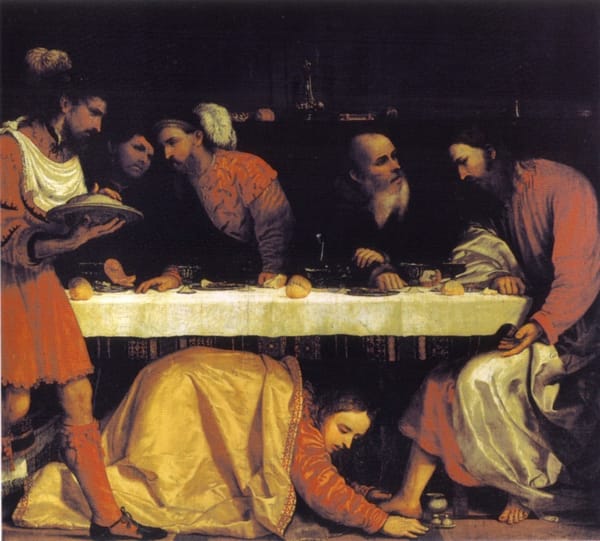
Cap. xiv.In illo tempore : Cum intraret Jesus in domum cujusdam principis pharisæorum sabbato manducare panem, et ipsi observabant eum. Et ecce homo quidam hydropicus erat ante illum. Et respondens Jesus, dixit ad legisperitos, et pharisæos, dicens : Si licet sabbato curare? At illi tacuerunt. Ipse vero apprehensum sanavit eum, ac dimisit. Et respondens ad illos, dixit : Cujus vestrum asinus, aut bos in puteum cadet, et non continuo extrahet illum die sabbati? Et non poterant ad hæc respondere illi. Dicebat autem et ad invitatos parabolani, intendens quomodo primos accubitus eligerent, dicens ad illos : Cum invitatus fueris ad nuptias, non discumbas in primo loco, ne forte honoratior te sit invitatus ab illo, et veniens is, qui te et illum vocavit, dicat tibi : Da huic locum : et tunc incipias cum rubore novissimum locum tenere. Sed cum vocatus fueris, vade, recumbe in novissimo loco : ut, cum venerit qui te invitavit, dicat tibi : Amice, ascende superius. Tune erit tibi gloria coram simul discumbentibus : quia omnis qui se exaltat, humiliabitur: et qui se humiliat, exaltabitur.
Ch. xiv.At that time : When Jesus went into the house of one of the chief of the pharisees on the Sabbath-day to eat bread, they watched him. And behold there was a certain man before him that had the dropsy. And Jesus answering, spoke to the lawyers and pharisees saying: Is it lawful to heal on the Sabbath-day? But they held their peace. But he taking him, healed him, and sent him away. And answering them, he said: Which of you shall have an ass or an ox fall into a pit; and will not immediately draw him out on the Sabbathday? And they could not answer him to these things. And he spoke a parable also to them that were invited, marking how they chose the first seats at the table, saying to them: When thou art invited to a wedding, sit not down in the first place, lest perhaps one more honourable than thou be invited by him: and he that invited thee and him, come and say to thee: Give this man place; and then thou begin with shame to take the lowest place. But when thou art invited, go, sit down in the lowest place, that when he who invited thee cometh, he may say to thee : Friend, go up higher. Then shalt thou have glory before them that sit at table with thee; because every one that exalteth himself shall be humbled; and he that humbleth himself shall be exalted.
Holy Church here tells us, and in a most unmistakable way, what has been her chief aim for her children ever since the feast of Pentecost. The wedding spoken of in to-day’s Gospel is that of heaven, of which there is a prelude given here below, by the union effected in the sacred banquet of holy Communion. The divine invitation is made to all; and the invitation is not like that which is given on occasion of earthly weddings, to which the bridegroom and bride invite their friends and relatives as simple witnesses to the union contracted between two individuals. In the Gospel wedding, Christ is the Bridegroom, and the Church is the bride.33 These nuptials are ours, inasmuch as we are members of the Church; and the banquet-hall, in this case, is something far superior to that of a commonplace marriage.
But, that this union be as fruitful as it ought to be, the soul, in the sanctuary of her own conscience, must bring with her a fidelity which is to be an enduring one, and a love which is to be active, even when the feast of the sacred mysteries is past. Divine union, when it is genuine, masters one’s entire being. It fixes one in the untiring contemplation of the beloved Object, in the earnest attention to His interests, in the continual aspiration of the heart towards Him, even when He seems to have absented Himself from the soul. The bride of the divine nuptials should be no less intent on her God, than those of earth are on their earthly spouse.34 It is on this condition alone, that the Christian soul can be said to have entered on the unitive life, or can yield its precious fruits.
But, for the attainment of all this—that is, that our Lord Jesus Christ may have that full control over the soul and its powers which makes her to be truly His, and subjects her to Him as the bride to her Spouse35—it is necessary that all alien competition be entirely and definitively put aside. Now, there is one sad fact, which everyone knows : the divinely noble Son of the eternal Father, the Incarnate Word whose beauty enraptures the heavenly citizens,36 the immortal King, whose exploits and power and riches are beyond all that the children of men can imagine37—has rivals, human rivals, who pretend to have stronger claims than He to creatures whom He has redeemed from slavery, and invited to share with Him the honours of His throne. Even in the case of those whom His loving mercy succeeds in winning over wholly to Himself, is He not frequently kept waiting, for perhaps years, before they can make up their minds to be wise enough to take Him? During that long period of unworthy wavering, He loses not His patience, He does not turn elsewhere as He might in all justice do, but He keeps on asking them to be wholly His,38 mercifully waiting for some secret touch of one of His graces, joined with the unwearied labour of the Holy Ghost, to get the better of all this inconceivable resistance.
Let us not be surprised at the Church bringing the whole influence of her liturgy to bear on the winning of souls to Christ; for every such conquest she makes for Him is a fresh and closer bond of union between herself and her Lord. This explains how, on some of these previous Sundays, she has given us such admirable instructions regarding the efforts of the triple concupiscence. Earthly pleasures, pride, and covetousness, are really the treacherous advisers, who excite within us, against God’s claims, those impertinent rivals of whom we were just now speaking. Having now reached the sixteenth week of this season of the reign of the Holy Ghost, and taking it for granted that her sons and daughters are in right good earnest about their Christian perfection, the Church hopes that they have fairly unmasked the enemy. To-day, therefore, hoping that her teaching will not fail to impress us, and that we shall no longer put off our most loving Jesus, she proposes to us, in the allegory of our Gospel, the great mystery of love of which He Himself has said : ‘The kingdom of heaven is likened to a King, who made a marriage for His Son.’39 But, after all, her anxiety as mother and bride never allows her to make quite sure of even her best and dearest children, so long as they are in this world. In order to keep them on their guard against falling into sin, she bids them listen to St. Ambrose, whom she has selected as her homilist for this Sunday. He addresses himself to the Christian who has become a veteran in the spiritual combat, and tells him that concupiscence has snares without end, even for him! Alas! he may trip, any day; he has gone far, perhaps very far, on the road to the kingdom of God, but, even so, he may go wrong, and be for ever shut out from the marriage feast, together with heretics, pagans, and Jews. Let him be on the watch, then, or he may become tainted with those sins, from which, hitherto, thanks to God’s grace, he has kept clear. Let him take heed, or he may become like the man mentioned in to-day’s Gospel, who had the dropsy; and dropsy, says our saintly preacher of Milan, is a morbid exuberance of humours, which stupefy the soul, and induce a total extinction of spiritual ardour. And yet, even if he were to have such a fall as that, let him not forget that the heavenly physician is ever ready to cure him. The saint, in this short homily, condenses the whole of St. Luke’s fourteenth chapter, of which we have been reading but a portion; and he shows, a little farther on, that attachment to the goods of this life is opposed to the ardour which should carry us on the wings of the spirit, towards the heaven where lives and reigns our loved One.’40 But, above all, it is to the constant attitude and exercise of humility that he must especially direct his attention who would secure a prominent place in the divine feast of the nuptials. All saints are ambitious for future glory of this best kind; but they are well aware that, in order to win it, they must go low down, during the present life, into their own nothingness; the higher in the world to come, the lower in this. Until the great day dawn, when each one is to receive according to his works,41 we shall lose nothing by putting ourselves, meanwhile, below everybody. The position reserved for us in the kingdom of heaven depends not, in the least, either upon our own thoughts about ourselves, or upon the judgment passed on us by other people; it depends solely on the will of God, who exalteth the humble, and bringeth down the mighty from their seat.42 Let us hearken to Ecclesiasticus. ‘The greater thou art, the more humble thyself in all things, and thou shalt find grace before God; for great is the power of God alone, and He is honoured by the humble.'43 Were it only, then, from a motive of self-interest, let us follow the advice of the Gospel, and, in all things, claim, as our own, the last place. Humility is not sterling, and cannot please God, unless, to the lowly estimation we have of ourselves, we join an esteem for others, preventing everyone with honour,44 gladly yielding to all in matters which do not affect our conscience; and all this, from a deep-rooted conviction of our own misery and worthlessness in the sight of Him who searches the reins and heart.45 The surest test of our humility before God, is that practical charity for our neighbour, which, in the several circumstances of everyday life, induces us, and without affectation, to give him the precedence over ourselves.
On the contrary, one of the most unequivocal proofs of the falseness of certain so-called spiritual ways, into which the enemy sometimes leads incautious souls, is the lurking contempt wherewith he inspires them for one or more of their acquaintance; it is dormant, perhaps, habitually, but when occasion offers—and it frequently offers—they allow it to influence their thoughts, and words, and actions. To a greater or less extent, and, it may be, with more or less unconsciousness, self-esteem is the basis of the structure of their virtues; but, as for the illuminations, and mystical sweetnesses, which these people sometimes tell their intimate friends they enjoy, they may be quite sure that such favours do not come to them from the holy Spirit. When the substantial light of the Sun of justice shall appear in the valley of the judgment, all counterfeits of this kind will be made evident,46 and they that trusted to them, and spent their lives in petting such phantoms, will find them all vanishing in smoke. Having then to take a much lower place than the one they dreamt of, they may reckon it a solace, that some place is still given them at the divine banquet. They will have to thank God that their chastisement goes no farther than the shame of seeing those very people passing high up in honour above them, for whom, during life, they had such utter contempt.
The greater the conquests made by the Church, the greater are the efforts of hell to destroy the souls of her dear children. This fearful danger calls for her fervent prayers; and our Offertory-anthem is one of these.
Offertory
The Secret reminds us, how the Sacrifice, at which we are present, and which is to be consummated, in a few moments, by the words of Consecration, is the most direct and efficacious of all the immediate preparations that we can make for the Communion of the Body and Blood, which that Sacrifice produces on the altar.
Secret
The other Secrets, as on page 180.
Now that the Church is filled, by the holy Communion just received, with the true substantial Wisdom of the Father, she promises God, as her thank-offering, that she will keep His justice, which is His law, and that she will labour to make His divine teaching produce its fruits.
Communion
In the Postcommunion, let us pray, with the Church, that we may be renewed by the purity, which these heavenly mysteries bring to us, who are well prepared for the gift: the effect of such a gift tells upon our bodies, both in this and in the next life.
Postcommunion
The other Postcommunions, as on page 131.
Vespers
The psalms, capitulum, hymn, and versicle, as above, pages 71-81.
Antiphon of the Magnificat
- Ps. xliv. 2. ↩︎
- 2 Tim. ii. 9. ↩︎
- Eph. vi. 19. ↩︎
- Eph. iii. 8, 9. ↩︎
- Ibid. vi. 20. ↩︎
- St. Jas. i. 17, 18. ↩︎
- Eph. i. 18, 19. ↩︎
- In ep. ad Eph., Hom. 1. ↩︎
- Eph. v. 22; vi. 1, 5. ↩︎
- Eph. i. 1. ↩︎
- Our Volume for Christmas, p. 23. ↩︎
- St. John i. 5. ↩︎
- See above, p. 11. ↩︎
- 1 Cor. ii. 14. ↩︎
- Ibid. 6-9. ↩︎
- Eph. i. 3. ↩︎
- Deut. xxviii. 1-14. ↩︎
- Eph. i. 4. ↩︎
- 1 Cor. xii. 12-31; Eph. iv. 12-16. ↩︎
- Ibid. i. 6. ↩︎
- Ibid 4, 5. ↩︎
- Ibid. i. 20, 23; ii. 6. ↩︎
- Ibid. i. 9. ↩︎
- Ibid. 11. ↩︎
- Ibid. 7; ii. 1-5. ↩︎
- Ibid. i. 7. ↩︎
- Hymn for the Ascension; Matins. ↩︎
- Eph. i. 4, 6. ↩︎
- Heb. i. 3. ↩︎
- Eph. ii. 14-18. ↩︎
- Ibid. i. 6, 12, 14. ↩︎
- Ibid. 9, 10. ↩︎
- Apoc. xix. 7. ↩︎
- 1 Cor. vii. 34. ↩︎
- 1 Cor. xi. 8-10. ↩︎
- Acta S. Agnetis. ↩︎
- Ps. xliv. ↩︎
- Apoc. iii. 20. ↩︎
- St. Matt. xxii. 2. ↩︎
- S. Amb., in Luc., vii., Homil. Diei. ↩︎
- St. Matt. xvi. 27. ↩︎
- St. Luke i. 52. ↩︎
- Ecclus. iii. 20, 21. ↩︎
- Rom. xii. 10. ↩︎
- Apoc. ii. 23. ↩︎
- 1 Cor. iv. 5. ↩︎
September 8: The Nativity of the Blessed Virgin Mary
|
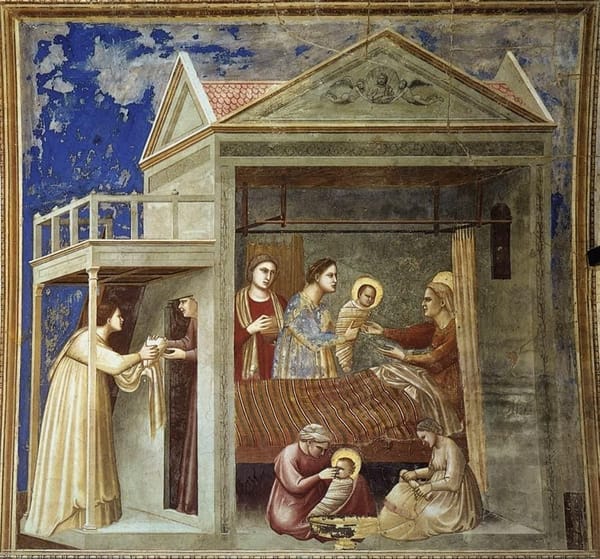
‘Let us celebrate the Nativity of the Virgin Mary; let us adore her Son, Christ our Lord.’.1 Such is the invitation addressed to us to-day by the Church. Let us hearken to her call; let us enter into her overflowing joy. The Bridegroom is at hand, for His throne is now set up on earth; yet a little while, and He will appear in the diadem of our human nature, wherewith His Mother is to crown Him on the day of the joy of His heart, and of ours. To-day, as on the glorious Assumption, the sacred Canticle is heard;2 but this time it belongs more to earth than to heaven.
Truly a better paradise than the first is given us at this hour. Eden, fear no more that man will endeavour to enter thee; thy Cherubim may leave the gates and return to heaven. What are thy beautiful fruits to us, since we cannot touch them without dying? Death is now for those who will not eat of the fruit so soon to appear amid the flowers of the virgin earth to which our God has led us.
Hail, new world, far surpassing in magnificence the first creation! Hail blessed haven, where we find a calm after so many storms! Aurora dawns; the rainbow glitters in the heavens; the dove comes forth; the ark rests upon the earth, offering new destinies to the world. The haven, the aurora, the rainbow, the dove, the ark of salvation, the paradise of the heavenly Adam, the creation whereof the fomer was but a shadow: all this art thou, sweet infant, in whom already dwell all grace, all truth, all life.
Thou art the little cloud, which the father of prophets in the suppliant anguish of his soul awaited; and thou bringest refreshment to the parched earth. Under the weakness of thy fragile form, appears the Mother of fair love and of holy hope. Thou art that other light cloud of exquisite fragrance, which our desert sends up to heaven. In the incomparable humility of thy soul, which knows not itself, the angels, standing like armed warriors around thy cradle, recognize their Queen.
O Tower of the true David; citadel withstanding the first shock of satan’s attack, and breaking all his power; true Sion, founded on the holy mountains, the highest summits of virtue; temple and palace, feebly foreshadowed by those of Solomon; house built by eternal Wisdom for herself: the faultless lines of thy fair architecture were planned from all eternity. Together with Emmanuel, who predestined thee for His home of delights, thou art thyself, O blessed child, the crowning point of creation, the divine ideal fully realized on earth.
Let us, then, understand the Church, when, even on this day, she proclaims thy divine maternity, and unites in her chants of praise the birth of Emmanuel and thine own. He who, being Son of God by essence, willed to be also Son of man, had, before all other designs, decreed that He would have a Mother. Such, consequently, was the primordial, absolute character of that title of mother, that, in the eternal decree, it was one with the very being of the chosen creature, the motive and cause of her existence, as well as the source of all her perfections natural and supernatural. We too, then, must recognize thee as Mother, even from thy very cradle, and must celebrate thy birthday by adoring thy Son our Lord.
Inasmuch as it embraces all the brethren of the Man-God, thy blessed maternity sheds its rays upon all time, both before and after this happy day. 'God is our king before ages: He hath wrought salvation in the midst of the earth.’3 ‘The midst of the earth,’ says the Abbot of Clairvaux, 'admirably represents Mary. Mary is the centre of the universe, the ark of God, the cause of creation, the business of ages. Towards her turn the inhabitants of heaven and the dwellers in the place of expiation, the men that have gone before us, and we that are now living, those who are to follow us, our children’s children and their descendants. Those in heaven look to her to have their ranks filled up; those in purgatory look for their deliverance; the men of the first ages, that they may be found faithful prophets; those who come after, that they may obtain eternal happiness. Mother of God, Queen of heaven, Sovereign of the world, all generations shall call thee blessed, for thou hast brought forth life and glory for all. In thee the angels ever find their joy, the just find grace, sinners pardon; in thee, and by thee, and from thee, the merciful hand of the Almighty has reformed the first creation.’4
Andrew of Crete calls this day a solemnity of entrance, a feast of beginning, whose end is the union of the Word with our flesh; a virginal feast, full of joy and confidence for all.5 ‘All ye nations, come hither,’ cries St. John Damascene; 'come every race and every tongue, every age and every dignity, let us joyfully celebrate the birthday of the world’s gladness.’6 ‘It is the beginning of salvation, the origin of every feast,' says St. Peter Damian; ‘for behold! the Mother of the Bridegroom is born. With good reason does the whole world rejoice to-day; and the Church, beside herself, bids her choirs sing wedding songs.’7
Not only do the Doctors of east and west use similar language in praise of Mary’s birth, but moreover the Latin and Greek Churches sing, each in its own tongue, the same beautiful formula, to close the office of the feast: ‘Thy birth O Virgin Mother of God, brought joy to the whole world: for out of thee arose the Sun of justice, Christ our God: who, taking off the curse, hath bestowed blessing; and defeating death, hath given us life everlasting.’8
This union of Rome and Byzantium in the celebration of to-day’s festival, dates back as far as the seventh century at least;9 beyond that we cannot speak with anything like certitude, nor is it known when the feast was first instituted. It is supposed to have originated at Angers, towards the year 430, by an apparition of our Lady to the holy bishop Maurillus in the fields of Marillais; and hence the name of Notre Dame Angevine often given to the feast. In the eleventh century Chartres, the city of Mary, claims for its own Fulbert, together with Robert the Pious, a principal share in the spreading of the glorious solemnity throughout France. It is well known how intimate the bishop was with the king; and how the latter himself set to music the three admirable responsories composed by Fulbert, wherein he celebrates the rising of the mysterious star that was to give birth to the Sun; the branch springing from the rod of Jesse, and producing the divine Flower whereon the holy Spirit was to rest; and the merciful power which caused Mary to blossom in Judæa like the rose on the thorn.10
In the year 1245, in the third session of the first Council of Lyons, (the same session which deposed Frederick II. from the empire), Innocent IV. established for the whole Church, not the feast which was already kept everywhere, but the Octave of the Nativity of the blessed Virgin Mary.11 It was the accomplishment of a vow made by him and the other Cardinals during the Church’s widowhood, which through the intrigues of the crafty emperor, lasted nineteen months after the death of Celestine IV., and which was brought to a close by the election of Sinibaldo Fieschi under the name of Innocent.
In 1377, the great Pope Gregory XI., who broke the chains of captivity in Avignon, wished to add a vigil to the solemnity of our Lady’s birthday. But whether he merely expressed a desire to this effect, as did his successor Urban VI. with regard to a fast on the eve of the Visitation, or whether for some other reason, the intentions of the holy Pope were carried out for only a very short time during the years of trouble that followed his death.
Together with the Church, let us ask, as the fruit of this sweet feast, for that peace which seems to flee ever farther and farther from our unhappy times. Our Lady was born during the second of the three periods of universal peace wherewith the reign of Augustus was blest, the last of which ushered in the Prince of peace Himself.
The temple of Janus is closed; in the eternal city a mysterious fountain of oil has sprung up from the spot where the first sanctuary of the Mother of God is one day to be built; signs and portents are multiplied; the whole world is in expectation; the poet has sung: ‘Behold the last age, foretold by the Sybil, is at hand; behold the great series of new worlds is beginning; behold the Virgin!’12
In Judæa, the sceptre has been taken away from Juda; but the usurper of his power, Herod the Idumæan, is hastening to complete the splendid restoration, which will enable the second temple worthily to receive within its walls the Ark of the new Covenant.
It is the sabbatical month, the first of the civil year, the seventh of the sacred cycle; the month of Tisri which begins the repose of each seventh year, and in which is announced the holy year of Jubilee; the most joyous of months, with its solemn Neomeniacelebrated with trumpets and singing, its feast of tabernacles, and the commemoration of the completion of Solomon’s temple.
In the heavens, the sun, in his passage through the zodiac, has left the sign of Leo and entered that of Virgo. On earth, two obscure descendants of David, Joachim and Anne, are thanking God for having blessed their long-barren union.
First Vespers
The psalms, capitulum, and hymn, are the same as on the other feasts of our Lady. The antiphons and versicle celebrate the birth of the noblest of Eve’s daughters, which brings honour to our race, gives to God a Mother, and to us an advocate whose prayers are never rejected.
Ps. Dixit Dominus, page 38.
Ps. Laudate pueri, page 41.
Psalm 121
Stantes erant pedes nostri: in atriis tuis, Jerusalem.
Jerusalem quæ ædificatur ut civitas: cujus participatio ejus in idipsum.
Illuc enim ascenderunt tribus, tribus Domini: testimonium Isræl ad confitendum nomini Domini.
Quia illic sederunt sedes in judicio: sedes super domum David.
Rogate quæ ad pacem sunt Jerusalem: et abundantia diligentibus te.
Propter fratres meos et proximos meos: loquebar pacem de te.
Propter domum Domini Dei nostri: quæsivi bona tibi.
4. ANT. Corde et animo Christo canamus gloriam, in hac sacra solemnitate præcelsæ Genitricis Dei Mariæ.
Our feet were standing in thy courts, O Jerusalem! Our heart loves and confides in thee, O Mary.
Mary is like to Jerusalem, that is built as a city: which is compact together.
For thither did the tribes go up, the tribes of the Lord: the testimony of Israel, to praise the name of the Lord.
Because seats sat there in judgment: seats upon the house of David, and Mary is of a kingly race.
Pray ye, through Mary, for the things that are for the peace of Jerusalem: and may abundance be on them that love thee, O Church of our God!
I. a daughter of Israel, for the sake of my brethren and of my neighbours, spoke peace of thee.
Because of the house of the Lord our God, I have sought good things for thee.
4. ANT. With heart and mind let us sing glory to Christ, on this sacred solemnity of Mary, the most high Mother of God.
Psalm 126
Nisi Dominus custodierit civitatem: frustra vigilat qui custodit eam.
Vanum est vobis ante lucem surgere: surgite postquam sederitis, qui manducatis panem doloris.
Cum dederit dilectis suis somnum: ecce hæreditas Domini, filii, merces, fructus ventris.
Sicut sagittæ in manu potentis: ita filii excussorum.
Beatus vir, qui implevit desiderium suum ex ipsis: non confundetur cum loquetur inimicis suis in porta.
Unless the Lord keep the city, he watcheth in vain that keepeth it.
It is vain for you to rise before light; rise ye after ye have sitten, you that eat of the bread of sorrow.
When he shall give sleep to his beloved: behold the inheritance of the Lord are children; the reward the fruit of the womb.
As arrows in the hand of the mighty, so the children of them that have been shaken.
Blessed is the man that hath filled his desire with them; ho shall not be confounded when he shall speak to his enemies at the gate.
Psalm 147
Quoniam confortavit seras portarum tuarum: benedixit filiis tuis in te.
Qui posuit fines tuos pacem: et adipe frumenti satiat te.
Qui emittit eloquium suum terræ: velociter currit sermo ejus.
Qui dat nivem sicut lanam: nebulam sicut cinerem spargit.
Mittitcrystallum suam sicut buccellas: ante faciem frigoris ejus quis sustinebit?
Emittet Verbum suum et liquefaciet ea: flabit Spiritus ejus, et fluent aquæ.
Qui annuntiat Verbum suum Jacob: justitias, et judicia sua Israel.
Non fecit taliter omni natio ai: et judicia sua non manifestavit eia.
Because he hath strengthened against sin the bolts of thy gates: he hath blessed thy children within thee.
Who hath placed peace in thy borders, and filleth thee with the fat of corn, with Jesus, who is the Bread of life.
Who sendeth forth, by thee, his Word to the earth; his Word runneth swiftly.
Who giveth snow like wool; scattereth mists like ashes.
He sendeth his crystal like morsels: who shall stand before the face of his cold?
He shall send forth his Word by Mary, and shall melt them: his Spirit shall breathe, and the waters shall run.
Who declareth his Word to Jacob: his justices and his judgments to Israel.
Until these our days, he hath not done in like manner to every nation; and his judgments he hath not made manifest to them.
Capitulum
Ecclus. xxvi.
Hymn
Dei Mater alma,
Atque semper Virgo,
Felix cœli porta.
Gabrielis ore,
Funda nos in pace,
Mutans Evæ nomen.
Profer lumen cæcis,
Mala nostra pelle,
Bona cuncta posce.
Sumat per te preces,
Qui, pro nobis natus,
Tulit esse tuus.
Inter omnes mitis,
Nos culpis solutos,
Mites fac et castos.
Iter para tutum,
Ut videntes Jesum,
Semper collætemur.
Summo Christo decus,
Spiritui Sancto,
Tribus honor unus.
Blessed Mother of God,
yet ever a Virgin!
O happy gate of heaven!
the Ave from Gabriel’s lips,
confirm us in peace,
and so let Eva be changed into an Ave of blessing for us.
bring light to the blind,
drive from us our evils,
and ask all good things for us.
and offer our prayers to Him
who would be born of thee
when born for us.
and meekest of the meek,
obtain us the forgiveness of our sins,
and make us meek and chaste.
and a safe pilgrimage;
that we may be united
with thee in the blissful vision of Jesus.
and to the Lord Jesus,
and to the Holy Ghost:
to the Three one self-same praise.
Antiphon of the Magnificat
The Prayer is the Collect of the Mass, page 158.
An illustrious martyr watches with the angels over the cradle of the Mother of God. On earth, he was an officer of the guards in the court of an emperor: in heaven he holds the same title under the Queen of the universe. Nicomedia was the scene of Adrian’s combat; but his body was taken thence first to Byzantium, and afterwards to the eternal city. Having on this day received the precious relics, Rome knew how to unite with her homage to Mary the honour due to the heroic soldier. In the seventh century,13 St. Adrian’s church was appointed as the starting-place for the solemn litany or procession, which went from the Forum to St. Mary Major, on this feast of the Nativity, and afterwards on those of the Annunciation and Assumption.
The Acts of St. Adrian’s martyrdom are now recognized as incontestable. The part played therein by his young wife Natalia, lends them a charm of heroic sweetness. Unknown to her pagan husband, she had been a Christian from infancy. When she heard that Adrian had been converted by witnessing the constancy of the confessors, and in the fervour of his generosity had asked to share their captivity, she hastened to him in a transport of joy, and, kissing his chains, cried out: ‘Blessed art thou, my lord Adrian.’ During the days which followed, such admirable scenes took place between the two spouses, as the greatest geniuses of antiquity never invented in their fictions Though she was left free by the gaolers, Natalia would not quit her husband’s side, now that he was far more glorious in her eyes than he had ever been in fighting under Cæsar’s standard. Sitting at his feet in the prison, or accompanying him to the pretorium, she had no thought but to keep up the neophyte, under the pressure of the tortures, to the height of his vocation to martyrdom; bidding him have no solicitude about earthly things. Upon herself, about to be left alone though scarcely more than a child, she made no reflection; except that, on the eve of the sacrifice, she let fall these words: ‘Remember thy co-operatrix in martyrdom; pray that I may die with thee, that other women may learn how to behave towards their husbands, on seeing thy love for me.’ At length the hour had come. Maintaining, in the simplicity of her pure heart, a fidelity whose heroism did not destroy its exquisite tenderness, she herself placed upon the anvil, whereon they were to be crushed, the feet of him she loved alone in this world. And as after this awful torture the martyr was still breathing, he stretched out his hand to Natalia, that she might offer it to the executioner to be cut off. Then he died; and remembering the prayer of his faithful companion, he soon called her after him to heaven.
Our Emmanuel, on the night of His birth, gave a share in His honours to the holy widow Anastasia; so now, with sweet motherly thoughtfulness, the Virgin of virgins inspired the Church to associate with the joys of this happy birthday the glorification of the heroic spouse of St. Natalia.
Mass
The Church intones the beautiful song of Prudentius to the Mother of God; for, like the Most High, she looks upon Mary as already Mother, since such she has been by predestination from all eternity. Our Lady answers the Church’s greeting, by the song of the bride, the psalm of the epithalamium, which no one else could ever sing as she can even from this her first day.
Introit
The liturgy here leaves the historical order of events, to follow that of the annual cycle, which began with the weeks of Advent. Thus, in the Collect we pray that the mystery of to-day may develop in us the work of sanctification and peace begun at Bethlehem.
Collect
In private Masses, after the Collect, Secret, and Postcommunion of the feast, a commemoration is made of St. Adrian.
Prayer
Epistle
Prov. cap. viii.Dominus possedit me in initio viarum suarum, antequam quidquam faceret a principio. Ab æterno ordinata sum, et ex antiquis, antequam terra fieret. Nondum erant abyssi, et ego jam concepta eram: necdum fontes aquarum eruperant: necdum montes gravi mole constiterant: ante colles ego parturiebar. Adhuc terram non fecerat, et flumina et cardines orbis terræ. Quando præparabat cœlos, aderam: quando certa lege, et gyro vallabatabyssos: quando æthera firmabat sursum, et librabat fontes aquarum: quando circumdabat mari terminum suum, et legem ponebat aquis ne transirent fines suos: quando appendebat fundamenta terræ. Cum eo eram cuncta componens: et dilectabar per singulos dies, ludens coram eo omni tempore, ludens in orbe terrarum: et deliciæ meæ esse cum filiis hominum. Nunc ergo, filii, audite me: Beati qui custodiunt vias meas. Audite disciplinam, et estote sapientes, et nolite abjicere eam. Beatus homo qui audit me, et qui vigilat ad fores meas quotidie, et observat ad postes ostii mei. Qui me invenerit, inveniet vitam, et hauriet salutem a Domino.
Prov. ch. viii.The Lord possessed me in the beginning of his ways, before he made anything from the beginning. I was set up from eternity, and of old before the earth was made. The depths were not as yet, and I was already conceived: neither had the fountains of waters as yet sprung out; the mountains with their huge bulk had not as yet been established: before the hills I was brought forth. He had not yet made the earth, nor the rivers, nor the poles of the world. When he prepared the heavens, I was present; when with a certain law and compass he enclosed the deep: when he established the sky above, and poised the fountains of waters: when he compassed the sea with its bounds, and set a law to the waters, that they should not pass their limits: when he balanced the foundations of the earth: I was with him forming all things: and was delighted every day, playing before him at ail times, playing in the world: and my delights were to be with the children of men. Now, therefore, ye children, hear me. Blessed are they that keep my ways. Hear instruction and be wise, and refuse it not. Blessed is the man that heareth me, and that watcheth daily at my gates, and waiteth at the posts of my doors. He that shall find me, shall find life, and shall have salvation from the Lord.
When princes are born, we prognosticate their future greatness by recalling the glory of their ancestors. The Church does in like manner to-day. The Gospel will recount the temporal genealogy of Messias, which is also the genealogy of her, who was born for the very purpose of giving birth to Him. But first, this passage from the Book of Proverbs sets before us the divine origin of the Son and of the Mother. It is of both that eternal Wisdom says: ‘Before the hills I was brought forth: when He prepared the heavens, I was present.’
Our weak human nature, subject to time, can conceive of things only according to the series of their progressive evolutions; but God sees them independently of time, which He rules with His eternity; He sees them in the order of mutual dependence in which He has placed them with a view to the manifestation of His glory. With God, the beginning and the principle of every work is the purpose for which it is done. Now the Most High acts outside Himself solely to reveal Himself, by His Word made Flesh and become the Son of a created Mother as He is the Son of the Creator. The God-Man as end, Mary as the means: such is the object of the eternal decrees, the purpose of the world’s existence, the fundamental conception, with regard to which all else is but accessory and dependent.
O Lady, who dost deign to call us also thy children, it is well for us that thy goodness is equal to thy greatness! Happy is the human race for having waited and watched for thee during so many long ages, and for having found thee at length; for with thee is salvation and life.
In the Gradual the Church again sings of Mary’s virginal and divine maternity; for this is the day which gave us the Mother of God.
Gradual
Gospel
Cap. i.Liber generationis Jesu Christi filii David, filii Abraham. Abraham genuit Isaac. Isaac autem genuit Jacob. Jacob autem genuit Judam et fratres ejus. Judas autem genuit Phares, et Zaram de Thamar. Phares autem genuit Esron. Esron autem genuit Aram. Aram autem genuit Aminadab. Aminadab autem genuit Naasson. Naasson autem genuit Salmon. Salmon autem genuit Booz de Rahab. Booz autem genuit Obed ex Ruth. Obed autem genuit Jesse. Jesse autem genuit David regem. David autem rex genuit Salomonem, ex ea quæ fuit Uriæ .Salomon autem genuit Roboam. Roboam autem genuit Abiam. Abias autem genuit Asa. Asa autem genuit Josaphat. Josaphat autem genuit Joram. Joram autem genuit Oziam. Ozias autem genuit Joatham. Joatham autem genuit Achaz. Acbaz autem genuit Ezechiam. Ezechias autem genuit Manassen. Manasses autem genuit Amon. Amon autem genuit Josiam. Josias autem genuit Jechoniam, et fratres ejus in transmigratione Babylonis. Et post transmigrationem Babylonis: Jechonias genuit Salathiel. Salathiel autem genuit Zororabel. Zorobabel autem genuit Abiud. Abiud autem genuit Eliacim. Eliacim autem genuit Azor. Azor autem genuit Sadoc. Sadoc autem genuit Achim. Achim autem genuit Eliud. Eliud autem genuit Eleazar. Eleazar autem genuit Mathan. Mathan autem genuit Jacob. Jacob autem genuit Joseph, virum Mariæ, de qua natus est Jesus, qui vocatur Christus.
Ch. i.The book of the generation of Jesus Christ, the Sonof David, the sou of Abraham. Abraham begot Isaac; and Isaac begot Jacob; and Jacob begot Judas and his brethren; and Judas begot Phares and Zara of Thamar; and Phares begot Esron; and Esron begot Aram; and Aram begot Aminadab; and Aminadab begot Naasson; and Naasson begot Salmon; and Salmon begot Booz of Rahab; and Booz begot Obed of Ruth; and Obed begot Jesse; and Jesse begot David the king. And David the king begot Solomon, of her who had been the wife of Urias; and Solomon begot Roboam; and Roboam begot Abia; and Abia begot Asa; and Asa begot Josaphat; and Josaphat begot Joram; and Joram begot Ozias; and Ozias begot Joatham; and Joatham begot Achaz; and Achaz begot Ezechias; and Ezechias begot Manasses; and Manasses begot Amon; and Amon begot Josias; and Josias begot Jechonias and his brethren in the transmigration of Babylon. And after the transmigration of Babylon Jechonias begot Salathiel; and Salathiel begot Zorobabel; and Zorobabel begot Abiud; and Abiud begot Eliacim; and Eliacim begot Azor; and Azor begot Sadoc; and Sadoc begot Achira; and Achim begot Eliud; and Eliud begot Eleazar; and Eleazar begot Mathan; and Mathan bogot Jacob; and Jacob begot Joseph, the husband of Mary, of whom was born Jesus, who is called Christ.
Mary of whom was born Jesus: these words contain the whole mystery of our Lady, the title which expresses her whole being according to both nature and grace; for, Jesus, who was to be born of Mary, to be made of a woman,14 was from the beginning the hidden reason of all creation, to be manifested in the fulness of time. This was God’s great work, of which the prophet said in ecstasy: ‘O Lord, Thy work, . . . in the midst of the years Thou shalt make it known; . . . the holy One shall come from the shady mountain.15 . . The hills of the world were bowed down by the journeys of His eternity.’16 This mountain, from whence the holy One, the Eternal, the Ruler of the world, is to come, is the blessed Virgin Mary,17 whom the power of the Most High will overshadow, and who, at her very birth, is set far above all the heights of earth and of heaven.18
The days, then, are accomplished. Ever since the hour when the eternal Trinity came forth from their repose to create heaven and earth, all the generations of heaven and earth have been in labour to bring forth the day which is to give a Mother to the Son of God. Parallel with the direct line from Abraham and David to the Messias, all human genealogies have been preparing for Mary the generation of adoptive sons whom Jesus is to make His brethren.
With the Church, let us congratulate our Lady on this her sublime maternity, which embraces all creatures together with the Creator.
Offertory
May this maternity, and the virginity which it sealed, draw us ever nearer to the Son of Mary and the Son of God; may they unite us in greater purity to the Sacrifice prepared on the altar.
Secret
Commemoration of St. Adrian
Preface
When we receive our Lord in holy Communion, let us not forget that we owe His coming to the blessed child who was horn on this day nineteen centuries ago.
Communion
May the annual return of the beautiful feast never be without fruit in our souls; and may the adorable mysteries it has led us to receive, deliver us from evils both temporal and eternal. This is what we ask for in the Postcommunion.
Postcommunion
Commemoration of St. Adrian
Second Vespers
The antiphons, psalms, capitulum, hymn, and versicle are the same as at First Vespers, page 152.
Antiphon of the Magnificat
In honour of our sweet Lady’s birth, let us sing the beautiful responsories composed by Fulbert of Chartres and Robert the Pious. France first adopted them, and the whole of Europe soon followed her example.
Responsories
At length, O Mary, our earth possesses thee! Thy birth reveals to it the secret of its destiny, the secret of that love which called it from nothingness, that it might become the palace of the God who dwelt above the heavens. But what a mystery, that poor, weak humanity, inferior to the angels by nature, should be chosen to give to the angels their King and their Queen! Their King they will soon adore, a new-born Babe in thine arms; their Queen they reverence to-day, admiring thee in thy cradle as only angels can admire. In the beginning these morning stars, these noble spirits, contemplated the manifestations of almighty power, and praised the Most High; yet never did their eager gaze discover such a marvel as that which delights their eyes at this hour: God, more purely imaged under a corporeal veil, under the fragile form of an infant one day old, than in all the strength and all the beauty of their nine angelic choirs; God, so captivated by such weakness united, by His grace, to such love, that He made it the culminating point of His work by determining to manifest His Son therein!
Queen of angels, thou art our Queen also; accept us as thy liegemen. On this day, when the first movement of thy holy soul was towards God, and the first smile of thy lovely eyes was for thy happy parents, may holy Anne allow us to kneel and kiss thy little hand, already filled with the divine bounties of which thou art the predestined dispenser. And now, grow up, sweet little one! Let thy feet be strengthened to crush the serpent, and thy arms to carry the treasure of the world! Angels and men, the whole of nature, God the Father, Son, and Holy Ghost, all are awaiting the solemn moment, when Gabriel may fly down from heaven to hail thee full of grace, and bring thee the message of eternal love.
- Invitatory of the feast. ↩︎
- Lessens of the 1st Nocturn. ↩︎
- Psalm lxxiii. 12. ↩︎
- Bern. In festo Pentecost. Sermon ii. 4. ↩︎
- Oratio i, in Nativit. Deiparæ. i. ↩︎
- In Natal. B. M. Homilia l. ↩︎
- Sermon xlv, in Nativit. B. M. V. ↩︎
- Trope of the dismissal in utroque Vespertine; Magnificat Ant. of 2nd Vespers. ↩︎
- Liber Pontific. in Sergio I. ↩︎
- ℟.℟. Solem justitiæ, Stirps Jesse virgam produxit, Ad nutum Domini. ↩︎
- Mansi, xxiii, 612. ↩︎
- Virg. Eclog. iv. Pollio. ↩︎
- Liber pontif. in Seryio I. ↩︎
- Gal. iv. 4. ↩︎
- Jurta lxx. ↩︎
- Habacuc iii. 2-6. ↩︎
- Andr. Cret. Oratio in Annunt. Deiparæ. ↩︎
- Joan. Damasc. in Natal. B. M. Homilia i. ↩︎
| Previous September 5: St. Laurence Justinian, Bishop and Confessor | Next September 8: The Nativity of the Blessed Virgin Mary |