Daily reading
After Pentecost
Double of the I Class · September 29 · Sanctoral
September 29, 2024
From Dom Guéranger’s The Liturgical Year.
A Double of the I Class leads the Sunday.Rubric

|
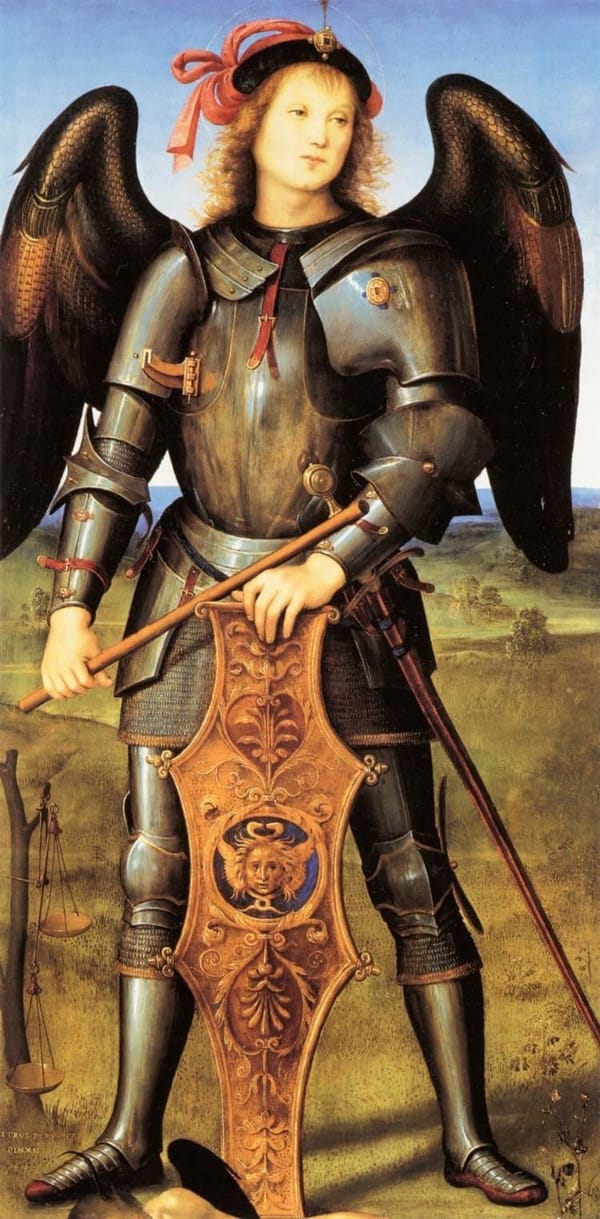
September 29: Dedication of St. Michael the Archangel
The glorious Archangel appears to-day at the head of the heavenly army: There was a great battle in heaven, Michael and his angels fought with the dragon, and the dragon fought and his angels.1 In the sixth century, the dedication of the churches of St. Michael on Monte Gargano and in the Roman Circus increased the celebrity of this day, which had however been long before consecrated by Rome to the memory of all the heavenly Virtues.
The east commemorates on the sixth of September an apparition of the victorious Prince at Chone2 in Phrygia; while the eighth of November is their solemnity of the angels, corresponding to our feast of to-day, and bearing the title: ‘Synaxis of Saint Michæl prince of the heavenly host, and of the other spiritual Powers.’ Although the term synaxis is usually applied only to religious assemblies here on earth, we are informed that in this instance it also signifies the gathering of the faithful angels at the cry of their chief, and their union eternally sealed by their victory.3
Who, then, are these heavenly Powers, whose mysterious combat heads the first page of history? Their existence is attested by the traditions of all nations as well as by the authority of holy Scripture. If we consult the Church, she teaches us that in the beginning God created simultaneously two natures, the spiritual and the corporal, and afterwards man who is composed of both.4 The scale of nature descends by gradation from beings made to the likeness of God, to the very confines of nothingness; and by the same degrees the creature mounts upwards to his Creator. God is infinite being, infinite intelligence, infinite love. The creature is for ever finite: but man, endowed with a reasoning intellect, and the angel, with an intuitive grasp of truth, are ever, by a continual process of purification, widening the bounds of their imperfect nature, in order to reach, by increase of light, the perfection of greater love.
God alone is simple with that unchangeable productive simplicity, which is absolute perfection excluding the possibility of progress; He is pure Act, in whom substance, power, and operation are one thing. The angel, though entirely independent of matter, is yet subject to the natural weakness necessary to a created being; he is not absolutely simple, for in him action is distinct from power, and power from essence5 How much greater is the weakness of man’s composite nature, unable to carry on the operations of the intellect without the aid of the senses!
One of the most enlightened brethren of the angelic doctor says:
Compared with ours, how calm and how luminous is the knowledge of pure spirits! They are not doomed to the intricate discoursing of our reason, which runs after the truth, composes and analyzes, and laboriously draws conclusions from premisses. They instantaneously apprehend the whole compass of primary truths. Their intuition is so prompt, so lively, so penetrating, that it is impossible for them to be surprised, as we are, into error. If they deceive themselves, it must be of their own will. The perfection of their will is equal to the perfection of their intellect. They know not what it is to be disturbed by the violence of appetites. Their love is without emotion; and their hatred of evil is as calm and as wisely tempered as their love. A will so free can know no perplexity as to its aims, no inconstancy in its resolutions. Whereas with us long and anxious meditation is necessary before we make a decision, it is the property of the angels to determine by a single act the object of their choice. God proposed to them, as He does to us, infinite beatitude in the vision of His own Essence; and to fit them for so great an end, He endowed them with grace at the same time as He gave them being. In one instant they said Yes or No; in one instant they freely and deliberately decided their own fate.6
Let us not be envious. By nature the angel is superior to us; but, to which of the angels hath He said at any time, ‘Thou art My Son?’7 The only begotten Son of God did not take to Himself the angelic nature. When on earth, He acknowledged the temporary subordination of humanity to those pure spirits, and deigned to receive from them, even as do His brethren in the flesh, the announcements of the divine will,8 and help and strength.9 But ‘God hath not subjected unto angels the world to come,’ says the apostle.10 How can we understand this attraction of God towards what is feeblest? We can only worship it in humble, loving faith. It was Lucifer’s stumbling-block on the day of the great battle in heaven. But the faithful angels prostrated themselves in joyous adoration at the feet of the Infant-God foreshown to them enthroned on Mary’s knee, and then rose up to sing: ‘Glory to God in the highest, and on earth peace to men of good will.’
O Christ, my Christ as St. Denis calls Thee,11 the Church to-day delightedly proclaims Thee the beauty of the holy angels.12 Thou, the God-Man, art the lofty height whence purity, light, and love flow down upon the triple hierarchy of the nine choirs. Thou art the supreme Hierarch, the centre of worlds, controller of the deifying mysteries at the eternal feast.
Flaming Seraphim, glittering Cherubim, steadfast Thrones, court of honour to the Most High, and possessed of the noblest inheritance: according to the Areopagite, ye receive your justice, your splendour, and your burning love by direct communication from our Lord:13 and through you, all grace overflows from Him upon the holy city.
Dominations, Virtues, and Powers; sovereign disposers, prime movers, and rulers of the universe: in whose name do ye govern the world? Doubtless in His whose inheritance it is; in the name of the King of glory, the Man-God, the Lord strong and mighty, the Lord of hosts.
Angels, Archangels, and Principalities; heaven’s messengers, ambassadors, and overseers here below: are ye not also, as the apostle says, ministers of the salvation wrought on earth by Jesus, the heavenly High-Priest?
We also, through this same Jesus, O most holy Trinity, glorify Thee, together with the three princely hierarchies, which surround Thy Majesty with their nine immaterial rings as with a many-circled rampart. To tend to Thee, and to draw all things to Thee, is their common law. Purification, illumination, union: by these three ways in succession, or simultaneously, are these noble beings attracted to God, and by the same they attract those who strive to emulate them. Sublime spirits, it is with your gaze ever fixed on high that ye influence those below and around you. Draw plentifully, both for yourselves and for us, from the central fires of the Divinity; purify us from more than the involuntary infirmities of nature; enlighten us; kindle us with your heavenly flames. For the same reason that satan hates us, ye love us: protect the race of the Word made Flesh against the common enemy. So guard us, that we may hereafter be worthy to occupy among you the places left vacant by the victims of pride.
Adam of St. Victor thus sings the fullness of to-day’s mystery.
Sequence
Psallat chorus in conspectu supernorum civium:
Laus jocunda, laus decora,
Quando laudi concanora puritas est cordium.
Nec ab hujus se defraudent Diei lætitia:
Felix dies qua sanctorum
Recensetur angelorum solemnis victoria.
Et draconis effugatur inimica legio:
Exturbatus est turbator
Et projectus accusator a cœli fastigio.
Pax in terra, pax in cœlis, laus et jubilatio:
Cum sit potens hic virtute,
Pro communi stans salute, triumphat in prælio.
Per hujus æris oberrat spatia:
Dolis invigilat, virus insibilat,
Sed hunc annihilat præsens custodia.
Jugi vacant theoriæ jugique psallentio:
Nec obsistit theoria
Sive jugis harmonia Jugi ministerio.
Est supernæ civitatis ter terna distinctio:
Quæ nos amat et tuetur,
Ut ex nobis restauretur ejus diminutio.
Distinctæ gloriæ justis in præmio:
Solis est alia quam lunæ dignitas,
Stellarum varia relucit claritas: sic resurrectio.
Se terrenus puritati conformet cœlestium:
Coæqualis his futurus,
Licet nondum plene punis, spe præsumat præmium.
Hos devote veneremur instantes obsequio:
Deo nos conciliat
Angelisque sociat sincera devotio.
Erigamus puras mentes in cœlum cum manibus:
Ut superna nos dignetur cohæredes curia,
Et divina collaudetur ab utrisque gratia.
Membrisque concordia.
let our choir sing in presence of the heavenly citizens:
our praise will be pleasing and beautiful,
if the purity of our hearts be in accord therewith.
let none deprive himself of this day’s joy.
O happy day! whereon the solemn victory
of the holy angels is recorded.
and all his hostile legions put to flight:
the disturber is himself disturbed,
the accuser is hurled down from the height of heaven.
there is peace on earth, peace in heaven, praise and exultation;
for he, mighty and valorous,
stands for the safety of all and triumphs in the battle.
wanders through the air:
he watches to lay his snares, and insinuates his poison;
but the guardian band of angels reduces his power to nought.
are ever occupied in contemplation and unending song;
nor does their contemplation
nor their ceaseless harmony interrupt their continual ministry.
of the three tripled choirs;
they love us and defend us,
and hope to see their ranks filled up by us.
the just will receive divers degrees of glory;
other is the excellence of the sun, other that of the moon,
and various the brightness of the stars; so shall be the resurrection.
the earthly to the purity of the heavenly citizens;
he is one day to be equal to them, and though not yet wholly pure,
let him in hope look forward to the prize.
let us devoutly venerate them and be untiring in our homage;
sincere devotion reconciles to God
and unites us with the angels.
and lift up pure minds and spotless hands on high:
Thus may the most high senate recognize us as coheirs;
and may the divine grace be praised alike by angels and men.
and among his members union.
- Apoc. xii. 7. ↩︎
- Thu ancient Colossæ. ↩︎
- Menolog. Basilii. ↩︎
- Conoil. Lateran. iv. cap. Firmiter. ↩︎
- Thom. Aquin. Summ. Theol. i. q. liv. art. 1-3. ↩︎
- Monsabré 15th Conference, Lent 1875. ↩︎
- Heb. i. 5; ex Ps. ii. 7. ↩︎
- Dionys. Areop. De cælesti hierarchiæ, iv. 4; ex Matt. ii. 13-15, 19-21. ↩︎
- St. Luke xxii. 43. ↩︎
- Heb. ii. 5. ↩︎
- Dionys. De cælesti hierarchia, ii. 5. ↩︎
- Hymn of Lauds. ↩︎
- Dionys. ubi supra, vii. 2. ↩︎
The Nineteenth Sunday after Pentecost
|
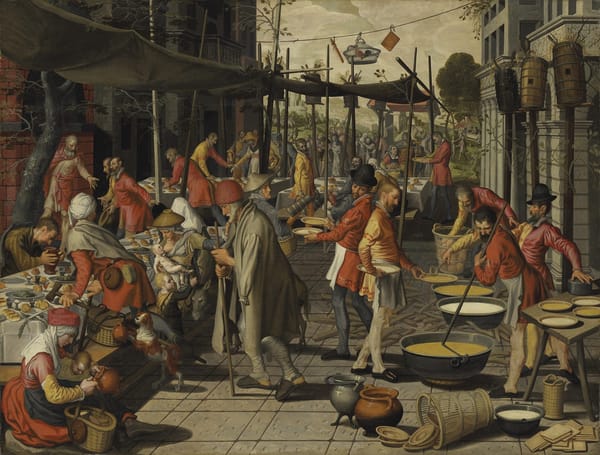
The divine Leader of God’s people is their salvation in all their distress. Did we not last Sunday see Him prove Himself such, and in a very telling way, by curing both body and soul of the poor paralytic, who was a figure of the whole human race? Let us hear His voice, in the Introit, with love and gratitude; let us promise Him the fidelity He asks of us; His Law, if we will but observe it, will preserve us from a relapse.
The anthem which follows is made up of several passages of holy Writ, without being exactly that of any one of them. The verse is taken from Psalm lxxvii.
Introit
Free both in mind and body by the omnipotent word of the Son of Man, the human race can devote itself, with all activity, to the service of God. Let us obtain from His divine Majesty, by uniting our prayer with that of the Church in her Collect, that the fatal paralysis, which was once so cruel a tyrant over our souls and faculties, may never return.
Collect
The other Collecte, as on page 120.
Epistle
Cap. iv.Fratres, Renovamini spiritu mentis vestræ, et induite novum hominem, qui secundum Deum creatus est in justitia, et sanctitate veritatis. Propter quod deponentep mendacium, loquimini veritatem unusquisque cum proximo suo : quoniam sumus invicem membra. Irascimini, et nolite peccare : sol non occidat super iracundiam vestram. Nolite locum dare diabolo : qui furabatur, jam non furetur : magis autem laboret, operando manibus suis, quod bonum est, ut habeat unde tribuat necessitatem patienti.
Ch. iv.Brethren : be renewed in the spirit of your mind; and put on the new man, who, according to God, is created in justice, and holiness of truth. Wherefore, putting away lying, speak ye the truth every man with his neighbour: for we are members one of another. Be angry and sin not. Let not the sun go down upon your anger. Give not place to the devil. He that stole, let him now steal no more; but rather let him labour, working with his hands the thing which is good, that he may have something to give to him that suffereth need.
The Epistle to the Ephesians, which was interrupted last Sunday in the manner we then described, is continued to-day by the Church. The apostle has already laid down the dogmatical principles of true holiness; he now deduces the moral consequences of those principles.
Let us call to mind how the holiness, which is in God, is His very truth—truth living and harmonious, which is no other than the admirable concert of the Three divine Persons, united in love. We have seen that holiness, as far as it exists in us men, is also union, by infinite love, with the eternal and living Truth. The Word took a Body unto Himself in order to manifest in the Flesh this sanctifying and perfect truth,1 of which He is the substantial expression;2 His Humanity, sanctified directly by the plenitude of the divine life and truth, which dwell within Him,3 became the model, as well as the means, the way, of all holiness to every creature.4 It was not sin alone, but it was, moreover, the finite nature of man that kept him at a distance from the divine life;5 but he finds in Christ Jesus, just as in God, the two elements of that life: truth and love. In Jesus, as the complement of His Incarnation, Wisdom aspires at uniting with herself all the members, also, of that human race, of which He is the Head,6 and the First-born;7 by Him the Holy Ghost, whose sacred fount He is,8 pours Himself out upon man, whereby to adapt him to his sublime vocation, and to consummate, in infinite love (which is Himself), that union of every creature with the divine Word. Thus it is that we verily partake of that life of God, whose existence and holiness are the knowledge and love of His own Word; thus it is that we are sanctified in truth9 by the participation of that very holiness wherewith God is holy by nature.
The Son of Man, being God, participates for us His brethren in the life of union in the truth which constitutes the holiness of the blessed Trinity. But He communicates that life, that truth, that deifying union, to none save those who have truly become His members, and who, in Him, reproduce between one another, by the operation of the Spirit of truth10 and love, that unity of which that sanctifying Spirit is the almighty bond in the Godhead.
‘May they all be one, as Thou, Father, in Me, and I in Thee,' said Jesus to His eternal Father, ‘that they also may be one in us. I have given unto them the glory (that is to say, the holiness) which Thou hast given unto Me, that they may be one, as we also are one; I in them, and Thou in Me, that they may be consummated (that is, be made perfect) in unity.'11 Here we have, and formulated by our Lord Himself, the simple but fruitful axiom, the foundation of Christian dogma and morals. By that sublime prayer, He explained what He had previously been saying: 'I sanctify Myself for them, that they, also, may be sanctified in truth.'12
Let us now understand the moral doctrine given us by St. Paul in our to-day's Epistle. What does he mean by that justice, and that holiness of truth, which is that of Christ,13 of the new man, whom everyone must put on, that aspires to the possession of the riches spoken of in the passages already read to us from this magnificent Epistle? Let us re-read the Epistle for the seventeenth Sunday, and we shall find that all the rules of Christian asceticism, as well as of the mystic life, are to St. Paul’s mind summed up in those words: Be careful to keep unity!14 It is the principle he lays down for all, both beginners and the perfect. It is the crowning of the sublimest vocations in the order of grace, as well as the foundation and reason of all God's commandments; so truly so, indeed, that, if we are commanded to abstain from lying, and to speak the truth to them that live with us, the motive is that we are members one of another.
There is a holy anger, of which the Psalmist speaks,15 and which is the outcome, on certain occasions, of zeal for the divine law and charity; but the movement of irritation excited in the soul must, even then, be speedily calmed down; to foster it would be to give place to the devil, to give him an opportunity of weakening, or even destroying, within us, by bitterness and hatred, the structure of holy unity.16
Before our conversion our neighbour, as well as God, was grieved by our sins; we cared little or nothing for injustice, provided it was not noticed; egotism was our law, and it was proof enough of the reign of satan over our souls. Now that the Spirit of holiness has expelled the unworthy usurper, the strongest evidence of His being our rightful master is that not only the rights of others are sacred in our estimation, but our toil and our labours are all undergone for the purpose of being serviceable to our neighbour. In a word, as the apostle continues a little farther on, we walk in love, because, as most dear children, we are followers of God.17
It is by this means alone, says St. Basil, that the Church manifests the many and great benefits bestowed on the world by the Incarnation. The Christian family, which, heretofore, was split up into a thousand separate fragments, is now made one, one in itself, and one in God; it is the repetition of what our Lord did, by assuming Flesh and making it one with Himself.18
Our Jesus has restored to our hands, which once were paralyzed for every supernatural work, the full freedom of their movements; let us, then, raise them up spiritually in prayer, giving glory to God by this our homage, which He graciously accepts as a fragrant sacrifice. The Church gives us this teaching in the Gradual, and by her own example as well.
Gradual
Gospel
Cap. xxii.In illo tempore; Loquebatur Jesus principibus sacerdotum, et pharisæis in parabolis, dicens : Simile factum est regnum cœlorum homini regi, qui fecit nuptias fìlio suo. Et misit servos suos vocare invitatos ad nuptias, et nolebant venire. Iterum misit alios servos, dicens : Dicite invitatis : Ecce prandium meum paravi; tauri mei, et altilia occisa sunt, et omnia parata; venite ad nuptias. Illi autem neglexerunt, et abierunt, alius in villam suam, alius vero ad negotiationem suam : reliqui vero tenuerunt servos ejus, et contumeliis affectos occiderunt. Rex autem cum audisset, iratus est : et missis exercitibus suis, perdidithomicidas illos, et civitatem illorum succendit. Tunc ait servis suis : Nuptiæ quidem paratæ sunt, sed qui invitati erant, non fuerunt digni. Ite ergo ad exitus viarum, et quoscumque inveneritis, vocate ad nuptias. Et egressi servi ejus in vias, congregaverunt omnes, quos invenerunt, malos et bonos : et impletæ sunt nuptiæ discumbentium. Intravit autem rex ut videret discumbentes, et vidit ibi hominem non vestitum veste nuptiali. Et ait illi: Amice, quomodo huc filtrasti, non habens vestem nuptialem? At ille obmutuit. Tunc dixit rex ministris : Ligatis manibuset pedibus ejus, mittite eum in tenebras exteriores : ibi erit fletus et stridor dentium. Multi enim sunt vocati, pauci vero electi.
Ch. xxii.At that time : Jesus spoke to the chief priests and the pharisees in parables, saying: The kingdom of heaven is likened to a king, who made a marriage for his son. And he sent his servants, to call them that were invited to the marriage: and they would not come. Again he sent other servants, saying: Tell them that were invited: Behold, I have prepared my dinner : my beeves and fatlings are killed, and all things are ready: come ye to the marriage. But they neglected, and went their ways, one to his farm, and another to his merchandise. And the rest laid hands on his servants, and having treated them contumeliously, put them to death. But when the king had heard of it, he was angry, and sending his armies, he destroyed those murderers, and burnt their city. Then he saith to his servants : The marriage indeed is ready : but they that were invited were not worthy. Go ye therefore into the highways; and as many as ye shall find, call to the marriage. And his servants going forth into the ways, gathered together all that they found, both bad and good : and the marriage was filled with guests. And the king went in to see the guests: and he saw there a man who had not on a wedding garment. And he saith to him: Friend, how eamest thou in hither not having on a wedding garment? But he was silent. Then the king said to the waiters : Bind his hands and his feet, and cast him into the exterior darkness; there shall be weeping and gnashing of teeth. For many are called, but few are chosen.
This Gospel has given to the present Sunday the name of the Sunday of the invited to the marriage. And yet, from the very opening of the dominical series, which began with the Descent of the Holy Ghost, the Church gave us the Gospel teaching which she offers to us, now a second time, for our consideration. On the second Sunday after Pentecost, she related to us, from St. Luke,19 the parable of the great supper, to which many were invited, and which St. Matthew, entering into fuller details, calls a marriage-feast.
Set thus before us, both at the beginning and at the close of the liturgical season over which the holy Spirit reigns supreme, this parable is, as it were, the interpreter of the whole portion of the year which it thus hems in : it is an additional revelation of the true aim of the Church. But how much has the light increased, since the first time we had these mystery-telling allegories! The certain man (homo quidam), who made a great supper, and invited many, has become the King, who makes a marriage for His Son, and, in this marriage, gives us an image of the kingdom of heaven. The world’s history, too, has been developing, as we gather from the terms respectively used by the two Evangelists. Those who were the first invited, and contented themselves with declining the kindness of the Master of the house, have grown in their impious ingratitude; laying hands on the messengers sent them by the loving kindness20 of the King, they treat them with contumely, and put them to death! We have seen the merited punishment inflicted on these deicides, by this Man, who was God Himself, the Father of Israel, now become King of the Gentiles : we have seen how He sent his armies to destroy them, and burn their city.21 And now at last, in spite of the refusal of the invited of Juda, in spite of the treacherous opposition put by them against the celebration of the nuptials of the Son of God, all things are ready for the marriage, and the banquet-hall is filled with guests.
Our heavenly King has confided, to the ministers of His love, the work of calling from every people the new guests. But now that His ambassadors, according to His command, have traversed the whole earth,22 bringing together all nations for this day of the joy of His heart,23 He Himself is coming in person, to see that nothing is wanting to the due preparation for the feast, and to give the signal for the eternal banquet of the divine nuptials. Now, for such a feast, and in such a place, if there be any deficiency, it can only be on the part of the guests. Let them, then, be careful not to draw down upon themselves, in this general and last examination, the displeasure of the great King, who has called them to an alliance with Himself. Though He has condescended to call them, notwithstanding their extreme poverty, from the public streets and highways, He has given them abundant time to lay aside their tatters; and knowing that they could not get ready of themselves, He has placed at their disposal, for the marriage-feast, the richest garments of His grace and virtues. Woe, then, to him who on the last day shall be found not having the wedding garment of charity! Such a want would admit of no excuse; and the King would justly punish it, by excluding the guilty man from the feast, as one that had insulted His Son.
Everything we have had on the preceding Sundays, has shown us how solicitous the Church ever is in preparing mankind for that wonderful marriage whose realization is the one object aimed at by the divine Word, in coming upon our earth. During her long exile, the bride of the Son of God has been a living model to her children; and, by her instructions, she has been unceasingly preparing them for the understanding of the great mystery of divine union. Three weeks ago,24 treating more directly than she had hitherto done on the great subject of her ambition as mother and bride, she reminded them of the great call. On the following Sunday, she gave them another lesson : she revealed to them the Bridegroom of the nuptials, to which they were invited, as the Man-God, the object of the twofold precept of love which embodies the whole Law. To-day, we have the teaching in all its perfection. It is condensed in the night Office, where we have St. Gregory explaining her whole teaching. The great doctor and the great Pope thus, in the name of the Church, explains our Gospel:
'The kingdom of heaven is the assembly of the just; for, the Lord says by a prophet: “Heaven is My throne";25 and Solomon says : “The soul of the just man is the throne of wisdom ”;26 and Paul calls Christ the Wisdom of God.27 If, therefore, heaven be the throne of God, we must evidently conclude that, as Wisdom is God, and the soul of the just man is the throne of Wisdom, this soul is a heaven . . . . The kingdom of heaven, then, is the assembly of the just . . . . If this kingdom is said to be like to a King, who made a marriage for his Son, your charity at once understands who is this King, who is the Father of a Son, King like Himself. It is He, of whom the psalmist says: “Give to the King Thy judgment, O God, and to the King’s Son Thy justice!”28 God the Father made the marriage of God His Son, when He wished that He, who had been God before all ages, should become Man towards the end of ages. But we must not, on that account, suppose that there are two persons in Jesus Christ, our God and our Saviour . . . . It is, perhaps, clearer and safer to say, that the King made a marriage for His Son, in that, by the mystery of the Incarnation, He united the Church to Him. The womb of the Virgin-Mother was the nuptial-chamber of that Bridegroom, of whom the psalmist says:29 He hath set His tabernacle in the sun : and He, as a Bridegroom, cometh out of His bride-chamber!'30
Notwithstanding her dignity of beloved bride of the Son of God, the Church is, none the less, subject to tribulations here below. The enemies of the Spouse, having ho longer any direct power to injure our Lord, turn all their rage against her. In these trials, endured as they are by the Church with love, Jesus sees a fresh trait of that resemblance which He wishes her to have to Himself; He, therefore, leaves her to suffer in this world, contenting Himself with ever upholding and saving her, as the Offertory says, in the midst of the evils which go on thickening around her.
Offertory
The august sacrifice, which is about to be offered, always obtains its effect, as far as the glory of the divine Majesty is concerned; but its virtue is applied to man in a greater or less degree, according to the dispositions of the creature, and depending on the divine mercy. Let us, in the Secret, beseech our heavenly Father, that we may experience abundantly the effects of the divine mysteries, which are so soon to be produced on our altar.
Secret
The other Secrets, as on page 130.
The Man-God, by His divine contact in the sacred banquet, has spiritually given vigour to our members; let us recall to mind that we must, henceforward, consecrate them to His service, and that our feet, now made sure, must run in the way of the divine commandments.
Communion
The Postcommunion, again, seems to be an allusion to the Gospel of the paralytic, which used formerly to be read on this Sunday. In it, we implore the assistance of the heavenly Physician, who sets man free from the palsy, which held him a prisoner; He also gives him the strength needed for fulfilling the law of God bravely and perseveringly.
Postcommunion
The other Postcommunions, as on page 181.
Vespers
The psalms, capitulum, hymn, and versicle, as above, pages 71-81.
Antiphon of the Magnificat
Oremus.
- St. John i. 14. ↩︎
- Heb. i. 3 ↩︎
- Col. ii. 3, 9, ↩︎
- St. John xiv. 6. ↩︎
- Eph. iv. 18. ↩︎
- Ibid. i. 10. ↩︎
- Col. i. 15-20. ↩︎
- Cf. St. John iv. 14; vii, 37, 39. ↩︎
- Ibid. xvii. 17. ↩︎
- Cf. St. John xv. 26. ↩︎
- Ibid. xvii. 21-23. ↩︎
- Ibid. 19. ↩︎
- Rom. xiii. 14. ↩︎
- Eph. iv. 3. ↩︎
- Ps. iv. 5. ↩︎
- S. Chrys., in ep. ad Eph. Hom., xiv. ↩︎
- Eph. v. 1, 2. ↩︎
- S. Basil, Const, mon., xviii ↩︎
- St. Luke xiv. 16-24. ↩︎
- See Time after Pentecost, vol. i., p. 358. ↩︎
- See Ninth Sunday after Pentecost. ↩︎
- Ps. xviii. 5. ↩︎
- Cant. iii. 11. ↩︎
- The Sixteenth Sunday after Pentecost. ↩︎
- Isa. lxvi. 1. ↩︎
- Wisd. vii. 27. ↩︎
- 1 Cor. i. 24. ↩︎
- Ps. lxxi. 2. ↩︎
- Ps. xviii. 6. ↩︎
- S. Greg., Hom, xxxviii. in Ev. ↩︎
| Previous September 28: St. Wenceslas, Duke and Martyr | Next The Nineteenth Sunday after Pentecost |