Daily reading
After Pentecost
Double of the II Class · Movable from Advent · Sanctoral
October 6, 2024
From Dom Guéranger’s The Liturgical Year.
A Double of the II Class leads the minor Sunday, which is commemorated.Rubrics

|
First Sunday of October: Feast of the Most Holy Rosary
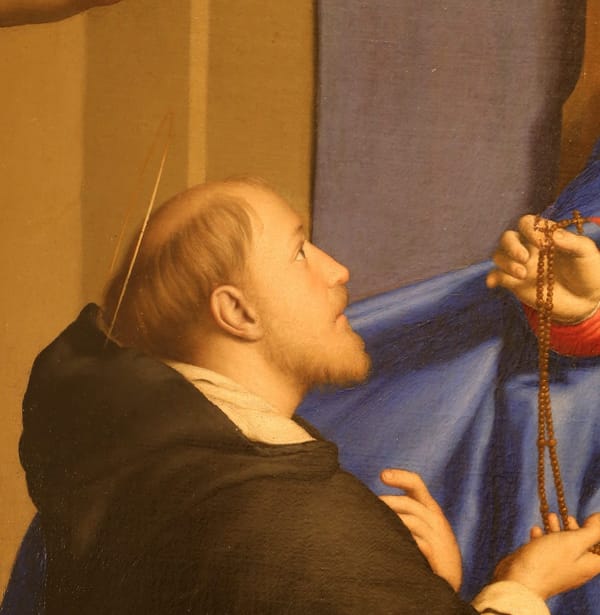
It is customary with men of the world to balance their accounts at the end of the year, and ascertain their profits. The Church is now preparing to do the same. We shall soon see her solemnly numbering her elect, taking an inventory of her holy relics, visiting the tombs of those who sleep in the Lord, and counting the sanctuaries, both new and old, that have been consecrated to her divine Spouse. But to-day’s reckoning is a more solemn one, the profits more considerable: she opens her balance-sheet with the gain accruing to our Lady from the mysteries which compose the cycle. Christmas, the cross, the triumph of Jesus, these produce the holiness of us all; but before and above all, the holiness of Mary. The diadem which the Church thus offers first to the august Sovereign of the world, is rightly composed of the triple crown of these sanctifying mysteries, the causes of her joy, of her sorrow, and of her glory. The joyful mysteries recall the Annunciation, the Visitation, the Birth of Jesus, Mary’s Purification, and the Finding of our Lord in the temple. The sorrowful mysteries bring before us the Agony of our blessed Lord, His being scourged, and crowned with thorns, the carrying of the cross, and the Crucifixion. While, in the glorious mysteries, we contemplate the Resurrection and Ascension of our Saviour, Pentecost, and the Assumption and Coronation of the Mother of God. Such is Mary’s rosary; a new and fruitful vine, which began to blossom at Gabriel’s salutation, and whose fragrant garlands form a link between earth and heaven.
In its present form, the rosary was made known to the world by St. Dominic at the time of the struggles with the Albigensians, that social war of such ill-omen for the Church. The rosary was then of more avail than armed forces against the power of satan; it is now the Church’s last resource. It would seem that, the ancient forms of social prayer being no longer relished by the people, the holy Spirit has willed by this easy and ready summary of the liturgy to maintain, in the isolated devotion of these unhappy times, the essential of that life of prayer, faith, and Christian virtue, which the public celebration of the Divine Office formerly kept up among the nations. Before the thirteenth century, popular piety was already familiar with what was called the psalter of the laity, that is, the angelical salutation repeated one hundred and fifty times; it was the distribution of these Hail Marys into decades, each devoted to the consideration of a particular mystery, that constituted the rosary. Such was the divine expedient, simple as the eternal Wisdom that conceived it, and far-reaching in its effects; for while it led wandering man to the Queen of Mercy, it obviated ignorance which is the food of heresy, and taught him to find once more ‘the paths consecrated by the Blood of the Man-God, and by the tears of His Mother.’1
Thus speaks the great Pontiff who, in the universal sorrow of these days, has again pointed out the means of salvation more than once experienced by our fathers. Leo XIII, in his encyclicals, has consecrated the present month to this devotion so dear to heaven; he has honoured our Lady in her litanies with a new title, Queen of the most holy rosary;2 and he has given the final development to the solemnity of this day, by raising it to the rank of a second class feast, and by enriching it with a proper Office explaining its permanent object.3 Besides all this, the feast is a memorial of glorious victories, which do honour to the Christian name.
Soliman II, the greatest of the Sultans, taking advantage of the confusion caused in the west by Luther, had filled the sixteenth century with terror by his exploits. He left to his son, Selim II, the prospect of being able at length to carry out the ambition of his race: to subjugate Rome and Vienna, the Pope and the emperor, to the power of the crescent. The Turkish fleet had already mastered the greater part of the Mediterranean, and was threatening Italy, when, on October 7, 1571, it came into action, in the Gulf of Lepanto, with the pontifical galleys supported by the fleets of Spain and Venice. It was Sunday; throughout the world the confraternities of the rosary were engaged in their work of intercession. Supernaturally enlightened, St. Pius V watched from the Vatican the battle undertaken by the leader he had chosen, Don John of Austria, against the three hundred vessels of Islam. The illustrious Pontiff, whose life’s work was now completed, did not survive to celebrate the anniversary of the triumph; but he perpetuated the memory of it by an annual commemoration of our Lady of Victory. His successor, Gregory XIII, altered this title to our Lady of the rosary, and appointed the first Sunday of October for the new feast, authorizing its celebration in those churches which possessed an altar under that invocation.
A century and a half later, this limited concession was made general. As Innocent XI, in memory of the deliverance of Vienna by Sobieski, had extended the feast of the most holy name of Mary to the whole Church; so, in 1716, Clement XI inscribed the feast of the rosary on the universal calendar, in gratitude for the victory gained by Prince Eugene at Peterwardein, on August 5, under the auspices of our Lady of the snow. This victory was followed by the raising of the siege of Corfu, and completed a year later by the taking of Belgrade.
Mass
The joys experienced on the other feasts of the Mother of God, are all gathered up and resumed in this one, for us, for the angels, and for our Lady herself. Like the angels, then, let us offer, together with Mary, the homage of our just delight to the Son of God, her Son, her King and ours.
Introit
The mysteries of the Son and of the Mother are our instruction and our hope. The Church prays in the Collect that they may also be our rule of life and our pledge of eternal happiness.
Collect
Then is made a commemoration of the occurring Sunday.
Epistle
Prov. cap. viii.Dominus possedit me in initio viarum suarum antequam quidquam faceret a principio. Ab æterno ordinata sum, et ex antiquis, antequam terra fieret, Nondum erant abyssi, et ego jam concepta eram. Nunc ergo, filii, audite me: Beati qui cnstodiunt vias meas. Audite disciplinam, et estote sapientes, et nolite abjicere eam. Beatus homo qui audit me, et qui vigilat ad fores meas quotidie, et observat ad postes ostii mei. Qui me invenerit, inveniet vitam, et hauriet salutem a Domino.
Prov. ch. viii.The Lord possessed me in the beginning of his ways, before he made anything from the beginning. I was set up from eternity, and of old before the earth was made. The depths were not as yet, and I was already conceived. Now therefore, ye children, hear me: Blessed are they that keep my ways. Hear instruction and be wise, and refuse it not. Blessed is the man that heareth mo, and that watcheth daily at my gates, and waiteth at the posts of my doors. He that shall find me, shall find life, and shall have salvation from the Lord.
Our Lady’s mysteries are before all time in God’s sight, like those of her divine Son; like these they will endure for all eternity; like them they rule the ages, which circle round the Word and Mary, preparing for both in the days of figures, perpetuating their presence by the incessant glorification of the most holy Trinity, in whose name all Christians are baptized. Now the rosary honours all this series of mysteries; to-day’s feast is a glance back upon the cycle as it draws to its close. From these mysteries, from this view of them, we must draw the conclusion formulated by our Lady herself in this passage from Proverbs, which the Church applies to her: ‘Now therefore, my children, consider my ways; imitate me, that you may find happiness.’ Blessed is he that watcheth at her gate! Let us pray to her, rosary in hand, considering her at the same time, meditating on her life and her greatness, and watching, were it but for a quarter of an hour, at the entrance to the palace of this incomparable Queen. The more faithful we are, the more assured will be our salvation and our progress in true life.
In the Gradual, let us congratulate the Queen of the holy rosary on her perfect life, all truth, and justice, and meekness, which won her the love of the supreme King. In the Alleluia verse, let us proclaim the nobility of her race, unequalled in the whole world.
Gradual
The Gospel is the same as on the feast of the most holy name of Mary (page 176). ‘At that time, the angel Gabriel was sent from God, into a city of Galilee, called Nazareth, to a Virgin espoused to a man whose name was Joseph, of the house of David; and the Virgin’s name was Mary. And the angel being come in, said to her: Hail, full of grace! the Lord is with thee; blessed art thou among women? Blessed art thou among women, repeated Elizabeth a few days later, and blessed is the fruit of thy womb. These two salutations, with the name of Mary added to the angel’s greeting and the name of Jesus to Elizabeth’s, constituted the Ave Maria in the time of St. Dominic, the promulgator of the rosary. The prayer, 'Holy Mary Mother of God’ which now so beautifully completes the formula of praise, received the sanction of the Church in the sixteenth century. No better Gospel could, then, have been chosen for to-day, for it gives the original text of the rosary, and describes the first of its mysteries.
All grace, all light, all life, are to be found in our Lady; by her holy rosary she, as we sing in the Offertory, has multiplied flowers and fruits in the garden of the Church. Every offering acceptable to God, comes from Mary, with and by Jesus.
Offertory
As the Secret tells us, the rosary, piously meditated, prepares us for the Sacrifice of the altar, that supereminent and august memorial of the mysteries which it imprints in the heart and mind of the Christian.
Secret
Then a commemoration of the Sunday.
The Preface as on September 8, substituting ‘in solemnitate, on the solemnity,’ for ‘in Nativitate, on the Nativity,’ of the blessed Virgin Mary.
After the sacred banquet, our soul must not remain barren. The fragrance of virtue’s flowers must embalm all that surrounds us, and prove to the Spouse that His visit has not been made in vain.
Communion
In the Postcommunion, the Church prays that our Lady may, by her intercession, second the effects of this Sacrifice, and-of the mysteries in which she played so great a part.
Postcommunion
Then is added the Postcommunion of the Sunday, and the Gospel of the same is read at the end of the Mass.
Vespers
A few days ago, the Church borrowed from the Servites of Mary her Office of the Seven Dolours; to-day she seeks her responsories, hymns, and antiphons from the noble family which claims the rosary as its birthright. The Christian world owes a new debt of gratitude to the sons of St. Dominic for enriching it with these beautiful liturgical formulæ. But as the Use of the Friars Preachers gives but one antiphon for the psalms in the Vespers of the saints, the following antiphons have been added for the Roman rite. The hymn, which so gracefully and yet concisely resumes the triple series of the mysteries, is the fourth of the entire Office: the first celebrates, at first Vespers, the joyful mysteries; the second, at Matins, the sorrowful; the third, at Lauds, the glorious. 'From these mysteries let us gather roses, and weave garlands for the Mother of fair love.’
Ps. Dixit Dominus, page 38.
Ps. Laudate pueri, page 41.
Ps.Lætatus sum, page 152.
Ps. Nisi Dominus, page 153.
Ps. Lauda Jerusalem, page 154.
Capitultum
Eccli. xxiv. xxxix.
Hymn
Te sauciam doloribus,
Te jugi amictam gloria,
O Virgo Mater pangimus.
Dum concipis, dum visitas,
Et edis, offers, invenis,
Mater beata, Filium.
In corde agonem, verbera,
Spinas, crucemque Filii
Perpessa, princeps martyrum.
In ignibus Paracliti,
In regni honore et lumine,
Regina fulgens gloria.
Ex his rosas mysteriis,
Et pulchri amoris inclytæ
Matri coronas nectite.
Qui natus es de Virgine,
Cum Patre et almo Spiritu,
In sempiterna sæcula.
thee wounded with the sword of sorrow,
thee girt with everlasting glory,
we sing, O Virgin Mother.
when thou conceivest; when thou visitest thy cousin;
when thou bringest forth thy Son, offerest him to God,
findest him in the temple, O happy Mother!
in thy inmost heart the agony, the scourging,
the thorns, and the cross of thy Son,
O first of martyrs!
in the triumphs of thy Son,
in the fires of the Paraclete,
in the honour and splendour of thy queenliness.
gather roses from these mysteries,
and wreathe therewith garlands
for the Mother of fair love.
born of the Virgin;
together with the Father and the holy Spirit,
through everlasting ages.
Antiphon of the Magnificat
The Prayer as on page 299.
Then is made a commemoration of the Sunday.
The Twentieth Sunday after Pentecost
|
The Gospel of last Sunday spoke to us of the nuptials of the Son of God with the human race. The realization of those sacred nuptials is the object which God had in view in the creation of the visible world; it is the only one He intends in His government of society. This being the case, we cannot be surprised, that the parable of the Gospel, whilst revealing to us this divine plan, has also brought before us the great fact of the rejection of the Jews, and the vocation of the Gentiles, which is not only the most important fact of the world’s history, but is also intimately connected with the consummation of the mystery of the divine union.
And yet, as we have already said,1 the exclusion of Juda is one day to cease. His obstinate refusal of the grace has caused it to be brought to us Gentiles by the messengers of God’s loving mercy. But, now that the fullness of the Gentiles2 has heard and followed the heavenly invitation, the time is advancing when the accession of Israel will complete the Church in her members, and give the bride the signal of the final call, which will put an end to the long labour of ages,3 by the appearance of the Bridegroom.4 The holy jealousy, which the apostle was so desirous to rouse in the people of his race by turning towards the Gentiles,5 will, at last, make itself felt by the descendants of Jacob. What joy will there be in heaven, when they, repentant and humble, shall unite before God in the song of gladness sung by the Gentiles, in celebration of the entrance of His countless Jewish people into the house of the divine banquet! That union of the two peoples will truly be a prelude to the great day mentioned by St. Paul, when, speaking in his patriotic enthusiasm of the Jews, he said : ‘If their offence (i.e., their fall) hath been the riches of the world, and their diminution be the riches of the Gentiles, how much more the fullness of them!’6 Now, the Mass of this twentieth Sunday after Pentecost gives us a foretaste of that happy day, when the new people will not be alone in singing hymns of praise for the divine favours bestowed on our earth. The ancient liturgists tell us that our Mass consists partly of the words of the prophets, giving to Jacob an expression of his repentance, whereby he is to merit a return of God’s favours, and partly of inspired formulas, wherein the Gentiles, who are already within the hall of the marriage-feast, are singing their canticles of love.7 The Gentile-choir takes the Gradual and Communion-anthem; the choir of the Jews, the Introit and Offertory.
The Introit is from the book of Daniel.8 Exiled to Babylon with his people, the prophet—in that captivity whose years of bitterness were a figure of the still longer and intenser sufferings of the present dispersion—laments with Juda in that strange land, and, at the same time, instructs his people how they may be readmitted into God’s favour. It is a secret which Israel had lost ever since his commission of the crime on Calvary; though, in the previous ages of his history, he knew the happy secret, and had continually experienced its efficacy. What it was, it still is and ever will be : it consists in the humble avowal of the sinner’s falls, in the suppliant regret of the culprit, and in the sure confidence that God’s mercy is infinitely above the sins of men, how grievous soever those may have been.
Introit
The divine forgiveness, which restores the soul to purity and peace, is the indispensable preparation for the sacred marriage-feast; for the wedding garment of its guests must, under pain of exclusion, be without a stain; their heart, too, must be without bitterness, lest it should cause the Bridegroom to be offended. Let us implore this precious pardon. Our Lord is all the more ready to grant it us, when we ask it through His beloved bride, the Church, our mother. Let us unite our voices with hers, and say her Collect.
Collect
Epistle
Cap. v.Fratres, Videte quomodo caute ambuletis : non quasi insipientes, sed ut sapientes : redimentes tempus, quoniam dies mali sunt. Propterea nolite fieri imprudentes, sed intelligentes quæ sit voluntas Dei. Et nolite inebrian vino, in quo est luxuria, sed implemini Spiritu sancto, loquentes vobismetipsis in psalmis, et hymnis, et canticis spiritualibus, cantantes, et psallentes in cordibus vestris Domino, gratias agentes semper pro omnibus, in nomine Domini nostri Jesu Christi Deo et Patri. Subjecti invicem in timore Christi.
Ch. v.Brethren: See, therefore, how you walk circumspectly, not as unwise, but as wise : redeeming the time, because the days are evil. Wherefore become not unwise, but understanding what is the will of God. And be not drunk with wine, wherein is luxury, but be ye filled with the holy Spirit, speaking to yourselves in psalms and hymns, and spiritual canticles, singing and making melody in your hearts to the Lord : giving thanks always for all things in the name of our Lord Jesus Christ to God and the Father. Being subject one to another in the fear of Christ.
The other Collects, as on page 120.
As the nuptials of the Son of God approach their final completion, there will be, also, on the side of hell, a redoubling of rage against the bride, with a determination to destroy her. The dragon of the Apocalypse,9 the old serpent who seduced Eve, will cast out water, as a river, from his mouth10—that is, he will urge on all the passions of man, that they may league together for her ruin. But, do what he will, he can never weaken the bond of the eternal alliance; and, having no power against the Church herself, he will turn his fury against the last children of the new Eve, who will have the perilous honour of those final battles, which are described by the prophet of Patmos.11
It is then, more than at all previous times, that the faithful will have to remember the injunction given to us by the apostle in to-day’s Epistle. They will have to comport themselves with that circumspection which he enjoins, taking every possible care to keep their understanding, no less than their heart, pure, in those evil days. Supernatural light will, in those days, not only have to withstand the attacks of the children of darkness, who will put forward their false doctrines; it will, moreover, be minimized and falsified by the very children of the light yielding on the question of principles; it will be endangered by the hesitations, and the human prudence, of those who are called far-seeing men. Many will practically ignore the master-truth, that the Church never can be overwhelmed by any created power. If they do remember that our Lord has promised to uphold His Church even to the end of the world,12 they will still believe that they do a great service to the good cause by making certain politically clever concessions, not weighed in the balance of the sanctuary. Those future worldly-wise people will forget that our Lord needs no shrewd schemes to help Him to keep His promise; they will entirely overlook this most elementary consideration, that the co-operation which Jesus deigns to accept at the hands of His servants in the defence of the rights of His Church, never could consist in the disguising of those grand truths which constitute the power and beauty of the bride. They will forget the apostle’s maxim, laid down in his Epistle to the Romans, that to conform oneself to this world, to attempt an impossible adaptation of the Gospel to a world that is unchristianized, is not the means for proving what is the good, and the acceptable, and the perfect will of God.13 So that it will be a thing of great and rare merit, in many an occurrence of those unhappy times, merely to understand what is the will of God, as our Epistle expresses it.
‘Look to yourselves,’ would St. John say to those men, 'that ye lose not the things which ye have wrought; make yourselves sure of the full reward,’ which is given only to the persevering thoroughness of doctrine and faith!14 Besides, it will be then, as in all other times, that, according to the saying of the Holy Ghost, the simplicity of the just shall guide them,15 and far more safely than any human ingenuity could do; humility will give them wisdom;16 and, keeping themselves closely united to this noble companion, they will be made truly wise by her, and will know what is acceptable to God.17 They will understand that, aspiring like the Church herself to union with the eternal Word, fidelity to the Spouse, for them as for the Church, is nothing else than fidelity to the truth; for the Word, who is the one same object of love to both of them, is, in God, no other than the splendour of infinite truth.18 Their one care, therefore, will ever be to approach nearer and nearer to their Beloved, by a continually increasing resemblance to Him— that is to say, by the completest reproduction, both in their words and works, of the beautiful truth. By so doing, they will be serving their fellowcreatures in the best possible way, for they will be putting in practice the counsel of Jesus, who bids them seek first the kingdom of God and His justice, and confide in Him for all the rest.19 Others may have recourse to human and accommodating combinations, fitted to please all parties; they may put forward dubious compromises, which (so their suggesters think) will keep back, for some weeks or some months perhaps, the fierce tide of revolution; but those who have God’s spirit in them will put a very different construction on the admonition given us by the apostle in to-day’s Epistle, where he tells us to redeem the time.
It was our Lord who bought time, and at a great price; and He bought it for us, that it might be employed by His faithful servants in procuring glory for God. By most men it is squandered away in sin or folly; but those who are united to Christ, as living members to the Spouse of their souls, will redeem it—that is, they will put such an intensity into their faith and their love that, as far as it is possible for human nature, not a moment of their time shall be anything but an earnest tribute of service to their Lord. To the insolent and blasphemous things which are then to be spoken by the beast,20 these determined servants of God will give, for their brave answer, the cry of St. Michael, which he uttered against satan, the helper of the beast :21 ‘Who is like unto God?’
These closing weeks of the year used, in olden times, to be called ‘Weeks of the holy Angel.'’ We have seen, on one of these Sundays,22 how the liturgy formerly announced the great Archangel’s coming to the aid of God’s people, according to the prophecy of Daniel.23 When, therefore, the final tribulations shall commence; when exile shall scatter the faithful, and the sword shall slay them,24 and the world shall approve all that, prostrate, as it then will be, before the beast and his image25— let us not forget that we have a leader chosen by God, and proclaimed by the Church; a leader who will marshal us during those final combats, in which the defeat of the saints26 will be more glorious than were the triumphs of the Church in the days when she ruled the world. For what God will then ask of His servants is not success of diplomatical arrangements, nor a victory won by arms, but fidelity to His truth—that is, to His Word; a fidelity all the more generous and perfect, as there will be an almost universal falling off around the little army fighting under the Archangel’s banner. Uttered by a single faithful heart, under such circumstances, and uttered with the bravery of faith and the ardour of love, the cry of St. Michael, which heretofore routed the infernal legions, will honour God more than the blasphemies uttered by the millions of degraded followers of the beast will insult Him.
Let us be thoroughly imbued with these thoughts which are suggested by the opening lines of our Epistle. Let us also master the other instructions it contains, and which, after all, differ but little from those we have been developing. As the Gospel of the nuptials of the Son of God and the invitation to His divine banquet was formerly read on this day, our holy mother the Church appropriately points out in the Epistle the immense difference there is between these sacred delights, and the joys of the world’s marriage-feasts. The calm, the purity, the peace of the just man, who is admitted into intimacy with God, are a continual feast to his soul;27 the food served up at that feast is Wisdom;28 Wisdom, too, is the beloved Guest, who is unfailingly there.29 The world is quite welcome to its silly, and often shameful, pleasures; the Word and the soul, which, in a mysterious way, He has filled with the holy Spirit,30 join together to sing to the eternal Father in admirable unison; they will go on for ever with their hymns of thanksgiving and praise, for the materials of both are infinite. The hideous sight of the earth’s inhabitants, who will then by thousands be paying homage to the harlot who sits on the beast, and offers them the golden cup of her abominations—no, not even that will interfere in the least with the bliss caused in heaven by the sight of those happy souls on earth. The convulsions of a world in its last agony, the triumphs of the woman drunk with the blood of the martyrs,31 far from breaking in on the harmony of a soul which is united with the Word, will but give greater fullness to the divine notes, and greater sweetness to the human music of her song. The apostle tells all this in his own magnificent way, where he says : ‘Who, then, shall separate us from the love of Christ? Shall tribulation? or distress? or famine? or nakedness? or danger? or persecution? or the sword? It is written : For thy sake we are put to death all the day long; we are accounted as sheep for the slaughter32—but in all these things we overcome, because of Him that hath loved us. For I am sure that neither death, nor life, nor angels, nor principalities, nor powers, nor things present, nor things to come, nor might, nor height, nor depth, nor any other creature, shall be able to separate us from the love of God, which is in Christ Jesus our Lord.33
In the Introit, the Jewish people sang its repentance and humble confidence; and now, in the Gradual, we have the Gentiles proclaiming, in music taught them by the Church, how, in the delights of the nuptial banquet, their hopes have been realized, yea, and surpassed.
Gradual
Gospel
Cap. iv.In illo tempore : Erat quidam regulus, cujus filius infirmabatur Capharnaum. Hic cum audisset, quia Jesus adveniret a Judæa in Galilæam, abiit ad eum: et rogabat eum ut descenderet, et sanaret filium ejus: incipiebat enim mori. Dixit ergo Jesus ad eum : Nisi signa, et prodigia videritis, non creditis. Dicit ad eum regulus: Domine, descende priusquam moriatur filius meus. Dicit ei Jesus: Vade; filius tuus vivit. Credidit homo sermoni, quem dixit ei Jesus, et ibat. Jam autem eo descendente, servi occurrerunt ei, et nuntiaverunt dicentes, quia filius ejus viveret. Interrogabat ergo horam ab eis, in qua melius habuerit. Et dixerunt ei: quia heri hora septima reliquit eum febris. Cognovit ergo pater, quia illa hora erat, in qua dixit ei Jesus: Filius tuus vivit: et credidit ipse, et domus ejus tota.
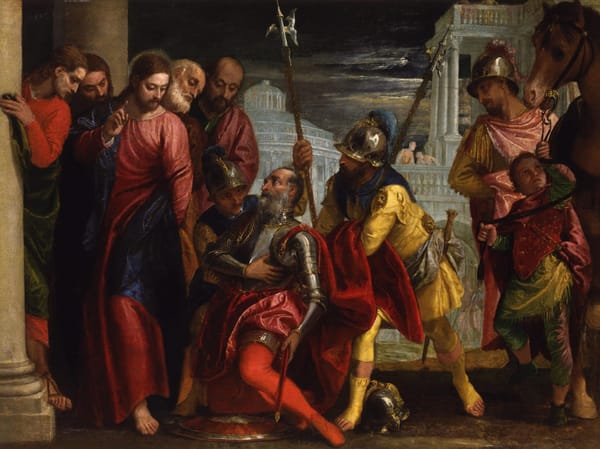
Ch. iv.At that time : There was a certain ruler whose son was sick at Capharnaum. He having heard that Jesus was come from Judea into Galilee, went to him, and prayed him to come down and heal his son, for he was at the point of death. Jesus therefore said to him: Unless you see signs and wonders you believe not. The ruler saith to him : Lord, come down before that my son die. Jesus saith to him: Go thy way, thy son liveth. The man believed the word which Jesus said to him, and went his way. And as he was going down, his servants met him: and they brought word, saying that his son lived. He asked therefore of them the hour wherein he grew better. And they said to him: Yesterday at the seventh hour the fever left him. The father therefore knew that it was at the same hour that Jesus said to him: Thy son liveth; and himself believed, and his whole house.
The Gospel for to-day is taken from St. John; it is the first and only time during the whole course of these Sundays after Pentecost. It gives the twentieth Sunday the name of ‘the Ruler of Capharnaum.’ The Church has selected this Gospel on account of its bearing a certain mysterious relation to the state of the world in those last days which the liturgy prophetically brings before us at the close of the year.
The world is drawing towards its end; like the ruler’s son, it begins to die. Tormented by the fever of the passions which have been excited in Capharnaum, the city of business and pleasure, it is too weak to go itself to the Physician who could cure it. It is for its father—for the pastors, who, by Baptism, gave it the life of grace, and who govern the Christian people as rulers of holy Church—to go to Jesus, and beseech Him to restore the sick man to health. St. John begins this account34 by mentioning the place where they were to find Jesus : it was at Cana, the city of the marriagefeast, where He first manifested His power35 in the banquet-hall; it is in heaven that the Man-God abides, now that He has quitted our earth, where He has left His disciples deprived of the Bridegroom,36 and having to pass a certain period of time in the field of penance. Capharnaum signifies the field of penance, and of consolation, which penance brings with it. Such was this earth intended to be, when man was driven from Eden; such was the consolation, to which, during this life, the sinner was to aspire; and, because of his having sought after other consolations, because of his having pretended to turn this field of penance into a new paradise, the world is now to be destroyed. Man has exchanged the life-giving delights of Eden for the pleasures which kill the soul, and ruin the body, and draw down the divine vengeance.
There is one remedy for all this, and only one: it is the zeal of the pastors, and the prayers of that portion of Christ’s flock which has withstood the torrent of universal corruption. But it is of the utmost importance that, on this point, the faithful and their pastors should lay aside all personal considerations, and thoroughly enter into the spirit which animates the Church herself. Though treated with the most revolting ingratitude, and injustice, and calumny, and treachery of every sort, this mother of mankind forgets all these her own wrongs, and thinks only of the true prosperity and salvation of the very countries which despise her.37 She is well aware that the time is at hand when God will make justice triumphant; and yet she goes on struggling, as Jacob did, with God,38 until the dawn of that terrible day, foretold by David and the sibyl.39 At the thought of the pool of fire,40 into which her rebellious children are to be plunged, she seems to have almost forgotten the approach of the eternal nuptials, and lost her vehement longings as a bride. One would say that she thinks of nothing but of her being a mother; and, as such, she keeps on praying as she has always prayed, only more fervently than ever, that the end may be deferred (pro mora finis).41
That we may fulfil her wishes, let us, as Tertullian says, ‘assemble together in one body, that we may, so to speak, offer armed force to God by our prayers. God loves such violence as that.'42 But that our prayer may have power of that kind, it must be inspired by a faith which is thorough, and proof against every difficulty. As it is our faith which overcometh the world,43 so it is, likewise, our faith which triumphs over God, even in cases which seem beyond all human hope. Let us do as our mother does, and think of the danger incurred by those countless men, who madly play on the brink of the precipice, into which, when they fall, they fall for ever. It is quite true they are inexcusable; it was only last Sunday that they were reminded of the weeping and gnashing of teeth, in the exterior darkness, which they will undergo that despise the call to the Kings marriage-feast.44 But they are our brethren, and we should not be quietly resigned to see them lose their souls. Let us hope against all hope. Did our Lord, who knew with certainty that obstinate sinners would be lost, hesitate, on that account, to shed all His Blood for them?
It is our ambition to unite ourselves to Him by the closest possible resemblance; let us, then, be resolved to imitate Him in that also, did occasion serve; at all events, let us pray without ceasing for the Church’s and our enemies, so long as we are not assured of their being lost. Such prayer is never useless, never thrown away; for, come what may, God is greatly honoured by our faith, and by the earnestness of our charity.
Only, let us be careful not to merit the reproach uttered by our Redeemer against the halting45 faith of the fellow-townsmen of the ruler of Capharnaum. We know that our Jesus has no need to come down from heaven to earth, in order to give efficiency to the commands of His gracious will. If He deign to multiply signs and wonders around us, we will rejoice at them, because of our brethren who are weak of faith; we will make them an occasion for exalting His holy name; but we will lovingly assure Him that our soul has no need of new proofs of His power, in order to believe in Him!
The Jewish people, whilst enduring its wellmerited captivity, and straying along the riverbanks of Babylon, has grown repentant, and, in our Offertory, joins our mother the Church, in singing the admirable hundred and thirty-sixth Psalm; there never was such a song of exile.
Offertory
The whole power of the God, who, with a word, cures both soul and body, resides in the mysteries which are about to be celebrated on our altar here. Let us, in the Secret, beseech Him, that their effects may tell on our hearts.
Secret
The other Secrets, as on page 130.
The word, spoken of in the Communion-anthem as having raised man up from the abyss of his misery, is that of the Gospel, which calls mankind, saying: Come to the marriage!46 But, although deified by his participation, here below, in the mystery of faith, man aspires to the perfect and eternal union, which is to be in the midday of glory.
Communion
A persevering fidelity in observing God’s commandments is the best preparation a Christian can make for approaching the holy Table, as the Postcommunion tells us.
Postcommunion
The other Postcommunions, as on page 181.
Vespers
The psalms, capitulum, hymn and versicle, as above, pages 71-81.
Antiphon of the Magnificat
- The Thirteenth Sunday after Pentecost. ↩︎
- Rom. xi. 25, 26. ↩︎
- Ibid. viii. 22. ↩︎
- Apoc. xxii. 17. ↩︎
- Rom. xi. 13, 14. ↩︎
- Ibid. 12. ↩︎
- Berno Aug., v.; Rup., De Div. Off., xii. 20; Durand., Ration., vi. 137. ↩︎
- Dan. iii. ↩︎
- Apoc. xii. 9. ↩︎
- Ibid. 15. ↩︎
- Ibid. 17 ↩︎
- St. Matt. xxviii. 20. ↩︎
- Rom. xii. 2. ↩︎
- 2 St. John 8, 9. ↩︎
- Prov. xi. 3. ↩︎
- Ibid. 2. ↩︎
- Wisd. ix. 10. ↩︎
- Ibid. vii. 25, 26. ↩︎
- St. Matt. vi. 33. ↩︎
- Apoc. xiii. 5, 6. ↩︎
- Ibid. 2. ↩︎
- The Seventeenth. ↩︎
- Dan. xii. 1. ↩︎
- Apoc. xiii. 7, 10. ↩︎
- Ibid. 3, 4, 8, 15. ↩︎
- Ibid. 7. ↩︎
- Prov. xv. 15. ↩︎
- Ecclus. xxiv. 29. ↩︎
- Wisd. viii. 16; Apoc. iii. 20. ↩︎
- Cant. i. 1. ↩︎
- Apoc. xvii. 1-6. ↩︎
- Ps. xliii. 22. ↩︎
- Rom. viii. 35-39. ↩︎
- St. John iv. 46. ↩︎
- Ibid. ii. 11. ↩︎
- St. Matt. ix. 15. ↩︎
- Allocutions of Leo XIII. ↩︎
- Gen. xxxii. 24-28. ↩︎
- The sequence Dies irœ. ↩︎
- Apoc. xxi. 8. ↩︎
- Tertull., Apol. xxxix. ↩︎
- Ibid. ↩︎
- 1 St. John v. 4. ↩︎
- St. Matt. xxii. 13. ↩︎
- Heb. xii. 13. ↩︎
- St. Matt. xxii. 4. ↩︎
October 6: St. Bruno, Confessor
Among the divers religious families, none is held in higher esteem by the Church than the Carthusian; the prescriptions of the corpus juris determine that a person may pass from any other Order into this, without deterioration.1 And yet it is of all the least given to active works. Is not this a new, and not the least convincing, proof that outward zeal, how praiseworthy soever, is not the only, or the principal thing in God’s sight? The Church, in her fidelity, values all things according to the preferences of her divine Spouse. Now, our Lord esteems His elect not so much by the activity of their works, as by the hidden perfection of their lives; that perfection which is measured by the intensity of the divine life, and of which it is said: ‘Be you therefore perfect, as also your heavenly Father is perfect.’2 Again it is said of this divine life: 'You are dead and your life is hid with Christ in God.'3 The Church, then, considering the solitude and silence of the Carthusian, his abstinence even unto death, his freedom to attend to God through complete disengagement from the senses and from the world—sees therein the guarantee of a perfection which may indeed be met with elsewhere, but here appears to be far more secure.4 Hence, though the field of labour is ever widening, though the necessity of warfare and struggle grows ever more urgent, she does not hesitate to shield with the protection of her her laws, and to encourage with the greatest favours, all who are called by grace to the life of the desert. The reason is not far to seek. In an age, when every effort to arrest the world in its Headlong downward career seems vain, has not man greater need than ever to fall back upon God? The enemy is aware of it; and therefore the first law he imposes upon his votaries is, to forbid all access to the way of the counsels, and to stifle all life of adoration, expiation, and prayer. For he well knows that, though a nation may appear to be on the verge of its doom, there is yet hope for it as long as the best of its sons are prostrate before the Majesty of God.
Look at the history of the west in the eleventh century. If there ever was a time when it seemed urgent that the cloister, far from increasing the number of its inmates, should send them forth to the last man, for the active service of the Church; it was surely the epoch when the flesh, victorious over the spirit, posted up its triumphs even in the sanctuary; when, for each other’s sake, Cæsar and satan held the pastors of the people in bondage. Nevertheless, at that very time, not only Cluny became the stronghold of Christianity, but Camaldoli, Vallombrosa, the charterhouse, and finally Citeaux, were founded and grew’ strong; so great was the demand even in the monastic life itself, for still closer retreat, by souls athirst for immolation and penance. And yet, so far from complaining of being abandoned, the world reckoned among its most glorious deliverers Romuald, John Gualbert, Bruno, and Robert of Molesmes. Moreover the century was great in the faith, and in that energy of faith which knew how to apply fire and steel to the festering wounds of humanity; great in the uprightness wherewith it recognized the necessity of expiation for such crying evils. Society, represented by its choicest members before the feet of God, received new life from Him.
This feast, then, is the world’s homage to one of its greatest benefactors. The legend of the breviary is short; but the reader may learn more about our saint by having recourse to his works; his letters, breathing the fragrance of solitude, and written in the beautiful style known to the monks of that heroic age, and his commentaries on St. Paul and on the psalms, which are clear and concise, revealing at once his science and his love of Jesus and of the Church.
According to the custom of the time, the breve depositionis announcing his death was sent round from church to church, and returned covered with testimonies of universal veneration. Nevertheless his disciples were more intent on imitating his holiness, than on having it recognized by the apostolic See. Four centuries after his death, Leo X without any process, on the simple evidence of the cause, authorized the Carthusians to pay public honour to their father. A hundred years later, in 1622, Gregory XV extended his feast to the entire world.
The following is the legend given in the holy liturgy.
Elapsis aliquot annis, cum sex aliis familiaribus mundo renuntians, sanctum Hugonem episcopum Gratianopolitanum adiit. Qui causa eorum adventus cognita, eosdemque intelligens esse, quos eadem nocte veluti septem stellas ad suos pedes corruentes in somnis viderat, montes sue diœcesis asperrimos quos Carthusianos appellant, illis concessit. Illuc Bruno cum sociis, ipso Hugone comitante, secedens, cum per aliquot annos eremiticam vitam egisset, ab Urbano Secundo, qui ejusdem Brunonis discipulus fuerat, Romam accersitur. Ejus consilio ac doctrina Pontifex, in tot illis Ecclesie calamitatibus, per aliquot annos usus est, donee Bruno, recusato Rhegiensi archiepiscopatu, discedendi facultatem obtinuit.
Bless, O Bruno, the grateful joy of God’s children. With their whole hearts they acquiesce in the judgment of their mother the Church, when, among the beautiful, rich fruit-trees in our Lord’s garden, she hides not her predilection for those whose silent shade attracts the preference of her divine Spouse. ‘Show me, O Thou whom my soul loveth, where Thou feedest, where Thou liest in the midday, lest I begin to wander after the flocks of Thy companions.’5 Thus speaks the bride in the sacred Canticle. And hearing the divine answer extolling the better part, thou minglest thy voice with the song of our Lord and the Church, saying: ‘O solitude and silence of the desert; hidden joy; good things unknown to the multitude, but known to the valiant! There are the young shoots of virtue carefully cultivated: there labour and rest are one and the same, and are nourished with fruits of paradise. There the eye acquires that look, which wounds the Bridegroom’s heart,6 and that purity, which beholds God.7 There is Rachel in all her beauty, more loved by Jacob than Lia, although less fruitful; and her sons, Joseph and Benjamin, are their father’s favourites.’8
Thy sons cherish, in their hereditary peace, this privilege of the perfect even in these days of feverish excitement. Simple as themselves is the history of their Order; full of the supernatural, yet seeming to eschew the marvellous aud the miraculous; while the heroism of all is so great, that very few stand out from the rest as remarkable for sanctity. Preserve this thine own spirit in thy children, O Bruno; and make us profit by their example. For their life silently preaches to the world the apostle’s doctrine: ‘Concerning spiritual things, ... I show unto you yet a more excellent way. If I speak with the tongues of men and of angels, and have not charity, ... if I should have prophecy, and know all mysteries and all knowledge, and if I should have all faith, so that I could remove mountains, . . . and if I should distribute all my goods to feed the poor, if I should deliver my body to be burned, and have not charity, it profiteth me nothing. Charity never falleth away: whether prophecies shall be made void, or tongues shall cease, or knowledge shall he destroyed. Do not become children in sense; but in malice be children, and in sense be perfect.’9
| Previous October 5: St. Placid and His Companions, Martyrs | Next The Twentieth Sunday after Pentecost |