Daily reading
After Pentecost
Semidouble · Temporal
November 17, 2024
From Dom Guéranger’s The Liturgical Year.

|
The Sixth Resumed Sunday after Epiphany
Introit
Collect
The other Collects, as on page 120.
Epistle
1 Cap. i.Fratres, Gratias agimus Deo semper pro omnibus vobis, memoriam vestri facientes in orationibus nostris sine intermissione, memores operis fidei vestra, et laboris et charitatis, et sustinentiæ spei Domini nostri Jesu Christi, ante Deum et Patrem nostrum : scientes, fratres, dilecti a Deo, electionem vestram : quia Evangelium nostrum non fuit ad vos in sermone tantum, sed et in virtute, et in Spiritu sancto, et in plenitudine multa, sicut scitis quales fuerimus in vobis propter vos. Et vos imitatores nostri facti estis, et Domini, excipientes verbum in tribulatione multa, cum gaudio Spiritus sancti : ita ut facti sitis forma omnibus credentibus in Macedonia, et in Achaia. A vobis enim diffamatus est sermo Domini, non solum in Macedonia, et in Achaia, sed et in omni loco fìdes vestra, quæ est ad Deum, profecta est, ita ut non sit nobis necesse quidquam loqui. Ipsi enim de nobis annuntiant qualem introitum habuerimus ad vos : et quomodo conversi estis ad Deum a simulacris, servire Deo vivo, et vero, et exspectare Filium ejus de cœlis (quem suscitavit ex mortuis) Jesum, qui eripuit nos ab ira ventura.
1 Ch. i.Brethren : We give thanks to God always for you all: making a remembrance of you in our prayers without ceasing: being mindful of the work of your faith, and labour and charity, and of the enduring of the hope of our Lord Jesus Christ, before God and our Father; knowing, brethren beloved of God, your election. For, our Gospel hath not been to you in word only, but in power also, and in the Holy Ghost, and in much fullness, as you know what manner of men we have been among you for your sakes. And you became followers of us, and of the Lord, receiving the word in much tribulation, with joy of the Holy Ghost: so that you were made a pattern to all that believe in Macedonia and in Achaia. For from you was spread abroad the word of the Lord, not only in Macedonia and in Achaia, but also in every place your faith, which is towards God, is gone forth, so that we need not to speak anything. For they themselves relate of us, what manner of entering in we had unto you : and how you turned to God from idols, to serve the living and true God, and to wait for his Son from heaven (whom he raised up from the dead) Jesus, who hath delivered us from the wrath to come.
Gradual
Gospel
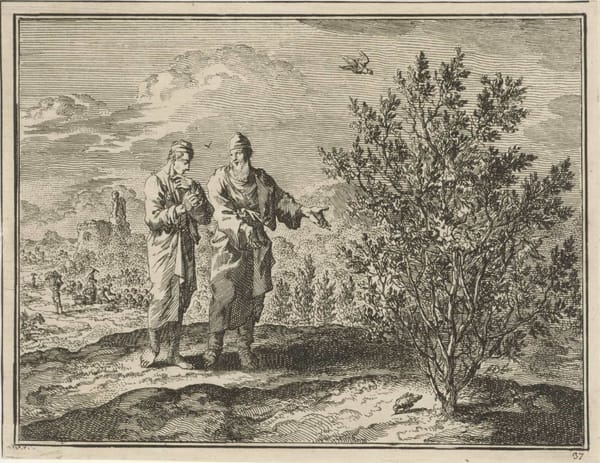
Cap. xiii.In illo tempore: Dixit Jesus turbis parabolam hanc : Simile est regnum cœlorum grano sinapis, quod accipiens homo seminavit in agro suo : quod minimum quidem est omnibus seminibus : cum autem creverit, majus est omnibus oleribus, et fit arbor, ita ut volucres cœli veniant, et habitent in ramis ejus. Aliam parabolam locutus est eis: Simile est regnum cœlorum fermento, quod acceptum mulier abscondit in farinæ satis tribus, donec fermentatum est totum. Hæc omnia locutus est Jesus in parabolis ad turbas et sine parabolis non loquebatur eis : ut impleretur quod dictum erat per prophetam, dicentem: Aperiam in parabolis os meum, eructabo abscondita a constitutione mundi.
Ch. xiii.At that time : Jesus spoke to the multitude this parable : The kingdom of heaven is like to a grain of mustard-seed, which a man took and sowed in his field. Which is the least indeed of all seeds; but, when it is grown up, it is greater than all herbs, and becometh a tree, so that the birds of the air come and dwell in the branches thereof. Another parable he spoke to them : The kingdom of heaven is like to leaven, which a woman took and hid in three measures of meal, until the whole was leavened. All these things Jesus spoke in parables to the multitudes, and without parables he did not speak to them : that it might be fulfilled which was spoken by the prophet, saying : I will open my mouth in parables; I will utter things hidden from the foundation of the world.
Offertory
Secret
The other Secrets, as on page 130.
Communion
Postcommunion
The other Postcommunions, as on page 131.
Vespers
The psalms, capitulum, hymn, and versicle, as above, pages 71-81.
Antiphon of the Magnificat
November 17: St. Gregory Thaumaturgus, Bishop and Confessor
MOSES instructed in all the wisdom of the Egyptians, mighty in his words and in his deeds,1 retired into the desert: Gregory, adorned with the best gifts of birth and nature, brilliant in rhetoric, rich in every science, hid himself from men in the flower of his youth, and hastened to offer to God in solitude the holocaust best pleasing to the Lord. Each was the hope of his race; yet each turned away to lose himself in the contemplation of heavenly mysteries. Meanwhile, the yoke of Pharaoh lay heavy upon Israel; meanwhile, souls were perishing, whom one of Gregory's burning words might have snatched from the empire of idolatry: was not such flight, then, desertion?
Is it for man to proclaim himself a saviour, when Jesus did not arrogate that title to himself? And when evil was rife all around, did the Carpenter of Nazareth do wrong to remain in the shade for thirty years previous to his short period of ministry? O ye teachers of our excited, fevered times, who dream of a new hierarchy among the virtues, and understand divine charity far otherwise than did our fathers: not those are of the race of Israel's saviours whose ideas concerning social good differ from those of the world's Redeemer.
Gregory, like Moses, was of that blessed race. His friends and enemies agreed in saying that he resembled the Hebrew legislator in the excellence of his virtue, and in the splendour of the prodigies wrought by his word.2 Both were actuated by the desire of knowing God, and manifesting him to the men they were called to lead: the fulness of doctrine is the gift most necessary to the guides of the people, and their want of it the greatest penury. I am who am was the answer to Moses' enquiry; and this sublime formula, confided to him from the midst of the burning bush, authenticated the mission which called him forth from the desert. When Gregory was commanded by God to go out into the world, the blessed Virgin, of whom the burning bush was a figure, appeared before his dazzled eyes in the dark night when he was praying for light. And St. John, following the Mother of God, let fall from his lips this other formula completing the former for the disciples of the Law of love:
One only God, Father of the living Word, of that substantial and mighty Wisdom who is the eternal expression of himself; the perfect principle of the only and perfect Son begotten by him. One only Lord, sole-begotten of the Only one; God of God, efficacious Word, Wisdom embracing and containing the world, creative power of all creation, true Son of a true Father. One only Holy Spirit, holding of God his divine existence, revealed to men by the Son of whom he is the perfect likeness, life and life-giving, holy and imparting holiness. The perfect Trinity, immutable, inseparable in glory, in eternity, in dominion.3
This was the message our Saint was to communicate to his country, the creed that was to bear his name in the Church. By his faith in the most holy Trinity he was to remove mountains, and set limits to the waves, to drive out Satan, and eradicate infidelity from Pontus. When, towards the year 240, Gregory, then bishop, was on his way to Neocaesarea, he saw on all sides the temples of idols, and stopped for the night at a famous sanctuary. In the morning all the gods had taken to flight and refused to come back; but the Saint gave to the priest of the oracle a note thus worded: Gregory to Satan: return. A more bitter defeat awaited the demons; forced to stay their precipitate retreat, they were compelled to witness the ruin of their empire over the souls they had abused. The priest was the first to give himself up to the Bishop, and became his deacon ; and soon upon the ruins of the temples everywhere overthrown arose the Church of Christ, the only God.
Happy was that Church, so firmly founded that heresy was powerless against it in the following century, when so many others bowed before the storm of Arianism. On the testimony of St. Basil, the successors of St. Gregory, themselves eminent men, were as an adornment of precious stones, a crown of stars, to the Church of Neocaesarea. Now all these illustrious Pontiffs, says he, considered it an honour to keep up the memory of their great predecessor; they would never suffer that any act, word, or movement other than his, in performing the sacred rites, should prevail over the traditions he had left.4
When Clement XII., as we have seen, established in the entire Church the feast of St. Gertrude the Great, he at first decreed that it should be kept on this day, on which it is still celebrated by the Order of St. Benedict. But as the 17th November had been for long centuries assigned to St. Gregory Thaumaturgus, it seemed unfitting, said Benedict XIV. that he who moved mountains should himself be moved from his place by the holy virgin. Accordingly in 1739, the year following its institution, the feast of St. Gertrude was fixed on the fifteenth of this month.5
Let us read the brief account of the great Thaumaturgus given in the holy Liturty.
O holy Pontiff, thy faith, removing mountains and commanding the waves, was a justification of our Lord's promise. Teach us in our turn to do honour to the Gospel, by never doubting of our Lord's word and of the help he promises us against Satan, whom the Church points out to us today as the proud mountain that is to be cast into the sea;6 and also against the overflowing tide of our passions, and the enticements of the world, of which thy writings teach us the vanity.7 After the victory let us not forget that the succour came to us from heaven; preserve us from ingratitude, which thou didst so detest. We still possess the touching eulogy dictated by thy gratitude towards the illustrious master, to whose teachings, under God, thou didst owe the glorious strength and splendour of thy faith. Here is a precious and practical lesson for all: while praising divine Providence in the man who was his predestined instrument in thy regard, thou didst not forget the homage due to the Angel of God, who had preserved thee from falling into the abyss, during the darkness of infidelity in which thy first years were spent; that heavenly Guardian who, ever watchful in his active, enlightened, persevering devotedness, supplies for our insufficiencies, nourishes and instructs us, leads us by the hand, and secretly arranges for our souls those blessed circumstances and occasions, which transform our life and secure eternal happiness.8
How can wo sinful creatures sufficiently thank the Author of all good, the infinite Being who gives to man both the holy Angels and the visible intermediaries of divine grace on earth? But let us take courage, for we have as our Head his own Son, his Word who saved our souls, and who rules the universe. He alone, and that without effort, can render to his Father unceasing, eternal thanksgiving, for himself and for us all, without risk of not knowing or of forgetting the least subject of gratitude, without fear of any imperfection in the manner or the magnitude of his praise. To him, then, to the divine Word, we commit as thou didst, O Gregory, the care of perfecting the expression of our gratitude for the unspeakable kindness of our heavenly Father; for the Word is to us, as to thee, the only channel of piety, gratitude, and love.9 May he give us in these days pastors who will imitate thy works; and may he raise up again the ancient churches of the East, which once received such light from thee!
- Acts vii. 22. ↩︎
- Basil. De Spiritu Sancto. xxix. ↩︎
- Greg. Nyss. Vita Greg. Thaumaturg. ↩︎
- Basil. De Spiritu Sancto xxix. ↩︎
- Benedict xiv. De canonizat. Ss. Lib. i. cap. xli. 40, 41. ↩︎
- Homil. Ad Matut. Ex Beda in Marc. ↩︎
- Greg. Thaumat. Metaphrastis in Ecclesiasten Salomonis. ↩︎
- In Origenem oration panegyrica. ↩︎
- Ibid. ↩︎
| Previous November 16 [November 15]: St. Gertrude, Virgin | Next November 17: St. Gregory Thaumaturgus, Bishop and Confessor |