Daily reading
December 17 · Sanctoral
December 17, 2024
From Dom Guéranger’s The Liturgical Year.
December 17: The Commencement of the Great Antiphons
The Church enters to-day on the seven days which precede the Vigil of Christmas, and which are known in the liturgy under the name of the Greater Ferias. The ordinary of the Advent Office becomes more solemn; the antiphons of the psalms, both for Lauds and the Hours of the day, are proper, and allude expressly to the great coming. Every day, at Vespers, is sung a solemn antiphon, consisting of a fervent prayer to the Messias, whom it addresses by one of the titles given Him in the sacred Scriptures.
In the Roman Church, there are seven of these antiphons, one for each of the greater ferias. They are commonly called the O’s of Advent, because they all begin with that interjection. In other Churches, during the middle ages, two more were added to these seven; one to our blessed Lady, O Virgo virginum; and the other to the angel Gabriel, O Gabriel; or to St. Thomas the apostle, whose feast comes during the greater ferias; it began O Thoma Didyme.1 There were even Churches where twelve great antiphons were sung; that is, besides the nine we have just mentioned, O Rex Pacifice to our Lord, O mundi Domina, to our Lady, and O Hierusalem to the city of the people of God.
The canonical Hour of Vespers has been selected as the most appropriate time for this solemn supplication to our Saviour, because, as the Church sings in one of her hymns, it was in the evening of the world (vergente mundi vespere) that the Messias came amongst us. These antiphons are sung at the Magnificat, to show us that the Saviour whom we expect is to come to us by Mary. They are sung twice, once before and once after the canticle, as on double feasts, and this to show their great solemnity. In some Churches it was formerly the practice to sing them thrice; that is, before the canticle, before the Gloria Patri, and after the Sicut erat. Lastly, these admirable antiphons, which contain the whole pith of the Advent liturgy, are accompanied by a chant replete with melodious gravity, and by ceremonies of great expressiveness, though, in these latter, there is no uniform practice followed. Let us enter into the spirit of the Church; let us reflect on the great day which is coming; that thus we may take our share in these the last and most earnest solicitations of the Church imploring her Spouse to come, to which He at length yields.
First Antiphon
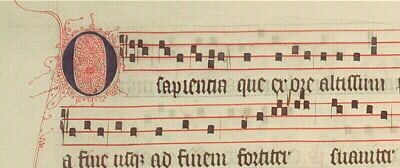
O uncreated Wisdom, who art so soon to make Thyself visible to Thy creatures, truly Thou disposest all things. It is by Thy permission that the emperor Augustus issues a decree ordering the enrolment of the whole world. Each citizen of the vast empire is to have his name enrolled in the city of his birth. This prince has no other object in this order, which sets the world in motion, but his own ambition. Men go to and fro by millions, and an unbroken procession traverses the immense Roman world; men think they are doing the bidding of man, and it is God whom they are obeying. This world-wide agitation has really but one object; it is, to bring to Bethlehem a man and woman who live at Nazareth in Galilee, in order that this woman, who is unknown to the world but dear to heaven, and who is at the close of the ninth month since she conceived her Child, may give birth to this Child in Bethlehem; for the Prophet has said of Him: ‘His going forth is from the beginning, from the days of eternity. And thou, O Bethlehem! art not the least among the thousand cities of Juda, for out of thee He shall come.’2 O divine Wisdom! how strong art Thou in thus reaching Thine ends by means which are infallible, though hidden; and yet, how sweet, offering no constraint to man’s free-will; and withal, how fatherly, in providing for our necessities! Thou choosest Bethlehem for Thy birth-place, because Bethlehem signifies the house of bread. In this, Thou teachest us that Thou art our Bread, the nourishment and support of our life. With God as our food, we cannot die. O Wisdom of the Father, living Bread that hast descended from heaven, come speedily into us, that thus we may approach to Thee and be enlightened3 by Thy light, and by that prudence which leads to salvation.
A Prayer for the Time of Advent
(The Mozarabic breviary, fourth Sunday of Advent, Oratio)
Tuesday of the Third Week of Advent
Cap. xxx.Exspectat Dominus ut misereatur vestri, et ideo exaltabitur parcens vobis; quia Deus judicii Dominus, beati omnes qui exspectant eum. Populus enim Sion habitabit in Jerusalem: plorans nequaquam plorabis: miserans miserebitur tui: ad vocem clamoris tui statim ut audierit, respondebit tibi. Et dabit vobis Dominus panem arctum, et aquam brevem: et non faciet avolare a te ultra doctorem tuum, et erunt oculi tui videntes præceptorem tuum. Et dabitur pluvia semini tuo, ubicumque seminaveris in terra: et panis frugum terrae erit uberrimus et pinguis. Pascetur in possessione tua in die illo agnus spatiose, et tauri tui, et pulli asinorum, qui operantur terram, commixtum migma comedent sicut in area ventilatum est. Et erunt super omnem montem excelsum, et super omnem collem elevatum rivi currentium aquarum in die interfectionis multorum, cum ceciderint turres. Et erit lux lunæ sicut lux solis, et lux solis erit septempliciter sicut lux septem dierum, in die qua alligaverit Dominus vulnus populi sui, et percussuram plagæ ejus sanaverit. Ecce nomen Domini venit de longinquo, ardens furor ejus, et gravis ad portandum: labia ejus repleta sunt indignatione, et lingua ejus quasi ignis devorans. Spiritus ejus velut torrens inundans usque ad medium colli, ad perdendas Gentes in nihilum, et frenum erroris quod erat in maxillis populorum.
Ch. xxx.The Lord waiteth that he may have mercy on you, and therefore shall he be exalted sparing you: because the Lord is the God of judgement, blessed are all they that wait for him. For the people of Sion shall dwell in Jerusalem: weeping thou shalt not weep: he will surely have pity on thee: at the voice of thy cry, as soon as he shall hear, he will answer thee. And the Lord will give you spare bread and short water: and will not cause thy teacher to flee away from thee any more, and thy eyes shall see thy teacher. And rain shall be given to thy seed, wheresoever thou shalt sow in the land: and the bread of the corn of the land shall be most plentiful and fat. The lamb in that day shall feed at large in thy possession, and thy oxen, and the ass-colts, that till the ground, shall eat mingled provender as it was winnowed in the floor. And there shall be upon every high mountain, and upon every elevated hill, rivers of running waters in the day of the slaughter of many, when the towers shall fall. And the light of the moon shall be as the light of the sun, and the light of the sun shall be sevenfold as the light of seven days, in the day when the Lord shall bind up the wound of his people, and shall heal the stroke of their wound. Behold the name of the Lord cometh from afar, his wrath burneth, and is heavy to bear: his lips are filled with indignation, and his tongue as a devouring fire. His breath as a torrent overflowing even to the midst of the neck, to destroy the nations unto nothing, and the bridle of error that was in the jaws of the people.
And are we then to weep no more, O Jesus? Happy we! How could we be sad now that Thou hast heard our prayers, and our eyes shall behold Thee, our Master, and our Teacher? If Thou yet delayest some days longer, it is only that we may have more time to receive what Thou hast made it Thy glory to give—mercy and the pardon of our sins. Oh, the happiness of Thy kingdom! Oh, the richness of our lands, that is, of our souls, when Thy dew shall have fallen upon them! Oh, the sweetness of our Bread, which is to be Thyself, O living Bread come down from heaven! Oh, the brightness of the light which Thou wilt give us, even on the very day when Thou wilt have bound up our wounds! Blessed day, come quickly! And thou, dear night, when Mary is to give her divine Babe to us, when wilt thou come? So great is our hope in this Thy merciful coming, that we listen with less dread to the awful words of Thy prophet, who, with a rapidity swift as Thine own word, passes over the long ages between the two events, and speaks to us of the approach of the terrible day, when Thou wilt come suddenly in Thy burning wrath, with Thy lips filed with indignation, and Thy tongue as a devouring fire. Our present feeling is hope, for we are looking forward to that coming, in which Thou art the beautiful Prince of peace and love, and we cannot but hope. When that last day comes, have mercy on us! but on this day of Thine amiable visit, permit us to say to Thee the words of one of Thy servants: ‘Yes, dear Jesus, come; come to us! but in swathing-bands, not with Thy hand raised to punish us: in humility, not in Thy greatness: in the crib, not in the clouds of heaven: in the arms of Thy Mother, not on the throne of Thy Majesty: on the colt of the ass, not on the Cherubim: to us, and not against us: to save us, and not to judge: to visit us in Thy peace, not to condemn us in Thy anger. If Thou comest unto us thus, O Jesus! it is not from Thee, but to Thee, that we will flee.’ (The venerable Peter of Celles, First sermon of Advent.)
Hymn Taken from the Anthology of the Greeks
(December 20)
Prayer from the Gallican Missal
(InAdventu Domini, Immolatio)
| Previous Monday of the Third Week of Advent | Next Tuesday of the Third Week of Advent |