Daily reading
Epiphanytide
Semidouble · Temporal
January 19, 2025
From Dom Guéranger’s The Liturgical Year.

|
The Second Sunday after Epiphany
THE third Mystery of the Epiphany shows us the completion of the merciful designs of God upon the world, at the same time that it manifests to us, for the third time, the glory of our Lord and Saviour, Jesus Christ. The star has led the soul to faith; the sanctified Waters of the Jordan have conferred purity upon her; the Marriage-Feast unites her to her God. We have been considering, during this Octave, the Bridegroom revealing himself to the Spouse; we have heard him calling her to come to him from the heights of Libanus; and now, after having enlightened and purified her, he invites her to the heavenly feast, where she is to receive the Wine of his divine love.
A Feast is prepared;1 it is a Marriage-Feast; and the Mother of Jesus is present at it, for it is just that, having co-operated in the mystery of the Incarnation of the Word, she should take part in all that her Son does, and in all the favours he bestows on his elect. But, in the midst of the Feast, the Wine fails. Wine is the symbol of Charity or Love, and Charity had failed on the earth; for the Gentiles had never tasted its sweetness; and as to the Synagogue, what had it produced but wild grapes?2 The True Vine is our Jesus, and he calls himself by that name.3 He alone could give that Wine which gladdeneth the heart of man;4 he alone could give us that Chalice which inebriateth,5 and of which the Royal Psalmist prophesied.
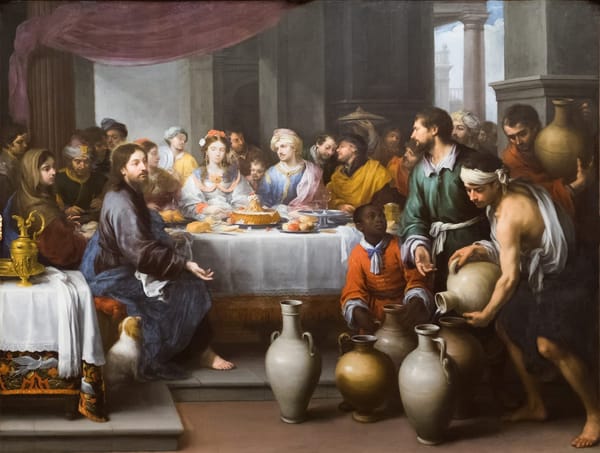
Mary said to Jesus: They have no Wine. It is the office of the Mother of God to tell him of the wants of men, for she is also their Mother. But Jesus answers her in words which are apparently harsh: Woman! what is it to me and to thee? My hour is not yet come. The meaning of these words is, that, in this great Mystery, he was about to act, not as the Son of Mary, but as the Son of God. Later on, the hour will come when, dying upon the Cross, he will do a work, in the presence of his Mother, and he will do it as Man, that is, according to that human nature which he has received from her. Mary at once understands the words of her Son, and she says to the waiters of the Feast, what she is now ever saying to her children: Do whatsoever he shall say to you.
Now, there were six large waterpots of stone there, and they were empty. The world was then in its Sixth Age, as St Augustine and other Holy Doctors tell us. During these six ages, the earth had been awaiting its Saviour, who was to instruct and redeem it. Jesus commands these waterpots to be filled with water; and yet water does not suit the Feast of the Spouse. The figures and the prophecies of the ancient world were this water, and until the opening of the Seventh Age, when Christ, who is the Vine, was to be given to the world, no man had contracted an alliance with the Divine Word.
But, when the Emmanuel came, he had but to say, Now draw out, and the waterpots were seen to be filled with the wine of the New Covenant, the Wine which had been kept to the end. When he assumed our human nature—a nature weak and unstable as water—he effected a change in it; he raised it up even to himself, by making us partakers of the divine nature;6 he gave us the power to love him, to be united to him, to form that one Body, of which he is the Head, that Church of which he is the Spouse, and which he loved from all eternity, and with such tender love, that he came down from heaven to celebrate his nuptials with her.
St Matthew, the Evangelist of the Humanity of our Lord, has received from the Holy Ghost the commission to announce to us the Mystery of Faith by the star; St Luke, the Evangelist of Jesus' Priesthood, has been selected, by the same Holy Spirit, to instruct us in the Mystery of the Baptism in the Jordan; but the Mystery of the Marriage-Feast was to be revealed to us by the Evangelist John, the Beloved Disciple. He suggests to the Church the object of this third Mystery, by this expression: This beginning of miracles did Jesus in Cana of Galilee, and he manifested his glory.7 At Bethlehem, the Gold of the Magi expressed the Divinity of the Babe; at the Jordan, the descent of the Holy Ghost and the voice of the Eternal Father proclaimed Jesus (known to the people as a carpenter of Nazareth) to be the Son of God; at Cana, it is Jesus himself that acts, and he acts as God, for, says St Augustine, he who changed the water into wine in the waterpots could be no other than the same who, every year, works the same miracle in the vine. Hence it was that, from that day, as St John tells us, his disciples believed in him,8 and the Apostolic College began to be formed.
Mass
The Introit proclaims the joy of this day, which shows us human nature espoused to the Son of the eternal Father. Surely the earth will henceforth surrender itself wholly to the love and praise of this sacred Name which, in the Marriage Feast, has become that of the Sons of Adam.
Introit
This name of Sons of God which has become ours by right through the bond of the sacred nuptials is none other, as Jesus himself tells us in his Beatitudes, than Peace—the Peace of God, ours truly through the action of his grace ever working it out within us. In the Collect Peace again figures as the final end of God's government both in heaven and on earth, likewise as the supreme desire of the Church.
Collect
Commemoration is made, by their proper Collects, of the Saint whose feast may occur with this Sunday; the third prayer will be that of the Blessed Virgin.
Commemoration of the Blessed Virgin Mary
Epistle
Cap. XII.Fratres: Habentes donationes secundum gratiam, quæ data est nobis, differentes: sive prophetiam secundum rationem fidei, sive ministeriura in ministrando, sive qui docet in doctrina, qui exhortatur in exhortando, qui tribuit in simplicitate, qui præest in sollicitudine, qui miseretur in hilaritate. Dilectio sine simulatione. Odientes malum, adhærentes bono: Caritate fraternitatis invicem diligentes: Honore invicem prævenientes: Sollicitudine non pigri: Spiritu ferventes: Domino servientes: Spe gaudentes: In tribulatione patientes: Orationi instantes: necessitatibus sanctorum communicantes: Hospitalitatem sectantes. Benedicite persequentibus vos: benedicite et nolite maledicere. Gaudere cum gaudentibus, flere cum flentibus: idipsum invicem sentientes: non alta sapientes, sed humilibus consentientes.
Ch. XII.Brethren: Having different gifts, according to the grace that is given us, either prophecy, to be used according to the rule of faith: or ministry, in ministering; or he that teacheth, in doctrine; he that exhorteth in exhorting; he that giveth with simplicity; he that ruleth with carefulness; he that sheweth mercy with cheerfulness. Let love be without dissimulation. Hating that which is evil, cleaving to that which is good. Loving one another with the charity of brotherhood: with honour preventing one another. In carefulness not slothful, in spirit fervent: serving the Lord: rejoicing in hope: patient in tribulation: instant in prayer: communicating to the necessities of the saints: pursuing hospitality. Bless them that persecute you: bless and curse not. Rejoice with them that rejoice, weep with them that weep. Being of one mind one towards another, not minding high things, but consenting to the humble.
This peace which characterizes, in the abode of saints, the Sons of God, effects in like measure on earth the oneness of the Bride, that is of the Church: peace it is that makes her to be but one body wherein the many members find their multiplicity upheld and guided by the head, the one lord; their functions, so diverse in themselves, regulated and brought under the rule and love of the Bridegroom, Christ Jesus. The Epistle which has just been read sets before us the different operations of this peace which has as its ruling motive Charity, the Queen of virtues, and which is so essential to Christianity; the Apostle specifies in detail its forms and conditions and adapts its practice to every social condition and circumstance of life. Of such value does the Church judge these considerations, that, on the following Sunday, she resumes the text of the Apostle where today she has interrupted it.
Far from a divine life in the peace of God which was its precious gift, the human race incurred death with its penalty of separation. Let us then in the Gradual sing of this wonder that has been wrought in our midst, and with the angelic choirs exalt the Lord in praise and admiration.
Gradual
Gospel
Cap. II.In illo tempore: Nuptiæ factæ sunt in Cana Galilææ, et erat Mater Jesu ibi. Vocatus est autem et Jesus et discipuli ejus ad nuptias. Et deficiente vino, dicit Mater Jesu ad eum: Vinum non habent. Et dicit ei Jesus: Quid mihi et tibi est, mulier? nondum venit hora mea. Dicit Mater ejus ministris: Quodcumque dixerit vobis, facite. Erant autem ibi lapideæ hydriæ sex, positæ secundum purificationem Judæorum, capientes singulæ metretas binas vel ternas. Dicit eis Jesus: Implete hydrias aqua. Et impleverunt eas usque ad summum. Et dicit eis Jesus: Haurite nunc, et ferte architriclino. Et tulerunt. Ut autem gustavit architriclinus aquam vinum factam, et non sciebat unde esset, ministri autem sciebant qui hauserant aquam; vocat sponsum architriclinus, et dicit ei: Omnis homo primum bonum vinum ponit, et cum inebriati fuerint, tunc id quod deterius est; tu autem servasti bonum vinum usque adhuc. Hoc fecit initium signorum Jesus in Cana Galilææ, et manifestavit gloriam suam, et crediderunt in eum discipuli ejus.
Ch. II.At that time, there was a marriage in Cana of Galilee; and the Mother of Jesus was there. And Jesus also was invited, and his disciples to the marriage. And the wine failing, the Mother of Jesus saith to him, They have no wine. And Jesus saith to her, Woman, what is it to me and to thee? my hour is not yet come. His Mother saith to the waiters, Whatsoever he shall say to you, do ye. Now there were set there six waterpots of stone; according to the manner of the purifying of the Jews, containing two or three measures apiece. Jesus saith to them, Fill the waterpots with water. And they filled them up to the brim. And Jesus saith to them, Draw out now, and carry to the chief steward of the feast: and they carried it. And when the chief steward had tasted the water made wine, and knew not whence it was, but the waiters knew who had drawn the water; the chief steward calleth the bridegroom, and saith to him, Every man at first setteth forth good wine, and when men have well drunk, then that which is worse: but thou hast kept the good wine until now. This beginning of miracles did Jesus in Cana of Galilee, and manifested his glory, and his disciples believed in him.
O the wonderful dignity of man! God has vouchsafed, says the Apostle, to show the riches of his glory on the vessels of mercy, which had no claim to, nay, were unworthy of such an honour. Jesus bids the waiters fill them with water and the water of Baptism purifies us; but, not satisfied with this, he fills these vessels, even to the brim, with that heavenly and new Wine, which was not to be drunk save in the kingdom of his Father.9 Thus, divine Charity, which dwells in the Sacrament of Love, is communicated to us; and that we might not be unworthy of the espousals with himself, to which he called us, he raises us up even to himself. Let us, therefore, prepare our souls for this wonderful union, and, according to the advice of the Apostle, let us labour to present them to our Jesus with such purity as to resemble that chaste Virgin, who was presented to the spotless Lamb.10
During the Offertory, the Church resumes her songs of joy and gives free course to her holy transports. All faithful souls are invited by her to the celebration of this adorable Mystery, the intimate union of man with God.
Offertory
Secret
After the Secret of the Saint who is being commemorated today, that of the Blessed Virgin is said.
Commemoration of the Blessed Virgin Mary
The Communion Antiphon recalls once more the miracle of the changing of the water into wine. This was only a dim figure of that wondrous transformation which is accomplished on our altars, only a symbol of that divine Sacrament, the food of our souls whereby, in an unspeakable way, is realized our union with God.
Communion
Postcommunion
Commemoration of the Blessed Virgin Mary
Vespers
The Psalms, Capitulum, Hymn and Verse are given on pages 88-97.
Antiphon of the Magnificat
January 19: Sts. Marius, Martha, Audifax, and Abachum, Martyrs
CHRISTIANS from all parts of the world have ever flocked to Rome as to the rock of faith and the foundation of the Church, and honoured with the greatest reverence and piety the spot hallowed by the sepulchre of the Prince of the Apostles.'* These words of Holy Church are exemplified in the Martyrs of to-day. Fired with ambition to have some part and fellowship in the glorious Society of the holy Apostles and Martyrs, they left all things and hastened to the Eternal City, there to receive in fullest measure what they sought. Like the Magi of old they came from the far East. The star of faith had shone for them, and in obedience to its call they set forth in all eagerness to offer their gifts of homage and loyalty to the divine King in the person of his Vicar and his suffering members. Such generosity was not left unrewarded; our Emmanuel crowned it with the laurels of martyrdom, admitting them into that cloud of witnesses that ever stand about him. Let us keep before our minds with our Lord, the author and finisher of their faith, this great and glorious band of martyrs, so that we too may ever run unwearied and with courage and patience in the fight proposed to us.
The following lesson is given in the office:
* Lessons for the Dedication Feast of the Basilicas of Ss Peter and Paul. ↩︎
January 19 (the Same Day): St. Canute, King and Martyr
THE Magi Kings, as we have already observed, have been followed to the Crib of Jesus by saintly Christian monarchs; and it was just that these should be represented on the Church's Calendar during the season which is consecrated to the Mystery of his Birth. The eleventh century is one of the most glorious of the Christian era, and gave, both to the Church and the various States of Europe, a great number of saintly Kings. Among them Canute the Fourth of Denmark stands pre-eminent by reason of the aureole of his martyrdom. He had every quality which forms a Christian prince: he was a zealous propagator of the faith of Christ, he was a brave warrior, he was pious, and he was charitable to the poor. His zeal for the Church (and in those days her rights were counted as the rights of the people) was made the pretext for putting him to death: he died in the midst of a sedition as a victim sacrificed for his people's sake. His offering to the new-born King was that of his blood; and in exchange for the perishable crown he lost, he received that which the Church gives to her Martyrs, and which can never be taken away. The history of Denmark in the eleventh century is scarce known by the rest of the world; but the glory of that country's having had one of her kings a Martyr is known throughout the whole Church, and the Church inhabits the whole earth. This power, possessed by the Spouse of Christ, of conferring honour on the name and actions of the servants and friends of God, is one of the grandest spectacles out of heaven; for when she holds up a name as worthy of honour, that name becomes immortalized, whether he who bore it were a powerful king or the poorest peasant.
We find the following life of this holy King given in the Lessons until recently used in the Breviary.
O holy King! the Sun of Justice had risen upon thy country, and all thy ambition was that thy people might enjoy the fulness of its light and warmth. Like the Magi of the East, thou didst lay thy crown at the feet of the Emmanuel, and at length didst offer thy very life in his service and in that of his Church. But thy people were not worthy of thee; they shed thy blood, as the ungrateful Israel shed the Blood of the Just One who is now born unto us, and whose sweet Infancy we are now celebrating. Thou didst offer thy martyrdom for the sins of thy people; offer it now also for them, that they may recover the true faith they have so long lost. Pray for the Rulers of Christian lands, that they may be faithful to their duties, zealous for justice, and may have respect for the liberty of the Church. Ask for us of the Divine Infant a devotedness in his cause like that which glowed in thy breast; and since we have not a crown to lay at his feet, pray for us that we may be generous enough to give our whole heart.
January 19 (the Same Day): St. Wulstan, Bishop and Confessor
SEVERAL dioceses in England celebrate on this day the feast of St Wulstan, Bishop of Worcester. The last of the Anglo-Saxon saints, Wulstan was worthy to close the long line of men and women who had earned for the country the proud title of 'Insula Sanctorum.' His character as sketched by a contemporary is singularly attractive. A simple man, strong in his simplicity, yet kindly and gifted with a merry wit, he held straight on his course in God's service a priest, monk, prior, and bishop, spending himself in the laborious offices of his ministry, much more intent on the burdens of his position than on its emoluments. A love of beauty ran through his life and manifested itself in building fine churches, in his care of books, in his love for the freshness of children.
In his long life of eighty-seven years Wulstan saw the gradual passing of the old order, the reigns of Ethelbert, Canute, Edward the Confessor, and of his friend King Harold, down to the fateful day when power passed into Norman hands. With all his love for his own land and dynasty the Saint gave no time to useless regrets. He had warned the people that for their sins the country would fall under the dominion of strangers, and when the conquest became a fact he threw his great influence into support of the new dynasty. But he was no time-server, and had no hesitation in confronting the Conqueror to demand redress of injustice done to his See. King William learned to admire the sturdy Saxon prelate, and Wulstan, instead of sharing the fate of nearly all the native bishops who were removed and replaced by Normans, remained in his See and was made the King’s lieutenant for the Midlands.
The following are the lessons of Saint Wulstan.
| Previous January 18 (the Same Day): St. Prisca, Virgin and Martyr | Next January 19: Sts. Marius, Martha, Audifax, and Abachum, Martyrs |