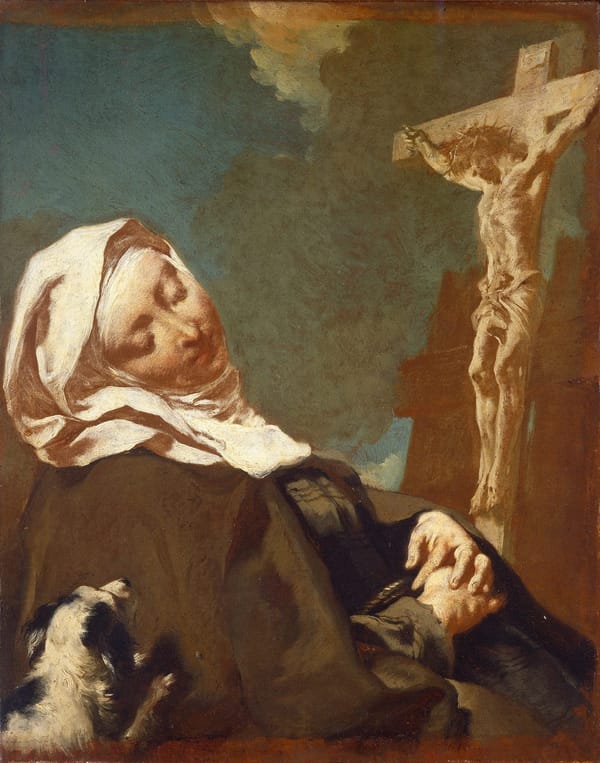
Close to the faithful virgins, who form the court of Jesus, there stand those holy women, whose repentance has merited for them a prominent place in the calendar of the Church. They are the bright trophies of God’s mercy. They expiated their sins by a life of penance; the tears of their compunction wiped away their guilt; He that is purity itself has found them worthy of His love, and, when pharisees affect to be shocked at His allowing them to be near Him, He warmly defends them. Foremost among these is Mary Magdalene, to whom much was forgiven, because she loved much;1 but there are two on the list of penitent saints whose names shine most brightly on the calendar of this portion of the year; and who were, like Mary Magdalene, ardent in their love of the divine Master, whom they had once offended: these are, Mary of Egypt, and Margaret of Cortona. It is the second of these who to-day tells us the consoling truth that if sin separate us from God, penance has the power not only of disarming His anger, but of forming between God and the sinner that ineffable bond of love, which the apostle alludes to when he says: ‘Where sin hath abounded, grace hath more abounded.'2
Let us study the virtues of the illustrious penitent of the thirteenth century. They are thus summed up by the Church in the lessons of to-day’s feast.
Margarita, a loco dormitionis Cortonensis appellata, Laviani in Tuscia ortum habuit. Primis adolescentiæ suæ annis mundi voluptatibus capta, in Montis Politiani civitate, vanam et lubricam vitam duxit: sed cum amasium ab hostibus fœde transfossum, indicio canis in fovea sub strue lignorum tumulatum fortuito reperisset, illico facta est manus Domini super eam, quæ magno culparum suarum mœrore tacta, exiit foras et flevit amare. Itaque Lavianum reversa, crine detonso, neglecto capite, pullaque veste contecta, erroribus suis mundique illecebris nuntium misit; inque ædibus Deo sacris fune ad collum alligato, humi procumbens, ab omnibus quos antea moribus suis palam offenderat, veniam exoravit. Mox Cortonam profecta, in cinere et cilicio ab se læsam Bei majestatem placare studuit, donec post triennale virtutum experimentum a Fratribus Minoribus spiritualis vitæ ducibus, Tertii Ordinis habitum impetravit. Uberes exinde lacrymæ ei familiares fuerunt, atque ima suspiria tanta animi contritione ducta, ut diu elinguis consisteret. Lectulus nuda humus, cervical lapis aut lignum porrexit; atque ita noctes insomnes in cœlestium meditatione trahere consuevit, nullum amplius pravum desiderium perpessa, dum bonus spiritus promptior infirmam camem ad subeundos labores erigebat.
A dæmone insidiis, funestisque conatibus Iacessita, mulier fortis hostem, ex verbis defcectum, semel atque iterum invicta repulit Ad eludendum vanæ gloriæ lenocinium, quo a malo spiritu petebatur, præterifcos mores suos per vicos et plateas alta voce accusare non destitit, omni supplicio se ream inclamans; nec, nisi a confessano deterrita, in speciosam faciem, olim impuri amoris causam, sævire abstinuit, æegre ferens suam formam longa carnis maceratione non aboleri. Quibus aliisque magnæ pœnitentiae argumentis, suorum criminum labe expiata, atque ita de se triumphatrix, ut sensus piane omnes a mundi illecebris custodiret, digna facta est quæ sæpe Domini consuetudine frueretur. Ejusdem quoque Christi et Virginis Matris dolorum, quod ipsa ardenter expetierat, particeps facta, cunctis sensibus destituta, et vere mortua interdum visa est. Ad eam proinde veluti ad perfectionis magistram, ex dissitis etiam regionibua plurimi conveniebant: ipsa vero cœlesti, quo erat perfusa, lumine, cordium secreta, conscientias hominum, imo et peccata in remotis licet partibus Deum offendentium cum dolore et lacrymis detegens, summaque in Deum et proximum charitate fervens, ingentem animarum fructum operata est. Ægris ad se venientibus salutem, obsessis a dæmone liberationem impetravit. Puerum defunctum, lugente matre, ad vitam reduxit. Imminentes bellorura tumultus assiduis orationibus sedavit. Denique summæ pietatis operibus vivos et mortuos sibi demeruit.
Tot sanctis operibus occupata, de rigore, quo assidue corpus suum exercebat, nihil remisit, neque a studio cœlestia meditandi se avelli passa est, in utroque vitæ genere piane admiranda, utramque sororem, Magdalenam et Martham, referens. Tandem pro se Dominum orans, ut ex hac valle lacrymarum sursum in cœlestem patriam evocaretur, exaudita est oratio ejus, die atque hora dormitionis ei patefactis. Meritis itaque et laboribus plena, ac cœlestibus donis cumulata, cœpit corporis viribus destitui, perque dies decem et septem nullo cibo, sed divinis tantum colloquiis refecta est: tum sanctissimis Ecclesiæ sacramentis rite susceptis, vultu hilari, atque oculis in cœlum conversis, octavo Kalendas Martias, anno ætatis quinquagesimo, suæ conversionis vigesimo tertio, humanæ vero salutis millesimo ducentesimo nonagesimo septimo, felix migravit ad Sponsum. Corpus in hanc usque diem vegetum, incorruptum, illæsum et suaviter olens, summa religione colitur in ecclesia fratrum Minorum, quæ jam ab eadem Margarita appellatur. Miraculis continuo floruit; quibus permoti Romani Pontifices, ad augendum ejus culturm plurima liberaliter indulsemnt. Benedictus vero decimus tertius, in festo Pentecostes, die sexta decima Mail anni millesimi septingentesimi vigesimi octavi, solemnem ejus canonizationem religiosissime celebravit.
Margaret of Cortona (so called from the town where she died), was born at Alviano in Tuscany. In her early youth she was a slave to the pleasures of this world, and led a vain and sinful life in the city of Montepulciano. Her attention was, one day, attracted by a dog, which seemed to wish her to follow it. She did so, and it led her to a pile of wood which covered a large hole. Looking in, she saw the body of her lover, whose enemies had murdered him, and thrown his mangled corpse into that place. She suddenly felt that the hand of God was upon her, and being overwhelmed with intense sorrow for her sins, she went forth, and wept bitterly. She returned to Alviano, cut off her hair, laid aside her trinkets, and, putting on a dark-coloured dress, she abandoned her evil ways and the pleasures of the world. She was to be found in the churches, with a rope tied round her neck, prostrate on the ground, and imploring pardon of all whom she had scandalized by her past life. She shortly afterwards set out for Cortona, and there, in sackcloth and ashes, she sought how she might appease the divine anger. For three years did she try herself in the practice of every virtue: and at the end of that time, she obtained permission from the Friars Minors (under whose spiritual guidance she had placed herself), to receive the habit of the Third Order. From that time forward, her tears were almost incessant; and the sighs which deep contrition wrung from her heart were such as to leave her speechless for hours. Her bed was the naked ground; and her pillow, a stone or piece of wood: so that she frequently passed whole nights in heavenly contemplation. Evil desires no longer tormented her, for her fervent spirit was so prompt, that the weak flesh was made to labour and obey.
The devil spared neither snares nor violent assaults, whereby to lead her from her holy purpose: but she, like a strong woman, detected him by his words, and drove him from her. This wicked spirit having tempted her to vain glory, she went into the streets, and cried out with a loud voice, that she had been a great sinner, and deserved the worst of punishments. It was obedience to her confessor that alone prevented her from disfiguring her features, which had been the cause of much sin: for the long and severe penance she had imposed on herself had not impaired her beauty. By these and such like exercises of a mortified life, she cleansed her soul from the stains of her sins, and gained such a victory over herself, that the allurements of the world had not the slightest effect upon her, and our Lord rewarded her by frequently visiting her. She also received the grace she so ardently desired, of being allowed to have a share in the sufferings of Jesus and Mary; so much so, indeed, that, at times, she lay perfectly unconscious, as though she were really dead. All this made her be looked up to as a guide in the path of perfection, and persons would come to her, even from distant countries, in order to seek her counsel. By the heavenly light granted her, she could read the hearts and consciences of others, and could see the sins committed against our Lord in various parts of the world, for which she would offer up, in atonement, her own sorrow and tears. Great indeed was the good she effected by the ardent charity she bore to God and her neighbour. She healed the sick who came to her, and drove out the devil from such as were possessed. A mother besought her, with many tears, to restore her child to life, which she did. Her prayers more than once averted war, when on the point of being declared. In a word, both the living and the dead experienced the effects of her unbounded charity.
While engaged in these manifold holy works, she relented not in the severity of her bodily mortifications, or in her contemplation of heavenly things. The two lives of Mary and Martha were admirably blended together in her; and rich in the merits of each, she besought our Lord to take her from this vale of tears, and give her to enter the heavenly country. Her prayer was heard, and the day and the hour of her death were revealed to her. Laden with meritorious works and divine favours, her bodily strength began to fail. For the last seventeen days of her life her only food was that of conversation with her Creator. At length, after receiving the most holy Sacraments of the Church, with a face beaming with joy, and her eyes raised up to heaven, her happy soul fled to its divine Spouse, on the eighth of the Calends of March (February 22), in the fiftieth year of her age, the twenty-third of her conversion, and in the year of our Lord one thousand two hundred and ninety-seven. Her body, which, even to this day, is fresh, incorrupt, and unaltered, and sheds a sweet fragrance, is devoutly honoured in the church (called after her Saint Margaret's) belonging to the Friars Minor. The many miracles which have been wrought at her shrine, have induced the Sovereign Pontiffs to promote devotion to Saint Margaret by the grant of many spiritual favours. She was canonized, with great solemnity, by Pope Benedict XIII., on May 16, which was the feast of Pentecost, in the year 1728.
If the angels of God rejoiced on the day of thy conversion, when Margaret the sinner became the heroic and saintly penitent, what a grand feast must they have kept when thy soul left this world, and they led thee to the eternal nuptials with the Lamb! Thou art one of the brightest trophies of divine mercy, and when we think of the saint of Cortona, our hearts glow with hope. We are sinners; we have deserved hell; and yet, when we hear thy name, heaven and mercy seem so near to us, yea, even to us. Margaret of Cortona! see how like we are to thee in thy weakness, and thy wanderings from the fold; but thou forcest us to hope that we may, like thee, be converted, do penance, and reach heaven at last. The instrument of thy conversion was death; and is not death busy enough around us? The sight of that corpse taught thee, and with an irresistible eloquence, that sin is madness, for it exposes the soul to fall into infinite misery; how comes it that death is almost daily telling us that life is uncertain, and that our eternal lot may be decided at any hour, and yet the lesson is so lost upon us? We are hard-hearted sinners, and we need thy prayers, O fervent lover of Jesus! The Church will soon preach to us the great Memento; she will tell us that we are but dust, and into dust must speedily return. Oh that this warning might detach us from the world and ourselves, and man us to the resolution of penance, that port of salvation for them that have suffered shipwreck! Oh that it might excite within us the desire of returning to that God, who knows not how to resist the poor soul who comes to Him after all her sins, throws herself into the bosom of His mercy, and asks Him to forgive! Thy example proves that we may hope for every grace. Pray for us, and exercise in our favour that maternal charity which filled thy heart even when thou wast living here below.