Daily reading
Lent
Double · March 7 · Sanctoral
March 7, 2025
From Dom Guéranger’s The Liturgical Year.
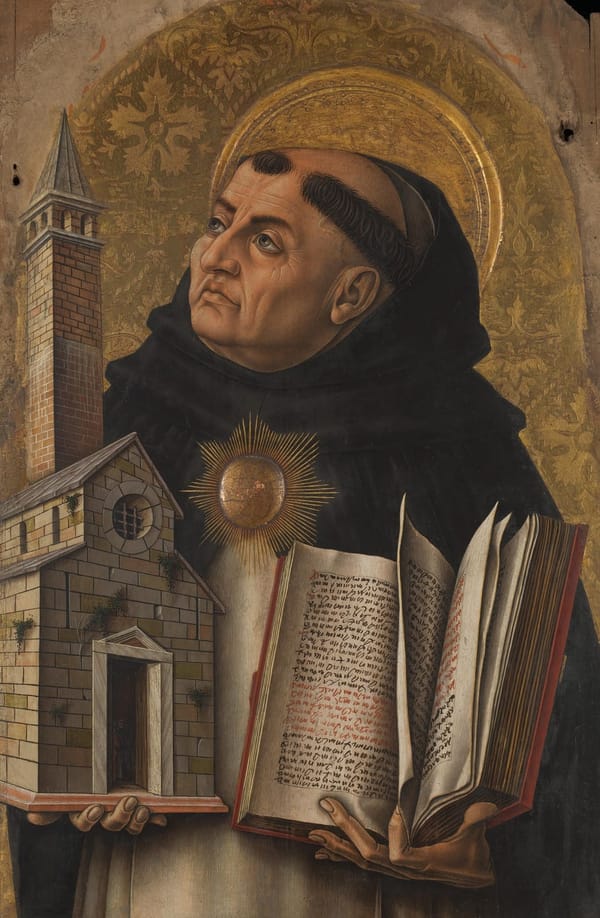 |
March 7: St. Thomas of Aquin, Doctor of the Church
The saint we are to honour to-day is one of the sublimest and most lucid interpreters of divine truth. He rose up in the Church many centuries after the apostolic age, nay, long after the four great Latin doctors, Ambrose, Augustine, Jerome, and Gregory. The Church, the ever young and joyful mother, is justly proud of her Thomas, and has honoured him with the splendid title of the angelical doctor, on account of the extraordinary gift of understanding wherewith God had blessed him; just as his contemporary and friend, St. Bonaventure, has been called the seraphic doctor, on account of the wonderful unction which abounds in the writings of this worthy disciple of St. Francis. Thomas of Aquin is an honour to mankind, for perhaps there never existed a man whose intellect surpassed his. He is one of the brightest ornaments of the Church, for not one of her doctors has equalled him in the clearness and precision wherewith he has explained her doctrines. He received the thanks of Christ Himself, for having well written of Him and His mysteries. How welcome ought this feast of such a saint to be to us during this season of the year, when our main study is our return and conversion to God! What greater blessing could we have than to come to the knowledge of God? Has not our ignorance of God, of His claims, and of His perfections, been the greatest misery of our past lives? Here we have a saint whose prayers are most efficacious in procuring for us that knowledge, which is unspotted, and converteth souls, and giveth wisdom to little ones, and gladdeneth the heart, and enlighteneth the eyes.1 Happy we if this spiritual wisdom be granted us! We shall then see the vanity of everything that is not eternal, the righteousness of the divine commandments, the malice of Bin, and the infinite goodness wherewith God treats us when we repent.
Let us learn from the Church the claims of the angelical doctor to our admiration and confidence.
The Dominican Order, of which St. Thomas is one of the greatest ornaments, has inserted the three following hymns in its liturgy of his feast:
Hymn
Laudans turba fidelium,
Errorum pulso nubilo
Per novi solis radium.
Fudit thesauros gratiæ:
Donis pienus ex æthere
Morum et sapientiæ.
Verbi coruscant faculæ,
Scripturæ sacræ Numinis,
Et veritatis regulæ.
Clarus vitæ munditia,
Splendens miris prodigiis,
Dat toti mundo gaudia.
Simulque sancto Flamini,
Qui sancti Thomæ merito
Nos cœli jungat agmini.
and give praise to God,
who has made a new sun to shine in our world,
and disperse the clouds of error.
that Thomas shed his treasures of heavenly light.
Heaven had enriched him
with gifts of virtue and wisdom:
we have derived a brighter knowledge of the Word,
the understanding of the divine Scriptures
and the rules of truth.
the light of his spotless life,
and the splendour of his miracles,
have filled the universe with joy.
and to the Holy Ghost.
And may our God, by the intercession and merits of his saint,
admit us into the choir of the blessed in heaven.
Hymn
Claram ducens originem,
Subit ætatis teneræ
Prædicatorum Ordinem.
Splendens in cœtu nubium,
Plusquam doctores cæteri
Purgans dogma Gentilium.
In lucem pandit abdita,
Dum supra sensus hominum
Obscura facit cognita.
Quadripartite pervius;
Fit Gedeonis gladius,
Tuba, lagena, radius.
Simulque sancto Flamini,
Qui sancti Thomæ merito,
Nos cœli jungat agmini.
Thomas, while in the bloom
of youth, embraced
the Order of Preachers.
brightly does he shine amidst the luminaries of earth,
and, more than any doctor of the Church,
refutes the doctrines of the Gentiles.
and brings to light the hidden gems of truth,
for he teaches us what the mind of man
had else never understood.
like to that four-branched river of paradise.
He made him to be her Gedeon’s sword,
her trumpet, her vase, her torch.
and to the Holy Ghost.
And may our God, by the intercession and merits of his saint,
admit us into the choir of the blessed in heaven.
Hymn
Thomæ felicem exitum,
Qui pervenit ad gaudia
Per Verbi vitæ meritum.
Thecam thesauri gratiæ,
Cum Christus Thomam efficit
Hæredem regni gloriæ.
Et funeris integritas,
Mira fragrans suavitas,
Ægris collata sanitas.
Terræ, ponto, et superis;
Nos juvet suis precibus,
Deo commendet meritis.
Simulque sancto Flamini,
Qui sancti Thomæ merito
Nos cœli jungat agmini.
the happy death of thy Thomas deserves a hymn of praise.
By the merits of him that is the Word of life,
he is now in endless joy.
of grace was welcomed as a guest.
It was there that he received from Christ
the inheritance of eternal glory.
he has loft us his glorious relics
which breathe forth a heavenly fragrance,
and work cures for the suffering sick.
earth, and sea, and heaven, all may give him praise.
May his prayers and merits
intercede for us with God.
and to the Holy Ghost.
And may our God, by the intercession and merits of his saint,
admit us into the choir of the blessed in heaven.
How shall we worthily praise thee, most holy Doctor! How shall we thank thee for what thou hast taught us? The rays of the divine Sun of justice beamed strongly upon thee, and thou hast reflected them upon us. When we picture thee contemplating truth, we think of those words of our Lord: 'Blessed are the clean of heart, for they shall see God.’2 Thy victory over the concupiscence of the flesh merited for thee the highest spiritual delights; and our Redeemer chose thee, because of the purity of thy angelic soul, to compose for His Church the Office whereby she should celebrate the divine Sacrament of His love. Learning did not impair thy humility. Prayer was ever thy guide in thy search after truth; and there was but one reward for which, after all thy labours, thou wast ambitious, the possession of God.
Thy life, alas! was short. The very masterpiece of thy angelical writings was left unfinished. But thou hast not lost thy power of working for the Church. Aid her in her combats against error. She holds thy teachings in the highest estimation, because she feels that none of her saints has ever known so well as thou, the secrets and mysteries of her divine Spouse. Now, perhaps more than in any other age, truths are decayed among the children of men;3 strengthen us in our faith, procure us light. Check the conceit of those shallow self-constituted philosophers, who dare to sit in judgment on the actions and decisions of the Church, and to force their contemptible theories upon a generation that is too ill-instructed to detect their fallacies. The atmosphere around us is gloomy with ignorance; loose principles, and truths spoilt by cowardly compromise, are the fashion of our times; pray for us; bring us back to that bold and simple acceptance of truth, which gives life to the intellect and joy to the heart.
Pray, too, for the grand Order which loves thee so devoutly, and honours thee as one of the most illustrious of its many glorious children. Draw down upon the family of thy patriarch St. Dominic the choicest blessings, for it is one of the most powerful auxiliaries of God’s Church.
We are on the eve of the holy season of Lent, preparing for the great work of earnest conversion of our lives. Thy prayers must gain for us the knowledge both of the God we have offended by our sins, and of the wretched state of a soul that is at enmity with its Maker. Knowing this, we shall hate our sins; we shall desire to purify our souls in the Blood of the spotless Lamb; we shall generously atone for our faults by works of penance
Friday after Ash Wednesday
The station for to-day is in the church of the holy martyrs, St. John and St. Paul.
Collect
Epistle
Cap. lviii.Hæc dicit Dominus Deus: Clama, ne cesses; quasi tuba exalta vocem tuam, et annuntia populo meo scelera eorum, et domui Jacob peccata eorum. Me etenim de die in diem quærunt, et scire vias meas volunt: quasi gens quæ justitiam fecerit, et judicium Dei sui non dereliquerit: rogant me judicia justitiæ: appropinquare Deo volunt. Quare jejunavimus et non aspexisti: humiliavimus animas nostras et nescisti? Ecce in die jejunii vestri invenitur voluntas vestra, et omnes debitores vestros repetitis. Ecce ad lites et contentiones jejunatis, et percutitis pugno impie. Nolite jejunare sicut usque ad hanc diem, ut audiatur in excelso clamor vester. Numquid tale est jejunium, quod elegi, per diem affligere hominem animam suam? numquid contorquere quasi circulum caput suum, et saccum et cinerem sternere? numquid istum vocabis jejunium, et diem acceptabilem Domino? Nonne hoc eat magis jejunium, quod elegi? dissolve colligationes impietatis, solve fasciculos deprimentes, dimitte eos qui confracti sunt liberos, et omne onus disrumpe. Frange esurienti panem tuum, et egenos vagosque induc in domum tuam: cum videris nudum, operi eum, et carnem tuam ne despoxeris. Tunc erumpet quasi mane lumen tuum, et sanitas tua citius orietur, et anteibit faciem tuam justitia tua, et gloria Domini colliget te. Tunc invocabis, et Dominus exaudiet: clamabis, et dicet: Ecce adsum. Quia misericors sum, Dominus Deus tuus.
Ch. lviii.Thus saith the Lord God: Cry, cease not, lift up thy voice like a trumpet, and show my people their wicked doings, and the house of Jacob their sins. For they seek me from day to day, and desire to know my ways, as a nation that hath done justice, and hath not forsaken the judgment of their God; they ask of me the judgments of justice: they are willing to approach to God. Why have we fasted, and thou hast not regarded: why have we humbled our souls, and thou hast not taken notice? Behold, in the day of your fast, your own will is found, and you exact of all your debtors. Behold you fast for debates and strife, and strike with the fist wickedly. Do not fast as you have done until this day, to make your cry to be heard on high. Is this such a fast as I have chosen: for a man to afflict his soul for a day? is this it, to wind his head about like a circle, and to spread sackcloth and ashes? wilt thou call this a fast, and a day acceptable to the Lord? Is not this rather the fast that I have chosen? loose the bands of wickedness, undo the bundles that oppress, let them that are broken go free, and break asunder every burden. Deal thy bread to the hungry, and bring the needy and the harbourless into thy house; when thou shalt see one naked, cover him, and despise not thy own flesh. Then shall thy light break forth as the morning, and thy health shall speedily arise, and thy justice shall go before thy face, and the glory of the Lord shall gather thee up. Then shalt thou call, and the Lord shall hear: thou shalt cry, and he shall say: Here I am; for I the Lord thy God am merciful.
We are told, in this lesson from the prophet Isaias, what are the dispositions which should accompany our fast. It is God Himself who here speaks to us—that God who had Himself commanded His people to fast. He tells us that the fasting from material food is a mere nothing in His eyes, unless they who practise it abstain also from sin. He demands the sacrifice of the body; but it is not acceptable to Him, unless that of the soul goes along with it. The living God can never consent to be treated as were the senseless gods of wood and stone, which the Gentiles adored, and which were incapable of receiving any other than a mere external homage. Let, then, the heretic cease to find fault with the Church for her observance of practices, which he pretends to scorn as being material; it is he that grows material by his system of letting the body have every indulgence. The children of the Church fast, because fasting is recommended in almost every page of both the old and the new Testament, and because Jesus Christ Himself fasted for forty days; but they are fully aware that this practice, which is thus recommended and urged, is then alone meritorious, when it is ennobled and completed by the homage of a heart that is resolved to reform its vicious inclinations. And after all, it would be an injustice, if the body, which has been led into guilt solely through the malice of the soul, were to be made to suffer, and the soul herself be allowed to continue in her sinful course. Hence it is that they whose ill-health prevents them from observing the bodily austerities of Lent, are equally bound to impose on their soul that spiritual fast, which consists in the amendment of their life, in avoiding everything that is sinful, and in the zealous performance of every good work in their power.
Gospel
Cap. v., vi.In illo tempore: Dixit Jesus discipulis suis: Audistis quia dictum est Diliges proximum tuum, et odio habebis inimicum tuum. Ego autem dico vobis: Diligite inimicos vestros, benefacite his qui oderunt vos: et orate pro persequentibus et calumniantibus vos: ut sitis filii Patris vestri, qui in cœlis est, qui solem suum oriri facit super bonos et malos, et pluit super justos et injustos. Si enim diligitis eos qui vos diligunt, quam mercedem habebitis? Nonne et publicani hoc faciunt? Et si salutaveritis fratres vestros tantum: quid amplius facitis? Nonne et ethnici hoc faciunt? Estote ergo vos perfecti, sicut et Pater vester cœlestis perfectus est. Attendite ne justitiam vestram faciatis coram hominibus, ut videamini ab eis: alioquin mercedem non habebitis apud Patrem vestrum qui in cœlis est. Cum ergo facis eleemosynam, noli tuba canere ante te, sicut hypocritæ faciunt in synagogis, et in vicis, ut honorificentur ab hominibus. Amen dico vobis, receperunt mercedem suam. Te autem faciente eleemosynam, nesciat sinistra tua, quid faciat dextera tua: ut sit eleemosyna tua in abscondito, et Pater tuus qui videt in abecondito, reddet tibi.
Ch. v., vi.At that time: Jesus said to his disciples: You have heard that it hath been said: Thou shalt love thy neighbour, and hate thy enemy. But I say to you: love your enemies, do good to them that hate you, and pray for them that persecute and calumniate you; that you may be the children of your Father who is in heaven, who maketh his sun to rise upon the good and bad, and raineth upon the just and the unjust. For if you love them that love you, what reward shall you have? do not even the publicans this? And if you salute your brethren only, what do you do more? do not also the heathens this? Be you therefore perfect, as also your heavenly Father is perfect. Take heed that you do not your justice before men to be seen by them: otherwise you shall not have a reward of your Father who is in heaven. Therefore, when thou dost an almsdeed, sound not a trumpet before thee, as the hypocrites do in the synagogues and in the streets, that they may be honoured by men. Amen, I say to you, they have received their reward. But when thou dost alms, let not thy left hand know what thy right hand doth; that thy alms may be in secret, and thy Father, who seeth in secret, will repay thee.
Almsdeeds is the third of the great penitential works: it is the sister virtue of prayer and fasting. For this reason, the Church puts before us, to-day, the instructions given by our Saviour on the manner in which we ought to do works of mercy. He puts upon us the duty of loving our fellow-men, without distinction of friends or enemies. God, who has created them all, loves them Himself; this is motive enough to make us show mercy to all. If He bears with them even when they are His enemies by sin, and patiently waits for their conversion even to the end of their lives, so that they who are lost are lost through their own fault, what ought not we to do, we who are sinners as they are, and their brethren, and created like them out of nothing? When, therefore, we do an act of kindness or mercy towards those who have God for their Father, we offer Him a most acceptable homage. Charity, the queen of virtues, absolutely requires of us the love of our neighbour, as being part of our love of God; and this charity, at the same time that it is a sacred obligation incumbent upon each member of the family of mankind, is, in the acts it inspires us to do towards each other, a work of penance, because it imposes upon us certain privations, and requires us to overcome every repugnance which nature stirs up within us, when we have to show this charity to certain individuals. And finally, we must in our almsdeeds follow the counsel our blessed Saviour gives us; it is the one He recommended to us, when He bade us fast: we must do it in secret, and shun ostentation. Penance loves humility and silence; it has a dread of being noticed by men; the only one whose applause it seeks, is He who seeth in secret.
| Previous March 6: Sts. Felicitas and Perpetua, Martyrs | Next Friday after Ash Wednesday |