Daily reading
Lent
Double · March 12 · Sanctoral
March 12, 2025
From Dom Guéranger’s The Liturgical Year.
A Double leads the weekday.Rubric
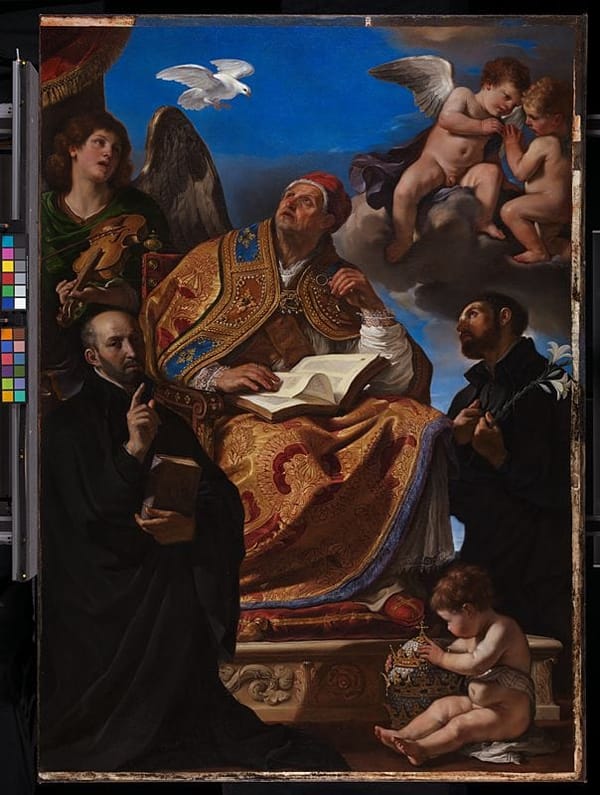 |
March 12: St. Gregory the Great, Pope and Doctor of the Church
Among all the pastors whom our Lord Jesus Christ has placed, as His vicegerents, over the universal Church, there is not one whose merits and renown have surpassed those of the holy Pope, whose feast we keep to-day. His name is Gregory, which signifies watchfulness; his surname is ‘the Great,’ and he was in possession of that title, when God sent the Seventh Gregory, the glorious Hildebrand, to govern His Church.
In recounting the glories of this illustrious Pontiff, it is but natural we should begin with his zeal for the services of the Church. The Roman liturgy, which owes to him some of its finest hymns, may be considered as his work, at least in this sense, that it is he who collected together and classified the prayers and rites drawn up by his predecessors, and reduced them to the form in which we now have them. He collected also the ancient chants of the Church, and arranged them in accordance with the rules and requirements of the divine Service. Hence it is, that our sacred music, which gives such solemnity to the liturgy, and inspires the soul with respect and devotion during the celebration of the great mysteries of our faith, is known as the Gregorian chant.
He is, then, the apostle of the liturgy, and this alone would have immortalized his name; but we must look for far greater things from such a Pontiff as Gregory. His name was added to the three, who had hitherto been honoured as the great Doctors of the Latin Church. These three are Ambrose, Augustine, and Jerome; who else could be the fourth but Gregory? The Church found in his writings such evidence of his having been guided by the Holy Ghost, such a knowledge of the sacred Scriptures, such a clear appreciation of the mysteries of faith, and such unction and authority in his teachings, that she gladly welcomed him as a new guide for her children.
Such was the respect wherewith everything he wrote was treated, that his very letters were preserved as so many precious treasures. This immense correspondence shows us that there was not a country, scarcely even a city, of the Christian world, on which the Pontiff had not his watchful eye steadily fixed; that there was not a question, however local or personal, which, if it interested religion, did not excite his zeal and arbitration as the Bishop of the universal Church. If certain writers of modern times had but taken the pains to glance at these letters, written by a Pope of the sixth century, they would never have asserted, as they have, that the prerogatives of the Roman Pontiff are based on documents fabricated, as they say, two hundred years after the death of Gregory.
Throned on the apostolic See, our saint proved himself to be a rightful heir of the apostles, not only as the representative and depositary of their authority, but as a fellow-sharer in their mission of calling nations to the true faith. To whom does England owe her having been, for so many ages, ‘the island of saints’? To Gregory, who, touched with compassion for those Angli, of whom, as he playfully said, he would fain make Angeli, sent to their island the monk Augustine with forty companions, all of them, as was Gregory himself, children of St. Benedict. The faith had been sown in this land as early as the second century, but it had been trodden down by the invasion of an infidel race. This time the seed fructified, and so rapidly that Gregory lived to see a plentiful harvest. It is beautiful to hear the aged Pontiff speaking with enthusiasm about the results of his English mission. He thus speaks in the twenty-seventh Book of his Morals: ‘Lo! the language of Britain, which could once mutter naught save barbarous sounds, has long since begun to sing, in the divine praises, the Hebrew Alleluia! Lo! that swelling sea is now calm, and saints walk on its waves. The tide of barbarians, which the sword of earthly princes could not keep back, is now hemmed in at the simple bidding of God’s priests.’*
During the fourteen years that this holy Pope held the place of Peter, he was the object of the admiration of the Christian world, both in the east and in the west. His profound learning, his talent for administration, his position, all tended to make him beloved and respected. But who could describe the virtue of his great soul? That contempt for the world and its riches, which led him to seek obscurity in the cloister; that humility, which made him flee the honours of the papacy, and hide himself in a cave, where, at length, he was miraculously discovered, and God Himself put into his hands the keys of heaven, which he was evidently worthy to hold, because he feared the responsibility; that zeal for the whole flock, of which he considered himself not the master, but the servant, so much so indeed that he assumed the title, which the Popes have ever since retained, of ‘servant of the servants of God’ that charity which took care of the poor throughout the whole world; that ceaseless solicitude, which provided for every calamity, whether public or private; that unruffled sweetness of manner, which he showed to all around him, in spite of the bodily sufferings which never left him during the whole period of his laborious pontificate; that firmness in defending the deposit of the faith, and crushing error wheresoever it showed itself; in a word, that vigilance with regard to discipline, which made itself felt for long ages after in the whole Church? All these services and glorious examples of virtue have endeared our saint to the whole world, and will cause his name to be blessed by all future generations, even to the end of time.
Let us now read the abridged life of our saint, as given us in the liturgy.
To these admirable lessons we subjoin a selection of antiphons and responsories, which are taken from an Office approved of by the holy See, for this feast of so great a saint.
Antiphons and Responsories*
St. Peter Damian, whose feast we kept a few days back, composed the following hymn in honour of our apostle:
Nunc angelorum eocius,
Ut tunc, Gregori, gentibus
Succurre jam credentibus.
Omnemque mundi gloriam
Spernis, ut inops inopem
Jesum sequaris principem.
Dum stipem petit angelus;
Tu munus jam post geminum,
Præbes et vas argenteum.
Suæ præfert Ecclesiæ:
Sic Petri gradum percipis,
Cujus et normam sequeris.
Lux et decus Ecclesiæ,
Non sinas in periculis,
Quos tot mandatis instruis.
Tua distillant labia,
Fragrantum vim aromatum
Tuum vincit eloquium.
Mire solvis ænigmata,
Theorica mysteria
Te docet ipsa Veritas.
Vicem simul et gloriam,
Nos solve culpæ nexibus,
Redde polorum sedibus.
Sit decus Unigenito,
Sit utriusque pariti
Majestas summa Flamini.
and now art a companion of the angels!
protect now, as of old, the nations
that believe in Christ.
and all the glory of the world,
that so thou, being poor,
mayst follow the Lord Jesus, who was poor.
in the garb of one that was shipwrecked, and asks an alms;
thou first makest him a double gift,
and then thou givest him a silver vase.
for thou didst imitate the virtues,
and now thou hast
the honours, of Peter.
Light and ornament of the Church!
Thou hast so richly instructed us,
assist us in our dangers.
that brings sweetness to the heart.
Thy words are more fragrant
than the richest perfume.
the obscure figures of sacred Writ.
The divine mysteries are taught thee
by him that is the very Truth.
the office and the glory of the apostles,
pray for us, that we may be loosed from the bonds of sin,
and obtain the thrones prepared for us above.
and to his only-begotten Son,
and to the Spirit of them
both be praise and highest kingship.
Father of the Christian people! Vicar of the charity, as well as of the authority, of Christ! O Gregory, vigilant Pastor! the Church, which thou hast so faithfully loved and served, turns to thee with confidence. Thou canst not forget the flock, which keeps up such an affectionate remembrance of thee; hear the prayer she offers thee on this thy solemnity. Protect and guide the Pontiff, who now holds the place of Peter, as thou didst; enlighten and encourage him in the difficulties wherewith he is beset. Bless the hierarchy of the pastors, which has received from thee such magnificent teachings and such admirable examples. Assist it to maintain inviolate the sacred trust of faith; bless the eSorts it is now making for the restoration of ecclesiastical discipline, without which all is disorder and confusion. God chose thee as the regulator of the divine service, the holy liturgy; foster, by thy blessing, the zeal which is now rising up among us for those holy traditions of prayer, which have been so neglected; teach us the long-forgotten secret, that the best way of praying is to use the prayers of the Church. Unite all Churches in obedience to the apostolic See, which is the ground and pillar of faith, and the fountain of spiritual authority.
But there is one country which was most dear to thee—our own native land. O apostle of England! look down with aSection on this island, which has now rebelled from Rome, and has become the resort of countless false religions. But now, after three centuries of apostasy from the true faith, the hand of God’s mercy is pressing her to conversion. She is thine own child in Christ Jesus: wilt thou not aid her to return to Him? Wilt thou not guide her, by thy prayers, to come forth out of the darkness, which still so thickly clouds her, and follow the light which heaven holds out to her? Oh! if England were once more Catholic, who can tell the good she would do? For what country is there that can do grander things for the propagation of the faith? Pray for her, then; she may regain her glorious title of Isle of Saints, for she has thee for her apostle!
These are the days of salvation; pray for the faithful, who have entered on their career of penance. Obtain for them compunction of heart, love of prayer, and an appreciation of the liturgy and its mysteries. The solemn ami devout homilies which thou didst address, at this season, to the people of Rome, are still read to ns; may they sink into our hearts and fill them with fear of God’s justice, and hope in His mercy, for His justice and mercy change not to suit the time. We are weak and timid, and this makes us count as harsh the laws of the Church which oblige us to fasting and abstinence; get us brave hearts, brave with the spirit of mortification. Thy holy life is an example to us, and thy writings are our instruction; what we still want is to be made true penitents, and this thy intercession must do for us: that so we may return, with the joy of a purified conscience, to the divine Alleluia, which thou hast taught us to sing on earth, and which we hope to chant together with thee in heaven.
* We may be permitted to express a hope, that the day is not far distant, when the Proper Offices, approved of by the holy See, will be adopted in England, for those saints in whom England has a special interest. Proper hymns, &c., have been composed and approved for St. Augustine of Canterbury and St. Anselm. [TRANSULATOR.]
* Moral, in Job. Lib. xxvii. Cap. xi. ↩︎
Wednesday in Ember Week of Lent
The fast of to-day is prescribed by a double law: it is Lent, and it is Ember Wednesday. It is the same with the Friday and Saturday of this week. There are two principal objects for the Ember days of this period of the year: the first is to offer up to God the season of spring, and, by fasting and prayer, to draw down His blessing upon it; the second is, to ask Him to enrich with His choicest graces the priests and sacred ministers who are to receive their Ordination on Saturday. Let us, therefore, have a great respect for these three days; and let those who violate, upon them, the laws of fasting or abstinence, know that they commit a twofold sin.
Up to the eleventh century the Ember days of spring were kept in the first week of March; and those of summer, in the second week of June. It was St. Gregory VII. who fixed them as we now have them; that is, the Ember days of spring in the first week of Lent, and those of summer in Whitsunweek.
The Station for to-day is in the basilica of Saint Mary Major. Let us honour the Mother of God, the refuge of sinners; and let us ask her to present to our divine Judge the humble tribute of our penance.
Collect
On all the Ember Wednesdays are read, in place of the Epistle at Mass, two lessons from sacred Scripture. To-day the Church brings before us the two great types of Lent, Moses and Elias, in order to impress us with an idea of the importance of this forty days’fast, which Christ Himself solemnly consecrated when He observed it, thus fulfilling, in His own Person, what the Law and the Prophets had but prefigured.
First Lesson
Cap. xxiv.In diebus illis: dixit Dominus ad Moysen: Ascende ad me in montem et esto ibi, dab oque tibi tabulas lapideas, et legem ac mandata, quæ scripsi, ut doceas filios Israël. Surrexerunt Moyses, et Josue minister ejus. Ascendensque Moyses in montem Dei, senioribus ait: Exspectate hic donec revertamur ad vos. Habetis Aaron et Hur vobiseum. Si quid natum fuerit quæstionis, referetis ad eos. Cumque ascendisset Moyses, operuit nubes montem, et habitavit gloria Domini super Sinai, tegens ilium nube sex diebus: septimo autem die vocavit eum de medio caliginis. Erat autem species gloriæ Domini, quasi ignis ardens super verticem montis in conspectu filiorum Ieraël. Ingressusque Moyses medium nebulæ, ascendit in montem: et fuit ibi quadraginta diebus et quadraginta noctibus.
Ch. xxiv.In those days: the Lord said to Moses: Come up to me into the mount, and be there; and I will give thee tables of stone, and the law, and the commandments which I have written, that thou mayst teach them. Moses rose up, and his minister Josue; and Moses going up into the mount of God, said to the ancients: Wait ye here till we return to you. You have Aaron and Hur with you: if any question shall arise, you shall refer it to them. And when Moses was gone up, a cloud covered the mount. And the glory of the Lord dwelt upon Sinai, covering it with a cloud six days; and the seventh day he called him out of the midst of the cloud. And the sight of the glory of the Lord was like a burning fire upon the top of the mount, in the eyes of the children of Israel. And Moses entering into the midst of the cloud, went up into the mountain; and he was there forty days and forty nights.
Second Lesson
3. Cap. xix.In diebus illis: venit Elias in Bersabee-Juda, et dimisit ibi puerum suum. et perrexit in desertum, viam unius diei. Cumque venisset, et sederet subter unam janiperum, petivit animæ suæ ut moreretur, et ait: Sufficit mihi, Domine: tolle animam meam: neque enim melior sum quam patres mei. Projecitque se et obdormivit in umbra juniperi: et ecce angelus Domini tetigit eum, et dixit illi: Surge, et comede. Respexit, et ecce ad caput suum subcinericius panis, et vas aquæ: comedit ergo et bibit, et rursum obdormivit. Reversusque est angelus Domini secundo, et tetigit eum, dixitque illi: Surge, comede: grandis enim tibi restat via. Qui cum surrexisset, comedit et bibit, et ambulavit in fortitudine cibi illius quadraginta diebus et quadraginta noctibus usque ad montem Dei Horeb.
Moses and Elias fast for forty days and forty nights, because God bids them come near to Him. Man must purify himself, he must unburden himself, in some measure at least, of the body which weighs him down, if he would enter into communication with Him who is the Spirit. And yet the vision of God granted to these two holy personages was very imperfect: they felt that God was near them, but they beheld not His glory. But when the fulness of time came,1 God manifested Himself in the flesh: and man saw, and heard, and touched Him.2 We, indeed, are not of the number of those favoured ones who lived with Jesus, the Word of life: but in the holy Eucharist He allows us to do more than see Him: He enters into our breasts, He is our food. The humblest member of the Church possesses God more fully than either Moses on Sinai, or Elias on Horeb. We cannot, therefore, be surprised that the Church, in order to fit us for this favour at the Easter solemnity, bids us go through a preparation of forty days, though its severity is not to be compared with the rigid fast which Moses and Elias had to observe as the condition of receiving what God promised them.
Gospel
Cap. xii.In illo tempore: Responderunt Jesu quidam de scribis et pharisæis, dicentes: Magister, volumus a te signum videre. Qui respondens, ait illis: Generatio mala et adultera signum quærit: et signum non dabitur ei, nisi signum Jonæ prophetæ. Sicut enim fuit Jonas in ventre ceti tribus diebus et tribus noctibus, sic erit Filius hominis in corde terræ tribus diebus et tribus noctibus. Viri Ninivitæ surgent in judicio cum generations ista, et condemnabunt eam: quia pœnitentiam egerunt in prædicatione Jonæ; et ecce plus quam Jonas hie. Regina Austri surget in judicio cum generations ista, et condemnabit eam: quia venit a finibus terræ audire sapientiam Salomonis; et ecce plus quam Salomon hic. Cum autem immundus spiritus exierit ab homine, ambulat per loca arida, quærens requiem, et non invenit. Tunc dicit: Revertar in domum meam, unde exivi. Et veniens invenit eam vacantem, scopis mundatam, et ornatam. Tunc vadit, et assumit septem alios spiritus secum nequiores se, et intran tes habitant ibi: et hunt novissima hominis illius pejora prioribus. Sic erit et generationi huic pessimæ. Adhuc eo loquente ad turbas, ecce mater ejus et fratres stabant foris quærentes loqui ei. Dixit autem ei quidam: Ecce mater tua, et fratres tui foris stant, quærentes te. At ipse respondens dicenti sibi, ait: Quæ est mater mea, et qui sunt fratres mei? Et extenderia manum in discipulos suos, dixit: Ecce mater mea, et fratres mei: quicumque enim fecerit voluntatem Patris mei, qui in cœlis est, ipse meus frater, et so ror, et mater est.
Ch. xii.At that time: Some of the scribes and pharisees answered him, saying: Master we would see a sign from thee. Who answering said to them: An evil and adulterous generation seeketh a sign; and a sign shall not be given it, but the sign of Jonas the prophet. For as Jonas was in the whale’s belly three days and three nights, so shall the Son of Man be in the heart of the earth three days and three nights. The men of Ninive shall rise in judgment with this generation, and shall condemn it, because they did penance at the preaching of Jonas; and behold a greater than Jonas here. The queen of the south shall rise in judgment with this generation, and shall condemn it, because she came from the ends of the earth to hear the wisdom of Solomon; and behold a greater than Solomon here. When an unclean spirit ie gone out of a man, he walketh through dry places, seeking rest and findeth none. Then he saith: I will return into my house, from whence I came out. And coming, he findeth it empty, swept, and garnished. Then he goeth, and taketh with him seven other spirits more wicked than himself, and they enter in and dwell there; and the last state of that man is made worse than the first. So shall it be also to this wicked generation. As he was yet speaking to the multitudes, behold his Mother and his brethren stood without, seeking to speak to him. And one said unto him: Behold thy Mother and thy brethren stand without, seeking thee. But he answering him that told him said: Who is my mother, and who are my brethren? And stretching forth his hand towards his disciples, he said: Behold my mother and my brethren; for whosoever shall do the will of my Father that is in heaven, he is my brother, and sister, and mother.
Our Lord forewarns Israel of the chastisements which its voluntary blindness and hardness of heart will bring upon it. The men of Israel refuse to believe, unless they see signs and prodigies; they have them in abundance, but will not see them. Such are the unbelievers of the present day. They say they want proofs of the divine origin of the Catholic religion. What is history but a tissue of proofs; what are the events of the present age, but testimony of the truth? And yet they remain incredulous. They have their own views and prejudices, and they intend to keep to them; how, then, can it be wondered at that they never embrace the true faith? Infidels, who have not had the like opportunities, will rise in judgment with such a generation and condemn it for its resistance to grace. Let us Catholics remember that amidst the great religious movement which is now going on, it is our duty to be not only most firm in our faith, but also most zealous in the observance of the laws of the Church, such, for example, as Lent. The apostolate of example will produce its fruits; and if a mere handful of Christians was to the Roman empire like that leaven of which our Saviour speaks,3 and which leavened the whole mass, what results might we not expect in a country like our own, which has retained so much Catholic practice and doctrine, if the Catholics themselves were but zealous in the exercise of their duties?
We take the following devout stanzas on fasting from the Triodion of the Greek Church
Hymn
- Gal. iv. 4. ↩︎
- 1 St. John i. 1. ↩︎
- See the Gospel for the sixth Sunday after the Epiphany, in our Septuagesima. ↩︎
| Previous Tuesday of the First Week of Lent | Next Wednesday in Ember Week of Lent |