Daily reading
Lent
Double of the I Class · March 19 · Sanctoral
March 19, 2025
From Dom Guéranger’s The Liturgical Year.
A Double of the I Class leads the weekday.Rubric

|
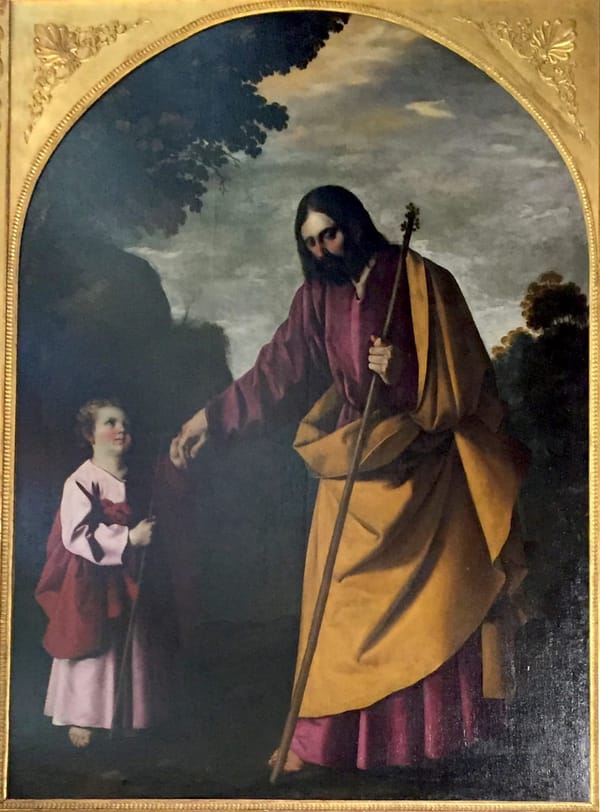
March 19: St. Joseph, Spouse of the Blessed Virgin
To-day, Joseph, the spouse of Mary, the fosterfather of the Son of God, comes to cheer us by his dear presence. In a few days hence, the august mystery of the Incarnation will demand our fervent adoration: who could better prepare us for the grand feast, than he that was both the confidant and thd faithful guardian of the divine secret?
The Son of God, when about to descend upon this earth to assume our human nature, would have a Mother; this Mother could not be other than the purest of Virgins, and her divine maternity was not to impair her incomparable virginity. Until such time as the Son of Mary were recognized as the Son of God, His Mother’s honour had need of a protector: some man, therefore, was to be called to the high dignity of being Mary’s spouse. This privileged mortal was Joseph, the most chaste of men.
Heaven designated him as being the only one worthy of such a treasure: the rod he held in his hand in the temple suddenly produced a flower, as though it were a literal fulfilment of the prophecy of Isaias: ‘There shall come forth a rod from the root of Jesse, and a flower shall rise up out of his root.’1 The rich pretenders to an alliance with Mary were set aside; and Joseph was espoused to the Virgin of the house of David, by a union which surpassed in love and purity everything the angels themselves had ever witnessed.
But he was not only chosen to the glory of having to protect the Mother of the Incarnate Word; he was also called to exercise an adopted paternity over the very Son of God. So long as the mysterious cloud was over the Saint of saints, men called Jesus the Son of Joseph and the carpenter's Son. When our blessed Lady found the Child Jesus in the temple, in the midst of the doctors, she thus addressed Him: ‘Thy father and I have sought Thee sorrowing’;2 and the holy evangelist adds that Jesus was subject to them, that is, that He was subject to Joseph as He was to Mary.
Who can imagine or worthily describe the sentiments which filled the heart of this man, whom the Gospel describes to us in one word, when it calls him the just man?3 Let us try to picture him to ourselves amidst the principal events of his life: his being chosen as the spouse of Mary, the most holy and perfect of God’s creatures; the angel’s appearing to him, and making him the one single human confidant of the mystery of the Incarnation, by telling him that his Virgin bride bore within her the fruit of the world’s salvation: the joys of Bethlehem, when he assisted at the birth of the divine Babe, honoured the Virgin Mother, and heard the angels singing; his seeing first the humble and simple shepherds, and then the rich eastern magi, coming to the stable to adore the new-born Child; the sudden fears which came to him, when he was told to arise, and, midnight as it was, to flee into Egypt with the Child and the Mother; the hardships of that exile, the poverty and the privations which were endured by the hidden God, whose foster-father he was, and by the Virgin, whose sublime dignity was now so evident to him; the return to Nazareth, and the humble and laborious life led in that village, where he so often witnessed the world's Creator sharing in the work of a carpenter; the happiness of such a life, in that cottage where his companions were the Queen of the angels and the eternal Son of God, both of whom honoured, and tenderly loved him as the head of the family—yes, Joseph was beloved and honoured by the uncreated Word, the Wisdom of the Father, and by the Virgin, the masterpiece of God’s power and holiness.
We ask, what mortal can justly appreciate the glories of St. Joseph? To do so, he would have to understand the whole of that mystery, of which God made him the necessary instrument. What wonder, then, if this foster-father of the Son of God was prefigured in the old Testament, and that by one of the most glorious of the patriarchs? Let us listen to St. Bernard, who thus compares the two Josephs: ‘The first was sold by his brethren, out of envy, and was led into Egypt, thus prefiguring our Saviour’s being sold; the second Joseph, that he might avoid Herod’s envy, led Jesus into Egypt. The first was faithful to his master, and treated his wife with honour; the second, too, was the most chaste guardian of his bride, the Virgin Mother of his Lord. To the first was given the understanding and interpretation of dreams; to the second, the knowledge of, and participation in, the heavenly mysteries. The first laid up stores of corn, not for himself, but for all the people; the second received the living Bread that came down from heaven, and kept It both for himself and for the whole world.’4
Such a life could not close save by a death that was worthy of so great a saint. The time came for Jesus to quit the obscurity of Nazareth, and show Himself to the world. His own works were henceforth to bear testimony to His divine origin; the ministry of Joseph, therefore, was no longer needed. It was time for him to leave this world, and await, in Abraham’s bosom, the arrival of that day, when heaven’s gates were to be opened to the just. As Joseph lay on his bed of death, there was watching by his side He that is the master of life, and that had often called this His humble creature, father. His last breath was received by the glorious Virgin-Mother, whom he had, by a just right, called his bride. It was thus, with Jesus and Mary by his side, caring for and caressing him, that Joseph sweetly slept in peace. The spouse of Mary, the fosterfather of Jesus, now reigns in heaven with a glory which, though inferior to that of Mary, is marked with certain prerogatives which no other inhabitant of heaven can have.
From heaven, he exercises a powerful protection over those that invoke him. In a few weeks from this time, the Church will show us the whole magnificence of this protection; a solemn feast will be kept in his honour in the third week after Easter. To-day the Liturgy sets before us his glories and privileges. Let us unite with the faithful throughout the world, and ofier to the spouse of Mary the hymns which are this day sung in his praise.
Hymn I
Te cuncti resonent Christiadum chori,
Qui clams meritis junctus es inclytæ
Casto fœdere Virgini.
Admirans, dubio tangeris anxius,
Afflatu superi Flaminis angelus
Conceptum puerum docet.
Ægypti profugum tu sequeris plagas:
Amissum Solymis quæris, et invenis,
Miscene gaudia fletibus.
Palmamque emeritos gloria suscipit;
Tu vivens, Superis par, frueris Deo,
Mira sorte beatior.
Da Joseph meritis sidera scandere:
Ut tandem liceat nos tibi perpetim
Gratum promere canticum.
May the choirs of Christendom resound with thy name,
for great are thy merits,
who wast united by a chaste alliance to the holy Virgin.
a cruel doubt afflicts thy heart; but an angel visits thee,
telling thee that she had conceived of the Holy Ghost
the Child she bore in her womb.
and go with the little fugitive to Egypt’s distant land.
When he was lost in Jerusalem, thou didst seek after him;
and having found him, thy tears were mingled with joy.
has crowned their life; they receive their glory, when they have won the palm:
but thou, by a strange, happy lot, hadst, even during life,
what the blessed have in heaven—thou hadst the sweet society of thy God.
and may the intercession of Joseph aid us to reach heaven:
that there we may sing to thee
our eternal hymn of grateful love.
Hymn II
Certa spes vitæ, columenque mundi,
Quas tibi læti canimus, benignus
Suscipe laudes.
Virginia sponsum, voluitque Ver bi
Te patrem dici, dedit et ministrum
Esse salutis.
Quem chorus vatum cecinit futurum,
Aspicis gaudens, humilisque natum
Numen adoras.
Cujus ad nutum tremit inferorum
Turba, cui pronus famulatur æther,
Se tibi subdit.
Quæ tibi præbens superos honores,
Det tuis nobis meritis beatæ
Gaudia vitae.
the sure hope of our life, and the pillar of the world!
Receive, in thy kind love,
the praises we now joyfully sing to thee.
the spouse of the holy Virgin;
willed thee to be called the father of the Word;
and gave thee to be an instrument of our salvation.
on the Redeemer lying in the stable,
him that the prophets had foretold was to come;
and seeing him, thou didst humbly adore the new-born King.
at whose bidding hell trembles
and before whom heaven prostrates ready to do his will,
yea, even he makes himself subject to thee.
May he that has conferred such high honours upon thee,
grant us, through the merits of thine intercession,
to come to the joys of heavenly life.
Hymn III
Cujus excelsos canimus triumphos,
Hac die, Joseph meruit perennis
Gaudia vitæ.
Cujus extremam vigiles ad horam
Christus et Virgo simul adstiterunt,
Ore sereno.
Camis, ad sedes placido sopore
Migrat æternas, rutilisque cingit
Tempora sertis.
Adsit ufc nobis, veniamque nostris
Obtinene culpis, tribuat supernæ
Munera pacis.
Trine qui regnas, Deus; et coronas
Aureas servo tribuis fideli,
Omne per ævum.
whose praises we, the faithful,
now gladly tell, and whose high triumph we sing,
deserved to receive the joys of eternal life.
thrice blessed saint,
at whose last hour Jesus and Mary
stood watching in tender love.
and Joseph, sweetly sleeping,
passed to the eternal home,
and received upon his brott the glittering crown.
let us beseech him to help us,
obtain us the pardon of our sins,
and procure us the gift of heavenly peace.
O God, O blessed Trinity,
who art our sovereign Lord!
who givest to thy faithful servant an everlasting crown of gold.
The Greek liturgy, which honours St. Joseph on the Sunday following the feast of Christmas, thus hymns his praise in the Menæa:
Hymn (Dominica post Natale Domini)
We praise and glorify thee, O happy saint! We hail thee as the spouse of the Queen of heaven, and foster-father of our Redeemer. These titles, which would seem too grand for any human being to enjoy, are thine; and they are but the expression of the dignities conferred on thee by God. The Church of heaven admires the sublime favours thou hast received; the Church on earth joyfully celebrates thy glories, and blesses thee for the favours thou art so unceasingly bestowing upon her.
Though born of the kingly race of David, thou wast the humblest of men; thy spirit led thee to seek obscurity, and a hidden life was thine ambition: but God chose thee to be an instrument in the sublimest of all His works. A noble Virgin of the same family of David, the object of heaven’s admiration, and the glory and hope of the world, is to be thy bride. The Holy Ghost is to dwell within her as in a most pure tabernacle; it is to thee, the just and chaste, that He entrusts her as an inestimable treasure. Espouse, then, to thyself her whose beauty the very King of heaven so greatly desires.5
The Son of God comes down to this earth, that He may live the life of man; He comes that He may sanctify the ties and affections of kindred. He calls thee father; He obeys thy orders. What strange emotions must have filled thy heart, O Joseph! when, knowing the prerogatives of thy bride and the divinity of thy adopted Son, thou hadst to be the head of this family, which united heaven and earth into one! What respectful and tender love for Mary, thy blessed bride! What gratitude and profound worship of Jesus, who obeyed thee as thy Child! Oh mysteries of Nazareth! a God dwells among men, and permits Himself to be called the Son of Joseph!
O sublime minister of the greatest of blessings, intercede for us with God made Man. Ask Him to bestow humility upon us, that holy virtue which raised thee to such exalted dignity, and which must be the basis of our conversion. It is pride that led us into sin, and made us prefer our own will to that of God: yet will He pardon us if we offer Him the sacrifice of a contrite and humble heart.6 Get us this virtue, without which there can be no true penance. Pray also for us, O Joseph, that we may be chaste. Without purity of mind and body we cannot come nigh the God of all sanctity, who suffers nothing defiled to approach Him. He wills to make our bodies, by His grace, the temples of His holy Spirit: do thou, great saint, help us to maintain ourselves in so exalted a dignity, or to recover it if we have lost it.
And lastly, O faithful spouse of Mary! recommend us to our Mother. If she cast a look of pity upon us during these days of reconciliation, we shall be saved: for she is the Queen of mercy, and Jesus, her Son, will pardon us and change our hearts, if she intercede for us, O Joseph! Remind her of Bethlehem, Egypt, and Nazareth, in all of which she received from thee such marks of thy devotedness. Tell her that we, also, love and honour thee; and Mary will reward us for our devotion to him who was given her by heaven as her protector and support.
Wednesday of the Second Week of Lent
THE Station is in the basilica of Saint Cecily. This church, one of the most venerable in Rome, was the house of the illustrious virgin and martyr whose name it bears. The body of Saint Cecily is under the high altar, together with those of Saints Valerian, Tiburtius, and Maximus, and of the holy Popes Urban and Lucius, all martyrs.
Collect
Epistle
Cap. xiii.In diebus illus: Oravit Mardochæus ad Dominum, dicens: Domine, Domine, Rex omnipotens, in ditione enim tua cuneta sunt posita, et non est qui possit tuæ resistero voluntad, si decreveris salvare Israël. Tu fecisti cœlum et terrain, et quidquid cœli ambitu continetur. Dominus omnium es, nec est qui resistat majestad tuæ. Et nunc, Domine Rex, Deus Abraham, miserere populi tui, quia volunt nos inimici nostri perdere, et hæreditatem tuam delere. Ne despicias partem tuam, quam redemisti tibi de Ægypto. Exaudi deprecationem meam, et propitius esto sorti et funiculo tuo, et converte luctum nostrum in gaudium, ut viventes laudemus nomen tuum, Domine, et ne claudas ora te canentium, Domine Deus noster.
Ch. xiii.In those days: Mardochai besought the Lord, and said: O Lord, Lord, almighty King, for all things are in thy power, and there is none that can resist thy will, if thou determine to save Israel. Thou hast made heaven and earth, and all things that are under the cope of heaven. Thou art Lord of all, and there is none that can resist thy majesty. And now, O Lord, O King, O God of Abraham, have mercy on thy people, because our enemies resolve to destroy us, and extinguish thine inheritance. Despise not thy portion, which thou hast redeemed for thyself out of Egypt. Hear my supplication and be merciful to thy lot and inheritance, and turn our mourning into joy, that we may live and praise thy name, O Lord, and shut not the mouths of them that sing to thee, O Lord, our God.
This petition, which Mardochai presented to God in favour of a whole nation that was doomed to destruction, represents the prayers which the saints of the old Testament offered for the salvation of the world. The human race was, to a great extent, in the power of satan, who is figured by Aman. The almighty King had given sentence against mankind: ‘Ye shall die the death.’Who was there that could induce Him to revoke the sentence? Esther made intercession with Assuerus, her lord; and she was heard. Mary presented herself before the throne of the eternal God: and it is she that, by her divine Son, crushes the head of the serpent, who was to have tormented us for ever. The sentence, then, is to be annulled; all shall live that wish to live.
To-day we have the Church praying for her children who are in the state of sin. She trembles at seeing them in danger of being eternally lost. She intercedes for them, and she uses Mardochai’s prayer. She humbly reminds her divine Spouse, that He has redeemed them out of Egypt; and, by Baptism, has made them His members, His inheritance. She beseeches Him to change their mourning into joy, even into the great Easter joy. She says to Him: Oh! shut not the mouths of them that sing to Thee! It is true, these poor sinners have in past times offended their God by word, as well as by deed and thought; but now they speak but words of humble prayer for mercy; and, when they shall have been pardoned, how fervently will they sing to their divine Deliverer, and bless Him in canticles of grateful love!
Gospel
Cap. xx.In illo tempore: Ascendena Jesus Jerosolymam, assumpsit duodecim discipulos secreto, et ait illis: Ecce ascendimus Jerosolymam, et Filius hominis tradetur principibus sacerdotum et scribis, et condemnabunt eum morte, et tradent eum gentibus ad illudendum, et flagellandum, et crucifigendum, et tertia die resurget. Tunc accessit ad eum mater filiorum Zebedæi cum filiis suis, adorans et petens aliquid ab eo. Qui dixit ei: Quid vis? Ait illi: Die ut sedeant hi duo filii mei, unus ad dexteram tuam, et unus ad sinistram, in regno tuo. Respondens autem Jesus, dixit: Nescitis quid petatis. Potestis bibere calicem, quem ego bibiturus sum? Dicunt ei: Possumue. Ait illis: Calicem quidem meum bibetis: sedere autem ad dexteram meam vel sinistram, non est meum dare vobis, sed quibus paratum est a Patre meo. Et audientes decem, indignati sunt de duobus fratribus. Jesus autem vocavit eos ad se, et ait: Scitis quia principes gentium dominantur eorum: et qui majores sunt, potestatem exercent in eos. Non ita erit inter vos: sed quicumque voluerit inter vos major fieri, sit vester minister: et qui voluerit inter vos primus esse, erit vester servus. Sicut Filius hominis non venit ministran, sed ministrare, et dare animam suam redemptionem pro multis.
Ch. xx.At that time: Jesus going up to Jersualem, took the twelve disciples apart, and said to them: Behold we go up to Jerusalem, and the Son of Man shall be betrayed to the chief priests and the scribes, and they shall condemn him to death, and shall deliver him to the Gentiles, to be mocked, and scourged, and crucified, and the third day he shall rise again. Then came to him the mother of the sons of Zebedee, with her sons, adoring and asking something of him. Who said to her: What wilt thou? She saith to him: Say that these my two sons may sit, the one on thy right hand, and the other on thy left, in thy kingdom. And Jesus answering, said: You know not what you ask. Can you drink the chalice that I shall drink? They said to him: We can. He saith to them: My chalice, indeed, you shall drink; but to sit on my right or left hand, is not mine to give to you, but to them for whom it is prepared by my Father. And the ten hearing it, were moved with indignation against the two brethren. But Jesus called them to him, and said: You know that the princes of the gentiles lord it over them; and they that are the greater, exercise power over them. It shall not be so among you, but whosoever will be the greater among you, let him be your minister; and he that will be first among you, shall be your servant. Even as the Son of Man is not come to be ministered unto, but to minister, and to give his life a redemption for many.
This is He that gave His own life in order to appease the anger of the almighty King, and redeem His people from death. It is Jesus, the Son of the new Esther, and the Son of God, who comes forward to humble the pride of Aman, at the very time when this perfidious enemy of ours is making sure of his victory. He goes up to Jerusalem, for it is there that the great battle is to be fought. He foretells to His disciples all that is to happen. He will be delivered up to the chief priests, who will condemn Him to death, and hand Him over to the Roman governor and soldiers. He will be mocked, scourged, and crucified; but He will rise again on the third day. The apostles heard this prophecy, for the Gospel says, that Jesus took the twelve apart, in order to tell them these things. Judas, consequently, was present; so were Peter, James, and John, the three that had witnessed the Transfiguration of their Master on Thabor, and had a clearer knowledge of His Divinity. And yet, all abandoned Him. Judas betrayed Him, Peter denied Him, and the whole flock fled away in fear, when the Shepherd was in the power of His enemies. Not one of them recollected how He had said that on the third day He would rise again: unless it were Judas, who was perhaps encouraged to commit his crime by the reflection that Jesus would soon triumph over His enemies and be again free. The rest could see no further than the scandal of the cross; that put an end to all their faith, and they deserted their Master. What a lesson for all future generations of Christians! How very few there are who look upon the cross, either for themselves or for others, as a sign of God’s special love!
We are men of little faith; we cannot understand the trials God sends to our brethren, and we are often tempted to believe that He has forsaken them, because He sends them the cross. We are men of little love, too; worldly tribulation seems an evil to us, and we think ourselves hardly dealt with, at the very time when our God is showing us the greatest mercy. We are like the mother of the sons of Zebedee: we would hold a high and conspicuous place near the Son of God, forgetting that we must first merit it, by drinking of the chalice that He drank, that is, the chalice of suffering. We forget, too, that saying of the apostle: ‘That we may be glorified with Jesus, we must suffer with Him!’* He, the just and All holy, entered not into His rest by honours, and pleasures: the sinner cannot follow Him, save by treading the path of penance.
The Christian poet continues his subject—the merits of fasting. To-day he is going to show us how Jesus consecrated it by His own practice of it.
Pridem caducis quum gravatus artubus
Jesus, dicato corde jejunaverit:
Prænuncupatus ore qui prophetico
Emmanuel est, sive nobiscum Deus.
Captumque laxo sub voluptatum jugo,
Virtutis arcta lege fecit liberum,
Emancipator servientis plasmatis,
Regnantis ante victor et cupidinis.
Quinis diebus octies labentibus,
Nullam ciborum vindicavit gratiam,
Firmans salubri scilicet jejunio
Vas appetendis imbecillum gaudiis.
Tantum laboris sustinere ac perpeti.
Explorat arte sciscitator callida,
Deusne membris sit receptus terreis:
Sed, increpata fraude, post tergum ruit.
Jesus, whom the prophet had announced to the world as the Emmanuel,
that is, God with us, when here on earth
sharing the miseries of our mortality,
fasted rigidly out of love for us.
set these our bodies free from their natural effeminacy,
and from the yoke of unbridled indulgence.
He emancipated his creatures from their slavery;
he conquered the tyrant concupiscence, that had reigned till then.
and for forty days refused himself the use of food.
By this salutary fast,
he strengthened the weakness of our bodies,
which crave after gratification.
that is but clay, can bear and suffer pain as long and sharp as this.
He, by cunning craft, contrives a plot,
whereby to sift this Jesus, and see if he perchance be God in human form.
But, rebuked and foiled, he flees away with shame.
* Rom. viii. 17. ↩︎
| Previous Tuesday of the Second Week of Lent | Next Wednesday of the Second Week of Lent |